REVIEW 5 major objections 8 minor 51 references
Towards Robust Unsupervised Attention Prediction in Autonomous Driving
T0 review · 5 major / 8 minor · reviewed 2026-08-10 · deepseek-v4-flash
Pith's one-line read Unsupervised driver attention prediction, built from refined pseudo-labels of natural-scene saliency models plus robust augmentation, matches or beats fully supervised methods on three benchmarks and is more robust to corruption and…
desk verdict A useful robustness benchmark and a plausible unsupervised attention model, but the headline robustness claim only holds on one subset and the pseudo-label targets are never validated against human gaze. read the letter →
The pith
A machine-rendered reading of the paper's core claim, the machinery that carries it, and where it could break.
The reading
What carries the argument
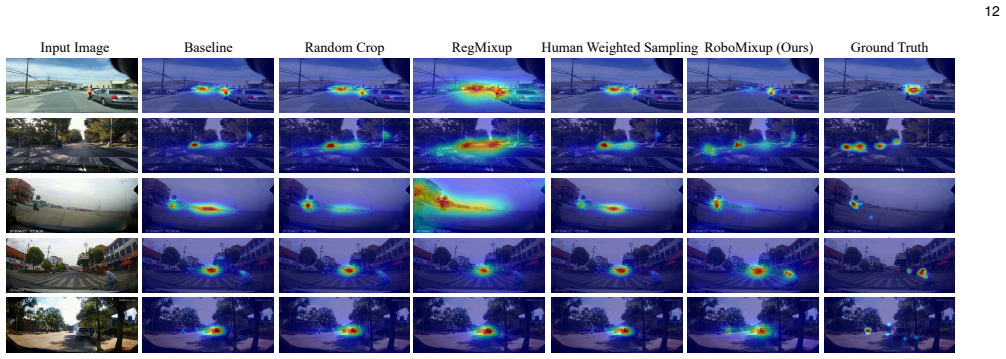
The load-bearing mechanism is the three-stage pseudo-label refinement pipeline. The Uncertainty Mining Branch (UMB) applies non-local self-attention across multi-scale encoder features and N pseudo-label maps to emit per-pixel uncertainty maps, and couples the predicted attention map to each pseudo-label through an uncertainty-weighted KL-divergence loss, where the predicted log variance weighs each pseudo-label's contribution. The Knowledge Embedding Block (KEB) multiplies each pseudo-label by a binary traffic-object mask produced by a frozen Mask R-CNN, with object categories selected automatically by picking frequent COCO classes whose mean pseudo-label attention is below a threshold, on the reasoning that natural-scene saliency models under-represent traffic objects. RoboMixup replaces the global scalar in Mixup with a pixel-level attention ratio between two samples, selects hard samples per batch by KL divergence to the average attention map, and combines random cropping with RegMixup's auxiliary-loss formulation to counter central bias.
What would settle it
Run the method on DADA-2000 crash frames where the recorded driver fixation lands on an object that is neither salient in natural-scene models nor a member of the boosted COCO categories, such as a fallen cyclist, an animal on the roadway, or scattered debris; if the predicted attention map shows no peak at the human fixation on such frames and per-frame KLD and CC drop below the supervised baselines for those frames, the pseudo-label adequacy assumption fails. A direct quantitative check: compute the mean pseudo-label attention over ground-truth fixation pixels; the claim predicts that the boosted categories account for most of this mass, so measuring the residual mass on unboosted categories across the three datasets would settle the adequacy question.
Extended reading notes
Core claim
The central claim is that the supervision signal for driver attention need not come from human fixations at all. The paper shows that pseudo-labels produced by two natural-scene saliency models, ML-Net and UNISAL, can be transformed into training targets that rival ground-truth attention maps by combining three mechanisms: an Uncertainty Mining Branch that models disagreements among pseudo-labels as per-pixel uncertainty and optimizes a KL-divergence-based uncertainty loss, a Knowledge Embedding Block that boosts traffic-relevant object classes using a frozen Mask R-CNN segmenter, and RoboMixup, which blends images with attention-weighted pixel mixing, dynamic hard-sample selection, and random-crop regularization. The reported outcome is that the unsupervised model achieves KLD of 1.099, 1.901, and 1.677 and CC of 0.640, 0.510, and 0.488 on BDD-A, DR(eye)VE, and DADA-2000 respectively, comparable to or better than supervised state-of-the-art methods, and that on the six-corruption DriverAttention-C benchmark the RoboMixup variant lowers relative corruption degradation to 0.755 and 0.846 in KLD and CC on BDD-A-C, the best among all compared methods.
Load-bearing premise
The load-bearing premise is that the enhanced pseudo-labels, natural-scene saliency outputs boosted on a mined set of common traffic-object categories, approximate what real drivers actually look at in safety-critical scenes; if those saliency models miss crash-relevant objects outside the boosted categories, the unsupervised training signal is blind to the very things that matter.
Editorial extensions
If this is right
- If the claim is correct, self-driving attention prediction no longer requires collecting human gaze data, which is expensive and prone to inconsistencies such as averaging eight drivers or relying on in-lab simulation.
- The robustness numbers imply that attention prediction can tolerate common camera corruptions such as noise, blur, JPEG compression, fog, and snow without being trained on corrupted images, improving safety margins under adverse weather.
- The central-bias results imply the model keeps attending to off-center objects such as pedestrians, cyclists, and fallen persons that are exactly the ones in accident scenarios, rather than collapsing to a road-center prior.
- The DriverAttention-C benchmark provides a standardized way to measure robustness of attention predictors across noise, blur, digital, and weather corruptions.
- The exploratory explainable-decision experiment suggests that predicted attention maps can be plugged into downstream driving-decision models to yield interpretable outputs.
Reading between the lines
- The recipe of multi-source pseudo-labels plus uncertainty mining, knowledge embedding, and robust mixup is domain-agnostic and could be applied to other sparse-label prediction tasks such as pedestrian intent or hazard detection, where gaze labels are equally scarce.
- The knowledge-mining rule assumes that natural-scene saliency models uniformly under-respond to traffic objects; a natural test is whether boosting categories with low mean attention helps only because of the specific class distribution of MS-COCO, and whether the rule needs re-mining for traffic cultures with different object frequencies.
- Because the robustness gain from dynamic augmentation, which selects samples with high KL divergence to the average map, is not disentangled from soft-attention mixing, an ablation of the selection rule alone would reveal which part of RoboMixup drives the 58.8% relative degradation reduction.
- A reader should not expect the same unsupervised gains on novel crash-relevant objects such as debris or animals that are absent from both the saliency models' training data and the MS-COCO taxonomy; for such objects the pseudo-label signal may be missing entirely.
Signed reviews
Editorial analysis
A structured set of objections, weighed in public.
Referee Report
Summary. The paper proposes an unsupervised driver-attention prediction framework that trains only on pseudo-labels produced by natural-scene saliency models, without using human gaze labels from driving datasets. Three components are introduced: an Uncertainty Mining Branch (UMB) that fuses multiple pseudo-label sources with multi-scale features, a Knowledge Embedding Block (KEB) that uses Mask R-CNN to boost attention on traffic-relevant categories mined from pseudo-label statistics, and a RoboMixup data augmentation that combines soft-attention Mixup, a dynamic augmentation strategy, and random-crop regularization. The authors also introduce a corruption benchmark, DriverAttention-C, generated from BDD-A, DR(eye)VE, and DADA-2000, and report that the method matches or surpasses fully supervised state-of-the-art on clean data and improves robustness to corruption and central bias. The central claim is that driver attention can be predicted without traffic gaze labels while being more robust than several supervised baselines.
Significance. If the central claim holds, the paper would make a useful contribution: it relaxes the annotation bottleneck for driver-attention prediction and provides a new corruption benchmark (DriverAttention-C) with 115k frames, alongside an augmentation method (RoboMixup) that reduces central bias. The evaluation is extensive, covering three public datasets, a new benchmark, multiple corruption types, and several ablations. The availability of code and data is a strength. However, the significance is conditional on the adequacy of the pseudo-label learning signal, which is never directly validated against human gaze, and on a more careful reporting of the robustness claims, which are currently overstated relative to the full benchmark results.
major comments (5)
- [§3.1-§3.2, Eq. (5)] The unsupervised learning signal is never validated against human gaze. The model trains exclusively on KEB-enhanced pseudo-labels from natural-scene saliency models, and Eq. (5) suppresses all non-mined regions by a factor α=0.3. Table 7 shows that the natural-to-driving domain gap is large (SALICON-trained APB yields KLD 2.109 / CC 0.287 on BDD-A versus 1.036 / 0.657 for BDD-A-trained APB). No experiment reports KLD/CC between the KEB pseudo-labels and the human gaze ground truth on held-out frames. Without such a check, the reported clean and robustness results cannot distinguish learning true driver attention from learning a shifted saliency prior. Please report pseudo-label-to-gaze agreement on each dataset, or an upper-bound ablation that replaces pseudo-labels with ground-truth labels.
- [Abstract; Tables 3 and 4] The claimed reductions of 58.8% and 52.8% in relative corruption degradation are specific to BDD-A-C and are computed relative to the UAP baseline (Table 4: Relative mCD 0.412 KLD / 0.472 CC). On DR(eye)VE-C and DADA-2000-C, RUAP does not achieve the best Relative mCD; e.g., DADA-2000-C KLD: DADA 0.044 vs RUAP 1.137, and DR(eye)VE-C KLD: Multi-Branch 0.505 vs RUAP 0.652. The abstract and Section 5.3 should state the dataset and baseline for these headline numbers. The text's explanation that low Relative mCD by other methods reflects 'stable but poor performance' is post hoc; a formal criterion (e.g., Pareto comparison over clean KLD and degradation) is needed before discounting those competitors.
- [§4.1-§4.2] The DriverAttention-C construction is under-specified and the reported counts are inconsistent. Section 4.1 reports a total of 115,332 frames and per-subset test counts 6,817 + 7,497 + 4,908 = 19,222, while Section 4.2 ends with 'filter out images with artificial stripes caused by inherent issues of the Cycle-GAN, resulting in 38,444 images.' Please clarify what 38,444 refers to, how many images were removed per corruption type, and whether filtering occurred before or after the train/test split. Because the filtering criterion is based on visual artifacts, it may introduce selection bias; the criterion and its effect on benchmark difficulty should be documented.
- [§3.3-§3.4, Eqs. (8)-(10)] The uncertainty loss uses a scalar u_n defined as the spatial mean of the pixel-level uncertainty map U_n, yet the UMB is motivated as producing pixel-level uncertainty maps. This scalarization discards spatial information and conflicts with the design narrative. Either adopt per-pixel uncertainty in the loss (e.g., u_i) or justify the scalar aggregation. Additionally, the '≈' step in Eq. (9) needs a derivation; as written it is not evident that the approximation from the negative log-likelihood to LCE/u_n^2 + log(u_n) holds for arbitrary S and Y_n.
- [§5.3, Tables 1-3] No error bars or significance tests are reported for any fully-supervised baseline, while Ours is shown with ±. Because the claim of equivalence or superiority relies on KLD differences as small as 0.03-0.1, the comparison is not fully supported without variance estimates for the baselines. Please report variance over at least three runs of the main baselines, or a paired significance test, for the central clean-benchmark and robustness tables.
minor comments (8)
- [Table 7] Typo: 'SALION' should be 'SALICON'.
- [§5.3] Typo: 'BDDA-C' appears in the paragraph after Table 3; it should be 'BDD-A-C'.
- [§4.1] Typo: 'DriverAttetnion-C' should be 'DriverAttention-C'.
- [§3.2, Eq. (2)] The notation 'µP · Mij / Mij' is confusing; it should be written as the mean of µP over the pixels of mask Mij.
- [§5.1] The text says ML-Net is selected as the baseline for mCD, but Table 4 uses UAP as the reference. Please state explicitly that different references are used in Tables 3 and 4.
- [Abstract] The phrase 'three public datasets and the proposed robustness benchmark' counts four items; consider 'three public datasets and the proposed corruption benchmark'.
- [Table 2] It is surprising that training on BDD-A pseudo-labels yields better DADA-2000 test KLD (1.677) than training on DADA-2000 pseudo-labels (1.711). A brief explanation of this cross-dataset result would help the reader assess the pseudo-label quality.
- [§3.2] The sentence 'We focus on the most frequent categories, as the remaining categories are likely to be misclassified due to their small proportion' is ambiguous; it suggests rare categories are noisy, but the mining then selects low-attention frequent categories. Please clarify.
Circularity Check
Minor self-referential pseudo-label enhancement in KEB; central benchmark evaluation is external and not circular.
-
self definitional
[Section 3.2 (Knowledge Embedding Block), Eqs. (1)-(5)]
"Pretrained attention prediction models for natural scenes lack the recognition capabilities for traffic-specific objects (e.g., stop signs), leading to an attention distribution bias ... We leverage this bias for knowledge mining by calculating the mean attention for all pseudo-label instances ... As a result, we mine the following categories as prior knowledge ... The process of generating the segmentation map with prior knowledge can be formally expressed as ... Knowledge Embedding Technique ... ˆYn = Yn · ( ˆM + α)"
The 'prior knowledge' set is defined by Eq. (3) as the categories whose mean pseudo-label attention V_ci is below η times the average of the first k categories. Eq. (5) then multiplies those same pseudo-labels by (1+α) inside the mined mask and by α outside it. Thus the enhancement is a deterministic function of the pseudo-labels themselves: the categories are selected because they are weak in Yn, and Yn is boosted exactly there. The post-embedding increase of attention in the mined categories is true by construction, not by evidence about driver gaze. This does not, however, force the benchmark KLD/CC numbers, since those are computed against human gaze maps that never enter the mining loop; the central claim therefore is not reduced to this loop.
full rationale
The paper's central evaluation is self-contained against external human-gaze benchmarks. The attention prediction branch is trained on pseudo-labels produced by external natural-scene saliency models (ML-Net, UNISAL) and refined with Mask R-CNN / MS-COCO masks, then scored with KLD and CC against official ground-truth gaze maps of BDD-A, DR(eye)VE, DADA-2000 and their corrupted DriverAttention-C variants. None of these ground truths are used to define the training targets, so the reported superiority is not a construction of the method's own outputs. The one self-referential element is the KEB: Eq. (3) mines low-attention categories from the pseudo-labels and Eq. (5) boosts them, which is an internal bootstrapping loop rather than an independent external source of 'driving knowledge.' Because the ablation and final numbers are measured on human gaze, this loop is not load-bearing for the central claim; it is a minor self-referential strengthening. The citation to the authors' ICCV paper [19] is transparent and not used to justify the method's validity. RoboMixup is compared fairly against external augmentation baselines. Overall circularity is minor, so the score is 2 rather than 0.
Assumptions & free parameters
free parameters (6)
- alpha (KEB adjustment) =
0.3
- eta (proportion factor) =
0.1
- p (coverage threshold) =
98%
- K-percent (dynamic augmentation selection) =
1/8
- number of pseudo-label sources =
2 (ML-Net + UNISAL)
- RegMixup alpha and loss weight eta =
alpha=10, eta=1
assumptions (7)
- domain assumption Pseudo-labels from natural-scene saliency models correlate with true driver attention after KEB enhancement.
- domain assumption Mask R-CNN pretrained on MS-COCO yields reliable masks for traffic objects in driving scenes.
- domain assumption CycleGAN fog/snow and Hendrycks-style corruptions are faithful proxies for real weather and camera corruptions.
- ad hoc to paper Low mean pseudo-label attention V_ci identifies traffic-relevant categories worth boosting.
- domain assumption Pseudo-label noise follows a Gibbs/Boltzmann distribution with a per-pseudo-label scalar temperature.
- domain assumption Attention-weighted Mixup, dynamic sample selection, and random-crop RegMixup improve corruption and central-bias robustness.
- ad hoc to paper ML-Net is an appropriate reference model for mCD and Relative mCD.
Cite this review
Pith. "Pith review of Towards Robust Unsupervised Attention Prediction in Autonomous Driving." pith.science (2026). https://pith.science/paper/57ZK2NFO
@misc{pith2026250115045,
  author       = {Pith},
  title        = {Pith review of: Towards Robust Unsupervised Attention Prediction in Autonomous Driving},
  year         = {2026},
  howpublished = {\url{https://pith.science/paper/57ZK2NFO}},
  note         = {Machine review of arXiv:2501.15045}
}
read the original abstract
Robustly predicting attention regions of interest for self-driving systems is crucial for driving safety but presents significant challenges due to the labor-intensive nature of obtaining large-scale attention labels and the domain gap between self-driving scenarios and natural scenes. These challenges are further exacerbated by complex traffic environments, including camera corruption under adverse weather, noise interferences, and central bias from long-tail distributions. To address these issues, we propose a robust unsupervised attention prediction method. An Uncertainty Mining Branch refines predictions by analyzing commonalities and differences across multiple pre-trained models on natural scenes, while a Knowledge Embedding Block bridges the domain gap by incorporating driving knowledge to adaptively enhance pseudo-labels. Additionally, we introduce RoboMixup, a novel data augmentation method that improves robustness against corruption through soft attention and dynamic augmentation, and mitigates central bias by integrating random cropping into Mixup as a regularizer. To systematically evaluate robustness in self-driving attention prediction, we introduce the DriverAttention-C benchmark, comprising over 100k frames across three subsets: BDD-A-C, DR(eye)VE-C, and DADA-2000-C. Our method achieves performance equivalent to or surpassing fully supervised state-of-the-art approaches on three public datasets and the proposed robustness benchmark, reducing relative corruption degradation by 58.8% and 52.8%, and improving central bias robustness by 12.4% and 11.4% in KLD and CC metrics, respectively. Code and data are available at https://github.com/zaplm/DriverAttention.
Figures


Figures from the paper (5 more)



Reference graph
Works this paper leans on
-
[44]
Multi-source uncertainty mining for deep unsupervised saliency detection
Yifan Wang, Wenbo Zhang, Lijun Wang, Ting Liu, and Huchuan Lu. Multi-source uncertainty mining for deep unsupervised saliency detection. In IEEE Conf. Comput. Vis. Pattern Recog., pages 11727–11736, 2022
work page 2022
-
[1]
Sonia Baee, Erfan Pakdamanian, Inki Kim, Lu Feng, Vi- cente Ordonez, and Laura Barnes. Medirl: Predicting the visual attention of drivers via maximum entropy deep inverse reinforcement learning. In Int. Conf. Comput. Vis. , pages 13178–13188, 2021
work page 2021
-
[2]
” looking at the right stuff”-guided semantic-gaze for autonomous driving
Anwesan Pal, Sayan Mondal, and Henrik I Christensen. ” looking at the right stuff”-guided semantic-gaze for autonomous driving. In IEEE Conf. Comput. Vis. Pattern Recog., pages 11883–11892, 2020
work page 2020
-
[3]
Ex- plainable object-induced action decision for autonomous vehicles
Yiran Xu, Xiaoyin Yang, Lihang Gong, Hsuan-Chu Lin, Tz-Ying Wu, Yunsheng Li, and Nuno Vasconcelos. Ex- plainable object-induced action decision for autonomous vehicles. In IEEE Conf. Comput. Vis. Pattern Recog. , pages 9523–9532, 2020
work page 2020
-
[4]
Stc-gan: Spatio-temporally coupled generative adversarial networks for predictive scene parsing
Mengshi Qi, Yunhong Wang, Annan Li, and Jiebo Luo. Stc-gan: Spatio-temporally coupled generative adversarial networks for predictive scene parsing. IEEE T rans. Image Process., 29:5420–5430, 2020
work page 2020
-
[5]
Ke- gan: Knowledge embedded generative adversarial net- works for semi-supervised scene parsing
Mengshi Qi, Yunhong Wang, Jie Qin, and Annan Li. Ke- gan: Knowledge embedded generative adversarial net- works for semi-supervised scene parsing. In IEEE Conf. Comput. Vis. Pattern Recog. IEEE, 2019
work page 2019
-
[6]
What uncertainties do we need in bayesian deep learning for computer vision? Adv
Alex Kendall and Yarin Gal. What uncertainties do we need in bayesian deep learning for computer vision? Adv. Neural Inform. Process. Syst. , 30, 2017
work page 2017
-
[7]
Predicting the driver’s focus of attention: the dr (eye) ve project
Andrea Palazzi, Davide Abati, Francesco Solera, Rita Cuc- chiara, et al. Predicting the driver’s focus of attention: the dr (eye) ve project. IEEE T rans. Pattern Anal. Mach. Intell. , 41(7):1720–1733, 2018
work page 2018
Show all 51 references
-
[8]
Predicting driver attention in critical situations
Ye Xia, Danqing Zhang, Jinkyu Kim, Ken Nakayama, Karl Zipser, and David Whitney. Predicting driver attention in critical situations. In Asian Conf. Comput. Vis. , pages 658–
-
[9]
Dr (eye) ve: a dataset for attention-based tasks with applications to autonomous and assisted driving
Stefano Alletto, Andrea Palazzi, Francesco Solera, Simone Calderara, and Rita Cucchiara. Dr (eye) ve: a dataset for attention-based tasks with applications to autonomous and assisted driving. In IEEE Conf. Comput. Vis. Pattern Recog. Worksh., pages 54–60, 2016
2016
-
[10]
Dada: Driver attention prediction in driving accident scenarios
Jianwu Fang, Dingxin Yan, Jiahuan Qiao, Jianru Xue, and Hongkai Yu. Dada: Driver attention prediction in driving accident scenarios. IEEE T rans. Intell. T ransp. Syst., 2021
2021
-
[11]
Advisable learning for self-driving vehicles by internalizing observation-to-action rules
Jinkyu Kim, Suhong Moon, Anna Rohrbach, Trevor Dar- rell, and John Canny. Advisable learning for self-driving vehicles by internalizing observation-to-action rules. In IEEE Conf. Comput. Vis. Pattern Recog. , pages 9661–9670, 2020
2020
-
[12]
Deep learning-based robust positioning for all-weather autonomous driving
Yasin Almalioglu, Mehmet Turan, Niki Trigoni, and An- drew Markham. Deep learning-based robust positioning for all-weather autonomous driving. Nature machine intel- ligence, 4(9):749–760, 2022
2022
-
[13]
Benchmarking neural network robustness to common corruptions and perturbations
Dan Hendrycks and Thomas Dietterich. Benchmarking neural network robustness to common corruptions and perturbations. Int. Conf. Learn. Represent. , 2019
2019
-
[14]
When human pose estimation meets robustness: Adversarial algorithms and benchmarks
Jiahang Wang, Sheng Jin, Wentao Liu, Weizhong Liu, Chen Qian, and Ping Luo. When human pose estimation meets robustness: Adversarial algorithms and benchmarks. In IEEE Conf. Comput. Vis. Pattern Recog. , pages 11855–11864, 2021
2021
-
[15]
Contrastive adaptation network for unsu- pervised domain adaptation
Guoliang Kang, Lu Jiang, Yi Yang, and Alexander G Hauptmann. Contrastive adaptation network for unsu- pervised domain adaptation. In IEEE Conf. Comput. Vis. Pattern Recog., pages 4893–4902, 2019
2019
-
[16]
Mask r-cnn
Kaiming He, Georgia Gkioxari, Piotr Doll ´ar, and Ross Girshick. Mask r-cnn. In Int. Conf. Comput. Vis. , pages 2961–2969, 2017
2017
-
[17]
Microsoft coco: Common objects in context
Tsung-Yi Lin, Michael Maire, Serge Belongie, James Hays, Pietro Perona, Deva Ramanan, Piotr Doll ´ar, and C Lawrence Zitnick. Microsoft coco: Common objects in context. In Eur. Conf. Comput. Vis., pages 740–755. Springer, 2014
2014
-
[18]
Unpaired image-to-image translation using cycle- consistent adversarial networks
Jun-Yan Zhu, Taesung Park, Phillip Isola, and Alexei A Efros. Unpaired image-to-image translation using cycle- consistent adversarial networks. In Int. Conf. Comput. Vis. , 2017
2017
-
[19]
Unsupervised self-driving attention prediction via uncertainty mining and knowledge embedding
Pengfei Zhu, Mengshi Qi, Xia Li, Weijian Li, and Huadong Ma. Unsupervised self-driving attention prediction via uncertainty mining and knowledge embedding. In Int. Conf. Comput. Vis., pages 8558–8568, 2023
2023
-
[20]
Fblnet: Feed- back loop network for driver attention prediction
Yilong Chen, Zhixiong Nan, and Tao Xiang. Fblnet: Feed- back loop network for driver attention prediction. In Int. Conf. Comput. Vis., pages 13371–13380, 2023
2023
-
[21]
Tased-net: Temporally- aggregating spatial encoder-decoder network for video saliency detection
Kyle Min and Jason J Corso. Tased-net: Temporally- aggregating spatial encoder-decoder network for video saliency detection. In Int. Conf. Comput. Vis. , pages 2394– 2403, 2019
2019
-
[22]
Unified image and video saliency modeling
Richard Droste, Jianbo Jiao, and J Alison Noble. Unified image and video saliency modeling. In Eur. Conf. Comput. Vis., pages 419–435. Springer, 2020
2020
-
[23]
Deep cropping via attention box prediction and aesthetics assessment
Wenguan Wang and Jianbing Shen. Deep cropping via attention box prediction and aesthetics assessment. In Int. Conf. Comput. Vis., pages 2186–2194, 2017
2017
-
[24]
Attentive relational networks for mapping images to scene graphs
Mengshi Qi, Weijian Li, Zhengyuan Yang, Yunhong Wang, and Jiebo Luo. Attentive relational networks for mapping images to scene graphs. In IEEE Conf. Comput. Vis. Pattern Recog. IEEE, 2019
2019
-
[25]
Semantics-aware spatial-temporal binaries for cross- modal video retrieval
Mengshi Qi, Jie Qin, Yi Yang, Yunhong Wang, and Jiebo Luo. Semantics-aware spatial-temporal binaries for cross- modal video retrieval. IEEE T rans. Image Process., 30:2989– 3004, 2021
2021
-
[26]
stagnet: An attentive semantic rnn for group activity recognition
Mengshi Qi, Jie Qin, Annan Li, Yunhong Wang, Jiebo Luo, and Luc Van Gool. stagnet: An attentive semantic rnn for group activity recognition. In Eur. Conf. Comput. Vis. springer, 2018
2018
-
[27]
Bbs-net: Rgb-d salient object detection with a bifurcated backbone strategy network
Deng-Ping Fan, Yingjie Zhai, Ali Borji, Jufeng Yang, and Ling Shao. Bbs-net: Rgb-d salient object detection with a bifurcated backbone strategy network. In Eur. Conf. Comput. Vis., pages 275–292. Springer, 2020
2020
-
[28]
Pyramid grafting network for one-stage high resolution saliency detection
Chenxi Xie, Changqun Xia, Mingcan Ma, Zhirui Zhao, Xiaowu Chen, and Jia Li. Pyramid grafting network for one-stage high resolution saliency detection. In IEEE Conf. Comput. Vis. Pattern Recog. , pages 11717–11726, 2022
2022
-
[29]
Robust perception and precise segmentation for scribble-supervised rgb-d saliency detection
Long Li, Junwei Han, Nian Liu, Salman Khan, Hisham Cholakkal, Rao Muhammad Anwer, and Fahad Shahbaz Khan. Robust perception and precise segmentation for scribble-supervised rgb-d saliency detection. IEEE T rans. Pattern Anal. Mach. Intell. , 2023
2023
-
[30]
Salicon: Saliency in context
Ming Jiang, Shengsheng Huang, Juanyong Duan, and Qi Zhao. Salicon: Saliency in context. In IEEE Conf. Comput. Vis. Pattern Recog. , pages 1072–1080, 2015
2015
-
[31]
Revisiting video saliency: A large- scale benchmark and a new model
Wenguan Wang, Jianbing Shen, Fang Guo, Ming-Ming 14 Cheng, and Ali Borji. Revisiting video saliency: A large- scale benchmark and a new model. In IEEE Conf. Comput. Vis. Pattern Recog., pages 4894–4903, 2018
2018
-
[32]
A deep multi-level network for saliency prediction
Marcella Cornia, Lorenzo Baraldi, Giuseppe Serra, and Rita Cucchiara. A deep multi-level network for saliency prediction. In Int. Conf. Pattern Recog. , pages 3488–3493. IEEE, 2016
2016
-
[33]
Predicting human eye fixations via an lstm-based saliency attentive model
Marcella Cornia, Lorenzo Baraldi, Giuseppe Serra, and Rita Cucchiara. Predicting human eye fixations via an lstm-based saliency attentive model. IEEE T rans. Image Process., 27(10):5142–5154, 2018
2018
-
[34]
Mobilevit: Light-weight, general-purpose, and mobile-friendly vision transformer
Sachin Mehta and Mohammad Rastegari. Mobilevit: Light-weight, general-purpose, and mobile-friendly vision transformer. In Int. Conf. Learn. Represent. , 2022
2022
-
[35]
Laplace redux-effortless bayesian deep learning
Erik Daxberger, Agustinus Kristiadi, Alexander Immer, Runa Eschenhagen, Matthias Bauer, and Philipp Hennig. Laplace redux-effortless bayesian deep learning. Adv. Neural Inform. Process. Syst. , 34:20089–20103, 2021
2021
-
[36]
Dropout as a bayesian approximation: Representing model uncertainty in deep learning
Yarin Gal and Zoubin Ghahramani. Dropout as a bayesian approximation: Representing model uncertainty in deep learning. In Int. Conf. Mach. Learn. , pages 1050–1059. PMLR, 2016
2016
-
[37]
Multi- task learning using uncertainty to weigh losses for scene geometry and semantics
Alex Kendall, Yarin Gal, and Roberto Cipolla. Multi- task learning using uncertainty to weigh losses for scene geometry and semantics. In IEEE Conf. Comput. Vis. Pattern Recog., pages 7482–7491, 2018
2018
-
[38]
Transmix: Attend to mix for vision transformers
Jie-Neng Chen, Shuyang Sun, Ju He, Philip HS Torr, Alan Yuille, and Song Bai. Transmix: Attend to mix for vision transformers. In IEEE Conf. Comput. Vis. Pattern Recog. , pages 12135–12144, 2022
2022
-
[39]
mixup: Beyond empirical risk mini- mization
Hongyi Zhang, Moustapha Cisse, Yann N Dauphin, and David Lopez-Paz. mixup: Beyond empirical risk mini- mization. In Int. Conf. Learn. Represent. , 2018
2018
-
[40]
Using mixup as a regularizer can surprisingly improve accuracy & out-of-distribution ro- bustness
Francesco Pinto, Harry Yang, Ser Nam Lim, Philip Torr, and Puneet Dokania. Using mixup as a regularizer can surprisingly improve accuracy & out-of-distribution ro- bustness. Adv. Neural Inform. Process. Syst., 35:14608–14622, 2022
2022
-
[41]
Pyramid scene parsing network
Hengshuang Zhao, Jianping Shi, Xiaojuan Qi, Xiaogang Wang, and Jiaya Jia. Pyramid scene parsing network. In IEEE Conf. Comput. Vis. Pattern Recog. , pages 2881–2890, 2017
2017
-
[42]
A unified framework for u-net design and analysis
Christopher Williams, Fabian Falck, George Deligiannidis, Chris C Holmes, Arnaud Doucet, and Saifuddin Syed. A unified framework for u-net design and analysis. Adv. Neural Inform. Process. Syst. , 36:27745–27782, 2023
2023
-
[43]
Non-local neural networks
Xiaolong Wang, Ross Girshick, Abhinav Gupta, and Kaim- ing He. Non-local neural networks. In IEEE Conf. Comput. Vis. Pattern Recog., pages 7794–7803, 2018
2018
-
[45]
Deep residual learning for image recognition
Kaiming He, Xiangyu Zhang, Shaoqing Ren, and Jian Sun. Deep residual learning for image recognition. In IEEE Conf. Comput. Vis. Pattern Recog. , pages 770–778, 2016
2016
-
[46]
Gated2depth: Real-time dense lidar from gated images
Tobias Gruber, Frank Julca-Aguilar, Mario Bijelic, and Felix Heide. Gated2depth: Real-time dense lidar from gated images. In Int. Conf. Comput. Vis. , 2019
2019
-
[47]
Dsor: A scalable statistical filter for removing falling snow from lidar point clouds in severe winter weather
Akhil Kurup and Jeremy Bos. Dsor: A scalable statistical filter for removing falling snow from lidar point clouds in severe winter weather. arXiv preprint arXiv:2109.07078 , 2021
2021 arXiv
-
[48]
Picanet: Learning pixel-wise contextual attention for saliency de- tection
Nian Liu, Junwei Han, and Ming-Hsuan Yang. Picanet: Learning pixel-wise contextual attention for saliency de- tection. In IEEE Conf. Comput. Vis. Pattern Recog. , pages 3089–3098, 2018
2018
-
[49]
What do different evaluation metrics tell us about saliency models? IEEE T rans
Zoya Bylinskii, Tilke Judd, Aude Oliva, Antonio Torralba, and Fr ´edo Durand. What do different evaluation metrics tell us about saliency models? IEEE T rans. Pattern Anal. Mach. Intell., 41(3):740–757, 2018
2018
-
[50]
Pytorch: An imperative style, high-performance deep learning library
Adam Paszke, Sam Gross, Francisco Massa, Adam Lerer, James Bradbury, Gregory Chanan, Trevor Killeen, Zeming Lin, Natalia Gimelshein, Luca Antiga, et al. Pytorch: An imperative style, high-performance deep learning library. Adv. Neural Inform. Process. Syst. , 32, 2019
2019
-
[51]
Distill- ing the knowledge in a neural network
Geoffrey Hinton, Oriol Vinyals, and Jeffrey Dean. Distill- ing the knowledge in a neural network. In Adv. Neural Inform. Process. Syst. Worksh. , 2015
2015
Reviewed August 10, 2026 · model on record in the stance chip above.
Discussion (0). Continue with ORCID to comment.