REVIEW 5 major objections 5 minor 3 cited by
Advanced Real-Time Fraud Detection Using RAG-Based LLMs
T0 review · 5 major / 5 minor · reviewed 2026-08-10 · deepseek-v4-flash
Pith's one-line read A retrieval-augmented language model that checks call transcripts against company policies can flag fraudulent calls at 97.98% accuracy on synthetic data, while policy updates require no retraining.
desk verdict A plausible RAG-based fraud detection architecture undermined by a circular synthetic benchmark; the 97.98% accuracy claim doesn't transfer to real calls. read the letter →
The pith
A machine-rendered reading of the paper's core claim, the machinery that carries it, and where it could break.
The reading
What carries the argument
The central mechanism is a retrieval-augmented generation pipeline: company policy documents are embedded into a vector database, and each transcribed call is turned into a prompt that includes the retrieved policy text plus the conversation, with the LLM instructed to answer 'Fraud' or 'Normal' based only on those policies. A cosine-similarity match on embedded company and employee names handles spelling variation before retrieval, and the same name matching feeds the impersonation check. The retrieved context is what carries the argument: it converts the classification problem into a rule-compliance reading task, so policy updates are reflected by changing the stored documents instead of retraining weights.
What would settle it
Feed the same RAG pipeline a held-out set of real or independently written call transcripts whose fraud tactics were not derived from Table 1, transcribe them with the deployed ASR engine rather than clean text, and compare the model's labels against human adjudication; a substantial drop from the reported 0.9798 accuracy would disprove the generalization claim.
Extended reading notes
Core claim
The discovery the paper seeks to establish is that feeding an LLM the relevant company policy text at inference time is enough to make it a strong fraud detector for call transcripts. Across three synthetic datasets of 100, 500, and 1000 calls, the RAG-based LLM consistently outperforms a BERT classifier and an untrained LLM, with the largest measured margin at 100 calls: accuracy 0.9798 and F1 0.9744, versus 0.7800/0.8281 for BERT and 0.6632/0.4074 for the untrained LLM. The authors attribute the gain to the retrieved policy context, which lets the model apply rules that are specific to each bank and to label only according to the supplied policies. The paper also demonstrates through example scenarios that the same model can absorb a policy change immediately and can explain its verdict, whereas BERT would classify on learned patterns and would need retraining. In deployment, the proposed system pairs this policy check with encryption, automatic speech recognition, and a two-step employee impersonation check.
Load-bearing premise
The reported accuracy rests on synthetic test calls generated from the same policy categories that the retrieval system is given as context, so the result stands or falls on whether real fraud conversations match those hand-authored patterns and on the untested assumption that automated transcription preserves the policy-relevant wording.
Editorial extensions
If this is right
- Policy changes become document edits: a bank can update its allowed-verification digits in the policy file, and the next call is judged under the new rule without retraining.
- Each organization can reuse the same model with its own policy corpus, producing personalized labels and justifications rather than a one-size-fits-all classifier.
- Every fraud/normal decision comes with an explanation of which policy was broken, which can be surfaced to customers and compliance teams.
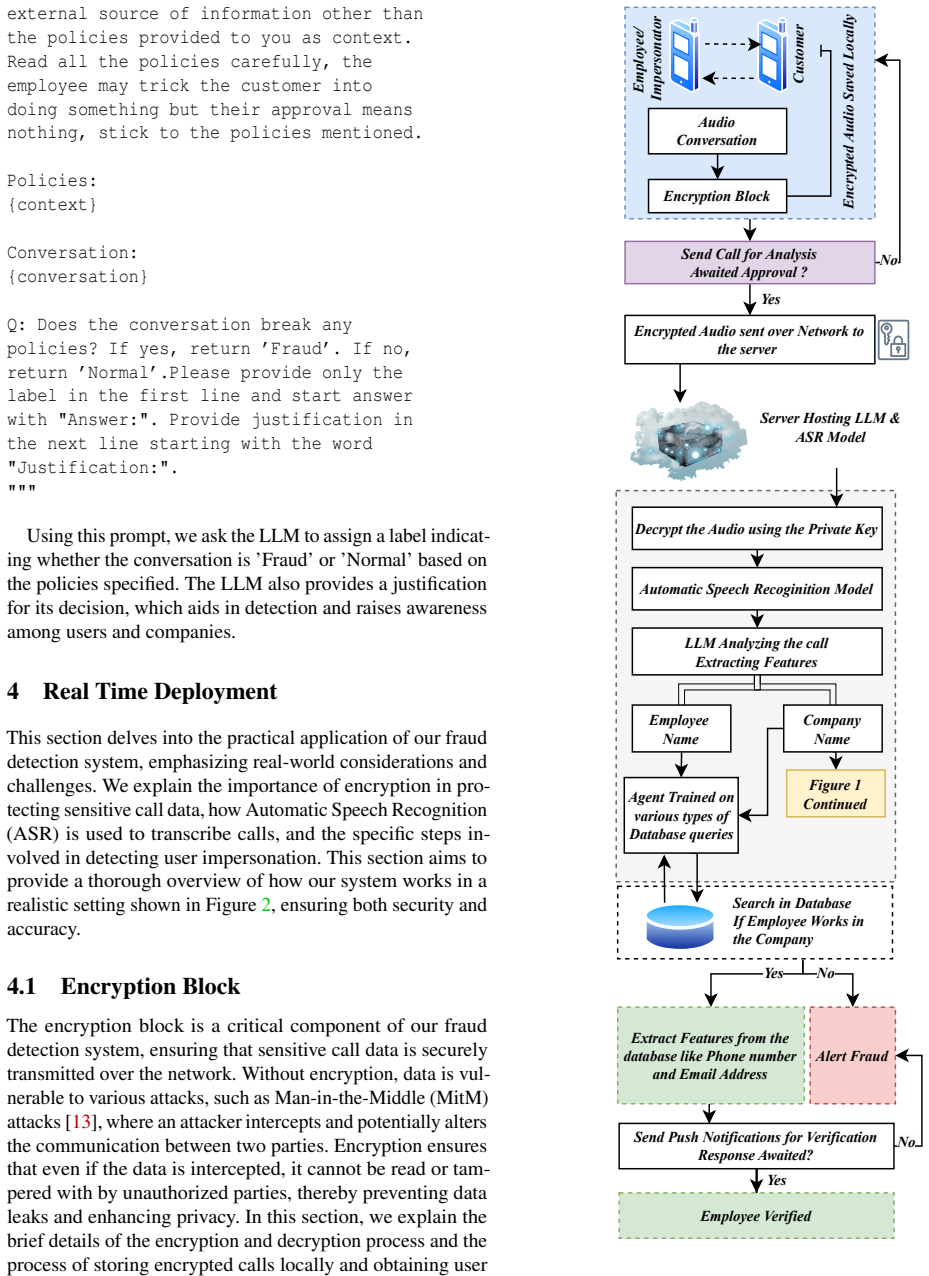
- The end-to-end design adds real-time transcription, encrypted transmission, local consent, and push-notification identity verification, so the RAG policy check is embedded in a deployable workflow.
- Because accuracy stays near 0.98 when the dataset grows from 100 to 1000 calls, the paper claims the approach scales without the training-cost curve of fine-tuned classifiers.
Reading between the lines
- An implication the authors do not spell out is that the decisive factor is retrieval quality: if the vector database returns the wrong or outdated policy text, the LLM's compliance judgment will inherit that error, so the system's reliability is bounded by the documentation, not by the LLM.
- The reported numbers were produced on synthetic calls generated from the same Table 1 categories that the policy documents encode; a live deployment test on transcripts with out-of-category fraud tactics, or with realistic ASR errors, would give a fairer estimate of real-world accuracy.
- The same 'retrieve the governing rule and ask an LLM to apply it' pattern could transfer to other text-based compliance checks, such as customer-service interactions governed by regulatory scripts, with the same no-retraining update property.
- A concrete extension would measure how label accuracy degrades as the policy corpus grows and documents overlap, since retrieval quality rather than model capacity would then become the bottleneck.
Signed reviews
Editorial analysis
A structured set of objections, weighed in public.
Referee Report
Summary. The paper proposes a real-time fraud detection system based on Retrieval-Augmented Generation (RAG). The system extracts company names from phone call transcripts, retrieves company-specific policy documents from a vector database, and uses an LLM to classify each call as Fraud or Normal against those policies. It also sketches a deployment architecture with encryption, ASR, and a two-step user impersonation check. The authors evaluate on synthetic call transcripts generated with LLMs using the same policy categories (Table 1) that later serve as the RAG context. They report 0.9798 accuracy and 0.9744 F1 on 100 calls, outperforming BERT and an untrained LLM, and conclude the system is suitable for real-world deployment.
Significance. If the evaluation were valid, the paper would provide a useful demonstration that RAG can let a fraud-detection system adapt to policy changes without retraining, while producing explanatory justifications. The strengths are that the idea is timely, the system description is concrete, and the paper includes a limitations section acknowledging the lack of real-world testing. However, the central evidence is circular: the test conversations are generated from the same policy rules that are injected as context, so the reported accuracy only measures rule-following on paraphrases, not detection of unseen fraud. The real-time deployment claims are not implemented: ASR is absent from all experiments, the impersonation check is only a design sketch, and no code, data, model identifiers, confidence intervals, or statistical tests are provided. The paper therefore cannot support its central claim of real-world readiness.
major comments (5)
- [§3.1, §3.3, §3.4, and Table 2] The evaluation is circular. Section 3.1 states that the synthetic calls were generated 'using the cases defined in Table 1,' and Section 3.3 says the company policy documents were created from the same policy categories. The Section 3.4 prompt injects those policies as context before asking for a label. The test conversations therefore instantiate the exact rules the model is given, and the 0.9798 accuracy / 0.9744 F1 in Table 2 shows only that an LLM can map paraphrases of an enumerated rule to the rule's label. It does not measure detection of novel or real-world fraud strategies, and Section 6 concedes the system has not been tested on real-world data. This undermines the central claim that the method is 'well suited for real-world deployment.'
- [§4.2 vs. §5] The real-time pipeline relies on ASR as an essential component: Section 4.2 says ASR is used 'to convert the decrypted call on the server to text format.' However, all experiments in Section 5 feed clean text transcripts; there is no ASR in the loop, no ASR error analysis, and no end-to-end audio-to-label evaluation. Since the deployment claim is real-time detection from phone calls, the reported accuracy is an upper bound that does not validate the audio pipeline.
- [§4.4] The proposed two-step user impersonation verification is only described, not evaluated. Section 4.4.1 lists the steps of checking employee names and sending push notifications, but there are no experiments, simulations, or measurements of accuracy, latency, or false-alarm rates for this component. The impersonation-detection front of the claimed system is therefore entirely unvalidated.
- [§5.1 and Table 2] The headline results are reported without model identifiers, hyperparameters, number of runs, confidence intervals, or statistical significance tests. The n=100 result has no error bars, and the 'untrained LLM' baseline is not a meaningful state-of-the-art comparison; an untrained model is expected to perform poorly, and the BERT variant and its training procedure are not described. Without these details, the claimed performance differences cannot be assessed.
- [§5.2 and Table 3] The key claimed advantage of the system, 'ability to update policies without retraining the entire model,' is not experimentally demonstrated. Table 3 shows illustrative responses for a policy-change scenario, but there is no measurement of accuracy after a policy update, no comparison of update costs, and no evidence that the RAG system maintains performance after a change.
minor comments (5)
- [§3.1 and Table 1] The 'Intermediate' case category is never mapped to the binary Fraud/Normal labels required by the Section 3.4 prompt; the paper does not state how intermediate calls were scored in Table 2.
- [Figure 1] Two distinct diagrams are both labeled 'Figure 1': one at the beginning of Section 3 and a second labeled 'Figure 1 Continued' in Section 4.3; the figures should be renumbered.
- [§4.4.1 and References] There are typos in Section 4.4.1 ('compnay' and 'Comapny'), and the CFCA reference [2] has a malformed URL containing a stray space and ellipsis. References [8] and [10] are the same paper by Liming Jiang and should be merged.
- [§3.2–§3.4] The paper does not state which LLM, embedding model, vector database, cosine-similarity threshold, or number of retrieved documents were used; these details are needed for reproducibility.
- [§4.1.2] The described pop-up asking for user consent 'during the call' is not plausible for ordinary phone calls; the deployment discussion should describe a more realistic consent mechanism or acknowledge this as an open design issue.
Circularity Check
The headline accuracy is measured on synthetic calls generated from the same Table 1 policy rules that the RAG prompt supplies as context, so it reduces to rule-matching on paraphrases rather than real-world fraud detection.
-
self definitional
[Sections 3.1, 3.3, 3.4; Tables 1 and 3]
"Each bank was given a set of legitimate, intermediate, and fraudulent cases. The LLM was given a prompt using the cases defined in Table 1, in order to generate calls with a variety of real-life scenarios based on the defined boundaries. ... So we created a collection of documents for each company outlining their employee policies and guidelines. ... Policies: {context} Conversation: {conversation} ... Does the conversation break any policies? If yes, return ’Fraud’."
The test conversations are generated from the Table 1 policy cases, the RAG context is the authors' policy documents encoding those same cases (Table 3's RAG responses quote the same wording, e.g., 'the last 4 digits'), and the prompt instructs the model to label the conversation using only that context. The ground-truth label is therefore determined by the same rule text the model is handed, so the reported 0.9798 accuracy / 0.9744 F1 measures whether the LLM can apply a supplied rule to a paraphrase of that rule, not whether it detects fraud strategies absent from the hand-authored policy categories. The abstract and conclusion nonetheless claim the system is 'well-suited for real world deployment,' while Section 6 concedes the methodology 'has not yet been tested on real-world data.'
full rationale
The central circularity is structural: the evaluation distribution is manufactured from the same policy definitions that form the retrieval context. Section 3.1 says the synthetic calls were generated 'using the cases defined in Table 1'; Section 3.3 says the policy documents were created by the authors for each company; and Section 3.4 feeds those policies into the prompt and asks for a 'Fraud'/'Normal' label. Consequently, the headline numbers are a self-consistency check of rule application, not a transferable detection rate. The paper's own Section 6 concedes the system 'has not yet been tested on real-world data' and that LLM hallucination persists; the ASR stage described as essential in Section 4.2 is never included in the experiments, since the evaluations use clean text. No code or data is released, so the synthetic generation process cannot be independently audited. These are limitations and gaps, not themselves circular, but they compound the core issue: the only quantitative evidence for the deployment claim is generated from the answer key. There is no load-bearing self-citation chain in the paper; the authors cite prior work without resting the argument on their own cited results. The 'policy update without retraining' advantage is illustrated only by a hypothetical Table 3 scenario rather than a measured experiment, which is an evidence gap rather than a circular step. Overall, the derivation of the central performance claim reduces, by construction, to matching paraphrases against supplied rules, so the result is partially circular and cannot support the real-world generalization claim.
Assumptions & free parameters
free parameters (3)
- Cosine similarity threshold =
not reported
- Retrieval top-k =
not reported
- Synthetic dataset class proportions =
not reported
assumptions (4)
- domain assumption Synthetic calls generated from Table 1 categories are representative of real-world fraudulent and legitimate phone calls.
- domain assumption Automatic Speech Recognition transcribes call audio with sufficient fidelity to preserve policy-relevant details.
- domain assumption The LLM's policy-compliance judgment is reliable and not materially affected by hallucination.
- standard math Cosine similarity between embedding vectors is a valid proxy for matching company and employee names.
Cite this review
Pith. "Pith review of Advanced Real-Time Fraud Detection Using RAG-Based LLMs." pith.science (2026). https://pith.science/paper/P2SX3PHR
@misc{pith2026250115290,
  author       = {Pith},
  title        = {Pith review of: Advanced Real-Time Fraud Detection Using RAG-Based LLMs},
  year         = {2026},
  howpublished = {\url{https://pith.science/paper/P2SX3PHR}},
  note         = {Machine review of arXiv:2501.15290}
}
read the original abstract
Artificial Intelligence has become a double edged sword in modern society being both a boon and a bane. While it empowers individuals it also enables malicious actors to perpetrate scams such as fraudulent phone calls and user impersonations. This growing threat necessitates a robust system to protect individuals In this paper we introduce a novel real time fraud detection mechanism using Retrieval Augmented Generation technology to address this challenge on two fronts. First our system incorporates a continuously updating policy checking feature that transcribes phone calls in real time and uses RAG based models to verify that the caller is not soliciting private information thus ensuring transparency and the authenticity of the conversation. Second we implement a real time user impersonation check with a two step verification process to confirm the callers identity ensuring accountability. A key innovation of our system is the ability to update policies without retraining the entire model enhancing its adaptability. We validated our RAG based approach using synthetic call recordings achieving an accuracy of 97.98 percent and an F1score of 97.44 percent with 100 calls outperforming state of the art methods. This robust and flexible fraud detection system is well suited for real world deployment.
Figures

Forward citations
Cited by 3 Pith papers
-
Operational Evidence Gaps for LLMs in Fraud Detection and Trust-and-Safety Workflows
A survey of 49 LLM fraud and trust-and-safety papers finds that fraud work reports almost no per-decision latency, cost, or calibration evidence, while moderation work reports more.
-
Domain Knowledge-Enhanced LLMs for Fraud and Concept Drift Detection
A domain-prompted dual-LLM pipeline with a one-class drift detector reportedly reaches 98% accuracy on fraudulent-conversation detection, while drift classification itself is not separately measured.
-
LLM Harms: A Taxonomy and Discussion
This paper proposes a taxonomy of LLM harms in five categories and suggests mitigation strategies plus a dynamic auditing system for responsible development.
Reference graph
Works this paper leans on
-
[10]
Detecting scams using large language models
JIANG LIMING. Detecting scams using large language models. arXiv preprint arXiv:2402.03147, 2024
arXiv 2024
-
[1]
Mobile money fraud detection using data analysis and visualiza- tion techniques
Rizik Al-Sayyed, Esra’a Alhenawi, Hadeel Alazzam, Ala’a Wrikat, and Dima Suleiman. Mobile money fraud detection using data analysis and visualiza- tion techniques. Multimedia Tools and Applications , 83(6):17093–17108, 2024
work page 2024
-
[2]
Communications Fraud Control Association et al. Fraud loss survey. Technical report, Technical Report. https://cfca. org/wp-content/uploads/2021/12/CFCA- Fraud . . . , 2021
work page 2021
-
[3]
Fraud detection in telephone conversations for financial services using linguistic features
Nikesh Bajaj, Tracy Goodluck Constance, Marvin Ra- jwadi, Julie Wall, Mansour Moniri, Cornelius Glackin, Nigel Cannings, Chris Woodruff, and James Laird. Fraud detection in telephone conversations for finan- cial services using linguistic features. arXiv preprint arXiv:1912.04748, 2019
work page Pith review arXiv 1912
-
[4]
Advancing anomaly detection: Non-semantic financial data encoding with llms
Alexander Bakumenko, Kateˇrina Hlaváˇcková-Schindler, Claudia Plant, and Nina C Hubig. Advancing anomaly detection: Non-semantic financial data encoding with llms. arXiv preprint arXiv:2406.03614, 2024
arXiv 2024
-
[5]
Llms for explainable few-shot deception detection
Dainis Boumber, Bryan E Tuck, Rakesh M Verma, and Fatima Zahra Qachfar. Llms for explainable few-shot deception detection. In Proceedings of the 10th ACM In- ternational Workshop on Security and Privacy Analytics, pages 37–47, 2024
work page 2024
-
[6]
Discussion paper: Exploiting llms for scam automa- tion: A looming threat
Gilad Gressel, Rahul Pankajakshan, and Yisroel Mirsky. Discussion paper: Exploiting llms for scam automa- tion: A looming threat. In Proceedings of the 3rd ACM Workshop on the Security Implications of Deepfakes and Cheapfakes, pages 20–24, 2024
work page 2024
-
[7]
Devendra Sambhaji Hapase and Lalit Vasantrao Patil. Telecommunication fraud resilient framework for effi- cient and accurate detection of sms phishing using ar- tificial intelligence techniques. Multimedia Tools and Applications, pages 1–23, 2024
work page 2024
Show all 22 references
-
[9]
Detecting fraud 9 calls vis-à-vis natural language processing
Pijush Kanti Kumar, Samrat Ray, Lakshmanan Ku- marasankaralingam, Athilingam Ramamoorthy, Pad- manavan Kumar, and Anurag Dutta. Detecting fraud 9 calls vis-à-vis natural language processing. In 2024 2nd International Conference on Advancement in Com- putation & Computer Techno...
2024
-
[11]
Enhancing the interpretability and explain- ability of ai-driven risk models using llm capabilities
Ayuns Luz. Enhancing the interpretability and explain- ability of ai-driven risk models using llm capabilities. Technical report, EasyChair, 2024
2024
-
[12]
De- tection and analysis of fraud phone calls using artifi- cial intelligence
Saloni Malhotra, Ginni Arora, and Ruchika Bathla. De- tection and analysis of fraud phone calls using artifi- cial intelligence. In 2023 International Conference on Recent Advances in Electrical, Electronics & Digital Healthcare Technologies (REEDCON), pages 592–595. IEEE, 2023
2023
-
[13]
Man-in-the-middle-attack: Understand- ing in simple words
Avijit Mallik. Man-in-the-middle-attack: Understand- ing in simple words. Cyberspace: Jurnal Pendidikan Teknologi Informasi, 2(2):109–134, 2019
2019
-
[14]
Dial one for scam: Analyzing and detecting tech- nical support scams
Najmeh Miramirkhani, Oleksii Starov, and Nick Niki- forakis. Dial one for scam: Analyzing and detecting tech- nical support scams. In 22nd Annual Network and Dis- tributed System Security Symposium (NDSS , volume 16, 2016
2016
-
[15]
Wangiri fraud: Pattern analysis and machine-learning-based de- tection
Akshaya Ravi, Mounira Msahli, Han Qiu, Gerard Memmi, Albert Bifet, and Meikang Qiu. Wangiri fraud: Pattern analysis and machine-learning-based de- tection. IEEE Internet of Things Journal , 10(8):6794– 6802, 2022
2022
-
[16]
Fraud detection and gaas topics
Smadar Rinat. Fraud detection and gaas topics. CPA Journal, 93, 2023
2023
-
[17]
Sok: Fraud in telephony networks
Merve Sahin, Aurélien Francillon, Payas Gupta, and Mustaque Ahamad. Sok: Fraud in telephony networks. In 2017 IEEE European Symposium on Security and Privacy (EuroS&P), pages 235–250. IEEE, 2017
2017
-
[18]
Nfa: A neural factorization autoencoder based online telephony fraud detection
Abdul Wahid, Mounira Msahli, Albert Bifet, and Gerard Memmi. Nfa: A neural factorization autoencoder based online telephony fraud detection. Digital Communica- tions and Networks, 10(1):158–167, 2024
2024
-
[19]
Eth- ical and social risks of harm from language models
Laura Weidinger, John Mellor, Maribeth Rauh, Conor Griffin, Jonathan Uesato, Po-Sen Huang, Myra Cheng, Mia Glaese, Borja Balle, Atoosa Kasirzadeh, et al. Eth- ical and social risks of harm from language models. arXiv preprint arXiv:2112.04359, 2021
2021 arXiv
-
[20]
An analysis of scam baiting calls: Identifying and extracting scam stages and scripts
Ian Wood, Michal Kepkowski, Leron Zinatullin, Travis Darnley, and Mohamed Ali Kaafar. An analysis of scam baiting calls: Identifying and extracting scam stages and scripts. arXiv preprint arXiv:2307.01965, 2023
2023 arXiv
-
[21]
Beyond the individual: An improved telecom fraud detection approach based on latent synergy graph learning
Junhang Wu, Ruimin Hu, Dengshi Li, Lingfei Ren, Zijun Huang, and Yilong Zang. Beyond the individual: An improved telecom fraud detection approach based on latent synergy graph learning. Neural Networks, 169:20– 31, 2024
2024
-
[22]
Revolutionizing finance with llms: An overview of applications and insights
Huaqin Zhao, Zhengliang Liu, Zihao Wu, Yiwei Li, Tianze Yang, Peng Shu, Shaochen Xu, Haixing Dai, Lin Zhao, Gengchen Mai, et al. Revolutionizing finance with llms: An overview of applications and insights. arXiv preprint arXiv:2401.11641, 2024
2024
-
[23]
Detecting telecommunication fraud by understanding the contents of a call
Qianqian Zhao, Kai Chen, Tongxin Li, Yi Yang, and XiaoFeng Wang. Detecting telecommunication fraud by understanding the contents of a call. Cybersecurity, 1:1–12, 2018. 10
2018
Reviewed August 10, 2026 · model on record in the stance chip above.
Discussion (0). Continue with ORCID to comment.