REVIEW 4 major objections 6 minor 45 references
FAVbot: An Autonomous Target Tracking Micro-Robot with Frequency Actuation Control
T0 review · 4 major / 6 minor · reviewed 2026-08-10 · deepseek-v4-flash
Pith's one-line read A 3-cm robot steers with a single piezoelectric actuator by switching drive frequency and autonomously tracks a target using on-board CNN vision.
desk verdict A credible integrated microrobot demo whose real novelty is the closed-loop system, but whose resonance-causality claim and thin statistics need work before it is publishable as-is. read the letter →
The pith
A machine-rendered reading of the paper's core claim, the machinery that carries it, and where it could break.
The reading
What carries the argument
The load-bearing mechanism is frequency-controlled resonance steering: one piezoelectric buzzer vibrates the whole robot, and the three bristles, being asymmetric in stiffness, act as separate resonators, so each drive frequency produces a distinct combination of stick-slip driving forces through its finite-element-identified mode shape, analogous to differential drive between left and right bristles. The vision loop is the complementary mechanism: a low-resolution 30-by-40-pixel convolutional network maps each camera frame to one of four target-location classes, and a microcontroller selects the pre-characterized frequency and actuation duration for the corresponding motion mode. The name FAVbot encodes the idea: Frequency-Actuated with Vision robot. The measured mapping from drive frequency to motion mode is what replaces multi-actuator differential steering with a single frequency-tunable actuator.
What would settle it
Measure the per-frequency heading and speed of FAVbot running on battery on a glass surface and compare with the tethered characterization in Section III; if the steering directions or speeds for the modes used in tracking differ, the mapping does not transfer. As a second check, use high-speed video of the bristle tips to see whether the observed motion modes occur at the finite-element-predicted resonance frequencies.
Extended reading notes
Core claim
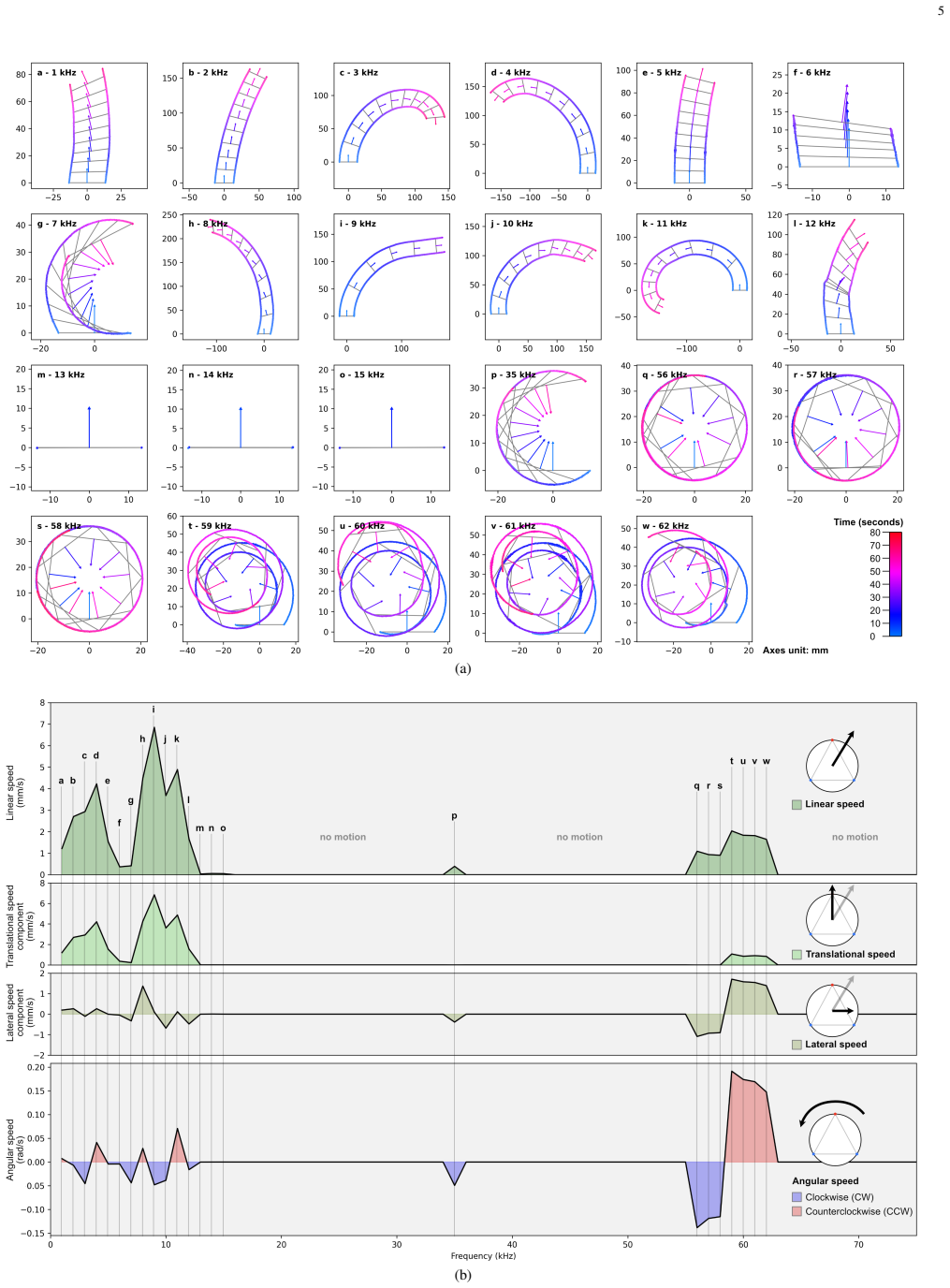
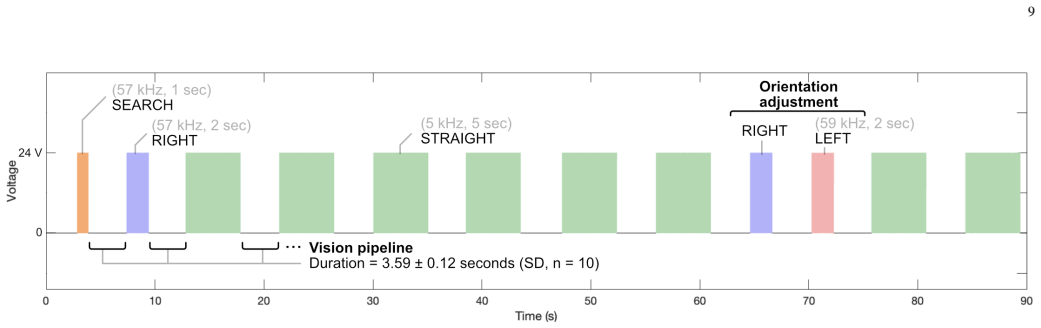
The paper's central claim is that autonomous locomotion at centimeter scale can be obtained from one piezoelectric buzzer plus vision feedback, without differential motors. The robot's three stainless-steel bristles have different diameters (0.51, 0.66, and 0.79 mm) and a 20-degree tilt, so at certain drive frequencies a particular bristle's resonance is amplified and the robot steers like a differentially driven vehicle; finite-element analysis predicts the mode shapes, and the frequency sweep from 1 to 100 kHz shows distinct motion modes with no-motion bands in between. Measured performance includes a maximum linear speed of $6.9\,\mathrm{cm/s}$ at 9 kHz and a maximum angular speed of $0.19\,\mathrm{rad/s}$ at 59 kHz. The vision pipeline, a two-stage convolutional network trained on 100,000 synthetic images, classifies target position into four zones with 96% real-image accuracy and takes $3.59 \pm 0.12$ seconds per control cycle; the robot then applies registered frequencies and durations for STRAIGHT, LEFT, RIGHT, and SEARCH. The paper concludes that the closed-loop system corrects the inherent randomness of vibration actuation and enables autonomous target tracking in dynamic environments.
Load-bearing premise
The frequency-to-motion map was measured with the robot powered by a tether on a glass substrate, and the closed-loop tracking experiments assume that same map holds during untethered battery operation.
Editorial extensions
If this is right
- Single-actuator frequency control can replace two-motor differential drives in centimeter-scale robots, simplifying actuation and reducing weight and volume.
- On-board CNN vision makes vibration-driven locomotion reliable enough for autonomous search-and-track by correcting for stochastic heading drift in real time.
- The rich set of resonance modes, including tight clockwise and counterclockwise turns with near-zero radius, supports scouting and maneuvering in confined spaces.
- The design is expected to scale down further (about three times) with custom integrated circuits, thin-film batteries, and MEMS actuators, since the actuation mechanism does not rely on bulky motors.
- The closed-loop control framework is generic: once frequencies are registered for STRAIGHT, LEFT, RIGHT, and SEARCH, the same pipeline can be reconfigured for other tasks or targets.
Reading between the lines
- Outside the paper: because bristle geometry sets the resonance spectrum, a swarm of similar robots with different bristle diameters could be steered selectively by broadcasting different drive frequencies, giving per-robot control without per-robot actuators.
- Outside the paper: the 3.59-second vision cycle limits correction frequency; the paper's own over-correction experiment implies that a faster inference pipeline would make tracking tighter, a testable hardware upgrade.
- Outside the paper: the CNN was trained only on synthetic images; retraining with a small set of real images under varied lighting would test whether the 96% accuracy transfers beyond the shown conditions.
Signed reviews
Editorial analysis
A structured set of objections, weighed in public.
Referee Report
Summary. The paper presents FAVbot, a 3-cm autonomous mobile micro-robotic system driven by a single piezoelectric buzzer actuator. The actuation concept is that asymmetric metallic bristles of different diameters and a tilt angle produce multiple mechanical resonance modes across the 1–100 kHz range, so that different drive frequencies yield distinct motion patterns (straight, left/right turn, CW/CCW rotation, lateral drift). The robot carries a camera, a microcontroller, a battery, and a boost converter; a lightweight LeNet-style CNN classifies the target's position into four zones (left, middle, right, out-of-view) to provide closed-loop control. Frequency-controlled motion is characterized on a glass substrate (Fig. 5), and two untethered tracking experiments plus one moving-target experiment are reported (Fig. 10). The paper claims this is the first autonomous mobile micro-robot using a frequency-controlled single-actuator mechanism and the smallest vision-based autonomous robotic system to the authors' knowledge.
Significance. If the central claims are substantiated, this is a notable systems-level demonstration: a single piezoelectric actuator with frequency tuning provides multi-directional steering, and the fully on-board vision-and-control pipeline achieves closed-loop target tracking in a 3-cm form factor. The paper provides a useful comparison table (Table I), a reproducible software pipeline (Fig. 8), and openly discusses limitations such as terrain sensitivity and the need for closed-loop correction. However, the quantitative evidence is currently thin in several load-bearing places: the resonance-causality claim is not experimentally verified, the motion characterization lacks repeated trials/error bars and was done under tethered power, the CNN real-life accuracy of 96% is not supported by a described test set, and the tracking demonstrations are not quantified with success rates or error metrics.
major comments (4)
- [Section II, Fig. 4; Section III, item 3; Section VI] The central novelty—that frequency-controlled steering is achieved through mechanical resonance of the asymmetric bristles—is not experimentally verified. Fig. 4 presents FEA-predicted first-order mode shapes for individual bristles, but no experimental modal analysis (e.g., laser Doppler vibrometry, high-speed imaging of bristle deflection, or measurement of the buzzer's output/mechanical response across frequency) is reported. The motion characterization in Fig. 5 and the no-motion bands are interpreted as evidence of 'underlying mechanical resonance,' but these observations are also consistent with the piezoelectric buzzer's own electromechanical transfer function or frequency-dependent stick-slip friction. Since the 'novel actuation mechanism' is a load-bearing contribution, the authors should either provide direct measurements that correlate observed motion modes with experimentally detected resonance peaks, or substantially reframe the contribution as an empirically characterized frequency-motion mapping without the resonance-causality claim.
- [Section V, Fig. 10] The closed-loop tracking demonstration lacks quantitative performance metrics. The paper reports qualitative trajectories for two parameter sets and one moving-target experiment, but no success rate, number of trials, final tracking error, time-to-target, or statistical variability is provided. The claim that FAVbot 'effectively' tracks targets and 'demonstrated effective vision and motion systems' (Section V) would be much stronger with repeated trials and a quantitative metric (e.g., distance to target at the end of a fixed run, percentage of runs in which the target remains in view, or a comparison against open-loop control). Without such data, the central claim of reliable autonomous tracking is not fully supported.
- [Section III, Fig. 5b; Section V] The frequency-to-motion characterization appears to be based on single trajectories, and the transfer from tethered to untethered operation is assumed rather than demonstrated. Fig. 5b reports extracted average speeds, but the number of characterization runs per frequency, standard deviations, and experimental conditions are not reported. In addition, the characterization is performed with external power supplied by 42 AWG magnet wires (Section III), while the tracking experiments in Section V use the on-board battery; the paper does not show that the frequency-mode mapping is unchanged under battery power (which could alter vibration characteristics or weight distribution). The authors should provide repeated-measurement statistics and, at minimum, a brief re-characterization or comparison of representative modes under battery power.
- [Section IV, Fig. 7c] The claimed 96% real-life CNN accuracy is not substantiated. The text states that the model achieves 96% validation accuracy on synthetic data and that Fig. 7c shows 'real-life accuracy on par with training accuracy, 96%,' but no test set size, composition, labeling procedure, or confusion matrix is given. Because this accuracy directly gates the closed-loop controller's behavior, the authors should report the number of real images tested, the distribution of the four classes, and ideally a confusion matrix or per-class accuracy.
minor comments (6)
- [Section III, Eq. (3)] Equation (3) is missing parentheses: it should read ˙θ[T] = (θ[T+δt] − θ[T])/δt, not ˙θ[T] = θ[T+δt] − θ[T]/δt, which would incorrectly divide only the second term by δt.
- [Fig. 5b caption] The word 'transnational' should be 'translational' in the caption of Fig. 5b.
- [Section VI] There are two typos in the conclusion: 'posts new challenges' should be 'poses new challenges,' and 'terrine' should be 'terrain'.
- [Section IV] The phrase 'compered to actuation segments' should be 'compared to actuation segments' in the description of average power consumption.
- [Table I] The note 'Green fill color indicates better or equal trait' is not visible in grayscale printing; please use symbols or bold font to distinguish better/equal traits.
- [Figure 5a] The trajectory plots in Fig. 5a are dense; adding scale bars or an inset with the robot's starting orientation for each mode would improve readability.
Circularity Check
No significant circularity: the frequency-to-motion mapping is directly measured, and the closed-loop tracking uses calibrated modes rather than predictions derived from the target result.
full rationale
The paper's central claims rest on experimental characterization, not on circular derivation. Section III sweeps actuation frequency from 1 to 100 kHz and directly measures robot trajectories, extracting linear and angular speeds (Eqs. 1-9). These measured modes are then registered as STRAIGHT, LEFT, RIGHT, and SEARCH commands in Section V and used for autonomous tracking; the tracking result is a demonstration of the calibrated modes, not a prediction derived from the tracking outcome. The FEA in Fig. 4 is used to guide bristle geometry selection and to interpret observed motion bands as resonance modes, but this is a design/rationalization step, not an equation-level derivation where the conclusion is assumed in the premises. The claim that no-motion bands 'emphasize the underlying mechanical resonance phenomenon' is an interpretation of observed data, and even if the causal mechanism were incompletely verified by modal analysis, that is a correctness or evidence gap, not circularity. Self-citations to [40] and [41] provide prior context and supporting observations for frequency-dependent bristle motion, but the current paper independently characterizes its own robot's motion and does not rely on a self-citation to force its central conclusion. The CNN vision system is trained on synthetically generated images with separate validation accuracy, independent of the actuation claims. No fitted parameter is renamed as a prediction, and no uniqueness theorem is imported from the authors' prior work. Therefore, the derivation chain is self-contained and no significant circularity is present.
Assumptions & free parameters
free parameters (3)
- Bristle geometry (length, diameters, tilt angle) =
12 mm length; 0.51, 0.66, 0.79 mm diameters; 20 degree tilt
- Actuation frequency and duration per motion mode =
Set 1: LEFT 11 kHz/1 s, RIGHT 9 kHz/1 s, STRAIGHT 5 kHz/2 s, SEARCH 57 kHz/1 s; Set 2: LEFT 59 kHz/2 s, RIGHT 57 kHz/2…
- CNN training data distribution =
100k synthetic images with random placement, scaling, skew; specific lighting conditions
assumptions (5)
- domain assumption Stick-slip bristle locomotion model from [34], [35] applies to the 3-bristle asymmetric design.
- domain assumption FEA-computed resonance modes correspond to the observed motion modes.
- domain assumption External tether during characterization does not affect the motion characteristics.
- domain assumption CNN trained on synthetic images generalizes to real camera images under the observed lighting.
- domain assumption Glass substrate friction is appropriate for stick-slip and remains the operation surface.
Cite this review
Pith. "Pith review of FAVbot: An Autonomous Target Tracking Micro-Robot with Frequency Actuation Control." pith.science (2026). https://pith.science/paper/Z4SKCKQB
@misc{pith2026250115426,
  author       = {Pith},
  title        = {Pith review of: FAVbot: An Autonomous Target Tracking Micro-Robot with Frequency Actuation Control},
  year         = {2026},
  howpublished = {\url{https://pith.science/paper/Z4SKCKQB}},
  note         = {Machine review of arXiv:2501.15426}
}
read the original abstract
Robotic autonomy at centimeter scale requires compact and miniaturization-friendly actuation integrated with sensing and neural network processing assembly within a tiny form factor. Applications of such systems have witnessed significant advancements in recent years in fields such as healthcare, manufacturing, and post-disaster rescue. The system design at this scale puts stringent constraints on power consumption for both the sensory front-end and actuation back-end and the weight of the electronic assembly for robust operation. In this paper, we introduce FAVbot, the first autonomous mobile micro-robotic system integrated with a novel actuation mechanism and convolutional neural network (CNN) based computer vision - all integrated within a compact 3-cm form factor. The novel actuation mechanism utilizes mechanical resonance phenomenon to achieve frequency-controlled steering with a single piezoelectric actuator. Experimental results demonstrate the effectiveness of FAVbot's frequency-controlled actuation, which offers a diverse selection of resonance modes with different motion characteristics. The actuation system is complemented with the vision front-end where a camera along with a microcontroller supports object detection for closed-loop control and autonomous target tracking. This enables adaptive navigation in dynamic environments. This work contributes to the evolving landscape of neural network-enabled micro-robotic systems showing the smallest autonomous robot built using controllable multi-directional single-actuator mechanism.
Figures


Figures from the paper (7 more)




Reference graph
Works this paper leans on
-
[40]
Maneuver at micro scale: Steering by actuation frequency control in micro bristle robots,
Z. Hao, D. Kim, A. R. Mohazab, and A. Ansari, “Maneuver at micro scale: Steering by actuation frequency control in micro bristle robots,” in 2020 IEEE International Conference on Robotics and Automation (ICRA). IEEE, 2020, pp. 10 299–10 304
work page 2020
-
[32]
Magnetic field-driven bristle-bots,
L. Supik, K. Str ´ansk´a, M. Kulich, L. P ˇreuˇcil, M. Somr, and K. Ko ˇsnar, “Magnetic field-driven bristle-bots,” IEEE Robotics and Automation Letters, 2023
work page 2023
-
[1]
A capsule-type microrobot with pick-and-drop motion for targeted drug and cell delivery,
S. Lee, S. Kim, S. Kim, J.-Y . Kim, C. Moon, B. J. Nelson, and H. Choi, “A capsule-type microrobot with pick-and-drop motion for targeted drug and cell delivery,” Advanced healthcare materials , vol. 7, no. 9, p. 1700985, 2018
work page 2018
-
[2]
Towards mobile microrobot swarms for additive micromanu- facturing,
D. Cappelleri, D. Efthymiou, A. Goswami, N. Vitoroulis, and M. Za- vlanos, “Towards mobile microrobot swarms for additive micromanu- facturing,” International Journal of Advanced Robotic Systems , vol. 11, no. 9, p. 150, 2014
work page 2014
-
[3]
Wsbot: A tiny, low-cost swarm robot for experimentation on industry 4.0,
M. A. Limeira, L. Piardi, V . C. Kalempa, A. S. de Oliveira, and P. Leit ˜ao, “Wsbot: A tiny, low-cost swarm robot for experimentation on industry 4.0,” in 2019 Latin American Robotics Symposium (LARS), 2019 Brazilian Symposium on Robotics (SBR) and 2019 Workshop on Robotics in Education (WRE) . IEEE, 2019, pp. 293–298
work page 2019
-
[4]
Development of a multi-leg type micro rescue robot for disaster victim search,
D. Misaki and Y . Murakami, “Development of a multi-leg type micro rescue robot for disaster victim search,” in 2011 IEEE International Conference on Robotics and Biomimetics. IEEE, 2011, pp. 1801–1806
work page 2011
-
[5]
Swim-sensing with independent micro-swimmers,
E. Schaler, A. Ansari, S. M. Howell, H. J. Lee, M. W. Smith, A. Rajguru, L. P. Tosi, Z. Hao, and J. D. Kim, “Swim-sensing with independent micro-swimmers,” in The Astrobiology Science Conference (AbSciCon) 2022, 2022, pp. 417–05
work page 2022
-
[6]
Fascination of down scaling — alice the sugar cube robot,
G. Caprari, T. Estier, and R. Siegwart, “Fascination of down scaling — alice the sugar cube robot,” Journal of Micromechatronics, vol. 1, no. 3, p. 177–189, Jul 2001
work page 2001
Show all 45 references
-
[7]
Rapid frequency modulation in a resonant system: aerial perturbation recovery in hawkmoths,
J. Gau, R. Gemilere, L.-V . F. subteam), J. Lynch, N. Gravish, and S. Sponberg, “Rapid frequency modulation in a resonant system: aerial perturbation recovery in hawkmoths,” Proceedings of the Royal Society B, vol. 288, no. 1951, p. 20210352, 2021
1951
-
[8]
Wireless steerable vision for live insects and insect-scale robots,
V . Iyer, A. Najafi, J. James, S. Fuller, and S. Gollakota, “Wireless steerable vision for live insects and insect-scale robots,”Science robotics, vol. 5, no. 44, p. eabb0839, 2020
2020
-
[9]
The gritsbot in its natural habitat-a multi-robot testbed,
D. Pickem, M. Lee, and M. Egerstedt, “The gritsbot in its natural habitat-a multi-robot testbed,” in 2015 IEEE International conference on robotics and automation (ICRA) . IEEE, 2015, pp. 4062–4067
2015
-
[10]
Roach: An autonomous 2.4 g crawling hexapod robot,
A. M. Hoover, E. Steltz, and R. S. Fearing, “Roach: An autonomous 2.4 g crawling hexapod robot,” in 2008 IEEE/RSJ international conference on intelligent robots and systems . IEEE, 2008, pp. 26–33. 11
2008
-
[11]
Using cooperative robots for explosive ordnance dis- posal,
J. McLurkin, “Using cooperative robots for explosive ordnance dis- posal,” Massachusetts Institute of Technology Artificial Intelligence Laboratory, pp. 1–10, 1996
1996
-
[12]
Kilobot: A low cost scalable robot system for collective behaviors,
M. Rubenstein, C. Ahler, and R. Nagpal, “Kilobot: A low cost scalable robot system for collective behaviors,” in 2012 IEEE international conference on robotics and automation . IEEE, 2012, pp. 3293–3298
2012
-
[13]
Group behavior control for mars (micro autonomous robotic system),
T. Fukuda, H. Mizoguchi, K. Sekiyama, and F. Arai, “Group behavior control for mars (micro autonomous robotic system),” in Proceedings 1999 IEEE International Conference on Robotics and Automation (Cat. No. 99CH36288C), vol. 2. IEEE, 1999, pp. 1550–1555
1999
-
[14]
Power and control autonomy for high- speed locomotion with an insect-scale legged robot,
B. Goldberg, R. Zufferey, N. Doshi, E. F. Helbling, G. Whittredge, M. Kovac, and R. J. Wood, “Power and control autonomy for high- speed locomotion with an insect-scale legged robot,” IEEE Robotics and Automation Letters , vol. 3, no. 2, p. 987–993, Apr 2018
2018
-
[15]
Modularity in small distributed robots,
L. E. Navarro-Serment, R. Grabowski, C. J. Paredis, and P. K. Khosla, “Modularity in small distributed robots,” in Sensor Fusion and Decen- tralized Control in Robotic Systems II , vol. 3839. SPIE, 1999, pp. 297–306
1999
-
[16]
Actuation of mobile microbots: a review,
H. Hussein, A. Damdam, L. Ren, Y . Obeid Charrouf, J. Challita, M. Zwain, and H. Fariborzi, “Actuation of mobile microbots: a review,” Advanced Intelligent Systems , vol. 5, no. 9, p. 2300168, 2023
2023
-
[17]
Bee+: A 95-mg four-winged insect-scale flying robot driven by twinned unimorph actuators,
X. Yang, Y . Chen, L. Chang, A. A. Calder´on, and N. O. P´erez-Arancibia, “Bee+: A 95-mg four-winged insect-scale flying robot driven by twinned unimorph actuators,” IEEE Robotics and Automation Letters , vol. 4, no. 4, pp. 4270–4277, 2019
2019
-
[18]
Four wings: An insect-sized aerial robot with steering abil- ity and payload capacity for autonomy,
S. B. Fuller, “Four wings: An insect-sized aerial robot with steering abil- ity and payload capacity for autonomy,” IEEE Robotics and Automation Letters, vol. 4, no. 2, pp. 570–577, 2019
2019
-
[19]
Inverted and vertical climbing of a quadrupedal microrobot using electroadhesion,
S. D. De Rivaz, B. Goldberg, N. Doshi, K. Jayaram, J. Zhou, and R. J. Wood, “Inverted and vertical climbing of a quadrupedal microrobot using electroadhesion,” Science Robotics , vol. 3, no. 25, p. eaau3038, 2018
2018
-
[20]
A 25 mg magnetically actuated microrobot walking at > 5 body lengths/sec,
D. V ogtmann, R. S. Pierre, and S. Bergbreiter, “A 25 mg magnetically actuated microrobot walking at > 5 body lengths/sec,” in 2017 IEEE 30th International Conference on Micro Electro Mechanical Systems (MEMS). IEEE, 2017, pp. 179–182
2017
-
[21]
Magnetically-actuated micro-scale bristle-bots,
D. Kim, Z. Hao, T. H. Wang, and A. Ansari, “Magnetically-actuated micro-scale bristle-bots,” in 2020 International Conference on Manip- ulation, Automation and Robotics at Small Scales (MARSS) . IEEE, 2020, pp. 1–6
2020
-
[22]
Acoustic actuation of bioinspired microswimmers,
M. Kaynak, A. Ozcelik, A. Nourhani, P. E. Lammert, V . H. Crespi, and T. J. Huang, “Acoustic actuation of bioinspired microswimmers,” Lab on a Chip , vol. 17, no. 3, pp. 395–400, 2017
2017
-
[23]
A 5 mg micro-bristle-bot fabricated by two-photon lithography,
D. Kim, Z. Hao, J. Ueda, and A. Ansari, “A 5 mg micro-bristle-bot fabricated by two-photon lithography,” Journal of Micromechanics and Microengineering, vol. 29, no. 10, p. 105006, 2019
2019
-
[24]
Controlling collision-induced aggregations in a swarm of micro bristle robots,
Z. Hao, S. Mayya, G. Notomista, S. Hutchinson, M. Egerstedt, and A. Ansari, “Controlling collision-induced aggregations in a swarm of micro bristle robots,” IEEE Transactions on Robotics , vol. 39, no. 1, pp. 590–604, 2022
2022
-
[25]
Light-driven, caterpillar-inspired miniature inching robot,
H. Zeng, O. M. Wani, P. Wasylczyk, and A. Priimagi, “Light-driven, caterpillar-inspired miniature inching robot,” Macromolecular rapid communications, vol. 39, no. 1, p. 1700224, 2018
2018
-
[26]
A tetherless microdriller for maneuverability and on-board cargo delivery inside viscoelastic media,
T. Wang, D. Yang, J. Chen, J. Chow, Y . Hu, K. Hoang, and A. Ansari, “A tetherless microdriller for maneuverability and on-board cargo delivery inside viscoelastic media,” in 2022 International Conference on Manip- ulation, Automation and Robotics at Small Scales (MARSS) . IEE...
2022
-
[27]
Implicit coordination for 3d underwater collective behaviors in a fish-inspired robot swarm,
F. Berlinger, M. Gauci, and R. Nagpal, “Implicit coordination for 3d underwater collective behaviors in a fish-inspired robot swarm,” Science Robotics, vol. 6, no. 50, p. eabd8668, 2021
2021
-
[28]
A study of a class of vibration-driven robots: Modeling, analysis, control and design of the brushbot,
G. Notomista, S. Mayya, A. Mazumdar, S. Hutchinson, and M. Egerst- edt, “A study of a class of vibration-driven robots: Modeling, analysis, control and design of the brushbot,” in 2019 IEEE/RSJ International Conference on Intelligent Robots and Systems (IROS) . IEEE, 2019, pp....
2019
-
[29]
Distinct forms of resonant optimality within insect indirect flight motors,
A. Pons and T. Beatus, “Distinct forms of resonant optimality within insect indirect flight motors,” Journal of The Royal Society Interface , vol. 19, no. 190, p. 20220080, 2022
2022
-
[30]
Cmos–mems resonators: From devices to applications,
A. Uranga, J. Verd, and N. Barniol, “Cmos–mems resonators: From devices to applications,” Microelectronic Engineering, vol. 132, pp. 58– 73, 2015
2015
-
[31]
Piezoelectric motors, an overview,
K. Spanner and B. Koc, “Piezoelectric motors, an overview,” in Actua- tors, vol. 5, no. 1. MDPI, 2016, p. 6
2016
-
[33]
Steerable miniature legged robot driven by a single piezoelectric bending unimorph actuator,
A. G. Dharmawan, H. H. Hariri, S. Foong, G. S. Soh, and K. L. Wood, “Steerable miniature legged robot driven by a single piezoelectric bending unimorph actuator,” in 2017 IEEE International Conference on Robotics and Automation (ICRA) . IEEE, 2017, pp. 6008–6013
2017
-
[34]
On the mechanics of bristle-bots-modeling, simulation and experiments,
F. Becker, S. Boerner, V . Lysenko, I. Zeidis, and K. Zimmermann, “On the mechanics of bristle-bots-modeling, simulation and experiments,” in ISR/Robotik 2014; 41st international symposium on robotics . VDE, 2014, pp. 1–6
2014
-
[35]
Motility of a model bristle-bot: A theoretical analysis,
G. Cicconofri and A. DeSimone, “Motility of a model bristle-bot: A theoretical analysis,” International Journal of Non-Linear Mechanics , vol. 76, pp. 233–239, 2015
2015
-
[36]
In- pipe bristled micromachine,
A. Gmiterko, M. Dovica, M. Kelemen, V . Fedak, and Z. Mlynkova, “In- pipe bristled micromachine,” in 7th International Workshop on Advanced Motion Control. Proceedings (Cat. No. 02TH8623) . IEEE, 2002, pp. 599–603
2002
-
[37]
Marsbot: A bristle-bot mi- crorobot with augmented reality steering control for wireless structural health monitoring,
A. Fath, Y . Liu, T. Xia, and D. Huston, “Marsbot: A bristle-bot mi- crorobot with augmented reality steering control for wireless structural health monitoring,” Micromachines, vol. 15, no. 2, p. 202, 2024
2024
-
[38]
The simulation and concept of a pipe crawl- ing robot for earthquake rescue,
Z. Wang and E. Appleton, “The simulation and concept of a pipe crawl- ing robot for earthquake rescue,” in Proceedings of the International Conference on Control Applications, vol. 1. IEEE, 2002, pp. 339–344
2002
-
[39]
Development of a vibration-driven capsule robot with protruding magnetic bristles with enhanced adaptability in wet and dry environments,
Y . Zhang, T. Wei, S. He, Y . Hong, and C. Hu, “Development of a vibration-driven capsule robot with protruding magnetic bristles with enhanced adaptability in wet and dry environments,” in 2023 IEEE International Conference on Robotics and Biomimetics (ROBIO). IEEE, 2023, pp. 1–6
2023
-
[41]
On the forward and backward motion of milli-bristlebots,
D. Kim, Z. Hao, A. R. Mohazab, and A. Ansari, “On the forward and backward motion of milli-bristlebots,” International Journal of Non- Linear Mechanics, vol. 127, p. 103551, 2020
2020
-
[42]
Gradient-based learning applied to document recognition,
Y . LeCun, L. Bottou, Y . Bengio, and P. Haffner, “Gradient-based learning applied to document recognition,” Proceedings of the IEEE , vol. 86, no. 11, pp. 2278–2324, 1998
1998
-
[43]
Combined frame-and event-based detection and tracking,
H. Liu, D. P. Moeys, G. Das, D. Neil, S.-C. Liu, and T. Delbr ¨uck, “Combined frame-and event-based detection and tracking,” in 2016 IEEE International Symposium on Circuits and systems (ISCAS). IEEE, 2016, pp. 2511–2514
2016
-
[44]
30.1 a 40nm vliw edge accelerator with 5mb of 0.256 pj/b rram and a localization solver for bristle robot surveillance,
S. D. Spetalnick, A. S. Lele, B. Crafton, M. Chang, S. Ryu, J.-H. Yoon, Z. Hao, A. Ansari, W.-S. Khwa, Y .-D. Chih et al. , “30.1 a 40nm vliw edge accelerator with 5mb of 0.256 pj/b rram and a localization solver for bristle robot surveillance,” in 2024 IEEE International Soli...
2024
-
[2007]
From 2013 to July 2019, he was an Associate Professor and held the ON Semiconductor Junior Professorship in the department
He joined the Georgia Institute of Technology (Georgia Tech), Atlanta, GA, USA, in January 2013. From 2013 to July 2019, he was an Associate Professor and held the ON Semiconductor Junior Professorship in the department. Prior to joining Georgia Tech, he held research position...
2013
Reviewed August 10, 2026 · model on record in the stance chip above.
Discussion (0). Continue with ORCID to comment.