REVIEW 4 major objections 6 minor 10 references
Optimizing Sentence Embedding with Pseudo-Labeling and Model Ensembles: A Hierarchical Framework for Enhanced NLP Tasks
T0 review · 4 major / 6 minor · reviewed 2026-08-10 · deepseek-v4-flash
Pith's one-line read This paper claims that retrieval-filtered pseudo-labeling plus a three-model hierarchical ensemble lifts sentence-embedding accuracy from 91.1% to 94.2% and F1 from 89.7% to 92.3%.
desk verdict An unverifiable empirical claim and an undefined label filter make this paper's reported gains moot, though the architecture and ablations are clearly presented. read the letter →
The pith
A machine-rendered reading of the paper's core claim, the machinery that carries it, and where it could break.
The reading
What carries the argument
The load-bearing mechanism is the error-based pseudo-label filter in Eq. (12): a snippet is kept only when $|\hat{y}_j - y_i| \le \sigma_i$, where $\sigma_i$ is the standard error of the gold label $y_i$. This filter is what the paper relies on to turn noisy pseudo-labeled external data into trustworthy training signal. Around it, the framework wraps three supporting mechanisms: cosine-similarity retrieval of the top $k=5$ snippets per sentence, a hierarchical encoder-refinement-ensemble stack with cross-attention between internal and external context, and ridge regression over the three encoders' predictions. The cross-attention layer and the ridge-regression fusion are what let the three large encoders contribute complementary information.
What would settle it
Run the full pipeline and the same pipeline with the Eq. (12) filter replaced by random retention at the same data size on a named public sentence-embedding benchmark; if the filtered version does not beat the random version, or if the gap between the proposed model and the baseline ensemble does not reproduce the Table I margin, the central claim is not confirmed.
Extended reading notes
Core claim
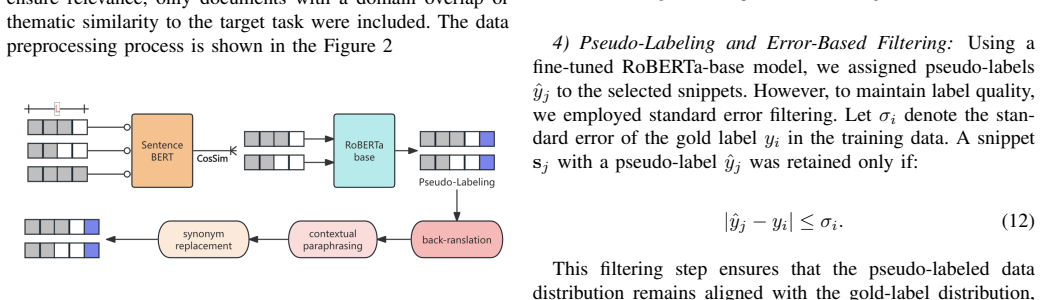
On its own terms, the paper's discovery is a complete data-and-model pipeline rather than a single new layer. A fine-tuned RoBERTa-base assigns pseudo-labels to externally retrieved snippets; the standard-error filter $|\hat{y}_j - y_i| \le \sigma_i$ keeps only snippets whose labels align with the gold distribution; those snippets are augmented by synonym replacement, back-translation, and contextual rewriting; and the merged dataset trains a hierarchy of ALBERT-xxlarge, RoBERTa-large, and DeBERTa-large encoders whose outputs are combined with ridge regression. The paper reports that this full model outperforms each single encoder and a simple baseline ensemble on all four metrics, and the ablation table attributes the gain to each added component. The claim is that the whole construction, not any single model, is what produces the improved sentence embeddings.
Load-bearing premise
The filter rests on the premise that every gold label $y_i$ has a meaningful standard error $\sigma_i$ and that keeping pseudo-labels within one standard error of $y_i$ keeps them aligned with the true label distribution; on a classification task, where labels are categories, that premise is undefined.
Editorial extensions
If this is right
- If the reported results are correct, the full pipeline should beat its strongest single encoder, ALBERT at 91.1% accuracy, by roughly three accuracy points and by 2.6 F1 points on the same evaluation setting.
- The ablation study says each ingredient pays: removing augmentation drops accuracy from 94.2% to 92.8%, removing cross-attention to 93.1%, and removing the ensemble to 92.0%.
- The method combines pretrained encoders with ridge regression rather than fine-tuning them jointly, so it can be applied to other encoder families without architectural changes.
- Because the pseudo-label filter needs only the gold labels' standard errors, the framework offers a way to exploit large unlabeled corpora without manual annotation, provided the task supplies numerically meaningful labels.
Reading between the lines
- An immediate consequence of the metric set is that the paper never pins down whether the target task is regression or classification: the loss is MSE (Eq. 8) while the reported metrics are accuracy, F1, LogLoss, and AUROC, so moving the pipeline to a named benchmark will require choosing one task type.
- A testable extension would be to replace the standard-error filter with random retention at the same data volume; if the filter does not beat random retention, the pseudo-labeling step is not the source of the gain.
- The benefit of the external-data stage should depend on corpus proximity: because snippets are retrieved by Sentence-BERT similarity, an external corpus far from the target domain would supply fewer useful snippets and the advantage over a plain ensemble should shrink.
- The same three-layer recipe could transfer to cross-lingual sentence embedding by swapping the encoders and the external corpus, which the introduction names as future work.
Editorial analysis
A structured set of objections, weighed in public.
Referee Report
Summary. The paper proposes a hierarchical sentence-embedding framework that combines transformer encoders (ALBERT-xxlarge, RoBERTa-large, DeBERTa-large), a convolutional/attention refinement layer, cross-attention over external data, pseudo-labeling of retrieved snippets, data augmentation, and a ridge-regression ensemble. The authors claim large accuracy and F1 improvements over single-model and baseline-ensemble systems, reporting 94.2% accuracy and 92.3% F1 in Table I, with ablation results in Table II. The core claim, as stated in the abstract and Section VI, is that the full pipeline substantially improves sentence-embedding performance.
Significance. If the pipeline and experimental results were fully specified and reproducible, the paper would offer a modest, plausibly useful empirical recipe combining self-training with ensemble prediction for sentence-level NLP tasks. The constituent techniques are largely established (pseudo-labeling/self-training, cross-attention, data augmentation, ridge-regression ensembling), so the novelty is mainly in the particular combination and the claimed gains. However, the manuscript provides no dataset name, no task definition, no split or hyperparameter details, no error bars, and no significance tests, so the central quantitative claims cannot be currently verified or compared with prior work. The paper does not ship code, a benchmark configuration, or any machine-checkable specification that would make its numbers reproducible, which substantially limits its value in its present form.
major comments (4)
- [Section V, Table I] The evaluation protocol is unspecified in a way that directly blocks verification of the central claim. The paper never names the dataset, the task (e.g., classification versus regression versus similarity ranking), the train/validation/test split, or the hyperparameter settings (beyond k=5 in Section III-F3 and the generic ridge objective in Eq. 7). No error bars, repeated-run statistics, or significance tests are provided. Under these conditions the 94.2% accuracy and 92.3% F1 values in Table I are uncheckable, and the abstract's claim of 'large improvements' is not supported by any reproducible experimental evidence.
- [Section III-F4, Eq. (12)] The pseudo-label filtering rule is internally inconsistent with the reported evaluation metrics. Equation (12) retains a pseudo-label only when |y_hat_j - y_i| <= sigma_i, where sigma_i is called the standard error of the gold label y_i. A categorical label used with Accuracy, F1, LogLoss, and AUROC (Section IV) does not have a standard error in any meaningful sense. If instead the underlying task is regression, the MSE loss in Eq. (8) is appropriate, but then the classification metrics in Tables I and II are inappropriate. Either way, the mechanism that is claimed to ensure pseudo-label quality is not well defined for the task reported, and the 1.8-point accuracy gain over the baseline ensemble cannot be attributed to this step as written.
- [Section III-D, Eq. (7) and Section V, Table II] The ensemble weights w_i in Eq. (7) and the pseudo-label retention threshold in Eq. (12) are fit to data, but the paper does not describe any held-out validation or cross-validation procedure that would prevent the reported numbers from reflecting selection on the test set. Without a clear separation between training, validation, and test data, the ablation study in Table II cannot be interpreted: the deltas between variants (e.g., 92.8% without augmentation vs. 94.2% full model) may be within noise, and no confidence intervals are given. This is a load-bearing gap for the empirical claims, not a cosmetic omission.
- [Section I and Section II] The paper does not identify the specific sentence-embedding benchmark or downstream task that the framework is evaluated on, and the related work does not cite standard sentence-embedding evaluation suites (e.g., SentEval or STS benchmarks). As a result, the contribution statement in Section I and the conclusion in Section VI do not position the result relative to the existing sentence-embedding literature; the central claim cannot be assessed against known baselines.
minor comments (6)
- [Abstract and page 1 header] The keyword line reads 'Kerwords', which should be 'Keywords'.
- [Section III, opening paragraph] The sentence 'we proposes a novel hierarchical approach' has a subject-verb agreement error; it should read 'we propose'.
- [Section V, Figure 4 caption] The caption says 'The changge metrics in training processing' and should be revised to something like 'Training dynamics of the evaluation metrics'.
- [Section III-A, Figure 1 and Section III-F, Figure 2] The paper references Figures 1 and 2 but does not describe their content in the text; adding at least one or two sentences explaining the pipeline diagrams would improve readability.
- [Section III-F4, Eq. (12)] The symbol sigma_i is introduced only in the text around Eq. (12) and is never defined operationally; even if the task were regression, the paper would need to state how sigma_i is estimated (e.g., from replicated labels or from a validation set).
- [References] Several references, particularly [1] and [10], are to work in other application domains (e.g., purchase prediction and LLM reasoning) and their direct relevance to the proposed sentence-embedding framework is asserted but not explained in detail.
Circularity Check
No circular reasoning found; the central performance claim is an empirical benchmark comparison, not a derivation from the paper's own fitted quantities.
full rationale
The paper's central claim is the measured performance gain in Table I, which is an empirical comparison rather than a quantity derived from its own inputs. The model is a composition of standard components (pretrained encoders, convolution/attention refinement, ridge-regression ensemble), and the ridge weights are fit to ground-truth labels via Eq. (7); this is ordinary supervised fitting, not a fitted parameter being renamed as an independent prediction. The pseudo-labeling loop in Section III-F is a standard self-training procedure: external snippets are retrieved by cosine similarity, assigned labels by a fine-tuned RoBERTa-base model, and filtered in Eq. (12). Even if Eq. (12) is internally problematic (a standard error sigma_i of a gold label is undefined for categorical labels, and the paper reports classification metrics), that is a correctness/consistency defect in the method description, not circularity, because the reported accuracy/F1 improvements are not obtained by substituting those metrics back into the filter. The related-work section cites external methods (Sentence-BERT, RoBERTa, EDA, supervised contrastive learning) and no load-bearing premise is justified solely by a self-citation; the reference list contains no author self-citations. Therefore, no equation or fitted quantity in the manuscript reduces by construction to the claimed result, and no circular step can be substantiated from the text.
Assumptions & free parameters
free parameters (4)
- k (number of retrieved snippets) =
5
- Ridge regularization parameter lambda =
unspecified
- Pseudo-label retention threshold (multiple of sigma_i) =
implicitly 1
- Ensemble weights w_i =
fitted on training data
assumptions (4)
- domain assumption External corpora (SimpleWiki, Wikipedia, BookCorpus) contain text sufficiently aligned with the target task to provide useful pseudo-labels.
- domain assumption Cosine similarity computed with a pre-trained Sentence-BERT model reliably retrieves top-k snippets that are semantically relevant to each training sentence.
- ad hoc to paper The standard error sigma_i of the gold label y_i is well-defined and finite for the labels used.
- domain assumption The pseudo-labeling model (fine-tuned RoBERTa-base) is accurate enough that filtered pseudo-labels do not introduce harmful noise.
Cite this review
Pith. "Pith review of Optimizing Sentence Embedding with Pseudo-Labeling and Model Ensembles: A Hierarchical Framework for Enhanced NLP Tasks." pith.science (2026). https://pith.science/paper/JV2LRBMV
@misc{pith2026250115876,
  author       = {Pith},
  title        = {Pith review of: Optimizing Sentence Embedding with Pseudo-Labeling and Model Ensembles: A Hierarchical Framework for Enhanced NLP Tasks},
  year         = {2026},
  howpublished = {\url{https://pith.science/paper/JV2LRBMV}},
  note         = {Machine review of arXiv:2501.15876}
}
read the original abstract
Sentence embedding tasks are important in natural language processing (NLP), but improving their performance while keeping them reliable is still hard. This paper presents a framework that combines pseudo-label generation and model ensemble techniques to improve sentence embeddings. We use external data from SimpleWiki, Wikipedia, and BookCorpus to make sure the training data is consistent. The framework includes a hierarchical model with an encoding layer, refinement layer, and ensemble prediction layer, using ALBERT-xxlarge, RoBERTa-large, and DeBERTa-large models. Cross-attention layers combine external context, and data augmentation techniques like synonym replacement and back-translation increase data variety. Experimental results show large improvements in accuracy and F1-score compared to basic models, and studies confirm that cross-attention and data augmentation make a difference. This work presents an effective way to improve sentence embedding tasks and lays the groundwork for future NLP research.
Figures


Figures from the paper (1 more)

Reference graph
Works this paper leans on
-
[1]
J. Lu, Y. Long, X. Li, Y. Shen, and X. Wang, ``Hybrid model integration of lightgbm, deepfm, and din for enhanced purchase prediction on the elo dataset,'' in 2024 IEEE 7th International Conference on Information Systems and Computer Aided Education (ICISCAE). 1em plus 0.5em minus 0.4em IEEE, 2024, pp. 16--20
work page 2024
-
[2]
N. Reimers, ``Sentence-bert: Sentence embeddings using siamese bert-networks,'' arXiv preprint arXiv:1908.10084, 2019
arXiv 1908
-
[3]
Y. Liu, ``Roberta: A robustly optimized bert pretraining approach,'' arXiv preprint arXiv:1907.11692, vol. 364, 2019
arXiv 1907
-
[4]
Z. Yang, ``Xlnet: Generalized autoregressive pretraining for language understanding,'' arXiv preprint arXiv:1906.08237, 2019
arXiv 1906
-
[5]
Khosla, P
P. Khosla, P. Teterwak, C. Wang, A. Sarna, Y. Tian, P. Isola, A. Maschinot, C. Liu, and D. Krishnan, ``Supervised contrastive learning,'' Advances in neural information processing systems, vol. 33, pp. 18\,661--18\,673, 2020
2020
- [6]
-
[7]
L. Mathew and V. Bindu, ``A review of natural language processing techniques for sentiment analysis using pre-trained models,'' in 2020 Fourth international conference on computing methodologies and communication (ICCMC). 1em plus 0.5em minus 0.4em IEEE, 2020, pp. 340--345
work page 2020
-
[8]
Raffel, N
C. Raffel, N. Shazeer, A. Roberts, K. Lee, S. Narang, M. Matena, Y. Zhou, W. Li, and P. J. Liu, ``Exploring the limits of transfer learning with a unified text-to-text transformer,'' Journal of machine learning research, vol. 21, no. 140, pp. 1--67, 2020
2020
Show all 10 references
-
[9]
Bouraoui, S
A. Bouraoui, S. Jamoussi, and A. B. Hamadou, ``A comprehensive review of deep learning for natural language processing,'' International Journal of Data Mining, Modelling and Management, vol. 14, no. 2, pp. 149--182, 2022
2022
-
[11]
۶ _ r @ @ @ 445 a* !/ @ @ Ҵ 9L&mY Ay< Wiq6,L&v)S E CCü^zM IX&QurJGh M( @ @ i =:u grjjj DhY֛Lmv С 1qe!
11em plus .33em minus .07em 4000 4000 100 4000 4000 500 `\.=1000 = #1 \@IEEEnotcompsoconly \@IEEEcompsoconly #1 * [1] 0pt [0pt][0pt] #1 * [1] 0pt [0pt][0pt] #1 * \| ** #1 \@IEEEauthorblockNstyle \@IEEEcompsocnotconfonly \@IEEEauthorblockAstyle \@IEEEcompsocnotconfonly \@IEEEco...
2024
Reviewed August 10, 2026 · model on record in the stance chip above.
Discussion (0). Continue with ORCID to comment.