REVIEW 4 major objections 4 minor 1 cited by
EDSep: An Effective Diffusion-Based Method for Speech Source Separation
T0 review · 4 major / 4 minor · reviewed 2026-08-10 · deepseek-v4-flash
Pith's one-line read A diffusion-based speech separation method, EDSep, claims to outperform both diffusion and discriminative baselines across three two-speaker datasets.
desk verdict Useful incremental diffusion-separation ideas, but Eq. 18 is not the probability-flow ODE of Eq. 6, and the abstract overclaims against Table I. read the letter →
The pith
A machine-rendered reading of the paper's core claim, the machinery that carries it, and where it could break.
The reading
What carries the argument
The load-bearing pieces are the projection-matrix SDE (Eq. 6), the denoiser Dθ (Eq. 15), and the stochastic sampler (Algorithm 1). The forward SDE drifts the K sources toward their average using the projection P̄; the reverse uses a probability-flow ODE (Eq. 18) with a time-dependent matrix A, and the sampler injects Gaussian noise before each ODE step. The denoiser combines the current sample with a network output scaled by the covariance factor Lt, trained to minimize the denoising score-matching loss with a permutation-minimizing term.
What would settle it
Redo the reverse path with the noise injection turned off (n = 0 in Algorithm 1) and compare SI-SDR on WSJ0-2mix; or mathematically verify that Eq. 18 is the probability-flow ODE of Eq. 6 by differentiating the marginal mean and covariance. If separation collapses without noise injection, or if the ODE derivation fails, the central claim is undermined.
Extended reading notes
Core claim
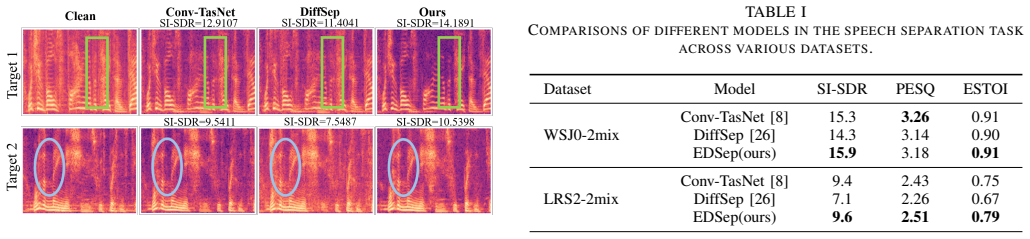
The paper's central claim is that a variance-exploding SDE whose forward drift pulls the separated sources toward their mixture can be reversed by a probability-flow ODE combined with per-step noise injection, yielding separated speech from a mixture. The authors construct a denoiser Dθ that estimates the clean sources conditioned on the mixture, train it with a permutation-aware loss that resolves source-assignment ambiguity, and sample with a stochastic integrator (Algorithm 1) that adds noise before each ODE step. On WSJ0-2mix, LRS2-2mix, and VoxCeleb2-2mix, the method reports SI-SDR, PESQ, and ESTOI values that exceed DiffSep everywhere and are competitive with or better than Conv-TasNet on most metrics.
Load-bearing premise
The reverse-path equation (Eq. 18) is presented without proof, and the sampler's noise injection has not been tested separately; if either step is wrong, the method would not separate sources.
Editorial extensions
If this is right
- EDSep's 30-step stochastic sampler shows that diffusion-based separation can be efficient enough for practical use.
- The permutation-aware training loss (with probability pT) reduces source-assignment ambiguity, contributing to higher PESQ and ESTOI on LRS2-2mix.
- The time-domain diffusion formulation with STFT-domain network processing extends to varied real-world two-speaker mixtures beyond WSJ0.
- The method's reported results on VoxCeleb2-2mix suggest robustness to noisier, less controlled conditions relative to the diffusion baseline.
Reading between the lines
- The noise-injection step in Algorithm 1 may be acting as a stochastic regularizer that prevents error accumulation in the ODE integration; ablating it would test this interpretation, but the paper provides no such ablation.
- Success on VoxCeleb2-2mix hints the method might generalize to more difficult or multi-speaker scenarios without architectural change, though the paper only evaluates two-speaker mixtures.
- The method's admitted gap to state-of-the-art discriminative models implies its current value lies more in generative quality and flexibility than in raw metric leadership.
Editorial analysis
A structured set of objections, weighed in public.
Referee Report
Summary. The paper proposes EDSep, a single-channel speech separation method based on score matching with a variance-exploding SDE. The forward process is defined on the concatenated source vector and drives the sources toward the mixture average; a denoiser network is trained by a weighted denoising score-matching loss, and a stochastic sampler (Algorithm 1) is constructed from an asserted probability-flow ODE. The method is evaluated on WSJ0-2mix, LRS2-2mix, and VoxCeleb2-2mix against DiffSep and Conv-TasNet using SI-SDR, PESQ, and ESTOI. The paper claims superior performance over diffusion and discriminative baselines, though the tabulated results show mixed outcomes.
Significance. Diffusion-based speech separation is an active topic, and a sampler that improves on DiffSep would be of interest. The paper makes a concrete proposal: a subspace-covariance VE SDE, a preconditioned denoiser, and a stochastic sampler with per-step noise injection. However, the central sampling equation is not derived and is inconsistent with the stated forward SDE, so the reported results cannot be attributed to the algorithm as written. The empirical claims are further weakened by the absence of error bars, significance tests, and baseline implementation details, and by the contradiction between the abstract and the conclusion. The paper does use standard public datasets and compare with relevant baselines, but the current evidence does not establish the claimed contributions.
major comments (4)
- [III-B, Eq. (18) and Algorithm 1] The ODE in Eq. (18) is not the probability-flow ODE of the forward SDE in Eq. (6). For the \bar P block, the forward process is an Ornstein-Uhlenbeck process whose variance satisfies \dot \lambda_2 = -2\gamma\lambda_2 + g(t)^2. The probability-flow identity therefore gives a score coefficient (1/2)g^2/\lambda_2 = \dot\lambda_2/(2\lambda_2)+\gamma in the \bar P block, not \dot\lambda_2/(2\lambda_2) as used in Eq. (19). Since the training loss in Eq. (17) trains D_\theta to approximate \mu_t, Eq. (18) under-amplifies the deviation x_t - \mu_t (equivalently x_t - D_\theta) by \gamma in the \bar P subspace. Algorithm 1 is constructed directly from Eq. (18), so the sampler is not the reverse process of Eq. (6), and the reported separation results cannot be attributed to the described algorithm. The paper provides no derivation of Eq. (18) and no ablation of the sampler; this is a load-bearing mathematical gap, not a mere missing derivation.
- [Abstract, Table I, and Section V] The abstract claims 'superior performance over existing diffusion and discriminative models,' but Table I reports EDSep below Conv-TasNet on VoxCeleb2-2mix SI-SDR (7.1 vs 7.3) and ESTOI (0.73 vs 0.75), and below Conv-TasNet on WSJ0-2mix PESQ (3.18 vs 3.26). The conclusion states there is a 'notable performance disparity with state-of-the-art discriminative methods,' which directly contradicts the abstract. The empirical claims need to be revised to match the data, or supported with statistical evidence.
- [IV-B, Table I] Table I reports single point estimates for each metric without error bars, significance tests, or the number of evaluation runs. Baseline details are missing: the Conv-TasNet and DiffSep configurations, optimization hyperparameters, and whether all methods used identical 8 kHz, 2-second preprocessing are not specified. Several reported differences are small (e.g., 0.01 in ESTOI on WSJ0-2mix), so without variance estimates the claimed improvements are not established.
- [III-B, Algorithm 1] Algorithm 1 samples x_0 \sim N(\bar s, \Sigma_{t_0} I) and iterates i=0,\dots,N with \Delta t = t_{i+1}-t_i, while the surrounding text says the ODE is solved 'backward from t_i to t_{i+1}'. If the schedule t_i is increasing, the iteration runs forward in time; if decreasing, \Delta t is negative. The direction of integration and the definition of the schedule are essential for reproducibility and are not specified.
minor comments (4)
- [III-A, Eq. (15)] The expression 'ln(1/2 σ(t))' is ambiguous; it should be written as ln(σ(t)/2) or with explicit parentheses to match the intended conditioning input.
- [III-B, Algorithm 1] In lines 2 and 4, the notation N(\bar s, \Sigma_{t_0} I_{KM}) and N(0, \Sigma_{t_i} I_{KM}) is dimensionally inconsistent: \Sigma_t is already a matrix, so multiplying by I_{KM} is either a typo or an undefined scalar-matrix product.
- [IV-A] There is a stray space in 'V oxCeleb2-2mix' in the dataset description; the dataset name should be 'VoxCeleb2-2mix'.
- [III-C and IV] The paper does not specify whether F_\theta operates on complex STFT coefficients or on magnitude/phase after the nonlinear transform m(x), and it does not provide code or audio examples, which limits reproducibility.
Circularity Check
No significant circularity: EDSep trains a standard denoising score-matching model and evaluates against external baselines; the questionable probability-flow ODE is a correctness concern, not a circularity.
full rationale
The paper's derivation chain is not circular. The training objective in Eq. 17 is a standard denoising score-matching loss with the denoiser parameterized as in Eq. 15, and the model is trained to fit the marginal distributions of the forward SDE in Eq. 6, which is adopted from prior work by Scheibler et al. [26]. The claimed contribution is an architecture and sampler design, and the empirical comparison in Table I uses external baselines (DiffSep and Conv-TasNet) with fixed hyperparameters, not quantities fitted to enforce the reported outcome. The permutation-aware training term is also inherited from DiffSep, but that is prior work, not a self-citation chain, and the central separation results are measured against those external models. The most serious issue raised by a critical reading is that Eq. 18 is asserted as the probability-flow ODE of Eq. 6 but, in the \barP block, the forward SDE is an Ornstein-Uhlenbeck process whose score coefficient should be \dot\lambda_2/(2\lambda_2)+\gamma rather than \dot\lambda_2/(2\lambda_2); if true, that renders the sampler mathematically inconsistent with the forward process and would undermine the attribution of the results to the described algorithm. That is a load-bearing correctness gap, not a circularity: the equation is not equivalent to its inputs by construction, and no fitted parameter or self-citation is being renamed as a prediction. Since the circularity criteria require exhibiting a reduction to the paper's own definitions or to a self-citation chain, and none is present, the honest finding is no significant circularity, score 0.
Assumptions & free parameters
free parameters (5)
- σmax and σmin =
0.5 and 0.05
- γ =
2
- pT =
0.1
- β and α =
0.15 and 0.5
- N =
29 sampling steps
assumptions (5)
- standard math Reverse-time SDE exists under standard regularity conditions (Anderson 1982).
- domain assumption The speech mixture is a linear combination of K sources, and the noise process drives the sources toward the mixture mean.
- ad hoc to paper The probability flow ODE in Eq. 18 is a correct reverse-time representation of the forward SDE.
- ad hoc to paper The denoiser parameterization Dθ(xt, σ(t), y) = xt + Lt Fθ(...) is flexible enough to approximate the ideal denoiser.
- ad hoc to paper Injecting noise into the denoiser output before each ODE step yields correct samples.
Cite this review
Pith. "Pith review of EDSep: An Effective Diffusion-Based Method for Speech Source Separation." pith.science (2026). https://pith.science/paper/GGKTB7YW
@misc{pith2026250115965,
  author       = {Pith},
  title        = {Pith review of: EDSep: An Effective Diffusion-Based Method for Speech Source Separation},
  year         = {2026},
  howpublished = {\url{https://pith.science/paper/GGKTB7YW}},
  note         = {Machine review of arXiv:2501.15965}
}
read the original abstract
Generative models have attracted considerable attention for speech separation tasks, and among these, diffusion-based methods are being explored. Despite the notable success of diffusion techniques in generation tasks, their adaptation to speech separation has encountered challenges, notably slow convergence and suboptimal separation outcomes. To address these issues and enhance the efficacy of diffusion-based speech separation, we introduce EDSep, a novel single-channel method grounded in score matching via stochastic differential equation (SDE). This method enhances generative modeling for speech source separation by optimizing training and sampling efficiency. Specifically, a novel denoiser function is proposed to approximate data distributions, which obtains ideal denoiser outputs. Additionally, a stochastic sampler is carefully designed to resolve the reverse SDE during the sampling process, gradually separating speech from mixtures. Extensive experiments on databases such as WSJ0-2mix, LRS2-2mix, and VoxCeleb2-2mix demonstrate our proposed method's superior performance over existing diffusion and discriminative models, validating its efficacy.
Figures

Forward citations
Cited by 1 Pith paper
-
DiffAU: Diffusion-Based Ambisonics Upscaling
DiffAU uses cascaded conditional diffusion models to generate missing higher-order Ambisonics channels from first-order input, matching true third-order quality in anechoic multi-speaker tests.
Reference graph
Works this paper leans on
-
[1]
Tasnet: time-domain audio separation network for real-time, single-channel speech separation,
Y . Luo and N. Mesgarani, “Tasnet: time-domain audio separation network for real-time, single-channel speech separation,” in Proceedings of the IEEE International Conference on Acoustics, Speech and Signal Processing. IEEE, 2018, pp. 696–700
work page 2018
-
[2]
End-to-end micro- phone permutation and number invariant multi-channel speech separa- tion,
Y . Luo, Z. Chen, N. Mesgarani, and T. Yoshioka, “End-to-end micro- phone permutation and number invariant multi-channel speech separa- tion,” in Proceedings of the IEEE International Conference on Acoustics, Speech and Signal Processing . IEEE, 2020, pp. 6394–6398
work page 2020
-
[3]
Deep clustering: Discriminative embeddings for segmentation and separation,
J. R. Hershey, Z. Chen, J. Le Roux, and S. Watanabe, “Deep clustering: Discriminative embeddings for segmentation and separation,” in Pro- ceedings of the IEEE international conference on acoustics, speech and signal processing. IEEE, 2016, pp. 31–35
work page 2016
-
[4]
Multitalker speech separation with utterance-level permutation invariant training of deep recurrent neural networks,
M. Kolbæk, D. Yu, Z.-H. Tan, and J. Jensen, “Multitalker speech separation with utterance-level permutation invariant training of deep recurrent neural networks,” IEEE/ACM Transactions on Audio, Speech, and Language Processing , vol. 25, no. 10, pp. 1901–1913, 2017
1901
-
[5]
End-to-End Speech Separation with Unfolded Iterative Phase Reconstruction
Z.-Q. Wang, J. L. Roux, D. Wang, and J. R. Hershey, “End-to-end speech separation with unfolded iterative phase reconstruction,” arXiv preprint arXiv:1804.10204, 2018
work page Pith review arXiv 2018
-
[6]
Deep learning based phase reconstruction for speaker separation: A trigonometric perspective,
Z.-Q. Wang, K. Tan, and D. Wang, “Deep learning based phase reconstruction for speaker separation: A trigonometric perspective,” in Proceedings of the IEEE International Conference on Acoustics, Speech and Signal Processing . IEEE, 2019, pp. 71–75
work page 2019
-
[7]
Divide and conquer: A deep casa approach to talker-independent monaural speaker separation,
Y . Liu and D. Wang, “Divide and conquer: A deep casa approach to talker-independent monaural speaker separation,” IEEE/ACM Transac- tions on audio, speech, and language processing , vol. 27, no. 12, pp. 2092–2102, 2019
work page 2019
-
[8]
Conv-tasnet: Surpassing ideal time– frequency magnitude masking for speech separation,
Y . Luo and N. Mesgarani, “Conv-tasnet: Surpassing ideal time– frequency magnitude masking for speech separation,” IEEE/ACM trans- actions on audio, speech, and language processing , vol. 27, no. 8, pp. 1256–1266, 2019
2019
Show all 42 references
-
[9]
Wavesplit: End-to-end speech separation by speaker clustering,
N. Zeghidour and D. Grangier, “Wavesplit: End-to-end speech separation by speaker clustering,” IEEE/ACM Transactions on Audio, Speech, and Language Processing, vol. 29, pp. 2840–2849, 2021
2021
-
[10]
Qdpn-quasi-dual-path network for single- channel speech separation
J. Rixen and M. Renz, “Qdpn-quasi-dual-path network for single- channel speech separation.” in Interspeech, 2022, pp. 5353–5357
2022
-
[11]
Efficient monaural speech separation with multiscale time-delay sampling,
S. Qian, L. Gao, H. Jia, and Q. Mao, “Efficient monaural speech separation with multiscale time-delay sampling,” in Proceedings of the IEEE International Conference on Acoustics, Speech and Signal Processing. IEEE, 2022, pp. 6847–6851
2022
-
[12]
Sfsrnet: Super-resolution for single-channel audio source separation,
J. Rixen and M. Renz, “Sfsrnet: Super-resolution for single-channel audio source separation,” in Proceedings of the AAAI Conference on Artificial Intelligence, vol. 36, no. 10, 2022, pp. 11 220–11 228
2022
-
[13]
Dual-path rnn: efficient long sequence modeling for time-domain single-channel speech separation,
Y . Luo, Z. Chen, and T. Yoshioka, “Dual-path rnn: efficient long sequence modeling for time-domain single-channel speech separation,” in Proceedings of the IEEE International Conference on Acoustics, Speech and Signal Processing . IEEE, 2020, pp. 46–50
2020
-
[14]
V oice separation with an unknown number of multiple speakers,
E. Nachmani, Y . Adi, and L. Wolf, “V oice separation with an unknown number of multiple speakers,” in International Conference on Machine Learning. PMLR, 2020, pp. 7164–7175
2020
-
[15]
Attention is all you need,
A. Vaswani, “Attention is all you need,” Advances in Neural Information Processing Systems, 2017
2017
-
[16]
Attention is all you need in speech separation,
C. Subakan, M. Ravanelli, S. Cornell, M. Bronzi, and J. Zhong, “Attention is all you need in speech separation,” in Proceedings of the IEEE International Conference on Acoustics, Speech and Signal Processing. IEEE, 2021, pp. 21–25
2021
-
[17]
Dual-path transformer network: Direct context-aware modeling for end-to-end monaural speech separation,
J. Chen, Q. Mao, and D. Liu, “Dual-path transformer network: Direct context-aware modeling for end-to-end monaural speech separation,” arXiv preprint arXiv:2007.13975 , 2020
2007 arXiv
-
[18]
Mossformer: Pushing the performance limit of monaural speech separation using gated single-head transformer with convolution-augmented joint self-attentions,
S. Zhao and B. Ma, “Mossformer: Pushing the performance limit of monaural speech separation using gated single-head transformer with convolution-augmented joint self-attentions,” inProceedings of the IEEE International Conference on Acoustics, Speech and Signal Processing . IE...
2023
-
[19]
Generative adversarial networks for single channel separation of convolutive mixed speech signals,
Y . Li, W.-T. Zhang, and S.-T. Lou, “Generative adversarial networks for single channel separation of convolutive mixed speech signals,” Neurocomputing, vol. 438, pp. 63–71, 2021
2021
-
[20]
Speech source separation using variational autoencoder and bandpass filter,
H. D. Do, S. T. Tran, and D. T. Chau, “Speech source separation using variational autoencoder and bandpass filter,” IEEE Access , vol. 8, pp. 156 219–156 231, 2020
2020
-
[21]
Deep generative modelling: A comparative review of vaes, gans, normalizing flows, energy-based and autoregressive models,
S. Bond-Taylor, A. Leach, Y . Long, and C. G. Willcocks, “Deep generative modelling: A comparative review of vaes, gans, normalizing flows, energy-based and autoregressive models,” IEEE transactions on pattern analysis and machine intelligence , vol. 44, no. 11, pp. 7327– 7347, 2021
2021
-
[22]
Hierarchical text-conditional image generation with clip latents,
A. Ramesh, P. Dhariwal, A. Nichol, C. Chu, and M. Chen, “Hierarchical text-conditional image generation with clip latents,” arXiv preprint arXiv:2204.06125, vol. 1, no. 2, p. 3, 2022
2022 arXiv
-
[23]
High- resolution image synthesis with latent diffusion models,
R. Rombach, A. Blattmann, D. Lorenz, P. Esser, and B. Ommer, “High- resolution image synthesis with latent diffusion models,” in Proceedings of the IEEE/CVF conference on computer vision and pattern recognition, 2022, pp. 10 684–10 695
2022
-
[24]
Dif- fwave: A versatile diffusion model for audio synthesis,
Z. Kong, W. Ping, J. Huang, K. Zhao, and B. Catanzaro, “Dif- fwave: A versatile diffusion model for audio synthesis,” arXiv preprint arXiv:2009.09761, 2020
2009 arXiv
-
[25]
Learn2sing 2.0: Diffusion and mutual information-based target speaker svs by learning from singing teacher,
H. Xue, X. Wang, Y . Zhang, L. Xie, P. Zhu, and M. Bi, “Learn2sing 2.0: Diffusion and mutual information-based target speaker svs by learning from singing teacher,” arXiv preprint arXiv:2203.16408 , 2022
2022 arXiv
-
[26]
Diffusion-based generative speech source separation,
R. Scheibler, Y . Ji, S.-W. Chung, J. Byun, S. Choe, and M.-S. Choi, “Diffusion-based generative speech source separation,” in Proceedings of the IEEE International Conference on Acoustics, Speech and Signal Processing. IEEE, 2023, pp. 1–5
2023
-
[27]
Score-based generative modeling through stochastic differ- ential equations,
Y . Song, J. Sohl-Dickstein, D. P. Kingma, A. Kumar, S. Ermon, and B. Poole, “Score-based generative modeling through stochastic differ- ential equations,” arXiv preprint arXiv:2011.13456 , 2020
2011 arXiv
-
[28]
S ¨arkk¨a and A
S. S ¨arkk¨a and A. Solin, Applied stochastic differential equations. Cam- bridge University Press, 2019, vol. 10
2019
-
[29]
Reverse-time diffusion equation models,
B. D. Anderson, “Reverse-time diffusion equation models,” Stochastic Processes and their Applications , vol. 12, no. 3, pp. 313–326, 1982
1982
-
[30]
Elucidating the design space of diffusion-based generative models,
T. Karras, M. Aittala, T. Aila, and S. Laine, “Elucidating the design space of diffusion-based generative models,” Advances in neural infor- mation processing systems , vol. 35, pp. 26 565–26 577, 2022
2022
-
[31]
Sepdiff: Speech separation based on denoising diffusion model,
B. Chen, C. Wu, and W. Zhao, “Sepdiff: Speech separation based on denoising diffusion model,” in Proceedings of the IEEE International Conference on Acoustics, Speech and Signal Processing . IEEE, 2023, pp. 1–5
2023
-
[32]
Learning fast samplers for diffusion models by differentiating through sample quality,
D. Watson, W. Chan, J. Ho, and M. Norouzi, “Learning fast samplers for diffusion models by differentiating through sample quality,” in International Conference on Learning Representations , 2022
2022
-
[33]
Analytic-dpm: an analytic estimate of the optimal reverse variance in diffusion probabilistic models,
F. Bao, C. Li, J. Zhu, and B. Zhang, “Analytic-dpm: an analytic estimate of the optimal reverse variance in diffusion probabilistic models,” arXiv preprint arXiv:2201.06503, 2022
2022 arXiv
-
[34]
Gotta go fast when generating data with score-based models,
A. Jolicoeur-Martineau, K. Li, R. Pich ´e-Taillefer, T. Kachman, and I. Mitliagkas, “Gotta go fast when generating data with score-based models,” arXiv preprint arXiv:2105.14080 , 2021
2021 arXiv
-
[35]
Generative modeling by estimating gradients of the data distribution,
Y . Song and S. Ermon, “Generative modeling by estimating gradients of the data distribution,” Advances in neural information processing systems, vol. 32, 2019
2019
-
[36]
Speech enhancement and dereverberation with diffusion-based genera- tive models,
J. Richter, S. Welker, J.-M. Lemercier, B. Lay, and T. Gerkmann, “Speech enhancement and dereverberation with diffusion-based genera- tive models,” IEEE/ACM Transactions on Audio, Speech, and Language Processing, vol. 31, pp. 2351–2364, 2023
2023
-
[37]
Speech enhancement with score-based generative models in the complex STFT domain,
S. Welker, J. Richter, and T. Gerkmann, “Speech enhancement with score-based generative models in the complex STFT domain,” in 23rd Annual Conference of the International Speech Communication Associ- ation, Interspeech. ISCA, 2022, pp. 2928–2932
2022
-
[38]
Deep audio-visual speech recognition,
T. Afouras, J. S. Chung, A. Senior, O. Vinyals, and A. Zisserman, “Deep audio-visual speech recognition,” IEEE transactions on pattern analysis and machine intelligence , vol. 44, no. 12, pp. 8717–8727, 2018
2018
-
[39]
V oxceleb2: Deep speaker recognition,
J. S. Chung, A. Nagrani, and A. Zisserman, “V oxceleb2: Deep speaker recognition,” arXiv preprint arXiv:1806.05622 , 2018
2018 arXiv
-
[40]
Sdr–half-baked or well done?
J. Le Roux, S. Wisdom, H. Erdogan, and J. R. Hershey, “Sdr–half-baked or well done?” in Proceedings of the IEEE International Conference on Acoustics, Speech and Signal Processing . IEEE, 2019, pp. 626–630
2019
-
[41]
Perceptual evaluation of speech quality (pesq)-a new method for speech quality assessment of telephone networks and codecs,
A. W. Rix, J. G. Beerends, M. P. Hollier, and A. P. Hekstra, “Perceptual evaluation of speech quality (pesq)-a new method for speech quality assessment of telephone networks and codecs,” in Proceedings of the IEEE international conference on acoustics, speech, and signal proce...
2001
-
[42]
An algorithm for predicting the intelligibility of speech masked by modulated noise maskers,
J. Jensen and C. H. Taal, “An algorithm for predicting the intelligibility of speech masked by modulated noise maskers,” IEEE/ACM Transac- tions on Audio, Speech, and Language Processing , vol. 24, no. 11, pp. 2009–2022, 2016
2009
Reviewed August 10, 2026 · model on record in the stance chip above.
Discussion (0). Continue with ORCID to comment.