REVIEW 5 major objections 5 minor 32 references
Enhanced Position Estimation in Tactile Internet-Enabled Remote Robotic Surgery Using MOESP-Based Kalman Filter
T0 review · 5 major / 5 minor · reviewed 2026-08-10 · deepseek-v4-flash
Pith's one-line read A Kalman filter whose state-space model is learned from surgical kinematic data via MOESP keeps patient-side arm position estimates above 95 percent accuracy under network delay, jitter, and packet loss.
desk verdict Reasonable-in-principle MOESP plus Kalman filter applied to JIGSAWS, but the paper's own Table II contradicts the >95% accuracy claim and Algorithm 1's update loop is incorrect; needs major revision before serious review. read the letter →
The pith
A machine-rendered reading of the paper's core claim, the machinery that carries it, and where it could break.
The reading
What carries the argument
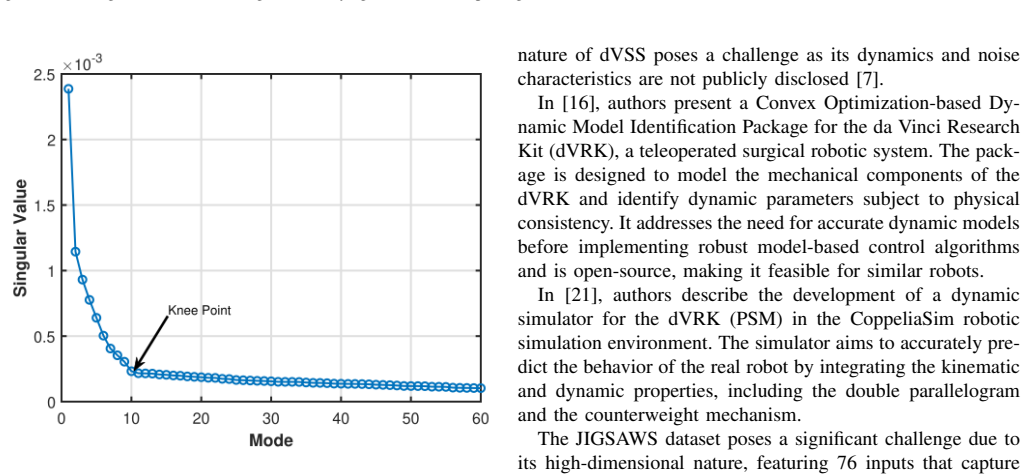
MOESP (Multivariable Output-Error State Space) is a subspace identification method that reconstructs the discrete-time state-space matrices $A$, $B$, $C$, $D$ directly from input-output data without a prescribed model structure. The pipeline builds block Hankel matrices of normalized master-tool (input) and patient-side (output) kinematic data, applies LQ decomposition and an oblique projection, and then an SVD; the singular-value spectrum shows a knee around mode 10, and that knee sets the model order. The identified matrices become the Kalman filter's prediction and measurement model, and the filter's noise covariances $Q$ and $R$ are estimated from residuals of an initial filter run. The load-bearing mechanism is replacing unknown proprietary robot dynamics with an identified linear model, which is what lets the Kalman filter predict the patient-side state between delayed or lost network updates.
What would settle it
Run the same MOESP identification on one JIGSAWS trial, estimate $Q$ and $R$ from that trial only, then evaluate the Kalman filter on a held-out trial from a different surgeon and task; if the average accuracy over $x$, $y$, $z$ falls below 95 percent under the mild-impairment settings, the claimed generalization of the identified model is not supported.
Extended reading notes
Core claim
The paper's central claim is that the MOESP-based Kalman filter recovers the patient-side arm's $x$, $y$, $z$ positions from master-tool commands with high fidelity despite network-induced corruption. Using the JIGSAWS kinematic data, the authors identify a linear state-space model of order about 10, selected at the knee of the singular-value spectrum, and place that model inside a Kalman filter whose noise covariances $Q$ and $R$ are estimated empirically from residuals. They then simulate transmission through a network with specified delay, jitter, and packet loss. Under the operating points they emphasize as representative of Tactile Internet use, the filter maintains estimation accuracy above 95 percent for all three position coordinates, with RMSE in the 0.02 to 0.04 range; under severe impairments (200 to 5000 ms delay, 1 percent packet loss) accuracy falls to roughly 86 to 91 percent. The authors further claim that the filter's linear-time complexity makes it practical for real-time control, in contrast to heavier alternatives.
Load-bearing premise
The load-bearing premise is that a single linear time-invariant model of order about 10, learned from one segment of JIGSAWS data, captures the patient-side arm's dynamics well enough to extrapolate under network impairments, with $Q$ and $R$ estimated from that same data reflecting true noise rather than in-sample fit.
Editorial extensions
If this is right
- If a Kalman filter with MOESP-identified matrices keeps above-95-percent accuracy under mild delay, jitter, and packet loss, then remote surgery position feedback can be maintained without a proprietary dynamic model of the da Vinci patient-side arm.
- The $O(n)$ per-step filter cost means the same estimator can run on the 30 Hz kinematic data with margin inside a 1 to 10 ms Tactile Internet latency budget.
- Accuracy degrades predictably with impairment severity, so the approach could serve as a graceful-degradation layer that stays high-fidelity under near-ideal links and remains usable under moderate ones.
- Because MOESP learns from a recorded trial of MTM/PSM data, the pipeline could be re-trained quickly for other teleoperated arms or new setup configurations, as long as kinematic data are available.
- Compared with GPR and transformer alternatives, the identified linear model plus Kalman filter avoids costly matrix inversions and is better suited to real-time operation.
Reading between the lines
- Editorial inference: the empirically estimated $Q$ and $R$ are computed from residuals of the same data used to evaluate the filter, so the reported accuracies may partly reflect in-sample tuning; a hold-out estimation protocol would test whether the above-95-percent figure survives on unseen trials.
- Editorial inference: the model-order choice, a knee near mode 10 under an 85 percent energy criterion, is made once; sweeping the order on validation trajectories and measuring RMSE would reveal whether the identified model is genuinely minimal or simply adequate for these tasks.
- Editorial inference: the network simulation treats delay, jitter, and packet loss as independent per-sample effects, whereas Tactile Internet traffic often has bursty loss and correlated delay, so a burst-loss model would be a stiffer test of the claimed resilience.
- Editorial inference: if the linear-time-invariant assumption holds only for the slow, structured motions in the JIGSAWS tasks, the same filter may need adaptation for fast or contact-rich maneuvers; a test with abrupt trajectory changes would define its operating envelope.
Signed reviews
Editorial analysis
A structured set of objections, weighed in public.
Referee Report
Summary. The manuscript proposes a Kalman filter (KF) for estimating the patient-side manipulator (PSM) position in teleoperated robotic surgery. The state-space model for the PSM dynamics is identified offline from the JIGSAWS dataset using the MOESP subspace identification method, and the KF is then evaluated under simulated network delay, jitter, and packet loss. The paper claims that the proposed approach achieves over 95% estimation accuracy despite network-induced uncertainties, with a linear-time KF making it suitable for Tactile Internet applications. The evaluation is performed in simulation using JIGSAWS kinematic data, with accuracy and RMSE reported for the x, y, and z positions under several network impairment scenarios.
Significance. If the claims were supported, the contribution would be a useful data-driven alternative to hand-derived kinematic models for PSM position estimation, with clear computational advantages and a falsifiable accuracy target. The paper uses a public dataset and explicitly states the algorithm, which are positive features for reproducibility. However, the central accuracy claim is contradicted by the paper's own Table II, the accuracy metric is never defined, and the Kalman update in Algorithm 1 does not implement a correct multi-output fusion. These issues make the quantitative results unreliable in their current form, so the contribution cannot be assessed as presented.
major comments (5)
- [Abstract, Section IX, Table II] The abstract and conclusion claim over 95% estimation accuracy, but Table II reports accuracies below 95% in nine of the fifteen per-axis entries. For the moderate row (jitter 1.0 ms, delay 1 ms, loss 0.001%) the values are x=90.66%, y=88.67%, z=93.47%; for the high row (2.0 ms, 5 ms, 0.001%) they are 88.46%, 89.32%, 93.65%; for the severe row (3.0 ms, 200–5000 ms, 1%) they are 85.95%, 87.68%, 90.95%. The statement in Section IX that "the KF maintains accuracies above 95% for all positions" is therefore false on the paper's own data. This is an internal inconsistency in the central claim and must be resolved.
- [Section VI] The "percentage accuracy" metric is never defined. The text says only that accuracy "reflects the similarity between the estimated and acPSM states," with no formula. Without a precise definition, the entries in Table II cannot be audited, and the reported accuracies are not even internally consistent with the RMSE values: for example, the row with jitter 0.5 ms, delay 0.5–2 ms, and loss 0.01% has RMSE_x=0.0363 and accuracy 96.67%, while the row with the same jitter/delay but loss 0.001% has a lower RMSE_x=0.0356 yet a lower accuracy of 95.58%. Please define the metric, for instance as 100*(1 - RMSE/range) or a normalized error measure, and report it consistently.
- [Algorithm 1, lines 9–13] The inner update loop recomputes the Kalman gain from the same a priori x_pred and P_pred for each output dimension d and overwrites x_est[k] and P on every iteration. As written, only the last output dimension's update survives, so the filter does not fuse the three position measurements; it effectively performs a single scalar update. A correct multi-output Kalman update should use the full measurement vector with the matrix gain K = P_pred C^T (C P_pred C^T + R)^{-1}, or a sequential update that propagates the updated state and covariance into each subsequent scalar update. The reported estimation results therefore cannot be attributed to the algorithm presented.
- [Section III-C and Section VI] The noise covariance matrices Q and R are estimated empirically from residuals of an initial KF run on the JIGSAWS data (Section III-C), while the final evaluation in Section VI appears to use the same dataset. Section V.B.3 states that a cross-validation methodology was used, but the manuscript does not specify which trials were used for MOESP identification, which for Q/R estimation, and which for final evaluation. If the same trials are used for all three stages, the reported accuracy is optimistically biased. Please specify the exact trial split and report results on a held-out test set that is disjoint from both model identification and noise covariance estimation.
- [Section V.A and Algorithm 2, line 19] The system order selection is ambiguous. The text says the knee point around mode 10 indicates the practical order, while Algorithm 2 line 19 instructs to "Choose n based on singular values (e.g., 85% energy criterion)." These are different criteria that can yield different model orders. Please state the exact rule used and report the resulting model order n for each experiment, since the identified model order is a free parameter that directly affects the Kalman filter's behavior.
minor comments (5)
- [Section IV and Section III.A] JIGSAWS is described as having 76 features, but the paper does not specify which MTM signals are used as the control input vector u in Eq. (1), nor how the three PSM position outputs are selected and extracted. Please clarify the exact input and output variables and their indices in the dataset.
- [Section V.B, Eq. (14)] The symbol n is used both as the width of the Hankel matrix and later as the system order; this is confusing. Please use distinct symbols for the Hankel dimension and the state dimension.
- [Table II and Section V.C] Since Min-Max normalization is applied to the data, please state whether the reported RMSE values are computed in normalized coordinates or in original physical units, and provide the corresponding units.
- [Section VIII, Table III] The comparison table claims "Robustness to Noise: Excellent" and "Real-Time Performance: High" for the proposed method without any quantitative runtime or noise-sensitivity measurements. Please provide measured computation times and statistical variability across trials, or temper these qualitative claims.
- [Section II] Reference [9] is the authors' own prior conference paper, which is mentioned only in the introduction. Please add an explicit quantitative comparison with this earlier KF approach in Section II or Section VI, since a central claim of the paper is that MOESP improves on it.
Circularity Check
No load-bearing circularity: the MOESP model is identified from external JIGSAWS data with stated cross-validation, and the Kalman filter pipeline is not shown to reduce by construction to its own inputs.
full rationale
The paper's derivation chain is data-driven but not definitionally circular. The MOESP state-space model (Section V) is identified from JIGSAWS input/output data, and the paper explicitly states cross-validation: 'To validate the MOESP model, we used a cross-validation methodology. We employed an independent dataset, different from the one used for system identification, to evaluate the model’s predictive performance.' The Kalman filter then uses the identified A, B, C, D plus empirically estimated Q and R (Section III-C). Estimating Q and R from residuals of an initial filter run is a tuning step, not a prediction; no equation in the paper forces the reported accuracy to equal the fitted residuals, and the paper does not explicitly state that the Section VI evaluation reuses the Q/R estimation data. The only self-citation ([9]) is background for extending prior work to MOESP and is not load-bearing. The abstract's 'over 95%' claim is contradicted by Table II (e.g., entries of 85.95%, 88.46%, and 90.66%), and the accuracy metric is undefined ('reflects the similarity between the estimated and acPSM states'), but these are correctness/reporting inconsistencies, not circularity. Under the hard rule requiring an exhibited equation-level reduction, no circular step is established.
Assumptions & free parameters
free parameters (3)
- State-space model order n =
around 10 (knee point)
- Initial noise covariances Q_initial, R_initial =
epsilon_Q * I, epsilon_R * I (values not reported)
- MOESP block size d =
not reported
assumptions (4)
- domain assumption The PSM arm dynamics are adequately represented as a linear time-invariant state-space model driven by MTM inputs.
- standard math MOESP subspace identification applied to normalized JIGSAWS data yields a valid model of the PSM.
- domain assumption JIGSAWS kinematic recordings are representative of the dVRK PSM behavior in remote surgery.
- domain assumption Network effects on the PSM state can be modeled by delay, jitter, and packet loss acting on measurements as in Algorithm 1.
Cite this review
Pith. "Pith review of Enhanced Position Estimation in Tactile Internet-Enabled Remote Robotic Surgery Using MOESP-Based Kalman Filter." pith.science (2026). https://pith.science/paper/LKFLOOT2
@misc{pith2026250116485,
  author       = {Pith},
  title        = {Pith review of: Enhanced Position Estimation in Tactile Internet-Enabled Remote Robotic Surgery Using MOESP-Based Kalman Filter},
  year         = {2026},
  howpublished = {\url{https://pith.science/paper/LKFLOOT2}},
  note         = {Machine review of arXiv:2501.16485}
}
read the original abstract
Accurately estimating the position of a patient's side robotic arm in real time during remote surgery is a significant challenge, especially within Tactile Internet (TI) environments. This paper presents a new and efficient method for position estimation using a Kalman Filter (KF) combined with the Multivariable Output-Error State Space (MOESP) method for system identification. Unlike traditional approaches that require prior knowledge of the system's dynamics, this study uses the JIGSAW dataset, a comprehensive collection of robotic surgical data, along with input from the Master Tool Manipulator (MTM) to derive the state-space model directly. The MOESP method allows accurate modeling of the Patient Side Manipulator (PSM) dynamics without prior system models, improving the KF's performance under simulated network conditions, including delays, jitter, and packet loss. These conditions mimic real-world challenges in Tactile Internet applications. The findings demonstrate the KF's improved resilience and accuracy in state estimation, achieving over 95 percent accuracy despite network-induced uncertainties.
Figures


Figures from the paper (3 more)


Reference graph
Works this paper leans on
-
[1]
How Resilient is QUIC to Security and Privacy Attacks?
Sengupta, Jayasree and Dey, Debasmita and Ferlin, Simone and Ghosh, Nirnay and Bajpai, Vaibhav, “Accelerating Tactile Internet with QUIC: A Security and Privacy Perspective,” arXiv preprint arXiv:2401.06657, 2024
work page Pith review arXiv 2024
-
[2]
Fitzek, Frank H. P., et al., eds. Tactile Internet: with Human- in-the-Loop, Academic Press, 2021. [Online]. Available: https://publikationen.bibliothek.kit.edu/1000141406
-
[3]
TIM: A Novel Quality of Service Metric for Tactile Internet,
Kroep, Kees, et al. “TIM: A Novel Quality of Service Metric for Tactile Internet,” inProceedings of the ACM/IEEE 14th International Conference on Cyber-Physical Systems (with CPS-IoT Week 2023) , pp. 199–208, 2023
work page 2023
-
[4]
The subjective effect of latency on haptic feed- back,
Zoltanski, Filip, “The subjective effect of latency on haptic feed- back,” M.S. thesis, 2023
work page 2023
-
[5]
Beyranvand, Hamzeh, et al. “Toward 5G: FiWi enhanced LTE-A HetNets with reliable low-latency fiber backhaul sharing and WiFi offloading,” IEEE/ACM Transactions on Networking , vol. 25, no. 2, pp. 690–707, 2016
work page 2016
-
[6]
Steinbach, Eckehard, et al. “Haptic communications,” Proceedings of the IEEE , vol. 100, no. 4, pp. 937–956, 2012
work page 2012
-
[7]
Toward haptic communications over the 5G tactile Internet,
Antonakoglou, Konstantinos, et al. “Toward haptic communications over the 5G tactile Internet,” IEEE Communications Surveys & Tutorials, vol. 20, no. 4, pp. 3034–3059, 2018
work page 2018
-
[8]
Salh, Adeeb, et al. “A survey on deep learning for ultra-reliable and low-latency communications challenges on 6G wireless systems,” IEEE Access, vol. 9, pp. 55098–55131, 2021
work page 2021
Show all 32 references
-
[9]
Enhancing Precision in Tactile Internet-Enabled Re- mote Robotic Surgery: Kalman Filter Approach,
Lashari, Muhammad Hanif, Batayneh, Wafa, and Khokhar, Ashfaq, “Enhancing Precision in Tactile Internet-Enabled Re- mote Robotic Surgery: Kalman Filter Approach,” arXiv e-prints , arXiv:2406.04503, 2024, doi: 10.48550/arXiv.2406.04503. IEEE TRANSACTIONS ON ROBOTICS, VOL. X, NO....
-
[10]
A machine learning framework for handling delayed/lost packets in tactile internet remote robotic surgery,
Boabang, Francis, et al. “A machine learning framework for handling delayed/lost packets in tactile internet remote robotic surgery,” IEEE Transactions on Network and Service Management , vol. 18, no. 4, pp. 4829–4845, 2021
2021
-
[11]
Deep learning with convolu- tional neural network for objective skill evaluation in robot-assisted surgery,
Wang, Ziheng and Majewicz Fey, Ann, “Deep learning with convolu- tional neural network for objective skill evaluation in robot-assisted surgery,” International journal of computer assisted radiology and surgery, vol. 13, pp. 1959–1970, 2018
1959
-
[12]
Human collective intelligence inspired multi- view representation learning—Enabling view communication by simulating human communication mechanism,
Jia, Xiaodong, et al. “Human collective intelligence inspired multi- view representation learning—Enabling view communication by simulating human communication mechanism,” IEEE Transactions on Pattern Analysis and Machine Intelligence , 2022
2022
-
[13]
An open-source research kit for the da Vinci Surgical System,
Kazanzides, Peter, et al. “An open-source research kit for the da Vinci Surgical System,” in 2014 IEEE international conference on robotics and automation (ICRA) , pp. 6434–6439, 2014
2014
-
[14]
Modelling and identification of the da Vinci research kit robotic arms,
Fontanelli, Giuseppe Andrea, et al. “Modelling and identification of the da Vinci research kit robotic arms,” in 2017 IEEE/RSJ International Conference on Intelligent Robots and Systems (IROS) , pp. 1464–1469, 2017
2017
-
[15]
Dynamic modeling of the da Vinci research kit arm for the estimation of interaction wrench,
Piqu ´e, Francesco, et al. “Dynamic modeling of the da Vinci research kit arm for the estimation of interaction wrench,” in 2019 Interna- tional Symposium on Medical Robotics (ISMR) , pp. 1–7, 2019
2019
-
[16]
A convex optimization-based dynamic model identification package for the da Vinci Research Kit,
Wang, Yan, et al. “A convex optimization-based dynamic model identification package for the da Vinci Research Kit,” IEEE Robotics and Automation Letters , vol. 4, no. 4, pp. 3657–3664, 2019
2019
-
[17]
Kalman filter: historical overview and review of its use in robotics 60 years after its creation,
Urrea, Claudio and Agramonte, Rayko, “Kalman filter: historical overview and review of its use in robotics 60 years after its creation,” Journal of Sensors , vol. 2021, pp. 1–21, 2021
2021
-
[18]
Review of the Applications of Kalman Filtering in Quantum Systems,
Ma, Kezhao, et al. “Review of the Applications of Kalman Filtering in Quantum Systems,” Symmetry, vol. 14, no. 12, pp. 2478, 2022
2022
-
[19]
Da Vinci Surgical System,
Intuitive Surgical, Inc., “Da Vinci Surgical System,” [Online]. Available: https://www.davincisurgery.com/, 2022, Accessed on 29 November 2023
2022
-
[20]
Motion analysis of the JHU-ISI gesture and skill assessment working set using robotics video and motion assessment software,
Lefor, Alan Kawarai, et al. “Motion analysis of the JHU-ISI gesture and skill assessment working set using robotics video and motion assessment software,” International Journal of Computer Assisted Radiology and Surgery , vol. 15, pp. 2017–2025, 2020
2017
-
[21]
A CoppeliaSim dynamic simulator for the da Vinci Research Kit,
Ferro, Marco, et al. “A CoppeliaSim dynamic simulator for the da Vinci Research Kit,” IEEE Robotics and Automation Letters , vol. 8, no. 1, pp. 129–136, 2022
2022
-
[22]
Application of Kalman Filter to Large-scale Geospatial Data: Modeling Population Dynam- ics,
Akatsuka, Hiroto and Terada, Masayuki, “Application of Kalman Filter to Large-scale Geospatial Data: Modeling Population Dynam- ics,” ACM Transactions on Spatial Algorithms and Systems , vol. 9, no. 1, pp. 1–29, 2023
2023
-
[23]
Towards near real-time assessment of surgical skills: A comparison of feature extraction techniques,
Anh, Nguyen Xuan, et al. “Towards near real-time assessment of surgical skills: A comparison of feature extraction techniques,” Computer methods and programs in biomedicine , vol. 187, pp. 105234, 2020
2020
-
[24]
5G support for industrial IoT applica- tions—challenges, solutions, and research gaps,
Varga, Pal, et al. “5G support for industrial IoT applica- tions—challenges, solutions, and research gaps,” Sensors, vol. 20, no. 3, pp. 828, 2020
2020
-
[25]
Performance prediction and enhancement of 5G networks based on linear regression machine learning,
Malekzadeh, Mina, “Performance prediction and enhancement of 5G networks based on linear regression machine learning,” EURASIP Journal on Wireless Communications and Networking , vol. 2023, no. 1, pp. 74, 2023
2023
-
[26]
The tactile internet: Applications and chal- lenges,
Fettweis, Gerhard P., “The tactile internet: Applications and chal- lenges,” IEEE vehicular technology magazine , vol. 9, no. 1, pp. 64– 70, 2014
2014
-
[27]
W., Wahab, N
Jamaludin, I. W., Wahab, N. A., Khalid, N. S., Sahlan, S., Ibrahim, Z., & Rahmat, M. F. (2013, March). N4SID and MOESP subspace identification methods. In 2013 IEEE 9th international colloquium on signal processing and its applications (pp. 140-145). IEEE
2013
-
[28]
Robles, A. (2017). MOESP-and-N4SID [GitHub repository]. GitHub. https://github.com/Alro10/MOESP-and-N4SID
2017
-
[29]
Towards enabling critical mMTC: A review of URLLC within mMTC,
Pokhrel, Shiva Raj, et al. “Towards enabling critical mMTC: A review of URLLC within mMTC,” IEEE access, vol. 8, pp. 131796– 131813, 2020
2020
-
[30]
Shi, Chang, Yi Zheng, and Ann Majewicz Fey. ”Recognition and prediction of surgical gestures and trajectories using transformer models in robot-assisted surgery.” 2022 IEEE/RSJ International Conference on Intelligent Robots and Systems (IROS). IEEE, 2022
2022
-
[31]
”Multimodal Transformers for Real- Time Surgical Activity Prediction.” arXiv preprint arXiv:2403.06705 (2024)
Weerasinghe, Keshara, et al. ”Multimodal Transformers for Real- Time Surgical Activity Prediction.” arXiv preprint arXiv:2403.06705 (2024)
2024 arXiv
-
[32]
”Direct robust matrix factorizatoin for anomaly detection.” 2011 IEEE 11th International Conference on Data Mining
Xiong, Liang, Xi Chen, and Jeff Schneider. ”Direct robust matrix factorizatoin for anomaly detection.” 2011 IEEE 11th International Conference on Data Mining. IEEE, 2011. IEEE TRANSACTIONS ON ROBOTICS, VOL. X, NO. X, MONTH YEAR 11 Muhammad Hanif Lashari was born in Sehwan, Sin...
2011
Reviewed August 10, 2026 · model on record in the stance chip above.
Discussion (0). Continue with ORCID to comment.