REVIEW 5 major objections 6 minor 41 references
SSF-PAN: Semantic Scene Flow-Based Perception for Autonomous Navigation in Traffic Scenarios
T0 review · 5 major / 6 minor · reviewed 2026-08-10 · deepseek-v4-flash
Pith's one-line read Iteratively coupling scene flow and static/dynamic segmentation lets a LiDAR-only vehicle localize and navigate without a pre-built map.
desk verdict A plausible integration of scene flow and motion segmentation for map-free navigation, but the evidence is undermined by a missing baseline reference, no runtime data, and an under-tested static/dynamic classification rule. read the letter →
The pith
A machine-rendered reading of the paper's core claim, the machinery that carries it, and where it could break.
The reading
What carries the argument
The load-bearing mechanism is the mutual-promotion loop between scene flow estimation and motion segmentation. Consecutive LiDAR frames and a current mask enter an ASF-based flow estimator; the predicted flow is concatenated with the point cloud and passed through an OGC-based segmentation network with a three-term self-supervised loss composed of rigid motion consistency, semantic scene-flow consistency, and Chamfer-distance rigidity. The resulting static/dynamic mask is fed back to the flow estimator until the total change in flow and mask is below $\epsilon = 10^{-3}$. Static/dynamic classification itself uses two rules: the largest cluster is declared static, and clusters whose average flow velocity is close to the ego vehicle's velocity are declared static.
What would settle it
Run SSF-PAN on a recorded LiDAR sequence in which one large truck or dense crowd is the largest connected cluster; if the quantity-based rule labels it static, the odometry trajectory error should spike and the planned path should ignore or mis-time the obstacle, directly exposing the failure.
Extended reading notes
Core claim
On its own terms, the discovery is that motion segmentation and scene flow estimation can be made to reinforce each other, and that this reinforcement is enough to run full map-free navigation. The SSF module starts from the active scene flow (ASF) network to predict scene flow between frames $P_t$ and $P_{t+1}$, concatenates the flow with the point cloud, and feeds the pair to a segmentation network built on the OGC architecture. A combined self-supervised loss, using rigid motion consistency, semantic scene-flow consistency, and Chamfer-distance rigidity, produces a mask separating static environment from dynamic clusters. The static mask then feeds back into the next iteration's flow estimation, while dynamic clusters supply obstacle positions and velocities to the planner; the loop continues until the change in flow and mask falls below a threshold. The paper reports that this loop lowers SLAM trajectory RMSE from 4.111 m to 0.102 m in one tested SLAM framework, a reduction of more than 93% relative to RANSAC, and reaches 93.27% segmentation accuracy on its validation data.
Load-bearing premise
The entire system rests on the assumption that the largest point cluster is static environment and that clusters moving at the same speed as the ego vehicle are static; if either fails, both odometry and obstacle avoidance degrade.
Editorial extensions
If this is right
- Using SSF-based odometry instead of RANSAC-based registration reduces SLAM trajectory RMSE by more than 93% in the paper's dynamic-traffic experiments.
- A single SSF segmentation step reaches 93.27% static/dynamic accuracy, exceeding the OGC, GMM, DBSCAN, and PointNet++ variants tested in the ablation.
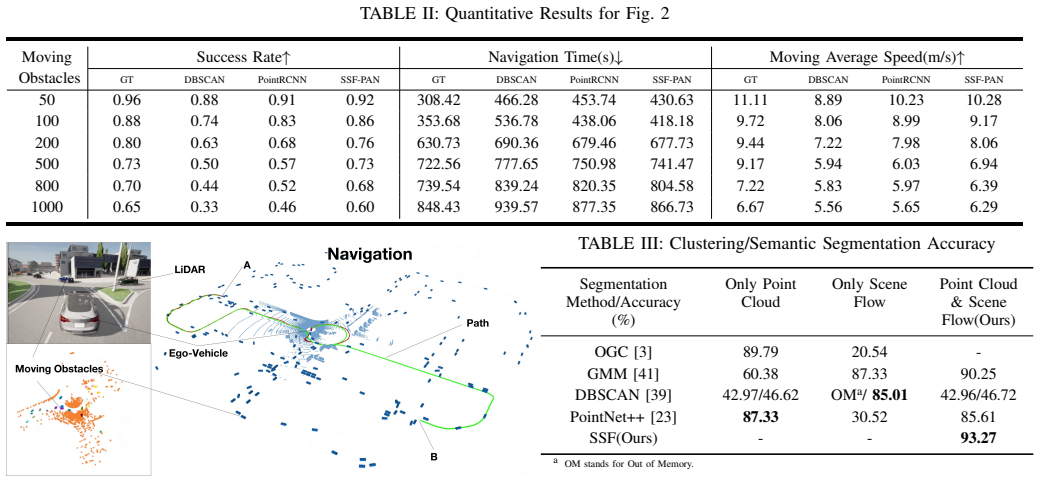
- In CARLA navigation trials with 50 to 1,000 moving obstacles, SSF-PAN raises success rate, shortens navigation time, and increases average speed relative to DBSCAN and PointRCNN baselines.
- The iterative loop converges to a stable flow-and-mask pair, and each additional iteration improves scene-flow error before the threshold is reached.
Reading between the lines
- Beyond the paper, the largest-cluster-is-static rule implies the method will most likely fail when a single dynamic object, such as a truck directly ahead or a dense crowd, supplies more LiDAR points than the static background; a learned prior or multi-hypothesis check would be a natural fix.
- Because the training losses are self-supervised, the same iterative coupling could transfer to other point-cloud platforms, such as indoor robots or drones, where static/dynamic separation matters but annotated data is scarce.
- The navigation results are from CARLA only, so the claim that SSF-PAN supports real map-free driving still needs verification on real busy intersections; the KITTI experiments validate odometry and segmentation, not closed-loop navigation.
Signed reviews
Editorial analysis
A structured set of objections, weighed in public.
Referee Report
Summary. The paper proposes SSF-PAN, a perception system that couples LiDAR scene flow estimation (based on the authors' prior ASF network) with self-supervised static/dynamic and instance segmentation (based on OGC), and iteratively refines both components. The resulting static/dynamic masks are used for odometry/SLAM and for obstacle velocity estimation in a CARLA-based map-free navigation platform. Experiments report a more than 93% reduction in relative pose error over a RANSAC baseline on a combined SUScape-CARLA/KITTI validation set, a segmentation accuracy of 93.27%, and navigation improvements over DBSCAN and PointRCNN in CARLA with up to 1,000 obstacles. The central claims are that the iterative mutual refinement improves scene flow and segmentation, and that the resulting perception stack supports map-free navigation without high-definition maps.
Significance. If the results hold, the work contributes a plausible self-supervised route to joint scene flow estimation and motion segmentation, together with an integrated simulation platform for closed-loop navigation evaluation. The use of public datasets (KITTI, SUScape-CARLA) and the ablation structure in Tables III-V give the evaluation some evidential value. However, the paper does not provide code, runtime measurements, or a fully specified evaluation protocol, and several load-bearing assumptions in the classifier and in the baselines are not pinned down. The novelty relative to the authors' prior ASF [7] and to OGC [3] also needs clearer delineation. The central idea is defensible, but the evidence as presented is incomplete.
major comments (5)
- [§IV-B, Eqs. (6)–(8)] The static/dynamic classification is the linchpin of the pipeline, yet the two rules are not robust as stated. Eq. (6) assumes that the largest point cluster is static; in dense traffic, a large nearby vehicle can dominate after clustering, and the paper gives no evidence that this does not occur. Eq. (7) computes a scalar speed from the scene-flow magnitude, and Eq. (8) compares this speed to Vego, which ignores motion direction and makes the classification ambiguous unless the reference frame of the scene flow is stated: static world points have zero velocity in a world frame, not velocity equal to Vego. The threshold θ is never specified. Please add a stress test on labeled frames with dense traffic, state the scene-flow frame and the value of θ, and use vector velocity rather than speed in Eq. (8).
- [Table I and §V-A2] The RANSAC baseline is cited only as '[?]', so the headline claim of a more than 93% reduction in trajectory error cannot be verified: the reader cannot know which RANSAC variant, outlier threshold, or initialization was used. Please replace the placeholder with a concrete reference and implementation details, and add at least per-condition variance or error bars for the reported RPE values.
- [Abstract and §V-B1] The abstract claims high computational efficiency and the experiment section says the system is 'capable for the real-time navigation task,' but the paper reports no per-frame inference time, latency, frame rate, or hardware configuration anywhere. Without these numbers, the efficiency claim is unsupported. Please add a runtime breakdown for ASF plus segmentation and for the end-to-end navigation loop.
- [§V-C1, Table III] The 93.27% segmentation accuracy is the main quantitative evidence for the segmentation claim, but the accuracy definition, ground-truth label source, and test split are not stated, and no variance or number of frames is given. In addition, OGC with 'Only Scene Flow' drops to 20.54%, which is surprising and unexplained, and DBSCAN is reported as 'OM' in one column. Please specify the metric and label protocol and report results across repeated runs or multiple scenes.
- [§V-B and §V-A1] The navigation and SLAM experiments are performed in the same simulator family (SUScape-CARLA and CARLA) used to generate the training data, so the validation is in-distribution; this does not by itself support a general claim of map-free navigation in complex traffic scenarios without a cross-distribution test. Please either add a cross-simulator or real-world LiDAR test or explicitly limit the claim to the tested distribution.
minor comments (6)
- [Table II caption] Table II is captioned 'Quantitative Results for Fig. 2', but the navigation experiment is illustrated in Fig. 7; the cross-reference is wrong.
- [§IV-B, Eq. (5)] The convergence criterion defines weights α and β and threshold ϵ, but the values of α and β are never given, and no convergence iteration counts are reported.
- [Table IV] For the DT set, the implicit strategy is worse than the 'Only Point Cloud' baseline (EPE3D 0.0867 versus 0.0510), yet the text concludes that semantic information helps; this inconsistency should be discussed.
- [Table V] Table V uses the symbols '×' and '"' without a legend, making it unclear which configuration elements are enabled; please add a clear notation.
- [§IV-A] The segmentation network is described only as 'based on modifications to the ASF and OGC networks'; more architectural detail (input features, number of clusters K, training hyperparameters) is needed for reproducibility.
- [§II-C] The statement that 'currently, there are no map-free navigation systems which utilize scene flow data for real-time applications' is a strong claim that should be softened unless a more systematic literature search is provided.
Circularity Check
No significant circularity: SSF-PAN is an empirical pipeline whose static/dynamic rules are explicit assumptions, not derivations that reduce to their own outputs.
full rationale
The paper does not contain a claimed prediction that is equivalent to its input by construction. The scene-flow backbone ASF [7] is a cited prior component from the same research group, but it is not used as an argument to close a derivation: the paper trains or fine-tunes it on a training split of SUScape-CARLA and KITTI and evaluates the resulting system on a held-out validation split (Section V-A1), so the SLAM numbers in Table I are externally measured rather than definitional. The segmentation network is validated against ground-truth labels in Table III, and the navigation results in Table II are benchmark comparisons under identical RDA planning, so they are empirical rather than reductions to the method's assumptions. Equations (6) and (8), which label the largest cluster or velocity-consistent cluster as static, are explicit modeling heuristics about traffic composition; a failure of those assumptions would degrade accuracy, but it does not make the reported result logically identical to the assumption. The iterative coupling of scene flow and mask (Eq. 5) is a feedback algorithm, not a circular proof, and its effect is tested by ablation in Fig. 8 and Table V. The unspecified threshold theta and the unstated coordinate frame for V_ego in Eq. 8 are correctness and robustness concerns, not circularity. No load-bearing step cites only the authors' prior work in place of evidence, and no result is forced by a self-citation chain.
Assumptions & free parameters
free parameters (6)
- alpha (convergence weight for scene flow term)
- beta (convergence weight for segmentation term)
- epsilon (convergence threshold) =
1e-3
- theta (velocity threshold for static classification)
- number of clusters K
- foreground point sampling counts (100 and 4000) =
100 / 4000
assumptions (5)
- domain assumption Largest point cluster is static environment (Eq. 6)
- domain assumption Objects with velocity close to the ego vehicle are static (Eq. 8)
- domain assumption ASF network's scene flow estimates are accurate enough to drive segmentation
- domain assumption Each dynamic object is locally rigid and can be represented by a single rigid transformation (Kabsch)
- domain assumption CARLA and SUScape-CARLA are representative of real traffic for validation
Cite this review
Pith. "Pith review of SSF-PAN: Semantic Scene Flow-Based Perception for Autonomous Navigation in Traffic Scenarios." pith.science (2026). https://pith.science/paper/WQN726X2
@misc{pith2026250116754,
  author       = {Pith},
  title        = {Pith review of: SSF-PAN: Semantic Scene Flow-Based Perception for Autonomous Navigation in Traffic Scenarios},
  year         = {2026},
  howpublished = {\url{https://pith.science/paper/WQN726X2}},
  note         = {Machine review of arXiv:2501.16754}
}
read the original abstract
Vehicle detection and localization in complex traffic scenarios pose significant challenges due to the interference of moving objects. Traditional methods often rely on outlier exclusions or semantic segmentations, which suffer from low computational efficiency and accuracy. The proposed SSF-PAN can achieve the functionalities of LiDAR point cloud based object detection/localization and SLAM (Simultaneous Localization and Mapping) with high computational efficiency and accuracy, enabling map-free navigation frameworks. The novelty of this work is threefold: 1) developing a neural network which can achieve segmentation among static and dynamic objects within the scene flows with different motion features, that is, semantic scene flow (SSF); 2) developing an iterative framework which can further optimize the quality of input scene flows and output segmentation results; 3) developing a scene flow-based navigation platform which can test the performance of the SSF perception system in the simulation environment. The proposed SSF-PAN method is validated using the SUScape-CARLA and the KITTI datasets, as well as on the CARLA simulator. Experimental results demonstrate that the proposed approach outperforms traditional methods in terms of scene flow computation accuracy, moving object detection accuracy, computational efficiency, and autonomous navigation effectiveness.
Figures


Figures from the paper (5 more)



Reference graph
Works this paper leans on
-
[7]
Shuaijun Wang, Rui Gao, Ruihua Han, Jianjun Chen, Zirui Zhao, Zhijun Lyu, and Qi Hao. Active scene flow estimation for autonomous driving via real-time scene prediction and optimal decision. IEEE Transactions on Intelligent Transportation Systems , 2023
work page 2023
-
[3]
Ogc: Unsupervised 3d object segmentation from rigid dynamics of point clouds
Ziyang Song and Bo Yang. Ogc: Unsupervised 3d object segmentation from rigid dynamics of point clouds. In S. Koyejo, S. Mohamed, A. Agarwal, D. Belgrave, K. Cho, and A. Oh, editors,Advances in Neural Information Processing Systems, volume 35, pages 30798–30812. Curran Associates, Inc., 2022
work page 2022
-
[1]
Vision meets robotics: The kitti dataset
Andreas Geiger, Philip Lenz, Christoph Stiller, and Raquel Urtasun. Vision meets robotics: The kitti dataset. The International Journal of Robotics Research, 32(11):1231–1237, 2013
2013
-
[2]
Pablo F Alcantarilla, Jos ´e J Yebes, Javier Almaz ´an, and Luis M Bergasa. On combining visual slam and dense scene flow to increase the robustness of localization and mapping in dynamic environments. In 2012 IEEE International Conference on Robotics and Automation, pages 1290–1297. IEEE, 2012
work page 2012
-
[4]
Dynaslam: Tracking, mapping, and inpainting in dynamic scenes
Berta Bescos, Jos ´e M F ´acil, Javier Civera, and Jos ´e Neira. Dynaslam: Tracking, mapping, and inpainting in dynamic scenes. IEEE Robotics and Automation Letters , 3(4):4076–4083, 2018
work page 2018
-
[5]
Ds-slam: A semantic visual slam towards dynamic environments
Chao Yu, Zuxin Liu, Xin-Jun Liu, Fugui Xie, Yi Yang, Qi Wei, and Qiao Fei. Ds-slam: A semantic visual slam towards dynamic environments. In 2018 IEEE/RSJ international conference on intelligent robots and systems (IROS), pages 1168–1174. IEEE, 2018
work page 2018
-
[6]
Xingyu Liu, Charles R. Qi, and Leonidas J. Guibas. Flownet3d: Learning scene flow in 3d point clouds. In 2019 IEEE/CVF Conference on Computer Vision and Pattern Recognition (CVPR), pages 529–537, 2019
work page 2019
-
[8]
Xiuye Gu, Yijie Wang, Chongruo Wu, Yong Jae Lee, and Panqu Wang. Hplflownet: Hierarchical permutohedral lattice flownet for scene flow estimation on large-scale point clouds. IEEE, 2019
work page 2019
Show all 41 references
-
[9]
Guibas, and Tolga Birdal
Zan Gojcic, Or Litany, Andreas Wieser, Leonidas J. Guibas, and Tolga Birdal. Weakly supervised learning of rigid 3d scene flow. 2021
2021
-
[10]
Ze- roflow: Scalable scene flow via distillation, 2023
Kyle Vedder, Neehar Peri, Nathaniel Chodosh, Ishan Khatri, Eric Eaton, Dinesh Jayaraman, Yang Liu, Deva Ramanan, and James Hays. Ze- roflow: Scalable scene flow via distillation, 2023
2023
-
[11]
Scalable scene flow from point clouds in the real world, 2021
Philipp Jund, Chris Sweeney, Nichola Abdo, Zhifeng Chen, and Jonathon Shlens. Scalable scene flow from point clouds in the real world, 2021
2021
-
[12]
A review of tracking, prediction and decision making methods for autonomous driving
Florin Leon and Marius Gavrilescu. A review of tracking, prediction and decision making methods for autonomous driving. arXiv preprint arXiv:1909.07707, 2019
1909 arXiv
-
[13]
Slim: Self-supervised lidar scene flow and motion segmentation
Stefan Andreas Baur, David Josef Emmerichs, Frank Moosmann, Peter Pinggera, Bj ¨orn Ommer, and Andreas Geiger. Slim: Self-supervised lidar scene flow and motion segmentation. In Proceedings of the IEEE/CVF International Conference on Computer Vision , pages 13126– 13136, 2021
2021
-
[14]
Multibodysync: Multi-body segmentation and motion estimation via 3d scan synchronization
Jiahui Huang, He Wang, Tolga Birdal, Minhyuk Sung, Federica Arrigoni, Shi-Min Hu, and Leonidas J Guibas. Multibodysync: Multi-body segmentation and motion estimation via 3d scan synchronization. In Proceedings of the IEEE/CVF Conference on Computer Vision and Pattern Recogniti...
2021
-
[15]
Deep part induction from articulated object pairs
Li Yi, Haibin Huang, Difan Liu, Evangelos Kalogerakis, Hao Su, and Leonidas Guibas. Deep part induction from articulated object pairs. arXiv preprint arXiv:1809.07417 , 2018
2018 arXiv
-
[16]
Self-supervised learning of lidar segmentation for autonomous indoor navigation
Hugues Thomas, Ben Agro, Mona Gridseth, Jian Zhang, and Timothy D Barfoot. Self-supervised learning of lidar segmentation for autonomous indoor navigation. In 2021 IEEE International Conference on Robotics and Automation (ICRA) , pages 14047–14053. IEEE, 2021
2021
-
[17]
Multiframe scene flow with piecewise rigid motion
Vladislav Golyanik, Kihwan Kim, Robert Maier, Matthias Nießner, Didier Stricker, and Jan Kautz. Multiframe scene flow with piecewise rigid motion. In 2017 International Conference on 3D Vision (3DV) , pages 273–281. IEEE, 2017
2017
-
[18]
Piecewise rigid scene flow
Christoph V ogel, Konrad Schindler, and Stefan Roth. Piecewise rigid scene flow. In Proceedings of the IEEE International Conference on Computer Vision, pages 1377–1384, 2013
2013
-
[19]
Rigid scene flow for 3d lidar scans
Ayush Dewan, Tim Caselitz, Gian Diego Tipaldi, and Wolfram Burgard. Rigid scene flow for 3d lidar scans. In 2016 IEEE/RSJ International Conference on Intelligent Robots and Systems (IROS), pages 1765–1770. IEEE, 2016
2016
-
[20]
Graphflow–6d large displacement scene flow via graph matching
Hassan Abu Alhaija, Anita Sellent, Daniel Kondermann, and Carsten Rother. Graphflow–6d large displacement scene flow via graph matching. In Pattern Recognition: 37th German Conference, GCPR 2015, Aachen, Germany, October 7-10, 2015, Proceedings 37, pages 285–296. Springer, 2015
2015
-
[21]
Deep rigid instance scene flow
Wei-Chiu Ma, Shenlong Wang, Rui Hu, Yuwen Xiong, and Raquel Urtasun. Deep rigid instance scene flow. In Proceedings of the IEEE/CVF Conference on Computer Vision and Pattern Recognition , pages 3614–3622, 2019
2019
-
[22]
Pointflownet: Learning representations for rigid motion estimation from point clouds
Aseem Behl, Despoina Paschalidou, Simon Donn ´e, and Andreas Geiger. Pointflownet: Learning representations for rigid motion estimation from point clouds. In Proceedings of the IEEE/CVF Conference on Computer Vision and Pattern Recognition , pages 7962–7971, 2019
2019
-
[23]
Point- net++: Deep hierarchical feature learning on point sets in a metric space
Charles Ruizhongtai Qi, Li Yi, Hao Su, and Leonidas J Guibas. Point- net++: Deep hierarchical feature learning on point sets in a metric space. Advances in neural information processing systems , 30, 2017
2017
-
[24]
Unsupervised multi-task feature learning on point clouds
Kaveh Hassani and Mike Haley. Unsupervised multi-task feature learning on point clouds. In Proceedings of the IEEE/CVF International Conference on Computer Vision , pages 8160–8171, 2019
2019
-
[25]
Self-supervised learning of local features in 3d point clouds
Ali Thabet, Humam Alwassel, and Bernard Ghanem. Self-supervised learning of local features in 3d point clouds. In Proceedings of the IEEE/CVF conference on computer vision and pattern recognition workshops, pages 938–939, 2020
2020
-
[26]
Self- supervised pretraining of 3d features on any point-cloud
Zaiwei Zhang, Rohit Girdhar, Armand Joulin, and Ishan Misra. Self- supervised pretraining of 3d features on any point-cloud. In Proceedings of the IEEE/CVF International Conference on Computer Vision , pages 10252–10263, 2021
2021
-
[27]
Vision-based road detection in automotive systems: A real-time expectation-driven approach
Alberto Broggi and Simona Berte. Vision-based road detection in automotive systems: A real-time expectation-driven approach. Journal of Artificial Intelligence Research , 3:325–348, 1995
1995
-
[28]
Real time detection of lane markers in urban streets
Mohamed Aly. Real time detection of lane markers in urban streets. In 2008 IEEE intelligent vehicles symposium , pages 7–12. IEEE, 2008
2008
-
[29]
Detection and tracking of boundary of unmarked roads
Young-Woo Seo and Ragunathan Raj Rajkumar. Detection and tracking of boundary of unmarked roads. In 17th International Conference on Information Fusion (FUSION) , pages 1–6. IEEE, 2014
2014
-
[30]
Autonomous vehicle navigation in rural environments without detailed prior maps
Teddy Ort, Liam Paull, and Daniela Rus. Autonomous vehicle navigation in rural environments without detailed prior maps. In 2018 IEEE international conference on robotics and automation (ICRA) , pages 2040–2047. IEEE, 2018
2018
-
[31]
Variational end-to-end navigation and localization
Alexander Amini, Guy Rosman, Sertac Karaman, and Daniela Rus. Variational end-to-end navigation and localization. In 2019 International Conference on Robotics and Automation (ICRA) , pages 8958–8964. IEEE, 2019
2019
-
[32]
End to end learning for self-driving cars
Mariusz Bojarski, Davide Del Testa, Daniel Dworakowski, Bernhard Firner, Beat Flepp, Prasoon Goyal, Lawrence D Jackel, Mathew Monfort, Urs Muller, Jiakai Zhang, et al. End to end learning for self-driving cars. arXiv preprint arXiv:1604.07316 , 2016
2016 arXiv
-
[33]
End-to-end driving via conditional imitation learning
Felipe Codevilla, Matthias M ¨uller, Antonio L ´opez, Vladlen Koltun, and Alexey Dosovitskiy. End-to-end driving via conditional imitation learning. In 2018 IEEE international conference on robotics and automation (ICRA), pages 4693–4700. IEEE, 2018
2018
-
[34]
Learning to drive in a day
Alex Kendall, Jeffrey Hawke, David Janz, Przemyslaw Mazur, Daniele Reda, John-Mark Allen, Vinh-Dieu Lam, Alex Bewley, and Amar Shah. Learning to drive in a day. In 2019 international conference on robotics and automation (ICRA) , pages 8248–8254. IEEE, 2019
2019
-
[35]
Eldar, Qi Hao, and Jia Pan
Ruihua Han, Shuai Wang, Shuaijun Wang, Zeqing Zhang, Qianru Zhang, Yonina C. Eldar, Qi Hao, and Jia Pan. Rda: An accelerated collision free motion planner for autonomous navigation in cluttered environments. IEEE Robotics and Automation Letters , 8(3):1715–1722, 2023
2023
-
[36]
A solution for the best rotation to relate two sets of vectors
Wolfgang Kabsch. A solution for the best rotation to relate two sets of vectors. Acta Crystallographica Section A: Crystal Physics, Diffraction, Theoretical and General Crystallography , 32(5):922–923, 1976
1976
-
[37]
CARLA: An open urban driving simulator
Alexey Dosovitskiy, German Ros, Felipe Codevilla, Antonio Lopez, and Vladlen Koltun. CARLA: An open urban driving simulator. In Proceedings of the 1st Annual Conference on Robot Learning , pages 1–16, 2017
2017
-
[38]
Loam: Lidar odometry and mapping in real- time
Ji Zhang and Sanjiv Singh. Loam: Lidar odometry and mapping in real- time. In Robotics: Science and systems , volume 2, pages 1–9. Berkeley, CA, 2014
2014
-
[39]
A density- based spatial clustering of application with noise
Henrik B ¨acklund, Anders Hedblom, and Niklas Neijman. A density- based spatial clustering of application with noise. Data Mining TNM033, 33:11–30, 2011
2011
-
[40]
Pointrcnn: 3d object proposal generation and detection from point cloud
Shaoshuai Shi, Xiaogang Wang, and Hongsheng Li. Pointrcnn: 3d object proposal generation and detection from point cloud. In The IEEE Conference on Computer Vision and Pattern Recognition (CVPR) , June 2019
2019
-
[41]
Gaussian mixture models
Douglas A Reynolds et al. Gaussian mixture models. Encyclopedia of biometrics, 741(659-663), 2009
2009
Reviewed August 10, 2026 · model on record in the stance chip above.
Discussion (0). Continue with ORCID to comment.