REVIEW 3 major objections 4 minor 1 cited by
Secure Federated Graph-Filtering for Recommender Systems
T0 review · 3 major / 4 minor · reviewed 2026-08-10 · deepseek-v4-flash
Pith's one-line read This paper shows that the normalized item-item matrix and the ideal low-pass filter can be computed over user-held data with secure aggregation, matching centralized accuracy to within 0.001 NDCG@20.
desk verdict The algebra is right and the privacy claim is wrong: the broadcast item-item matrix leaks full user profiles through degree-1 items. read the letter →
The pith
A machine-rendered reading of the paper's core claim, the machinery that carries it, and where it could break.
The reading
What carries the argument
The load-bearing object is the per-user gram term $R^{(u)\\top} R^{(u)}$ divided by the user's degree, together with the secure aggregation that sums these terms into the global item-item matrix. A distributed randomized power iteration over the normalized interaction matrix supplies the top singular vectors needed for the ideal low-pass filter, with only the server performing QR factorizations.
What would settle it
Take a synthetic dataset with one distinctive user who has interacted with a rare pair of items that no other user has both interacted with; if the released normalized item-item matrix allows an observer to recover that pair, the confidentiality claim is false.
Extended reading notes
Core claim
The central claim is Theorem 3.1: the normalized item-item matrix can be written as a secure aggregation of per-user terms, $\tilde{P} = V^{-1/2}\,\mathrm{SecAgg}_u(d_{\mathrm{user}}(u)^{-1} R^{(u)\\top} R^{(u)})\, V^{-1/2}$. This identity turns a global gram-matrix computation into a sum of local contributions, so the filter is computed without exposing any individual row of the interaction matrix. The paper also supplies a distributed version of the randomized power iteration that computes the ideal low-pass filter, and it proves that the protocol is confidential and correct under the honest-but-curious threat model with no dropouts. The empirical result is that the decentralized filters reproduce centralized recommendation accuracy to within 0.001 NDCG@20 on three standard datasets.
Load-bearing premise
The whole protocol stays confidential only if the final aggregate outputs—the item-item matrix and the released singular vectors—cannot be used to reconstruct any user's interaction pattern; the paper asserts this without proving a formal bound.
Editorial extensions
If this is right
- If the central claim is correct, recommender systems that rely on the normalized item-item matrix or the ideal low-pass filter can be instantiated over user-held data with no central curator, because the computed filters are algebraically equivalent to the centralized ones.
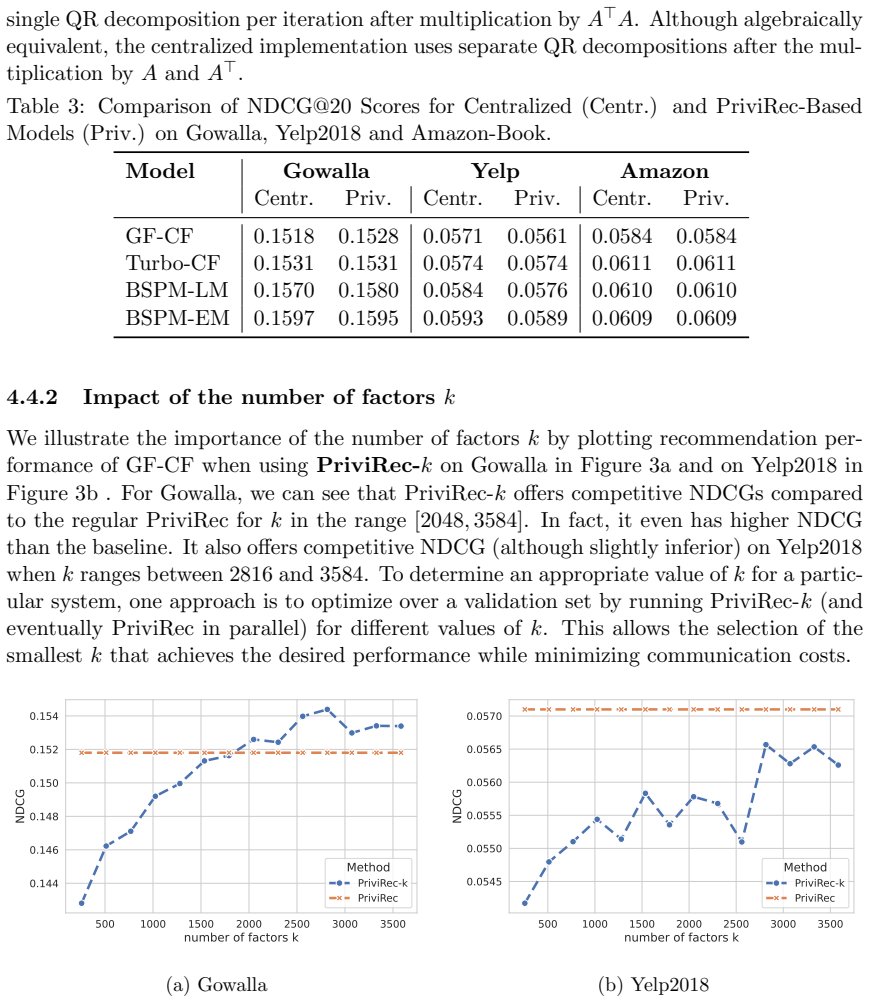
- PriviRec-k shows that keeping only $k$ singular vectors (around 2000 to 3584 on the benchmark datasets) preserves competitive NDCG while cutting communication from order $|I|^2$ to order $k |I|$.
- Because the protocol uses secure aggregation with polylogarithmic overhead, the per-client communication grows slowly with the number of participants.
- The same filters can then be combined with other components of GF-CF, BSPM, or Turbo-CF without changing the inference formulas.
Reading between the lines
- A natural extension is to apply the same per-user gram decomposition to other gram-matrix-based filters, such as user-user similarity or higher-order graph filters, provided each local term is a polynomial in $R^{(u)}$.
- The confidentiality guarantee depends on the released aggregates not revealing individual patterns; one could test this by bounding the information in the public item-item matrix under a differential-privacy-style adversary.
- Moving beyond the no-dropout assumption would require pairing the protocol with drop-out-resistant secure aggregation and client sampling, which the paper does not analyze.
- The paper's empirical claim covers only binary interactions; extending to explicit ratings or multi-valued feedback would require a different normalization but the same aggregation structure.
Editorial analysis
A structured set of objections, weighed in public.
Referee Report
Summary. The paper proposes PriviRec and PriviRec-k, two decentralized protocols that use Secure Aggregation to compute the normalized item-item matrix and the ideal low-pass filter used by graph-based recommender systems such as GF-CF and BSPM. The core algebraic claim is that the normalized item-item matrix can be written as a secure aggregation of per-user Gram terms, and the ideal low-pass filter can be obtained from a distributed randomized power method. The authors evaluate the resulting filters by plugging them into GF-CF, Turbo-CF, and BSPM on Gowalla, Yelp2018, and Amazon-Book, reporting NDCG@20 values within a few thousandths of the centralized counterparts. The paper also provides communication-complexity comparisons showing that the low-rank variant PriviRec-k is cheaper than federated GCN/matrix-factorization baselines.
Significance. The algebraic decomposition in Theorem 3.1 is clean and correct, and the empirical finding that the distributed protocol reproduces centralized recommendation accuracy up to numerical noise is a useful and convincing demonstration. The communication-cost analysis is also an asset: it gives concrete complexity expressions and translates them to float counts for Gowalla, making the claimed efficiency concrete. However, the headline contribution is confidentiality, and that claim is not supported. The broadcast output itself leaks user profiles, as detailed below, so the paper does not establish the advertised privacy guarantee. If the confidentiality claims were removed and replaced by an honest analysis of output leakage, the distributed-computation contribution could be salvageable, but as submitted the main advertised benefit is invalidated.
major comments (3)
- [§3.5.2, Lemma 3.4, Eq. (7), Figure 4] The confidentiality claim fails for the broadcast aggregate. The protocol broadcasts P~ = V^{-1/2} P' V^{-1/2} (Figure 4), and V is public (Eq. (6)), so every honest-but-curious client recovers P'. For any item i with V_ii = 1, exactly one user u has r_ui = 1. Equation (9) then gives P'_{i,j} = (1/d_user(u)) r_{u,j} for every j, so the support of row i of P' is exactly the full interaction vector of user u, and the normalization constant 1/d_user(u) is recoverable from that row. The benchmark datasets have densities 0.084%, 0.130%, and 0.062% (Table 2), and sparse long-tail item degree distributions make degree-one items common; even a single degree-one item suffices to violate the confidentiality requirement stated in §3.2 and contradicted by the §3.5.2 assertion that the item-item matrix 'does not give information about users.' Secure aggregation protects only the computation phase; it does not protect the deliberately broadcast final output. The same structural issue can affect F_IDL through S_k S_k^T whenever a top singular vector is aligned with a rare user-item pattern. No part of the security analysis addresses this, because the proof treats output confidentiality as self-evident rather than proving it.
- [Appendix A, Algorithm 1, Theorem 3.2] The proof in Appendix A does not match the algorithm as written. Algorithm 1 iteratively computes Y_0 = SecAgg(A(u)^T X_0) and then Y_ell = SecAgg(A(u)^T A(u) X_{ell-1}), with one QR factorization per iteration. The proof in Eq. (17), by contrast, analyzes Y = (\tilde R^T \tilde R)^\alpha \tilde R^T \Omega and derives SS^T = QQ^T. The relationship between the generic A(u), the normalized matrix \tilde R, the exponent \alpha, and the two-phase power iteration is never defined or justified. Since Theorem 3.2 is the load-bearing justification for the distributed ideal low-pass filter, the authors must reconcile the proof with Algorithm 1, or state exactly which variant of the randomized power method is implemented and prove the algorithm that is actually run.
- [§3.5, Lemma 3.4] The security proof of Lemma 3.4 is not a proof of the stated confidentiality property. Point 1 of the lemma requires that 'the aggregate must not leak sensitive information,' but the proof only cites properties of Secure Aggregation regarding individual contributions and correctness. The item-item matrix computation in §3.5.2 asserts that the aggregate 'does not give information about users' without any formal argument, and this assertion is false for the degree-one-item attack described above. A revision must either provide a rigorous information-theoretic or computational argument for output privacy, or substantially weaken the confidentiality claim and add an explicit leakage analysis.
minor comments (4)
- [Figure 1 caption] The caption says the server 'homomorphically sums' masked data, but Bell et al.'s Secure Aggregation relies on mask cancellation and secret sharing rather than homomorphic encryption; the wording should be corrected.
- [§3.6] There is a typo: 'we use use L = 3' should be 'we use L = 3'.
- [§3.4.1, Eq. (10)] The notation in Eq. (10) writes \tilde P = \sum_u \tilde R_u^T \tilde R_u, but earlier definitions include the V^{-1/2} normalization on both sides; the relationship between these expressions should be stated explicitly to avoid confusion.
- [Appendix A] The proof introduces \alpha and \Omega without connecting them to Algorithm 1; either define them precisely in the algorithm or remove them from the proof.
Circularity Check
No significant circularity; the central derivation is exact algebraic rewriting with no fitted constants, and the only self-citation is not load-bearing.
full rationale
The core mathematical contribution is Theorem 3.1, which rewrites the normalized item-item matrix as P = V^{-1/2}(SecAgg_u(1/d_user(u) R(u)^T R(u)))V^{-1/2}. This follows directly from the definitions of the normalized interaction matrix, the user-degree matrix U, and the item-degree matrix V; no fitted parameter is introduced, and the target matrix is not assumed as an input. The distributed power iteration for the ideal low-pass filter relies on external, published results on randomized power iteration [18] and secure aggregation [5], and the self-citation [40] merely notes that differentially private variants exist; it is not used to justify any load-bearing step. The empirical comparison in Table 3 checks that the securely computed components reproduce the centralized components' accuracy; because the distributed computation is algebraically equivalent, the near-identical NDCG values are a consistency check rather than a fitted prediction. The security analysis in Section 3.5.2 contains an unsupported assertion that the aggregate item-item matrix 'does not give information about users,' which may be false for sparse interaction data, but this is a correctness or security gap, not circularity. Overall, the derivation chain is self-contained and independent of its own conclusions.
Assumptions & free parameters
free parameters (2)
- rank k (PriviRec-k) =
k in [2048, 3584] for Gowalla, [2816, 3584] for Yelp
- power iteration count L =
L = 2 in experiments, L = 3 in the Gowalla communication comparison
assumptions (4)
- domain assumption Secure Aggregation is a secure primitive that reveals only the sum
- domain assumption Honest-but-curious participants and fixed participant set with no dropouts
- ad hoc to paper The final output matrices do not leak user-specific information
- standard math Randomized power iteration converges to the top-k singular subspace in the needed number of iterations
Cite this review
Pith. "Pith review of Secure Federated Graph-Filtering for Recommender Systems." pith.science (2026). https://pith.science/paper/QXD2SGXS
@misc{pith2026250116888,
  author       = {Pith},
  title        = {Pith review of: Secure Federated Graph-Filtering for Recommender Systems},
  year         = {2026},
  howpublished = {\url{https://pith.science/paper/QXD2SGXS}},
  note         = {Machine review of arXiv:2501.16888}
}
read the original abstract
Recommender systems often rely on graph-based filters, such as normalized item-item adjacency matrices and low-pass filters. While effective, the centralized computation of these components raises concerns about privacy, security, and the ethical use of user data. This work proposes two decentralized frameworks for securely computing these critical graph components without centralizing sensitive information. The first approach leverages lightweight Multi-Party Computation and distributed singular vector computations to privately compute key graph filters. The second extends this framework by incorporating low-rank approximations, enabling a trade-off between communication efficiency and predictive performance. Empirical evaluations on benchmark datasets demonstrate that the proposed methods achieve comparable accuracy to centralized state-of-the-art systems while ensuring data confidentiality and maintaining low communication costs. Our results highlight the potential for privacy-preserving decentralized architectures to bridge the gap between utility and user data protection in modern recommender systems.
Figures


Figures from the paper (2 more)


Forward citations
Cited by 1 Pith paper
-
Dropout-Robust Mechanisms for Differentially Private and Fully Decentralized Mean Estimation
IncA is a fully decentralized, differentially private mean-estimation protocol whose correlated noise cancels in the no-dropout case, achieving central-DP accuracy under a strong adversarial model.
Reference graph
Works this paper leans on
-
[42]
C. Philippenko. In-depth analysis of low-rank matrix factorisation in a federated setting. 2024
work page 2024
-
[1]
R. Agrawal and R. Srikant. Privacy-preserving data mining. In Proc. ACM SIGMOD Int. Conf. on Management of data , pages 439–450, 2000
work page 2000
-
[2]
Y. Allouah, A. Koloskova, A. E. Firdoussi, M. Jaggi, and R. Guerraoui. The privacy power of correlated noise in decentralized learning. arXiv preprint arXiv:2405.01031 , 2024
arXiv 2024
- [3]
- [4]
-
[5]
J. H. Bell, K. A. Bonawitz, A. Gasc´ on, T. Lepoint, and M. Raykova. Secure single- server aggregation with (poly) logarithmic overhead. In Proc. 2020 ACM SIGSAC Conf. Comput. Commun. Security , pages 1253–1269, 2020
work page 2020
-
[7]
K. Bonawitz, V. Ivanov, B. Kreuter, A. Marcedone, H. B. McMahan, S. Patel, D. Ra- mage, A. Segal, and K. Seth. Practical secure aggregation for privacy-preserving machine learning. In Proc. 2017 ACM SIGSAC Conf. Comput. Commun. Security , pages 1175–1191, 2017
work page 2017
-
[8]
K. A. Bonawitz, V. Ivanov, B. Kreuter, A. Marcedone, H. B. McMahan, S. Patel, D. Ramage, A. Segal, and K. Seth. Practical secure aggregation for federated learning on user-held data. In NIPS Workshop on Private Multi-Party Mach. Learn. , 2016. URL https://arxiv.org/abs/1611.04482
arXiv 2016
Show all 55 references
-
[9]
D. Chai, L. Wang, K. Chen, and Q. Yang. Secure federated matrix factorization. IEEE Intelligent Systems , 36(5):11–20, 2020
2020
-
[10]
L. Chen, L. Wu, R. Hong, K. Zhang, and M. Wang. Revisiting graph-based collab- orative filtering: A linear residual graph convolutional network approach. In Proc. AAAI, 2020
2020
-
[11]
E. Cho, S. A. Myers, and J. Leskovec. Friendship and mobility: user movement in location-based social networks. In Proc. 17th ACM SIGKDD Int. Conf. Knowl. Discov. Data Mining , pages 1082–1090, 2011. 18
2011
-
[12]
J. Choi, J. Jeon, and N. Park. Lt-ocf: Learnable-time ode-based collaborative filtering. In Proc. CIKM, 2021
2021
-
[13]
J. Choi, S. Hong, N. Park, and S.-B. Cho. Blurring-sharpening process models for collaborative filtering. In Proc. 46th Int. ACM SIGIR Conf. Res. Dev. Inf. Retrieval , pages 1096–1106, 2023
2023
-
[14]
Covington, J
P. Covington, J. Adams, and E. Sargin. Deep neural networks for youtube recommen- dations. In Proc. 10th ACM Conf. Recommender Syst. , pages 191–198, 2016
2016
-
[15]
W. Fan, X. Liu, W. Jin, X. Zhao, J. Tang, and Q. Li. Graph trend filtering networks for recommendation. In Proc. SIGIR, pages 112–121, 2022
2022
-
[16]
H.-M. Fu, P. Poirson, K. S. Lee, and C. Wang. Revisiting neighborhood-based link prediction for collaborative filtering. In Proc. TheWebConf Workshop Geometrical Topological Represent. Learn., 2022
2022
-
[17]
Gonz´ alez, Y
F. Gonz´ alez, Y. Yu, A. Figueroa, C. L´ opez, and C. Aragon. Global reactions to the cambridge analytica scandal: A cross-language social media study. In Companion Proc. of the 2019 www conference , pages 799–806, 2019
2019
-
[18]
Halko, P.-G
N. Halko, P.-G. Martinsson, and J. A. Tropp. Finding structure with randomness: Probabilistic algorithms for constructing approximate matrix decompositions. SIAM Rev., 53(2):217–288, 2011
2011
-
[19]
P. Han, B. Xie, F. Yang, and R. Shen. A scalable p2p recommender system based on distributed collaborative filtering. Expert Syst. Appl. , 27(2):203–210, 2004
2004
-
[20]
Hardt and E
M. Hardt and E. Price. The noisy power method: A meta algorithm with applications. Adv. Neural Inf. Process. Syst. , 27, 2014
2014
-
[21]
C. He, K. Balasubramanian, E. Ceyani, C. Yang, H. Xie, L. Sun, L. He, L. Yang, P. S. Yu, Y. Rong, et al. Fedgraphnn: A federated learning system and benchmark for graph neural networks. arXiv preprint arXiv:2104.07145 , 2021
2021 arXiv
-
[22]
X. He, L. Liao, H. Zhang, L. Nie, X. Hu, and T.-S. Chua. Neural collaborative filtering. In Proc. 26th Int. Conf. World Wide Web , pages 173–182, 2017
2017
-
[23]
X. He, K. Deng, X. Wang, Y. Li, Y. Zhang, and M. Wang. Lightgcn: Simplifying and powering graph convolution network for recommendation. In Proc. 43rd Int. ACM SIGIR Conf. Res. Dev. Inf. Retrieval , pages 639–648, 2020
2020
-
[24]
Heged˝ us, G
I. Heged˝ us, G. Danner, and M. Jelasity. Decentralized learning works: An empirical comparison of gossip learning and federated learning. J. Parallel Distrib. Comput. , 148:109–124, 2021. 19
2021
-
[25]
J. Hu, S. Qian, Q. Fang, and C. Xu. Mgdcf: Distance learning via markov graph diffusion for neural collaborative filtering. arXiv preprint arXiv:2204.02338 , 2022
2022 arXiv
-
[26]
Y. Hu, Y. Koren, and C. Volinsky. Collaborative filtering for implicit feedback datasets. In 2008 Eighth IEEE Int. Conf. Data Mining , pages 263–272. IEEE, 2008
2008
-
[27]
Jalalirad, M
A. Jalalirad, M. Scavuzzo, C. Capota, and M. Sprague. A simple and efficient federated recommender system. In Proc. 6th IEEE/ACM Int. Conf. Big Data Comput., Applic. Technol., pages 53–58, 2019
2019
-
[28]
J¨ arvelin and J
K. J¨ arvelin and J. Kek¨ al¨ ainen. Cumulated gain-based evaluation of ir techniques. ACM Trans. Inf. Syst. , 20(4):422–446, 2002
2002
-
[29]
Klicpera, A
J. Klicpera, A. Bojchevski, and S. G¨ unnemann. Predict then propagate: Graph neural networks meet personalized pagerank. In Proc. ICLR, 2019
2019
-
[30]
T. Kong, T. Kim, J. Jeon, J. Choi, Y.-C. Lee, N. Park, and S.-W. Kim. Linear, or non-linear, that is the question! In Proc. WSDM, pages 517–525, 2022
2022
-
[31]
D. Lee, S. Kang, H. Ju, C. Park, and H. Yu. Bootstrapping user and item represen- tations for one-class collaborative filtering. In Proc. SIGIR, pages 317–326, 2021
2021
-
[32]
F. Liu, Z. Cheng, L. Zhu, Z. Gao, and L. Nie. Interest-aware message-passing gcn for recommendation. In Proc. TheWebConf (former WWW) , pages 1296–1305, 2021
2021
-
[33]
Z. Liu, L. Meng, F. Jiang, J. Zhang, and P. S. Yu. Deoscillated graph collaborative filtering. arXiv preprint arXiv:2011.02100 , 2020
2011 arXiv
-
[34]
Z. Liu, J. Guo, W. Yang, J. Fan, K.-Y. Lam, and J. Zhao. Privacy-preserving aggre- gation in federated learning: A survey. IEEE Trans. Big Data , 2022
2022
-
[35]
J. Ma, P. Cui, K. Kuang, X. Wang, and W. Zhu. Disentangled graph convolutional networks. In Proc. ICML, pages 4212–4221, 2019
2019
-
[36]
K. Mao, J. Zhu, J. Wang, Q. Dai, Z. Dong, X. Xiao, and X. He. Simplex: A simple and strong baseline for collaborative filtering. In Proc. CIKM, pages 1243–1252, 2021
2021
-
[37]
K. Mao, J. Zhu, X. Xiao, B. Lu, Z. Wang, and X. He. Ultragcn: Ultra simplification of graph convolutional networks for recommendation. In Proc. CIKM, 2021
2021
-
[38]
H. B. McMahan, E. Moore, D. Ramage, and B. A. y Arcas. Federated learning of deep networks using model averaging. arXiv preprint arXiv:1602.05629 , 2:2, 2016
2016 arXiv
-
[39]
Muhammad, Q
K. Muhammad, Q. Wang, D. O’Reilly-Morgan, E. Tragos, B. Smyth, N. Hurley, J. Geraci, and A. Lawlor. Fedfast: Going beyond average for faster training of feder- ated recommender systems. In Proc. 26th ACM SIGKDD Int. Conf. Knowl. Discov. & Data Mining , pages 1234–1242, 2020. 20
2020
-
[40]
Nicolas, C
J. Nicolas, C. Sabater, M. Maouche, S. B. Mokhtar, and M. Coates. Differentially pri- vate and decentralized randomized power method. arXiv preprint arXiv:2411.01931 , 2024
2024 arXiv
-
[41]
Park, Y.-M
J.-D. Park, Y.-M. Shin, and W.-Y. Shin. Turbo-cf: Matrix decomposition-free graph filtering for fast recommendation. In Proc. of the 47th Int. ACM SIGIR , pages 2672– 2676, 2024
2024
-
[43]
Y. Rong, W. Huang, T. Xu, and J. Huang. Dropedge: Towards deep graph convolu- tional networks on node classification. In Proc. ICLR, 2020
2020
-
[44]
Sabater, A
C. Sabater, A. Bellet, and J. Ramon. An accurate, scalable and verifiable protocol for federated differentially private averaging. Machine Learning, 111(11):4249–4293, 2022
2022
-
[45]
Seeman and D
J. Seeman and D. Susser. Between privacy and utility: On differential privacy in theory and practice. ACM Journal on Responsible Computing , 1(1):1–18, 2024
2024
-
[46]
Y. Shen, Y. Wu, Y. Zhang, C. Shan, J. Zhang, B. K. Letaief, and D. Li. How powerful is graph convolution for recommendation? In Proc. 30th ACM Int. Conf. Inf. & Knowledge Manag. , pages 1619–1629, 2021
2021
-
[47]
J. So, C. He, C.-S. Yang, S. Li, Q. Yu, R. E Ali, B. Guler, and S. Avestimehr. Lightsecagg: a lightweight and versatile design for secure aggregation in federated learning. Proc. of Mach. Learn. and Systems , 4:694–720, 2022
2022
-
[48]
H. Steck. Embarrassingly shallow autoencoders for sparse data. In Proc. TheWebConf (former WWW) , pages 3251–3257, 2019
2019
-
[49]
Veliˇ ckovi´ c, G
P. Veliˇ ckovi´ c, G. Cucurull, A. Casanova, A. Romero, P. Li` o, and Y. Bengio. Graph attention networks. In Proc. ICLR, 2018
2018
-
[50]
X. Wang, X. He, M. Wang, F. Feng, and T.-S. Chua. Neural graph collaborative filtering. In Proc. 42nd Int. ACM SIGIR Conf. Res. Dev. Inf. Retrieval , pages 165– 174, 2019
2019
-
[51]
X. Wang, H. Jin, A. Zhang, X. He, T. Xu, and T.-S. Chua. Disentangled graph collaborative filtering. In Proc. SIGIR, 2020
2020
-
[52]
G. Wu, W. Pan, and Z. Ming. Gnn4fr: A lossless gnn-based federated recommendation framework. arXiv preprint arXiv:2308.01197 , 2023. 21
2023 arXiv
-
[53]
J. Wu, X. Wang, F. Feng, X. He, L. Chen, J. Lian, and X. Xie. Self-supervised graph learning for recommendation. In Proc. SIGIR, pages 726–735, 2021
2021
-
[54]
K. Xu, C. Li, Y. Tian, T. Sonobe, K. i. Kawarabayashi, and S. Jegelka. Representation learning on graphs with jumping knowledge networks. In Proc. ICML, pages 5453– 5462, 2018
2018
-
[55]
Zhang, S
C. Zhang, S. Li, J. Xia, W. Wang, F. Yan, and Y. Liu. {BatchCrypt}: Efficient homomorphic encryption for {Cross-Silo} federated learning. In USENIX ATC 20 , pages 493–506, 2020
2020
-
[56]
Zhang, P
Y. Zhang, P. Wang, X. Zhao, H. Qi, J. He, J. Jin, C. Peng, Z. Lin, and J. Shao. Ia-gcn: Interactive graph convolutional network for recommendation. arXiv preprint arXiv:2204.03827, 2022. 22 A Security of the decentralized randomized power iteration We now provide the proof of ...
2022 arXiv
Reviewed August 10, 2026 · model on record in the stance chip above.
Discussion (0). Continue with ORCID to comment.