REVIEW 3 major objections 4 minor 2 cited by
Generative AI for Vision: A Comprehensive Study of Frameworks and Applications
T0 review · 3 major / 4 minor · reviewed 2026-08-10 · deepseek-v4-flash
Pith's one-line read A survey organizes image generation by input type: noise, latent codes, text prompts, and control signals.
desk verdict A useful survey for newcomers with a genuinely broken organizing taxonomy; the categorization needs major revision before it can be trusted. read the letter →
The pith
A machine-rendered reading of the paper's core claim, the machinery that carries it, and where it could break.
The reading
What carries the argument
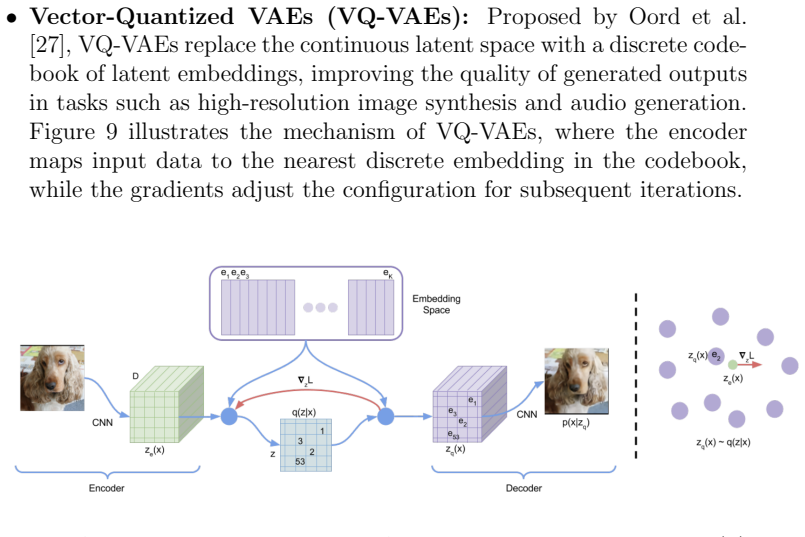
The machinery that carries the argument is the taxonomy itself: a four-way classification of image generation techniques by input modality—noisy vectors, latent-space representations, conditional inputs, and textual descriptions. Within the survey, the prompt-to-image category is further decomposed into a fixed three-component pipeline: a text encoder (BERT-style or multimodal, such as CLIP), an image generator (typically a diffusion or autoregressive model), and an image decoder (often a VAE decoder) that turns latent embeddings into pixels. For each family, the paper identifies the defining objective or mechanism—the GAN minimax game, the diffusion denoising process, the VAE evidence lower bound with KL regularization, and the cross-attention conditioning used by Stable Diffusion and ControlNet. The taxonomy does the organizing work: it determines which frameworks are discussed together, which comparisons are drawn, and which challenges are presented as field-wide rather than model-specific.
What would settle it
The taxonomy would be falsified by a widely used generative model whose design and practical use cannot be usefully described by its input type—for example, a unified multimodal model that accepts text, images, and structural controls interchangeably and behaves the same regardless of which input is supplied—or by a systematic survey showing practitioners actually choose models by output requirements or training data rather than by input type.
Extended reading notes
Core claim
The paper's central claim is that the nature of the input is the most useful axis for understanding image generation, and that nearly all current methods fall into one of four input-driven categories: noisy vectors, latent-space representations, conditional inputs, and textual descriptions. Under that scheme, GANs and diffusion models are both noise-to-image engines, VAEs are latent-code-to-image engines, prompt-to-image systems like Stable Diffusion, DALL-E, and Janus-Pro are text-to-image pipelines, and ControlNet-style systems are text-plus-structure-to-image pipelines. The survey walks through the principles of each family, including the GAN minimax objective, the diffusion forward/reverse denoising process, the VAE reconstruction-plus-KL objective, and the three-stage text encoder–generator–decoder architecture shared by prompt-to-image systems. It then uses the taxonomy to frame the field's shared problems: bias inherited from training data, high computational cost, alignment of outputs with user intent, and misuse of generated content. The author's conclusion is that this input-centric map gives practitioners a practical route through the landscape, with future progress coming from stronger multimodal alignment, scalability, fairness, real-time generation, and agentic systems that combine vision with action.
Load-bearing premise
The taxonomy's load-bearing premise is that the nature of the input is the best organizing axis for image generation methods, and that the four categories are complete and distinct enough to be useful.
Editorial extensions
If this is right
- A developer who knows a task's input type can narrow the candidate models: noise-based inputs point to GANs or diffusion models, latent-code manipulation points to VAEs, text prompts point to text-to-image pipelines, and structural guidance points to ControlNet-style conditional models.
- The three-component view of prompt-to-image systems implies that improving any single stage—text encoder, generator, or decoder—can improve end-to-end text-to-image quality, so research can be localized.
- Diffusion models are presented as the current dominant paradigm because they avoid GAN-style training instability and produce more diverse samples, which suggests continued investment in diffusion-based and latent-diffusion architectures.
- The challenges listed—bias, cost, intent alignment, misuse—apply across all four families, meaning that progress on them, such as RLHF-based alignment or efficient architectures, would benefit the whole field.
- Multimodal alignment and agentic vision systems are the stated future directions, implying the next generation of models will blur the boundaries between the four input categories.
Reading between the lines
- The input-type axis is one of several possible organizing principles; an output-type or training-objective axis could be equally informative, and the taxonomy's usefulness depends on whether it predicts design choices rather than merely relabeling them.
- As unified multimodal models such as Janus-Pro accept text, images, and structural signals through one backbone, the four categories may converge, and the taxonomy may become a historical map rather than a live design guide.
- A testable extension would be a systematic benchmark that asks practitioners to select a model family from a task description and measures whether the input-type heuristic improves selection accuracy over a baseline that just lists popular models.
- The survey's application examples suggest but do not demonstrate comparative performance; a reader should treat the framework as a map of the field rather than as evidence that any one model family outperforms another.
Editorial analysis
A structured set of objections, weighed in public.
Referee Report
Summary. The manuscript is a survey of generative image models organized around an input-centric taxonomy. It proposes four categories—noisy vectors, latent-space representations, conditional inputs, and textual descriptions—and uses them to structure short reviews of GANs, diffusion models, VAEs, and prompt-to-image systems such as DALL-E, Stable Diffusion, DeepSeek Janus-Pro, and ControlNet. Each method is accompanied by a high-level description, an application-oriented discussion, and in some cases a figure. The paper frames the taxonomy as its main contribution and concludes with challenges and future directions.
Significance. If the taxonomy were consistently applied, the paper would be a readable introductory survey: the GAN and VAE objective functions in Eq. (1) and (2) are standard and correctly stated, and the application sections are concrete. However, the central organizing claim is not currently established. Section 3 is titled 'Noisy Vectors' but contains Pix2Pix and CycleGAN, two models explicitly described as image-to-image translation methods whose inputs are images; Section 5 then treats image-to-image translation as a separate paradigm from noisy-vector generation. Section 5.5 also misdescribes the cited DALL-E paper as autoregressive. Because these issues affect the paper's framing and a flagship framework description, they are load-bearing. The paper has no machine-checked proofs or reproducible code, so its value rests entirely on the accuracy and organizing power of the survey; a careful revision could make it a serviceable reference.
major comments (3)
- [Sections 2, 3, and 5] The proposed input-based taxonomy is internally inconsistent. Section 2 defines 'Noisy Vectors' as methods that 'use random noise as input,' and Section 3 opens by stating that 'Noisy vector-based models rely on random noise as input.' Yet Section 3.1.2 summarizes Pix2Pix as 'paired image-to-image translation tasks, where each input image has a corresponding target image,' and Section 3.1.3 summarizes CycleGAN as unpaired image-to-image translation. Neither model consumes random noise as its primary input. Section 5 then explicitly contrasts 'noisy vector-based image generation ... which uses random noise as input (e.g., GANs)' with 'image-to-image translation tasks,' so the paper contradicts its own classification. The overlap also appears within the diffusion part: Section 3.2 lists Latent Diffusion Models under noisy vectors, while Section 5.4 presents Stable Diffusion, a latent diffusion model, under prompt-to-image generation. The abstract's claim of a structured classification by input modality therefore requires either a redefined taxonomy with clearly disjoint categories and explicit placement criteria, or a reclassification of the models; as written, the main contribution is not supported.
- [Section 5.5] The description of DALL-E is factually incorrect with respect to the cited reference. Section 5.5 states that DALL-E [32] 'employs an autoregressive approach to synthesize images' and that it 'predicts the image tokens sequentially.' Reference [32] is Ramesh et al. (2022), 'Hierarchical Text-Conditional Image Generation with CLIP Latents' (DALL-E 2), which uses a diffusion prior and a diffusion decoder rather than autoregressive generation of image tokens. The error is propagated by the section title 'DALL·E: Autoregressive Frameworks' and by Figure 14. If the intended subject is the original autoregressive DALL-E, the citation and figure source must be replaced; if the intended subject is the cited paper, the section must be rewritten to describe diffusion-based prior and decoding. Either way, the current text cites a source that does not support the claim.
- [Conclusion, Section 8] The conclusion states that 'this work has presented a comprehensive evaluation of generative AI frameworks for vision,' but the paper does not evaluate frameworks in a comparative or quantitative sense; it provides descriptive summaries. The title and abstract also promise a 'comprehensive study.' Since the manuscript contains no evaluation methodology, success criteria, or benchmark comparisons, the 'comprehensive evaluation' wording overstates the contribution. I recommend replacing 'evaluation' with 'overview' or 'survey' and qualifying the comprehensiveness claim, or adding a systematic comparison component if the claim is to be retained.
minor comments (4)
- [Section 1 and References] Citation handling for CLIP is duplicated: reference [29] and reference [30] are the same Radford et al. paper, while Section 1 cites CLIP as [30]. Please merge these entries and update all in-text citations.
- [Section 3.1.3] The 'Implementation Framework' paragraph contains a grammatical error: 'Similar to Pix2Pix, the following the framework pytorch-CycleGAN-and-pix2pix [47] can be leveraged.' Please rephrase to 'Similar to Pix2Pix, the framework pytorch-CycleGAN-and-pix2pix [47] can be leveraged.'
- [Throughout] Several model names are typeset with unnatural spacing, such as 'V AEs,' 'DALL ·E,' and 'FLA V A.' Please ensure the names are formatted consistently (e.g., 'VAEs,' 'DALL-E,' 'FLAVA').
- [Section 3.2] The statement that diffusion models 'avoid such instability' and produce more diverse samples than GANs is an overgeneralization; training stability and mode coverage remain active research topics for both model families. Please qualify the claim with references or a discussion of known limitations.
Circularity Check
No significant circularity: the paper is a descriptive survey/taxonomy, and no step reduces to its own input or to a load-bearing self-citation chain.
full rationale
This paper is a survey/taxonomy, not a derivation. Its central claim is a proposed categorization of image-generation methods by input modality (Section 2). The categories are introduced definitionally ('Noisy Vectors: Methods like GANs use random noise as input...'), and the sections simply report established methods and architectures (Vanilla GAN, Pix2Pix, CycleGAN, StyleGAN, diffusion models, VAEs, Stable Diffusion, DALL-E, Janus-Pro, ControlNet). No quantity is fitted and then relabeled as a prediction, and no derived result is shown to equal an input by construction. The only self-citations are [3] and [4] in Section 8, where agentic systems are mentioned as a future direction; this is a forward-looking remark and does not support the taxonomy or any claim in the paper. The internal inconsistency noted by a reader (Pix2Pix/CycleGAN described as image-to-image translation yet placed under 'Noisy Vectors'; Section 5 explicitly separates image-to-image translation from noisy-vector generation) is a taxonomy-consistency/correctness issue, not a circular-reasoning issue: the paper never claims to derive those placements from the noisy-vector definition. Therefore no circularity is established, and the honest score is 0.
Assumptions & free parameters
assumptions (1)
- domain assumption The categorization of image generation techniques by input modality is a valid and useful organizing framework.
Cite this review
Pith. "Pith review of Generative AI for Vision: A Comprehensive Study of Frameworks and Applications." pith.science (2026). https://pith.science/paper/IEBSAKGN
@misc{pith2026250118033,
  author       = {Pith},
  title        = {Pith review of: Generative AI for Vision: A Comprehensive Study of Frameworks and Applications},
  year         = {2026},
  howpublished = {\url{https://pith.science/paper/IEBSAKGN}},
  note         = {Machine review of arXiv:2501.18033}
}
read the original abstract
Generative AI is transforming image synthesis, enabling the creation of high-quality, diverse, and photorealistic visuals across industries like design, media, healthcare, and autonomous systems. Advances in techniques such as image-to-image translation, text-to-image generation, domain transfer, and multimodal alignment have broadened the scope of automated visual content creation, supporting a wide spectrum of applications. These advancements are driven by models like Generative Adversarial Networks (GANs), conditional frameworks, and diffusion-based approaches such as Stable Diffusion. This work presents a structured classification of image generation techniques based on the nature of the input, organizing methods by input modalities like noisy vectors, latent representations, and conditional inputs. We explore the principles behind these models, highlight key frameworks including DALL-E, ControlNet, and DeepSeek Janus-Pro, and address challenges such as computational costs, data biases, and output alignment with user intent. By offering this input-centric perspective, this study bridges technical depth with practical insights, providing researchers and practitioners with a comprehensive resource to harness generative AI for real-world applications.
Figures


Figures from the paper (15 more)




Forward citations
Cited by 2 Pith papers
-
GenTune: Toward Traceable Prompts to Improve Controllability of Image Refinement in Environment Design
GenTune improves AI image refinement by tracing image regions back to prompt labels and allowing element-level, semantic-guided edits.
-
Generative AI for Industrial Contour Detection: A Language-Guided Vision System
A GAN-plus-VLM pipeline improves industrial remnant contour extraction, with GPT-image-1 outperforming Gemini 2.0 Flash on SSIM, LPIPS, and Hausdorff distance.
Reference graph
Works this paper leans on
-
[33]
High-resolution image synthesis with latent diffusion models
Robin Rombach, Andreas Blattmann, Dominik Lorenz, Patrick Esser, and Bjorn Ommer. High-resolution image synthesis with latent diffusion models. Proceedings of the IEEE/CVF Conference on Computer Vision and Pattern Recognition, pages 10684–10695, 2022
work page 2022
-
[34]
High-resolution image synthesis with latent diffusion models, 2022
Robin Rombach, Andreas Blattmann, Dominik Lorenz, Patrick Esser, and Bj¨ orn Ommer. High-resolution image synthesis with latent diffusion models, 2022
2022
-
[29]
Learning transferable visual models from natural language supervision
Alec Radford, Jong Wook Kim, Chris Hallacy, Aditya Ramesh, Gabriel Goh, Sandhini Agarwal, Girish Sastry, Amanda Askell, Pamela Mishkin, Jack Clark, et al. Learning transferable visual models from natural language supervision. arXiv preprint arXiv:2103.00020 , 2021
arXiv 2021
-
[30]
Learning transferable visual models from natural language supervision, 2021
Alec Radford, Jong Wook Kim, Chris Hallacy, Aditya Ramesh, Gabriel Goh, Sandhini Agarwal, Girish Sastry, Amanda Askell, Pamela Mishkin, Jack Clark, Gretchen Krueger, and Ilya Sutskever. Learning transferable visual models from natural language supervision, 2021
2021
-
[36]
Sara Mahdavi, Rapha Gontijo Lopes, Tim Salimans, Jonathan Ho, David J Fleet, and Mohammad Norouzi
Chitwan Saharia, William Chan, Saurabh Saxena, Lala Li, Jay Whang, Emily Denton, Seyed Kamyar Seyed Ghasemipour, Burcu Karagol Ayan, S. Sara Mahdavi, Rapha Gontijo Lopes, Tim Salimans, Jonathan Ho, David J Fleet, and Mohammad Norouzi. Photorealistic text-to-image diffusion models with deep language understanding, 2022. 51
work page 2022
-
[37]
Chitwan Saharia, William Chan, Saurabh Saxena, Lala Li, Jay Whang, Emily Denton, Seyed Kamyar Seyed Ghasemipour, Burcu Karagol Ayan, Shoubhik Mahdavi, Raphael Gontijo Lopes, et al. Imagen: Text-to- image diffusion models with large pretrained models.Advances in Neural Information Processing Systems, 35, 2022
work page 2022
-
[32]
Hierarchical text-conditional image generation with clip latents, 2022
Aditya Ramesh, Prafulla Dhariwal, Alex Nichol, Casey Chu, and Mark Chen. Hierarchical text-conditional image generation with clip latents, 2022
2022
-
[1]
Flamingo: A visual language model for few-shot learning
Jean-Baptiste Alayrac, Jeff Donahue, Pauline Luc, Arthur Mensch, Seunghoon Hong Clarke, Matthew Prior, Guillaume Lecoq, et al. Flamingo: A visual language model for few-shot learning. arXiv preprint arXiv:2204.14198, 2022
arXiv 2022
Show all 47 references
-
[2]
Wasserstein gan
Martin Arjovsky, Soumith Chintala, and L´ eon Bottou. Wasserstein gan. arXiv preprint arXiv:1701.07875 , 2017
2017 arXiv
-
[3]
Agentic systems: A guide to transforming indus- tries with vertical ai agents, 2025
Fouad Bousetouane. Agentic systems: A guide to transforming indus- tries with vertical ai agents, 2025
2025
-
[4]
Physical ai agents: Integrating cognitive intelli- gence with real-world action, 2025
Fouad Bousetouane. Physical ai agents: Integrating cognitive intelli- gence with real-world action, 2025
2025
-
[5]
Large scale gan training for high fidelity natural image synthesis
Andrew Brock, Jeff Donahue, and Karen Simonyan. Large scale gan training for high fidelity natural image synthesis. In International Con- ference on Learning Representations, 2018
2018
-
[6]
Instructpix2pix: Learning to follow image editing instructions
Tim Brooks et al. Instructpix2pix: Learning to follow image editing instructions. arXiv preprint arXiv:2211.09800 , 2022
2022 arXiv
-
[7]
Janus-pro: Unified multi- modal understanding and generation with data and model scaling, 2025
Xiaokang Chen, Zhiyu Wu, Xingchao Liu, Zizheng Pan, Wen Liu, Zhenda Xie, Xingkai Yu, and Chong Ruan. Janus-pro: Unified multi- modal understanding and generation with data and model scaling, 2025
2025
-
[8]
Deepseek llm: Scaling open-source language models with longtermism
DeepSeek-AI. Deepseek llm: Scaling open-source language models with longtermism. arXiv preprint arXiv:2401.02954 , 2024. 48
2024 arXiv
-
[9]
Bert: Pre-training of deep bidirectional transformers for language un- derstanding
Jacob Devlin, Ming-Wei Chang, Kenton Lee, and Kristina Toutanova. Bert: Pre-training of deep bidirectional transformers for language un- derstanding. arXiv preprint arXiv:1810.04805 , 2018
2018 arXiv
-
[10]
Diffusion models beat gans on image synthesis
Prafulla Dhariwal and Alexander Quinn Nichol. Diffusion models beat gans on image synthesis. Advances in Neural Information Processing Systems, 34:8780–8794, 2021
2021
-
[11]
An image is worth one word: Personalizing text-to-image generation using textual inversion
Rinon Gal et al. An image is worth one word: Personalizing text-to-image generation using textual inversion. arXiv preprint arXiv:2208.01618, 2022
2022 arXiv
-
[12]
Gen- erative adversarial nets
Ian Goodfellow, Jean Pouget-Abadie, Mehdi Mirza, Bing Xu, David Warde-Farley, Sherjil Ozair, Aaron Courville, and Yoshua Bengio. Gen- erative adversarial nets. Advances in neural information processing sys- tems, 27, 2014
2014
-
[13]
beta-vae: Learning basic visual concepts with a constrained variational framework
Irina Higgins, Loic Matthey, Arka Pal, et al. beta-vae: Learning basic visual concepts with a constrained variational framework. International Conference on Learning Representations, 2017
2017
-
[14]
Denoising diffusion proba- bilistic models, 2020
Jonathan Ho, Ajay Jain, and Pieter Abbeel. Denoising diffusion proba- bilistic models, 2020
2020
-
[15]
Denoising criterion for variational autoencoding frameworks
Daniel Jiwoong Im, Sungjin Ahn, Roland Memisevic, and Kyunghyun Cho. Denoising criterion for variational autoencoding frameworks. arXiv preprint arXiv:1703.02370, 2017
2017 arXiv
-
[16]
Image- to-image translation with conditional adversarial networks
Phillip Isola, Jun-Yan Zhu, Tinghui Zhou, and Alexei A Efros. Image- to-image translation with conditional adversarial networks. In Proceed- ings of the IEEE conference on computer vision and pattern recognition , pages 1125–1134, 2017
2017
-
[17]
Scaling up visual and vision-language representation learning with noisy text supervision
Chao Jia, Yinfei Yang, Ye Xia, Yi-Ting Chen, Zarana Parekh, Hieu Pham, Quoc V Le, Yun-Hsuan Sung, Zhen Li, and Tom Duerig. Scaling up visual and vision-language representation learning with noisy text supervision. International Conference on Machine Learning , 2021
2021
-
[18]
A style-based generator architecture for generative adversarial networks
Tero Karras, Samuli Laine, and Timo Aila. A style-based generator architecture for generative adversarial networks. In Proceedings of the 49 IEEE/CVF Conference on Computer Vision and Pattern Recognition (CVPR), pages 4401–4410, 2019
2019
-
[19]
Auto-encoding variational bayes
Diederik P Kingma and Max Welling. Auto-encoding variational bayes. arXiv preprint arXiv:1312.6114 , 2013
2013 arXiv
-
[20]
Albert: A lite bert for self-supervised learning of language representations
Zhenzhong Lan, Mingda Chen, Sebastian Goodman, Kevin Gimpel, Piyush Sharma, and Radu Soricut. Albert: A lite bert for self-supervised learning of language representations. arXiv preprint arXiv:1909.11942 , 2019
1909 arXiv
-
[21]
Photo-realistic single image super-resolution using a generative adversarial network
Christian Ledig, Lucas Theis, Ferenc Husz´ ar, Jose Caballero, Andrew Cunningham, Alejandro Acosta, Andrew Aitken, Alykhan Tejani, Jo- hannes Totz, Zehan Wang, and Wenzhe Shi. Photo-realistic single image super-resolution using a generative adversarial network. Proceedings of ...
2017
-
[22]
Junnan Li, Dongxu Li, Caiming Xiong, and Steven C.H. Hoi. Blip: Bootstrapped language-image pre-training for unified vision-language understanding and generation. arXiv preprint arXiv:2201.12086 , 2022
2022 arXiv
-
[23]
Roberta: A robustly optimized bert pretraining approach
Yinhan Liu, Myle Ott, Naman Goyal, Jingfei Du, Mandar Joshi, Danqi Chen, Omer Levy, Mike Lewis, Luke Zettlemoyer, and Veselin Stoy- anov. Roberta: A robustly optimized bert pretraining approach. arXiv preprint arXiv:1907.11692, 2019
1907 arXiv
-
[24]
Pose guided person image generation
Liqian Ma et al. Pose guided person image generation. arXiv preprint arXiv:1705.09368, 2017
2017 arXiv
-
[25]
Adversarial autoencoders
Alireza Makhzani, Jonathon Shlens, Navdeep Jaitly, Ian Goodfel- low, and Brendan Frey. Adversarial autoencoders. arXiv preprint arXiv:1511.05644, 2015
2015 arXiv
-
[26]
T2i-adapter: Learning adapters to dig out more controllable ability for text-to-image diffusion models
Chendong Mou et al. T2i-adapter: Learning adapters to dig out more controllable ability for text-to-image diffusion models. arXiv preprint arXiv:2302.08453, 2023
2023 arXiv
-
[27]
Neural discrete representation learning
Aaron van den Oord, Oriol Vinyals, and Koray Kavukcuoglu. Neural discrete representation learning. Advances in Neural Information Pro- cessing Systems, 30, 2017. 50
2017
-
[28]
Gpt-4 technical report, 2024
OpenAI, Josh Achiam, and Steven Adler et all. Gpt-4 technical report, 2024
2024
-
[31]
Language models are unsupervised multitask learn- ers
Alec Radford, Jeffrey Wu, Rewon Child, David Luan, Dario Amodei, and Ilya Sutskever. Language models are unsupervised multitask learn- ers. OpenAI preprint, 2019
2019
-
[35]
Dreambooth: Fine tuning text-to-image diffusion models for subject-driven generation
Nataniel Ruiz et al. Dreambooth: Fine tuning text-to-image diffusion models for subject-driven generation. arXiv preprint arXiv:2208.12242 , 2022
2022 arXiv
-
[38]
Flava: A foundational language and vision alignment model
Amanpreet Singh, Ronghang Hu, Amaia Salvador, Dhruv Batra, Devi Parikh, Stefan Lee, Wieland Brendel, Piotr Doll´ ar, and Ross Girshick. Flava: A foundational language and vision alignment model. arXiv preprint arXiv:2112.04482, 2022
2022 arXiv
-
[39]
Learning structured output representation using deep conditional generative models
Kihyuk Sohn, Xinchen Yan, and Honglak Lee. Learning structured output representation using deep conditional generative models. In Advances in Neural Information Processing Systems , pages 3483–3491, 2015
2015
-
[40]
Ladder variational autoencoders
Casper Kaae Sonderby, Tapani Raiko, Lars Maaloe, Jascha Sohl- Dickstein, and Ole Winther. Ladder variational autoencoders. Advances in Neural Information Processing Systems , 29, 2016
2016
-
[41]
Consistency models
Yang Song, Chenlin Meng, and Stefano Ermon. Consistency models. arXiv preprint arXiv:2303.01469 , 2023
2023 arXiv
-
[42]
Score-based generative modeling through stochastic differential equations
Yang Song, Jascha Sohl-Dickstein, Diederik P Kingma, Abhishek Ku- mar, Stefano Ermon, and Ben Poole. Score-based generative modeling through stochastic differential equations. International Conference on Learning Representations, 2021
2021
-
[43]
Llama 2: Open foundation and fine-tuned chat models, 2023
Hugo Touvron, Louis Martin, and et all. Llama 2: Open foundation and fine-tuned chat models, 2023
2023
-
[44]
Diffusion models: A comprehensive survey of methods and applications, 2024
Ling Yang, Zhilong Zhang, Yang Song, Shenda Hong, Runsheng Xu, Yue Zhao, Wentao Zhang, Bin Cui, and Ming-Hsuan Yang. Diffusion models: A comprehensive survey of methods and applications, 2024
2024
-
[45]
Coca: Contrastive captioners are image-text foun- dation models
Jiahui Yu, Alaaeldin El-Nouby, Golnaz Ghiasi, Raphael Gontijo-Lopes, Karan Alwala, Ting Huang, Yin Cui, Jonathan Clark, Xiaoqi Wang, Jonas Hoffman, et al. Coca: Contrastive captioners are image-text foun- dation models. arXiv preprint arXiv:2205.01917 , 2022. 52
2022 arXiv
-
[46]
Adding conditional control to text-to-image diffusion models
Lvmin Zhang and Maneesh Agrawala. Adding conditional control to text-to-image diffusion models. arXiv preprint arXiv:2302.05543 , 2023
2023 arXiv
-
[47]
Unpaired image-to-image translation using cycle-consistent adversarial networks
Jun-Yan Zhu, Taesung Park, Phillip Isola, and Alexei A Efros. Unpaired image-to-image translation using cycle-consistent adversarial networks. In Computer Vision (ICCV), 2017 IEEE International Conference on , 2017. 53
2017
Reviewed August 10, 2026 · model on record in the stance chip above.
Discussion (0). Continue with ORCID to comment.