REVIEW 3 major objections 4 minor 145 references
GenTune: Toward Traceable Prompts to Improve Controllability of Image Refinement in Environment Design
T0 review · 3 major / 4 minor · reviewed 2026-08-05 · deepseek-v4-flash
Pith's one-line read The paper claims that tracing any image element back to the prompt words that created it — and editing those words rather than the whole prompt — turns trial-and-error AI image refinement into predictable element-level control, with studies
desk verdict A competent HCI systems paper with a genuinely useful traceable-prompt interaction loop, but the abstract overstates the stats and the label-mapping component deserves more scrutiny. read the letter →
The pith
A machine-rendered reading of the paper's core claim, the machinery that carries it, and where it could break.
The reading
What carries the argument
The traceable-prompt pipeline: after a brainstorming LLM expands the user's input into a structured prompt and a label-extraction LLM pulls element labels from the content category, a designer's region selection is segmented by SAM, cropped and alpha-masked, and matched against label texts by CLIP using the template 'The bright part is a segmentation of label'; the winning label reveals its prompt segment. The companion mechanism is semantic-guided refinement: a Refinement LLM edits only the prompt segment bound to that label, then regenerates with the same seed so unchanged content stays visually stable; for local-only edits, an inpainting-prompt LLM writes a context-aware prompt for the in
What would settle it
Run GenTune's trace stage on scenes with many repeated or overlapping elements (shelves of bottles, rows of similar windows) and compare CLIP's top label against human-annotated region-label pairs; chance-level accuracy on such scenes, or a disappearance of the baseline gap when labels are replaced by human-verified ones, would show the trace premise, rather than the image model, carries the result.
Extended reading notes
Core claim
GenTune's central claim is that an element-level trace from image back to prompt restores control that current text-to-image workflows lack. The system structures LLM-expanded prompts into six categories (theme, art style, content, lighting, color, shot angle), extracts element labels from the content category, and maps a designer's region selection to the right label by combining SAM segmentation with CLIP semantic similarity. Refinement then operates on that label: a Refinement LLM rewrites the corresponding prompt segment from the user's instruction or reference image and regenerates with a controlled seed so the rest of the scene stays coherent, or an inpainting-prompt LLM produces a sty
Load-bearing premise
GenTune's benefit hinges on the label-region mapping being accurate: if the selected region is matched to a wrong, missing, or ambiguous label, the refinement targets the wrong thing, and the paper's own participants report exactly that failure in scenes crowded with similar elements.
Editorial extensions
If this is right
- Editing by label changes every element sharing that label in one pass — replacing 'vintage cars' with 'vintage electrical tram' also added overhead wires — collapsing what was a slow multi-region Photoshop task into a single instruction.
- Seed-controlled prompt regeneration keeps lighting, style, and structure stable where inpainting breaks them, giving designers a refinement option that does not exist in current prompt-and-inpaint practice, and both modes are offered side by side for comparison.
- The trace-and-revise paradigm carries over to character design, interior design, and game UI, and in principle to video and animation if labels carry attributes like motion and speed.
- On measured use, GenTune averaged 9.23 minutes and 5.3 iterations per within-subjects task versus 12.50 minutes and 6.8 iterations for the baseline, and the field study reported an estimated 8-hour task finished in 2 hours with three client revision rounds completed in half a day.
Reading between the lines
- The load-bearing assumption is measurable: a benchmark of the SAM-plus-CLIP label mapping against human region-label annotations, weighted toward scenes with repeated or overlapping elements, would locate the failure boundary of the whole approach — the authors' own participants report wrong or ambiguous labels exactly there.
- Reverse tracing — selecting a label to highlight every image region it governs — is the natural next control; it would have warned the participant whose refinery replaced all 'blackboard'-labeled instances and the one whose shrine refinement also removed the torii gate.
- As LLM-driven generation becomes more multi-stage (directors, planners, agents), traceability of intermediate outputs becomes a general usability requirement; GenTune is a concrete instance of that principle in images, but the same click-to-intermediate-representation loop could apply to video and code generation.
- If traceability makes revisions cheap, client-facing iteration volume may rise — the treadmill effect the authors acknowledge — so the efficiency win and the workload shift should be tracked together in longer deployments rather than treating speed as an unqualified gain.
Editorial analysis
A structured set of objections, weighed in public.
Referee Report
Summary. The paper presents GenTune, a human-centered system for environment designers that makes LLM-expanded text-to-image prompts traceable to image regions and supports semantic-guided refinement (prompt regeneration with a controlled seed or context-aware inpainting). The authors report a formative study with 10 designers, a summative within-subjects experiment and an open-ended task with 20 designers, and a 3-participant field study in two studios. They claim that GenTune significantly improves prompt-image comprehension, refinement effectiveness/quality/efficiency, and overall satisfaction compared to a baseline that lacks the two core modules, with all reported p-values below .01 in the abstract.
Significance. If substantiated, this work addresses a real and timely problem: the opacity of LLM-generated prompts in text-to-image workflows used by environment designers. The contribution is primarily an HCI paradigm—traceable, element-level control—rather than a new generative model. The paper's strengths include a detailed system implementation, a within-subjects comparison against a reasonable baseline that includes conversational editing and basic inpainting, rich qualitative observations, and a field deployment. The self-consistency of the trace labels (labels derive from the prompt that generated the image) is a design feature, not a circularity in the evaluation. However, the evidence base is largely self-reported, the accuracy of the label-region mapping is not quantified despite being load-bearing, and the statistical reporting is internally inconsistent. These issues need to be addressed before the central claims can be accepted as stated.
major comments (3)
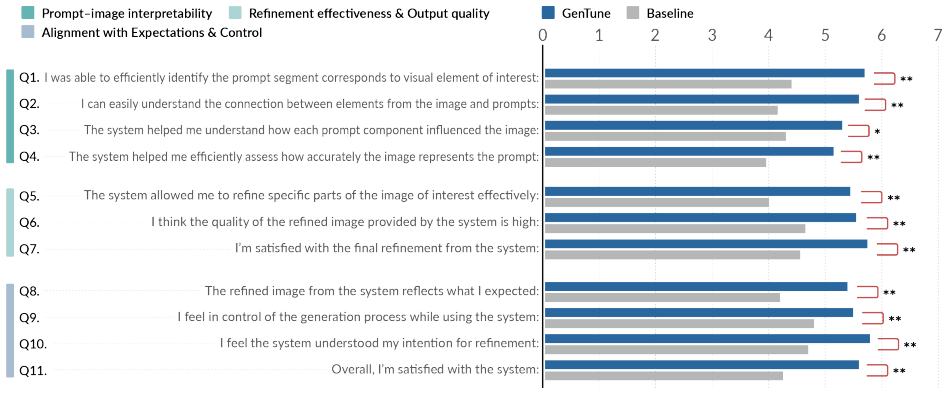
- [Abstract; §6.1; Fig. 7] The abstract states that GenTune significantly improved prompt-image comprehension, refinement quality and efficiency, and overall satisfaction with 'all p < .01.' In the body, however, §6.1 reports the prompt-image interpretability items (Q1–Q3) only at p < .05, and Fig. 7 marks them with a single asterisk. The blanket 'all p < .01' is therefore contradicted by the presented results. Please correct the abstract and report exact p-values for each item, or qualify the statement appropriately.
- [§4.3.1, §6.1, §8.4] The traceable-prompt mechanism is implemented as SAM segmentation followed by CLIP top-5 scoring with a fixed template ('The bright part is a segmentation of label'). The manuscript provides no quantitative accuracy or failure-rate measurement for this mapping. §8.4 concedes that label inaccuracies arise from T2I hallucinations and from an overabundance of similar/ambiguous labels, and §6.1 quotes P11 and P15 reporting wrong or indistinguishable labels in exactly the kind of multi-element scenes environment designers work with. Since RQ1–RQ3 benefits depend on the correctness of the label-region mapping, this is a load-bearing component that is currently unvalidated. Please report mapping accuracy on the study stimuli (e.g., agreement with human-annotated regions) and/or analyze the main outcomes separately for traces that succeeded versus failed. The user study may still support the cla
- [§6.2.3 / Table 2; §5.1.3] The abstract claims significantly improved refinement efficiency, but Table 2 reports raw average time and iterations (12.5 vs. 9.23 minutes; 6.8 vs. 5.3 iterations) without any inferential test. The questionnaire items measure perceived efficiency and quality via self-report, and no objective measure of output quality (e.g., independent expert raters blind to condition) is provided. §8.4 acknowledges the reliance on self-report. Please add significance tests for the Table 2 metrics and, ideally, an external evaluation of final image quality, or temper the claims to 'perceived' efficiency and quality. This is important because the 'quality and efficiency' claim is a headline result.
minor comments (4)
- [§7] The field study includes only three participants, all of whom were returning collaborators from the earlier studies. This should be described explicitly as an exploratory pilot rather than as evidence of generalizable real-world effectiveness. The manuscript's conclusion ('further demonstrated') is stronger than the design supports.
- [§6.1] The phrase '95 and 100% of participants preferred GenTune' is imprecise; please report the actual fractions (e.g., 19/20 and 20/20) for Fig. 8 items Q1–Q3.
- [Throughout] Minor typos and formatting issues: 'intial' in §4.3.1, 'instablilty' in §6.3, 'futuraistic' in §7.2, and 'p ¡' should be 'p <' throughout.
- [§5.1.3] Multiple Wilcoxon tests are run on the Fig. 7 items without correction or effect sizes. This is acceptable for an exploratory HCI study, but reporting effect sizes and confidence intervals would strengthen the quantitative claims.
Circularity Check
No significant circularity; GenTune's claims are grounded in an empirical user study against a baseline, not in a derivation that reduces to its inputs.
full rationale
GenTune is a system paper, not a derivation. The central claims (improved prompt-image comprehension, refinement effectiveness, and satisfaction) come from a within-subjects study comparing GenTune against a baseline that omits the two modules, plus an open-ended task and a field study. The traceable-prompt module extracts labels from the generated structured prompt and uses SAM+CLIP to match selected regions to those labels; this is a design choice about where labels come from, not a fitted parameter later renamed as a prediction. Because the paper does not claim to predict an external ground-truth quantity from first principles, the label-source self-consistency is not circular. The acknowledged label-accuracy limitation in Section 8.4 ('The effectiveness of GenTune's refinement relies heavily on accurate label selection... Label inaccuracies typically arise from hallucinations... and an overabundance of similar or ambiguous labels') is a validity threat to the system's usefulness, but it is an empirical limitation, not a circularity: the user-study outcomes are not logically forced by the label-extraction procedure. The only self-referential element is a citation to the authors' prior AIdeation work [122] as inspiration for the brainstorming module, but that citation is not load-bearing for the paper's main results, which are independently benchmarked against a baseline without the proposed modules. No equation or analysis step reduces to an input by construction, so the appropriate circularity score is 0.
Assumptions & free parameters
free parameters (3)
- Outside-mask darkening ratio =
80%
- Number of candidate labels returned =
5
- Prompt category count =
6
assumptions (5)
- domain assumption Designers value aesthetic coherence over pixel-level accuracy
- domain assumption CLIP text-image similarity is a valid proxy for semantic label-region correspondence
- domain assumption SAM segmentations accurately capture the user-selected visual element
- domain assumption Fixed-seed regeneration with a refined prompt preserves non-targeted elements
- domain assumption Self-reported Likert ratings correspond to actual workflow quality
Cite this review
Pith. "Pith review of GenTune: Toward Traceable Prompts to Improve Controllability of Image Refinement in Environment Design." pith.science (2026). https://pith.science/paper/I4PTKFIH
@misc{pith2026250815227,
  author       = {Pith},
  title        = {Pith review of: GenTune: Toward Traceable Prompts to Improve Controllability of Image Refinement in Environment Design},
  year         = {2026},
  howpublished = {\url{https://pith.science/paper/I4PTKFIH}},
  note         = {Machine review of arXiv:2508.15227}
}
abstract
Environment designers in the entertainment industry create imaginative 2D and 3D scenes for games, films, and television, requiring both fine-grained control of specific details and consistent global coherence. Designers have increasingly integrated generative AI into their workflows, often relying on large language models (LLMs) to expand user prompts for text-to-image generation, then iteratively refining those prompts and applying inpainting. However, our formative study with 10 designers surfaced two key challenges: (1) the lengthy LLM-generated prompts make it difficult to understand and isolate the keywords that must be revised for specific visual elements; and (2) while inpainting supports localized edits, it can struggle with global consistency and correctness. Based on these insights, we present GenTune, an approach that enhances human--AI collaboration by clarifying how AI-generated prompts map to image content. Our GenTune system lets designers select any element in a generated image, trace it back to the corresponding prompt labels, and revise those labels to guide precise yet globally consistent image refinement. In a summative study with 20 designers, GenTune significantly improved prompt--image comprehension, refinement quality, and efficiency, and overall satisfaction (all $p < .01$) compared to current practice. A follow-up field study with two studios further demonstrated its effectiveness in real-world settings.
Figures


Figures from the paper (13 more)




Reference graph
Works this paper leans on
-
[1]
The Ultimate Concept Art Career Guide
3dtotal Publishing. The Ultimate Concept Art Career Guide . 3dtotal Publishing, 2018
2018
-
[2]
Environment designer
M3DS Academy. Environment designer. https://www.artstation.com/blogs/ m3dsacademy/zXXz6/environment-designer, 2024
2024
-
[3]
Promptmap: An alternative interaction style for ai- based image generation
Krzysztof Adamkiewicz, Pawe l Wojciech Wo´ zniak, Julia Dominiak, Andrzej Romanowski, Jakob Karolus, and Stanislav Frolov. Promptmap: An alternative interaction style for ai- based image generation. In Proceedings of the 30th International Conference on Intelligent User Interfaces, IUI ’25, page 1162–1176, New York, NY, USA, 2025. Association for Com- put...
2025
-
[4]
Cognitive processes in iterative design behavior
Robin S Adams and Cynthia J Atman. Cognitive processes in iterative design behavior. In FIE’99 Frontiers in Education. 29th Annual Frontiers in Education Conference. Designing the Future of Science and Engineering Education. Conference Proceedings (IEEE Cat. No. 99CH37011, volume 1, pages 11A6–13. IEEE, 1999
1999
-
[5]
Crafting effective prompts: A guideline for successful image generation
Noor Wahyuni Ahmad and Suzana Ruslan. Crafting effective prompts: A guideline for successful image generation. In 2024 14th International Conference on System Engineering and Technology (ICSET), pages 84–89. IEEE, 2024
2024
-
[6]
Prompting for discovery: Flexible sense-making for ai art-making with dreamsheets
Shm Garanganao Almeda, JD Zamfirescu-Pereira, Kyu Won Kim, Pradeep Mani Rathnam, and Bjoern Hartmann. Prompting for discovery: Flexible sense-making for ai art-making with dreamsheets. In Proceedings of the CHI Conference on Human Factors in Computing Systems, pages 1–17, 2024
2024
-
[7]
The concept of coherence in art
L Aschenbrenner. The concept of coherence in art. Springer Science & Business Media, 2012
2012
-
[8]
Human-centered ai: The role of human-centered design research in the development of ai
Jan Auernhammer. Human-centered ai: The role of human-centered design research in the development of ai. 2020
2020
Show all 145 references
-
[9]
Does the whole exceed its parts? the effect of ai ex- planations on complementary team performance
Gagan Bansal, Tongshuang Wu, Joyce Zhou, Raymond Fok, Besmira Nushi, Ece Kamar, Marco Tulio Ribeiro, and Daniel Weld. Does the whole exceed its parts? the effect of ai ex- planations on complementary team performance. In Proceedings of the 2021 CHI Conference on Human Factors ...
2021
-
[10]
A review of ai image generator: influences, challenges, and future prospects for architectural field
Eleonora Vilgia Putri Beyan, Anastasya Gisela Cinintya Rossy, et al. A review of ai image generator: influences, challenges, and future prospects for architectural field. Journal of Artificial Intelligence in Architecture , 2(1):53–65, 2023
2023
-
[11]
Challenges in generating accurate text in images: A benchmark for text-to-image models on specialized content
Zenab Bosheah and Vilmos Bilicki. Challenges in generating accurate text in images: A benchmark for text-to-image models on specialized content. Applied Sciences, 15(5):2274, 2025
2025
-
[12]
Generative ai for vision: A comprehensive study of frameworks and applications
Fouad Bousetouane. Generative ai for vision: A comprehensive study of frameworks and applications. arXiv preprint arXiv:2501.18033 , 2025
2025 arXiv
-
[13]
Promp- tify: Text-to-image generation through interactive prompt exploration with large language models
Stephen Brade, Bryan Wang, Mauricio Sousa, Sageev Oore, and Tovi Grossman. Promp- tify: Text-to-image generation through interactive prompt exploration with large language models. In Proceedings of the 36th Annual ACM Symposium on User Interface Software and Technology, pages ...
2023
-
[14]
The Pocket Mentor for Video Game UX UI (The Pocket Mentors for Games Careers)
Simon Brewer. The Pocket Mentor for Video Game UX UI (The Pocket Mentors for Games Careers). 1st edition, 2023
2023
-
[15]
Exploring the role of text-to-image ai in concept generation
Ross Brisco, Laura Hay, and Sam Dhami. Exploring the role of text-to-image ai in concept generation. Proceedings of the Design Society , 3:1835–1844, 2023
2023
-
[16]
Instructpix2pix: Learning to follow image editing instructions
Tim Brooks, Aleksander Holynski, and Alexei A Efros. Instructpix2pix: Learning to follow image editing instructions. In Proceedings of the IEEE/CVF conference on computer vision and pattern recognition, pages 18392–18402, 2023
2023
-
[17]
Peculiarity of interior design materials for accommodation areas of cruise ships: A state-of-the-art review
L-S Byun. Peculiarity of interior design materials for accommodation areas of cruise ships: A state-of-the-art review. Ships and Offshore Structures , 1(3):171–183, 2006. 25
2006
-
[18]
Designaid: Using generative ai and semantic di- versity for design inspiration
Alice Cai, Steven R Rick, Jennifer L Heyman, Yanxia Zhang, Alexandre Filipowicz, Matthew Hong, Matt Klenk, and Thomas Malone. Designaid: Using generative ai and semantic di- versity for design inspiration. In Proceedings of The ACM Collective Intelligence Conference, pages 1–11, 2023
2023
-
[19]
Testing for preference using a sum of wilcoxon signed rank statistics
Marinela Capanu, Gregory A Jones, and Ronald H Randles. Testing for preference using a sum of wilcoxon signed rank statistics. Computational statistics & data analysis , 51(2):793– 796, 2006
2006
-
[20]
Environment designer
cgspectrum. Environment designer. https://www.cgspectrum.com/career-pathways/ environment-designer, 2024
2024
-
[21]
Get- ting it right: Improving spatial consistency in text-to-image models
Agneet Chatterjee, Gabriela Ben Melech Stan, Estelle Aflalo, Sayak Paul, Dhruba Ghosh, Tejas Gokhale, Ludwig Schmidt, Hannaneh Hajishirzi, Vasudev Lal, Chitta Baral, et al. Get- ting it right: Improving spatial consistency in text-to-image models. In European Conference on Com...
2024
-
[22]
Kim, and Nadir Weibel
Chen Chen, Cuong Nguyen, Thibault Groueix, Vladimir G. Kim, and Nadir Weibel. Memovis: A genai-powered tool for creating companion reference images for 3d design feedback. ACM Trans. Comput.-Hum. Interact., 31(5), November 2024
2024
-
[23]
Autospark: Supporting automobile appearance design ideation with kansei engineering and generative ai
Liuqing Chen, Qianzhi Jing, Yixin Tsang, Qianyi Wang, Ruocong Liu, Duowei Xia, Yunzhan Zhou, and Lingyun Sun. Autospark: Supporting automobile appearance design ideation with kansei engineering and generative ai. In Proceedings of the 37th Annual ACM Symposium on User Interfac...
2024
-
[24]
Towards reasoning era: A survey of long chain-of-thought for reasoning large language models
Qiguang Chen, Libo Qin, Jinhao Liu, Dengyun Peng, Jiannan Guan, Peng Wang, Mengkang Hu, Yuhang Zhou, Te Gao, and Wangxiang Che. Towards reasoning era: A survey of long chain-of-thought for reasoning large language models. arXiv preprint arXiv:2503.09567, 2025
2025 arXiv
-
[25]
Next steps for human-centered generative ai: A technical perspective
Xiang’Anthony’ Chen, Jeff Burke, Ruofei Du, Matthew K Hong, Jennifer Jacobs, Philippe Laban, Dingzeyu Li, Nanyun Peng, Karl DD Willis, Chien-Sheng Wu, et al. Next steps for human-centered generative ai: A technical perspective. arXiv preprint arXiv:2306.15774 , 2023
2023 arXiv
-
[26]
Elevating and sharpening convergent thinking: The potential of generative ai for creative professionals
YU-HAN CHIU and Chun-Ching Chen. Elevating and sharpening convergent thinking: The potential of generative ai for creative professionals. Available at SSRN 4911494 , 2024
2024
-
[27]
Cre- ativeconnect: Supporting reference recombination for graphic design ideation with generative ai
DaEun Choi, Sumin Hong, Jeongeon Park, John Joon Young Chung, and Juho Kim. Cre- ativeconnect: Supporting reference recombination for graphic design ideation with generative ai. In Proceedings of the CHI Conference on Human Factors in Computing Systems , pages 1–25, 2024
2024
-
[28]
Prompting for products: investigating design space exploration strategies for text-to-image generative models
Leah Chong, I-Ping Lo, Jude Rayan, Steven Dow, Faez Ahmed, and Ioanna Lykourentzou. Prompting for products: investigating design space exploration strategies for text-to-image generative models. Design Science, 11:e2, 2025
2025
-
[29]
Promptpaint: Steering text-to-image generation through paint medium-like interactions
John Joon Young Chung and Eytan Adar. Promptpaint: Steering text-to-image generation through paint medium-like interactions. In Proceedings of the 36th Annual ACM Symposium on User Interface Software and Technology, UIST ’23, New York, NY, USA, 2023. Association for Computing ...
2023
-
[30]
The intersection of users, roles, interactions, and technologies in creativity support tools
John Joon Young Chung, Shiqing He, and Eytan Adar. The intersection of users, roles, interactions, and technologies in creativity support tools. In Proceedings of the 2021 ACM Designing Interactive Systems Conference , DIS ’21, page 1817–1833, New York, NY, USA,
2021
-
[31]
Comfyui: A powerful and modular stable diffusion gui and backend
ComfyUI Contributors. Comfyui: A powerful and modular stable diffusion gui and backend. https://github.com/comfyanonymous/ComfyUI, 2023
2023
-
[32]
Intellingo: An intelligible translation en- vironment
Sven Coppers, Jan Van den Bergh, Kris Luyten, Karin Coninx, Iulianna van der Lek-Ciudin, Tom Vanallemeersch, and Vincent Vandeghinste. Intellingo: An intelligible translation en- vironment. In Proceedings of the 2018 CHI Conference on Human Factors in Computing Systems, CHI ’1...
2018
-
[33]
Insight-v: Exploring long-chain visual reasoning with multimodal large language models
Yuhao Dong, Zuyan Liu, Hai-Long Sun, Jingkang Yang, Winston Hu, Yongming Rao, and Ziwei Liu. Insight-v: Exploring long-chain visual reasoning with multimodal large language models. arXiv preprint arXiv:2411.14432 , 2024
2024 arXiv
-
[34]
Generative ai enhances individual creativity but reduces the collective diversity of novel content
Anil R Doshi and Oliver P Hauser. Generative ai enhances individual creativity but reduces the collective diversity of novel content. Science Advances, 10(28):eadn5290, 2024
2024
-
[35]
What is game environment design and how to get started? https://www.domestika.org/en/blog/ 10804-what-is-game-environment-design-and-how-to-get-started , 2022
Lauren du Plessis. What is game environment design and how to get started? https://www.domestika.org/en/blog/ 10804-what-is-game-environment-design-and-how-to-get-started , 2022
2022
-
[36]
Explainable ai (xai): Core ideas, techniques, and solutions
Rudresh Dwivedi, Devam Dave, Het Naik, Smiti Singhal, Rana Omer, Pankesh Patel, Bin Qian, Zhenyu Wen, Tejal Shah, Graham Morgan, and Rajiv Ranjan. Explainable ai (xai): Core ideas, techniques, and solutions. ACM Comput. Surv. , 55(9), January 2023
2023
-
[37]
Vera Liao, Elizabeth Anne Watkins, Carina Manger, Hal Daum´ e III, Andreas Riener, and Mark O Riedl
Upol Ehsan, Philipp Wintersberger, Q. Vera Liao, Elizabeth Anne Watkins, Carina Manger, Hal Daum´ e III, Andreas Riener, and Mark O Riedl. Human-centered explainable ai (hcxai): Beyond opening the black-box of ai. In Extended Abstracts of the 2022 CHI Conference on Human Facto...
2022
-
[38]
Expertise elevates ai usage: experimental evidence comparing laypeople and professional artists
Thomas F Eisenmann, Andres Karjus, Mar Canet Sola, Levin Brinkmann, Braman- tyo Ibrahim Supriyatno, and Iyad Rahwan. Expertise elevates ai usage: experimental evidence comparing laypeople and professional artists. arXiv preprint arXiv:2501.12374 , 2025
2025 arXiv
-
[39]
Ganzilla: User-driven direction discovery in gen- erative adversarial networks
Noyan Evirgen and Xiang’Anthony’ Chen. Ganzilla: User-driven direction discovery in gen- erative adversarial networks. In Proceedings of the 35th Annual ACM Symposium on User Interface Software and Technology, pages 1–10, 2022
2022
-
[40]
Ganravel: User-driven direction disentanglement in generative adversarial networks
Noyan Evirgen and Xiang’Anthony Chen. Ganravel: User-driven direction disentanglement in generative adversarial networks. In Proceedings of the 2023 CHI Conference on Human Factors in Computing Systems , pages 1–15, 2023
2023
-
[41]
From text to pixels: Enhancing user understanding through text-to-image model explanations
Noyan Evirgen, Ruolin Wang, and Xiang ’Anthony Chen. From text to pixels: Enhancing user understanding through text-to-image model explanations. In Proceedings of the 29th International Conference on Intelligent User Interfaces , IUI ’24, page 74–87, New York, NY, USA, 2024. A...
2024
-
[42]
Promptmagician: Interactive prompt engineering for text-to- image creation
Yingchaojie Feng, Xingbo Wang, Kam Kwai Wong, Sijia Wang, Yuhong Lu, Minfeng Zhu, Baicheng Wang, and Wei Chen. Promptmagician: Interactive prompt engineering for text-to- image creation. IEEE Transactions on Visualization and Computer Graphics , 30(1):295–305, 2023
2023
-
[43]
How digital tools im- pact convergent and divergent thinking in design ideation
Jonas Frich, Midas Nouwens, Kim Halskov, and Peter Dalsgaard. How digital tools im- pact convergent and divergent thinking in design ideation. In Proceedings of the 2021 CHI Conference on Human Factors in Computing Systems , CHI ’21, New York, NY, USA, 2021. Association for Co...
2021
-
[44]
” i like your story!”: A co-creative story-crafting game with a persona-driven character based on generative ai
Jiaying Fu, Xiruo Wang, Zhouyi Li, Kate Vi, Chuyan Xu, and Yuqian Sun. ” i like your story!”: A co-creative story-crafting game with a persona-driven character based on generative ai. arXiv preprint arXiv:2503.09102 , 2025
2025 arXiv
-
[45]
The paradox of artificial creativity: Challenges and opportunities of gen- erative ai artistry
Manuel B Garcia. The paradox of artificial creativity: Challenges and opportunities of gen- erative ai artistry. Creativity Research Journal, pages 1–14, 2024
2024
-
[46]
Seed-data-edit technical report: A hybrid dataset for instructional image editing
Yuying Ge, Sijie Zhao, Chen Li, Yixiao Ge, and Ying Shan. Seed-data-edit technical report: A hybrid dataset for instructional image editing. arXiv preprint arXiv:2405.04007 , 2024
2024 arXiv
-
[47]
Prompthis: Visualizing the process and influence of prompt editing during text-to-image creation
Yuhan Guo, Hanning Shao, Can Liu, Kai Xu, and Xiaoru Yuan. Prompthis: Visualizing the process and influence of prompt editing during text-to-image creation. IEEE Transactions on Visualization and Computer Graphics , 2024
2024
-
[48]
Archcode: In- corporating software requirements in code generation with large language models
Hojae Han, Jaejin Kim, Jaeseok Yoo, Youngwon Lee, and Seung-won Hwang. Archcode: In- corporating software requirements in code generation with large language models. In Proceed- ings of the 62nd Annual Meeting of the Association for Computational Linguistics (Volume 1: Long Pa...
2024
-
[49]
Multi-stage guided code generation for large language models
Yewei Han and Chen Lyu. Multi-stage guided code generation for large language models. Engineering Applications of Artificial Intelligence , 139:109491, 2025
2025
-
[50]
Viewdiff: 3d-consistent image gener- ation with text-to-image models
Lukas H¨ ollein, Aljaˇ z Boˇ ziˇ c, Norman M¨ uller, David Novotny, Hung-Yu Tseng, Christian Richardt, Michael Zollh¨ ofer, and Matthias Nießner. Viewdiff: 3d-consistent image gener- ation with text-to-image models. In Proceedings of the IEEE/CVF conference on computer vision ...
2024
-
[51]
Di- rect2v: Large language models are frame-level directors for zero-shot text-to-video generation
Susung Hong, Junyoung Seo, Heeseong Shin, Sunghwan Hong, and Seungryong Kim. Di- rect2v: Large language models are frame-level directors for zero-shot text-to-video generation. arXiv preprint arXiv:2305.14330 , 2023
2023 arXiv
-
[52]
Hu, Yelong Shen, Phillip Wallis, Zeyuan Allen-Zhu, Yuanzhi Li, Shean Wang, and Weizhu Chen
Edward J. Hu, Yelong Shen, Phillip Wallis, Zeyuan Allen-Zhu, Yuanzhi Li, Shean Wang, and Weizhu Chen. Lora: Low-rank adaptation of large language models. In International Conference on Learning Representations, 2021
2021
-
[53]
Dialoggen: Multi-modal interactive dialogue system for multi-turn text-to-image generation
Minbin Huang, Yanxin Long, Xinchi Deng, Ruihang Chu, Jiangfeng Xiong, Xiaodan Liang, Hong Cheng, Qinglin Lu, and Wei Liu. Dialoggen: Multi-modal interactive dialogue system for multi-turn text-to-image generation. arXiv preprint arXiv:2403.08857 , 2024
2024 arXiv
-
[54]
Plantography: Incorporating iterative design process into generative artificial intelligence for landscape ren- dering
Rong Huang, Haichuan Lin, Chuanzhang Chen, Kang Zhang, and Wei Zeng. Plantography: Incorporating iterative design process into generative artificial intelligence for landscape ren- dering. In Proceedings of the 2024 CHI Conference on Human Factors in Computing Systems, CHI ’24...
2024
-
[55]
Videodiff: Human-ai video co-creation with alternatives
Mina Huh, Dingzeyu Li, Kim Pimmel, Hijung Valentina Shin, Amy Pavel, and Mira Dontcheva. Videodiff: Human-ai video co-creation with alternatives. arXiv preprint arXiv:2502.10190, 2025
2025 arXiv
-
[56]
The association of creativity with diver- gent and convergent thinking
Syed Fahad Javaid and James Paul Pandarakalam. The association of creativity with diver- gent and convergent thinking. Psychiatria danubina , 33(2):133–139, 2021
2021
-
[57]
Shih, and Kyungsik Han
Youngseung Jeon, Seungwan Jin, Patrick C. Shih, and Kyungsik Han. Fashionq: An ai-driven creativity support tool for facilitating ideation in fashion design. In Proceedings of the 2021 CHI Conference on Human Factors in Computing Systems , CHI ’21, New York, NY, USA,
2021
-
[58]
Jiang, Lauren Brown, Jessica Cheng, Mehtab Khan, Abhishek Gupta, Deja Work- man, Alex Hanna, Johnathan Flowers, and Timnit Gebru
Harry H. Jiang, Lauren Brown, Jessica Cheng, Mehtab Khan, Abhishek Gupta, Deja Work- man, Alex Hanna, Johnathan Flowers, and Timnit Gebru. Ai art and its impact on artists. In Proceedings of the 2023 AAAI/ACM Conference on AI, Ethics, and Society , AIES ’23, page 363–374, New ...
2023
-
[60]
Analysis and refinement of iterative design processes
Eric William Johnson. Analysis and refinement of iterative design processes . University of Notre Dame, 1997
1997
-
[61]
Self-planning code generation with large language models
Xue Jiang, Yihong Dong, Lecheng Wang, Zheng Fang, Qiwei Shang, Ge Li, Zhi Jin, and Wenpin Jiao. Self-planning code generation with large language models. ACM Transactions on Software Engineering and Methodology , 33(7):1–30, 2024
2024
-
[62]
Sunnie S. Y. Kim, Elizabeth Anne Watkins, Olga Russakovsky, Ruth Fong, and Andr´ es Monroy-Hern´ andez. ”help me help the ai”: Understanding how explainability can support human-ai interaction. In Proceedings of the 2023 CHI Conference on Human Factors in Com- puting Systems ,...
2023
-
[63]
Convergent versus divergent thinking
Kyung Hee Kim and Robert A Pierce. Convergent versus divergent thinking. Encyclopedia of creativity, invention, innovation and entrepreneurship , pages 245–250, 2013
2013
-
[64]
Large- scale text-to-image generation models for visual artists’ creative works
Hyung-Kwon Ko, Gwanmo Park, Hyeon Jeon, Jaemin Jo, Juho Kim, and Jinwook Seo. Large- scale text-to-image generation models for visual artists’ creative works. In Proceedings of the 28th international conference on intelligent user interfaces , pages 919–933, 2023
2023
-
[65]
Segment anything
Alexander Kirillov, Eric Mintun, Nikhila Ravi, Hanzi Mao, Chloe Rolland, Laura Gustafson, Tete Xiao, Spencer Whitehead, Alexander C Berg, Wan-Yen Lo, et al. Segment anything. In Proceedings of the IEEE/CVF international conference on computer vision, pages 4015–4026, 2023
2023
-
[66]
Human creativ- ity in the age of llms: Randomized experiments on divergent and convergent thinking
Harsh Kumar, Jonathan Vincentius, Ewan Jordan, and Ashton Anderson. Human creativ- ity in the age of llms: Randomized experiments on divergent and convergent thinking. In Proceedings of the 2025 CHI Conference on Human Factors in Computing Systems , CHI ’25, New York, NY, USA,...
2025
-
[67]
Un- derstanding visual artists’ adoption of large-scale text-to-image generation models for creative works
Hyung-Kwon Ko, Gwanmo Park, Hyeon Jeon, Jaemin Jo, Juho Kim, and Jinwook Seo. Un- derstanding visual artists’ adoption of large-scale text-to-image generation models for creative works. In Proceedings of the 2023 ACM SIGCHI Conference on Human Factors in Computing Systems, pag...
2023
-
[68]
Flowgpt: Exploring domains, output modalities, and goals of community-generated ai chatbots
Xian Li, Yuanning Han, Di Liu, Pengcheng An, and Shuo Niu. Flowgpt: Exploring domains, output modalities, and goals of community-generated ai chatbots. In Companion Publication of the 2024 Conference on Computer-Supported Cooperative Work and Social Computing , pages 355–361, 2024
2024
-
[69]
Enhancing compositional text-to- image generation with reliable random seeds
Shuangqi Li, Hieu Le, Jingyi Xu, and Mathieu Salzmann. Enhancing compositional text-to- image generation with reliable random seeds. arXiv preprint arXiv:2411.18810 , 2024. 29
2024 arXiv
-
[70]
Eliott J. Lilly. Big Bad World of Concept Art for Video Games: An Insider’s Guide for Students. Design Studio Press, 2015
2015
-
[71]
Human-centered explainable ai (xai): From algorithms to user experiences
Q Vera Liao and Kush R Varshney. Human-centered explainable ai (xai): From algorithms to user experiences. arXiv preprint arXiv:2110.10790 , 2021
2021 arXiv
-
[72]
Sketchflex: Facilitating spatial- semantic coherence in text-to-image generation with region-based sketches
Haichuan Lin, Yilin Ye, Jiazhi Xia, and Wei Zeng. Sketchflex: Facilitating spatial- semantic coherence in text-to-image generation with region-based sketches. arXiv preprint arXiv:2502.07556, 2025
2025 arXiv
-
[73]
Inkspire: Supporting design exploration with generative ai through analogical sketching
David Chuan-En Lin, Hyeonsu B Kang, Nikolas Martelaro, Aniket Kittur, Yan-Ying Chen, and Matthew K Hong. Inkspire: Supporting design exploration with generative ai through analogical sketching. arXiv preprint arXiv:2501.18588 , 2025
2025 arXiv
-
[74]
Design guidelines for prompt engineering text-to-image gen- erative models
Vivian Liu and Lydia B Chilton. Design guidelines for prompt engineering text-to-image gen- erative models. In Proceedings of the 2022 CHI Conference on Human Factors in Computing Systems, CHI ’22, New York, NY, USA, 2022. Association for Computing Machinery
2022
-
[75]
From prompt engineering to prompt craft
Joseph Lindley and Roger Whitham. From prompt engineering to prompt craft. In Pro- ceedings of the Nineteenth International Conference on Tangible, Embedded, and Embodied Interaction, pages 1–12, 2025
2025
-
[76]
3dall-e: Integrating text- to-image ai in 3d design workflows
Vivian Liu, Jo Vermeulen, George Fitzmaurice, and Justin Matejka. 3dall-e: Integrating text- to-image ai in 3d design workflows. In Proceedings of the 2023 ACM Designing Interactive Systems Conference, DIS ’23, page 1955–1977, New York, NY, USA, 2023. Association for Computing...
2023
-
[77]
Opal: Multimodal image generation for news illustration
Vivian Liu, Han Qiao, and Lydia Chilton. Opal: Multimodal image generation for news illustration. In Proceedings of the 35th Annual ACM Symposium on User Interface Software and Technology, UIST ’22, New York, NY, USA, 2022. Association for Computing Machinery
2022
-
[78]
Elaborating a framework that is able to structure and evaluate design workflow and composition of generative ai visualiza- tions
Gianmarco Longo, Deborah Middleton, and Silvia Albano. Elaborating a framework that is able to structure and evaluate design workflow and composition of generative ai visualiza- tions. In IHIET-AI 2024: 11th International Conference on Human Interaction & Emerging Technologies...
2024
-
[79]
Sketchar: Supporting character design and illustration prototyping using generative ai
LING Long, CHEN Xinyi, WEN Ruoyu, LI Toby Jia-Jun, and LC Ray. Sketchar: Supporting character design and illustration prototyping using generative ai. Proceedings of the ACM on Human-Computer Interaction, 8(CHI PLAY):337, 2024
2024
-
[80]
Llm-generated explanations for recommender systems
Sebastian Lubos, Thi Ngoc Trang Tran, Alexander Felfernig, Seda Polat Erdeniz, and Viet- Man Le. Llm-generated explanations for recommender systems. In Adjunct Proceedings of the 32nd ACM Conference on User Modeling, Adaptation and Personalization , pages 276–285, 2024
2024
-
[81]
Ryan Louie, Andy Coenen, Cheng Zhi Huang, Michael Terry, and Carrie J. Cai. Novice-ai music co-creation via ai-steering tools for deep generative models. In Proceedings of the 2020 CHI Conference on Human Factors in Computing Systems , CHI ’20, page 1–13, New York, NY, USA, 20...
2020
-
[82]
Gpt4motion: Scripting physical motions in text-to-video generation via blender-oriented gpt planning
Jiaxi Lv, Yi Huang, Mingfu Yan, Jiancheng Huang, Jianzhuang Liu, Yifan Liu, Yafei Wen, Xiaoxin Chen, and Shifeng Chen. Gpt4motion: Scripting physical motions in text-to-video generation via blender-oriented gpt planning. In Proceedings of the IEEE/CVF conference on computer vi...
2024
-
[83]
Repaint: Inpainting using denoising diffusion probabilistic models
Andreas Lugmayr, Martin Danelljan, Andres Romero, Fisher Yu, Radu Timofte, and Luc Van Gool. Repaint: Inpainting using denoising diffusion probabilistic models. In Proceedings of the IEEE/CVF conference on computer vision and pattern recognition, pages 11461–11471, 2022
2022
-
[84]
The Random Guidebook of Concept Designers : Tips and Tricks
Adrian Marc. The Random Guidebook of Concept Designers : Tips and Tricks . JOLUA, 1st edition, 2023
2023
-
[85]
Improving text-to-image consistency via automatic prompt optimization
Oscar Ma˜ nas, Pietro Astolfi, Melissa Hall, Candace Ross, Jack Urbanek, Adina Williams, Aishwarya Agrawal, Adriana Romero-Soriano, and Michal Drozdzal. Improving text-to-image consistency via automatic prompt optimization. arXiv preprint arXiv:2403.17804 , 2024
2024 arXiv
-
[86]
” i don’t want to feel like i’m working in a 1960s factory”: The practitioner perspective on creativity support tool adoption
Srishti Palani, David Ledo, George Fitzmaurice, and Fraser Anderson. ” i don’t want to feel like i’m working in a 1960s factory”: The practitioner perspective on creativity support tool adoption. In Proceedings of the 2022 CHI Conference on Human Factors in Computing Systems, ...
2022
-
[87]
Prompting ai art: An investi- gation into the creative skill of prompt engineering
Jonas Oppenlaender, Rhema Linder, and Johanna Silvennoinen. Prompting ai art: An investi- gation into the creative skill of prompt engineering. International journal of human–computer interaction, pages 1–23, 2024
2024
-
[88]
Exploring visual prompts: Refining images with scribbles and annotations in generative ai image tools
Hyerim Park, Malin Eiband, Andre Luckow, and Michael Sedlmair. Exploring visual prompts: Refining images with scribbles and annotations in generative ai image tools. arXiv preprint arXiv:2503.03398, 2025
2025 arXiv
-
[89]
Evolving roles and workflows of creative practitioners in the age of generative ai
Srishti Palani and Gonzalo Ramos. Evolving roles and workflows of creative practitioners in the age of generative ai. In Proceedings of the 16th Conference on Creativity & Cognition , C&C ’24, page 170–184, New York, NY, USA, 2024. Association for Computing Machinery
2024
-
[90]
Ai image generator
Manisha Pise, Naveen Yadgiri, Preksha Gaikwad, Yashika Dusawar, and Prathamesh Nan- danwar. Ai image generator. networks (GANs) , 4(4), 2024
2024
-
[91]
Xiaohan Peng, Janin Koch, and Wendy E. Mackay. Designprompt: Using multimodal inter- action for design exploration with generative ai. page 804–818, 2024
2024
-
[92]
Learning transferable visual models from natural language supervision
Alec Radford, Jong Wook Kim, Chris Hallacy, Aditya Ramesh, Gabriel Goh, Sandhini Agar- wal, Girish Sastry, Amanda Askell, Pamela Mishkin, Jack Clark, et al. Learning transferable visual models from natural language supervision. In International conference on machine learning, ...
2021
-
[93]
Evaluating consistency of image generation models with vector similarity
CB Pronin, AA Podberezkin, and AM Borzenkov. Evaluating consistency of image generation models with vector similarity. In 2024 Intelligent Technologies and Electronic Devices in Vehicle and Road Transport Complex (TIR VED), pages 1–4. IEEE, 2024
2024
-
[94]
Design principles for tools to support creative thinking
Mitchel Resnick, Brad Myers, Kumiyo Nakakoji, Ben Shneiderman, Randy Pausch, Ted Selker, and Mike Eisenberg. Design principles for tools to support creative thinking. 2005
2005
-
[95]
From explainable to interactive ai: A literature review on current trends in human-ai interaction
Muhammad Raees, Inge Meijerink, Ioanna Lykourentzou, Vassilis-Javed Khan, and Kon- stantinos Papangelis. From explainable to interactive ai: A literature review on current trends in human-ai interaction. International Journal of Human-Computer Studies , page 103301, 2024
2024
-
[96]
Ana Rodrigues, Diogo Cabral, and Pedro F. Campos. Creativity support tools and convergent thinking: A preliminary review on idea evaluation and selection. In Proceedings of the 15th Conference on Creativity and Cognition, C&C ’23, page 305–311, New York, NY, USA, 2023. Associa...
2023
-
[97]
Analysis of paired likert data: how to evaluate change and preference questions
Paula K Roberson, SJ Shema, DJ Mundfrom, and TM Holmes. Analysis of paired likert data: how to evaluate change and preference questions. Family medicine, 27(10):671–675, 1995
1995
-
[98]
Dreambooth: Fine tuning text-to-image diffusion models for subject-driven generation
Nataniel Ruiz, Yuanzhen Li, Varun Jampani, Yael Pritch, Michael Rubinstein, and Kfir Aber- man. Dreambooth: Fine tuning text-to-image diffusion models for subject-driven generation. In Proceedings of the IEEE/CVF conference on computer vision and pattern recognition, pages 225...
2023
-
[99]
High-resolution image synthesis with latent diffusion models
Robin Rombach, Andreas Blattmann, Dominik Lorenz, Patrick Esser, and Bj¨ orn Ommer. High-resolution image synthesis with latent diffusion models. InProceedings of the IEEE/CVF conference on computer vision and pattern recognition , pages 10684–10695, 2022
2022
-
[100]
Critical reflections on visualization authoring systems
Arvind Satyanarayan, Bongshin Lee, Donghao Ren, Jeffrey Heer, John Stasko, John Thomp- son, Matthew Brehmer, and Zhicheng Liu. Critical reflections on visualization authoring systems. IEEE transactions on visualization and computer graphics , 26(1):461–471, 2019
2019
-
[101]
Layered chain-of-thought prompting for multi-agent llm systems: A com- prehensive approach to explainable large language models
Manish Sanwal. Layered chain-of-thought prompting for multi-agent llm systems: A com- prehensive approach to explainable large language models. arXiv preprint arXiv:2501.18645 , 2025
2025 arXiv
-
[102]
The Art of Game Design: A Book of Lenses
Jesse Schell. The Art of Game Design: A Book of Lenses . CRC Press, 2008
2008
-
[103]
Ojas D. Sawant. Visual Storytelling with Generative AI: A Practical Handbook for modern Filmmakers and Content Creators . Independently published, 2024
2024
-
[104]
Understanding generative ai in art: An interview study with artists on g-ai from an hci perspective
Jingyu Shi, Rahul Jain, Runlin Duan, and Karthik Ramani. Understanding generative ai in art: An interview study with artists on g-ai from an hci perspective. arXiv preprint arXiv:2310.13149, 2023
2023 arXiv
-
[105]
A programmable interface for creative exploration
Pol Baladas Gerard Serra, Oriol Domingo, and Pol Baladas. A programmable interface for creative exploration. In Machine Learning for Creativity and Design Workshop at the 36th Conference on Neural Information Processing Systems (NeurIPS 2022)(December 2022). https://neuripscre...
2022
-
[106]
Genquery: Support- ing expressive visual search with generative models
Kihoon Son, DaEun Choi, Tae Soo Kim, Young-Ho Kim, and Juho Kim. Genquery: Support- ing expressive visual search with generative models. In Proceedings of the CHI Conference on Human Factors in Computing Systems , pages 1–19, 2024. 32
2024
-
[107]
Human-centered AI
Ben Shneiderman. Human-centered AI. Oxford University Press, 2022
2022
-
[108]
Generative ai in the wild: Prospects, challenges, and strategies
Yuan Sun, Eunchae Jang, Fenglong Ma, and Ting Wang. Generative ai in the wild: Prospects, challenges, and strategies. In Proceedings of the 2024 CHI Conference on Human Factors in Computing Systems , CHI ’24, New York, NY, USA, 2024. Association for Computing Machinery
2024
-
[109]
The shaping of form: Exploring designers’ use of aesthetic knowledge
Ileana Stigliani and Davide Ravasi. The shaping of form: Exploring designers’ use of aesthetic knowledge. Organization Studies, 39(5-6):747–784, 2018
2018
-
[110]
Using generative ai midjourney to enhance divergent and conver- gent thinking in an architect’s creative design process
Linus Tan and Max Luhrs. Using generative ai midjourney to enhance divergent and conver- gent thinking in an architect’s creative design process. The Design Journal , 27(4):677–699, 2024
2024
-
[111]
A generalization of the wilcoxon signed-rank test and its applications
SM Taheri and Gholamreza Hesamian. A generalization of the wilcoxon signed-rank test and its applications. Statistical Papers, 54:457–470, 2013
2013
-
[112]
What’s next? exploring utiliza- tion, challenges, and future directions of ai-generated image tools in graphic design
Yuying Tang, Mariana Ciancia, Zhigang Wang, and Ze Gao. What’s next? exploring utiliza- tion, challenges, and future directions of ai-generated image tools in graphic design. arXiv preprint arXiv:2406.13436, 2024
2024 arXiv
-
[113]
Mimir: Improving video diffusion models for precise text understanding
Shuai Tan, Biao Gong, Yutong Feng, Kecheng Zheng, Dandan Zheng, Shuwei Shi, Yujun Shen, Jingdong Chen, and Ming Yang. Mimir: Improving video diffusion models for precise text understanding. In Proceedings of the Computer Vision and Pattern Recognition Conference , pages 23978–...
2025
-
[114]
Keyframer: Empowering animation design using large language models
Tiffany Tseng, Ruijia Cheng, and Jeffrey Nichols. Keyframer: Empowering animation design using large language models. arXiv preprint arXiv:2402.06071 , 2024
2024 arXiv
-
[115]
Interpretability as a dynamic of human-ai interaction
Anja Thieme, Ed Cutrell, Cecily Morrison, Alex Taylor, and Abigail Sellen. Interpretability as a dynamic of human-ai interaction. Interactions, 27(5):40–45, September 2020
2020
-
[116]
an adapt-or-die type of situation
Veera Vimpari, Annakaisa Kultima, Perttu H¨ am¨ al¨ ainen, and Christian Guckelsberger. “an adapt-or-die type of situation”: Perception, adoption, and use of text-to-image-generation ai by game industry professionals. Proceedings of the ACM on Human-Computer Interaction , 7(CH...
2023
-
[117]
Happonen, and J
Usman Ahmad Usmani, A. Happonen, and J. Watada. Human-centered artificial intelligence: Designing for user empowerment and ethical considerations. 2023 5th International Congress on Human-Computer Interaction, Optimization and Robotic Applications (HORA) , pages 01–05, 2023
2023
-
[118]
Learning to learn better visual prompts
Fengxiang Wang, Wanrong Huang, Shaowu Yang, Qi Fan, and Long Lan. Learning to learn better visual prompts. In Proceedings of the AAAI Conference on Artificial Intelligence , volume 38, pages 5354–5363, 2024
2024
-
[119]
Breaking the midas spell: Understanding progressive novice-ai collaboration in spatial design
Zijun Wan, Jiawei Tang, Linghang Cai, Xin Tong, and Can Liu. Breaking the midas spell: Understanding progressive novice-ai collaboration in spatial design. arXiv preprint arXiv:2410.20124, 2024
2024 arXiv
-
[120]
Roomdreaming: Generative-ai approach to facilitating iterative, preliminary interior design exploration
Shun-Yu Wang, Wei-Chung Su, Serena Chen, Ching-Yi Tsai, Marta Misztal, Katherine M Cheng, Alwena Lin, Yu Chen, and Mike Y Chen. Roomdreaming: Generative-ai approach to facilitating iterative, preliminary interior design exploration. In Proceedings of the CHI Conference on Huma...
2024
-
[121]
Layered representation for motion analysis
John YA Wang and Edward H Adelson. Layered representation for motion analysis. In Proceedings of IEEE Conference on Computer Vision and Pattern Recognition , pages 361–
-
[122]
Aideation: Designing a human-ai collaborative ideation system for concept designers
Wen-Fan Wang, Chien-Ting Lu, Nil Ponsa Campany` a, Bing-Yu Chen, and Mike Y Chen. Aideation: Designing a human-ai collaborative ideation system for concept designers. arXiv preprint arXiv:2502.14747, 2025
2025 arXiv
-
[123]
Popblends: Strategies for conceptual blending with large language models
Sitong Wang, Savvas Petridis, Taeahn Kwon, Xiaojuan Ma, and Lydia B Chilton. Popblends: Strategies for conceptual blending with large language models. In Proceedings of the 2023 CHI Conference on Human Factors in Computing Systems , CHI ’23, New York, NY, USA,
2023
-
[124]
Reprompt: Automatic prompt editing to refine ai-generative art towards precise expressions
Yunlong Wang, Shuyuan Shen, and Brian Y Lim. Reprompt: Automatic prompt editing to refine ai-generative art towards precise expressions. InProceedings of the 2023 CHI conference on human factors in computing systems , pages 1–29, 2023
2023
-
[125]
Interpretable directed diversity: Leveraging model explanations for iterative crowd ideation
Yunlong Wang, Priyadarshini Venkatesh, and Brian Y Lim. Interpretable directed diversity: Leveraging model explanations for iterative crowd ideation. In Proceedings of the 2022 CHI Conference on Human Factors in Computing Systems , CHI ’22, New York, NY, USA, 2022. Association...
2022
-
[126]
Are explanations helpful? a comparative study of the effects of explanations in ai-assisted decision-making
Xinru Wang and Ming Yin. Are explanations helpful? a comparative study of the effects of explanations in ai-assisted decision-making. In Proceedings of the 26th International Con- ference on Intelligent User Interfaces , IUI ’21, page 318–328, New York, NY, USA, 2021. Associat...
2021
-
[127]
Dialogpaint: A dialog-based image editing model
Jingxuan Wei, Shiyu Wu, Xin Jiang, and Yequan Wang. Dialogpaint: A dialog-based image editing model. arXiv preprint arXiv:2303.10073 , 2023
2023 arXiv
-
[128]
Wilcoxon signed-rank test
Robert F Woolson. Wilcoxon signed-rank test. Encyclopedia of biostatistics , 8, 2005
2005
-
[129]
Promptcharm: Text-to- image generation through multi-modal prompting and refinement
Zhijie Wang, Yuheng Huang, Da Song, Lei Ma, and Tianyi Zhang. Promptcharm: Text-to- image generation through multi-modal prompting and refinement. 2024
2024
-
[130]
The cognitive process of creative design: a perspective of divergent thinking
X Xie. The cognitive process of creative design: a perspective of divergent thinking. think skills creat. 101266 (2023), 2023
2023
-
[131]
Good seed makes a good crop: Discovering secret seeds in text-to-image diffusion models
Katherine Xu, Lingzhi Zhang, and Jianbo Shi. Good seed makes a good crop: Discovering secret seeds in text-to-image diffusion models. arXiv preprint arXiv:2405.14828 , 2024
2024 arXiv
-
[132]
From imagination to innovation: a creative development process
Hsuan-Yi Wu and Vic Callaghan. From imagination to innovation: a creative development process. In Intelligent Environments 2016 , pages 514–523. IOS Press, 2016
2016
-
[133]
Genagent: Build collabora- tive ai systems with automated workflow generation–case studies on comfyui
Xiangyuan Xue, Zeyu Lu, Di Huang, Wanli Ouyang, and Lei Bai. Genagent: Build collabora- tive ai systems with automated workflow generation–case studies on comfyui. arXiv preprint arXiv:2409.01392, 2024. 34
2024
-
[134]
Xcreation: A graph- based crossmodal generative creativity support tool
Zihan Yan, Chunxu Yang, Qihao Liang, and Xiang’Anthony’ Chen. Xcreation: A graph- based crossmodal generative creativity support tool. In Proceedings of the 36th Annual ACM Symposium on User Interface Software and Technology , pages 1–15, 2023
2023
-
[135]
Transitioning to human interaction with ai systems: New challenges and opportunities for hci professionals to enable human- centered ai
Wei Xu, Marvin J Dainoff, Liezhong Ge, and Zaifeng Gao. Transitioning to human interaction with ai systems: New challenges and opportunities for hci professionals to enable human- centered ai. International Journal of Human–Computer Interaction , 39(3):494–518, 2023
2023
-
[136]
In- paint anything: Segment anything meets image inpainting
Tao Yu, Runseng Feng, Ruoyu Feng, Jinming Liu, Xin Jin, Wenjun Zeng, and Zhibo Chen. In- paint anything: Segment anything meets image inpainting. arXiv preprint arXiv:2304.06790, 2023
2023 arXiv
-
[137]
Zamfirescu-Pereira, Heather Wei, Amy Xiao, Kitty Gu, Grace Jung, Matthew G Lee, Bjoern Hartmann, and Qian Yang
J.D. Zamfirescu-Pereira, Heather Wei, Amy Xiao, Kitty Gu, Grace Jung, Matthew G Lee, Bjoern Hartmann, and Qian Yang. Herding ai cats: Lessons from designing a chatbot by prompting gpt-3. In Proceedings of the 2023 ACM Designing Interactive Systems Conference, DIS ’23, page 220...
2023
-
[138]
Generative im- age inpainting with contextual attention
Jiahui Yu, Zhe Lin, Jimei Yang, Xiaohui Shen, Xin Lu, and Thomas S Huang. Generative im- age inpainting with contextual attention. In Proceedings of the IEEE conference on computer vision and pattern recognition, pages 5505–5514, 2018
2018
-
[139]
Gener- ative image ai using design sketches as input: Opportunities and challenges
Chengzhi Zhang, Weijie Wang, Paul Pangaro, Nikolas Martelaro, and Daragh Byrne. Gener- ative image ai using design sketches as input: Opportunities and challenges. In Proceedings of the 15th Conference on Creativity and Cognition , pages 254–261, 2023
2023
-
[140]
Research on interior intelligent design system based on image generation technology
Fang Zhang, Zhenlun Sun, and Qian Chen. Research on interior intelligent design system based on image generation technology. Procedia Computer Science, 243:690–699, 2024
2024
-
[141]
Zamfirescu-Pereira, Richmond Y
J.D. Zamfirescu-Pereira, Richmond Y. Wong, Bjoern Hartmann, and Qian Yang. Why johnny can’t prompt: How non-ai experts try (and fail) to design llm prompts. In Proceedings of the 2023 CHI Conference on Human Factors in Computing Systems , CHI ’23, New York, NY, USA, 2023. Asso...
2023
-
[142]
Aflow: Automating agentic workflow generation
Jiayi Zhang, Jinyu Xiang, Zhaoyang Yu, Fengwei Teng, Xionghui Chen, Jiaqi Chen, Mingchen Zhuge, Xin Cheng, Sirui Hong, Jinlin Wang, et al. Aflow: Automating agentic workflow generation. arXiv preprint arXiv:2410.10762 , 2024
2024 arXiv
-
[143]
Adding conditional control to text-to-image diffusion models
Lvmin Zhang, Anyi Rao, and Maneesh Agrawala. Adding conditional control to text-to-image diffusion models. In Proceedings of the IEEE/CVF international conference on computer vision, pages 3836–3847, 2023
2023
-
[144]
Protodreamer: A mixed-prototype tool combining physical model and gen- erative ai to support conceptual design
Hongbo Zhang, Pei Chen, Xuelong Xie, Chaoyi Lin, Lianyan Liu, Zhuoshu Li, Weitao You, and Lingyun Sun. Protodreamer: A mixed-prototype tool combining physical model and gen- erative ai to support conceptual design. In Proceedings of the 37th Annual ACM Symposium on User Interf...
2024
-
[147]
Add prayer flags on the towers
Weili Zhu, Siyuan Shang, Weili Jiang, Meng Pei, and Yanjie Su. Convergent thinking moder- ates the relationship between divergent thinking and scientific creativity. Creativity Research Journal, 31(3):320–328, 2019. A Appendix 35 Figure 10: Comparison of refinement workflows b...
2019
-
[2023]
Association for Computing Machinery
Reviewed August 5, 2026 · model on record in the stance chip above.
Discussion (0). Sign in to comment.