REVIEW 2 major objections 5 minor 52 references
Neural Network Modeling of Microstructure Complexity Using Digital Libraries
T0 review · 2 major / 5 minor · reviewed 2026-08-10 · deepseek-v4-flash
Pith's one-line read Spiking neural networks beat artificial networks on microstructure prediction at lower cost.
desk verdict Plausible new application of spiking networks to microstructure surrogates, but the headline Turing accuracy gain rests on five independent test trajectories and needs robustness checks before it can be taken at face value. read the letter →
The pith
A machine-rendered reading of the paper's core claim, the machinery that carries it, and where it could break.
The reading
What carries the argument
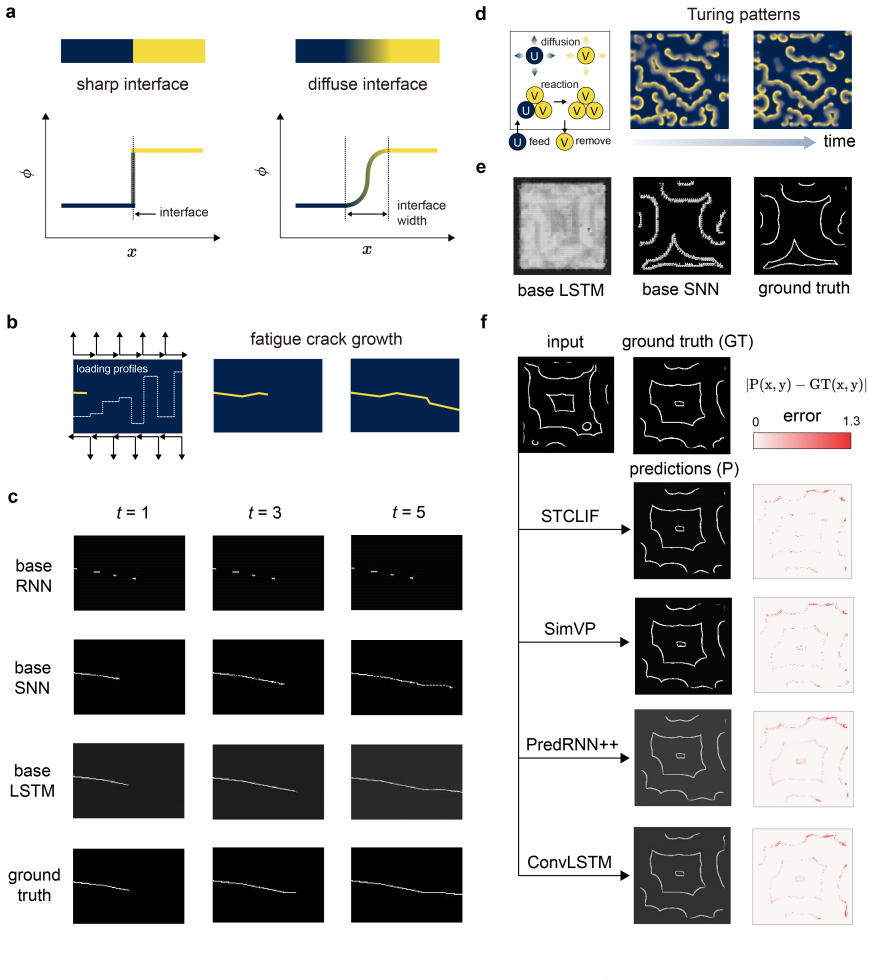
The load-bearing object is the spatiotemporal circuit leaky integrate-and-fire (STCLIF) neuron, a spiking unit whose membrane potential decays over time and that adds an autaptic synaptic circuit—a self-connection—so that spike history shapes later firing. It processes space and time in a single integrated scheme, unlike ANN baselines that separate a CNN spatial encoder from an RNN/LSTM temporal processor. The paper also relies on the 'digital library' concept: time-series image data generated by a fatigue-crack XFEM solver and Gray-Scott reaction-diffusion simulations replace PDE-constrained modeling, so the network learns evolution purely from data. The argument is carried by comparing STCLIF and its base-SNN counterpart against ConvLSTM, PredRNN++, and SimVP on two benchmarks with contrasting interface types (sharp crack vs diffuse Turing patterns).
What would settle it
Rerun the Turing-pattern comparison on a test set of many independently initialized simulations with non-overlapping windows, and require that STCLIF's 27.71% mean-absolute-error reduction over the ANN models persists with confidence intervals; the claim collapses if the gap shrinks to within noise. A supporting check is whether the same ranking holds under multiple random seeds and across an order-of-magnitude range of training-set sizes.
Extended reading notes
Core claim
The central claim is that on microstructure-evolution benchmarks, spiking neural networks do not merely approximate the accuracy of artificial neural networks at lower cost—they exceed ANN accuracy while reducing parameters and memory. Concretely, for Turing-pattern prediction the STCLIF model achieves the lowest mean absolute error of all models compared, a 27.71% reduction over the ANN baselines (ConvLSTM, PredRNN++, SimVP), with an order of magnitude fewer parameters; for fatigue crack growth the base SNN matches ANN/LSTM accuracy with roughly four to five orders of magnitude fewer parameters. The authors attribute this to the event-driven nature of spiking neurons and to architectural properties emerging after training: reduced weight variance, smaller weight magnitudes, and a connectivity density roughly 22% lower than ConvLSTM's, which act like built-in regularization. The message is that the dominant practice of scaling dense, pixel-regressing ANNs is not the only route to predictive accuracy on physical interface problems.
Load-bearing premise
The reported accuracy advantage rests on test sets built from a handful of independent simulated trajectories, because sliding windows overlap heavily (Turing test samples share 19 of 20 frames), so the model comparison may have effectively only about five independent test cases.
Editorial extensions
If this is right
- If the result holds, event-driven spiking models become a practical choice for embedded structural-health monitoring, where energy and memory budgets are tight but interface predictions must be accurate.
- The finding implies that model architecture should be chosen to match spatiotemporal complexity: localized interface problems need only about 1,000 parameters (base SNN), while collective diffuse patterns need millions (STCLIF), so resource allocation can be scaled to the physics.
- The digital-library approach can be extended to problems such as grain growth and phase transformations, using either high-fidelity simulation data or experimental data, freeing prediction from the 'mathematical overconstraints' of governing PDEs.
- Weight sparsity and small weight ranges—not raw parameter count—are presented as the source of the spiking model's generalization, pointing to architecture-level regularization as a design principle for physical prediction tasks.
Reading between the lines
- A caveat drawn from the paper's own supplementary setup: the Turing test set is built from 5 independent trajectories expanded into 48 overlapping windows each, so successive test samples share 19 of 20 frames; the 27.71% error reduction may partly reflect very few independent test cases, and an independent-trajectory validation would test this.
- The pixel-versus-vector analogy suggests the spiking advantage should grow with resolution: as interfaces occupy fewer pixels relative to the bulk, event-driven sparse representations should waste less computation on homogeneous regions, a prediction that could be checked by varying image resolution and measuring the accuracy-cost gap.
- The scaling discussion implies 3D extensions are the next test; if STCLIF retains its advantage with 3D convolutions on voxel data, the memory savings (about 3/4 of LSTM-based alternatives) would become more valuable for real-time monitoring.
- One could test the regularization interpretation directly by penalizing weight magnitude and connectivity in the ANN baselines to see whether the accuracy gap narrows; if it does, sparsity rather than spike timing is the operative advantage.
Editorial analysis
A structured set of objections, weighed in public.
Referee Report
Summary. Zhao and Xu compare artificial and spiking neural networks for predicting microstructure evolution in synthetic digital libraries of fatigue crack growth (FCG) and Turing patterns. They evaluate base RNN/LSTM/SNN models on FCG and advanced spatiotemporal models (ConvLSTM, PredRNN++, SimVP, STCLIF) on Turing patterns, using MAE as the accuracy metric and parameter count/memory estimates as cost metrics. The paper reports that the spiking STCLIF model yields a 27.71% lower MAE than the ANN alternatives on Turing-pattern prediction while using an order of magnitude fewer parameters, and interprets this advantage via reduced weight variance and connectivity density. The authors argue that SNNs can overcome the usual accuracy-cost tradeoff for these microstructure evolution tasks.
Significance. If the central claim is established, the work is a valuable demonstration that event-driven models can outperform recurrent convolutional architectures on spatiotemporal microstructure benchmarks at lower memory cost, with implications for on-device structural health monitoring and materials processing. The paper contributes a clearly specified benchmark protocol (digital libraries from XFEM and Gray-Scott simulations) and compares a wider set of architectures than is typical in the domain. However, the claim of superior accuracy currently rests on a small effective test set with no uncertainty quantification, so the significance is conditional.
major comments (2)
- [Supplementary Note 1; Sec. 3.3; Fig. 4c] The headline result that STCLIF achieves a 27.71% error reduction over ANN models for Turing-pattern prediction is not statistically supported. The Turing test set is generated by expanding 5 independent trajectories with a sliding window of length 20 and step 1, producing 48 windows per trajectory (240 total) whose successive windows share 19 of 20 input frames. The effective number of independent test cases is therefore about 5, far smaller than the nominal 240. No per-trajectory errors, confidence intervals, or multiple-seed runs are reported, so the reported reduction could be dominated by one or two trajectories. Please report per-trajectory errors and a significance test that respects trajectory boundaries (e.g., a paired bootstrap over the 5 trajectories, or a non-overlapping window evaluation), and repeat training with multiple random seeds. The same overlapping-window issue affects the FCG test set (Supplementary Note 1) and should be addressed there as well.
- [Sec. 3.4; Fig. 5; Abstract] The abstract and conclusions claim that STCLIF's accuracy benefit arises from reduced weight range and sparser connections, but Section 3.4 provides only a correlational comparison of weight statistics for a single trained pair (ConvLSTM vs. STCLIF). These models differ in many architectural respects (spiking dynamics, autaptic connections, layer counts, etc.), so the observed differences in weight variance and connectivity density do not establish causation. A controlled experiment, e.g., imposing the same weight regularization or connectivity constraints on the ANN baseline, or ablating components of STCLIF, is needed to support the claimed mechanism. As written, the explanation is a plausible post-hoc interpretation rather than a demonstrated cause.
minor comments (5)
- [Sec. 2.2.2; Supplementary Note 1; Sec. 3.1] There are several typos and unclear notations: 'to to enable' in Section 2.2.2, 'machine larning' in Supplementary Note 1, and 'p(r, t) or p(r, t)' in Section 3.1 where a symbol appears twice. Please proofread the manuscript carefully.
- [Supplementary Note 1] For the Turing-pattern data, a time series of length 68 with a sliding window of length 20 and step 1 yields 49 possible windows per trajectory, not 48 as stated. Please clarify the extraction rule or correct the counts.
- [Fig. 4] The axes of Figure 4 are described only as 'observation duration' and 'time step' in the text; please define them in the captions and include absolute MAE values and error bars where available.
- [Sec. 3.1] The estimate that 'spiking neurons save about 3/4 of memory compared to artificial neurons in LSTM' is based only on a parameter-count comparison of the temporal cells; actual memory usage depends on implementation details such as precision, batching, and whether inference uses hardware-specific spike optimizations. Please add a caveat.
- [Sec. 3.2] The crack-thickness numbers ('8 for base ANN/LSTM and 1 for base SNN') should be defined: how is thickness measured in pixels, and why is a smaller thickness considered better (presumably because it indicates a sharper interface)?
Circularity Check
No significant circularity: the paper's benchmark claims are empirical evaluations, not reductions to fitted inputs or self-cited theorems.
full rationale
The paper's central claims are empirical: trained neural architectures are evaluated on held-out simulated test sets, and MAE, parameter counts, and memory usage are measured outcomes rather than quantities fitted to enforce the conclusions. The 27.71% error reduction for STCLIF over ANN models is a reported benchmark result, not a parameter fitted to the test data; it may be statistically fragile due to overlapping sliding windows and a small number of independent Turing-pattern trajectories, but that is a robustness limitation, not circularity. The FCG digital library is sourced from the authors' prior XFEM work (ref. [13]), but this is a data-generation citation rather than a self-citation doing argumentative work; the simulations follow established fracture mechanics and are externally checkable. The STCLIF architecture itself is taken from external prior work (ref. [9]), so no uniqueness or ansatz is imported from the authors' own unverified claims. The weight-distribution and connectivity analyses in Section 3.4 are post-hoc interpretations of trained networks, not derivations used to fabricate the accuracy result. The memory-saving estimate for spiking versus LSTM cells follows from the architectures' parameter structures, but this is transparent accounting rather than a renamed prediction. Overall, the derivation chain does not reduce to its inputs by construction, and no circular step is exhibited.
Assumptions & free parameters
free parameters (3)
- LIF membrane threshold (uth) =
1
- LIF membrane decay rate =
0.5
- Connectivity density threshold =
0.001
assumptions (4)
- domain assumption Gray-Scott reaction-diffusion and XFEM crack-growth simulations are treated as faithful ground truth for the digital libraries.
- domain assumption Sliding windows from different positions within the same simulated trajectory are treated as independent training/test samples.
- domain assumption Mean absolute error on pixel values is an adequate metric for evaluating interface evolution accuracy.
- standard math Adam with MSE loss and the listed hyperparameters finds comparably good optima for all models.
Cite this review
Pith. "Pith review of Neural Network Modeling of Microstructure Complexity Using Digital Libraries." pith.science (2026). https://pith.science/paper/HPAU4CUR
@misc{pith2026250118189,
  author       = {Pith},
  title        = {Pith review of: Neural Network Modeling of Microstructure Complexity Using Digital Libraries},
  year         = {2026},
  howpublished = {\url{https://pith.science/paper/HPAU4CUR}},
  note         = {Machine review of arXiv:2501.18189}
}
read the original abstract
Microstructure evolution in matter is often modeled numerically using field or level-set solvers, mirroring the dual representation of spatiotemporal complexity in terms of pixel or voxel data, and geometrical forms in vector graphics. Motivated by this analog, as well as the structural and event-driven nature of artificial and spiking neural networks, respectively, we evaluate their performance in learning and predicting fatigue crack growth and Turing pattern development. Predictions are made based on digital libraries constructed from computer simulations, which can be replaced by experimental data to lift the mathematical overconstraints of physics. Our assessment suggests that the leaky integrate-and-fire neuron model offers superior predictive accuracy with fewer parameters and less memory usage, alleviating the accuracy-cost tradeoff in contrast to the common practices in computer vision tasks. Examination of network architectures shows that these benefits arise from its reduced weight range and sparser connections. The study highlights the capability of event-driven models in tackling problems with evolutionary bulk-phase and interface behaviors using the digital library approach.
Figures


Figures from the paper (2 more)


Reference graph
Works this paper leans on
-
[1]
Chen L Q 2002 Annu. Rev. Mater. Res. 32 113–140
work page 2002
-
[2]
Osher S and Sethian J A 1988 J. Comput. Phys. 79 12–49
work page 1988
-
[3]
Cahn J W and Hilliard J E 1958 J. Chem. Phys. 28 258–267
work page 1958
-
[4]
Gaston D, Newman C, Hansen G and Lebrun-Grandie D 2009 Nucl. Engr. Des. 239 1768–1778
work page 2009
-
[5]
Greene M S, Xu H, Tang S, Chen W and Liu W K 2013Comput. Methods Appl. Mech. Eng.254 271–291
-
[6]
Shi X, Chen Z, Wang H, Yeung D Y , Wong W K and Woo W C 2015 Convolutional LSTM network: A machine learning approach for precipitation nowcasting Adv. Neural. Inf. Process. Syst. vol 28 pp 802–810
work page 2015
-
[7]
Wang Y , Gao Z, Long M, Wang J and Philip S Y 2018 PredRNN++: Towards a resolution of the deep- in-time dilemma in spatiotemporal predictive learning Int. Conf. Mach. Learn. vol 80 pp 5123–5132
work page 2018
-
[8]
Gao Z, Tan C, Wu L and Li S Z 2022 SimVP: Simpler yet better video prediction Proc. IEEE Comput. Soc. Conf. Comput. Vis. Pattern Recognit. pp 3170–3180
work page 2022
Show all 52 references
-
[9]
Wang L and Yu Z 2024 Autaptic synaptic circuit enhances spatio-temporal predictive learning of spiking neural networks Int. Conf. Mach. Learn. vol 235 pp 52083–52098
2024
-
[10]
Yang K, Cao Y , Zhang Y , Fan S, Tang M, Aberg D, Sadigh B and Zhou F 2021 Patterns 2 100243
2021
-
[11]
10 1659–1671
Maass W 1997 Neural Netw. 10 1659–1671
1997
-
[12]
Neurophysiol
Brette R and Gerstner W 2005 J. Neurophysiol. 94 3637–3642
2005
-
[13]
Zhao Y , Liu Y and Xu Z 2023 Theor. Appl. Mech. Lett. 13 100477
2023
-
[14]
2 pp 792–801
Mettu S, Shivakumar V, Beek J, Yeh F , Williams L, Forman R, McMahon J and Newman Jr J 1999 NASGRO 3.0: A software for analyzing aging aircraft The Second Joint NASA/FAA/DoD Conference on Aging Aircraft Pt. 2 pp 792–801
1999
-
[15]
Shih C F and Asaro R J 1988 J. Appl. Mech. 55 299–316
1988
-
[16]
Basic Eng
Paris P and Erdogan F 1963 J. Basic Eng. 85 528–533
1963
-
[17]
Park J Y , Kim B K, Nam D G and Kim M H 2022 Metals 12 173
2022
-
[18]
Zhang J, Zhang X, Wang X, Ding J, Traoré Y , Paddea S and Williams S 2016 Mater. Des. 104 365–375
2016
-
[19]
Shim T S, Yang S M and Kim S H 2015 Nat. Commun. 6 6584
2015
-
[20]
Pearson J E 1993 Science 261 189–192
1993
-
[21]
Srivastava N, Mansimov E and Salakhudinov R 2015 Unsupervised learning of video representations using LSTMs Int. Conf. Mach. Learn. vol 37 pp 843–852
2015
-
[22]
Tan C, Li S, Gao Z, Guan W , Wang Z, Liu Z, Wu L and Li S Z 2023 Openstl: A comprehensive benchmark of spatio-temporal predictive learning Adv. Neural. Inf. Process. Syst. vol 36 pp 69819–69831
2023
-
[23]
of the IEEE 86 2278–2324
LeCun Y , Bottou L, Bengio Y and Haffner P 1998 Proc. of the IEEE 86 2278–2324
1998
-
[24]
9 1735–1780
Hochreiter S 1997 Neural Comput. 9 1735–1780
1997
-
[25]
132 108–120 11
He W , Wu Y , Deng L, Li G, Wang H, Tian Y , Ding W , Wang W and Xie Y 2020Neural Net. 132 108–120 11
-
[26]
111 47–63
Tavanaei A, Ghodrati M, Kheradpisheh S R, Masquelier T and Maida A 2019 Neural Netw. 111 47–63
2019
-
[27]
Jozefowicz R, Zaremba W and Sutskever I 2015 An empirical exploration of recurrent network ar- chitectures Int. Conf. Mach. Learn. vol 37 pp 2342–2350
2015
-
[28]
Krogh A and Hertz J 1991 A simple weight decay can improve generalization Adv. Neural. Inf. Pro- cess. Syst. vol 4 pp 950–957
1991
-
[29]
Srivastava N, Hinton G, Krizhevsky A, Sutskever I and Salakhutdinov R 2014 J. Mach. Learn. Res. 15 1929–1958
2014
-
[30]
Dosovitskiy A 2020 arXiv preprint arXiv:2010.11929
2020 arXiv
-
[31]
Bertasius G, Wang H and Torresani L 2021 Is space-time attention all you need for video under- standing? Int. Conf. Mach. Learn. vol 139 pp 813–824
2021
-
[32]
Tang Y , Qi L, Xie F , Li X, Ma C and Yang M H 2024 arXiv preprint arXiv:2410.04733
2024
-
[33]
IEEE Comput
Peebles W and Xie S 2023 Scalable diffusion models with transformers Proc. IEEE Comput. Soc. Conf. Comput. Vis. Pattern Recognit. pp 4195–4205
2023
-
[34]
Brooks T , Peebles B, Holmes C, DePue W , Guo Y , Jing L, Schnurr D, Taylor J, Luhman T , Luhman E, Ng C, Wang R and Ramesh A 2024 URL https://openai.com/research/ video-generation-models-as-world-simulators
2024
-
[35]
Kuaishou 2024 URL https://ir.kuaishou.com/news-releases/news-release-details/ kuaishou-unveils-proprietary-video-generation-model-kling/
2024
-
[36]
Impacts 10 100131
Safa A, Catthoor F and Gielen G G 2021 Softw. Impacts 10 100131
2021
-
[37]
AAAI Conf
Zhang S, Yang Q, Ma C, Wu J, Li H and Tan K C 2024 Tc-lif: A two-compartment spiking neuron model for long-term sequential modelling Proc. AAAI Conf. Artif. Intell. vol 38 pp 16838–16847
2024
-
[38]
Alhada-Lahbabi K, Deleruyelle D and Gautier B 2024 Npj Comput. Mater. 10 197
2024
-
[39]
Henkes A, Eshraghian J K and Wessels H 2024 R. Soc. Open Sci. 11 231606
2024
-
[40]
Raissi M, Perdikaris P and Karniadakis G E 2019 J. Comput. Phys. 378 686–707
2019
-
[41]
Liu Z, Wang Y , Vaidya S, Ruehle F , Halverson J, Soljačić M, Hou T Y and Tegmark M 2024arXiv preprint arXiv:2404.19756
-
[42]
Wang Y , Sun J, Bai J, Anitescu C, Eshaghi M S, Zhuang X, Rabczuk T and Liu Y 2025Comput. Methods. Appl. Mech. Eng. 433 117518
-
[43]
Lu L, Jin P , Pang G, Zhang Z and Karniadakis G E 2021 Nat. Mach. Intell. 3 218–229
2021
-
[44]
Yang L, Liu S, Meng T and Osher S J 2023 Proc. Natl. Acad. Sci. U. S. A. 120 e2310142120
2023
-
[45]
Kahana A, Zhang Q, Gleyzer L and Karniadakis G E 2022 arXiv preprint arXiv:2205.10130
2022 arXiv
-
[46]
Zhao Y , Zhang Z and Xu Z 2024 arXiv preprint arXiv:2403.07526
2024 arXiv
-
[47]
2024 arXiv preprint arXiv:2412.00568
Ohana R, McCabe M, Meyer L, Morel R, Agocs F J, Beneitez M, Berger M, Burkhart B, Dalziel S B, Fielding D B et al. 2024 arXiv preprint arXiv:2412.00568
2024 arXiv
-
[48]
Simonyan K, Vedaldi A and Zisserman A 2013 arXiv preprint arXiv:1312.6034
2013 arXiv
-
[49]
Lundberg S M and Lee S I 2017 A unified approach to interpreting model predictions Adv. Neural. Inf. Process. Syst. vol 30 pp 4765–4774 12
2017
-
[50]
Koza J R 1994 Stat. Comput. 4 87–112
1994
-
[51]
Messeri L and Crockett M 2024 Nature 627 49–58
2024
-
[52]
(a) Turing patterns in nature
Hughes T J 2003 The Finite Element Method: Linear Static and Dynamic Finite Element Analysis (Courier Corporation) 13 Figure 1: Representations of spatiotemporal complexity. (a) Turing patterns in nature. (b) Evolution of physical systems in pixel/voxel representations, encomp...
2003
Reviewed August 10, 2026 · model on record in the stance chip above.
Discussion (0). Continue with ORCID to comment.