REVIEW 3 major objections 4 minor 1 cited by
Character factorisations, $z$-asymmetric partitions and plethysm
T0 review · 3 major / 4 minor · reviewed 2026-08-09 · deepseek-v4-flash
Pith's one-line read This paper proves a uniform factorisation theorem: applying the t-th Verschiebung operator to the Hamel-King symmetric function $X_\lambda(z;q)$ either vanishes or splits into a product of generalised rational universal characters, with…
desk verdict A genuinely unifying (z,q)-factorisation theorem with a real but likely fillable gap in the negative-z sign case. read the letter →
The pith
A machine-rendered reading of the paper's core claim, the machinery that carries it, and where it could break.
The reading
What carries the argument
The machinery has three parts. First, $X_\lambda(z;q)$ is the Hamel-King symmetric function, whose determinantal form and skew-Schur expansion connect determinants with combinatorial sums. Second, $z$-asymmetric partitions, written in Frobenius notation as $(u+z\mid u)$, are the indexing set for that expansion and generalise self-conjugate partitions ($z=0$) and doubled-distinct or threshold partitions ($z=1$). Third, the Littlewood decomposition splits a partition into a $t$-core and a $t$-quotient; Theorem 2.3 and Corollary 2.4 describe how $z$-asymmetry appears in the quotient, pairing runners by conjugation and shifting them by amounts depending on the core tuple $c\in C_{b;t}$. That description converts the sum over skew Schur functions in the proof of Theorem 4.3 into a product of sums, each sum being the skew-Schur expansion of a generalised rational universal character $\operatorname{rs}_{\lambda,\mu}(a;c;q)$, a symmetric-function lift of rational $GL_n$ characters.
What would settle it
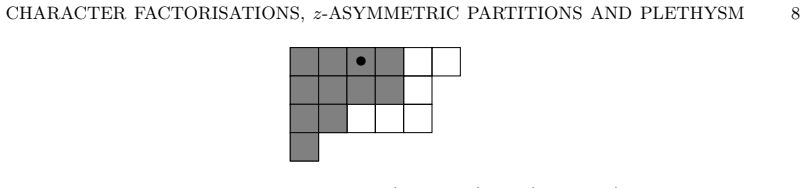
One concrete check: for $t=3$, $z=2$ and the partition $\lambda=(6,5,5,1)$ used in the paper, compute $\varphi_3 X_\lambda(2;q)$ two ways, from the determinant (3.17a) and from the product formula in Theorem 4.3, and compare the resulting $q$-powers and signs; a mismatch would refute the theorem. Alternatively, enumerate all z-asymmetric partitions up to size 20 for $t=3,z=2$ and verify directly that their Littlewood decompositions satisfy the conditions of Theorem 2.3 and Corollary 2.4.
Extended reading notes
Core claim
The central object is the Hamel-King symmetric function $X_\lambda(z;q)$, defined by a Jacobi-Trudi-type determinant and expanded as a signed sum of skew Schur functions over $z$-asymmetric partitions. Theorem 4.3 states that for $t\ge 2$, $z=at+b$ with $0\le b\le t-1$, $\varphi_t X_\lambda(z;q)=0$ unless $\kappa_t(\operatorname{t-core}(\lambda))=c\in C_{b;t}$ and $\lambda\supseteq\mu_c$; when these conditions hold, $\varphi_tX_\lambda(z;q)$ equals $\varepsilon(q)$ times a product of generalised rational universal characters $\operatorname{rs}_{\lambda(r),\lambda(b-r-1)}(a+1;c_r;q)$ and $\operatorname{rs}_{\lambda(s),\lambda(t+b-s-1)}(a;c_s;q)$, with at most two further $X$-factors depending on the parities of $b$ and $t$. The prefactor is $\varepsilon(q)=(-1)^{(|\mu_c|-(z+1)\operatorname{rk}(\operatorname{t-core}(\lambda)))/2}\operatorname{sgn}_t(\lambda/\mu_c)q^{\operatorname{rk}(\operatorname{t-core}(\lambda))}$. The paper proves this by applying the known Verschiebung action on skew Schur functions to the expansion of $X_\lambda(z;q)$, then using the new Littlewood-decomposition description of $z$-asymmetric partitions to show that the signed sum decouples as a product of sums.
Load-bearing premise
The proof takes on trust an expansion identity from earlier work that expresses the general symmetric function as a signed sum of skew Schur functions over z-asymmetric partitions; if that identity needs extra hypotheses, the entire factorisation theorem inherits them.
Editorial extensions
If this is right
- Setting $q=0$ in Theorem 4.3 yields the classical Schur factorisation: $\varphi_t s_\lambda=0$ unless the $t$-core of $\lambda$ is empty, and then it is a signed product of the $t$ Schur functions indexed by the $t$-quotient.
- Setting $q=(-1)^z$ and $z=0,1,-1$ recovers the universal odd-orthogonal, even-orthogonal, and symplectic factorisations, including the explicit ribbon-tiling signs and the self-conjugacy conditions on the $t$-core.
- The new characterisation of $z$-asymmetric partitions under the Littlewood decomposition reduces the classification of nonvanishing cases for all $z$ to checking a core tuple $c\in C_{b;t}$ and a containment $\lambda\supseteq\mu_c$.
- The skew-Schur factorisation theorem for $\varphi_t$ is shown to be equivalent to the SXP rule for $s_\lambda\circ p_t$, and the known universal-character SXP rules can be restated as sums over partitions with empty $t$-core with explicit signs.
Reading between the lines
- Because $q$ is kept as a formal parameter, the theorem implicitly provides $q$-deformations of all classical character factorisations; evaluating at roots of unity other than $1$ or $-1$ is not carried out in the paper but would give new product identities of the same kind.
- The explicit sign formula makes the earlier branching-algorithm approach to these factorisations fully combinatorial; one could read the factorisation directly from the $t$-Maya diagram, a step the paper explains but does not package as an algorithm.
- For $z\ge 2$, the $t$-core of a $z$-asymmetric partition need not itself be $z$-asymmetric, so the nonvanishing condition is genuinely different from self-conjugacy; this suggests the minimal partition $\mu_c$ may play a role analogous to self-conjugate cores in crank and partition statistics beyond the $z=1$ case.
Editorial analysis
A structured set of objections, weighed in public.
Referee Report
Summary. The paper studies the Verschiebung operators φ_t acting on the Hamel–King symmetric functions X_λ(z;q), a family that specializes to Schur functions and to the universal symplectic, orthogonal, and odd-orthogonal characters. The main result is Theorem 4.3: for t≥2 and z=at+b with 0≤b≤t−1, the image φ_t X_λ(z;q) vanishes unless the t-core of λ lies in the prescribed set C_{b;t} and λ contains the minimal z-asymmetric partition μ_c, and otherwise it factors explicitly into generalized rational universal characters rs and possibly X factors, with an explicit prefactor ε(q). This unifies the Schur, symplectic, orthogonal, and universal-character factorizations of Littlewood–Richardson, Lecouvey, Ayyer–Kumari, and the author's previous work. The proof proceeds by using the Hamel–King skew Schur expansion of X_λ(z;q), applying the skew Schur Verschiebung rule, and then controlling the sign by a bead-counting argument in the t-Maya diagram. A second main contribution is Theorem 2.3, a characterization of z-asymmetric partitions under the Littlewood decomposition.
Significance. If fully established, the paper gives a substantial and credible unification: the known factorizations are recovered as special cases, the signs are expressed through explicit combinatorial statistics, and the z-asymmetric core/quotient characterization is a useful result in its own right. The Maya-diagram 'cut and twist' method is concrete and appears to be the right tool, and the paper is careful to identify exactly which ingredients are quoted from earlier work. The main caveat is that one load-bearing part of the proof—the sign factorization for negative z—is asserted rather than proved, so as written the central claim is not yet established over the full parameter range claimed in Theorem 4.3. The gap is probably repairable, but it is inside the proof rather than a matter of presentation.
major comments (3)
- [§4.3.3] The sign-factorization step is carried out only under the assumption z≥0, and the negative-z case is dismissed with the sentence 'For z ≤ 0 the same set of steps will yield the factorisation of the sign, and we spare the reader repeating the details.' This is load-bearing: Theorem 4.3 is stated for all integers z, the symplectic case is z=−1, and the definition of μ_c for negative z relies on a conjugation convention that is stated but not proved in detail. Please either supply the full bead-counting proof for z≤0 or derive it explicitly from the z≥0 case by conjugating with (3.18), including the parity bookkeeping in ε(q). As written, the proof does not establish Theorem 4.3 for the entire negative-z range.
- [§2.2, proof of Theorem 2.3 and Corollary 2.4] The induction proof of Theorem 2.3 treats the range 1≤r≤z−2 explicitly and then says that the cases r=0 and z≤s≤t−1 'follow by the same argument.' These boundary cases are exactly where the residue conventions of the t-Maya diagram matter. Corollary 2.4 is then justified in a single sentence ('t iterations of the cut and twist map...'), even though formulae (2.5a)–(2.5b) are used directly in §4.3.2 to replace the sum over μ∈P_z by the t-quotient data. Since Theorem 4.3 depends on this replacement, please give a complete proof of Corollary 2.4 and of the boundary cases in Theorem 2.3, or state explicitly which chains of equalities establish them.
- [§4.3.3, sign-factorisation cases] The sign-factorisation argument is described as an induction by considering terms μ and ν with |μ|−|ν| minimal, but no formal induction is set up and no measure of minimality is specified. The case analysis is plausible, but because the prefactor ε(q) and the product structure of Theorem 4.3 depend on the exact signs in (4.3), please make the induction explicit: state the claims to be proved for all quotient tuples, verify the minimal term μ_c, and show that each of the listed moves changes both sides by the same factor.
minor comments (4)
- [§3.2, equation (3.17b)] The expansion X_λ(z;q)=∑_{μ∈P_z} (−1)^{(|μ|−rk(μ)(z+1))/2} q^{rk(μ)} s_{λ/μ} is quoted from [19,20] and is the only bridge between X_λ(z;q) and the skew Schur combinatorics used in the proof. Since it plays this central role, please display it as a numbered external theorem with its precise hypotheses, rather than citing it inline.
- [Theorem 4.3, formula for ε(q)] The displayed formula for ε(q) has an ambiguous exponent. It should be written as ε(q)=sgn_t(λ/μ_c) (−1)^{( |μ_c| − (z+1) rk(t-core(λ)) )/2} q^{rk(t-core(λ))}, with the closing parenthesis in the exponent made explicit.
- [Corollary 2.5] The statement says that a t-core is z-asymmetric if and only if 0≤z≤t−2, but the paper later uses the corollary for negative z by conjugation. Please state the conjugated version explicitly, including the meaning of μ_c for z<0.
- [Throughout] There are a few typographical issues, e.g. 'paramaterised' in the introduction should be 'parameterised'. The notation rs_{λ,μ}(a;c;q) introduced just before Theorem 4.3 should be defined with the subscript order of the arguments made unambiguous in one displayed equation.
Circularity Check
No circular reduction: Theorem 4.3 is derived from independent Hamel-King and skew-Schur Verschiebung inputs; self-citations are reproved or contextual. The z <= 0 sign case is omitted, but that is a completeness gap, not circularity.
full rationale
The claimed derivation chain for Theorem 4.3 is non-circular. The proof starts from (4.1), which applies the independently published Hamel-King skew Schur expansion (3.17b) from [19,20] and the skew Schur Verschiebung formula Theorem 3.2; Theorem 3.2 is proven in the paper from the Jacobi-Trudi determinant (3.6), with the ribbon sign supplied by Lemma 2.7, whose proof is also given. The vanishing and prefactor come from Theorem 2.3/Corollaries 2.4-2.5 and Lemma 2.6, all proved here or with short proofs included. The final decoupling uses Theorem 3.3, proved by Laplace expansion. No parameter is fitted: epsilon(q) is an explicit function of t-core(lambda), |mu_c| and sgn_t(lambda/mu_c), and q,z are free variables. The self-citations to [2] (Lemma 2.7, prior universal character factorisations) are not load-bearing: Lemma 2.7 is reproved, and the classical cases appear as specialisations, not as inputs. The paper honestly notes that setting q=0 recovers Theorem 3.2 without giving a new proof, which is legitimate because Theorem 3.2 is a weaker ingredient, not the conclusion. The one flagged weakness is in Section 4.3.3: 'It is most convenient here to assume that z >= 0. For z <= 0 the same set of steps will yield the factorisation of the sign, and we spare the reader repeating the details.' This leaves the negative-z branch of Theorem 4.3 (e.g., z = -1) unproved as written, and the conjugation remark for mu_c is terse. That is a completeness/correctness gap, not a circularity, since no part of the proof assumes Theorem 4.3 or an equivalent statement. Score 2 reflects only the presence of minor self-citations, not a circular derivation.
Assumptions & free parameters
assumptions (4)
- standard math Hamel-King identity (3.17a)=(3.17b): the determinant det(h_{lambda_i-i+j} + [j>-z] q h_{lambda_i-i-j+1-z}) equals the signed skew Schur expansion over z-asymmetric partitions.
- standard math Skew Schur Verschiebung formula (Theorem 3.2): phi_t s_{lambda/mu} = sgn_t(lambda/mu) prod_r s_{lambda^{(r)}/mu^{(r)}} if lambda/mu is t-tileable, and zero otherwise.
- standard math Well-definedness of sgn_t(lambda/mu), i.e. independence of the t-ribbon decomposition.
- standard math Littlewood decomposition bijection and the criterion that lambda/mu is t-tileable iff t-core(lambda)=t-core(mu) and mu^{(r)} subseteq lambda^{(r)} for all r.
Cite this review
Pith. "Pith review of Character factorisations, $z$-asymmetric partitions and plethysm." pith.science (2026). https://pith.science/paper/4UGXDQJM
@misc{pith2026250118520,
  author       = {Pith},
  title        = {Pith review of: Character factorisations, $z$-asymmetric partitions and plethysm},
  year         = {2026},
  howpublished = {\url{https://pith.science/paper/4UGXDQJM}},
  note         = {Machine review of arXiv:2501.18520}
}
abstract
The Verschiebung operators $\varphi_t $ are a family of endomorphisms on the ring of symmetric functions, one for each integer $t\geq2$. Their action on the Schur basis has its origins in work of Littlewood and Richardson, and is intimately related with the decomposition of a partition into its $t$-core and $t$-quotient. Namely, they showed that the action on $s_\lambda$ is zero if the $t$-core of the indexing partition is nonempty, and otherwise it factors as a product of Schur functions indexed by the $t$-quotient. Much more recently, Lecouvey and, independently, Ayyer and Kumari have provided similar formulae for the characters of the symplectic and orthogonal groups, where again the combinatorics of cores and quotients plays a fundamental role. We embed all of these character factorisations in an infinite family involving an integer $z$ and parameter $q$ using a very general symmetric function defined by Hamel and King. The proof hinges on a new characterisation of the $t$-cores and $t$-quotients of $z$-asymmetric partitions which generalise the well-known classifications for self-conjugate and doubled distinct partitions. We also explain the connection between these results, plethysms of symmetric functions and characters of the symmetric group.
Figures


Figures from the paper (3 more)


Forward citations
Cited by 1 Pith paper
-
Measures and generalizations of dual Littlewood identities
Vertex-operator methods produce new derivations of B/C/D dual Littlewood identities, determinantal kernels for their measures, generalized identities for restricted and (−n)-asymmetric partitions, and a new proof of t...
Reference graph
Works this paper leans on
-
[1]
R. M. Adin and Y. Roichman, On characters of wreath products , Comb. Theory 2 (2022), Paper No. 17, 12pp
work page 2022
-
[2]
S. P. Albion, Universal characters twisted by roots of unity , Algebr. Comb. 6 (2023), 1653– 1676
work page 2023
-
[3]
A. Ayyer and N. Kumari, Factorization of classical characters twisted by roots of uni ty, J. Algebra 609 (2022), 437–483
work page 2022
-
[4]
A. Ayyer and N. Kumari, Further results for classical and universal characters twiste d by roots of unity , arXiv:2501.00275
-
[5]
J. Baik and E. M. Rains, Algebraic aspects of increasing subsequences , Duke Math. J. 109 (2001), 1–25
work page 2001
-
[6]
Brauer, On a conjecture of Nakayama , Trans
R. Brauer, On a conjecture of Nakayama , Trans. Roy. Soc. Canada Sect. III 41 (1947), 11–19
work page 1947
-
[7]
D. M. Bressoud and S.-Y. Wei, Determinental formulae for complete symmetric functions , J. Combin. Theory Ser. A 60 (1992), 277–286
work page 1992
-
[8]
O. Brunat and R. Nath, Cores and quotients of partitions through the Frobenius symb ol, arXiv:1911.12098
arXiv 1911
Show all 69 references
-
[9]
Y. M. Chen, A. M. Garsia and J. Remmel, Algorithms for plethysm , Contemp. Math. 34 (1984), 109–153
1984
-
[10]
Evseev, R
A. Evseev, R. Paget and M. Wildon, Character deflations and a generalization of the Murnaghan–Nakayama rule , J. Group Theory 17 (2014), 1035–1070
2014
-
[11]
Farahat, On p-quotients and star diagrams of the symmetric group , Proc
H. Farahat, On p-quotients and star diagrams of the symmetric group , Proc. Cambridge Phil. Soc. 49 (1953), 157–160
1953
-
[12]
Farahat, On the representations of the symmetric group , Proc
H. Farahat, On the representations of the symmetric group , Proc. London Math. Soc. 4 (1954), 303–316
1954
-
[13]
Farahat, On Schur functions , Proc
H. Farahat, On Schur functions , Proc. London Math. Soc. 8 (1958), 621–630
1958
-
[14]
Garvan, D
F. Garvan, D. Kim and D. Stanton, Cranks and t-cores, Invent. Math. 101 (1990), 1–17
1990
-
[15]
Gessel and X
I. Gessel and X. G. Viennot, Determinants, paths, and plane partitions , (1989), (link)
1989
-
[16]
Goulden, Directed graphs and the Jacobi–Trudi identity , Can
I. Goulden, Directed graphs and the Jacobi–Trudi identity , Can. J. Math. 37 (1985), 1201– 1210
1985
-
[17]
Grinberg, Petrie symmetric functions , Algebr
D. Grinberg, Petrie symmetric functions , Algebr. Comb. 5 (2022), 947–1013
2022
- [18]
-
[19]
Hamel and R
A. Hamel and R. C. King, Extended Bressoud–Wei and Koike skew Schur function identi ties, J. Combin. Theory Ser. A 118 (2011), 545–557
2011
-
[20]
Hamel and R
A. Hamel and R. C. King, Lattice path proofs of extended Bressoud–Wei and Koike skew Schur function identities , Electron. J. Combin. 18 (2011), #P47
2011
-
[21]
J. F. Humphreys, Blocks of projective representations of the symmetric group s, J. London Math. Soc. (2) 33 (1986), 441–452
1986
-
[22]
James and A
G. James and A. Kerber, The Representation Theory of the Symmetric Group , Encyclopedia of Mathematics and its Applications, Vol. 16, Addison-Wesl ey, Reading MA, 1981. CHARACTER F ACTORISATIONS, z-ASYMMETRIC PARTITIONS AND PLETHYSM 36
1981
-
[23]
Kerber, F
A. Kerber, F. Sänger and B. Wagner, Quotienten und Kerne von Young-Diagrammen, Brettspiele und Plethysmen gewöhnlicher irreduzibler Darst ellungen symmetrischer Gruppen , Mitt. Math. Sem. Giessen (1981), no. 149, 131–175
1981
-
[24]
R. C. King, Modification rules and products of irreducible representatio ns of the unitary, or- thogonal and symplectic groups , J. Math. Phys. 12 (1971), 1588–1598
1971
-
[25]
Koike, On the decomposition of tensor products of the representati ons of the classical groups: By means of the universal characters , Adv
K. Koike, On the decomposition of tensor products of the representati ons of the classical groups: By means of the universal characters , Adv. Math. 74 (1989), 57–86
1989
-
[26]
Koike, Representations of spinor groups and the difference charact ers of SO(2n), Adv
K. Koike, Representations of spinor groups and the difference charact ers of SO(2n), Adv. Math. 128 (1997), 40–81
1997
-
[27]
Koike and I
K. Koike and I. Terada, Young-diagrammatic methods for the representation theory o f the classical groups of type Bn, Cn, Dn, J. Algebra 107 (1987), 466–511
1987
-
[28]
Koike and I
K. Koike and I. Terada, Young-diagrammatic methods for the restriction of represen tations of complex classical Lie groups to reductive subgroups of maxi mal rank , Adv. Math. 79 (1990), 104–135
1990
-
[29]
V. S. Kumar, Flagged skew Schur polynomials twisted by roots of unity , arXiv:2306.10289
-
[30]
Kumari, Factorization of classical characters twisted by roots of uni ty: II , J
N. Kumari, Factorization of classical characters twisted by roots of uni ty: II , J. Pure Appl. Algebra 228, Paper No. 107714, 45pp
-
[31]
Lascoux, B
A. Lascoux, B. Leclerc and J.-Y. Thibon, Ribbon tableaux, Hall–Littlewood functions, quantum affine algebras, and unipotent varieties , J. Math. Phys. 38 (1997), 1041–1068
1997
-
[32]
Lecouvey, Parabolic Kazhdan–Lusztig polynomials, plethysm and gene ralized Hall– Littlewood functions for classical types , European J
C. Lecouvey, Parabolic Kazhdan–Lusztig polynomials, plethysm and gene ralized Hall– Littlewood functions for classical types , European J. Combin. 30 (2009), 157–191
2009
-
[33]
Lecouvey, Stabilized plethysms for the classical Lie groups , J
C. Lecouvey, Stabilized plethysms for the classical Lie groups , J. Combin. Theory Ser. A 116 (2009), 757–771
2009
-
[34]
D. E. Littlewood, Some properties of S-functions, Proc. London Math. Soc. 40 (1935), 49–70
1935
-
[35]
D. E. Littlewood, Polynomial concomitants and invariant matrices , J. London Math. Soc. 11 (1936), 49–55
1936
-
[36]
D. E. Littlewood, The Theory of Group Characters and Matrix Representations of Gr oups, Oxford University Press, London, 1940
1940
-
[37]
D. E. Littlewood, On invariant theory under restricted groups , Philos. Trans. Roy. Soc. London Ser. A 239 (1944), 387–417
1944
-
[38]
D. E. Littlewood, Modular representations of symmetric groups , Proc. Roy. Soc. London Ser. A 209 (1951), 333–353
1951
-
[39]
D. E. Littlewood, Products and plethysms of characters with orthogonal, symple ctic and sym- metric groups , Canad. J. Math. 10 (1958), 17–32
1958
-
[40]
D. E. Littlewood and A. R. Richardson, Group characters and algebra , Philos. Trans. Roy. Soc. London Ser. A 233 (1934), 99–141
1934
-
[41]
D. E. Littlewood and A. R. Richardson, Immanants of some special matrices , Quart. J. Math. Oxford Ser. 5 (1934), 269–282
1934
-
[42]
D. E. Littlewood and A. R. Richardson, Some special S-functions and q-series, Quart. J. Math. Oxford Ser. 6 (1935), 184–198
1935
-
[43]
Lübeck and D
F. Lübeck and D. Prasad, A character relationship between symmetric group and hypero cta- hedral group, J. Combin. Theory Ser. A 179 (2021), Paper No. 105368, 20pp
2021
-
[44]
I. G. Macdonald, Symmetric Functions and Hall Polynomials , The Clarendon Press, Oxford University Press, New York, 1995
1995
-
[45]
Mizukawa, Factorization of Schur’s Q-functions and plethysm , Ann
H. Mizukawa, Factorization of Schur’s Q-functions and plethysm , Ann. Comb. 6 (2002), 87– 101
2002
-
[46]
Mizukawa, Factorization of Schur functions of various types , J
H. Mizukawa, Factorization of Schur functions of various types , J. Algebra 269 (2003), 215– 226
2003
-
[47]
A. O. Morris, The spin representation theory of the symmetric group , Canadian J. Math. 17 (1965), 543–549
1965
-
[48]
Nakayama, On some modular properties of irreducible representations of a symmetric group, I, Jpn
T. Nakayama, On some modular properties of irreducible representations of a symmetric group, I, Jpn. J. Math. 17 (1940), 165–184
1940
-
[49]
Nakayama, On some modular properties of irreducible representations of a symmetric group II, Jpn
T. Nakayama, On some modular properties of irreducible representations of a symmetric group II, Jpn. J. Math. 17 (1940), 411–423
1940
-
[50]
Nakayama and M
T. Nakayama and M. Osima, Note on blocks of symmetric groups , Nagoya Math. J. 2 (1951), 111–117. CHARACTER F ACTORISATIONS, z-ASYMMETRIC PARTITIONS AND PLETHYSM 37
1951
-
[51]
J. B. Olsson, Frobenius symbols for partitions and degrees of spin charact ers, Math. Scand. 61 (1987), 223–247
1987
-
[52]
Osima, On the irreducible representations of the symmetric group , Canad
M. Osima, On the irreducible representations of the symmetric group , Canad. J. Math. 4 (1952), 381–384
1952
-
[53]
Pak, Ribbon tile invariants , Trans
I. Pak, Ribbon tile invariants , Trans. Amer. Math. Soc. 352 (2000), 5525–5561
2000
-
[54]
Pfannerer, A refinement of the Murnaghan–Nakayama rule by descents for bor der strip tableaux, Comb
S. Pfannerer, A refinement of the Murnaghan–Nakayama rule by descents for bor der strip tableaux, Comb. Theory 2 (2022), Paper No. 16, 12pp
2022
-
[55]
Reiner, D
V. Reiner, D. Stanton and D. White, The cyclic sieving phenomenon , J. Combin. Theory Ser. A 108 (2004), 17–50
2004
-
[56]
J. B. Remmel and M. Shimozono, A simple proof of the Littlewood–Richardson rule and ap- plications, Discrete Math. 193 (1998), 257–266
1998
-
[57]
Rhoades, Cyclic sieving, promotion, and representation theory , J
B. Rhoades, Cyclic sieving, promotion, and representation theory , J. Combin. Theory Ser. A 117 (2010), 39–76
2010
-
[58]
Rhoades, Plethysm and a character embedding problem of Miller , C
B. Rhoades, Plethysm and a character embedding problem of Miller , C. R. Math. Acad. Sci. Paris 306 (2022), 1113–1116
2022
-
[59]
G. de B. Robinson, On a conjecture of Nakayama , Trans. Roy. Soc. Canada Sect. III 41 (1947), 20–25
1947
-
[60]
G. de B. Robinson, On the representations of the symmetric group III , Amer. J. Math. 70 (1948), 277–294
1948
-
[61]
Scharf and J.-Y
T. Scharf and J.-Y. Thibon, A Hopf algebra approach to inner plethysm , Adv. Math. 104 (1994), 30–58
1994
-
[62]
R. A. Staal, Star diagrams and the symmetric group , Can. J. Math. 2 (1950), 79–92
1950
-
[63]
R. P. Stanley, Enumerative Combinatorics. Vol. 2 , Cambridge Stud. Adv. Math., 62, Cam- bridge University Press, Cambridge, 1999
1999
-
[64]
Stanton and D
D. Stanton and D. White, A Schensted algorithm for rim-hook tableaux , J. Combin. Theory Ser. A 40 (1985), 211–247
1985
-
[65]
J. R. Stembridge, Rational tableaux and the tensor algebra of gln, J. Combin. Theory Ser. A 46 (1987), 79–120
1987
-
[66]
J. R. Stembridge, On the eigenvalues of representations of reflection groups a nd wreath prod- ucts, Pacific J. Math. 140 (1989), 353–396
1989
-
[67]
Weyl, The Classical Groups: Their Invariants and Representations , Princeton University Press, Princeton, N.J., 1939
H. Weyl, The Classical Groups: Their Invariants and Representations , Princeton University Press, Princeton, N.J., 1939
1939
-
[68]
Wildon, A generalized SXP rule proved by bijections and involutions , Ann
M. Wildon, A generalized SXP rule proved by bijections and involutions , Ann. Comb. 22 (2018), 885–905
2018
-
[69]
A character relationship between symm etric group and hyperoctahedral group
M. Wildon, Review of the article “A character relationship between symm etric group and hyperoctahedral group” by F. Lübeck and D. Prasad , Mathematical Reviews MR4196561 (2021). F akultät für Mathematik, Universität Wien, Oskar-Morgenstern-Platz 1, A-1090 Vienna, Austria Emai...
2021
Reviewed August 9, 2026 · model on record in the stance chip above.
Discussion (0). Continue with ORCID to comment.