pith. machine review for the scientific record. sign in

math.RT

Representation Theory

Linear representations of algebras and groups, Lie theory, associative algebras, multilinear algebra

0
math.RT 2026-05-14 Recognition

τ-regular modules are those with maximal rank projective presentations

On the additivity of projective presentations of maximal rank

The equivalence shows these modules form open sets in module varieties and connects additivity of presentations to reductions in projective

abstract click to expand
We study projective presentations of finite-dimensional modules over finite-dimensional algebras. We discuss if projective presentations of maximal rank behave additively. More precisely, we ask if the direct sum of copies of a projective presentation of maximal rank is again of maximal rank. The modules which have a projective presentation of maximal rank are exactly the $\tau$-regular modules. This class of modules can be seen as a generalization of modules of projective dimension at most one, and of $\tau$-rigid modules. The $\tau$-regular modules form open subsets of module varieties. Their closures are therefore unions of irreducible components, which are called generically $\tau$-regular. We discuss when a $\tau$-regular module or a generically $\tau$-regular component can be reduced to a module or component of projective dimension at most one, and we show that this is closely related to the question on the additivity of maximal rank presentations.
0
0
math.RT 2026-05-13 Recognition

Classifying real isometries where linear conjugacy equals orthogonal conjugacy

Conjugacy of Isometries in Real Orthogonal Groups

The work identifies exactly which orthogonal transformations on finite-dimensional real quadratic spaces satisfy the property.

abstract click to expand
We determine all orthogonal transformations of a quadratic space over reals such that any orthogonal transformation which is conjugate to one of them in the linear group is conjugate in the orthogonal group.
0
0
math.RT 2026-05-13 Recognition

Nonvanishing character sets may control local behavior better than Sylow normalizers

Alperin's Main Problem of Block Theory

A framework for Alperin's 1976 problem uses Irr^x(G) and Sub_G(x) to link global and local data, recovering McKay's conjecture as a special

abstract click to expand
This paper proposes a conjectural framework for Alperin's Main Problem of Block Theory from 1976. The character sets considered here are defined by nonvanishing at given elements, not only by degree conditions. From this point of view, McKay's conjecture is usually recovered as a first degree-level consequence. The guiding idea is that the right local objects governing character values are not, in general, the sets ${\rm Irr}_{p'}(G)$ and the normalizers of Sylow $p$-subgroups, but rather the sets ${\rm Irr}^x(G)$ of irreducible characters not vanishing at a given element $x$, together with the subnormalizer subgroup ${\rm Sub}_G(x)$. I state the basic conjectures of this theory, propose stronger versions, and verify the main conjectures in several families, including the simple groups with TI Sylow $p$-subgroups. I also show how this perspective reorganizes several classical questions in character theory.
0
0
math.RT 2026-05-13 Recognition

Quiver skew braces resist groupoid-style decomposition

On quiver skew braces, their ideals and products

No split into a loop group plus vertices exists, allowing richer theory and new definitions for ideals and products.

Figure from the paper full image
abstract click to expand
Quiver skew braces or skew bracoids are equivalent to braided groupoids, that is, groupoids with a constraint of abelianity. They are the quiver-theoretic version of skew braces, an increasingly studied structure lying in the intersection of group and ring theory. In this paper, we define ideals and quotients for quiver skew braces, with respect to two notions of morphisms. Following the track of a previous work of ours (2025), we define a classical semidirect product \`a la Brown, and a categorical semidirect product \`a la Bourn and Janelidze, for the category of quiver skew braces. It is known that connected groupoids can be expressed as the datum of a group of loops and a set of vertices. We demonstrate how no such decomposition holds for quiver skew braces, which makes their theory richer than the theory of groupoids.
0
0
math.RT 2026-05-13 Recognition

Hecke-Clifford superalgebras are semisimple only when h exceeds n or 2n

Representations of Hecke-Clifford superalgebras at roots of unity

The threshold follows from classifying irreducible completely splittable representations of the corresponding affine superalgebras.

abstract click to expand
In this article, we give a classification of irreducible completely splittable representations of affine Hecke-Clifford superalgebras $H_n^{\mathrm{aff}}(q)$ when $q^2$ is a primitive $h$-th root of unity. As an application, we derive a necessary and sufficient condition for the finite Hecke-Clifford superalgebra $H_n(q)$ to be semisimple. Specially we show that $H_n(q)$ is semisimple if and only $h >n$ in the case $h$ is odd and $h >2n$ in the case $h$ is even.
0
0
math.RT 2026-05-12 1 theorem

Min and max sizes of well-balanced subsets found for all simple root systems

Balanced subsets in root systems

Explicit bounds are determined for every irreducible root system arising from compact Lie algebras.

abstract click to expand
Balanced and well-balanced subsets of the set of positive roots of compact Lie algebras arise naturally in problems related to Hermitian and spin geometry. In this paper we compute the maximal and minimal size of well-balanced subsets in all simple root systems.
0
0
math.RT 2026-05-12 3 theorems

Linear isomorphisms create fractal structure in G-fan of Markov quiver

Fractal phenomenon in c- and g-vectors of the Markov quiver

Subpatterns of modified c- and g-vectors are linearly isomorphic and parametrized by coprime integers via Calkin-Wilf-like recursion.

Figure from the paper full image
abstract click to expand
We study the $C$- and $G$-patterns associated with rank $3$ skew-symmetrizable matrices of $B$-invariant type, including the Markov quiver. Motivated by the self-contained simple mutations in Markov-type cluster algebras, we prove that large classes of subpatterns of modified $c$- and $g$-vectors are linearly isomorphic, yielding a fractal structure of the corresponding $G$-fan. We further derive explicit recursive formulas for all modified $c$- and $g$-vectors in terms of integer pairs satisfying a recursion analogous to the Calkin-Wilf tree, which leads to a parameterization by coprime integers. As an application, we describe all connected components of the complement of the support of the $G$-fan, and show that they are generated recursively by three kinds of linear maps.
0
0
math.RT 2026-05-12 Recognition

Lie algebra middle convolution unifies algebraic and geometric cases

Middle convolution for Lie algebra representations

It generalizes the Long-Moody functor and links holonomy Lie algebra modules to local systems on arrangement complements.

abstract click to expand
This paper introduces a Lie algebra analogue of the middle convolution functor, which is defined on the category of modules over certain Lie algebras, including, as typical motivating examples, free Lie algebras, Drinfeld-Kohno Lie algebras, and the holonomy Lie algebras of complements of hyperplane arrangements. First, we demonstrate that the middle convolution for Lie algebra representations can be regarded as a natural generalization of the infinitesimal analogue of the Long-Moody functor for Drinfeld-Kohno Lie algebras. Second, we show that our middle convolution recovers the Dettweiler-Reiter additive middle convolution for Fuchsian systems on the punctured Riemann sphere as a special case. Furthermore, we show that when applied to the holonomy Lie algebra of the complement of a hyperplane arrangement, our functor is compatible with Haraoka's middle convolution for logarithmic connections on such complements. Finally, we establish a Riemann-Hilbert correspondence between the middle convolution for the holonomy Lie algebra and the middle convolution for local systems on complements of hyperplane arrangements.
0
0
math.RT 2026-05-11 2 theorems

Hecke monoid homomorphisms classified for classical types

Hecke monoids, their homomorphisms and parabolicity

Local injectivity and connectedness classify the maps and are expected to imply full injectivity, with a byproduct description of arbitrary

abstract click to expand
We study homomorphisms of Hecke monoids, notably parabolic homomorphisms, which map parabolic elements to parabolic elements, and injective ones. The importance of the first class stems from the fact that parabolic elements form a rather mysterious submonoid of the Hecke monoid, and we found a plethora of parabolic homomorphisms.Concerning injective ones, as a first step towards their classification, we classified all locally injective connected homomorphisms between Hecke monoids of classical types and expect all of them to be injective. As a surprising byproduct of our study of parabolic and injective homomorphisms we described, to some extent, all homomorphisms between Hecke monoids.
0
0
math.RT 2026-05-11 1 theorem

Reciprocity theorem extends from groups to symmetric algebras

A reciprocity theorem of Robinson-Benson-Webb for finite-dimensional symmetric algebras

A bimodule link transfers the Robinson-Benson-Webb relation to finite-dimensional symmetric algebras over a field.

abstract click to expand
We generalize the reciprocity theorem of G.R.~Robinson, D. Benson and P. Webb between a finite group and its subgroup to the case of finite-dimensional {\it symmetric} algebras over a field which are connected by a bimodule for the two algebras.
0
0
math.RT 2026-05-11 2 theorems

Jacobi-Trudi algebras supply BGG resolutions restricting to Specht modules

BGG resolutions, Koszulity, and stratifications, part II: the Jacobi-Trudi algebra

Nil-Koszul quotients of KLR algebras give resolutions of Specht modules by permutation modules via the symmetric group map.

abstract click to expand
We categorify the Jacobi-Trudi determinant formula for Schur functions as a shadow of a highest-weight phenomenon by considering certain quasi-hereditary quotients of certain cyclotomic KLR algebras, which we call ``Jacobi-Trudi algebras''. These algebras come equipped with a map from $\mathbb{C} S_n$, and we show that the dominant simple modules for these algebras admit BGG resolutions which, when restricted to $\mathbb{C} S_n$, become resolutions of Specht modules by permutation modules. We establish these BGG resolutions by showing that these Jacobi-Trudi algebras, as well as the Soergel calculi to which they are Morita equivalent, are ``nil-Koszul'', meaning that they have ``lower half subalgebras'' which are Koszul. We also show that Koszul duality with respect to this half subalgebra can be used to recover the differentials of the BGG resolutions. Hence this paper gives another example of a nil-Koszul algebra appearing naturally in categorification and gives another demonstration of the intricate connection between nil-Koszulity and BGG resolutions.
0
0
math.RT 2026-05-11 2 theorems

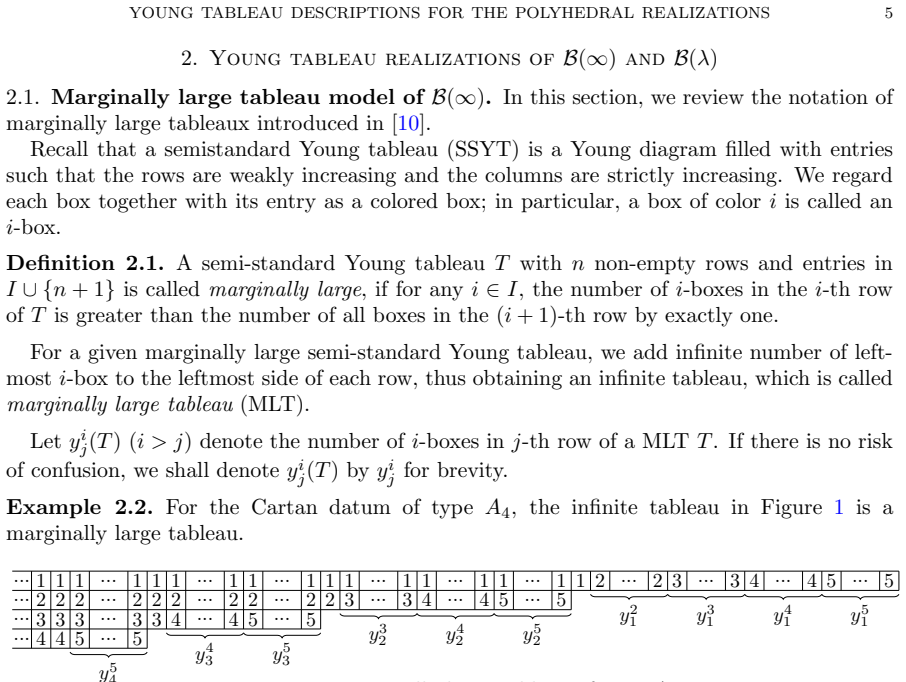
Reverse tableaux describe polyhedral crystal bases in type A_n

Young tableau descriptions for the polyhedral realizations of crystal bases in type A_n

An explicit bijection maps the polyhedral models of B(λ) and B(∞) to reverse semi-standard and marginally large Young tableaux.

Figure from the paper full image
abstract click to expand
By utilizing the combinatorial properties of various tableau models, we establish an explicit correspondence between the polyhedral realizations of the crystal bases $\mathcal B(\lambda)$ (resp. $\mathcal B(\infty)$) of type $A_n$ and the reverse semi-standard Young tableaux (resp. reverse marginally large tableaux), thereby providing a combinatorial description of the corresponding polyhedral realizations. Furthermore, a crystal structure on the set of Gelfand-Tsetlin patterns is obtained via the correspondence between the polyhedral realization of $\mathcal{B}(\lambda)$ and the reverse tableaux. As applications of our framework, we present concrete combinatorial realizations of the crystal embedding of $\mathcal B(\lambda)$ into $\mathcal B(\infty)$ and the set of Lusztig data.
0
0
math.RT 2026-05-11 Recognition

Homotopy colimits realize silting objects for nested t-structures

Limits and colimits in silting theory with applications to the wall and chamber structure of an algebra

The construction produces two-term large silting objects for numerical torsion pairs and limiting walls in the real Grothendieck group of a

Figure from the paper full image
abstract click to expand
In this paper we consider a family of nested t-structures given by silting objects and construct a silting object corresponding to the intersection of aisles of these t-structures as a homotopy colimit. The dual construction for the cosilting case is given as a homotopy limit. The results are applied to construct two-term large silting objects corresponding to the numerical torsion pairs and the limiting walls in the wall and chamber structure of the real Grothendieck group of a finite dimensional algebra. In particular, in case the algebra is tame we can describe any numerical torsion pair in this way by combining our results with results of Plamondon and Yurikusa.
0
0
math.RT 2026-05-08 2 theorems

Refined Langlands correspondence holds for disconnected real groups

On the refined local Langlands conjecture for discrete L-parameters of inner forms of quasi-split disconnected real reductive groups

Discrete L-parameters produce L-packets that obey endoscopic identities on all inner forms of G ⋊ A.

abstract click to expand
Given a quasi-split connected reductive $\mathbb{R}$-group $G$ and a finite group $A$ acting on $G$ by $\mathbb{R}$-automorphisms that preserve an $\mathbb{R}$-pinning, we construct for each discrete $L$-parameter for $G$ a corresponding $L$-packet of irreducible discrete series representations on each inner forms $\tilde G_z(\mathbb{R})$ of the disconnected group $\tilde G = G \rtimes A$. We prove that these $L$-packets satisfy the endoscopic character identities with respect to normalized transfer factors. This proves the conjectural refined local Langlands correspondence for inner forms of quasi-split disconnected real reductive groups, as recently formulated by the first author.
0
0
math.RT 2026-05-08 2 theorems

Duality on unipotent L-parameters reduces to Fourier transform and conjugation

A Microlocal Description of Aubert-Zelevinsky Duality on Unipotent L-Parameters

A microlocal view using perverse sheaves shows this for all inner forms of simple adjoint p-adic groups and proves a related conjecture.

abstract click to expand
We give a microlocal description of the Aubert--Zelevinsky involution for all unipotent representations of all inner forms of simple adjoint unramified $p$-adic groups. Via the realization of enhanced $L$-parameters as perverse sheaves, we show that the involution corresponds to the composition of three operations: Fourier transform, the complex conjugation map coming from the compact form of the dual group, and inversion on the compact part of the infinitesimal parameter. We also show that when the group is not inner to a triality form of $D_4$, this simplifies to the composition of Fourier transform, Chevalley involution, and duality on local systems. This was previously verified in certain special examples by several authors where only the contribution by Chevalley involution and Fourier transform was observed. Duality on local systems is invisible in these examples since they only involve self-dual local systems. Finally, we prove the microlocal Hiraga conjecture for unipotent $A$-parameters of inner-to-split simple adjoint groups as a consequence of our results. In order to give a uniform proof of our results we reformulate and clarify several aspects of the construction of the unipotent local Langlands correspondence. This additionally allows us to characterize how various affine and graded Hecke algebras are identified. We prove that there is a `canonical' way to do so by showing that there is a unique isomorphism of graded Hecke algebras compatible with the Kottwitz isomorphism. As an application of this, we show that a simple module of the geometric graded Hecke algebra is uniquely determined by certain composition multiplicities coming from the corresponding representation of the $p$-adic group. This can be understood as a characterization of the unipotent local Langlands correspondence.
0
0
math.RT 2026-05-08

Aubert-Zelevinsky duality on unipotent L-parameters is three geometric operations

A Microlocal Description of Aubert-Zelevinsky Duality on Unipotent L-Parameters

Fourier transform, complex conjugation from the dual compact form, and inversion on the infinitesimal parameter together give the involution

abstract click to expand
We give a microlocal description of the Aubert--Zelevinsky involution for all unipotent representations of all inner forms of simple adjoint unramified $p$-adic groups. Via the realization of enhanced $L$-parameters as perverse sheaves, we show that the involution corresponds to the composition of three operations: Fourier transform, the complex conjugation map coming from the compact form of the dual group, and inversion on the compact part of the infinitesimal parameter. We also show that when the group is not inner to a triality form of $D_4$, this simplifies to the composition of Fourier transform, Chevalley involution, and duality on local systems. This was previously verified in certain special examples by several authors where only the contribution by Chevalley involution and Fourier transform was observed. Duality on local systems is invisible in these examples since they only involve self-dual local systems. Finally, we prove the microlocal Hiraga conjecture for unipotent $A$-parameters of inner-to-split simple adjoint groups as a consequence of our results. In order to give a uniform proof of our results we reformulate and clarify several aspects of the construction of the unipotent local Langlands correspondence. This additionally allows us to characterize how various affine and graded Hecke algebras are identified. We prove that there is a `canonical' way to do so by showing that there is a unique isomorphism of graded Hecke algebras compatible with the Kottwitz isomorphism. As an application of this, we show that a simple module of the geometric graded Hecke algebra is uniquely determined by certain composition multiplicities coming from the corresponding representation of the $p$-adic group. This can be understood as a characterization of the unipotent local Langlands correspondence.
0
0
math.RT 2026-05-08

Heisenberg Verma modules map to Legendre polynomials via Sugawara operator

A Sugawara-Legendre mechanism for the hyperelliptic Heisenberg algebra

In the hyperelliptic case the Shapovalov form has Legendre norms, the module is irreducible for p-admissible parameters, and an explicit map

abstract click to expand
We study the $\varphi$-Verma modules of the Heisenberg subalgebra $\mathcal{H}_m$ of the universal central extension of $\mathfrak{sl}_2 \otimes A_m$, where $A_m$ is the coordinate ring of the superelliptic curve $u^m = P(t)$, and ask how the orthogonal polynomial families that arise in the centre relations are controlled by the module theory of $\mathcal{H}_m$. Our main results are proved unconditionally for the hyperelliptic case $m=2$, $r=1$; corresponding statements for $m \ge 3$ are recorded as conjectures. In the hyperelliptic case we prove three theorems. First, the canonical contravariant (Shapovalov) form on $M(\varphi)$ is diagonal in the polynomial basis $\{\tilde{P}_n\}_{n \ge 0}$ determined by the cocycle, with Legendre squared norms $h_n = 2/(2n+1)$. Second, $M(\varphi)$ is irreducible if and only if $\varphi$ is $p$-admissible, and this is equivalent to non-degeneracy of the Shapovalov form. Third, there is an explicit intertwiner $\Phi \colon M(\varphi) \to \mathbb{C}[x]$ which sends the free-boson Sugawara zero mode $\Omega = -L_0(L_0 + \mathrm{Id}) \in \widetilde{U(\mathcal{H}_m)}$ to the classical Legendre differential operator $L = (1-x^2)\partial_x^2 - 2x\partial_x$, the level-$n$ image of the highest-weight vector to the Legendre polynomial $P_n(x)$, and the Casimir tower $\{\Omega^r\}_{r \ge 1}$ to $\{L^r\}_{r \ge 1}$. As a companion result, $M(\varphi)$ is canonically isomorphic to a bosonic Fock space with the Shapovalov form identified with the Fock inner product.
0
0
math.RT 2026-05-08

Scott module kernels decide Brauer indecomposability

Kernel of Scott modules and Brauer indecomposability

Generalized criterion ties kernel to the property, which lifts from p-local subgroups under stated conditions

abstract click to expand
Let $k$ be an algebraically closed field of a prime characteristic $p$. Let $G$ be a finite group. We investigate the Brauer indecomposability of Scott $kG$-modules in relation to the kernel of modules. We generalize a criterion for Brauer indecomposability. We also prove that, in certain cases, Brauer indecomposability of a Scott $kG$-module can be lifted from that of a Scott module over a $p$-local subgroup.
0
0
math.RT 2026-05-07

Pinned splitting gives canonical bijection for depth-zero supercuspidals

A Pinned Local Langlands Correspondence for Depth-Zero Supercuspidal Representations

The construction separates toral and unipotent parts with Jordan decomposition to link representations reversibly to their enhanced params.

abstract click to expand
We construct a pinned local Langlands correspondence for depth-zero supercuspidal representations of a connected reductive group over a non-archimedean local field. After fixing a pinned splitting of the quasi-split inner form, we obtain a canonical bijection between irreducible depth-zero supercuspidal representations and relevant cuspidal enhanced depth-zero Langlands parameters. The construction separates the tame toral part from the unramified unipotent part. The toral part is normalized by the local Langlands correspondence for maximally unramified elliptic tori and by the corresponding canonical \(L\)-embeddings. The finite representation occurring in a depth-zero type is then passed, through a pinned Jordan decomposition for possibly disconnected finite reductive quotients, to a cuspidal unipotent label on the dual centralizer. The unramified unipotent contribution is supplied by the Feng--Opdam--Solleveld correspondence for supercuspidal unipotent representations. Combining these ingredients gives the enhanced parameter attached to a depth-zero supercuspidal representation, and the inverse map is obtained by reversing the same finite Jordan decomposition. The correspondence is independent of auxiliary choices apart from the fixed pinned normalization. It is compatible with the tame inertial parameter attached to the depth-zero character, with weakly unramified twists, and with central characters via the torus correspondence. Thus the main output is a canonical, pinning-normalized bijection between the two depth-zero supercuspidal sides, together with the finite unipotent bookkeeping needed to make the construction reversible.
0
0
math.RT 2026-05-07

Schur elements formula decides semisimplicity for Hecke-Clifford superalgebras

On the semisimplicity and Schur elements of (super)symmetric superalgebras

Closed expression for these scalars yields explicit criteria for the cyclotomic Hecke-Clifford case and four families of quiver Hecke super

abstract click to expand
In this paper, we use Schur elements to derive semisimplicity criteria for (super)symmetric superalgebras. We obtain a closed formula for the Schur elements of cyclotomic Hecke-Clifford superalgebras $\mathcal{H}^{f}_{\mathbb{K}}$. As applications, we prove that two trace functions $\gimel_n$ and $t_{1,n}$ on the Hecke-Clifford superalgebra, which are defined in different ways, are proportional. We give a semisimplicity criterion for $\mathcal{H}^{f}_{\mathbb{K}}$ when it is (super)symmetric. We also derive semisimplicity criteria for cyclotomic quiver Hecke superalgebras of types $A^{(1)}_{e}$, $C^{(1)}_{e}$, $A^{(2)}_{2e}$ and $D^{(2)}_{e+1}$.
1 0
0
math.RT 2026-05-07

Type I affine superalgebras have exactly u ordinary modules at boundary levels

Classification of the irreducible ordinary modules for affine vertex operator superalgebras

The classification fixes the count at u for type I cases and at 1 for type II and ordinary Lie algebras when the level equals h^∨/u minus h^

abstract click to expand
Let $\mathfrak{g}$ be a basic classical Lie superalgebra, $\mathcal{k}=\frac{h^{\vee}}{u}-h^{\vee}$ a boundary admissible level of $\widehat{\mathfrak{g}}$, where $u$ is a positive integer and $h^{\vee}$ is the dual Coxeter number of $\mathfrak{g}$. In this paper, we classify the irreducible ordinary modules for the affine vertex operator superalgebra $L_{\widehat{\mathfrak{g}}}(\mathcal{k},0)$ associated to any basic classical Lie superalgebra $\mathfrak{g}$. More specifically, if $\mathfrak{g}$ is a basic classical Lie superalgebra of type I, we prove that $L_{\widehat{\mathfrak{g}}}(\mathcal{k},0)$ has exactly $u$ inequivalent irreducible ordinary modules. If $\mathfrak{g}$ is a finite dimensional simple Lie algebra or a basic classical Lie superalgebra of type II, we prove that $L_{\widehat{\mathfrak{g}}}(\mathcal{k},0)$ itself is the only irreducible ordinary $L_{\widehat{\mathfrak{g}}}(\mathcal{k},0)$-module.
0
0
math.RT 2026-05-07

Wilde conjecture reduces to nearly simple group checks

Zeros of characters and orders of elements in finite groups

The connection between character table zeros and element orders holds after reduction to prime-by-prime verification on nearly simple groups

abstract click to expand
We investigate a beautiful conjecture of T. Wilde on character values and element orders of finite groups. We reduce it to a statement on nearly simple groups that can be checked ``prime by prime". For these groups, we show that a strong form of Wilde's conjecture holds in many important cases, and for primes $p>5$ we are able to show the required statement for most classes of nearly simple groups. The few remaining cases, however, seem to require information on extensions of irreducible characters that are not available at the present time.
0
0
math.RT 2026-05-06

New categories yield higher-level affine wreath product algebras

Higher-level affine wreath product algebras

Path algebras built from a Frobenius superalgebra produce unified higher-level versions of the degenerate affine Hecke and Sergeev algebras.

abstract click to expand
We define and study two new classes of algebras, called higher-level affine wreath product algebras and higher-level affine Frobenius Hecke algebras. They depend on a Frobenius superalgebra and are defined, respectively, as path algebras of the higher-level affine wreath product category and higher-level affine Frobenius Hecke category. Our constructions produce a broad range of new higher-level algebras under a unified framework. Special cases include higher-level analogues of the degenerate affine Hecke algebra and affine Sergeev algebras, both of which appear to be new.
0
0
math.RT 2026-05-06

Super Krawtchouk polynomials arise from Lie superalgebra representations

Super Krawtchouk Polynomials via Lie Superalgebras

These multivariate extensions of the classical Krawtchouk polynomials are shown to be orthogonal, satisfy recurrences, and link to fermionic

abstract click to expand
Multivariate extensions of the Krawtchouk polynomials have been studied by numerous authors in recent decades by exploring new connections to probability, representation theory and quantum integrability. We develop a theory of multivariate super Krawtchouk polynomials using the representation theory of the general linear Lie superalgebra, extending results of the first author in the classical setting. Specifically, in the present work we generalize the classical Krawtchouk polynomials, prove their orthogonality, construct certain recurrence relations, and discuss their connections with zonal spherical functions arising from a fermionic Fock-space framework in quantum mechanics.
0
0
math.RT 2026-05-06

Divergence-zero Lie algebra modules are either cuspidal or highest weight

Classification of irreducible Harish-Chandra modules over extended Divergence-zero Lie algebras

With nontrivial action by nonzero degree elements, they reduce to highest weight modules via suitable triangular decompositions, completing

abstract click to expand
Let $\mathcal{A}_n = \C[t_1^{\pm1}, t_2^{\pm1}, \ldots, t_n^{\pm1}]$, and let $\EuScript{D}_n$ denote the divergence-zero subalgebra of $\text{Der}\,(\mathcal{A}_n)$. In this paper, we classify irreducible Harish-Chandra modules over the extended divergence-zero Lie algebra $\EuScript{G}:=\EuScript{D}_n \ltimes \mathcal{A}_n$ with nontrivial $\mathcal{A}_n'$-action, where $\mathcal{A}'n= \oplus_{{\bf{m}} \in \Z^n\setminus \{\bf{0}\}} \C t^{\bf{m}}$. We prove that every such module is either cuspidal or a generalised highest weight module. We further prove that every irreducible generalised highest weight $\EuScript{G}$-module is an irreducible highest weight module with respect to a suitable triangular decomposition of $\EuScript{G}$. As a consequence, we obtain a classification of irreducible Harish-Chandra modules over $\EuScript{G}$ with nontrivial $\mathcal{A}_n'$-action.
0
0
math.RT 2026-05-06 2 theorems

Proper Ginzburg algebras equip cluster algebras with Λ-structures

Additive categorification of the monoidal Λ-invariant

Negative extensions in Higgs categories realize the monoidal Λ-invariant for Hernandez-Leclerc categories of untwisted simply-laced type.

abstract click to expand
In this paper, we contribute to the broad aim of relating invariants of additive and monoidal categorifications of cluster algebras. Specifically, in the setting of representations of a quantum affine algebra $U_q'(\mathfrak{g})$, Kashiwara-Kim-Oh-Park proved that the Hernandez-Leclerc categories form a monoidal categorification of their Grothendieck rings. Furthermore, these rings are $\Lambda$-cluster algebras, meaning they are equipped with a compatible Poisson structure, constructed via the $\Lambda$-invariant. Under certain natural conditions, where $U_q'(\mathfrak{g})$ is of untwisted simply-laced type, we provide an additive interpretation of the $\Lambda$-invariant within the framework of Higgs categories. More precisely, there is an ice quiver with potential associated with these cluster algebras, and a key ingredient of our work consists in proving that its relative Ginzburg algebra is proper. More generally, if the relative Ginzburg algebra associated with an arbitrary ice quiver with potential is proper, we prove that the corresponding cluster algebra admits the structure of a $\Lambda$-cluster algebra defined in terms of negative extensions in the Higgs category. Moreover, we provide a homological formula to compute the corresponding tropical and $F$-invariants introduced by Cao.
0
0
math.RT 2026-05-06

Twisted Yu construction extends to residual characteristic 2

Characteristic-free approaches around Yu's construction

Characteristic-free twisted Heisenberg-Weil representations are built directly when root systems lack symmetric and ramified roots, enabling

abstract click to expand
We give a direct characteristic-free construction of twisted Heisenberg-Weil representations when there are no symmetric and ramified roots. As a consequence, we show that twisted Yu's construction naturally extends to residual characteristic $2$. Moreover, we give a geometric realization of such twisted Heisenberg-Weil representations via the Deligne-Lusztig construction for Heisenberg group schemes. As an application, we give an explicit description of positive-depth parahoric Deligne-Lusztig induction in the generic case.
0
0
math.RT 2026-05-06

Quiver tensor powers split into indecomposables at controlled rates

Growth rates of indecomposable summands in tensor powers of representations of quivers

For both pointwise and coalgebra tensor products the number of summands follows explicit growth laws that can be computed from the quiver.

abstract click to expand
Tensor products of quiver representations have been extensively studied; typical examples include the pointwise tensor product and the tensor product induced by the coalgebra structure of path algebras. In this paper, we investigate the growth rates of the number of indecomposable direct summands in tensor powers of quiver representations with respect to these two typical tensor products.
0
0
math.RT 2026-05-06

Side-preserving duality induces self-bijection on definable subcategories

A duality for definable subcategories and its application to torsion classes

For two-sided noetherian rings it pairs torsion classes with torsion-free classes; for finite-dimensional algebras it gives an anti-autormph

abstract click to expand
For a ring $A$, there is a well-known duality between definable subcategories of right $A$-modules and definable subcategories of left $A$-modules, which is a consequence of Auslander-Gruson-Jensen duality $\rm mod\text{-}(\rm mod\text{-}A) \rightarrow \rm mod\text{-}(\rm mod\text{-}A^{op})$. In this paper, first we construct a duality $\rm mod\text{-}(\rm mod\text{-}A) \rightarrow \rm mod\text{-}(\rm mod\text{-}A)$ (without changing the side). Then, using this duality, we obtain a natural bijection from definable subcategories of right $A$-module to itself. If $A$ is two-sided noetherian, we prove that this bijection restricts to a bijection between definable torsion classes and definable torsion-free classes. When $A$ is a finite dimensional algebra, this gives an anti-automorphism of the lattice of torsion classes of $\rm mod\text{-}A$.
0
0
math.RT 2026-05-06

Affine cotangent bundle closure equals C* reduction of type D orbit

A connection between minimal nilpotent orbits of types A and D via Hamiltonian reduction

The isomorphism connects type-A and type-D minimal nilpotent orbits and proves the resulting space has no symplectic resolution.

abstract click to expand
We establish a novel connection between the minimal nilpotent orbit $\mathbb{O}_n$ in $\mathfrak{sl}_n$ and the minimal nilpotent orbit closure $\overline{\mathbf{O}}_n$ in $\mathfrak{so}_{2n+2}$, which differs from the shared-orbit paradigm of Brylinski and Kostant, where no direct type-A--type-D relation appears. More precisely, we show that the affine closure of the cotangent bundle $\overline{T^*\mathbb{O}_n}^{\mathrm{aff}}$ is isomorphic to a $\mathbb{C}^*$-Hamiltonian reduction of $\overline{\mathbf{O}}_n$. This provides a quasi-classical analogue of a quantum result of Levasseur and Stafford. A detailed study of the geometry of this Hamiltonian reduction reveals that $\overline{T^*\mathbb{O}_n}^{\mathrm{aff}}$ has no symplectic resolution.
0
0
math.RT 2026-05-05

Pinned bijection canonically refines Jordan decomposition of characters

Pinned Jordan Decomposition of Characters and Depth-Zero Hecke Algebras

For finite reductive groups the map from each Lusztig series to unipotent characters of the dual centralizer is uniquely fixed by Deligne-Lu

abstract click to expand
We construct a pinned canonical Jordan decomposition of characters for finite reductive groups in situations where the dual centralizers may be disconnected. For a connected reductive group \(\bG\) over a finite field, equipped with a pinning, and for a semisimple element \(s\in G^*\), we construct a uniquely determined bijection \[ \J_s:\cE(G,s)\xrightarrow{\sim}\Uch\bigl(C_{\bG^*}(s)^{F^*}\bigr). \] This refines Lusztig's orbit-valued Jordan decomposition for groups with disconnected centre, and is characterized by compatibility with the Deligne--Lusztig character formula and with Harish--Chandra series. We then extend the construction to possibly disconnected reductive groups with abelian component group, obtaining a canonical bijection between disconnected Lusztig series and unipotent characters of the corresponding disconnected dual centralizers. The main technical input is a canonical choice of preferred extensions of cuspidal unipotent characters to their inertia groups. The construction uses Lusztig's preferred extensions, Clifford theory, relative Weyl group comparison, and connected and disconnected forms of Howlett--Lehrer theory. These tools allow the cuspidal Jordan decomposition to be extended functorially to all Harish--Chandra series. As an application, we prove a pinned canonical reduction from depth-zero Bernstein blocks of tame \(p\)-adic reductive groups to unipotent blocks. More precisely, for a depth-zero Bernstein type \((K_{x_0},\rho_{x_0})\), the associated Hecke algebra is canonically isomorphic, after fixing the same pinning, to a unipotent Hecke algebra. This refines an earlier result of Ohara. This isomorphism preserves the standard anti-involutions.
0
0
math.RT 2026-05-05

Central extension relations match orthogonal polynomial recurrences

A partial dictionary between universal central extensions and orthogonal polynomials in the superelliptic Krichever--Novikov setting

Basis reductions in centers of superelliptic derivation algebra extensions correspond to three-term recurrences in parameter a

abstract click to expand
Let $m \geq 2$, let $P(x) \in \mathbb{C}[x]$ have simple roots, and let $A = \mathbb{C}[x^{\pm 1},\,u \mid u^m = P(x)]$ be the coordinate ring of the associated superelliptic curve. The derivation algebra $\mathrm{Der}(A)$ and the current algebra $\mathfrak{g}\otimes A$ (for $\mathfrak{g}$ a simple Lie algebra) each admit a universal central extension whose center is multi-dimensional and carries linear algebraic relations among its basis elements. We establish a systematic dictionary between these relations and families of orthogonal polynomials in the parameter $a$ encoding the branch locus of $P$. The dictionary has three canonical entries: (1)~the basis reduction relations in the center of $\widehat{\mathrm{Der}(A)}$ are exactly the three-term recurrence of an orthogonal polynomial family; (2)~the generating function of the center satisfies the Sturm--Liouville ODE of that family; (3)~the mixed-sector $2$-cocycle equals the Legendre antiderivative $(P_{n-1}(a)-P_{n+1}(a))/(2n+1)$ in the quadratic case. We prove the dictionary completely for $P(x)=x^2-2ax+1$ (Legendre polynomials) and for the quartic palindromic case $P(x)=x^4-2ax^2+1$. In the quadratic case, palindromic symmetry forces the recurrence to be the Legendre three-term recurrence; in the quartic case, the odd sector is Legendre and the even sector satisfies a two-component recurrence with palindromic coefficients. We conjecture this pattern -- palindromic $P$ forcing symmetric recurrence coefficients -- holds in all even degrees. The same dictionary governs the K\"{a}hler side $\Omega^1_A/dA$: all sectors reduce to the sector-$1$ family at a rescaled parameter, and the recurrence and ODE entries are canonical while the mixed-cocycle entry is partially choice-dependent.
0
0
math.RT 2026-05-04

Digroups split representations on rho side under group condition

Cohomological Maschke's Theorem for Generalized Digroups

Enveloping algebra equivalence turns cocycle obstructions into Ext^1 groups and yields a spectral sequence for splitting.

abstract click to expand
We study Maschke-type phenomena in the representation theory of generalized digroups. For a generalized digroup $D$, we construct an associative enveloping algebra $A_D$ and prove that $Rep(D)$ is equivalent to the category of left $A_D$-modules. Under a Maschke-type condition on the group component, we show that short exact sequences split on the $\rho$-side, while the obstruction to full splitting is described by cocycles and identified with $Ext^1_{Rep(D)}(Q,W)$. We also derive a spectral sequence with consequences for splitting and non-semisimplicity.
0
0
math.RT 2026-05-01

Thread quiver representations form hereditary categories

On the Hereditariness of the Representations of Thread Quivers

The category of pointwise finite dimensional representations has vanishing higher Ext groups for any thread quiver.

abstract click to expand
We prove a conjecture of Paquette, Rock, and Yildirim by showing that, for every thread quiver, the abelian category of pointwise finite dimensional representations is hereditary. Since this category typically lacks enough projectives and injectives, standard homological methods do not apply directly. Our approach combines a Yoneda Ext criterion for hereditariness, established in this paper, with structural reductions to the subcategory of quasi noise free representations. We also indicate an alternative proof using a Keller's theorem on derived categories.
0
0
math.RT 2026-05-01

Tensor products induce Lie bialgebras from Leibniz and Zinbiel bialgebras

Lie bialgebras constructed from Zinbiel bialgebras and Leibniz bialgebras

The structures inherit quasi-triangular properties and yield infinite-dimensional examples in the graded case.

abstract click to expand
There is a Lie algebra structure on the tensor product of a Leibniz algebra and a Zinbiel algebra for the operads of Leibniz algebras and Zinbiel algebras are Koszul dual. In this paper, we extend such conclusion to the context of bialgebras. We show that there is a Lie bialgebra structure on the tensor product of a Leibniz bialgebra and a quadratic Zinbiel algebra; there is an infinite-dimensional Lie bialgebra structure on the tensor product of a Zinbiel bialgebra and a quadratic $\mathbb{Z}$-graded Leibniz algebra. For special quadratic $\mathbb{Z}$-graded Leibniz algebra, the tensor product with a Zinbiel bialgebra being a Lie bialgebra characterizes the Zinbiel bialgebra. By analyzing the relationship between solutions of the classical Yang-Baxter equation in a Zinbiel algebra (resp. a Leibniz algebra) and solutions of the classical Yang-Baxter equation in the induced Lie algebra, we prove that the induced Lie bialgebra is quasi-triangular (resp. triangular, factorizable) if the original Zinbiel bialgebra (resp. Leibniz bialgebra) is quasi-triangular (resp. triangular, factorizable). Finally, we provide a construction of a quasi-Frobenius Lie algebra on the tensor product of a quasi-Frobenius Zinbiel algebra and a quadratic Leibniz algebra.
0
0
math.RT 2026-05-01 2 theorems

Tensor products of Leibniz bialgebras and quadratic Zinbiel algebras form Lie bialgebras

Lie bialgebras constructed from Zinbiel bialgebras and Leibniz bialgebras

Extends known algebra results to bialgebras while transferring Yang-Baxter solutions to preserve quasi-triangular and triangular properties.

abstract click to expand
There is a Lie algebra structure on the tensor product of a Leibniz algebra and a Zinbiel algebra for the operads of Leibniz algebras and Zinbiel algebras are Koszul dual. In this paper, we extend such conclusion to the context of bialgebras. We show that there is a Lie bialgebra structure on the tensor product of a Leibniz bialgebra and a quadratic Zinbiel algebra; there is an infinite-dimensional Lie bialgebra structure on the tensor product of a Zinbiel bialgebra and a quadratic $\mathbb{Z}$-graded Leibniz algebra. For special quadratic $\mathbb{Z}$-graded Leibniz algebra, the tensor product with a Zinbiel bialgebra being a Lie bialgebra characterizes the Zinbiel bialgebra. By analyzing the relationship between solutions of the classical Yang-Baxter equation in a Zinbiel algebra (resp. a Leibniz algebra) and solutions of the classical Yang-Baxter equation in the induced Lie algebra, we prove that the induced Lie bialgebra is quasi-triangular (resp. triangular, factorizable) if the original Zinbiel bialgebra (resp. Leibniz bialgebra) is quasi-triangular (resp. triangular, factorizable). Finally, we provide a construction of a quasi-Frobenius Lie algebra on the tensor product of a quasi-Frobenius Zinbiel algebra and a quadratic Leibniz algebra.
0
0
math.RT 2026-05-01

Unique generic module builds all torsionfree divisible modules

From finite to infinite length modules over tame hereditary algebras

A complete description of pure-injective modules connects infinite length representations directly to finite dimensional ones over tame and

abstract click to expand
A self-contained introduction to infinite dimensional representations over a tame hereditary algebra is provided, assuming a basic knowledge of the category of finite dimensional representations. This includes a complete description of all pure-injective modules. Of particular interest are the torsionfree divisible modules, which are precisely the direct sums of copies of the unique generic module.
0
0
math.RT 2026-04-30

Stiefel-Whitney classes vanish for almost all large GL_n orthogonal reps

Asymptotic Vanishing of Stiefel--Whitney Classes for GL_n(mathbb{F}_q)

With q fixed and odd, the proportion having trivial first and second classes approaches 1 as n grows.

abstract click to expand
We study the asymptotic behavior of Stiefel--Whitney classes of irreducible orthogonal representations of the finite general linear groups $\mathrm{GL}_n(\mathbb{F}_q)$. Building on recent formulas expressing these classes in terms of character values at elements of order dividing $2$, we relate questions about characteristic classes to problems of $2$-adic divisibility of character values. For fixed odd $q$, we show that as $n \to \infty$, the values of irreducible orthogonal characters become highly divisible by powers of $2$ for almost all representations. As a consequence, the proportion of irreducible orthogonal representations with trivial first and second Stiefel--Whitney classes tends to $1$, and if $q \equiv 1 \pmod{4}$, the same holds for the fourth Stiefel--Whitney class. In particular, almost all orthogonal representations are spinorial in the large rank limit. In contrast, when the rank is fixed and $q \to \infty$, the behavior is markedly different. Focusing on $\mathrm{GL}_2(\mathbb{F}_q)$, we show that the second Stiefel--Whitney class vanishes with limiting probability $5/16$ among irreducible orthogonal representations.
0
0
math.RT 2026-04-29 2 theorems

Demazure operators recover coordinate ring of universal centralizer iff scheme integral

The coordinate ring of the universal centralizer via Demazure operators

Criterion applies to Weil restrictions of affine schemes over Cartan subalgebras with compatible Weyl action, yielding explicit description.

abstract click to expand
We give a simple description of the coordinate ring of the universal centralizer associated to a simply connected semisimple group. To this end, we prove a general result on Weil restriction of affine schemes $X$ over the Cartan subalgebra $\mathfrak{t}$ equipped with a compatible action of the Weyl group $W$. Specifically, we show that the coordinate ring of the scheme $\mathrm{Res}^W(X)$ of $W$-fixed points of Weil restriction of $X$ to the categorical quotient $\mathfrak{t}//W$ can be obtained from the coordinate ring of $X$ by applying Demazure operators if and only if the scheme $\mathrm{Res}^W(X)$ is integral.
0
0
math.RT 2026-04-29

Demazure operators yield universal centralizer ring iff scheme is integral

The coordinate ring of the universal centralizer via Demazure operators

The equivalence holds for schemes over the Cartan subalgebra with Weyl group action, giving an explicit description for simply connected sem

abstract click to expand
We give a simple description of the coordinate ring of the universal centralizer associated to a simply connected semisimple group. To this end, we prove a general result on Weil restriction of affine schemes $X$ over the Cartan subalgebra $\mathfrak{t}$ equipped with a compatible action of the Weyl group $W$. Specifically, we show that the coordinate ring of the scheme $\mathrm{Res}^W(X)$ of $W$-fixed points of Weil restriction of $X$ to the categorical quotient $\mathfrak{t}//W$ can be obtained from the coordinate ring of $X$ by applying Demazure operators if and only if the scheme $\mathrm{Res}^W(X)$ is integral.
0
0
math.RT 2026-04-29

Formal Lie groups match Lie pairs exactly

Lie pairs and formal Lie groups

The equivalence extends the classical theorem by identifying group objects in formal manifolds with Lie pairs.

abstract click to expand
In a previous paper, we introduce and study formal manifolds, which generalize smooth manifolds. In this paper, we establish the basic theory of formal Lie groups, which are group objects in the category of formal manifolds. In particular, extending the classical formal Lie theory theorem, we prove that the category of formal Lie groups is equivalent to the category of Lie pairs.
0
0
math.RT 2026-04-29

Orbit atom spectrum subsets classify tensor torsion-free classes

Atom spectra of symmetric monoidal abelian categories and classification of subcategories

In symmetric monoidal noetherian abelian categories, arbitrary subsets of this quotient label all tensor-compatible torsion-free classes and

abstract click to expand
We extend the classification results for torsion classes and torsion-free classes in the category of finitely generated modules over a commutative noetherian ring to suitable symmetric monoidal closed noetherian abelian categories. Our main tool is the orbit atom spectrum, defined as the quotient of Kanda's atom spectrum by the action induced by tensoring with invertible objects. We prove that, under natural tensor-theoretic assumptions, several classes of subcategories collapse to Serre subcategories or torsion-free classes. Moreover, torsion-free classes compatible with the tensor structure are classified by arbitrary subsets of the orbit atom spectrum. As applications, we recover the classical classifications for commutative noetherian rings and obtain analogues for graded modules, coherent sheaves, and dg modules.
0
0
math.RT 2026-04-29

Faithful perverse hearts equal glued exceptional collections

Faithful perversities

This identification plus a dimension bound lets hypercohomology be read off from resolutions of the constant sheaf on finite-strata spaces.

abstract click to expand
We show that the faithful highest weight hearts in an algebraic triangulated category are the serially faithful glued hearts, equivalently the hearts containing a dual pair of full exceptional collections in the sense of Bodzenta--Bondal (arXiv:2601.22004). We then characterise faithful highest weight categories of perverse sheaves on topologically stratified spaces algebraically, in terms of the exactness of certain functors, and topologically, in terms of the vanishing of certain cohomology groups of pairwise links. We prove that the global dimension of a faithful category of perverse sheaves on a topologically stratified space $X$ with finitely many strata is bounded by the dimension of $X$. Finally, we show that in this setting the hypercohomology of a perverse sheaf can be computed from a projective resolution of the constant sheaf, and conversely that the multiplicities of the terms in a minimal projective resolution of the constant sheaf can be computed as intersection cohomology groups.
0
0
math.RT 2026-04-29

Tameness of super Yangian modules fixed by highest-weight test

Representations of Super Yangians with Gelfand-Tsetlin bases

A necessary and sufficient condition on weights decides which simple quotients of evaluation tensor modules over Y_{m|n} are tame, extending

abstract click to expand
The evaluation homomorphisms from the super Yangian $\Ymn$ to the universal enveloping algebra $\U(\gl_{m|n})$ allows one to regard the covariant tensor module of $\gl_{m|n}$ as $\Ymn$ modules. We study simple quotients of the submodules generated by a tensor product of highest weight vectors inside the tensor products of covariant evaluation modules. In the case $n=0$, this recover all finite-dimensional simple modules of $\Y(\mathfrak{gl}_m)$. We give a necessary and sufficient condition for such modules to be tame, which generalizes the earlier work of Nazarov and Tarasov for $\Y(\mathfrak{gl}_m)$ to the super case.
0
0
math.RT 2026-04-29

Virasoro action on Fock spaces yields level-rank dualities for all classical affine types

Level-rank dualities and moving vectors

Uniform combinatorial models replace character calculations and convert KLR defects into sums of moving-vector components.

Figure from the paper full image
abstract click to expand
Duality relations between Lie algebras are a significant phenomenon in Lie algebra representation theory, with level-rank duality as a famous example. Level-rank dualities for affine Lie algebras of type $A^{(1)}$ were first discovered by Frenkel in 1982, and later extended to all classical non-twisted affine types by Hasegawa in 1989 through elaborate character calculations. In this paper, for all classical affine Lie algebras, we construct appropriate Fock spaces in a uniform way and establish corresponding combinatorial models (Maya diagrams and abaci), extending Uglov map to all classcial affine types. Through the action of the Virasoro algebra, we completely characterize the joint highest weight vectors in the Fock space, thereby obtaining the corresponding level-rank duality theory. Our method no longer relies on character calculations. Using this new level-rank duality theory, the defect of the cyclotomic KLR algebra $\mathscr{R}^{\Lambda}_{\beta}$ of classical affine type can be interpreted as the sum of the components of the correponding moving vector.
0
0
math.RT 2026-04-29

Chebyshev quotients for Demazure multiplicities turn positive eventually

Chebyshev quotients, Demazure multiplicities, and Dyck-path models

The quotients either terminate or have strictly positive coefficients from some degree on, with many cases counted by unsigned bounded Dyck

abstract click to expand
We study Chebyshev quotients that arise in the representation theory of Lie algebras, specifically within the theory of Demazure flags for fusion products of $\mathfrak{sl}_2[t]$-modules. Motivated by a recent formula that expresses certain Demazure multiplicities as coefficients of such quotients, we prove a general eventual non-negativity theorem: each quotient either terminates or has strictly positive coefficients for sufficiently large degrees, which we in turn interpret in terms of matchings and bounded walks. In several natural infinite families, these are unsigned bounded Dyck path models, giving both a structural explanation for the observed positivity phenomenon and concrete combinatorial models for key families of Demazure multiplicities. The theorems in this paper were autonomously produced and formalized in Lean/Mathlib by AxiomProver from natural-language statements.
0
0
math.RT 2026-04-29

Bruhat invariants determine B' orbits on flags for classified pairs in GL(n)

B'-orbits on flag varieties and symmetry breaking

The classification gives explicit descriptions of double cosets and closed orbits, aiding branching problems for principal series.

Figure from the paper full image
abstract click to expand
Motivated by branching problems for principal series representations of the Lie group $G = GL(n,\mathbb R)$, we consider all pairs $(G', P)$ with $G'$ being the Levy factor of a parabolic subgroup of $G$ and $P$ a parabolic subgroup of $G$ for which a Borel subgroup $B'$ of $G'$ has finitely many orbits on $G/P$. We classify all such pairs $(G',P)$ for which $B'$-orbits on the generalized flag variety $G/P$ are determined by invariant functions inspired from the Bruhat decomposition. We also describe explicitly the double coset space $B'\backslash G/P$ as well as the closed $B'$-orbits on $G/P$ whenever $B'$-orbits are computed by these invariant functions.
0
0
math.RT 2026-04-29

Fences mark constant-multiplicity zones in sl_2 branching

Stability of Multiplicities in Symmetry Breaking: The sl₂ Case

Linear inequalities replace separate calculations and unify Pieri, fusion, and K-type rules as parameters move.

abstract click to expand
This expository paper explains, in the case of $\mathfrak{sl}_2$, the ideas introduced in the preprints (arXiv:2509.17007, 2604.22262), which develop a new framework for the study of multiplicities in branching laws of representations, with particular emphasis on their dependence on representation parameters. Taking the Lie algebra $\mathfrak{sl}_2$ as a guiding example, we show that multiplicities, which are often computed via ad hoc, case-by-case arguments, are in fact governed by universal systems of linear inequalities. To describe these inequalities, we introduce the notion of \emph{fences}, which encode the piecewise-linear boundaries of regions in parameter space on which multiplicities remain constant. Within this framework, we give an explicit description of how multiplicities vary as parameters move inside reduced coherent families of representations. Our approach applies uniformly both to finite-dimensional representations and to admissible smooth Fr\'echet representations of real reductive Lie groups, and reveals a subtle and intrinsic interplay between the parameters of a group and those of its subgroup. As an application of the general theory, we establish stability results and explicit formulas that clarify and unify a variety of classical phenomena, including the Pieri rule, $K$-type formulas, fusion rules, and tensor products of Verma modules. In particular, the stability of fusion multiplicities provides a concrete manifestation of the theory. More broadly, this framework suggests a unified approach to branching multiplicities extending beyond the $\mathfrak{sl}_2$ case.
0
0
math.RT 2026-04-29

Local Langlands correspondence defined for unipotent supercuspidals on disconnected groups

The local Langlands correspondence of essentially unipotent supercuspidal representations for disconnected reductive groups

Rigid inner forms framework yields functoriality, compatibilities, and stronger automorphism equivariance than earlier results.

abstract click to expand
We construct the local Langlands correspondence of essentially unipotent supercuspidal representations under the framework of rigid inner forms and prove a certaion functoriality and compatibilities. In particular, we show the equivariance under automorphisms, which is stronger than the analogous result in [FOS20]. We also generalize this correspondence for disconnected reductive groups under a mild condition on the group structure. We expect to use this result for extension of the explicit local Langlands correspondence in [Kal21] for more general supercuspidal representations.
0
0
math.RT 2026-04-29

Whittaker blocks over bar S_2 reduce to parabolic finite-dim modules

The category of Whittaker modules over the Cartan Type Lie algebra bar{S}₂

Equivalences classify simples via gl_2-modules and equate one block to finite-dimensional H_1-modules

abstract click to expand
Let $\bar{S}_2$ be the Lie algebra of polynomial vector fields on $A_2=\mathbb{C}[t_1,t_2]$ with constant divergence.In this paper, we first show that each block $\Omega^{\widetilde{S}_2}_{\mathbf{a}}$ of the category of $(A_2, \bar{S}_2)$-Whittaker modules with finite-dimensional Whittaker vector spaces is equivalent to the finite-dimensional module category over the parabolic subalgebra $\bar{S}_2^{\geq 0}$. Then we classify all simple Whittaker $\bar{S}_2$-modules with finite-dimensional Whittaker vector spaces using $\mathfrak{gl}_2$-modules. Finally, we establish an equivalence between $\Omega^{\bar{S}_2}_{\mathbf{1}}$ and the category $H_{\mathbf{1}}$-fmod of finite-dimensional modules over an associative algebra $H_{\mathbf{1}}$.
0
0
math.RT 2026-04-28

Doubling method yields multiplicative gamma factors for depth zero reps

On classical doubling method gamma factors for certain depth zero representations

Explicit formulas from Deligne-Lusztig data link the finite case to p-adic local factors.

abstract click to expand
Piatetski-Shapiro--Rallis discovered an integral representation construction, known as the doubling method, for the tensor product $L$-function of a cuspidal automorphic representation of $G \times \mathrm{GL}_1$, where $G$ is a classical group. Lapid--Rallis defined and studied the counterpart local factors. In this article, following Lapid--Rallis, we define and study an analogous doubling method gamma factor associated to irreducible representations of classical finite groups of Lie type. We prove that this gamma factor is multiplicative and use results of Yost-Wolff--Zelingher to give explicit formulas for it in terms of the Deligne--Lusztig data of the representation in the non-conjugate-dual character case. Finally, we relate our construction to the local construction of Lapid--Rallis via certain depth zero supercuspidal representations of classical groups.
0
0
math.RT 2026-04-28

Picky elements and subnormalizers give local rules for character values

The Main Problem of Block Theory: Picky Elements and Subnormalizers

Conjectures in block theory tie character values to specific sets and subgroups linked to each p-element.

abstract click to expand
This article is essentially an English translation of a paper of mine, published in \emph{La Gaceta de la RSME}. Its aim is to present, for a broad mathematical audience, a research programme in local representation theory that goes beyond the classical restrictions to characters of $p'$-degree, characters of height zero, and blocks of abelian defect. The final and most recent part of this programme concerns Alperin's main problem of block theory: the search for local rules for character values. In that direction I describe the conjectures on picky elements and subnormalizers, which suggest that the sets ${\rm Irr}^x(G)$ and the subgroups ${\rm Sub}_G(x)$ are the natural objects attached to a $p$-element $x$.
0
0
math.RT 2026-04-27

Super restriction map fails to be isomorphism for so7

Super-Chevalley Restriction and Relative Lie Algebra Cohomology over the 2|3 Algebra

Non-Cartan and fortuitous classes in the 2|3 current algebra break expected isomorphisms and duality for so7 and sp6 cohomologies.

abstract click to expand
Let $A:=\mathbb{C}[z_+,z_-]\otimes \Lambda(\theta_1,\theta_2,\theta_3)$, with $z_\pm$ even and $\theta_1,\theta_2,\theta_3$ odd. For a reductive Lie algebra $\mathfrak g$, let $\mathfrak g[A]:=\mathfrak g\otimes A$ be the corresponding current Lie superalgebra. Motivated by the Chang--Yin description of weak-coupling $1/16$-BPS cohomology in $\mathcal N=4$ super-Yang--Mills, we study the relative Lie algebra cohomology $H^\bullet(\mathfrak g[A],\mathfrak g;\mathbb{C})$. We isolate three finite-rank phenomena. First, the natural $3|2$ super-commuting restriction map, viewed as a super analogue of Chevalley restriction and its commuting-scheme variants, already fails to be an isomorphism for $\mathfrak g=\mathfrak{so}_7$; the obstruction is a non-Cartan class. Second, the same algebra produces explicit fortuitous classes for $\mathfrak{sl}_2$ and $\mathfrak{so}_7$, giving concrete counterexamples to naive stable-image expectations suggested by the type-A Loday--Quillen--Tsygan theorem and its current-algebra refinements. Third, the classical relative cohomologies for the Langlands-dual pair $(\mathfrak{so}_7,\mathfrak{sp}_6)$ are not isomorphic. We then record the conjectural quantum deformation of the differential expected to restore duality, together with first-order evidence pairing the fortuitous and non-Cartan $\mathfrak{so}_7$ classes.
0
0
math.RT 2026-04-27

Hereditary Hovey triples chain into equivalent model structures

Chains of model structures arising from cotorsion pairs on extriangulated categories

Starting from one triple, further ones produce a sequence of model structures whose homotopy categories are all triangulated equivalent to a

abstract click to expand
The main aim of this paper is to study chains of model structures arising from cotorsion pairs in extriangulated categories. Starting with a hereditary Hovey triple, we construct further hereditary Hovey triples whose homotopy categories are equivalent under suitable completeness assumptions, thereby refining results due to El Maaouy and Shao-Wang-Zhang. As an application, we consider objects of finite Gorenstein injective dimension with respect to a proper class of $\mathbb{E}$-triangles. Under mild set-theoretic assumptions, we obtain a chain of model structures whose homotopy categories are all triangulated equivalent to a common stable category. This recovers known results for Gorenstein injective modules and yields new examples in the derived category of a ring when the proper class is given by cohomological ghost triangles.
0
0
math.RT 2026-04-27

Combinatorial rules describe every m-coloured D_n quiver

The coloured mutation class of mathbb{D}_n- quivers and their application to m-cluster tilted algebras

The rules give all Gabriel quivers of m-cluster-tilted algebras of type D_n and recover the m=1 case as a special instance.

Figure from the paper full image
abstract click to expand
In this paper, we present an explicit and purely combinatorial characterization of the $m$-coloured quivers that appear within the $m$-coloured mutation class of a quiver of type $\mathbb{D}_n$. The $m$-coloured mutation, as defined by Buan and Thomas in \cite{BT}, generalises the well-known quiver mutation introduced by Fomin and Zelevinsky \cite{FZ}. Consequently, we derive a comprehensive description of the Gabriel quivers associated with $m$-cluster-tilted algebras of type $\mathbb{D}_n$. Notably, our characterization extends a result by Vatne, \cite{Va}, which we recover when $m=1$.
0
0
math.RT 2026-04-27

Multiplicities stay constant inside linear fences for orthogonal pairs

Stability of Branching Multiplicities for Orthogonal Gelfand Pairs

Piecewise-linear hypersurfaces divide parameter space into regions where branching numbers do not change.

abstract click to expand
We propose a structural framework for branching multiplicities in representation theory, emphasizing their behavior under variation of infinitesimal characters. For the orthogonal reductive pairs $(G,G')$ with complexified Lie algebras $(\mathfrak{o}(n+1,\mathbb{C}), \mathfrak{o}(n,\mathbb{C}))$, we show that branching multiplicities are governed by universal systems of linear inequalities on the parameter space of reduced coherent families introduced in this paper. To describe the loci where multiplicities may change, we introduce \emph{fences}: piecewise-linear hypersurfaces that divide the parameter space into convex regions. We prove that the multiplicity function is locally constant on each such region bounded by these fences. The framework applies uniformly to finite-dimensional representations and to admissible smooth Fr\'echet representations of real reductive groups. It accounts for classical results such as the Weyl branching law and provides a unified explanation for a range of phenomena, including the Gross--Prasad conjecture, sporadic symmetry breaking operators, and fusion rules for Verma modules. These results establish a general paradigm for branching multiplicities in orthogonal Gelfand pairs.
1 0
0
math.RT 2026-04-24

Conjugacy quandle irreps are products iff symmetric 2-cocycles are coboundaries

On irreducible representations of conjugacy quandles

The condition implies the enveloping group of Conj(G) embeds into G times Z to the power of the number of conjugacy classes, becoming an iso

abstract click to expand
For $G$ a finite group, one way to construct irreducible quandle representations over $\mathbb{C}$ of the conjugacy quandle $Conj(G)$ is by taking the product of an irreducible linear group representation of $G$ by what we call a quandle character of $Conj(G)$ (a quandle morphism into $\mathbb{C}^\times$ ). We show that these are all the irreducible quandle representations of $Conj(G)$ over $\mathbb{C}$ if and only if all the symmetric $2$-cocyles over $G$ ($\alpha(g,h)=\alpha(h,g)$ for all $g,h$) with values in $\mathbb{C}^\times$ are coboundaries. For instance, this is the case of groups with trivial Bogomolov multiplier. We apply this to study the enveloping group of $Conj(G)$. If $G$ finite satisfies the previous condition on symmetric $2$-cocycles, we obtain that the enveloping group of $Conj(G)$ injects into $G\times \mathbb{Z}^{c_G}$ where $c_G$ is the number of the conjugacy classes of $G$. If moreover $G$ is perfect the injection is an isomorphism.
0
0
math.RT 2026-04-24

RLL realization covers orthosymplectic quantum supergroups for any parity

Orthosymplectic quantum groups revisited

Precomputed R-matrices enable a uniform construction that preserves generalized double structures and factors the reduced R-matrix.

abstract click to expand
We present the RLL-realization of extended orthosymplectic quantum supergroups for any parity sequence, with R-matrices evaluated in the earlier work arxiv:2408.16720. Our isomorphism is compatible with the internal structure of generalized doubles. We also relate different sign conventions through 2-cocycle twists. Furthermore, we establish a factorization of the reduced R-matrix within the RLL-realization.
0
0
math.RT 2026-04-24

Twisted Kazhdan-Lusztig conjecture holds for p-adic GL(n)

Twisted Kazhdan-Lusztig conjecture for p-adic general linear group

Multiplicities in the Grothendieck group of unramified principal series match the predicted values using enhanced parameters.

abstract click to expand
We use enhanced Langlands parameters to obtain a classification for irreducible representations of twisted $p$-adic general linear groups in unramified principal series. We give the definition of standard representations and prove the twisted Kazhdan-Lusztig conjecture for the multiplicities in the Grothendieck group. We mainly follow Lusztig's work in the connected case using graded Hecke algebra. We show that the parametrization is compatible with the Whittaker-normalized one.
0
0
math.RT 2026-04-24

Nilpotent-supported functions equal their Fourier transforms up to a Gauss sum

Lusztig constants and endoscopy

The relation fixes the Lusztig constant in character formulas for groups of Lie type and proves a conjecture on induction compatibility.

abstract click to expand
We prove that on a semisimple Lie algebra $\mathfrak{g}$ over a finite field of large characteristic, if a complex-valued invariant function $f$ and its Fourier transform $\hat f$ are both supported in the nilpotent cone of $\mathfrak{g}$, then $\hat f = \gamma^{-1}f$ for an explicit quadratic Gauss sum $\gamma$. Consequently, we determine a fourth root of unity appearing in various formulae of generalised Gel'fand--Graev characters, known as Lusztig constant, previously known in special cases due to works of Kawanaka, Digne--Lehrer--Michel, Waldspurger and Geck. As consequence, we show the validity of a conjecture of Letellier on the compatibility of Fourier transform with Deligne--Lusztig induction.
0
0
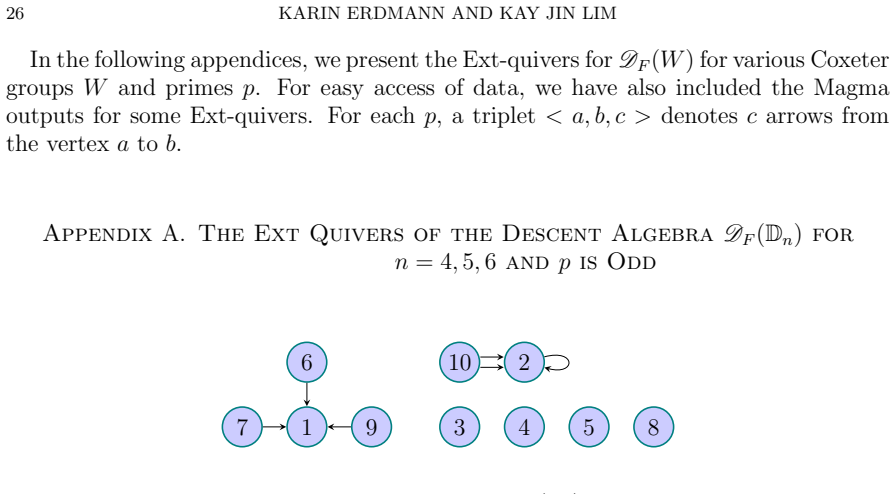
math.RT 2026-04-24

Descent algebra representation types classified except for E8

The Representation Type of the Descent Algebras

Type B proved theoretically; small D and exceptional cases settled by Ext-quiver computation over any characteristic.

Figure from the paper full image
abstract click to expand
Schocker classified the representation type of the descent algebra of type $\mathbb{A}$ over any field of characteristic zero. In an earlier paper, the authors extended this classification for type $\mathbb{A}$ to fields of positive characteristic. In this paper, we complete the classification for all other types except for $\mathbb{E}_8$. The proof for type $\mathbb{B}$ is entirely theoretical, while some small cases in type $\mathbb{D}$ and the exceptional types require computer computation to determine their Ext-quivers.
0
0
math.RT 2026-04-24

Quantizations of GL_N nilpotent orbits fully classified in positive characteristics

Quantization of nilpotent coadjoint GL_N-orbit closures in positive characteristics

They arise exactly from primitive quotients of the enveloping algebra induced from stabilizers of Frobenius-twisted p-characters.

abstract click to expand
Let $G$ be a reductive group over an algebraically closed field of positive characteristic $p$, good for the root system of $G$. The closures of $G$-orbits in the Hilbert nullcone of the coadjoint representation are conical affine Poisson varieties, generically of full rank, known as {\em nilpotent coadjoint orbits}. In this paper, we classify the filtered Hamiltonian quantizations of these orbit closures for $G = GL_N$ and any $p > 0$. Our main new technique is a construction of quantizations from certain primitive quotients of the enveloping algebra, inducing them from the stabiliser in $G$ of the Frobenius twisted $p$-character.
0
0
math.RT 2026-04-23

Strong factorization holds for smooth vectors of exponential solvable Lie groups

Strong factorization theorem for smooth vectors of exponential solvable Lie group representations

Extends Dixmier-Malliavin theorem from nilpotent groups to the full exponential solvable class on Fréchet spaces

abstract click to expand
We establish new strong factorization properties for the smooth vectors of representations of exponential solvable Lie groups on Fr\'{e}chet spaces. In particular, our results improve upon the Dixmier-Malliavin factorization theorem for simply connected nilpotent Lie groups.
0
0
math.RT 2026-04-23

Universal 2-parameter N=2 W∞-algebra proves dualities among Y-algebras

Universal 2-parameter mathcal{N}=2 supersymmetric mathcal{W}_{infty}-algebra

It extends the superconformal algebra with four generators per level and yields strong rationality of super W-algebras at k = -1 + 1/(n+a+1)

Figure from the paper full image
abstract click to expand
The universal $2$-parameter vertex algebra $\mathcal{W}_{\infty}$ of type $\mathcal{W}(2,3,\dots)$ is a classifying object for vertex algebras of type $\mathcal{W}(2,3,\dots,N)$ for some $N$; under mild hypotheses, all such vertex algebras arise as quotients of $\mathcal{W}_{\infty}$. In 2017, Gaiotto and Rap\v{c}\'ak introduced a family of such vertex algebras called $Y$-algebras, and conjectured that they fall into groups of three that are mutually isomorphic. This is a common generalization of both Feigin-Frenkel duality and the coset realization of principal $\mathcal{W}$-algebras in type $A$, and was proven in 2021 for the simple $Y$-algebras (i.e., one label is zero) by the first and third authors. In this paper, we extend this entire story to the $\mathcal{N}=2$ superconformal setting. First, we prove the 2013 conjecture of Gaberdiel and Candu that there exists a universal $2$-parameter vertex algebra $\mathcal{W}^{\mathcal{N}=2}_{\infty}$ which is an extension of the $\mathcal{N}=2$ superconformal algebra, and has four additional generators in weights $i, i + \frac{1}{2}, i + \frac{1}{2}, i+1$, for each integer $i > 1$. This admits many $1$-parameter quotients which we call $\mathcal{N}=2$ supersymmetric $Y$-algebras, and we prove the dualities among these algebras which were conjectured in 2018 by Prochazka and Rap\v{c}\'ak. A special case is the coset realization of the principal $\mathcal{W}$-algebra $\mathcal{W}^k(\mathfrak{sl}_{n+1|n})$ which was conjectured in 1992 by Ito. As a corollary, we obtain the strong rationality of $\mathcal{W}_k(\mathfrak{sl}_{n+1|n})$ for $k = -1 + \frac{1}{n+a+1}$ for all positive integers $n,a$, and we describe its module category. This generalizes Adamovi\'c's 1999 result on $\mathcal{N}=2$ minimal models, which is the case $n=1$.
0
0
math.RT 2026-04-23

Reduction classifies simple birepresentations for affine Soergel bimodules

Almost finitary birepresentation theory and applications to affine Soergel bimodules

Generalized finitary theory reduces the infinite Coxeter case to finitary substructures, with explicit results for extended affine type A.

abstract click to expand
In this article, we develop a generalization of finitary birepresentation theory applicable to Soergel bimodules for infinite Coxeter groups. We establish a reduction process for the classification of simple birepresentations of almost finitary bicategories, and consider in detail the case of Soergel bimodules in extended affine type A.
0
0
math.RT 2026-04-23

Unitary highest weight modules classified for fixed integral character

Unitary highest weight modules for mathfrak{su}(p, q) and mathfrak{so}^{*}(2n) with fixed integral infinitesimal character

Complete list for su(p,q) and so*(2n) in both regular and singular cases, identified inside Hasse diagrams.

abstract click to expand
We classify unitary highest weight modules with a given integral infinitesimal character for the real Lie algebras $\mathfrak{su}(p,q)$ and $\mathfrak{so}^*(2n)$. We treat both regular and singular cases. For $\mathfrak{su}(p,q)$ we identify the unitarizable modules in the Hasse diagrams of the highest weight orbit. Analogous results for the other Hermitian Lie algebras were given in our earlier publications.
0
0
math.RT 2026-04-23

Representation cohomology arises from nerve simplices of any small category

Representation Cohomology of a Small Category

Grothendieck groups of modules over the levels of the associated simplicial object in Cat form a cochain complex whose cohomology is studied

abstract click to expand
Let $C_\bullet$ be a simplicial object in the category $Cat$ of small categories. For a field $k$, taking the Grothendieck groups of isomorphism classes of $kC_n$-modules gives rise to a cochain complex, whose cohomology, which we refer to as representation cohomology, is the object studied in this article. In particular, to any small category $C$, we associate a simplicial object in $Cat$, where for each $n\ge 0$ the objects of the level $n$ category are the simplices of the nerve of $C$. The basic properties of the resulting representation cohomology of these simplicial objects and certain subobjects are then studied in detail. We present some general theoretical computations in favourable cases.
0
0
math.RT 2026-04-23

Vandermonde determinants factor as sums of terms in fewer variables

Multivariable Vandermonde determinants, amalgams of matrices and Specht modules

Amalgamating entries from two smaller matrices produces determinant formulae enabling this decomposition and proving transfinite diameter is

abstract click to expand
Using results of Fayers on the structure of Specht modules, we prove two different formulae for the determinant of matrices which are obtained by amalgamating the entries of two smaller matrices. In particular, this gives formulae for multivariable Vandermonde determinants as a sum of completely factorising terms, each of which is a Vandermonde determinant in fewer variables. As an application, we deduce an elementary proof of the multiplicativity of the transfinite diameter for products of compact sets.
0
0
math.RT 2026-04-23

Quadratic monomial algebras yield coherent Koszul duals

Koszul Duality for Quadratic Monomial Algebras

Finitely presented modules coincide with perfect ones, so tails categories become abelian and hereditary with rational series.

abstract click to expand
This paper provides a new class of examples for the Koszul dualities established in~\cite{5}. We study quadratic monomial algebras from the perspective of Koszul duality, with particular emphasis on finitely presented and finitely copresented graded modules over the Koszul dual algebra. For a finite-dimensional quadratic monomial algebra \(\Lambda\), we prove that the Koszul dual \(\Lambda^{!}\) is both left coherent and left co-coherent, and that finitely presented (resp.\ finitely copresented) modules coincide with perfect (resp.\ coperfect) modules. As a consequence, the associated tails and cotails categories are abelian and hereditary, and admit explicit structural descriptions. We further show that quadratic monomial algebras are absolutely Koszul and have global linearity defect at most one. In particular, every finitely presented module has rational Poincar\'e and Hilbert series. Building on these results, we refine the graded derived and singular Koszul dualities, as well as the graded BGG correspondence, by giving explicit realizations of the associated triangulated equivalences. These equivalences induce nonstandard \(t\)-structures whose hearts admit concrete descriptions in terms of linear complexes and modules. We also obtain corresponding refinements in the ungraded setting.
0
0
math.RT 2026-04-22

Twisted Calabi-Yau algebras have higher Auslander replications

Fractionally Calabi-Yau algebras and cluster tilting

This unifies higher Auslander-Reiten theory with fractionally Calabi-Yau properties and yields new constructions of tilting modules.

abstract click to expand
We show that the class of twisted fractionally Calabi-Yau algebras of finite global dimension coincides with the stable endomorphism algebras of $d$-cluster tilting modules over $d$-representation-finite algebras. This is an application of our main result stating that an algebra $A$ of finite global dimension is twisted fractionally Calabi-Yau if and only if there exists $i$ such that the replicated algebra $A^{(i)}$ is a higher Auslander algebra if and only if there exist infinitely many $i$ such that $A^{(i)}$ is a higher Auslander algebra. This gives a new connection between the study of higher Auslander-Reiten theory and twisted fractionally Calabi-Yau algebras, and provides a new construction of large classes of higher Auslander algebras and higher representation-finite algebras. We give several applications such as an explicit characterisation of twisted $\frac{n}{2}$-Calabi-Yau algebras, and a triangle equivalence between the bounded derived category of a twisted fractionally Calabi-Yau algebra of finite global dimension and the $\mathbb{Z}$-graded stable module category of an associated higher preprojective algebra.
0
0
math.RT 2026-04-22

D-module sections mix Langlands and Knapp-Zuckerman classifications

Computing the Cousin-Zuckerman Resolution and the Lusztig-Vogan Bijection

The mixture yields explicit resolutions of the trivial representation and proves the Lusztig-Vogan bijection for GL(n,H) when n=2 or 3.

abstract click to expand
The goal of this article is to give a proof of a result seemingly absent from the literature characterizing global sections of standard $\mathcal{D}$-modules on the flag variety. This characterization yields a mixture of the Langlands Classification of admissible representations with the Knapp-Zuckerman classification of tempered representations of a real reductive group. We use this result to compute the Cousin-Zuckerman resolution of the trivial representation in terms of standard $(\mathfrak{g},K)$-modules. Further, in the case of $GL(n,\mathbb{H})$ we use this to prove the Lusztig-Vogan bijection for $n=2,3$ and compute the lowest $K$-type map for the zero and principal orbits for general $n$ as well as the image of the trivial representation for even orbits.
0
0
math.RT 2026-04-22

Tableau conditions give Verma basis for spo(4|1) irreps

Verma Bases for finite dimensional Representations of the orthosymplectic Lie superalgebra mathfrak{spo}(4|1)

Kashiwara-Nakashima tableaux index a basis for every finite-dimensional highest-weight module of the orthosymplectic superalgebra.

Figure from the paper full image
abstract click to expand
We define the Verma vector system for each finite dimensional irreducible representation of the orthosymplectic Lie superalgebra $\mathfrak{spo}(4|1)$ with the highest weight $\lambda,$ via the conditions that making a tableau with shape $\lambda$ to be a Kashiwara-Nakashima tableau. We then show the linearly independence of this vector system. It turns out to be a basis of the finite dimensional irreducible representation $L(\lambda)$ of the orthosymplectic Lie superalgebra $\mathfrak{spo}(4|1)$ with the highest weight $\lambda,$ which analogs to the Verma basis of representations of $\mathfrak{sp}_4,$ called the Verma basis of the finite dimensional irreducible representation of $\mathfrak{spo}(4|1)$.
0
0
math.RT 2026-04-22

Bijection links Verma vectors to KN tableaux for sp_4

Verma Bases and Kashiwara-Nakashima Tableaux of mathfrak{sp}₄

The explicit matching also yields a direct proof that the vectors are linearly independent.

Figure from the paper full image
abstract click to expand
We construct a one-to-one correspondence between the Verma basis vectors of a finite dimensional irreducible representation $L(\lambda)$ of the symplectic Lie algebra $\mathfrak{sp}_4$ and the Kashiwara-Nakashima tableaux of $\mathfrak{sp}_4$ with shape $\lambda $ naturally. We also give a proof of the linear independence of the Verma vector system directly.
0
0
math.RT 2026-04-22

Universal groups unify all virtual and welded braids as quotients

On Universal Virtual and Welded Braid Groups and Their Linear Representations

UV_n(c) recovers known virtual braid groups and has one family of 2-local representations; its welded quotient UW_n(c) has three families, Z

abstract click to expand
We introduce linear representations of the universal virtual braid group $UV_n(c)$, where $n\geq 2$ and $c\geq 1$, which is a unifying framework for braid-type groups with multiple types of crossings. We classify and study its complex homogeneous $2$-local representations for all $n\geq 3$ and $c\geq 1$ (unique up to equivalence) and complex homogeneous $3$-local representations for all $n\geq 4$ and $c=2$ (four distinct families). We then introduce the universal welded braid group $UW_n(c)$ as a quotient of $UV_n(c)$ by the welded relations. This group recovers all known welded-type groups as quotients. We prove that $UW_n(c)$ has abelianization $\mathbb{Z}^c \oplus \mathbb{Z}_2$, perfect commutator subgroup for $n \geq 5$, trivial center, and $S_n$ as its smallest non-abelian finite quotient. Finally, we classify and study the complex homogeneous $2$-local representations of $UW_n(c)$ for all $n\geq 3$ and $c\geq 1$, obtaining three distinct families.
0
0
math.RT 2026-04-22

P-nilpotent groups make thick subcategory lattices distributive

Ore's theorem for thick subcategories

This classifies exactly which finite groups have a distributive lattice of thick subcategories in their bounded derived category of modular

abstract click to expand
We characterize those finite groups for which the bounded derived category of finite dimensional representations over an algebraically closed field of characteristic $p$ has distributive lattice of thick subcategories: they are precisely the $p$-nilpotent groups. Along the way we give necessary and sufficient criteria for the bounded derived category and perfect complexes of a finite dimensional $k$-algebra to have distributive lattices of thick subcategories.
0
0
math.RT 2026-04-21

Optimization recovers Kazhdan-Lusztig basis for partitions up to 7

Kazhdan-Lusztig Basis and Optimization

Maximization under non-negativity constraints on 1+s isolates the canonical basis in small Specht modules and detects other positive bases

Figure from the paper full image
abstract click to expand
We describe a conjectural approach to obtaining canonical bases of the Hecke algebra at $q=1$ via continuous quadratic optimization. We focus on Specht modules $S^\lambda$ and proper cones inside $S^\lambda$ that are invariant under the action of $1+s$ for all simple reflections $s\in S$. We show that there are unique minimal and maximal cones invariant under all $1+s$. For hook shapes, two-column shapes, and partitions of the form $(n-2,2)$, we prove that the Kazhdan--Lusztig basis spans this maximal cone. More generally, we define an optimization problem over bases that are unitriangular with respect to the polytabloid basis, subject to the constraint that the operators $1+s$ act non-negatively. We prove that the feasible region forms a compact semialgebraic set, and interpret it in terms of a hierarchy of invariant cones under all $1+s$. We demonstrate that minimizing the trace of the Gram matrix uniquely recovers Young's seminormal basis. Furthermore, we verify computationally that maximization uniquely recovers the Kazhdan--Lusztig basis for all partitions of $n\leq 7$. In higher ranks, the optimization detects deviations from the Kazhdan--Lusztig basis and may favour other natural positive bases, such as the Springer basis or $p$-canonical bases. Finally, we extend this framework to irreducible representations of $\mathfrak{sl}_n$. We observe that the Gelfand--Tsetlin basis corresponds to the unique minimizer, and we conjecture that the canonical basis corresponds to the maximum in small ranks.
0

browse all of math.RT → full archive · search · sub-categories