REVIEW 2 major objections 3 minor 298 references
Complex network approaches to nonlinear time series analysis
T0 review · 2 major / 3 minor · reviewed 2026-08-09 · deepseek-v4-flash
Pith's one-line read Complex network representations of time series can estimate dynamical invariants—fractal dimension and Lyapunov-like exponents—more dependably than classical nonlinear methods, this review argues.
desk verdict A competent, self-aware reprint of the 2019 Physics Reports review; the flagship dimension-estimation claim is less proven than the intro suggests, but the paper itself flags the gap. read the letter →
The pith
A machine-rendered reading of the paper's core claim, the machinery that carries it, and where it could break.
The reading
What carries the argument
The load-bearing objects are the three time-series-to-network transformations. Recurrence networks take the recurrence matrix $R_{ij}(\varepsilon)=\Theta(\varepsilon-\|\vec{x}_i-\vec{x}_j\|)$ as an adjacency matrix, minus the diagonal; the equivalence to random geometric graphs then supplies analytic formulas for degree distributions, transitivity, and percolation, and the limit $\varepsilon\,l_{ij}(\varepsilon)\to g(\vec{x}_i,\vec{x}_j)$ links shortest paths to geodesics on the attractor. The transitivity dimension $\mathcal{D}_T=\lim \log T(\varepsilon)/\log(3/4)$, with upper and lower variants, inverts the known dependence of random-geometric-graph transitivity on dimension. Visibility graphs connect observations that see each other, encoding local convexity and record statistics, with directed variants that test time-series irreversibility. Transition networks coarse-grain phase space or ordinal patterns and count transition frequencies, giving Markov-chain-like graphs whose out-degrees and diameters act as dynamical indices.
What would settle it
On a two-dimensional chaotic map with a known fractal dimension, estimate the transitivity dimension from a single long trajectory and from an ensemble of many short independent trajectories. If the estimates differ beyond finite-sample scatter, or if neither matches the known dimension, the ergodic-sampling premise and the claimed geometric interpretation are not supported.
Extended reading notes
Core claim
The paper's central claim is that complex network approaches can partially solve fundamental, long-standing problems that other time series methods have not successfully addressed. Concretely, recurrence networks—graphs whose edges connect state vectors closer than a threshold $\varepsilon$—are random geometric graphs embedded in the attractor, so their transitivity and local clustering define upper and lower transitivity dimensions and clustering dimensions that approximate the attractor's fractal dimension. Ordinal-pattern transition networks, whose vertices are rank-order patterns and whose edges are observed successions, yield mean out-degrees and diameters that track the Lyapunov exponent. The review further claims that these three network families provide complementary geometric, ordering, and symbolic information, and it assembles practical guidance on embedding, thresholds, noise, and non-stationarity that makes the methods usable beyond toy models.
Load-bearing premise
The load-bearing premise is that one sufficiently long trajectory samples the attractor's invariant density representatively, and that a valid time-delay embedding exists; if the dynamics are not ergodic or the embedding is invalid, the network measures lose their claimed geometric and dynamical meaning.
Editorial extensions
If this is right
- If the central claim is right, fractal dimension and Lyapunov-like stability can be estimated from recurrence and ordinal-pattern networks without selecting a linear scaling region, removing a notoriously subjective step in nonlinear time series analysis.
- Network measures such as transitivity and average path length can serve as normalized, system-independent discriminators between periodic and chaotic regimes, including in parameter sweeps and sliding-window analyses of slowly drifting systems.
- The same toolbox transfers to multivariate settings: multiplex recurrence networks and joint or cross recurrence networks detect synchronization and coupling geometry in coupled systems.
- Visibility-graph degree statistics and time-directed decompositions provide practical tests for long-range correlations and time-series irreversibility on unevenly sampled or noisy data.
- Because the methods are collected in a modular software package, the review's recommendations translate directly into applied analysis across climatology, physiology, engineering, and economics.
Reading between the lines
- Beyond the paper: if transitivity dimensions are as stable as claimed, sliding-window recurrence networks could provide online bifurcation and tipping-point detectors that flag regime shifts without pre-specifying embedding parameters—a use the review notes but does not develop.
- Beyond the paper: the random-geometric-graph analogy suggests a surrogate test—compare the observed transitivity dimension against the analytic value for the best-fitting invariant density—which would turn network measures into goodness-of-fit statistics for hypothesized dynamics.
- Beyond the paper: combining visibility-graph scaling with multiplex layers across time scales could yield a multifractal characterization of a single series, extending the review's univariate long-range-correlation estimates.
- Testable extension: on noisy chaotic data, direct comparison of recurrence-network dimension estimates with the classical correlation-dimension algorithm as a function of noise level and series length would make the claimed stability advantage precise.
Editorial analysis
A structured set of objections, weighed in public.
Referee Report
Summary. This manuscript is a comprehensive review of complex-network representations of time series, organized around three main families: phase-space recurrence networks, visibility graphs, and Markov/ordinal-pattern transition networks. It covers the methodological definitions, network-theoretic measures, analytical connections to random geometric graphs, practical parameter-selection issues (threshold, embedding, noise, non-stationarity), multivariate extensions, real-world applications, and a software overview. The central claim is that these network approaches are not merely alternative visualizations but can supplement and partially solve long-standing problems in nonlinear time series analysis, with two headline examples: estimating fractal dimension from recurrence-network transitivity/clustering dimensions, and estimating Lyapunov-type instability from ordinal-pattern transition network measures.
Significance. If its central claims are accepted, the review is a valuable synthesis of a large and active literature, and the random-geometric-graph framework genuinely clarifies the geometric content of recurrence-network measures. The paper is also unusually transparent about practical limitations: it discusses threshold selection, embedding dependence, noise robustness, non-stationarity, and explicitly identifies open theoretical questions. Its strengths include the systematic taxonomy of network types, the careful distinction between geometric and dynamical information, and the concrete guidance on algorithmic choices. The main weakness is that one of the two headline claims in Section 1.1 — robust estimation of fractal dimension via transitivity dimensions — is stated more strongly than the analytical foundation presented in Sections 3.4 and 3.5.5 supports.
major comments (2)
- [§1.1, §3.4.2, §3.5.5 (Eqs. 50–53)] The headline claim that recurrence-network transitivity and local clustering dimensions provide a more robust estimation of fractal dimension is not supported by the analytical framework that the review itself presents. Section 3.4.2 explicitly restricts the continuum-limit framework to compact smooth manifolds and states that the limit 'may not be assessible in the case of fractal sets S, which we will not further consider.' The classical random-geometric-graph transitivity result cited from [150] is for integer-dimensional metric spaces. Nevertheless, Eqs. (50)–(53) are applied to the Hénon and Rössler attractors, with the text immediately conceding that a detailed analytical investigation of the differing behavior for continuous versus fragmented invariant densities 'will be subject of future work.' Because this is one of only two concrete examples in Section 1.1 of the review's central assertion, the manuscript should either explicitly downgrade the claim to a numerically validated heuristic for fractal attractors, or supply the missing analytical argument linking these limits to the fractal dimension. Without one of these changes, the 'more robust estimation' statement overstates the current theoretical basis.
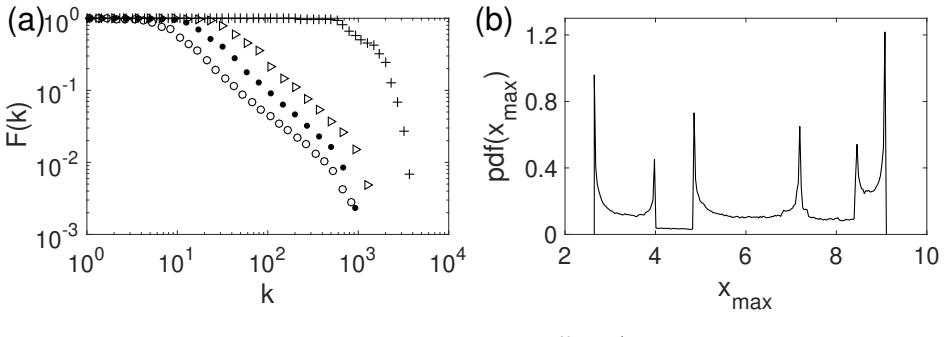
- [§3.5.5 (Eqs. 50–53) and Fig. 9] The text says that for systems without fragmented invariant density the upper and lower transitivity dimensions 'practically coincide,' allowing estimation from a single network instance at one suitably chosen ε. For the Hénon map, which has a fragmented invariant density, Fig. 9(a) shows ε-dependent oscillations between two accumulation points, so a single-ε estimate does not define either D_T^u or D_T^l uniquely. Since the Hénon map is one of the paper's flagship examples for the dimension-estimation claim, the review should explicitly warn that for such attractors the transitivity dimension is defined only through the two limits over ε and that a single-network, single-threshold estimate can be ambiguous.
minor comments (3)
- [§3.3, first paragraph] The statement that RN analysis can be performed using only a single fixed scale ε 'instead of explicitly studying scaling properties over a range of threshold values' is in tension with Section 3.5.5, where the transitivity and clustering dimensions are defined as limits over ε. This sentence should be qualified to say that most RN measures are computed at a single scale, whereas the dimension estimators require systematic scale variation.
- [Nomenclature and §3.5.5] The notation for the dimension estimators is not fully consistent: the table of abbreviations lists \hat{D}_C and \hat{D}_T, while Eqs. (50)–(53) use D_T^u, D_T^l, D_C^u, D_C^l without the hat. Using one consistent notation would improve readability.
- [General formatting] The text contains numerous typographical and OCR artifacts (for example, 'dara minimg' in the introduction and garbled symbols in several display equations). A careful copyediting pass is needed before publication.
Circularity Check
The flagship fractal-dimension claim rests on a (3/4)^D ansatz that the paper's own analytic section excludes and defers; the fractal-case bridge is a self-citation [40].
-
ansatz smuggled in via citation
[Section 3.5.5 (Eqs. (50)–(53)) vs. Section 3.4.2 and Section 1.1]
"Continuous analogs ... should be approximated by taking the limit N → ∞ and ε → 0 (note that the latter limit may not be assessible in the case of fractal sets S, which we will not further consider in the following). ... This analytical relationship can be generalized to attractor manifolds with non-integer fractal dimensions, which can in turn be estimated from the RN transitivity by inverting this function. ..."
The flagship claim (§1.1) makes RN transitivity/clustering dimensions estimate fractal dimension. The only proven link in the review is the integer-dimensional RGG law T=(3/4)^m [150]. The load-bearing extension T≈(3/4)^D to non-integer fractal dimension is asserted in one sentence ('can be generalized to attractor manifolds with non-integer fractal dimensions') and attributed to [40], the authors' own prior work — while §3.4.2 says the continuum limit 'may not be assessible in the case of fractal sets S, which we will not further consider,' and §3.5.5 calls the analytic treatment of fragmented invariant densities 'subject of future work.' Because Eqs.
-
self definitional
[Section 3.5.5, paragraph following Eqs. (50)–(53)]
"Notably, the analytical relationship in Eqs. (50), (51) between the effective (geometric) dimension of chaotic attractors and RN transitivity provides the theoretical justification and foundation for applying T as a characteristic discriminating between high and low dynamical complexity of chaotic attractors."
Eqs. (50)–(53) are the definitions of the upper/lower transitivity dimensions (log T / log(3/4)); the paper itself introduces them as the 'two definitions' of these quantities. Invoking these definitions as 'the analytical relationship ... between the effective (geometric) dimension of chaotic attractors and RN transitivity' converts the justification for using T as a complexity discriminator into the definition plus the assumed (3/4)^D scaling. By construction, D_T equals the dimension m whenever the RGG law holds, so the claimed 'theoretical justification' is the calibration of the estimator on integer-dimensional RGGs, with the fractal case still unproven by the paper's own account.
full rationale
This review is largely a survey, and most of its content is a faithful synthesis of results derived elsewhere. I found no instance of a fitted parameter being renamed as a prediction, and I did not flag the visibility-graph Hurst or ordinal-pattern-transition-network Lyapunov claims because the provided text does not exhibit their derivations. The one genuinely load-bearing circular element concerns the flagship claim of Section 1.1: RN transitivity and local clustering dimensions are said to approximate the fractal dimension of chaotic attractors and thereby 'solve partially some fundamental and long standing problems' of robustly estimating dynamical invariants. Within the paper's own derivation chain, the estimator D_T = log T / log(3/4) (Eqs. 50–53) is the inversion of the RGG law T = (3/4)^m, which is proven only for integer-dimensional, uniform, max-norm settings (Dall–Christensen [150]). Section 3.4.2 explicitly states that the continuum limit 'may not be assessible in the case of fractal sets S,' and Section 3.5.5 concedes that the ε-dependence of transitivity for attractors with fragmented invariant densities 'will be subject of future work.' The generalization to non-integer fractal dimension is asserted in a single sentence and attributed to [40], the authors' own prior work; the in-review figure (Fig. 9) validates only that finite-N estimates converge to the estimator's own limsup/liminf, not agreement with independently known dimension values. In this sense the central 'prediction' of fractal dimension is, at the level of the review's own derivation, the assumed scaling law restated by definition, with the gap filled by self-citation. This is partial circularity, not wholesale: the integer-dimension RGG theory is a genuine external theorem, and [40]'s numerical comparison against the independently known correlation dimension of the Hénon and Rössler attractors is externally falsifiable evidence, so the central claim retains real independent content. The paper is also candid about several related gaps (degree-distribution power laws are not generally related to fractal dimension; the average path length has reduced explanatory power), which weighs against a higher score. Overall, the loading-bearing self-citation and definitional construction justify a moderate circularity score, but the independent numerical content keeps it well below the 'forced by definition' range.
Assumptions & free parameters
assumptions (4)
- standard math Takens' time-delay embedding theorem: for deterministic dynamics, an m-dimensional embedding is topologically equivalent to the original phase space if m is sufficiently large relative to the attractor dimension.
- domain assumption Sampled state vectors can be treated as draws from the invariant density of the attractor, relying on ergodicity and suitable sampling conditions.
- domain assumption Recurrence networks are random geometric graphs on the attractor manifold, with adjacency defined by a hard distance threshold.
- domain assumption The transitivity of a random geometric graph decays as (3/4)^D with geometric dimension D, allowing dimension estimation by inverting this relationship.
Cite this review
Pith. "Pith review of Complex network approaches to nonlinear time series analysis." pith.science (2026). https://pith.science/paper/AHC6CCXK
@misc{pith2026250118737,
  author       = {Pith},
  title        = {Pith review of: Complex network approaches to nonlinear time series analysis},
  year         = {2026},
  howpublished = {\url{https://pith.science/paper/AHC6CCXK}},
  note         = {Machine review of arXiv:2501.18737}
}
read the original abstract
In the last decade, there has been a growing body of literature addressing the utilization of complex network methods for the characterization of dynamical systems based on time series. While both nonlinear time series analysis and complex network theory are widely considered to be established fields of complex systems sciences with strong links to nonlinear dynamics and statistical physics, the thorough combination of both approaches has become an active field of nonlinear time series analysis, which has allowed addressing fundamental questions regarding the structural organization of nonlinear dynamics as well as the successful treatment of a variety of applications from a broad range of disciplines. In this report, we provide an in-depth review of existing approaches of time series networks, covering their methodological foundations, interpretation and practical considerations with an emphasis on recent developments. After a brief outline of the state-of-the-art of nonlinear time series analysis and the theory of complex networks, we focus on three main network approaches, namely, phase space based recurrence networks, visibility graphs and Markov chain based transition networks, all of which have made their way from abstract concepts to widely used methodologies. These three concepts, as well as several variants thereof will be discussed in great detail regarding their specific properties, potentials and limitations. More importantly, we emphasize which fundamental new insights complex network approaches bring into the field of nonlinear time series analysis. In addition, we summarize examples from the wide range of recent applications of these methods, covering rather diverse fields like climatology, fluid dynamics, neurophysiology, engineering and economics, and demonstrating the great potentials of time series networks for tackling real-world contemporary scientific problems.
Figures


Figures from the paper (33 more)




Reference graph
Works this paper leans on
-
[150]
J. Dall, M. Christensen, Random geometric graphs, Phy s. Rev. E 66 (1) (2002) 016121. doi:10.1103/PhysRevE.66.016121
-
[1]
Mayer-Sch¨ onberger, K
V. Mayer-Sch¨ onberger, K. Cukier, Big Data: A Revolution That Will Transform How We Live, Work, and Think, Eamon Dolan/Houghton Mifflin Harcourt, 2013
2013
-
[2]
Hurwitz, D
J. Hurwitz, D. Kirsch, Machine Learning For Dummies, IBM Limited Edition, John Wiley & Sons, Inc., 2018
2018
-
[3]
R. Albert, A.-L. Barabasi, Statistical mechanics of com plex networks, Rev. Mod. Phys. 74 (1) (2002) 47–97. doi:10.1103/RevModPhys.74.47
-
[4]
M. E. J. Newman, The structure and function of complex net works, SIAM Rev. 45 (2) (2003) 167–256. doi:10.1137/S003614450342480
-
[5]
M. E. J. Newman, Networks: An introduction, Oxford Unive rsity Press, Oxford, 2010
2010
-
[6]
Kantz, T
H. Kantz, T. Schreiber, Nonlinear time series analysis, 2nd Edition, Cambridge University Press, 2004
2004
-
[7]
H. D. I. Abarbanel, R. Brown, J. J. Sidorowich, L. S. Tsimr ing, The analysis of observed chaotic data in physical systems, Rev. Mod. Phys. 65 (4) (1993) 1331–1392. doi:10.1103/RevModPhys.65.1331
Show all 298 references
-
[8]
J. C. Sprott, Chaos and Time-Series Analysis, Oxford Uni versity Press, Oxford, 2003
2003
-
[9]
Keogh, S
E. Keogh, S. Kasetty, On the Need for Time Series Data Mini ng Benchmarks: A Survey and Empirical Demonstration, Data Min. Knowl. Discov. 7 (4) (2003) 349–371. doi:10.1023/A:1024988512476
2003 doi
-
[10]
Fu, A review on time series data mining, Eng
T.-c. Fu, A review on time series data mining, Eng. Appl. Artif. Intell. 24 (1) (2011) 164–181. doi:10.1016/j.engappai.2010.09.007
2011 doi
-
[11]
Aghabozorgi, A
S. Aghabozorgi, A. Seyed Shirkhorshidi, T. Ying Wah, Ti me-series clustering – A decade review, Inf. Syst. 53 (2015) 16–38. doi:10.1016/j.is.2015.04.007
2015 doi
-
[12]
Zanin, D
M. Zanin, D. Papo, P. Sousa, E. Menasalvas, A. Nicchi, E. Kubik, S. Boccaletti, Combining complex networks and data mining: Why and how, Phys. Rep. 635 (2016) 1–44. doi:10.1016/j.physrep.2016.04.005
2016 doi
-
[13]
Zanin, J
M. Zanin, J. M. Alcazar, J. V. Carbajosa, M. G. Paez, D. Pa po, P. Sousa, E. Menasalvas, S. Boccaletti, Parenclitic networks: uncovering new functions in biological data, Sci . Rep. 4 (1) (2015) 5112. doi:10.1038/srep05112
2015 doi
-
[14]
Karsakov, T
A. Karsakov, T. Bartlett, A. Ryblov, I. Meyerov, M. Ivan chenko, A. Zaikin, Parenclitic Network Analysis of Methylation Data for Cancer Identification, PLoS One 12 (1) (2017) 1–11. doi:10.1371/journal.pone.0169661
2017 doi
-
[15]
H. J. Whitwell, O. Blyuss, U. Menon, J. F. Timms, A. Zaiki n, Parenclitic networks for predicting ovarian cancer, Oncotarget 9 (32) (2018) 22717–22726. doi:10.18632/oncotarget.25216
2018 doi
-
[16]
Ott, Chaos in Dynamical Systems, 2nd Edition, Cambri dge University Press, Cambridge, 2002
E. Ott, Chaos in Dynamical Systems, 2nd Edition, Cambri dge University Press, Cambridge, 2002
2002
-
[17]
Bradley, H
E. Bradley, H. Kantz, Nonlinear time-series analysis r evisited, Chaos 25 (9) (2015) 097610. arXiv:1503.07493, doi:10.1063/1.4917289
2015 arXiv
-
[18]
N. H. Packard, J. P. Crutchfield, J. D. Farmer, R. S. Shaw, Geometry from a Time Series, Phys. Rev. Lett. 45 (9) (1980) 712–716. doi:10.1103/PhysRevLett.45.712
1980 doi
-
[19]
Grassberger, I
P. Grassberger, I. Procaccia, Characterization of str ange attractors, Phys. Rev. Lett. 50 (5) (1983) 346–349. doi:10.1103/PhysRevLett.50.346
1983 doi
-
[20]
Boccaletti, J
S. Boccaletti, J. Kurths, G. Osipov, D. Valladares, C. Z hou, The synchronization of chaotic systems, Phys. Rep. 366 (1-2) (2002) 1–101. doi:10.1016/S0370-1573(02)00137-0
2002 doi
-
[21]
Pikovsky, M
A. Pikovsky, M. Rosenblum, J. Kurths, Synchronization – A Universal Concept in Nonlinear Sciences, Cambridge Uni- versity Press, 2001
2001
-
[22]
Boccaletti, V
S. Boccaletti, V. Latora, Y. Moreno, M. Chavez, D.-U. Hw ang, Complex networks: Structure and dynamics, Phys. Rep. 424 (4-5) (2006) 175–308. doi:10.1016/j.physrep.2005.10.009
2006 doi
-
[23]
Stankovski, T
T. Stankovski, T. Pereira, P. V. E. McClintock, A. Stefa novska, Coupling functions: Universal insights into dynam ical interaction mechanisms, Rev. Mod. Phys. 89 (4) (2017) 045001. arXiv:1706.01810, doi:10.1103/RevModPhys.89.045001
2017 arXiv
-
[24]
Frenzel, B
S. Frenzel, B. Pompe, Partial Mutual Information for Co upling Analysis of Multivariate Time Series, Phys. Rev. Let t. 99 (20) (2007) 204101. doi:10.1103/PhysRevLett.99.204101
2007 doi
-
[25]
Vejmelka, M
M. Vejmelka, M. Paluˇ s, Inferring the directionality of coupling with conditional mutual information, Phys. Rev. E 77 (2) (2008) 026214. doi:10.1103/PhysRevE.77.026214
2008 doi
-
[26]
C. W. J. Granger, Investigating Causal Relations by Eco nometric Models and Cross-spectral Methods, Econometrica 37 (1969) 424–438
1969
-
[27]
Dhamala, G
M. Dhamala, G. Rangarajan, M. Ding, Estimating Granger Causality from Fourier and Wavelet Transforms of Time Series Data, Phys. Rev. Lett. 100 (1) (2008) 018701. doi:10.1103/PhysRevLett.100.018701
2008 doi
-
[28]
Schreiber, Measuring Information Transfer, Phys
T. Schreiber, Measuring Information Transfer, Phys. Rev. Lett. 85 (2) (2000) 461–464.doi:10.1103/PhysRevLett.85.461
2000 doi
-
[29]
Runge, J
J. Runge, J. Heitzig, N. Marwan, J. Kurths, Quantifying causal coupling strength: A lag-specific measure for multivariate time series related to transfer entropy, Physical Review E 8 6 (2012) 061121. doi:10.1103/PhysRevE.86.061121
2012 doi
-
[30]
R. Q. Quiroga, J. Arnhold, P. Grassberger, Learning dri ver-response relationships from synchronization pattern s, Phys. Rev. E 61 (5) (2000) 5142–5148. doi:10.1103/PhysRevE.61.5142
2000 doi
-
[31]
M. G. Rosenblum, A. S. Pikovsky, Detecting direction of coupling in interacting oscillators, Phys. Rev. E 64 (4) (20 01) 045202. doi:10.1103/PhysRevE.64.045202
-
[32]
M. G. Rosenblum, L. Cimponeriu, A. Bezerianos, A. Patza k, R. Mrowka, Identification of coupling direction: Application to cardiorespiratory interaction, Phys. Rev. E 65 (4) (2002 ) 041909. doi:10.1103/PhysRevE.65.041909
2002 doi
-
[33]
D. A. Smirnov, R. G. Andrzejak, Detection of weak direct ional coupling: Phase-dynamics approach versus state-spa ce approach, Phys. Rev. E 71 (3) (2005) 036207. doi:10.1103/PhysRevE.71.036207
2005 doi
-
[34]
Paluˇ s, M
M. Paluˇ s, M. Vejmelka, Directionality of coupling from bivariate time series: How to avoid false causalities and m issed connections, Phys. Rev. E 75 (5) (2007) 056211. doi:10.1103/PhysRevE.75.056211. 110
2007 doi
-
[36]
Bahraminasab, F
A. Bahraminasab, F. Ghasemi, A. Stefanovska, P. V. E. Mc Clintock, H. Kantz, Direction of Coupling from Phases of Interacting Oscillators: A Permutation Informat ion Approach, Phys. Rev. Lett. 100 (8) (2008) 084101. doi:10.1103/PhysRevLett.100.084101
2008 doi
-
[38]
M. Ding, Y. Chen, S. L. Bressler, Granger Causality: Bas ic Theory and Application to Neuroscience, in: B. Schelter, M. Winterhalder, J. Timmer (Eds.), Handb. Time Ser. Anal., Wiley-VCH Verlag GmbH & Co. KGaA, 2007, pp. 437–460
2007
-
[39]
Hlavackovaschindler, M
K. Hlavackovaschindler, M. Paluˇ s, M. Vejmelka, J. Bha ttacharya, Causality detection based on information-theo retic approaches in time series analysis, Phys. Rep. 441 (1) (2007 ) 1–46. doi:10.1016/j.physrep.2006.12.004
2007 doi
-
[40]
R. V. Donner, J. Heitzig, J. F. Donges, Y. Zou, N. Marwan, J. Kurths, The geometry of chaotic dynamics — a complex network perspective, Eur. Phys. J. B 84 (4) (2011) 653–672. doi:10.1140/epjb/e2011-10899-1
2011 doi
-
[41]
McCullough, M
M. McCullough, M. Small, T. Stemler, H. H.-C. Iu, Time la gged ordinal partition networks for capturing dynamics of continuous dynamical systems, Chaos 25 (5) (2015) 053101. arXiv:arXiv:1501.06656v1, doi:10.1063/1.4919075
2015 arXiv
-
[42]
L. da F. Costa, F. A. Rodrigues, G. Travieso, P. R. Villas Boas, Characterization of complex networks: A survey of measurements, Adv. Phys. 56 (1) (2007) 167–242. doi:10.1080/00018730601170527
2007 doi
-
[43]
Bullmore, O
E. Bullmore, O. Sporns, Complex brain networks: graph t heoretical analysis of structural and functional systems, Nat. Rev. Neurosci. 10 (2009) 186–198. doi:10.0.4.14/nrn2575
2009
-
[44]
C. Zhou, L. Zemanova, G. Zamora, C. C. Hilgetag, J. Kurths, Hierarchical organization unveiled by functional connectivity in complex brain networks, Phys. Rev. Lett. 97 (23) (2006) 23 8103. doi:10.1103/PhysRevLett.97.238103
2006 doi
-
[45]
C. Zhou, L. Zemanova, G. Zamora-Lopez, C. C. Hilgetag, J . Kurths, Structure-function relationship in complex brai n networks expressed by hierarchical synchronization, New J . Phys. 9 (6) (2007) 178. doi:10.1088/1367-2630/9/6/178
2007 doi
-
[46]
A. A. Tsonis, P. J. Roebber, The architecture of the clim ate network, Physica A 333 (2004) 497–504. doi:10.1016/j.physa.2003.10.045
2004 doi
-
[47]
J. F. Donges, Y. Zou, N. Marwan, J. Kurths, The backbone o f the climate network, Europhys. Lett. 87 (4) (2009) 48007. doi:10.1209/0295-5075/87/48007
2009 doi
-
[48]
J. F. Donges, Y. Zou, N. Marwan, J. Kurths, Complex netwo rks in climate dynamics - Comparing linear and nonlinear network construction methods, Eur. Phys. J. ST 174 (2009) 15 7–179. doi:10.1140/epjst/e2009-01098-2
2009 doi
-
[49]
Zhang, M
J. Zhang, M. Small, Complex Network from Pseudoperiodi c Time Series: Topology versus Dynamics, Phys. Rev. Lett. 96 (23) (2006) 238701. doi:10.1103/PhysRevLett.96.238701
2006 doi
-
[50]
X. Xu, J. Zhang, M. Small, Superfamily phenomena and mot ifs of networks induced from time series, Proc. Natl. Acad. Sci. 105 (50) (2008) 19601–19605. doi:10.1073/pnas.0806082105
2008 doi
-
[51]
Lacasa, B
L. Lacasa, B. Luque, F. Ballesteros, J. Luque, J. C. Nuno , From time series to complex networks: The visibility graph , Proc. Natl. Acad. Sci. 105 (13) (2008) 4972–4975. arXiv:0810.0920, doi:10.1073/pnas.0709247105
2008 arXiv
-
[52]
Marwan, J
N. Marwan, J. F. Donges, Y. Zou, R. V. Donner, J. Kurths, C omplex network approach for recurrence analysis of time series, Phys. Lett. A 373 (46) (2009) 4246–4254. arXiv:0907.3368, doi:10.1016/j.physleta.2009.09.042
2009 arXiv
-
[53]
R. V. Donner, Y. Zou, J. F. Donges, N. Marwan, J. Kurths, R ecurrence networks — a novel paradigm for nonlinear time series analysis, New J. Phys. 12 (3) (2010) 033025. arXiv:0908.3447v1, doi:10.1088/1367-2630/12/3/033025
2010 arXiv
-
[54]
R. V. Donner, M. Small, J. F. Donges, N. Marwan, Y. Zou, R. Xiang, J. Kurths, Recurrence-based time series analysis by means of complex network methods, Int. J. Bifurc . Chaos 21 (04) (2011) 1019–1046. arXiv:1010.6032, doi:10.1142/S0218127411029021
2011 arXiv
-
[55]
Battista, P
G. Battista, P. Eades, R. Tamassia, I. Tollis, Algorith ms for drawing graphs: An annotated bibliography, Computat ional Geometry: Theory and Applications 4 (5) (1994) 235–282. doi:10.1016/0925-7721(94)00014-X
1994 doi
-
[56]
Zhang, J
J. Zhang, J. Sun, X. Luo, K. Zhang, T. Nakamura, M. Small, Characterizing pseudoperiodic time series through the complex network approach, Phys. D 237 (22) (2008) 2856–2865 . doi:10.1016/j.physd.2008.05.008
2008 doi
-
[57]
Y. Yang, H. Yang, Complex network-based time series ana lysis, Physica A 387 (5-6) (2008) 1381–1386. doi:10.1016/j.physa.2007.10.055
2008 doi
-
[58]
Marwan, M
N. Marwan, M. C. Romano, M. Thiel, J. Kurths, Recurrence plots for the analysis of complex systems, Phys. Rep. 438 (5–6) (2007) 237–329. doi:10.1016/j.physrep.2006.11.001
2007 doi
-
[59]
Luque, L
B. Luque, L. Lacasa, F. Ballesteros, J. Luque, Horizont al visibility graphs: Exact results for random time series, Phys. Rev. E 80 (4) (2009) 046103. arXiv:1002.4526, doi:10.1103/PhysRevE.80.046103
2009 arXiv
-
[60]
R. V. Donner, J. F. Donges, Visibility graph analysis of geophysical time series: Potentials and possible pitfalls , Acta Geophys. 60 (3) (2012) 589–623. doi:10.2478/s11600-012-0032-x
2012 doi
-
[61]
Lacasa, B
L. Lacasa, B. Luque, J. Luque, J. C. Nu˜ no, The visibilit y graph: A new method for estimating the Hurst exponent of fractional Brownian motion, EPL (Europhysics Lett. 86 (3) ( 2009) 30001. doi:10.1209/0295-5075/86/30001
2009 doi
-
[62]
Ni, Z.-Q
X.-H. Ni, Z.-Q. Jiang, W.-X. Zhou, Degree distribution s of the visibility graphs mapped from fractional Brow- nian motions and multifractal random walks, Phys. Lett. A 37 3 (42) (2009) 3822–3826. arXiv:0812.2099, doi:10.1016/j.physleta.2009.08.041
2009 arXiv
-
[63]
J. F. Donges, R. V. Donner, J. Kurths, Testing time serie s irreversibility using complex network methods, EPL (Euro - physics Lett. 102 (1) (2013) 10004. arXiv:1211.1162, doi:10.1209/0295-5075/102/10004
2013 arXiv
-
[64]
Lacasa, A
L. Lacasa, A. Nu˜ nez, ´E. Rold´ an, J. M. R. Parrondo, B. Luque, Time series irrevers ibility: a visibility graph approach, Eur. Phys. J. B 85 (6) (2012) 217. arXiv:1108.1691, doi:10.1140/epjb/e2012-20809-8
2012 arXiv
-
[65]
Nicolis, A
G. Nicolis, A. G. Cantu, C. Nicolis, Dynamical aspects o f interaction networks, Int. J. Bifurc. Chaos 15 (11) (2005) 111 3467–3480. doi:10.1142/S0218127405014167
2005 doi
-
[66]
C. W. Kulp, J. M. Chobot, H. R. Freitas, G. D. Sprechini, U sing ordinal partition transition networks to analyze ECG data, Chaos 26 (7) (2016) 073114. doi:10.1063/1.4959537
2016 doi
-
[67]
Balasis, R
G. Balasis, R. Donner, S. Potirakis, J. Runge, C. Papadi mitriou, I. Daglis, K. Eftaxias, J. Kurths, Statistical Mec han- ics and Information-Theoretic Perspectives on Complexity in the Earth System, Entropy 15 (12) (2013) 4844–4888. doi:10.3390/e15114844
2013 doi
-
[68]
Barth´ elemy, Spatial networks, Phys
M. Barth´ elemy, Spatial networks, Phys. Rep. 499 (1-3)(2011) 1–101. doi:10.1016/j.physrep.2010.11.002
2011 doi
-
[69]
Wiedermann, J
M. Wiedermann, J. F. Donges, J. Kurths, R. V. Donner, Spa tial network surrogates for disentangling complex system structure from spatial embedding of nodes, Phys. Rev. E 93 (4 ) (2016) 042308. doi:10.1103/PhysRevE.93.042308
2016 doi
-
[70]
Bandt, B
C. Bandt, B. Pompe, Permutation Entropy: A Natural Comp lexity Measure for Time Series, Phys. Rev. Lett. 88 (17) (2002) 174102. doi:10.1103/PhysRevLett.88.174102
2002 doi
-
[71]
Zhang, J
J. Zhang, J. Zhou, M. Tang, H. Guo, M. Small, Y. Zou, Const ructing ordinal partition transition networks from multi- variate time series, Sci. Rep. 7 (1) (2017) 7795. doi:10.1038/s41598-017-08245-x
2017 doi
-
[72]
Eroglu, F
D. Eroglu, F. H. McRobie, I. Ozken, T. Stemler, K. H. Wyrw oll, S. F. Breitenbach, N. Marwan, J. Kurths, See-saw relationship of the Holocene East Asian-Australia n summer monsoon, Nat. Commun. 7 (2016) 1–7. doi:10.1038/ncomms12929
2016 doi
-
[73]
J. F. Donges, J. Heitzig, B. Beronov, M. Wiedermann, J. R unge, Q. Y. Feng, L. Tupikina, V. Stolbova, R. V. Donner, N. Marwan, H. A. Dijkstra, J. Kurths, Unified functional network and nonlinear time series analysis for complex systems science: The pyunicorn package, Chaos 25 (...
2015 arXiv
-
[74]
Cohen, S
R. Cohen, S. Havlin, Complex networks: Structure, robu stness and function, Cambridge University Press, Cambridg e, 2010
2010
-
[75]
Rashevsky, Life, information theory, and topology, Bull
N. Rashevsky, Life, information theory, and topology, Bull. Math. Biophys. 17 (3) (1955) 229–235. doi:10.1007/BF02477860
1955 doi
-
[76]
MacArthur, Fluctuations of Animal Populations and a Measure of Community Stability, Ecology 36 (3) (1955) 533 –
R. MacArthur, Fluctuations of Animal Populations and a Measure of Community Stability, Ecology 36 (3) (1955) 533 –
1955
-
[77]
Dehmer, Information Theory of Networks, Symmetry (B asel)
M. Dehmer, Information Theory of Networks, Symmetry (B asel). 3 (4) (2011) 767–779. doi:10.3390/sym3040767
2011 doi
-
[78]
R. Milo, S. Shen-Orr, S. Itzkovitz, N. Kashtan, D. Chklo vskii, U. Alon, Network motifs: Simple building blocks of complex networks, Science 298 (5594) (2002) 824–827
2002
-
[79]
sma ll-world
D. J. Watts, S. H. Strogatz, Collective dynamics of “sma ll-world” networks, Nature 393 (6684) (1998) 440–442. doi:10.1038/30918
1998 doi
-
[80]
Barrat, M
A. Barrat, M. Weigt, On the properties of small-world ne twork models, Eur. Phys. J. B 13 (2000) 547–560. doi:10.1007/s100510050067
2000 doi
-
[81]
Erd¨ os, A
P. Erd¨ os, A. R´ enyi, On random graphs. i, Publicationes Mathematicae 6 (1959) 290?297
1959
-
[82]
Milgram, Small-world problem, Psychology Today 1 (1 ) (1967) 61–67
S. Milgram, Small-world problem, Psychology Today 1 (1 ) (1967) 61–67
1967
-
[83]
Barab´ asi, R
A.-L. Barab´ asi, R. Albert, Emergence of scaling in ran dom networks, Science 286 (5439) (1999) 509–512. doi:10.1126/science.286.5439.509
1999 doi
-
[84]
Clauset, C
A. Clauset, C. R. Shalizi, M. E. J. Newman, Power-Law Dis tributions in Empirical Data, SIAM Rev. 51 (4) (2009) 661–703. doi:10.1137/070710111
2009 doi
-
[85]
M. E. J. Newman, Assortative Mixing in Networks, Phys. R ev. Lett. 89 (20) (2002) 208701. doi:10.1103/PhysRevLett.89.208701
2002 doi
-
[86]
Boccaletti, G
S. Boccaletti, G. Bianconi, R. Criado, C. del Genio, J. G ´ omez-Garde˜ nes, M. Romance, I. Sendi˜ na-Nadal, Z. Wang, M. Zanin, The structure and dynamics of multilayer n etworks, Phys. Rep. 544 (1) (2014) 1–122. doi:10.1016/j.physrep.2014.07.001
2014 doi
-
[87]
G´ omez, A
S. G´ omez, A. D´ ıaz-Guilera, J. G´ omez-Garde˜ nes, C. J. P´ erez-Vicente, Y. Moreno, A. Arenas, Diffusion Dynamics o n Multiplex Networks, Phys. Rev. Lett. 110 (2) (2013) 028701. doi:10.1103/PhysRevLett.110.028701
2013 doi
-
[88]
Granell, S
C. Granell, S. G´ omez, A. Arenas, Dynamical Interplay b etween Awareness and Epidemic Spreading in Multiplex Net- works, Phys. Rev. Lett. 111 (12) (2013) 128701. doi:10.1103/PhysRevLett.111.128701
2013 doi
-
[89]
J. T. Matamalas, J. Poncela-Casasnovas, S. G´ omez, A. A renas, Strategical incoherence regulates cooperation in s ocial dilemmas on multiplex networks, Sci. Rep. 5 (1) (2015) 9519. doi:10.1038/srep09519
2015 doi
-
[90]
S. V. Buldyrev, R. Parshani, G. Paul, H. E. Stanley, S. Ha vlin, Catastrophic cascade of failures in interdependent networks, Nature 464 (7291) (2010) 1025–1028. doi:{10.1038/nature08932}
2010 doi
-
[91]
J. F. Donges, H. C. Schultz, N. Marwan, Y. Zou, J. Kurths, Investigating the topology of interacting networks: Theory and application to coupled climate subnetworks, Eur . Phys. J. B 84 (4) (2011) 635–651. arXiv:1102.3067, doi:10.1140/epjb/e2011-10795-8
2011 arXiv
-
[92]
Wiedermann, J
M. Wiedermann, J. F. Donges, J. Heitzig, J. Kurths, Node -weighted interacting network measures improve the representation of real-world complex systems, EPL (Europh ysics Lett. 102 (2) (2013) 28007. arXiv:1301.0805, doi:10.1209/0295-5075/102/28007
2013 arXiv
-
[93]
J. F. Donges, Functional network macroscopes for probing past and present earth system dynamics: Complex hierarchical interactions, tipping points, and beyond, Ph.D. thesis, Hu mboldt University, Berlin (2012)
2012
-
[94]
Eckmann, S
J.-P. Eckmann, S. O. Kamphorst, D. Ruelle, Recurrence plots of dynamical systems, Europhys. Lett. 4 (9) (1987) 973–977. doi:10.1209/0295-5075/4/9/004
1987 doi
-
[95]
J. P. Zbilut, C. L. Webber Jr., Embeddings and delays as d erived from quantification of recurrence plots, Physics Letters A 171 (3–4) (1992) 199–203. doi:10.1016/0375-9601(92)90426-M
1992 doi
-
[96]
L. L. Trulla, A. iani, J. P. Zbilut, C. L. Webber Jr., Recu rrence quantification analysis of the logistic equation wit h transients, Physics Letters A 223 (4) (1996) 255–260. doi:10.1016/S0375-9601(96)00741-4. 112
1996 doi
-
[97]
Marwan, M
N. Marwan, M. Thiel, N. R. Nowaczyk, Cross Recurrence Plot Based Synchronization of Time Series, Nonlinear Processes in Geophysics 9 (3/4) (2002) 325–331
2002
-
[98]
J. P. Zbilut, A. iani, C. L. Webber Jr., Detecting determ inistic signals in exceptionally noisy environments using cross- recurrence quantification, Phys. Lett. A 246 (1-2) (1998) 12 2 – 128. doi:10.1016/S0375-9601(98)00457-5
1998 doi
-
[99]
M. C. Romano, M. Thiel, J. Kurths, W. von Bloh, Multivari ate Recurrence Plots, Physics Letters A 330 (3–4) (2004) 214–223. doi:10.1016/j.physleta.2004.07.066
2004 doi
-
[100]
Eroglu, N
D. Eroglu, N. Marwan, M. Stebich, J. Kurths, Multiplex recurrence networks, Phys. Rev. E 97 (1) (2018) 012312. doi:10.1103/PhysRevE.97.012312
2018 doi
-
[101]
A. M. Fraser, H. L. Swinney, Independent coordinates f or strange attractors from mutual information, Phys. Rev. A 33 (2) (1986) 1134–1140. doi:10.1103/PhysRevA.33.1134
1986 doi
-
[102]
M. B. Kennel, R. Brown, H. D. I. Abarbanel, Determining embedding dimension for phase-space reconstruction using a geometrical construction, Phys. Rev. A 45 (6) (1992) 3403–3 411. doi:10.1103/PhysRevA.45.3403
1992 doi
-
[103]
Takens, Detecting strange attractors in turbulenc e, in: D
F. Takens, Detecting strange attractors in turbulenc e, in: D. A. Rand, L.-S. Young (Eds.), Dynamical Systems and Turbulence, Warwick 1980, Vol. 898 of Lecture Notes in Ma thematics, Springer, New York, 1981, pp. 366–381. doi:10.1007/BFb0091924
1980 doi
-
[104]
Poincar´ e, Sur la probl` eme des trois corps et les ´ equations de la dynamique, Acta Mathematica 13 (1) (1890) A3–A270
H. Poincar´ e, Sur la probl` eme des trois corps et les ´ equations de la dynamique, Acta Mathematica 13 (1) (1890) A3–A270
-
[105]
Horai, T
S. Horai, T. Yamada, K. Aihara, Determinism analysis w ith iso-directional recurrence plots, IEEJ Transactions o n Electronics, Information and Systems 122 (1) (2002) 141–14 7
2002
-
[106]
Marwan, N
N. Marwan, N. Wessel, U. Meyerfeldt, A. Schirdewan, J. Kurths, Recurrence Plot Based Measures of Complexity and it s Application to Heart Rate Variability Data, Phys. Rev. E 66 ( 2002) 26702
2002
-
[107]
Marwan, A Historical Review of Recurrence Plots, Eu r
N. Marwan, A Historical Review of Recurrence Plots, Eu r. Phys. J. – Spec. Top. 164 (2008) 3–12
2008
-
[108]
Facchini, C
A. Facchini, C. Mocenni, N. Marwan, A. Vicino, E. Tiezz i, Nonlinear time series analysis of dissolved oxygen in the Orbetello Lagoon (Italy), Ecol. Modell. 203 (2007) 339–348
2007
-
[109]
Litak, J
G. Litak, J. T. Sawicki, R. Kasperek, Cracked rotor det ection by recurrence plots, Nondestruct. Test. Eval. 24 (20 09) 347–351. doi:10.1080/10589750802570836
-
[110]
Marwan, M
N. Marwan, M. H. Trauth, M. Vuille, J. Kurths, Comparin g modern and Pleistocene ENSO-like influences in NW Argentina using nonlinear time series analysis methods, Cl im. Dyn. 21 (2003) 317–326
2003
-
[111]
Marwan, J
N. Marwan, J. Kurths, P. Saparin, Generalised Recurre nce Plot Analysis for Spatial Data, Phys. Lett. A 360 (2007) 545–551
2007
-
[112]
Giuliani, R
A. Giuliani, R. Benigni, J. P. Zbilut, C. Webber, P. Sir abella, A. Colosimo, Nonlinear signal analysis meth- ods in the elucidation of protein sequence — structure relat ionships, Chemical Reviews 102 (5) (2002) 1471–1492. doi:10.1021/cr0101499
2002 doi
-
[113]
J. P. Zbilut, J. C. Mitchell, A. Giuliani, N. Marwan, C. L. Webber Jr., Singular Hydrophobicity Patterns and Net Charge: A Mesoscopic Principle for Protein Aggregation/Folding, P hysica A 343 (2004) 348–358
2004
-
[114]
C. L. Webber Jr., N. Marwan, A. Facchini, A. Giuliani, Simpler methods do it better: Success of Recurrence Quantification Analysis as a general purpose data analysis tool, Phys. Lett . A 373 (2009) 3753–3756
2009
-
[115]
Thiel, M
M. Thiel, M. C. Romano, P. L. Read, J. Kurths, Estimatio n of dynamical invariants without embedding by recurrence plots, Chaos 14 (2) (2004) 234–243. doi:10.1063/1.1667633
2004 doi
-
[116]
M. C. Romano, M. Thiel, J. Kurths, I. Z. Kiss, J. Hudson, Detection of synchronization for non-phase-coherent and non-stationary data, Europhysics Letters 71 (3) (2005) 466 –472. doi:10.1209/epl/i2005-10095-1
2005 doi
-
[117]
M. C. Romano, M. Thiel, J. Kurths, C. Grebogi, Estimati on of the direction of the coupling by conditional probabili ties of recurrence, Phys. Rev. E 76 (3) (2007) 036211. doi:10.1103/PhysRevE.76.036211
2007 doi
-
[118]
Van Leeuwen, D
P. Van Leeuwen, D. Geue, M. Thiel, D. Cysarz, S. Lange, M . C. Romano, N. Wessel, J. Kurths, D. H. Gr¨ onemeyer, Influence of paced maternal breathing on fetal – maternal hea rt rate coordination, Proc. Natl. Acad. Sci. 106 (2009) 13661–13666. doi:10.1073/pnas.0901049106
2009 doi
-
[119]
Nawrath, M
J. Nawrath, M. C. Romano, M. Thiel, I. Z. Kiss, M. Wickra masinghe, J. Timmer, J. Kurths, B. Schelter, Distinguishin g Direct from Indirect Interactions in Oscillatory Networks with Multiple Time Scales, Phys. Rev. Lett. 104 (3) (2010) 1–4. doi:10.1103/PhysRevLett.104.038701
2010 doi
-
[120]
Marwan, Y
N. Marwan, Y. Zou, N. Wessel, M. Riedl, J. Kurths, Estim ating coupling directions in the cardiorespiratory system using recurrence properties, Philos. Trans. R. Soc. A Math. Phys. Eng. Sci. 371 (1997) (2013) 20110624–20110624. arXiv:1306.0697, doi:10.1098/rsta.2011.0624
1997 arXiv
-
[121]
T. D. Pham, Fuzzy recurrence plots, EPL (Europhysics L ett. 116 (5) (2016) 50008. doi:10.1209/0295-5075/116/50008
2016 doi
-
[122]
beim Graben, A
P. beim Graben, A. Hutt, Detecting Recurrence Domains of Dynamical Systems by Symbolic Dynamics, Phys. Rev. Lett. 110 (15) (2013) 154101. doi:10.1103/PhysRevLett.110.154101
2013 doi
-
[123]
D. G. d. B. Costa, B. M. d. F. Reis, Y. Zou, M. G. Quiles, E. E. N. Macau, Recurrence Density Enhanced Complex Net- works for Nonlinear Time Series Analysis, Int. J. Bifurc. Chaos 28 (01) (2018) 1850008. doi:10.1142/S0218127418500086
2018 doi
-
[124]
H. Yang, G. Liu, Self-organized topology of recurrenc e-based complex networks, Chaos 23 (4) (2013) 043116. doi:10.1063/1.4829877
2013 doi
-
[125]
Thiel, M
M. Thiel, M. C. Romano, J. Kurths, How much information is contained in a recurrence plot?, Phys. Lett. A 330 (5) (2004) 343–349. doi:10.1016/j.physleta.2004.07.050
2004 doi
-
[126]
Hirata, S
Y. Hirata, S. Horai, K. Aihara, Reproduction of distan ce matrices and original time series from recurrence plots a nd their applications, Eur. Phys. J. Spec. Top. 164 (1) (2008) 1 3–22. doi:10.1140/epjst/e2008-00830-8
2008 doi
-
[127]
Shimada, T
Y. Shimada, T. Kimura, T. Ikeguchi, Analysis of Chaoti c Dynamics Using Measures of the Complex Network The- ory, in: Artif. Neural Networks - ICANN 2008, Springer Berli n Heidelberg, Berlin, Heidelberg, 2008, pp. 61–70. doi:10.1007/978-3-540-87536-9_7 . 113
2008 doi
-
[128]
Small, J
M. Small, J. Zhang, X. Xu, Transforming Time Series int o Complex Networks, in: J. Zhou (Ed.), Complex Sci. First Int. Conf. Complex 2009. Shanghai, China, Febr. 2009. Revis . Pap. Part 2, Springer, Berlin, 2009, Ch. Transformi, pp. 2078–2089. doi:10.1007/978-3-642-02469-6_84
2009 doi
-
[129]
Liu, W.-X
C. Liu, W.-X. Zhou, Superfamily classification of nons tationary time series based on DFA scaling exponents, J. Phy s. A Math. Theor. 43 (49) (2010). arXiv:0912.2016, doi:10.1088/1751-8113/43/49/495005
2010 arXiv
-
[130]
A. Khor, M. Small, Examining k-nearest neighbour netw orks: Superfamily phenomena and inversion, Chaos 26 (4) (2016) 043101. doi:10.1063/1.4945008
2016 doi
-
[131]
Y. Li, H. Cao, Y. Tan, A comparison of two methods for mod eling large-scale data from time series as complex networks, AIP Adv. 1 (1) (2011) 012103. doi:10.1063/1.3556121
2011 doi
-
[132]
Y. Li, H. Ca¨ o, Y. Tan, Novel method of identifying timeseries based on network graphs, Complexity 17 (1) (2011) 13–34. doi:10.1002/cplx.20384
2011 doi
-
[133]
H. Cao, Y. Li, Unraveling chaotic attractors by comple x networks and measurements of stock market complexity, Cha os 24 (1) (2014) 013134. doi:10.1063/1.4868258
2014 doi
-
[134]
X. Fan, L. Wang, H. Xu, S. Li, L. Tian, Characterizing ai r quality data from complex network perspective, Environ. S ci. Pollut. Res. (2015). doi:10.1007/s11356-015-5596-y
2015 doi
-
[135]
K. H. Kraemer, R. V. Donner, J. Heitzig, N. Marwan, Recu rrence threshold selection for obtaining robust recurrenc e characteristics in different embedding dimensions, Chaos 2 8 (8) (2018) 085720. doi:10.1063/1.5024914
2018 doi
-
[136]
X. Li, D. Yang, X. Liu, X.-M. Wu, Bridging Time Series Dy namics and Complex Network Theory with Application to Electrocardiogram Analysis, IEEE Circuits Syst. Mag. 12 (4 ) (2012) 33–46. doi:10.1109/MCAS.2012.2221521
2012
-
[137]
C. S. Daw, C. E. A. Finney, E. R. Tracy, A review of symbol ic analysis of experimental data, Rev. Sci. Instrum. 74 (2) (2003) 915–930. doi:10.1063/1.1531823
2003 doi
-
[138]
Donner, U
R. Donner, U. Hinrichs, B. Scholz-Reiter, Symbolic re currence plots: A new quantitative framework for performan ce analysis of manufacturing networks, Eur. Phys. J. Spec. Top. 164 (1) (2008) 85–104. doi:10.1140/epjst/e2008-00836-2
2008 doi
-
[139]
Faure, A
P. Faure, A. Lesne, Recurrence plots for symbolic sequ ences, Int. J. Bifurcation Chaos 20 (6) (2010) 1731–1749. doi:10.1142/S0218127410026794
2010 doi
-
[140]
T. D. Pham, From fuzzy recurrence plots to scalable rec urrence networks of time series, EPL (Europhysics Lett. 118 (2) (2017) 20003. doi:10.1209/0295-5075/118/20003
2017 doi
-
[141]
J. F. Donges, R. V. Donner, M. H. Trauth, N. Marwan, H.-J . Schellnhuber, J. Kurths, Nonlinear detection of paleoclimate-variability transitions possibly related t o human evolution, Proc. Natl. Acad. Sci. 108 (51) (2011) 204 22– 20427. doi:10.1073/pnas.1117052108
2011 doi
-
[142]
J. F. Donges, R. V. Donner, K. Rehfeld, N. Marwan, M. H. T rauth, J. Kurths, Identification of dynamical transitions in marine palaeoclimate records by recurrence network anal ysis, Nonlinear Process. Geophys. 18 (5) (2011) 545–562. doi:10.5194/npg-18-545-2011
2011 doi
-
[143]
M. C. Casdagli, Recurrence plots revisited, Physica˜ D 108 (1997) 12–44
1997
-
[144]
Iwayama, Y
K. Iwayama, Y. Hirata, K. Takahashi, K. Watanabe, K. Ai hara, H. Suzuki, Characterizing global evolutions of compl ex systems via intermediate network representations, Sci. Re p. 2 (1) (2012) 423. doi:10.1038/srep00423
2012 doi
-
[145]
J. F. Donges, J. Heitzig, R. V. Donner, J. Kurths, Analy tical framework for recurrence network analysis of time ser ies, Phys. Rev. E 85 (4) (2012) 046105. arXiv:arXiv:1203.4701v1, doi:10.1103/PhysRevE.85.046105
2012 arXiv
-
[146]
Thiel, M
M. Thiel, M. C. Romano, J. Kurths, M. Rolfs, R. Kliegl, T win surrogates to test for complex synchronisation, Europhys. Lett. 75 (4) (2006) 535–541. doi:10.1209/epl/i2006-10147-0
2006 doi
-
[147]
M. C. Romano, M. Thiel, J. Kurths, K. Mergenthaler, R. E ngbert, Hypothesis test for synchronization: Twin surroga tes revisited, Chaos 19 (1) (2009) 015108. doi:10.1063/1.3072784
2009 doi
-
[148]
Penrose, Random Geometric Graphs, Oxford Universi ty Press, Oxford, 2003
M. Penrose, Random Geometric Graphs, Oxford Universi ty Press, Oxford, 2003
2003
-
[149]
Herrmann, M
C. Herrmann, M. Barth´ elemy, P. Provero, Connectivit y distribution of spatial networks, Phys. Rev. E 68 (2) (2003 ) 026128. doi:10.1103/PhysRevE.68.026128
2003 doi
-
[151]
J. P. Eckmann, D. Ruelle, Ergodic theory of chaos and st range attractors, Rev. Mod. Phys. 57 (1985) 617–656. doi:10.1103/RevModPhys.57.617
1985 doi
-
[152]
Y. Zou, R. V. Donner, J. F. Donges, N. Marwan, J. Kurths, Identifying complex periodic windows in continuous-time dy- namical systems using recurrence-based methods, Chaos 20 (4) (2010) 043130. arXiv:1011.5172, doi:10.1063/1.3523304
2010 arXiv
-
[153]
Y. Zou, J. Heitzig, R. V. Donner, J. F. Donges, J. D. Farm er, R. Meucci, S. Euzzor, N. Marwan, J. Kurths, Power- laws in recurrence networks from dynamical systems, EPL (Eu rophysics Lett. 98 (4) (2012) 48001. arXiv:1203.3345, doi:10.1209/0295-5075/98/48001
2012 arXiv
-
[154]
Jacob, K
R. Jacob, K. P. Harikrishnan, R. Misra, G. Ambika, Measure for degree heterogeneity in complex networks and its applica- tion to recurrence network analysis, R. Soc. Open Sci. 4 (1) (2016) 160757. arXiv:1605.06607, doi:10.1098/rsos.160757
2016 arXiv
-
[155]
R. V. Donner, J. F. Donges, Y. Zou, F. J. H., Complex netw ork analysis of recurrences, in: C. L. Webber, Jr., N. Marwan (Eds.), Recurrence Quantification Analysis: Theory and Bes t Practices, Springer International Publishing, Cham, 201 5, pp. 101 – 163. doi:10.1007/978-3-319-...
-
[156]
Jacob, K
R. Jacob, K. P. Harikrishnan, R. Misra, G. Ambika, Cros s over of recurrence networks to random graphs and random geometric graphs, Pramana 88 (2) (2017) 37. doi:10.1007/s12043-016-1339-y
2017 doi
-
[157]
Jacob, K
R. Jacob, K. Harikrishnan, R. Misra, G. Ambika, Recurr ence network measures for hypothesis testing using sur- rogate data: Application to black hole light curves, Commun . Nonlinear Sci. Numer. Simul. 54 (2018) 84–99. doi:10.1016/j.cnsns.2017.05.018
2018 doi
-
[158]
Jacob, K
R. Jacob, K. Harikrishnan, R. Misra, G. Ambika, Charac terization of chaotic attractors under noise: A recurrence 114 network perspective, Commun. Nonlinear Sci. Numer. Simul. 41 (2016) 32–47. doi:10.1016/j.cnsns.2016.04.028
2016 doi
-
[159]
R. V. Donner, J. F. Donges, Y. Zou, N. Marwan, J. Kurths, Recurrence-based evolving networks for time series analys is of complex systems, Proc. NOLTA 2010 (2010) 87–90
2010
-
[160]
R. V. Donner, Y. Zou, J. F. Donges, N. Marwan, J. Kurths, Ambiguities in recurrence-based complex network represen- tations of time series, Phys. Rev. E 81 (1) (2010) 015101. arXiv:1001.4620, doi:10.1103/PhysRevE.81.015101
2010 arXiv
-
[161]
Y. Zou, R. V. Donner, J. Kurths, Geometric and dynamic p erspectives on phase-coherent and noncoherent chaos, Chaos 22 (1) (2012) 013115. arXiv:arXiv:1202.4823v1, doi:10.1063/1.3677367
2012 arXiv
-
[162]
Y. Zou, R. V. Donner, M. Wickramasinghe, I. Z. Kiss, M. S mall, J. Kurths, Phase coherence and attractor geometry of chaotic electrochemical oscillators, Chaos 22 (3) (2012) 0 33130. doi:10.1063/1.4747707
2012 doi
-
[163]
Faure, H
P. Faure, H. Korn, A new method to estimate the Kolmogor ov entropy from recurrence plots: its application to neuron al signals, Physica D 122 (1-4) (1998) 265–279. doi:10.1016/S0167-2789(98)00177-8
1998 doi
-
[164]
Grassberger, Generalized dimensions of strange at tractors, Phys
P. Grassberger, Generalized dimensions of strange at tractors, Phys. Lett. A 97 (6) (1983) 227–230. doi:10.1016/0375-9601(83)90753-3
1983 doi
-
[165]
D. P. Lathrop, E. J. Kostelich, Characterization of an experimental strange attractor by periodic-orbits, Phys. Rev. A 40 (7) (1989) 4028–4031. doi:10.1103/PhysRevA.40.4028
1989 doi
-
[166]
Strozzi, J
F. Strozzi, J. M. Zald´ ıvar, K. Poljansek, F. Bono, E. G uti´ errez, From complex networks to time series analysis an d viceversa : application to metabolic networks complex netw orks time series, Tech. rep., European Commission Joint Research Centre Contact (2009). doi:10.2788/25588
2009 doi
-
[167]
Schinkel, O
S. Schinkel, O. Dimigen, N. Marwan, Selection of recur rence threshold for signal detection, Eur. Phys. J. Spec. To p. 164 (1) (2008) 45–53. doi:10.1140/epjst/e2008-00833-5
2008 doi
-
[168]
Gao, N.-D
Z.-K. Gao, N.-D. Jin, Flow-pattern identification and nonlinear dynamics of gas-liquid two-phase flow in complex n et- works, Phys. Rev. E 79 (6) (2009) 1–14. doi:10.1103/PhysRevE.79.066303
2009 doi
-
[169]
Yang, W.-X
D. Yang, W.-X. Ren, Y.-D. Hu, D. Li, Selection of optimal threshold to construct recurrence plot for structural operational vibration measurements, J. Sound Vib. 349 (2015) 361–374. doi:10.1016/j.jsv.2015.03.046
2015 doi
-
[170]
Penrose, Random geometric graphs, no
M. Penrose, Random geometric graphs, no. 5 in Oxford st udies in probability, Oxford University Press, Oxford, UK, 2003
2003
-
[171]
Herrmann, M
C. Herrmann, M. Barth´ elemy, P. Provero, Connectivit y distribution of spatial networks, Phys. Rev. E 68 (2) (2003 ) 26128
2003
-
[172]
M. T. Gastner, M. E. Newman, The spatial structure of ne tworks, Eur. Phys. J. B 49 (2) (2006) 247–252. doi:10.1140/epjb/e2006-00046-8
2006 doi
-
[173]
Jacob, K
R. Jacob, K. P. Harikrishnan, R. Misra, G. Ambika, Unif orm framework for the recurrence-network analysis of chaot ic time series, Phys. Rev. E 93 (1) (2016) 012202. arXiv:arXiv:1502.03527v1, doi:10.1103/PhysRevE.93.012202
2016 arXiv
-
[174]
Eroglu, N
D. Eroglu, N. Marwan, S. Prasad, J. Kurths, Finding rec urrence networks’ threshold adaptively for a specific time series, Nonlinear Process. Geophys. 21 (6) (2014) 1085–1092. doi:10.5194/npg-21-1085-2014
2014 doi
-
[175]
M. Lin, X. X. Fan, G. Wang, G. Zhao, Network structure en tropy and its dynamical evolution for recurrence networks from earthquake magnitude time series, Eur. Phys. J. B 89 (5) (2016) 131. doi:10.1140/epjb/e2016-70004-0
2016 doi
-
[176]
Y. Zou, R. V. Donner, M. Thiel, J. Kurths, Disentanglin g regular and chaotic motion in the standard map using complex network analysis of recurrences in phase space, Cha os 26 (2) (2016) 023120. arXiv:arXiv:1603.06388v1, doi:10.1063/1.4942584
2016 arXiv
-
[177]
I. Vega, C. Sch¨ utte, T. Conrad, Finding metastable states in real-world time series with recurrence networks, Ph ysica A 445 (2016) 1–17. arXiv:1404.7807, doi:10.1016/j.physa.2015.10.041
2016 arXiv
-
[178]
Wiedermann, J
M. Wiedermann, J. F. Donges, J. Kurths, R. V. Donner, Ma pping and discrimination of networks in the complexity- entropy plane, Phys. Rev. E 96 (4) (2017) 042304. doi:10.1103/PhysRevE.96.042304
2017 doi
-
[179]
Lekscha, R
J. Lekscha, R. V. Donner, Phase space reconstruction f or non-uniformly sampled noisy time series, Chaos 28 (8) (20 18) 085702. arXiv:1801.09517, doi:10.1063/1.5023860
-
[180]
Y. Zou, R. V. Donner, J. Kurths, Analyzing long-term co rrelated stochastic processes by means of recurrence netwo rks: Potentials and pitfalls, Phys. Rev. E 91 (2) (2015) 022926. arXiv:1409.3613, doi:10.1103/PhysRevE.91.022926
2015 arXiv
-
[181]
Liu, Z.-G
J.-L. Liu, Z.-G. Yu, V. Anh, Topological properties and fractal analysis of a recurrence network constructed fromfractional Brownian motions, Phys. Rev. E 89 (3) (2014) 032814. doi:10.1103/PhysRevE.89.032814
2014 doi
-
[182]
Thiel, M
M. Thiel, M. C. Romano, J. Kurths, R. Meucci, E. Allaria , F. T. Arecchi, Influence of observational noise on the recurrence quantification analysis, Phys. D 171 (2002) 138– 152
2002
-
[183]
Puthanmadam Subramaniyam, J
N. Puthanmadam Subramaniyam, J. Hyttinen, Character ization of dynamical systems under noise using re- currence networks: Application to simulated and EEG data, P hys. Lett. A 378 (46) (2014) 3464–3474. doi:10.1016/j.physleta.2014.10.005
2014 doi
-
[184]
Goswami, N
B. Goswami, N. Boers, A. Rheinwalt, N. Marwan, J. Heitz ig, S. F. M. Breitenbach, J. Kurths, Abrupt transitions in time series with uncertainties, Nat. Commun. 9 (1) (2018) 48. doi:10.1038/s41467-017-02456-6
2018 doi
-
[185]
Lichtenberg, M
A. Lichtenberg, M. Lieberman, Regular and Chaotic Dyn amics, 2nd Edition, Springer, Berlin, 1992
1992
-
[186]
J. D. Meiss, Symplectic maps, variational principles , and transport, Rev. Mod. Phys. 64 (3) (1992) 795–848. doi:10.1103/RevModPhys.64.795
1992 doi
-
[187]
C. F. Karney, Long-time correlations in the stochasti c regime, Phys. D 8 (3) (1983) 360–380. doi:10.1016/0167-2789(83)90232-4
1983 doi
-
[188]
Lacasa, V
L. Lacasa, V. Nicosia, V. Latora, Network structure of multivariate time series, Sci. Rep. 5 (1) (2015) 15508. arXiv:1408.0925, doi:10.1038/srep15508
2015 arXiv
-
[189]
Marwan, J
N. Marwan, J. Kurths, Nonlinear analysis of bivariate data with cross recurrence plots, Phys. Lett. A 302 (2002) 299–307
2002
-
[190]
Feldhoff, Multivariate extensions of recurrence ne twork analysis, Master’s thesis, Humboldt University, Berlin (2011)
J. Feldhoff, Multivariate extensions of recurrence ne twork analysis, Master’s thesis, Humboldt University, Berlin (2011). 115
2011
-
[191]
J. H. Feldhoff, R. V. Donner, J. F. Donges, N. Marwan, J. K urths, Geometric detection of coupling direc- tions by means of inter-system recurrence networks, Phys. L ett. A 376 (46) (2012) 3504–3513. arXiv:1301.0934, doi:10.1016/j.physleta.2012.10.008
2012 arXiv
-
[192]
J. H. Feldhoff, R. V. Donner, J. F. Donges, N. Marwan, J. K urths, Geometric signature of complex synchronisation scenarios, EPL (Europhysics Lett. 102 (3) (2013) 30007. arXiv:1301.0806, doi:10.1209/0295-5075/102/30007
2013 arXiv
-
[193]
Guimer` a, M
R. Guimer` a, M. Sales-Pardo, L. A. N. Amaral, Module id entification in bipartite and directed networks, Phys. Rev. E 76 (3) (2007) 036102. doi:10.1103/PhysRevE.76.036102
2007 doi
-
[194]
Kitsak, D
M. Kitsak, D. Krioukov, Hidden variables in bipartite networks, Phys. Rev. E 84 (2011) 026114. doi:10.1103/PhysRevE.84.026114
2011 doi
-
[195]
Guillaume, M
J.-L. Guillaume, M. Latapy, Bipartite structure of al l complex networks, Inform. Process. Lett. 90 (5) (2004) 215 –221. doi:10.1016/j.ipl.2004.03.007
2004 doi
-
[196]
Guillaume, M
J.-L. Guillaume, M. Latapy, Bipartite graphs as model s of complex networks, Physica A 371 (2) (2006) 795–813. doi:10.1016/j.physa.2006.04.047
2006 doi
-
[197]
Fortunato, Community detection in graphs, Phys
S. Fortunato, Community detection in graphs, Phys. Rep. 486 (3-5) (2010) 75–174. doi:10.1016/j.physrep.2009.11.002
2010 doi
-
[198]
M. J. Barber, Modularity and community detection in bi partite networks, Phys. Rev. E 76 (6) (2007) 066102. doi:10.1103/PhysRevE.76.066102
2007 doi
-
[199]
T. Murata, Detecting communities from bipartite netw orks based on bipartite modularities, in: Proceedings of th e 2009 International Conference on Computational Science and Engineering - Volume 04, IEEE Computer Society, Washington, DC, USA, 2009, pp. 50–57. doi:10.1109/CSE.2009.81
2009 doi
-
[200]
Suzuki, K
K. Suzuki, K. Wakita, Extracting multi-facet communi ty structure from bipartite networks, in: Proceedings of th e 2009 International Conference on Computational Science and Engineering - Volume 04, IEEE Computer Society, Washington, DC, USA, 2009, pp. 312–319. doi:10.1109/CSE...
2009 doi
-
[201]
N. Du, B. Wang, B. Wu, Y. Wang, Overlapping community de tection in bipartite networks, in: Proceedings of the 2008 IEEE/WIC/ACM International Conference on Web Intelligenc e and Intelligent Agent Technology - Volume 01, IEEE Computer Society, Washington, DC, USA, 2008, pp. 17...
2008 doi
-
[202]
Lehmann, M
S. Lehmann, M. Schwartz, L. K. Hansen, Biclique commun ities, Phys. Rev. E 78 (1) (2008) 016108. doi:10.1103/PhysRevE.78.016108
2008 doi
-
[203]
E. N. Sawardecker, C. A. Amundsen, M. Sales-Pardo, L. A . N. Amaral, Comparison of methods for the detection of node group membership in bipartite networks, Eur. Phys. J. B 72 (2 009) 671–677. doi:10.1140/epjb/e2009-00397-6
-
[204]
P. G. Lind, M. C. Gonz´ alez, H. J. Herrmann, Cycles and c lustering in bipartite networks, Phys. Rev. E 72 (5) (2005) 056127. doi:10.1103/PhysRevE.72.056127
2005 doi
-
[205]
Zhang, J
P. Zhang, J. Wang, X. Li, M. Li, Z. Di, Y. Fan, Clustering coefficient and community structure of bipartite networks, Physica A 387 (27) (2008) 6869–6875. doi:10.1016/j.physa.2008.09.006
2008 doi
-
[206]
M. E. J. Newman, Detecting community structure in netw orks, Eur. Phys. J. B 38 (2) (2004) 321–330. doi:10.1140/epjb/e2004-00124-y
2004 doi
-
[207]
Y. Zou, M. C. Romano, M. Thiel, N. Marwan, J. Kurths, Inf erring indirect coupling by means of recurrences, Int. J. Bifurc. Chaos 21 (04) (2011) 1099–1111. doi:10.1142/S0218127411029033
2011 doi
-
[208]
A. Wolf, J. B. Swift, H. L. Swinney, J. A. Vastano, Determining Lyapunov exponents from a time series, Physica D 16 (3) (1985) 285–317. doi:10.1016/0167-2789(85)90011-9
1985 doi
-
[209]
Gao, X.-W
Z.-K. Gao, X.-W. Zhang, N.-D. Jin, N. Marwan, J. Kurths , Multivariate recurrence network analysis for characteri zing horizontal oil-water two-phase flow, Phys. Rev. E 88 (3) (201 3) 1–12. doi:10.1103/PhysRevE.88.032910
-
[210]
Gao, Y.-X
Z.-K. Gao, Y.-X. Yang, Q. Cai, S.-S. Zhang, N.-D. Jin, M ultivariate weighted recurrence network inference for uncovering oil-water transitional flow behavior in a vertical pipe, Cha os 26 (6) (2016) 063117. doi:10.1063/1.4954271
2016 doi
-
[211]
Gao, Y.-X
Z.-K. Gao, Y.-X. Yang, L.-S. Zhai, W.-D. Dang, J.-L. Yu , N.-D. Jin, Multivariate multiscale complex network analysis of vertical upward oil-water two-phase flow in a small diameter pipe, Sci. Rep. 6 (1) (2016) 20052. doi:10.1038/srep20052
2016 doi
-
[212]
Paluˇ s, Testing for nonlinearity using redundancies: quantitative and qualitative aspects, Physica D 80 (1995) 186–205
M. Paluˇ s, Testing for nonlinearity using redundancies: quantitative and qualitative aspects, Physica D 80 (1995) 186–205. doi:10.1016/0167-2789(95)90079-9
1995 doi
-
[213]
Prichard, J
D. Prichard, J. Theiler, Generalized redundancies fo r time series analysis, Physica D 84 (1995) 476–493. doi:10.1016/0167-2789(95)00041-2
1995 doi
-
[214]
Zhang, X
J. Zhang, X. Luo, M. Small, Detecting chaos in pseudope riodic time series without embedding, Phys. Rev. E 73 (1) (2006) 016216. doi:10.1103/PhysRevE.73.016216
2006 doi
-
[215]
Theiler, P
J. Theiler, P. E. Rapp, Re-examination of the evidence for low-dimensional, nonlinear structure in the human elec troen- cephalogram, Electroencephalogr. Clin. Neurophysiol. 98 (3) (1996) 213–222
1996
-
[216]
Small, D
M. Small, D. Yu, R. G. Harrison, Surrogate Test for Pseu doperiodic Time Series Data, Phys. Rev. Lett. 87 (18) (2001) 188101. doi:10.1103/PhysRevLett.87.188101
2001 doi
-
[217]
Zhang, J
J. Zhang, J. Sun, X. Xu, M. Small, Time series classifica tion by complex network transformation, in: 2008 Int. Symp. Nonlinear Theory its Appl., 2008, pp. 90–93
2008
-
[218]
Emmert-Streib, Parametric construction of episod e networks from pseudoperiodic time series based on mutual i nfor- mation, PLoS One 6 (12) (2011)
F. Emmert-Streib, Parametric construction of episod e networks from pseudoperiodic time series based on mutual i nfor- mation, PLoS One 6 (12) (2011). doi:10.1371/journal.pone.0027733
2011 doi
-
[219]
C. Men, J. Wang, Y.-M. Qin, B. Deng, X.-L. Wei, Characte rizing electrical signals evoked by acupuncture through complex network mapping: A new perspective on acupuncture, Comput. Methods Programs Biomed. 104 (3) (2011) 498–504. doi:10.1016/j.cmpb.2011.08.006
2011 doi
-
[220]
M. U. Kobayashi, Y. Saiki, Network analysis of chaotic systems through unstable periodic orbits, Chaos 27 (8) (201 7) 081103. doi:10.1063/1.4995043
-
[221]
Cvitanovi´ c, Invariant Measurement of Strange Sets in Terms of Cycles, Phys
P. Cvitanovi´ c, Invariant Measurement of Strange Sets in Terms of Cycles, Phys. Rev. Lett. 61 (24) (1988) 2729–273 2. 116 doi:10.1103/PhysRevLett.61.2729
1988 doi
-
[222]
Grebogi, E
C. Grebogi, E. Ott, J. A. Yorke, Unstable periodic orbi ts and the dimensions of multifractal chaotic attractors, P hys. Rev. A 37 (5) (1988) 1711–1724. doi:10.1103/PhysRevA.37.1711
1988 doi
-
[223]
Thiel, M
M. Thiel, M. C. Romano, J. Kurths, Spurious structures in recurrence plots induced by embedding, Nonlinear Dyn. 44 (1-4) (2006) 299–305. doi:10.1007/s11071-006-2010-9
2006 doi
-
[224]
F.-Z. Hou, J. Wang, X.-C. Wu, F.-R. Yan, A dynamic marke r of very short-term heartbeat under pathological states vi a network analysis, EPL (Europhysics Lett. 107 (5) (2014) 580 01. doi:10.1209/0295-5075/107/58001
2014 doi
-
[225]
Hempel, A
S. Hempel, A. Koseska, J. Kurths, Z. Nikoloski, Inner C omposition Alignment for Inferring Directed Networks from Short Time Series, Phys. Rev. Lett. 107 (5) (2011) 054101. doi:10.1103/PhysRevLett.107.054101
2011 doi
-
[226]
Lozano-P´ erez, M
T. Lozano-P´ erez, M. A. Wesley, An algorithm for planning collision-free paths among polyhedral obstacles, Comm unica- tions of the ACM 22 (10) (1979) 560–570. doi:10.1145/359156.359164
1979
-
[227]
Nagy, Terrain visibility, Computers & Graphics 18 ( 6) (1994) 763 – 773
G. Nagy, Terrain visibility, Computers & Graphics 18 ( 6) (1994) 763 – 773. doi:https://doi.org/10.1016/0097-8493(94)90002-7
1994 doi
-
[228]
De Floriani, P
L. De Floriani, P. Marzano, E. Puppo, Line-of-sight co mmunication on terrain models, Int. J. Geogr. Inf. Syst. 8 (4 ) (1994) 329–342. doi:10.1080/02693799408902004
1994 doi
-
[229]
Turner, M
A. Turner, M. Doxa, D. O’Sullivan, A. Penn, From Isovis ts to Visibility Graphs: A Methodology for the Analysis of Architectural Space, Environ. Plan. B Plan. Des. 28 (1) (200 1) 103–121. doi:10.1068/b2684
-
[230]
Lacasa, W
L. Lacasa, W. Just, Visibility graphs and symbolic dyn amics, Phys. D Nonlinear Phenom. 374-375 (2018) 35–44. doi:10.1016/j.physd.2018.04.001
2018 doi
-
[231]
Nu˜ nez, L
A. Nu˜ nez, L. Lacasa, J. Patricio, B. Luque, Visibility Algorithms: A Short Review, in: New Front. Graph Theory, InTech, 2012, Ch. 6, pp. 119–152. doi:10.5772/34810
2012 doi
-
[232]
Luque, F
B. Luque, F. J. Ballesteros, A. Robledo, L. Lacasa, Ent ropy and Renormalization in Chaotic Visibility Graphs, in: Math. Found. Appl. Graph Entropy, Wiley-VCH Verlag GmbH & Co . KGaA, Weinheim, Germany, 2016, pp. 1–39. doi:10.1002/9783527693245.ch1
2016 doi
-
[233]
Y. Zou, R. V. Donner, N. Marwan, M. Small, J. Kurths, Lon g-term changes in the north–south asymmetry of solar activity: a nonlinear dynamics characterization using vis ibility graphs, Nonlinear Process. Geophys. 21 (6) (2014) 1 113–
2014
-
[234]
Lacasa, R
L. Lacasa, R. Toral, Description of stochastic and chaotic series using visibility graphs, Phys. Rev. E 82 (3) (2010) 036120. doi:10.1103/PhysRevE.82.036120
2010 doi
-
[235]
Luque, M
B. Luque, M. Cordero-Gracia, M. G´ omez, A. Robledo, Quasiperiodic graphs at the onset of chaos, Phys. Rev. E 88 (6) (2013) 062918. doi:10.1103/PhysRevE.88.062918
2013 doi
-
[236]
Luque, F
B. Luque, F. J. Ballesteros, A. M. N´ u˜ nez, A. Robledo, Quasiperiodic graphs: Structural design, scaling and entr opic properties, J. Nonlinear Sci. 23 (2) (2013) 335–342. arXiv:1203.3717, doi:10.1007/s00332-012-9153-2
2013 arXiv
-
[237]
G. Zhu, Y. Li, P. P. Wen, Analysis and Classification of Sleep Stages Based on Difference Visibility Graphs From a Single- Channel EEG Signal, IEEE J. Biomed. Heal. Informatics 18 (6) (2014) 1813–1821. doi:10.1109/JBHI.2014.2303991
2014
-
[238]
L. Wang, X. Long, J. B. Arends, R. M. Aarts, EEG analysis of seizure patterns using visibility graphs for detection o f generalized seizures, J. Neurosci. Methods 290 (2017) 85–9 4. doi:10.1016/j.jneumeth.2017.07.013
2017 doi
-
[239]
F. M. Bianchi, L. Livi, C. Alippi, R. Jenssen, Multiplex visibility graphs to investigate recurrent neural network dynamics, Sci. Rep. 7 (2017) 44037. doi:10.1038/srep44037
2017 doi
-
[240]
Ahadpour, Y
S. Ahadpour, Y. Sadra, Randomness criteria in binary v isibility graph and complex network perspective, Inf. Sci. (Ny). 197 (2012) 161–176. arXiv:1004.2189, doi:10.1016/j.ins.2012.02.022
2012 arXiv
-
[241]
Bezsudnov, A
I. Bezsudnov, A. Snarskii, From the time series to the complex networks: The parametric natural visibility graph, Physica A 414 (2014) 53–60. doi:10.1016/j.physa.2014.07.002
2014 doi
-
[242]
Snarskii, I
A. Snarskii, I. Bezsudnov, Critical phenomena in the d ynamical visibility graph, ArXiv e-prints (2013). arXiv:1302.3265
2013 arXiv
-
[243]
Zhou, N.-D
T.-T. Zhou, N.-D. Jin, Z.-K. Gao, Y.-B. Luo, Limited pe netrable visibility graph for establishing complex networ k from time series, Acta Phys. Sin. 61 (3) (2012) 30506. doi:10.7498/aps.61.030506
2012 doi
-
[244]
Gao, L.-D
Z.-K. Gao, L.-D. Hu, T.-T. Zhou, N.-D. Jin, Limited pen etrable visibility graph from two-phase flow for investigat ing flow pattern dynamics, Acta Phys. Sin. 62 (11) (2013) 110507. doi:10.7498/aps.62.110507
2013 doi
-
[245]
Z.-K. Gao, Q. Cai, Y.-X. Yang, W.-D. Dang, S.-S. Zhang, Multiscale limited penetrable horizontal visibility grap h for analyzing nonlinear time series, Sci. Rep. 6 (1) (2016) 3562 2. doi:10.1038/srep35622
2016 doi
-
[246]
X. Pei, J. Wang, B. Deng, X. Wei, H. Yu, WLPVG approach to the analysis of EEG-based functional brain network under manual acupuncture, Cogn. Neurodyn. 8 (5) (2014) 417– 428. doi:10.1007/s11571-014-9297-x
2014 doi
-
[247]
J. Wang, C. Yang, R. Wang, H. Yu, Y. Cao, J. Liu, Function al brain networks in Alzheimer’s disease: EEG analysis based on limited penetrable visibility graph and p hase space method, Physica A 460 (2016) 174–187. doi:10.1016/j.physa.2016.05.012
2016 doi
-
[248]
R. Wang, J. Gao, Z. Gao, X. Gao, H. Jiang, Complex networ k theory-based condition recognition of electromechanica l system in process industry, Sci. China Technol. Sci. 59 (4) ( 2016) 604–617. doi:10.1007/s11431-016-6025-2
2016 doi
-
[249]
X. Li, M. Sun, C. Gao, D. Han, M. Wang, The parametric mod ified limited penetrable visibility graph for constructing complex networks from time series, Physica A 492 (2018) 1097 –1106. doi:10.1016/j.physa.2017.11.040
2018 doi
-
[250]
M. Wang, A. L. M. Vilela, R. Du, L. Zhao, G. Dong, L. Tian, H. E. Stanley, Exact results of the limited pene- trable horizontal visibility graph associated to random ti me series and its application, Sci. Rep. 8 (1) (2018) 5130. doi:10.1038/s41598-018-23388-1
2018 doi
-
[251]
M. Wang, H. Xu, L. Tian, H. Eugene Stanley, Degree distr ibutions and motif profiles of limited penetrable horizonta l visibility graphs, Physica A 509 (2018) 620–634. doi:10.1016/j.physa.2018.06.077
2018 doi
-
[252]
M. Wang, A. L. M. Vilela, R. Du, L. Zhao, G. Dong, L. Tian, H. E. Stanley, Topological properties of the limited 117 penetrable horizontal visibility graph family, Phys. Rev. E 97 (5) (2018) 052117. doi:10.1103/PhysRevE.97.052117
2018 doi
-
[253]
Q. Xiao, X. Pan, X.-L. Li, M. Stephen, H.-J. Yang, Y. Jia ng, J.-Y. Wang, Q.-J. Zhang, Row—column visibility graph approach to two-dimensional landscapes, Chinese Phys. B 23 (7) (2014) 078904. doi:10.1088/1674-1056/23/7/078904
2014 doi
-
[254]
Lacasa, J
L. Lacasa, J. Iacovacci, Visibility graphs of random s calar fields and spatial data, Phys. Rev. E 96 (1) (2017) 01231 8. arXiv:1702.07813, doi:10.1103/PhysRevE.96.012318
2017 arXiv
-
[255]
H. Wang, H. Mo, R. Sadiq, Y. Hu, Y. Deng, Ordered visibil ity graph weighted averaging aggregation operator: A methodology based on network analysis, Comput. Ind. Eng. 88 (2015) 181–190. doi:10.1016/j.cie.2015.06.021
2015 doi
-
[256]
Stephen, C
M. Stephen, C. Gu, H. Yang, Visibility Graph Based Time Series Analysis, PLoS One 10 (11) (2015) e0143015. doi:10.1371/journal.pone.0143015
2015 doi
-
[257]
Mutua, C
S. Mutua, C. Gu, H. Yang, Visibility graphlet approach to chaotic time series, Chaos 26 (5) (2016) 053107. doi:10.1063/1.4951681
2016 doi
-
[258]
Tsiotas, A
D. Tsiotas, A. Charakopoulos, Visibility in the topol ogy of complex networks, Physica A 505 (2018) 280–292. doi:10.1016/j.physa.2018.03.055
2018 doi
-
[259]
Gutin, T
G. Gutin, T. Mansour, S. Severini, A characterization of horizontal visibility graphs and combinatorics on words, Physica A 390 (12) (2011) 2421–2428. arXiv:1010.1850, doi:10.1016/j.physa.2011.02.031
2011 arXiv
-
[260]
X. Lan, H. Mo, S. Chen, Q. Liu, Y. Deng, Fast transformat ion from time series to visibility graphs, Chaos 25 (8) (2015 ) 083105. doi:10.1063/1.4927835
2015 doi
-
[261]
J. O. Pierini, M. Lovallo, L. Telesca, Visibility grap h analysis of wind speed records measured in central Argenti na, Physica A 391 (20) (2012) 5041–5048. doi:10.1016/j.physa.2012.05.049
2012 doi
-
[262]
Ahmadlou, H
M. Ahmadlou, H. Adeli, A. Adeli, Improved visibility g raph fractality with application for the diagnosis of Autis m Spectrum Disorder, Physica A 391 (20) (2012) 4720–4726. doi:10.1016/j.physa.2012.04.025
2012 doi
-
[263]
Czechowski, M
Z. Czechowski, M. Lovallo, L. Telesca, Multifractal a nalysis of visibility graph-based Ito-related connectivi ty time series, Chaos 26 (2) (2016) 023118. doi:10.1063/1.4942582
2016 doi
-
[264]
Lacasa, Q
L. Lacasa, Q. Mary, On the degree distribution of horiz ontal visibility graphs associated with Markov processes a nd dynamical systems: Diagrammatic and variational approach es, Nonlinearity 27 (9) (2014) 2063–2093. arXiv:1402.5368, doi:10.1088/0951-7715/27/9/2063
2014 arXiv
-
[265]
Z. G. Yu, V. Anh, R. Eastes, Multifractal analysis of so lar flare indices and their horizontal visibility graphs, No nlinear Process. Geophys. 19 (6) (2012) 657–665. doi:10.5194/npg-19-657-2012
2012 doi
-
[266]
Braga, L
A. Braga, L. Alves, L. Costa, A. Ribeiro, M. de Jesus, A. Tateishi, H. Ribeiro, Characterization of river flow fluctuations via horizontal visibility graphs, Physica A 444 (2016) 1003–1011. arXiv:1510.07009, doi:10.1016/j.physa.2015.10.102
2016 arXiv
-
[267]
Y. Zou, M. Small, Z. Liu, J. Kurths, Complex network app roach to characterize the statistical features of the sunsp ot series, New J. Phys. 16 (1) (2014) 013051. doi:10.1088/1367-2630/16/1/013051
2014 doi
-
[268]
B. A. Gon¸ calves, L. Carpi, O. A. Rosso, M. G. Ravetti, T ime series characterization via horizontal visibility gra ph and Information Theory, Physica A 464 (2016) 93–102. doi:10.1016/j.physa.2016.07.063
2016 doi
-
[269]
S. Chen, Y. Hu, S. Mahadevan, Y. Deng, A visibility grap h averaging aggregation operator, Physica A 403 (2014) 1–12 . arXiv:1311.4166, doi:10.1016/j.physa.2014.02.015
2014 arXiv
-
[270]
Jiang, B
W. Jiang, B. Wei, J. Zhan, C. Xie, D. Zhou, A visibility g raph power averaging aggregation operator: A methodology based on network analysis, Comput. Ind. Eng. 101 (2016) 260– 268. doi:10.1016/j.cie.2016.09.009
2016 doi
-
[271]
M. G. Ravetti, L. C. Carpi, B. A. Gon¸ calves, A. C. Frery , O. A. Rosso, Distinguishing Noise from Chaos: Objec- tive versus Subjective Criteria Using Horizontal Visibili ty Graph, PLoS One 9 (9) (2014) e108004. arXiv:1401.2139, doi:10.1371/journal.pone.0108004
2014 arXiv
-
[272]
Zhang, Y
R. Zhang, Y. Zou, J. Zhou, Z.-K. Gao, S.-G. Guan, Visibility graph analysis for re-sampled time series from auto-regressive stochastic processes, Commun. Nonlinear Sci. Numer. Simul . 42 (2017) 396–403. doi:10.1016/j.cnsns.2016.04.031
2017 doi
-
[273]
Manshour, Complex network approach to fractional t ime series, Chaos 25 (10) (2015) 103105
P. Manshour, Complex network approach to fractional t ime series, Chaos 25 (10) (2015) 103105. arXiv:1512.08205, doi:10.1063/1.4930839
2015 arXiv
-
[274]
Luque, L
B. Luque, L. Lacasa, Canonical horizontal visibility graphs are uniquely determined by their degree sequence, Eur. Phys. J. Spec. Top. 226 (3) (2017) 383–389. arXiv:1605.05222, doi:10.1140/epjst/e2016-60164-1
2017 arXiv
-
[275]
Shao, Network analysis of human heartbeat dynam ics, Appl
Z.-G. Shao, Network analysis of human heartbeat dynam ics, Appl. Phys. Lett. 96 (7) (2010) 073703. doi:10.1063/1.3308505
2010 doi
-
[276]
Xie, W.-X
W.-J. Xie, W.-X. Zhou, Horizontal visibility graphs transformed from fractional Brownian motions: Topologicalproperties versus the Hurst index, Physica A 390 (20) (2011) 3592–3601. arXiv:1012.3850, doi:10.1016/j.physa.2011.04.020
2011 arXiv
-
[277]
C. Song, S. Havlin, H. A. Makse, Origins of fractality i n the growth of complex networks, Nat. Phys. 2 (4) (2006) 275–281. doi:10.1038/nphys266
2006 doi
-
[278]
Ahmadlou, H
M. Ahmadlou, H. Adeli, A. Adeli, New diagnostic EEG mar kers of the Alzheimer’s disease using visibility graph, J. Neural Transm. 117 (9) (2010) 1099–1109. doi:10.1007/s00702-010-0450-3
2010 doi
-
[279]
X. Tang, L. Xia, Y. Liao, W. Liu, Y. Peng, T. Gao, Y. Zeng, New approach to epileptic diagnosis using visibility graph of high-frequency signal, Clin. EEG Neurosci. 44 (2) (2013) 150–156. doi:10.1177/1550059412464449
2013 doi
-
[280]
Nasrolahzadeh, Z
M. Nasrolahzadeh, Z. Mohammadpoory, J. Haddadnia, An alysis of heart rate signals during meditation using visibi lity graph complexity, Cogn. Neurodyn. (2018) in press doi:10.1007/s11571-018-9501-5
2018 doi
-
[281]
J. Kim, T. Wilhelm, What is a complex graph?, Physica A 3 87 (11) (2008) 2637–2652. doi:10.1016/j.physa.2008.01.015
2008 doi
-
[282]
X. Li, Z. Dong, Detection and prediction of the onset of human ventricular fibrillation: An approach based on comple x network theory, Phys. Rev. E 84 (6) (2011) 062901. doi:10.1103/PhysRevE.84.062901
2011 doi
-
[283]
Iacovacci, L
J. Iacovacci, L. Lacasa, Sequential visibility-grap h motifs, Phys. Rev. E 93 (4) (2016) 042309. arXiv:1512.00297, doi:10.1103/PhysRevE.93.042309. 118
2016 arXiv
-
[284]
R. J. Telford, E. Heegaard, H. J. B. Birks, All age-dept h models are wrong: But how badly?, Quat. Sci. Rev. 23 (1-2) (2004) 1–5. doi:10.1016/j.quascirev.2003.11.003
2004 doi
-
[285]
Telesca, M
L. Telesca, M. Lovallo, Analysis of seismic sequences by using the method of visibility graph, EPL (Europhysics Le tt. 97 (5) (2012) 50002. doi:10.1209/0295-5075/97/50002
2012 doi
-
[286]
Theiler, Spurious dimension from correlation algo rithms applied to limited time-series data, Phys
J. Theiler, Spurious dimension from correlation algo rithms applied to limited time-series data, Phys. Rev. A 34 ( 1986) 2427–2432. doi:10.1103/PhysRevA.34.2427
1986 doi
-
[287]
C. W. Kulp, J. M. Chobot, B. J. Niskala, C. J. Needhammer , Using forbidden ordinal patterns to detect determinism in irregularly sampled time series, Chaos 26 (2) (2016) 023107 . doi:10.1063/1.4941674
2016 doi
-
[288]
McCullough, K
M. McCullough, K. Sakellariou, T. Stemler, M. Small, C ounting forbidden patterns in irregularly sampled time ser ies. I. The effects of under-sampling, random depletion, and timingjitter, Chaos 26 (12) (2016) 123103.doi:10.1063/1.4968551
2016 doi
-
[289]
Sakellariou, M
K. Sakellariou, M. McCullough, T. Stemler, M. Small, C ounting forbidden patterns in irregularly sampled time ser ies. ii. reliability in the presence of highly irregular sampling, C haos 26 (12) (2016). doi:10.1063/1.4970483
2016 doi
-
[290]
Ahmadlou, H
M. Ahmadlou, H. Adeli, Visibility graph similarity: A new measure of generalized synchronization in coupled dyna mic systems, Phys. D 241 (4) (2012) 326–332. doi:10.1016/j.physd.2011.09.008
2012 doi
-
[291]
Mitra, B
A. Mitra, B. Pyne, Measuring Synchronization for coup led systems using Visibility Graph Similarity, Int. J. Rece nt Technol. Eng. 1 (3) (2012) 163–168
2012
-
[292]
Mehraban, a
S. Mehraban, a. H. Shirazi, M. Zamani, G. R. Jafari, Cou pling between time series: A network view, EPL (Europhysics Lett. 103 (5) (2013) 50011. doi:10.1209/0295-5075/103/50011
2013 doi
-
[293]
Sannino, S
S. Sannino, S. Stramaglia, L. Lacasa, D. Marinazzo, Vi sibility graphs for fMRI data: Multiplex temporal graphs an d their modulations across resting-state networks, Netw. Ne urosci. 1 (3) (2017) 1–14. doi:10.1162/NETN_a_00012
2017 doi
-
[294]
Ahmadi, R
N. Ahmadi, R. M. H. Besseling, M. Pechenizkiy, Assessm ent of visibility graph similarity as a synchronization mea sure for chaotic, noisy and stochastic time series, Soc. Netw. An al. Min. 8 (1) (2018) 47. doi:10.1007/s13278-018-0526-x
2018 doi
-
[295]
Sengupta, A
A. Sengupta, A. Routray, S. Kar, Complex brain network s using Visibility Graph synchronization, in: 2013 Annu. IE EE India Conf., IEEE, 2013, pp. 1–4. doi:10.1109/INDCON.2013.6726126
2013
-
[296]
R. V. Donner, J. F. Donges, Identifying nonlinearities by time-reversal asymmetry of vertex properties in visibility graphs, in: Proc. 2012 Int. Symp. Nonlin. Theor. Appl. (NOLTA2012), 2012, pp. 435–438
2012
-
[297]
Weiss, Time-reversibility of linear stochastic pr ocesses, Journal of Applied Probability 12 (4) (1975) 831?8 36
G. Weiss, Time-reversibility of linear stochastic pr ocesses, Journal of Applied Probability 12 (4) (1975) 831?8 36. doi:10.2307/3212735
1975 doi
-
[298]
A. J. Lawrance, Directionality and Reversibility in T ime Series, Int. Stat. Rev. / Rev. Int. Stat. 59 (1) (1991) 67. doi:10.2307/1403575
1991 doi
-
[299]
C. Diks, J. C. van Houwelingen, F. Takens, J. DeGoede, R eversibility as a criterion for discriminating time series , Phys. Lett. A 201 (2-3) (1995) 221–228. doi:10.1016/0375-9601(95)00239-Y
1995 doi
-
[1126]
doi:10.5194/npg-21-1113-2014
2014 doi
Reviewed August 9, 2026 · model on record in the stance chip above.
Discussion (0). Continue with ORCID to comment.