REVIEW 4 major objections 5 minor 25 references
Swarm-Gen: Fast Generation of Diverse Feasible Swarm Behaviors
T0 review · 4 major / 5 minor · reviewed 2026-08-09 · deepseek-v4-flash
Pith's one-line read Sampling a learned generative model and projecting the samples through a differentiable safety filter generates diverse, collision-free swarm trajectories in tens of milliseconds.
desk verdict A GPU-batched safety filter with learned warm-start is the real contribution; the multi-modal diversity claim is not supported by the single-trajectory dataset. read the letter →
The pith
A machine-rendered reading of the paper's core claim, the machinery that carries it, and where it could break.
The reading
What carries the argument
The load-bearing object is the safety filter, written as $\min_\xi \tfrac{1}{2}\|\xi-\hat{\xi}\|_2^2$ subject to $A\xi=b$ and $g(\xi)\le 0$, where $\xi$ stacks polynomial coefficients for all robots. The paper rewrites the non-convex inter-robot collision and workspace ellipsoid constraints in spherical coordinates, so that each step of an alternating-minimization scheme, involving angles, distances, Lagrange multipliers, and coefficient updates, has a closed-form update and the whole loop becomes a fixed-point iteration $_{k+1}\xi,\,_{k+1}\lambda = f_{FP}({}_k\xi,\,{}_{k+1}\lambda)$ that uses only matrix-matrix products once a precomputed factorization is stored. That differentiability is what lets the authors train an initialization network, a CNN over start-goal states feeding an MLP, by unrolling $f_{FP}$ for $K$ iterations and minimizing fixed-point residuals plus displacement from the generative sample. The generative models, a VQ-VAE with a PixelCNN prior and a CVAE, supply the distribution over trajectories, while this fixed-point filter supplies feasibility; together they form the claimed real-time generator.
What would settle it
Run the pipeline on a fixed start-goal pair with a large batch size, cluster the safety-filtered trajectories by a behavioral signature such as pairwise orderings of agent positions over time, and plot the number of clusters against batch size; if the number saturates at one or two clusters even for VQ-VAE, the central claim of multi-modal diverse behavior fails, whereas continued appearance of new clusters as batch size grows would confirm it.
Extended reading notes
Core claim
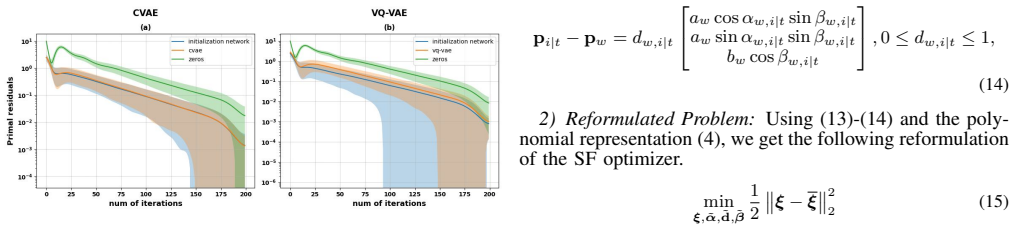
The central discovery is that combining a generative prior over optimal trajectories with a learned, GPU-accelerated safety filter turns the hard problem of finding diverse feasible swarm behaviors into a two-stage sampling-and-project pipeline. Trajectories from a CVAE or VQ-VAE are polynomials parameterized by coefficients, and a differentiable quadratic-programming layer enforces boundary conditions at the decoder output. The safety filter then solves $\min_\xi \tfrac{1}{2}\|\xi-\hat{\xi}\|_2^2$ subject to $A\xi=b$ and $g(\xi)\le 0$ by an alternating-minimization fixed-point iteration that uses a spherical-coordinate reformulation of the collision and workspace constraints, so every update is closed-form, differentiable, and batchable over GPUs. Because the solver is differentiable, an initialization network can be trained end-to-end through unrolled solver iterations to warm-start the fixed point, and the paper reports that this learned initialization reduces primal residuals faster than zero or raw generative-model initializations. The paper's claim is that this architecture produces a large set of multi-modal, feasible trajectories in a few tens of milliseconds, with VQ-VAE delivering higher diversity and CVAE delivering higher speed and more feasible solutions.
Load-bearing premise
The load-bearing premise is that the training data contain the full range of multi-modal swarm behaviors, even though each sampled start-goal pair in the dataset is assigned just one optimal trajectory; if the observed variety is only sampling noise rather than distinct coordination strategies, the multi-modality claim weakens.
Editorial extensions
If this is right
- A robotics simulator could generate alternative coordination behaviors on the fly, making data-driven training of navigation policies cheaper and richer without a separate optimization run per scene.
- For up to eight agents, both pipelines run at interactive rates on a commodity GPU, so an operator could steer a team and receive several safe alternatives in real time.
- The speed-versus-diversity trade-off is explicit: use VQ-VAE when distinct behaviors matter and batch sizes are small, and use CVAE when throughput matters or the swarm is large.
- Because the initialization network is trained through the solver, it can be retrained whenever the solver or constraint set changes, keeping the speedup tied to the actual downstream optimizer.
Reading between the lines
- A testable consequence the paper does not pursue is that its 'multi-modality' should be measured by clustering the safety-filtered trajectories for a fixed start-goal pair; if all samples fall into one or two behavioral patterns for both models, the observed diversity is mostly sampling noise rather than distinct coordination strategies.
- The single-optimal-trajectory-per-pair dataset suggests the diversity is manufactured at inference time by latent sampling plus the non-convex safety-filter projection; a richer expert set containing multiple true modes per pair might change the comparison between the two generative models.
- The same safety-filter-plus-generative-model recipe could extend to other constraint types, such as road geometry or fixed obstacle maps, by adding a similarly structured reformulation of those constraints.
Editorial analysis
A structured set of objections, weighed in public.
Referee Report
Summary. The paper proposes a pipeline, Swarm-Gen, for generating diverse and feasible multi-robot swarm trajectories. A CVAE or VQ-VAE is trained on optimal trajectories produced by an existing trajectory optimizer, and at inference time many latent-space samples are drawn and then projected onto the set of collision- and workspace-feasible trajectories by a custom batched safety filter (SF). The SF is formulated as a fixed-point iteration, and a neural network is trained, in a self-supervised manner through the unrolled solver, to provide good initializations for the SF. The paper reports that the approach generates several feasible, diverse swarm behaviors in tens of milliseconds on an RTX 3090, that VQ-VAE yields more diverse outputs while CVAE is faster, and that the learned initialization accelerates SF convergence relative to zero and raw generative-sample initializations.
Significance. If the claims hold, the paper addresses a useful and relatively underexplored problem: generating multiple feasible, collision-free swarm trajectories in real time for data-driven simulation and downstream planning. The paper has clear strengths: it provides open-source code, the safety-filter derivation in the appendix is plausible, the GPU-batched fixed-point formulation is a practical contribution, and the learned warm-start idea, already validated in single-agent settings, is sensibly extended to a non-convex multi-robot setting. The comparison between CVAE and VQ-VAE is also potentially useful for practitioners. However, the significance of the central claim depends on whether the generated outputs are genuinely multi-modal in a behavioral sense and whether the feasibility and speed claims are supported by rigorous, comparative empirical evidence; on both points the current manuscript is not yet convincing.
major comments (4)
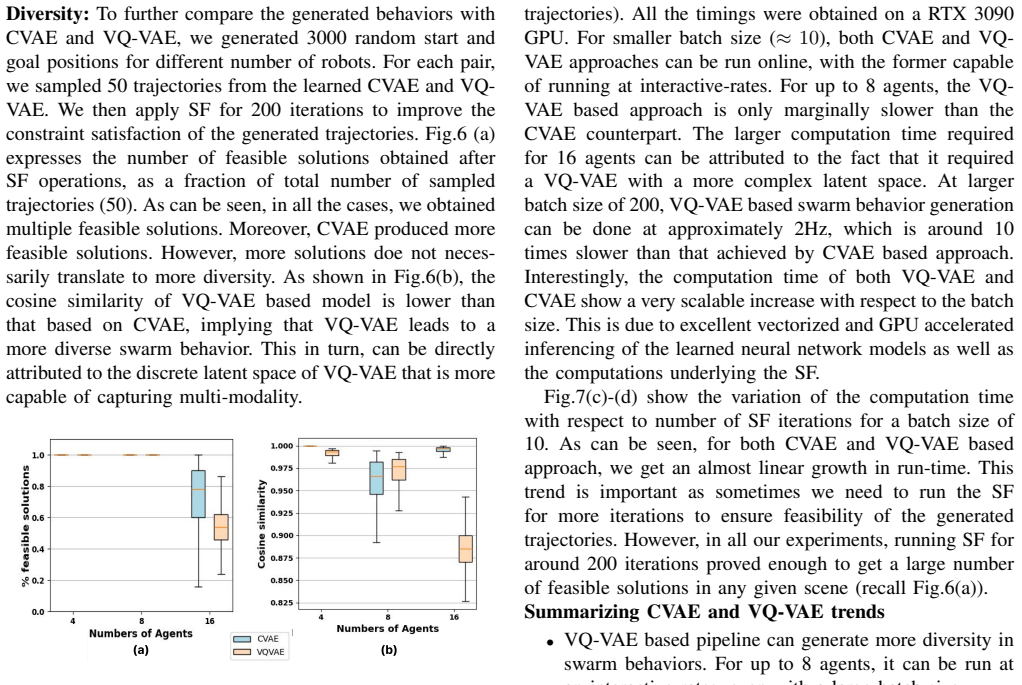
- [Abstract, Section I, Section V-A, Fig. 6] The central claim of generating 'multi-modal' swarm behaviors is not established. The training data are generated by running an improved version of [10] between sampled start and goal pairs (Section V-A), which produces one deterministic optimal trajectory per pair. The learned CVAE/VQ-VAE can therefore only encode perturbations around a single expert mode per conditioning input. The diversity observed after the safety filter could arise from latent sampling noise and from the non-convex SF projection mapping nearby samples to different local optima, rather than from learned, distinct coordination modes. The paper should provide a direct mode-identification test: cluster the feasible outputs (for example, by robot-ordering or by pairwise trajectory distance) and show well-separated clusters; additionally, compare against a baseline that samples noise around the single expert trajectory and then applies the SF. Without such evidence, the abstract's 'multi-modal' claim should be weakened to 'diverse'.
- [Section V-B, Fig. 6(a), Eq. (25)] The feasibility claim is not quantitatively supported. Fig. 6(a) reports the 'fraction of feasible solutions' after 200 SF iterations, but the paper does not state the feasibility tolerance, the maximum constraint violation, or whether the primal residual (25) is driven below any threshold. Since the SF solves a non-convex problem through a fixed-point iteration, 200 iterations may satisfy constraints only approximately. The paper should report the distribution of final constraint violations (collision and workspace) over the full test set, or state an explicit tolerance and the percentage of outputs meeting it.
- [Section IV, Section V-B, Figs. 6-7] The empirical evaluation lacks baseline comparisons and statistical measures. The paper contrasts with diffusion-based [21] only qualitatively, and the speed/diversity claims are not compared against any prior generative method, against the authors' own single-trajectory optimizer [10], or against a simple baseline of sampling around the expert trajectory plus SF. Moreover, Figs. 6 and 7 show point estimates without error bars or significance tests; it is therefore unclear whether the reported CVAE-versus-VQ-VAE differences in feasibility, diversity, and runtime would replicate across seeds and test scenes. Please add error bars over multiple random seeds and a baseline comparison on the same hardware.
- [Section V-C, Fig. 8] The claim that the learned initialization provides faster convergence is based on a single residual plot without quantitative metrics. Fig. 8 shows primal-residual curves, but no iteration count to a target residual, no wall-clock time, and no error bars over multiple scenes. Since 'faster convergence' is one of the two stated contributions, the paper should define a convergence metric (for example, iterations or time to reach a specified residual) and report it over the same benchmark used in the diversity experiments.
minor comments (5)
- [Eq. (1)] The boundary condition at time H is written as (p_{i|H}, \ddot p_{i|H}, \ddot p_{i|H}) = b_H; the second entry should presumably be \dot p_{i|H}.
- [Eq. (11)] The fixed-point iteration is written as (k+1 ξ, k+1 λ) = f_FP(k ξ, k+1 λ); the right-hand side should use k λ (or the notation should be clarified), since the update uses the current multiplier.
- [Eq. (12)] The summation limits are written as 'k−1 X k=0', which appears to be a typo for K−1; please correct the index.
- [Eqs. (22)-(24)] The Lagrange multiplier λ in the augmented Lagrangian (22) is written as if it multiplies ξ, while the update in (23d) is for the residual Fξ − e. This can be made consistent by defining λ as F^T times the multiplier of the equality constraint, but the paper should state this redefinition explicitly.
- [Abstract, Section V-B] Minor typos: 'thecinitialization' in the abstract, 'files closer' in the caption of Fig. 1, and 'is ran' in the caption of Fig. 7. Also, the caption of Fig. 6 does not mention what the box plots or error bars (if any) represent.
Circularity Check
No circularity: generative models, safety filter, and initialization network are fitted independently, with no prediction reducing to its inputs by construction.
full rationale
The paper's derivation chain is not circular. The generative models (CVAE and VQ-VAE) are trained only on reconstruction, codebook, commitment, or KL losses (Eqs. 7 and 9), while the diversity and feasibility metrics (Fig. 6, Eq. 25) are measured on post-hoc outputs and are never used as training targets. The safety filter is a standalone projection (Eq. 10) onto independently stated boundary, workspace, and collision constraints (Eqs. 1-3), with the fixed-point solver derived in the Appendix (Eqs. 23-24). Although the text says the solver is 'an improved and batched version of the optimizer presented in [10]' and the expert dataset is produced by 'an improved version of [10]', the present paper provides the actual fixed-point equations rather than importing the solver as a black-box theorem; the self-citations to [10], [24], and [25] are normal author-continuation and are not used to forbid alternatives or to establish uniqueness. The nearest concern is that Section V-A collects only one expert trajectory per sampled start-goal pair, which may weaken the multi-modality claim; however, this is an empirical limitation, not a circular reduction, because diversity could still arise from latent-space sampling and from the non-convex safety-filter projection, and no equation equates the claimed diversity with any fitted value. The absence of external benchmarks affects generalizability, not circularity. Score 0.
Assumptions & free parameters
free parameters (5)
- Augmented Lagrangian penalty rho =
not reported
- Number of SF iterations =
200
- VQ-VAE codebook size N =
512
- VQ-VAE latent vector size L =
25 (4/8 agents), 100 (16 agents)
- VQ-VAE commitment loss weight beta =
not reported
assumptions (4)
- standard math The spherical reformulation (13)-(14) exactly represents all spheroid collision-avoidance and workspace constraints.
- domain assumption The alternating-minimization fixed-point iteration (11) converges to a feasible solution within 200 iterations for all sampled inputs.
- domain assumption The learned generative models approximate the true distribution of optimal swarm trajectories, including its multi-modality.
- domain assumption The self-supervised loss (12), minimized through unrolled fixed-point iterations, produces an initialization that accelerates the SF solver without biasing the feasible set.
Cite this review
Pith. "Pith review of Swarm-Gen: Fast Generation of Diverse Feasible Swarm Behaviors." pith.science (2026). https://pith.science/paper/YW5TNM72
@misc{pith2026250119042,
  author       = {Pith},
  title        = {Pith review of: Swarm-Gen: Fast Generation of Diverse Feasible Swarm Behaviors},
  year         = {2026},
  howpublished = {\url{https://pith.science/paper/YW5TNM72}},
  note         = {Machine review of arXiv:2501.19042}
}
read the original abstract
Coordination behavior in robot swarms is inherently multi-modal in nature. That is, there are numerous ways in which a swarm of robots can avoid inter-agent collisions and reach their respective goals. However, the problem of generating diverse and feasible swarm behaviors in a scalable manner remains largely unaddressed. In this paper, we fill this gap by combining generative models with a safety-filter (SF). Specifically, we sample diverse trajectories from a learned generative model which is subsequently projected onto the feasible set using the SF. We experiment with two choices for generative models, namely: Conditional Variational Autoencoder (CVAE) and Vector-Quantized Variational Autoencoder (VQ-VAE). We highlight the trade-offs these two models provide in terms of computation time and trajectory diversity. We develop a custom solver for our SF and equip it with a neural network that predicts context-specific initialization. Thecinitialization network is trained in a self-supervised manner, taking advantage of the differentiability of the SF solver. We provide two sets of empirical results. First, we demonstrate that we can generate a large set of multi-modal, feasible trajectories, simulating diverse swarm behaviors, within a few tens of milliseconds. Second, we show that our initialization network provides faster convergence of our SF solver vis-a-vis other alternative heuristics.
Figures


Figures from the paper (5 more)



Reference graph
Works this paper leans on
-
[10]
Gpu accelerated convex approximations for fast multi- agent trajectory optimization,
F. Rastgar, H. Masnavi, J. Shrestha, K. Kruusam ¨ae, A. Aabloo, and A. K. Singh, “Gpu accelerated convex approximations for fast multi- agent trajectory optimization,” IEEE Robotics and Automation Letters, vol. 6, no. 2, pp. 3303–3310, 2021
work page 2021
-
[18]
Learning to warm-start fixed-point optimization algorithms,
R. Sambharya, G. Hall, B. Amos, and B. Stellato, “Learning to warm-start fixed-point optimization algorithms,” Journal of Machine Learning Research, vol. 25, no. 166, pp. 1–46, 2024
work page 2024
-
[21]
Motiondiffuser: Controllable multi-agent motion prediction using diffusion,
C. Jiang, A. Cornman, C. Park, B. Sapp, Y . Zhou, D. Anguelov et al. , “Motiondiffuser: Controllable multi-agent motion prediction using diffusion,” in Proceedings of the IEEE/CVF Conference on Computer Vision and Pattern Recognition , 2023, pp. 9644–9653
work page 2023
-
[1]
Heter- sim: Heterogeneous multi-agent systems simulation by interactive data-driven optimization,
J. Ren, W. Xiang, Y . Xiao, R. Yang, D. Manocha, and X. Jin, “Heter- sim: Heterogeneous multi-agent systems simulation by interactive data-driven optimization,” IEEE transactions on visualization and computer graphics, vol. 27, no. 3, pp. 1953–1966, 2019
work page 1953
-
[2]
B-gap: Behavior-rich simulation and navigation for autonomous driving,
A. Mavrogiannis, R. Chandra, and D. Manocha, “B-gap: Behavior-rich simulation and navigation for autonomous driving,”IEEE Robotics and Automation Letters, vol. 7, no. 2, pp. 4718–4725, 2022
work page 2022
-
[3]
Gpudrive: Data-driven, multi-agent driving simulation at 1 mil- lion fps,
S. Kazemkhani, A. Pandya, D. Cornelisse, B. Shacklett, and E. Vinit- sky, “Gpudrive: Data-driven, multi-agent driving simulation at 1 mil- lion fps,” arXiv preprint arXiv:2408.01584 , 2024
arXiv 2024
-
[4]
Target-visible polynomial trajectory generation within an mav team,
Y . Lee, J. Park, B. Jeon, and H. J. Kim, “Target-visible polynomial trajectory generation within an mav team,” in 2021 IEEE/RSJ Interna- tional Conference on Intelligent Robots and Systems (IROS) . IEEE, 2021, pp. 1982–1989
work page 2021
-
[5]
Communication through motion: Legibility of multi-robot systems,
B. Capelli, C. Secchi, and L. Sabattini, “Communication through motion: Legibility of multi-robot systems,” in 2019 International Symposium on Multi-Robot and Multi-Agent Systems (MRS) . IEEE, 2019, pp. 126–132
work page 2019
Show all 25 references
-
[6]
Amswarm: An alternating minimization approach for safe motion planning of quadrotor swarms in cluttered environments,
V . K. Adajania, S. Zhou, A. K. Singh, and A. P. Schoellig, “Amswarm: An alternating minimization approach for safe motion planning of quadrotor swarms in cluttered environments,” in 2023 IEEE Interna- tional Conference on Robotics and Automation (ICRA) . IEEE, 2023, pp. 1421–1427
2023
-
[7]
Amswarmx: Safe swarm coordination in complex environments via implicit non-convex decomposition of the obstacle-free space,
——, “Amswarmx: Safe swarm coordination in complex environments via implicit non-convex decomposition of the obstacle-free space,” in 2024 IEEE International Conference on Robotics and Automation (ICRA). IEEE, 2024, pp. 14 555–14 561
2024
-
[8]
Distributed predictive drone swarms in cluttered environments,
E. Soria, F. Schiano, and D. Floreano, “Distributed predictive drone swarms in cluttered environments,” IEEE Robotics and Automation Letters, vol. 7, no. 1, pp. 73–80, 2021
2021
-
[9]
Generation of collision-free trajectories for a quadrocopter fleet: A sequential convex programming approach,
F. Augugliaro, A. P. Schoellig, and R. D’Andrea, “Generation of collision-free trajectories for a quadrocopter fleet: A sequential convex programming approach,” in 2012 IEEE/RSJ international conference on Intelligent Robots and Systems . IEEE, 2012, pp. 1917–1922
2012
-
[11]
Smart: Simultane- ous multi-agent recurrent trajectory prediction,
N. Sriram, B. Liu, F. Pittaluga, and M. Chandraker, “Smart: Simultane- ous multi-agent recurrent trajectory prediction,” in Computer Vision– ECCV 2020: 16th European Conference, Glasgow, UK, August 23–28, 2020, Proceedings, Part XXVII 16 . Springer, 2020, pp. 463–479
2020
-
[12]
Continual multi- agent interaction behavior prediction with conditional generative mem- ory,
H. Ma, Y . Sun, J. Li, M. Tomizuka, and C. Choi, “Continual multi- agent interaction behavior prediction with conditional generative mem- ory,” IEEE Robotics and Automation Letters , vol. 6, no. 4, pp. 8410– 8417, 2021
2021
-
[13]
Congestion- aware multi-agent trajectory prediction for collision avoidance,
X. Xie, C. Zhang, Y . Zhu, Y . N. Wu, and S.-C. Zhu, “Congestion- aware multi-agent trajectory prediction for collision avoidance,” in 2021 IEEE International Conference on Robotics and Automation (ICRA). IEEE, 2021, pp. 13 693–13 700
2021
-
[14]
Tra- jectron++: Dynamically-feasible trajectory forecasting with heteroge- neous data,
T. Salzmann, B. Ivanovic, P. Chakravarty, and M. Pavone, “Tra- jectron++: Dynamically-feasible trajectory forecasting with heteroge- neous data,” in Computer Vision–ECCV 2020: 16th European Confer- ence, Glasgow, UK, August 23–28, 2020, Proceedings, Part XVIII 16 . Springer, 2...
2020
-
[15]
Neural discrete representation learning,
A. v. d. Oord, O. Vinyals, and K. Kavukcuoglu, “Neural discrete representation learning,” arXiv preprint arXiv:1711.00937 , 2017
2017 arXiv
-
[16]
Conditional image generation with pixelcnn decoders,
A. Van den Oord, N. Kalchbrenner, L. Espeholt, O. Vinyals, A. Graves et al. , “Conditional image generation with pixelcnn decoders,” Ad- vances in neural information processing systems , vol. 29, 2016
2016
-
[17]
Learning structured output represen- tation using deep conditional generative models,
K. Sohn, H. Lee, and X. Yan, “Learning structured output represen- tation using deep conditional generative models,” Advances in neural information processing systems , vol. 28, 2015
2015
-
[19]
Multi-agent tensor fusion for contextual trajectory prediction,
T. Zhao, Y . Xu, M. Monfort, W. Choi, C. Baker, Y . Zhao, Y . Wang, and Y . N. Wu, “Multi-agent tensor fusion for contextual trajectory prediction,” in Proceedings of the IEEE/CVF conference on computer vision and pattern recognition , 2019, pp. 12 126–12 134
2019
-
[20]
Agentformer: Agent- aware transformers for socio-temporal multi-agent forecasting,
Y . Yuan, X. Weng, Y . Ou, and K. M. Kitani, “Agentformer: Agent- aware transformers for socio-temporal multi-agent forecasting,” in Proceedings of the IEEE/CVF International Conference on Computer Vision, 2021, pp. 9813–9823
2021
-
[22]
Transformer-based model predictive control: Trajectory optimization via sequence modeling,
D. Celestini, D. Gammelli, T. Guffanti, S. D’Amico, E. Capello, and M. Pavone, “Transformer-based model predictive control: Trajectory optimization via sequence modeling,” IEEE Robotics and Automation Letters, 2024
2024
-
[23]
Pilot: Efficient planning by imitation learning and optimisation for safe autonomous driving,
H. Pulver, F. Eiras, L. Carozza, M. Hawasly, S. V . Albrecht, and S. Ramamoorthy, “Pilot: Efficient planning by imitation learning and optimisation for safe autonomous driving,” in 2021 IEEE/RSJ International Conference on Intelligent Robots and Systems (IROS) . IEEE, 2021, pp...
2021
-
[24]
End-to-end learning of behavioural inputs for autonomous driving in dense traffic,
J. Shrestha, S. Idoko, B. Sharma, and A. K. Singh, “End-to-end learning of behavioural inputs for autonomous driving in dense traffic,” in 2023 IEEE/RSJ International Conference on Intelligent Robots and Systems (IROS). IEEE, 2023, pp. 10 020–10 027
2023
-
[25]
Learning sampling distribution and safety filter for autonomous driving with vq-vae and differentiable optimization,
S. Idoko, B. Sharma, and A. K. Singh, “Learning sampling distribution and safety filter for autonomous driving with vq-vae and differentiable optimization,” arXiv preprint arXiv:2403.19461 , 2024
2024 arXiv
Reviewed August 9, 2026 · model on record in the stance chip above.
Discussion (0). Continue with ORCID to comment.