REVIEW 4 major objections 4 minor 2 cited by
An embedded Disk (eDisk) in the IceAge: Investigating the jet and outflow from CED 110 IRS4
T0 review · 4 major / 4 minor · reviewed 2026-08-09 · deepseek-v4-flash
Pith's one-line read The embedded protostar Ced 110 IRS4A drives a wide, fast atomic jet that JWST has now resolved for the first time, alongside a molecular outflow whose shape argues against MHD disk winds.
desk verdict A genuinely new resolved jet detection from Ced 110 IRS4A with solid morphology, but the headline velocity and timescale rest on a fragile deprojection and should be revised before publication. read the letter →
The pith
A machine-rendered reading of the paper's core claim, the machinery that carries it, and where it could break.
The reading
What carries the argument
The analysis rides on three observational tools. MIRI MRS integral-field spectroscopy resolves the atomic jet and molecular hydrogen lines at roughly 50 au scales, letting the authors measure jet width and velocity as functions of position. The 5.34 $\mu$m [Fe II] transition offers the finest spatial and spectral resolution among the detected lines and anchors the kinematic analysis. ALMA eDisk data supply the disk scale and orientation: the 1.3 mm dust continuum gives disk radii and the $76^\circ$ inclination used to deproject the jet velocity, while the position of the dust disk defines the jet axis. The Sobel--Feldman edge-detection filter applied to the H$_2$ images measures outflow widths across transitions, and the MIRI PSF is subtracted in quadrature to obtain deconvolved jet widths.
What would settle it
Measure the blue- and red-shifted jet velocities independently at higher spectral resolution and compare them, and fit the ALMA velocity field to get an independent disk inclination; if the two jet sides are not symmetric or the inclination differs significantly from $76^\circ$, the claimed 124 km s$^{-1}$ jet velocity and 25-year dynamical timescale would need to be revised.
Extended reading notes
Core claim
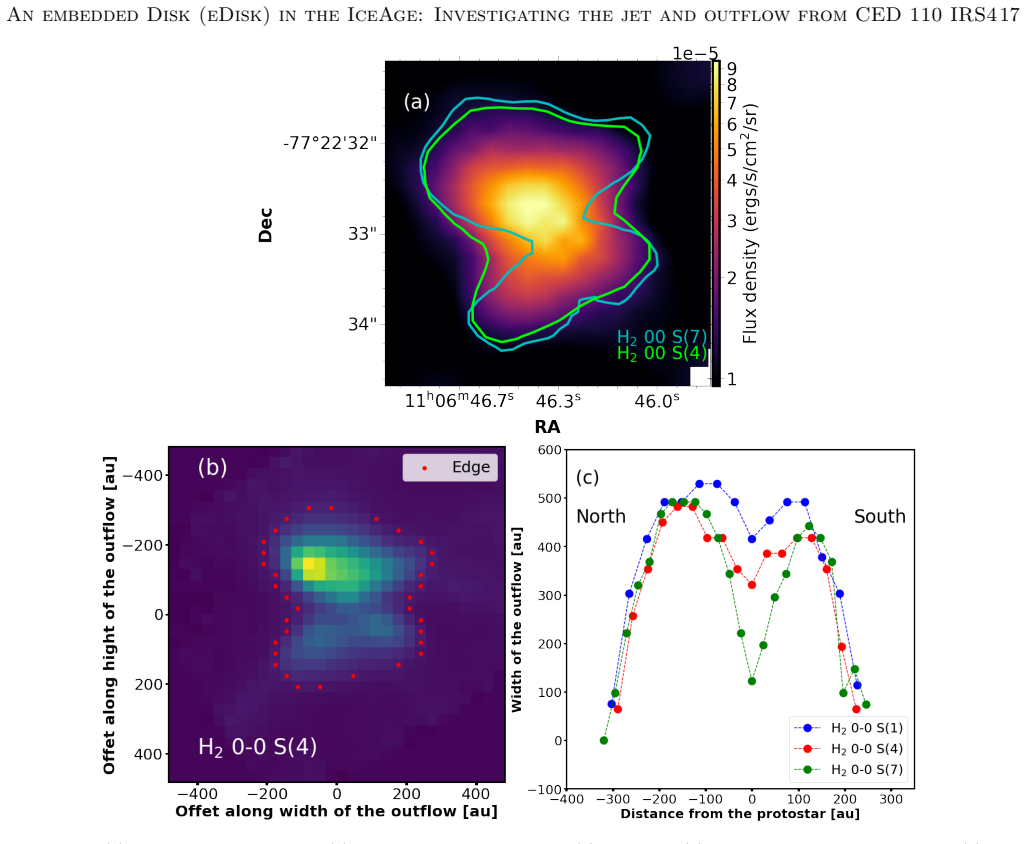
The central discovery is that Ced 110 IRS4A, a Class 0/I protostar in the Chamaeleon I cloud, drives an atomic jet that is now resolved for the first time. MIRI MRS observations detect the jet in four [Fe II] transitions as well as [Ni II] at 6.64 $\mu$m, [Ar II] at 6.99 $\mu$m, and [Ne II] at 12.81 $\mu$m; the 5.34 $\mu$m [Fe II] line shows a goblet-like morphology that widens from an upper-limit base width of $51 \pm 8.6$ au to an opening angle of $23^\circ \pm 4^\circ$. A position--velocity analysis of the same line gives a peak-to-peak velocity of about 60 km s$^{-1}$, which the authors divide by $\cos(76^\circ)$ to obtain a deprojected jet velocity of about $124$ km s$^{-1}$ and, from the 1324 au jet length, a dynamical timescale of about 25 years. The molecular hydrogen outflow is morphologically distinct: rather than the usual hourglass, it appears as two hemispheres meeting at a neck at the protostar, and its measured width is roughly constant across the 0-0 S(1), S(4), and S(7) transitions. The authors interpret this transition-independent width as evidence that MHD disk winds may not drive the H$_2$ outflow, and report that the outflow width at the protostar ($130 \pm 10$ au) lies between the jet width and the 183.4 au dust disk diameter.
Load-bearing premise
The load-bearing premise is that the disk is tilted at $76^\circ$ and the jet is symmetric, so dividing the observed 30 km s$^{-1}$ line-of-sight velocity by $\cos(76^\circ)$ gives the true speed; a different tilt or an asymmetric jet would change the derived 124 km s$^{-1}$ speed and the 25-year dynamical timescale substantially.
Editorial extensions
If this is right
- Ced 110 IRS4A joins the small set of Class 0 protostars whose atomic jets are spatially resolved, allowing direct comparison of jet and disk sizes during the main accretion phase.
- The $23^\circ \pm 4^\circ$ opening angle is much larger than the roughly $4.6^\circ$ expected for a ballistically confined jet at $124$ km s$^{-1}$, implying the jet is not confined or is precessing.
- If MHD disk winds drove the H$_2$ outflow, higher-excitation lines should appear more collimated than lower-excitation ones; the equal widths across S(1), S(4), and S(7) argue against that launching mechanism.
- The outflow width at the protostar ($130 \pm 10$ au) being smaller than the 183.4 au disk diameter but larger than the 51 au jet width constrains where the outflow is launched relative to the disk.
Reading between the lines
- If equal H$_2$ width across excitation transitions is found in other Class 0 sources, the general case for MHD disk winds as the primary outflow driver would weaken, and alternative mechanisms such as entrainment by wide-angle winds would need more attention.
- The large opening angle could be a sign of jet precession driven by the binary companion at 250 au separation; multi-epoch JWST imaging over a few years could look for a wobble in the jet position angle.
- The 30 km s$^{-1}$ line-of-sight velocity could be checked with higher spectral resolution observations of the [Fe II] lines, which would directly test the symmetry assumption without relying on the $76^\circ$ inclination.
Editorial analysis
A structured set of objections, weighed in public.
Referee Report
Summary. This paper presents JWST NIRCam and MIRI MRS observations, combined with ALMA eDisk data, of the Class 0/I protostellar binary Ced 110 IRS4. The main claims are: detection of an atomic jet from Ced 110 IRS4A in multiple [Fe II] lines plus [Ni II], [Ar II], and [Ne II], marking the first well-resolved jet from the system; a jet width upper limit of 51 au and an opening angle of 23° ± 4°; an inclination-corrected jet velocity of 124 km/s and a dynamical timescale of 25 years; a molecular H2 outflow with a back-to-back hemisphere morphology whose extent is similar across transitions, interpreted as a possible sign that MHD disk winds do not drive the outflow; and an outflow width at the protostar of 130 ± 10 au. The paper also reports disk shadows, arc-like envelope structures, and tentative evidence for a jet from IRS4B.
Significance. The reported detection of a well-resolved atomic/fine-structure jet from Ced 110 IRS4A is a concrete observational advance: it adds a deeply embedded Class 0 source to the small sample of jets mapped with JWST, and the width and opening-angle measurements are valuable, especially when combined with the ALMA disk characterization. The multi-line consistency of the jet morphology and the explicit astrometric alignment between JWST and ALMA are strengths of the paper. However, the more quantitative claims — the 124 km/s deprojected velocity, the 25-year timescale, and the inference about MHD disk winds — are not yet as secure as the morphological detection. In particular, the kinematic numbers in the abstract and summary rest on an imposed symmetry assumption and an unpropagated inclination, and should be treated as order-of-magnitude estimates pending revision.
major comments (4)
- [Section 3.4 and Figure 11] The derived jet velocity of 124 km/s and the dynamical timescale of 25 years rest on two steps that are not defended: (i) the assumption that the jet velocity is symmetric and the average velocity is set to zero, rather than using the ALMA systemic velocity of 4.67 km/s that is cited in the same section; and (ii) deprojection by cos(76°) with no uncertainty propagation. Because 1/cos i is about 4.1 at i = 76°, an inclination uncertainty of only ±5° changes the deprojected velocity from roughly 90 to 190 km/s and the derived timescale by a similar factor. Please re-derive the jet velocity relative to the known systemic velocity, propagate the inclination and any velocity-measurement uncertainties, or explicitly state that 124 km/s and 25 years are order-of-magnitude estimates rather than measured results.
- [Abstract; Section 3.2; Summary item 4] The abstract states that MIRI MRS observations reveal a jet from 'both protostars' and calls this the first detection of a jet from the system, but the body of the paper only reports 'hints of weak [Fe II] emission' from Ced 110 IRS4B and notes that it is difficult to separate the emission between IRS4A and IRS4B. Summary item 4 correctly uses the word 'hints.' The abstract overstates the evidence for an IRS4B jet and should be revised to attribute the well-resolved jet to IRS4A and to describe the IRS4B emission as tentative.
- [Section 4.2 and Figure 14] The conclusion that the similar extent of H2 emission across the S(1), S(4), and S(7) transitions suggests that MHD disk winds may not drive the outflow is not established by the presented analysis. The three transitions have PSF FWHMs that differ by more than a factor of two (0.668″ for S(1) versus 0.288″ for S(7); Table 4), and the comparison in Figure 14(a) uses 10% of peak contours, which conflates intrinsic spatial structure with resolution, excitation, and optical-depth effects. A quantitative test, such as forward-convolving a model intrinsic width with each line's PSF or checking the sensitivity of the derived extents to the contour level, is needed before this can be used as a constraint on the launching mechanism. At minimum, the abstract and Section 4.2 should present this as a tentative suggestion rather than a stated result.
- [Section 4.1] The dynamical timescale derivation is ambiguous. The text says the 26 µm [Fe II] emission has a spatial extent of 6.8″ (1285 au) from tip to tip and that after inclination correction the 'total jet length' is 1324 au, but then obtains a timescale of about 25 years using v = 124 km/s. If 1324 au is the full bipolar extent, the relevant length for a single lobe is about 662 au, giving roughly 25 years; if the full extent is used instead, the timescale is about 50 years. Please define whether the quoted length is one-sided or two-sided and make the calculation of the reported 25-year value explicit.
minor comments (4)
- [Section 2.2] The filter is referred to as 'F410' in one place; this should be 'F410M' to match Table 2 and the rest of the text.
- [Section 3.4] The text first states that the bulk blue- and red-shifted velocities are about 30–40 km/s, then adopts 30 km/s from the PV peak-to-peak shift of about 60 km/s. Please state how the 30–40 km/s range was obtained and why the lower value is used for the deprojection.
- [Table 3] The uncertainties for the IRS4B line fluxes are quoted to 0.005 × 10^-15 erg s^-1 cm^-2; these appear to be formal photometric uncertainties and do not include the significant aperture/PSF contamination from IRS4A noted in Section 3.2. A systematic uncertainty should be added or the caveat made explicit in the table or text.
- [Section 4.1] The statement that the jet from Ced 110 IRS4B 'seems to be more extended and brighter on the southern side' is based on marginal detections; given the contamination issues acknowledged in Section 3.2, this should be explicitly labeled as tentative.
Circularity Check
No circularity: direct JWST/ALMA observations with an external ALMA inclination input.
full rationale
The paper's central results—jet detection, width, opening angle, and velocity—are direct measurements from JWST MIRI MRS line maps, moment maps, and PV diagrams, not outputs of a self-referential fit. The deprojected velocity v_jet=124 km/s is obtained by dividing the measured LOS shift (~30 km/s) by cos(76°) using the disk inclination from Sai et al. (2023); that inclination is an ALMA-based geometric measurement from prior work that does not incorporate the jet velocity or any quantity predicted here, so it functions as an external input rather than a circular premise. The symmetry assumption in §3.4 ('assume that the velocity of the jet is symmetric and set the average velocity of the jet to be zero') sets the velocity zero-point but does not determine the peak-to-peak amplitude of ~60 km/s, which is measured from the PV diagram; hence the 30 km/s value is not defined into existence. Similarly, the H2 outflow width and the jet opening angle are derived from direct spatial fitting of observed emission and PSF deconvolution, with no fitted parameter later relabeled as a prediction. The repeated citation of Sai et al. (2023) for disk properties and systemic velocity is same-team prior work, but it is used as a geometric/kinematic reference, not as a load-bearing self-citation that substitutes for evidence. No equation in the paper reduces to its own input by construction. Robustness concerns about the inclination uncertainty and the symmetry assumption are validity/uncertainty issues, not circularity.
Assumptions & free parameters
free parameters (4)
- Opening angle of [Fe II] jet =
23° ± 4°
- Jet half-velocity from PV diagram =
30 km/s
- Deconvolved jet width at base =
≤51 ± 8.6 au
- Outflow width at protostar from H2 S(7) =
130 ± 10 au
assumptions (4)
- domain assumption The disk inclination is 76 degrees and the systemic velocity is 4.67 km/s, from Sai et al. (2023).
- ad hoc to paper The jet's velocity is symmetric about the systemic velocity, so the average velocity is set to zero.
- domain assumption The MIRI MRS PSF widths from Law et al. (2023) are accurate enough for quadrature deconvolution.
- domain assumption The H2 0-0 S(1), S(4), and S(7) transitions trace the same outflow structure.
Cite this review
Pith. "Pith review of An embedded Disk (eDisk) in the IceAge: Investigating the jet and outflow from CED 110 IRS4." pith.science (2026). https://pith.science/paper/VHBNXXX2
@misc{pith2026250200394,
  author       = {Pith},
  title        = {Pith review of: An embedded Disk (eDisk) in the IceAge: Investigating the jet and outflow from CED 110 IRS4},
  year         = {2026},
  howpublished = {\url{https://pith.science/paper/VHBNXXX2}},
  note         = {Machine review of arXiv:2502.00394}
}
abstract
We present a comprehensive study of the large-scale structure, jet and outflow morphology, and kinematics of the Class 0/I protostellar binary Ced 110 IRS4, using JWST NIRCam (F150W and F410M) and MIRI MRS observations from the JWST ERC program IceAge, along with ALMA data from the Early Planet Formation in Embedded Disks (eDisk) program. NIRCam images, combined with ALMA continuum and CO data, reveal arc-like structures ($\sim$1100 au), suggesting a dense envelope around the protostars. We detect disk shadows from both protostars in F150W. The MIRI MRS IFU data reveal a jet from both protostars in multiple [Fe II] lines, [Ar II] 6.99 $\mu$m and [Ne II] 12.81 $\mu$m, marking the first detection of a jet from the system. The [Fe II] (5.34 $\mu$m) jet from Ced 110 IRS4A has a width of $\leq$ 51~au at the protostellar location, with a large opening angle of 23\arcdeg{} $\pm$ 4\arcdeg. After inclination correction, the jet velocity is 124 km s$^{-1}$, corresponding to a dynamical timescale of 25 years. The molecular H$_2$ outflow displays a distinct morphology resembling two hemispheres placed back-to-back. The consistent H$_2$ emission extent across transitions, differing from previous observations of protostellar outflows detected with JWST, suggests that MHD disk winds may not drive the observed outflow. We find that the upper limit to the width of the outflow at the protostellar location is 130 $\pm$ 10 au which is smaller than the disk diameter of 183.4 {$\pm$ 0.4 au} but much larger than the width of the [Fe II] jet.
Figures


Figures from the paper (11 more)


Forward citations
Cited by 2 Pith papers
-
Using Scattered Near-Infrared Light to Map Water Ice in Prestellar Cores with SPHEREx
Coreshine SPHEREx spectra map 3 µm H2O ice across four prestellar cores; the two densest show an unexplained central drop in ice absorption that standard Bonnor-Ebert scattering models cannot reproduce.
-
JWST/MIRI Detection of Molecular H$_2$ Winds from an Edge-on Class II Source HV Tau C
The edge-on Class II disk HV Tau C hosts a spatially extended, wide-angled molecular hydrogen wind with warm (~600 K) and hot (~2000 K) components and a mass-loss rate near 1e-8 solar masses per year.
Reference graph
Works this paper leans on
-
[1]
, " * write output.state after.block = add.period write newline
ENTRY address archivePrefix author booktitle chapter doi edition editor eprint howpublished institution journal key month number organization pages publisher school series title misctitle type volume year version url label extra.label sort.label short.list INTEGERS output.state before.all mid.sentence after.sentence after.block FUNCTION init.state.consts ...
-
[2]
write newline
" write newline "" before.all 'output.state := FUNCTION format.url url empty "" new.block "" url * "" * if FUNCTION format.eprint eprint empty "" archivePrefix empty "" archivePrefix "arXiv" = new.block " " eprint * " " * new.block " " eprint * " " * if if if FUNCTION format.doi doi empty "" " " doi * " " * if FUNCTION format.pid doi empty eprint empty ur...
-
[3]
B !̕3g#ۺN_8 p Cۻ |U <Ҹqxsn .q ! n p1_ XS 3Jι ss<ιó i
thebibliography [1] 20pt to REFERENCES 6pt =0pt -12pt 10pt plus 3pt =0pt =0pt =1pt plus 1pt =0pt =0pt -12pt =13pt plus 1pt =20pt =13pt plus 1pt \@M =10000 =-1.0em =0pt =0pt 0pt =0pt =1.0em @enumiv\@empty 10000 10000 `\.\@m \@noitemerr \@latex@warning Empty `thebibliography' environment \@ifnextchar \@reference \@latexerr Missing key on reference command E...
2021
-
[4]
doi:10.1051/0004-6361/201220488
Agra-Amboage, V., Cabrit, S., Dougados, C., et al.\ 2014, , 564, A11. doi:10.1051/0004-6361/201220488
-
[5]
Andre, P., Ward-Thompson, D., & Barsony, M.\ 1993, , 406, 122. doi:10.1086/172425
doi:10.1086/172425 1993
-
[6]
Assani, K., Harsono, D., Ramsey, J., et al.\ 2024, arXiv:2404.18334. doi:10.48550/arXiv.2404.18334
-
[7]
Alexander, R. D.\ 2008, , 391, L64. doi:10.1111/j.1745-3933.2008.00556.x
arXiv 2008
-
[9]
Appel, S. M., Burkhart, B., Semenov, V. A., et al.\ 2023, , 954, 93. doi:10.3847/1538-4357/ace897
Show all 105 references
-
[10]
R., et al.\ 2023, , 675, A111
Argyriou, I., Glasse, A., Law, D. R., et al.\ 2023, , 675, A111. doi:10.1051/0004-6361/202346489
2023 doi
-
[11]
doi:10.1146/annurev-astro-081915-023341
Bally, J.\ 2016, , 54, 491. doi:10.1146/annurev-astro-081915-023341
2016 doi
-
[12]
R.\ 2009, , 392, 1363
Bate, M. R.\ 2009, , 392, 1363. doi:10.1111/j.1365-2966.2008.14165.x
2009
-
[13]
F., Tychoniec, L., et al.\ 2023, , 673, A121
Beuther, H., van Dishoeck, E. F., Tychoniec, L., et al.\ 2023, , 673, A121. doi:10.1051/0004-6361/202346167
2023 doi
-
[14]
Blandford, R. D. & Payne, D. G.\ 1982, , 199, 883. doi:10.1093/mnras/199.4.883
1982 doi
-
[15]
L., Crapsi, A., Myers, P
Bourke, T. L., Crapsi, A., Myers, P. C., et al.\ 2005, , 633, L129. doi:10.1086/498449
2005 doi
-
[16]
Brunken, N. G. C., Rocha, W. R. M., van Dishoeck, E. F., et al.\ 2024, , 685, A27. doi:10.1051/0004-6361/202348718
2024 doi
-
[17]
& Moosman, A.\ 1981, , 48, 353
Cassen, P. & Moosman, A.\ 1981, , 48, 353. doi:10.1016/0019-1035(81)90051-8
1981 doi
- [18]
- [19]
-
[20]
doi:10.1086/523645
Di Francesco, J., Johnstone, D., Kirk, H., et al.\ 2008, , 175, 277. doi:10.1086/523645
2008 doi
- [22]
-
[23]
J., Dunham, M
Evans, N. J., Dunham, M. M., J rgensen, J. K., et al.\ 2009, , 181, 321. doi:10.1088/0067-0049/181/2/321
2009 doi
-
[24]
M., Krumholz, M
Fall, S. M., Krumholz, M. R., & Matzner, C. D.\ 2010, , 710, L142. doi:10.1088/2041-8205/710/2/L142
2010 doi
- [25]
-
[26]
A., Megeath, S
Federman, S. A., Megeath, S. T., Rubinstein, A. E., et al.\ 2024, , 966, 41. doi:10.3847/1538-4357/ad2fa0
2024 doi
-
[27]
F., et al.\ 2022, , 937, L9
Fiorellino, E., Tychoniec, ., Manara, C. F., et al.\ 2022, , 937, L9. doi:10.3847/2041-8213/ac8fee
2022 doi
-
[28]
doi:10.3847/1538-4357/aca320
Fiorellino, E., Tychoniec, ., Cruz-S \'a enz de Miera, F., et al.\ 2023, , 944, 135. doi:10.3847/1538-4357/aca320
2023 doi
-
[29]
P., Cabrit, S., et al.\ 2014, Protostars and Planets VI, 451
Frank, A., Ray, T. P., Cabrit, S., et al.\ 2014, Protostars and Planets VI, 451. doi:10.2458/azu\_uapress\_9780816531240-ch020
2014 doi
-
[30]
E., Najita, J
Glassgold, A. E., Najita, J. R., & Igea, J.\ 2007, , 656, 515. doi:10.1086/510013
2007 doi
-
[31]
E., Rothman, L
Gordon, I. E., Rothman, L. S., Hargreaves, R. J., et al.\ 2022, , 277, 107949. doi:10.1016/j.jqsrt.2021.107949
2022
- [32]
-
[33]
Y., Offner, S
Guszejnov, D., Grudi \'c , M. Y., Offner, S. S. R., et al.\ 2022, , 515, 4929. doi:10.1093/mnras/stac2060
2022 doi
-
[34]
K., Bourke, T
J rgensen, J. K., Bourke, T. L., Myers, P. C., et al.\ 2007, , 659, 479. doi:10.1086/512230
2007 doi
-
[35]
K., van Dishoeck, E
J rgensen, J. K., van Dishoeck, E. F., Visser, R., et al.\ 2009, , 507, 861. doi:10.1051/0004-6361/200912325
2009 doi
-
[36]
M., Megeath, S
Habel, N. M., Megeath, S. T., Booker, J. J., et al.\ 2021, , 911, 153. doi:10.3847/1538-4357/abded8
2021 doi
-
[37]
P., et al.\ 2023, , 951, L32
Harsono, D., Bjerkeli, P., Ramsey, J. P., et al.\ 2023, , 951, L32. doi:10.3847/2041-8213/acdfca
2023 doi
-
[38]
doi:10.1146/annurev-astro-081915-023347
Hartmann, L., Herczeg, G., & Calvet, N.\ 2016, , 54, 135. doi:10.1146/annurev-astro-081915-023347
2016 doi
-
[39]
Cambridge, UK ; New York : Cambridge University Press, 1998
Hartmann, L.\ 1998, Accretion processes in star formation / Lee Hartmann. Cambridge, UK ; New York : Cambridge University Press, 1998. (Cambridge astrophysics series ; 32) ISBN 0521435072
1998
-
[40]
doi:10.3847/1538-4357/abbfab
Hennebelle, P., Commer c on, B., Lee, Y.-N., et al.\ 2020, , 904, 194. doi:10.3847/1538-4357/abbfab
2020 doi
-
[41]
doi:10.1086/519269
Hiramatsu, M., Hayakawa, T., Tatematsu, K., et al.\ 2007, , 664, 964. doi:10.1086/519269
2007 doi
-
[42]
& Gorti, U.\ 2009, , 703, 1203
Hollenbach, D. & Gorti, U.\ 2009, , 703, 1203. doi:10.1088/0004-637X/703/2/1203
2009 doi
- [43]
-
[44]
NIST Atomic Spectra Database (ver
Kramida, A., Ralchenko, Yu., Reader, J., and NIST ASD Team (2023). NIST Atomic Spectra Database (ver. 5.11), [Online]. Available: https://physics.nist.gov/asd [2023, December 19]. National Institute of Standards and Technology, Gaithersburg, MD. DOI: https://doi.org/10.18434/T4W30F
2023 doi
-
[45]
C., & Kim, H.-J.\ 2016, Journal of Korean Astronomical Society, 49, 109
Koo, B.-C., Raymond, J. C., & Kim, H.-J.\ 2016, Journal of Korean Astronomical Society, 49, 109. doi:10.5303/JKAS.2016.49.3.109
2016 doi
-
[46]
F., J rgensen, J
Lahuis, F., van Dishoeck, E. F., J rgensen, J. K., et al.\ 2010, , 519, A3. doi:10.1051/0004-6361/200913957
2010 doi
-
[47]
D., Morrison, J
Law, D. D., Morrison, J. E., Argyriou, I., et al.\ 2023, , 166, 45. doi:10.3847/1538-3881/acdddc
2023 doi
-
[48]
doi:10.1051/0004-6361/202347913
Lebreuilly, U., Hennebelle, P., Maury, A., et al.\ 2024, , 683, A13. doi:10.1051/0004-6361/202347913
2024 doi
-
[49]
Lee, C.-F., Ho, P. T. P., Li, Z.-Y., et al.\ 2017, Nature Astronomy, 1, 0152. doi:10.1038/s41550-017-0152
2017 doi
-
[50]
doi:10.3847/2041-8213/abda38
Lee, C.-F., Tabone, B., Cabrit, S., et al.\ 2021, , 907, L41. doi:10.3847/2041-8213/abda38
2021 doi
- [51]
-
[52]
H., Furlan, E., et al.\ 2011, , 193, 11
Manoj, P., Kim, K. H., Furlan, E., et al.\ 2011, , 193, 11. doi:10.1088/0067-0049/193/1/11
2011 doi
-
[53]
N., et al.\ 2019, , 871, 221
Matsushita, Y., Takahashi, S., Machida, M. N., et al.\ 2019, , 871, 221. doi:10.3847/1538-4357/aaf1b6
2019 doi
- [54]
-
[55]
K., Rocha, W
McClure, M. K., Rocha, W. R. M., Pontoppidan, K. M., et al.\ 2023, Nature Astronomy, 7, 431. doi:10.1038/s41550-022-01875-w
2023 doi
-
[56]
P., Waters, B., Schiebel, D., et al.\ 2007, Astronomical Data Analysis Software and Systems XVI, 376, 127
McMullin, J. P., Waters, B., Schiebel, D., et al.\ 2007, Astronomical Data Analysis Software and Systems XVI, 376, 127
2007
-
[57]
E., & Najita, J
Meijerink, R., Glassgold, A. E., & Najita, J. R.\ 2008, , 676, 518. doi:10.1086/527411
2008 doi
-
[58]
doi:10.3847/2041-8213/ad1de3
Narang, M., Manoj, P., Tyagi, H., et al.\ 2024, , 962, L16. doi:10.3847/2041-8213/ad1de3
2024 doi
-
[59]
doi:10.1007/s12036-023-09982-4
Narang, M., Manoj, P., Tyagi, H., et al.\ 2023, Journal of Astrophysics and Astronomy, 44, 92. doi:10.1007/s12036-023-09982-4
2023 doi
-
[60]
Nazari, P., Rocha, W. R. M., Rubinstein, A. E., et al.\ 2024, , 686, A71. doi:10.1051/0004-6361/202348695
2024 doi
-
[61]
G., Giannini, T., et al.\ 2024, , 967, 168
Nisini, B., Navarro, M. G., Giannini, T., et al.\ 2024, , 967, 168. doi:10.3847/1538-4357/ad3d5a
2024 doi
-
[62]
Offner, S. S. R. & Arce, H. G.\ 2014, , 784, 61. doi:10.1088/0004-637X/784/1/61
2014 doi
-
[63]
J., J rgensen, J
Ohashi, N., Tobin, J. J., J rgensen, J. K., et al.\ 2023, , 951, 8. doi:10.3847/1538-4357/acd384
2023 doi
-
[64]
L., Cabrit, S., et al.\ 2024, Nature Astronomy
Pascucci, I., Beck, T. L., Cabrit, S., et al.\ 2024, Nature Astronomy. doi:10.1038/s41550-024-02385-7
2024 doi
-
[65]
R., G \'o mez, M., et al.\ 2001, , 376, 907
Persi, P., Marenzi, A. R., G \'o mez, M., et al.\ 2001, , 376, 907. doi:10.1051/0004-6361:20010962
2001 doi
-
[66]
doi:10.1051/0004-6361/201731377
Pinte, C., M \'e nard, F., Duch \^e ne, G., et al.\ 2018, , 609, A47. doi:10.1051/0004-6361/201731377
2018 doi
-
[67]
doi:10.1051/0004-6361/202038429
Podio, L., Tabone, B., Codella, C., et al.\ 2021, , 648, A45. doi:10.1051/0004-6361/202038429
2021 doi
-
[68]
A., Krumholz, M
Pokhrel, R., Gutermuth, R. A., Krumholz, M. R., et al.\ 2021, , 912, L19. doi:10.3847/2041-8213/abf564
2021 doi
-
[69]
T., Gutermuth, R
Pokhrel, R., Megeath, S. T., Gutermuth, R. A., et al.\ 2023, , 266, 32. doi:10.3847/1538-4365/acbfac
2023 doi
-
[70]
T., Gutermuth, R
Pokhrel, R., Megeath, S. T., Gutermuth, R. A., et al.\ 2023, Extension of HOPS Out to 500 ParSecs, IPAC, doi:10.26131/IRSA553
2023 doi
-
[71]
Pontoppidan, K. M. & Dullemond, C. P.\ 2005, , 435, 595. doi:10.1051/0004-6361:20042059
2005 doi
-
[72]
O., Whittet, D
Prusti, T., Clark, F. O., Whittet, D. C. B., et al.\ 1991, , 251, 303. doi:10.1093/mnras/251.2.303
1991 doi
-
[73]
Pudritz, R. E. & Norman, C. A.\ 1983, , 274, 677. doi:10.1086/161481
1983 doi
- [74]
-
[75]
Ray, T. P. & Ferreira, J.\ 2021, , 93, 101615. doi:10.1016/j.newar.2021.101615
2021
-
[76]
P., McCaughrean, M
Ray, T. P., McCaughrean, M. J., Caratti o Garatti, A., et al.\ 2023, , 622, 48. doi:10.1038/s41586-023-06551-1
2023 doi
-
[77]
A., Andrews, S
Rosenfeld, K. A., Andrews, S. M., Hughes, A. M., et al.\ 2013, , 774, 16. doi:10.1088/0004-637X/774/1/16
2013 doi
- [78]
-
[79]
doi:10.1086/324738
Reipurth, B., Heathcote, S., Morse, J., et al.\ 2002, , 123, 362. doi:10.1086/324738
2002 doi
-
[80]
J., Bally, J., et al.\ 2019, , 158, 107
Reipurth, B., Davis, C. J., Bally, J., et al.\ 2019, , 158, 107. doi:10.3847/1538-3881/ab2d25
2019 doi
-
[81]
& Smith, N.\ 2013, , 433, 2226
Reiter, M. & Smith, N.\ 2013, , 433, 2226. doi:10.1093/mnras/stt889
2013 doi
-
[82]
H., Wright, G
Rieke, G. H., Wright, G. S., B \"o ker, T., et al.\ 2015, , 127, 584. doi:10.1086/682252
2015 doi
-
[83]
doi:10.1088/1538-3873/acb293
Rigby, J., Perrin, M., McElwain, M., et al.\ 2023, , 135, 048001. doi:10.1088/1538-3873/acb293
2023 doi
- [84]
-
[85]
doi:10.3847/1538-4357/ace52d
Sai, J., Yen, H.-W., Ohashi, N., et al.\ 2023, , 954, 67. doi:10.3847/1538-4357/ace52d
2023 doi
-
[86]
F., Tychoniec, ., et al.\ 2024, , 688, A29
Slavicinska, K., van Dishoeck, E. F., Tychoniec, ., et al.\ 2024, , 688, A29. doi:10.1051/0004-6361/202449785
2024 doi
-
[87]
Shang, H., Li, Z.-Y., & Hirano, N.\ 2007, Protostars and Planets V, 261
2007
-
[88]
Sobel, Irwin and Feldman, Gary\ 2015, An Isotropic 3x3 Image Gradient Operator doi:10.13140/RG.2.1.1912.4965
2015
-
[89]
H., Lizano, S., Ruden, S
Shu, F. H., Lizano, S., Ruden, S. P., et al.\ 1988, , 328, L19. doi:10.1086/185152
1988 doi
-
[90]
H., Najita, J
Shu, F. H., Najita, J. R., Shang, H., et al.\ 2000, Protostars and Planets IV, 789
2000
-
[91]
Stahler, S. W. & Palla, F.\ 2004, The Formation of Stars, by Steven W. Stahler, Francesco Palla, 865 pp. ISBN 3-527-40559-3. Wiley-VCH, 2004
2004
-
[92]
doi:10.1088/0004-637X/759/1/47
Szul \'a gyi, J., Pascucci, I., \'A brah \'a m, P., et al.\ 2012, , 759, 47. doi:10.1088/0004-637X/759/1/47
2012 doi
-
[93]
Tayal, S. S. & Zatsarinny, O.\ 2018, , 98, 012706. doi:10.1103/PhysRevA.98.012706
2018 doi
-
[94]
J., Sheehan, P
Tobin, J. J., Sheehan, P. D., Megeath, S. T., et al.\ 2020, , 890, 130. doi:10.3847/1538-4357/ab6f64
2020 doi
- [95]
- [96]
-
[97]
L., van Dishoeck, E
Tychoniec, ., van Gelder, M. L., van Dishoeck, E. F., et al.\ 2024, , 687, A36. doi:10.1051/0004-6361/202348889
2024 doi
- [98]
-
[99]
E., et al.\ 2020, Nature Methods, 17, 261
Virtanen, P., Gommers, R., Oliphant, T. E., et al.\ 2020, Nature Methods, 17, 261. doi:10.1038/s41592-019-0686-2
2020 doi
-
[100]
A., van Dishoeck, E
van Kempen, T. A., van Dishoeck, E. F., Hogerheijde, M. R., et al.\ 2009, , 508, 259. doi:10.1051/0004-6361/200811099
2009 doi
-
[101]
M., Calvet, N
Watson, D. M., Calvet, N. P., Fischer, W. J., et al.\ 2016, , 828, 52. doi:10.3847/0004-637X/828/1/52
2016 doi
-
[102]
L., Nunez-Iglesias, J., et al.\ 2014, PeerJ, 2, e453
van der Walt, S., Sch \"o nberger, J. L., Nunez-Iglesias, J., et al.\ 2014, PeerJ, 2, e453. doi:10.7717/peerj.453
2014 doi
-
[103]
White, R. J. & Hillenbrand, L. A.\ 2004, , 616, 998. doi:10.1086/425115
2004 doi
- [104]
-
[105]
S., Wright, D., Goodson, G
Wright, G. S., Wright, D., Goodson, G. B., et al.\ 2015, , 127, 595. doi:10.1086/682253
2015 doi
-
[106]
D., Pontoppidan, K
Yang, Y.-L., Green, J. D., Pontoppidan, K. M., et al.\ 2022, , 941, L13. doi:10.3847/2041-8213/aca289
2022 doi
-
[107]
J., et al.\ 1999, , 352, L73
Zinnecker, H., Krabbe, A., McCaughrean, M. J., et al.\ 1999, , 352, L73
1999
Reviewed August 9, 2026 · model on record in the stance chip above.
Discussion (0). Continue with ORCID to comment.