REVIEW 4 major objections 6 minor 3 cited by
Predicting the number density of heavy seed massive black holes due to an intense Lyman-Werner field
T0 review · 4 major / 6 minor · reviewed 2026-08-09 · deepseek-v4-flash
Pith's one-line read Lyman-Werner radiation alone cannot explain the abundance of high-redshift massive black holes JWST observes.
desk verdict The LW-only heavy seed channel is likely subdominant, and this paper makes the case clearly, but the Renaissance-informed peak near 10^-4 cMpc^-3 is an uncalibrated tail extrapolation and should not be quoted as a tight limit. read the letter →
The pith
A machine-rendered reading of the paper's core claim, the machinery that carries it, and where it could break.
The reading
What carries the argument
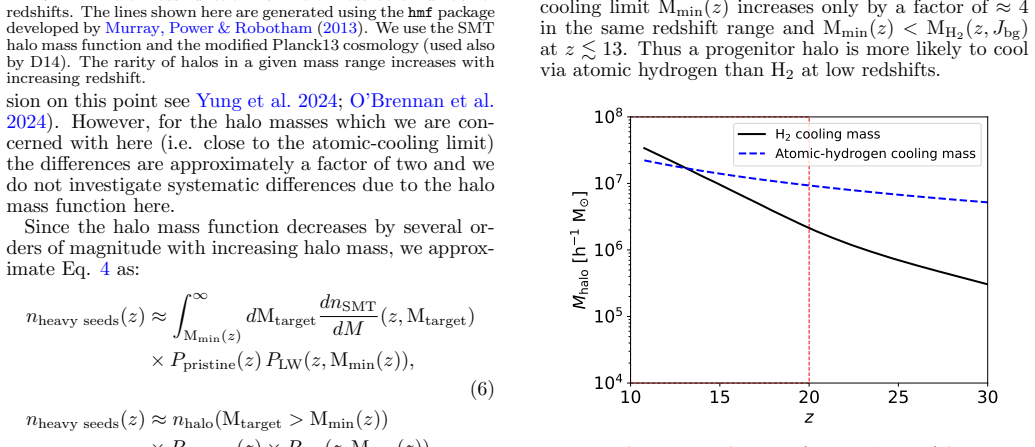
The machinery is the LW heavy-seed number-density integral, $$n_{\mathrm{heavy}}(z) = \int_{M_{\min}(z)}^\infty dM\,\frac{dn}{dM}\,P_{\mathrm{pristine}}(z)\,P_{\mathrm{LW}}(z, M),$$ which counts atomic-cooling halos that are simultaneously metal-free and bathed in supercritical LW flux. The paper evaluates $P_{\mathrm{pristine}}$ with either the Trenti & Stiavelli genetic-pollution model or the Renaissance pristine fraction, and evaluates $P_{\mathrm{LW}}$ by integrating over neighboring halo masses and separations, assigning each neighbor a lognormal LW luminosity and requiring the summed flux to exceed a critical value $J_{\mathrm{crit}}$ (300 or 1000 $J_{21}$). The new element is replacing the analytic mean LW luminosity with Renaissance measurements, which removes the artificial redshift growth in the analytic luminosity and yields the steeper, lower-density predictions.
What would settle it
A direct test is to measure, in a radiation-hydrodynamic simulation or a deep survey, the fraction of atomic-cooling halos at $z \approx 10$--$12$ that are simultaneously metal-free ($Z < 10^{-16}\,Z_\odot$) and bathed in $J > 300\,J_{21}$: if that joint fraction substantially exceeds the product of the separate probabilities, the paper's LW-only densities are underestimates. A robust JWST census of $z \approx 4$--$7$ AGN that, after duty-cycle and growth corrections, requires more than $10^{-4}\,\mathrm{cMpc}^{-3}$ seeds would confirm the incompatibility claim.
Extended reading notes
Core claim
The paper's central claim is that the Lyman-Werner-only pathway is very unlikely to be the dominant route to the massive black holes seen at high redshift. In the fiducial analytic model, following the method of Dijkstra, Ferrara & Mesinger (2014), the heavy-seed number density stays near or below $10^{-6}\,\mathrm{cMpc}^{-3}$ at $z = 10$; when the analytic model is augmented with mean LW luminosity densities and pristine fractions from the Renaissance simulations, the peak rises to roughly $10^{-4}\,\mathrm{cMpc}^{-3}$ at $z \sim 10$--$12.5$. Even that optimistic peak, once converted from seeds to active black holes through growth requirements and AGN duty cycles, falls short of the $\gtrsim 10^{-4}\,\mathrm{cMpc}^{-3}$ AGN densities inferred from recent JWST observations of Little Red Dots. The paper therefore concludes that the LW-only channel is likely incompatible with JWST and can account for only a modest fraction of high-$z$ AGN, with rapid-assembly and streaming-velocity channels appearing better positioned.
Load-bearing premise
The calculation multiplies the probability that a halo is metal-free by the probability that it receives a supercritical Lyman-Werner flux, treating those two conditions as independent; if strong radiation actually helps keep halos pristine by suppressing star formation in their progenitors, the predicted seed density could be higher.
Editorial extensions
If this is right
- If the LW-only channel peaks at about $10^{-4}$ cMpc$^{-3}$ before growth and duty-cycle corrections, then it cannot by itself supply the AGN population JWST sees, so other heavy-seed channels must dominate.
- The fiducial analytic model, at about $10^{-6}$ cMpc$^{-3}$ at $z = 10$, is two orders of magnitude below the inferred AGN density and is effectively ruled out as a dominant channel.
- Channels that predict roughly $10^{-2}$ cMpc$^{-3}$, such as rapid halo assembly and baryon-dark matter streaming velocities, are more consistent with JWST if their seed formation criteria hold.
- Any high-redshift JWST AGN that is later confirmed to host a heavy seed would require a formation mechanism beyond external LW radiation.
- The steep decline of the Renaissance-informed seed density toward $z > 15$ means LW-only seeds are even rarer at earlier times.
Reading between the lines
- I infer that the paper's strongest vulnerability is the independence assumption in Eq. 4: if supercritical LW flux suppresses star formation in progenitor halos, the joint probability of being pristine and irradiated exceeds the product, and the LW-only density could rise. A testable extension is to measure this joint distribution directly in radiation-hydrodynamic simulations.
- I infer that the conclusion is tied to the Little Red Dot interpretation: if most LRDs turn out to be dusty star-forming galaxies rather than AGN, the required seed density drops and the LW-only channel becomes less inconsistent.
- I infer that a full test of the LW-only channel needs a coupled seed-formation and black-hole-growth model; the paper stops at seed host densities, and growth plus duty cycle could either worsen or, if growth is very efficient, partially offset the shortfall.
Editorial analysis
A structured set of objections, weighed in public.
Referee Report
Summary. This paper re-implements the Lyman-Werner (LW) channel model of Dijkstra, Ferrara & Mesinger (2014, D14) for heavy-seed massive black hole (MBH) formation, computing the comoving number density of halos that simultaneously exceed the atomic-cooling mass, remain metal-free, and receive supercritical LW flux (Jcrit = 300 or 1000 J21) over 10 ≤ z ≤ 30. The authors augment the analytic model with median LW luminosity densities and pristine fractions taken from the Renaissance simulation suite, and compare the resulting seed densities with other heavy-seed channels from the literature (Trinca et al. 2022; Chiaki et al. 2023; McCaffrey et al. 2025) and with JWST-based AGN/LRD number density estimates (Inayoshi 2025; Kokorev et al. 2024; Kocevski et al. 2024). The central claim is that the LW-only channel peaks at roughly 10^-4 cMpc^-3 at z ≈ 10–12.5 in the Renaissance-informed model and at about 10^-6 cMpc^-3 at z = 10 in the fiducial analytic model, and that after accounting for seed growth requirements and AGN duty cycles the LW-only pathway can at most contribute a small subset of the high-redshift MBH population inferred from JWST observations.
Significance. If the conclusion holds, this is a timely and useful contribution: it re-derives a widely cited heavy-seed channel with a clearly stated formalism, augments it with independent simulation inputs, and places it in a comparative frame with other channels and with JWST-based AGN densities. The calculation is not circular relative to the observations it targets: Jcrit, f*, fesc, Δ, and σ_LW are taken from prior literature, and the Renaissance inputs (median LW luminosity, pristine fraction) are extracted from an independent simulation rather than fitted to the JWST points. The predicted seed densities are also falsifiable in the sense that they are compared, without renormalization, to observed AGN densities. The paper is commendably candid about its limitations, explicitly flagging the independence assumption in Eq. 4, the absence of streaming velocities, and the failure to reproduce D14's exact numbers. The qualitative conclusion (LW-only is subdominant) is robust to the leading acknowledged uncertainty, because the independence correction is bounded by roughly 1/Ppristine, a factor of a few.
major comments (4)
- [§2.5.2 (Eq. 21), §3, Figure 8] The Renaissance-informed peak number density of about 10^-4 cMpc^-3 at z ≈ 12.5 (Jcrit = 300 J21) is an extrapolation of an uncalibrated lognormal tail, not a measured quantity. Equation 21 fixes σ_LW = 0.4, and Eqs. 8–9 integrate that lognormal beyond Jcrit = 300 J21 after inserting the Renaissance median luminosity ⟨L_LW,Ren⟩; the manuscript itself states in §3 that Renaissance “cannot capture the rare halos that experience super-critical L W radiation” at Jcrit ≳ 300 J21. Because the threshold lies several σ above the median, P_LW is exponentially sensitive to σ_LW: changing σ_LW from 0.4 to ~0.5–0.6, or biasing the median through the small Normal-region volume, can move the peak density by orders of magnitude and across the JWST comparison threshold of ~10^-4 cMpc^-3. Since this peak is the abstract's headline number and motivates the “still likely incompatible” conclusion, I request (i) an explicit sensitivity study of n_heavy_seeds(z) to σ_LW, for both the fiducial and Renaissance-informed models, and (ii) calibration of σ_LW from the actual distribution of LW luminosities at fixed halo mass in Renaissance, which is available in the simulation but currently unused. Without that calibration, the “tight limits” phrasing in §1 overstates what Eqs. 8–9 deliver.
- [§3.2, §4] The paper reports that it could not reproduce D14's results despite following the same methodology, and that it cannot locate the source of the discrepancy without D14's code. Because the fiducial model is presented as a re-implementation of D14, and the statement in §4 that the analysis “agrees very well with the D14 as we approach z = 10” is what carries the ~10^-6 cMpc^-3 value into the JWST comparison, the unexplained divergence at z ≳ 20 leaves the re-implementation unverified: with only the two curves shown, a reader cannot tell whether the difference arises from a coding error on either side or from a genuine modeling difference. I request a controlled diagnostic that varies one ingredient at a time (Eqs. 7, 12, 19, 21, 23; the mass and separation integration limits; the halo mass function) against D14's published points, or, failing that, a clear label of the fiducial curve as a “D14-like” model rather than a reproduction. The central qualitative conclusion is unlikely to change, but the verification gap should be closed or explicitly scoped.
- [§4, Eq. 4] The independence assumption behind Eq. 4 is acknowledged in §4 but is not bounded, and the bound is in fact favorable to the paper's conclusion. Because P_LW is much smaller than P_pristine in the regime of interest, the error from assuming independence is at most a factor of roughly 1/Ppristine ≈ 3–10 at z ≈ 10–12.5 (Figure 5); it therefore cannot close the ~100× gap between the fiducial 10^-6 cMpc^-3 and the JWST-informed AGN density of ~10^-4 cMpc^-3. I recommend stating this bound explicitly when the assumption is introduced, so that readers can see the acknowledged correlation effect does not threaten the qualitative conclusion.
- [Abstract, §3.2, §4] The peak redshift of the Renaissance-informed Jcrit = 300 model is quoted as z ≈ 10 in the abstract and again in §4, but as z ≈ 12.5 in §3.2; these are mutually inconsistent statements of the paper's headline result. The abstract and the body should be reconciled, and the same pass should harmonize “less than 10^-6 cMpc^-3 at z ≳ 10” (§3.2) with “approximately 10^-6 cMpc^-3 at z = 10” (§4) for the fiducial model.
minor comments (6)
- [§2.2] In the sentence beginning “From Renaissance the key quantities that can be extracted…”, the pristine fraction is labeled P_LW,Ren.(z, Mtarget); the subscript should be “pristine” to avoid collision with the supercritical-flux probability P_LW,Ren defined in §2.1.
- [Figure 8 caption] The caption's statement that the LW-only models “are unable or only very marginally able to reproduce” the JWST density is too compressed: the Renaissance-informed Jcrit = 300 points reach 10^-4 cMpc^-3 at their peak, so the caption should state that the incompatibility enters through the growth and duty-cycle step that must be applied between seed density and observed AGN density.
- [Eq. 5] Mmin(z) is written without the h^-1 convention used for other masses (e.g., Eq. 20); please make the unit conventions uniform, given the explicit statement in §2.1 that calculations use factors of h.
- [Figure 6] The Renaissance data points are medians of the redshift bins, but Eq. 21 defines µ as log10⟨L_LW(z,M)⟩. For a skewed luminosity distribution the mean and median differ; the text should specify which statistic is used for µ and comment on the difference.
- [§2.4.2, §2.5.2] The free parameters fesc = 1, f* = 0.05, and Δ = 60 in Eqs. 7 and 23 are adopted without provenance or sensitivity discussion; a sentence indicating their origin (following D14/TS09) and noting that the fiducial P_LW scales directly with f* and fesc would help the reader.
- [§3.2, §4] The argument that the Renaissance-informed 10^-4 cMpc^-3 case is “still likely incompatible” rests on an unquantified growth-and-duty-cycle step; a sentence giving even a fiducial survival fraction (e.g., a few percent of seeds reaching 10^6 M⊙ by z ~ 7) would make the verdict more concrete and falsifiable.
Circularity Check
No significant circularity: the predicted number densities are model outputs built from prior-literature parameters and independent Renaissance simulation data, not fits to the JWST benchmarks they are compared against.
full rationale
The derivation chain in Eqs. 4-23 combines: (i) the SMT halo mass function, (ii) a pristine fraction from TS07/TS09 or Renaissance, and (iii) a supercritical LW probability constructed from a lognormal scatter sigma_LW=0.4 (Eq. 21, from D08), mean LW luminosities from D14/Starburst99 or Renaissance (Fig. 6), and a threshold Jcrit=300 J21 taken from the prior literature. None of these inputs is adjusted to reproduce the JWST/AGN number densities plotted in Fig. 8; the Inayoshi (2025), Kokorev et al. (2024), and Kocevski et al. (2024) curves are external comparison benchmarks, not fitting targets. The central negative conclusion (LW-only density below ~10^-6 cMpc^-3 at z~10) already follows from the fiducial D14-style analytic model, so it does not depend on the Renaissance-informed branch. The Renaissance augmentation raises the peak to ~10^-4 cMpc^-3, still below the JWST-based estimates once seed growth and AGN duty cycles are included. Self-citations (Renaissance suite; McCaffrey et al. 2025; O'Brennan et al. 2024) provide data or comparison points, but are not used as a uniqueness theorem or to forbid alternative channels, and the same conclusion is supported by the independent D14 model and by external Trinca et al. (2022) and Chiaki et al. (2023) curves. The paper's own flagged weakness, multiplying Ppristine and PLW in Eq. 4 as if independent, is a physical modeling assumption acknowledged in Sec. 4, not a circular reduction. The exponential sensitivity of the Eq. 21 lognormal tail to sigma_LW=0.4 and the fact that Renaissance itself contains no supercritical halos are robustness/correctness concerns about extrapolation, not evidence that the prediction is equivalent to its inputs by construction.
Assumptions & free parameters
free parameters (5)
- Jcrit =
300 J21 (fiducial), also 1000, 30, 1 J21
- f_* =
0.05
- sigma_LW =
0.4
- Delta =
60
- fesc =
1
assumptions (5)
- standard math The Sheth-Mo-Tormen halo mass function and bias apply at z = 10 to 30 for the relevant mass range.
- domain assumption The Renaissance Normal region is representative of mean cosmic density.
- domain assumption A halo being metal-free and receiving supercritical LW flux are independent events.
- domain assumption All target halos at redshift z have mass Mmin(z) when computing PLW.
- domain assumption Star formation and supernovae in neighboring halos begin simultaneously with the onset of target halo collapse.
Cite this review
Pith. "Pith review of Predicting the number density of heavy seed massive black holes due to an intense Lyman-Werner field." pith.science (2026). https://pith.science/paper/MDTY3KYQ
@misc{pith2026250200574,
  author       = {Pith},
  title        = {Pith review of: Predicting the number density of heavy seed massive black holes due to an intense Lyman-Werner field},
  year         = {2026},
  howpublished = {\url{https://pith.science/paper/MDTY3KYQ}},
  note         = {Machine review of arXiv:2502.00574}
}
abstract
The recent detections of a large number of candidate active galactic nuclei at high redshift (i.e. $z \gtrsim 4$) has increased speculation that heavy seed massive black hole formation may be a required pathway. Here we re-implement the so-called Lyman-Werner (LW) channel model of Dijkstra et al. (2014) to calculate the expected number density of massive black holes formed through this channel. We further enhance this model by extracting information relevant to the model from the $\texttt{Renaissance}$ simulation suite. $\texttt{Renaissance}$ is a high-resolution suite of simulations ideally positioned to probe the high-$z$ Universe. Finally, we compare the LW-only channel against other models in the literature. We find that the LW-only channel results in a peak number density of massive black holes of approximately $\rm{10^{-4} \ cMpc^{-3}}$ at $z \sim 10$. Given the growth requirements and the duty cycle of active galactic nuclei, this means that the LW-only is likely incompatible with recent JWST measurements and can, at most, be responsible for only a small subset of high-$z$ active galactic nuclei. Other models from the literature (e.g. rapid assembly; relative velocities between baryons and dark matter) seem therefore better positioned, at present, to explain the high frequency of massive black holes at high $z$.
Figures


Figures from the paper (5 more)


Forward citations
Cited by 3 Pith papers
-
The Emergence and Ionizing Feedback of Pop III.1 Stars as Progenitors for Supermassive Black Holes
Radiation-hydro simulations show Pop III.1 stars ionize bubbles of about 1 cMpc, which sets an isolation distance that yields n_SMBH ~ 10^-1 cMpc^-3 by z=14.
-
The Evolution of Pop III.1 Protostars Powered by Dark Matter Annihilation. I. Fiducial model and first results
WIMP annihilation heating above roughly 5e14 GeV/cm3 can keep primordial protostars cool and inflated, letting them grow past 1e5 solar masses and form heavy black hole seeds.
-
Flash Ionization of the Early Universe by Pop III.1 Supermassive Stars
Pop III.1 supermassive stars flash-ionize much of the early universe at z~20-30, adding tau~0.04 to the CMB optical depth and potentially easing Hubble tension and DESI anomalies.
Reference graph
Works this paper leans on
-
[1]
Agarwal B., Khochfar S., 2015, , 446, 160
work page 2015
-
[2]
Agarwal B., Smith B., Glover S., Natarajan P., Khochfar S., 2016, , 459, 4209
work page 2016
- [3]
-
[4]
Ba \ n ados E. et al. , 2018, , 553, 473
work page 2018
-
[5]
Barkana R., Loeb A., 2001, Physics Reports, 349, 125
work page 2001
-
[6]
Brummel-Smith C. et al. , 2019, The Journal of Open Source Software, 4, 1636
work page 2019
-
[7]
Bryan G. L., Norman M. L., O'Shea B. W., Abel T., Wise J. H., Turk M. J., The Enzo Collaboration , 2014, , 211, 19
work page 2014
-
[8]
Chen P., Wise J. H., Norman M. L., Xu H., O'Shea B. W., 2014, , 795, 144
work page 2014
Show all 75 references
-
[9]
Dijkstra M., Ferrara A., Mesinger A., 2014, MNRAS, 442, 2036
2014
-
[10]
Dijkstra M., Haiman Z., Mesinger A., Wyithe J. S. B., 2008, Monthly Notices of the Royal Astronomical Society, 391, 1961
2008
-
[11]
L., Haiman Z., Li M., 2014, , 439, 3798
Fernandez R., Bryan G. L., Haiman Z., Li M., 2014, , 439, 3798
2014
-
[12]
Galli D., Palla F., 1998, , 335, 403
1998
-
[13]
Greene J. E. et al. , 2024, , 964, 39
2024
-
[14]
E., Strader J., Ho L
Greene J. E., Strader J., Ho L. C., 2020, , 58, 257
2020
-
[15]
Habouzit M., Volonteri M., Latif M., Dubois Y., Peirani S., 2016, , 463, 529
2016
-
[16]
L., Woosley S
Heger A., Fryer C. L., Woosley S. E., Langer N., Hartmann D. H., 2003, , 591, 288
2003
-
[17]
Hirano S., Hosokawa T., Yoshida N., Kuiper R., 2017, Science, 357, 1375
2017
-
[18]
Inayoshi K., Visbal E., Haiman Z., 2020, ARA&A, in press; e-print arXiv:1911.05791, arXiv:1911.05791
2020 arXiv
-
[19]
L., 2012, in The First Galaxies, Springer Berlin Heidelberg, pp
Johnson J. L., 2012, in The First Galaxies, Springer Berlin Heidelberg, pp. 177--222
2012
-
[20]
L., 2021, , 917, 40
Kulkarni M., Visbal E., Bryan G. L., 2021, , 917, 40
2021
-
[21]
Lambrides E. et al. , 2024, arXiv e-prints, arXiv:2409.13047
2024 arXiv
-
[22]
A., Bovino S., Van Borm C., Grassi T., Schleicher D
Latif M. A., Bovino S., Van Borm C., Grassi T., Schleicher D. R. G., Spaans M., 2014, , 443, 1979
2014
-
[23]
A., Niemeyer J
Latif M. A., Niemeyer J. C., Schleicher D. R. G., 2014, , 440, 2969
2014
-
[24]
A., Whalen D
Latif M. A., Whalen D. J., Khochfar S., Herrington N. P., Woods T. E., 2022, , 607, 48
2022
-
[25]
Leitherer C. et al. , 1999, , 123, 3
1999
-
[26]
Li J. et al. , 2024, arXiv e-prints, arXiv:2403.00074
2024 arXiv
-
[27]
M., 2007, , 671, 1160
Luki \'c Z., Heitmann K., Habib S., Bashinsky S., Ricker P. M., 2007, , 671, 1160
2007
-
[28]
Lupi A., Haardt F., Dotti M., Fiacconi D., Mayer L., Madau P., 2016, , 456, 2993
2016
-
[29]
Lupi A., Haiman Z., Volonteri M., 2021, , 503, 5046
2021
-
[30]
Ma Y. et al. , 2024, arXiv e-prints, arXiv:2410.06257
2024 arXiv
-
[31]
Madau P., Haardt F., Dotti M., 2014, , 784, L38
2014
-
[32]
J., 2001, , 551, L27
Madau P., Rees M. J., 2001, , 551, L27
2001
-
[33]
R., Zwick L., Di Matteo T., 2023, arXiv e-prints, arXiv:2304.02066
Mayer L., Capelo P. R., Zwick L., Di Matteo T., 2023, arXiv e-prints, arXiv:2304.02066
2023 arXiv
-
[34]
Mayer L., Fiacconi D., Bonoli S., Quinn T., Ro s kar R., Shen S., Wadsley J., 2015, , 810, 51
2015
-
[35]
Mayer L., Kazantzidis S., Escala A., Callegari S., 2010, , 466, 1082
2010
-
[36]
R., Adamo A., 2024, arXiv e-prints, arXiv:2411.00670
Mayer L., van Donkelaar F., Messa M., Capelo P. R., Adamo A., 2024, arXiv e-prints, arXiv:2411.00670
2024 arXiv
-
[37]
McCaffrey J., Regan J., Smith B., Wise J., O'Shea B., Norman M., 2024, arXiv e-prints, arXiv:2409.16413
2024 arXiv
-
[38]
A., Prole L., 2024, arXiv e-prints, arXiv:2409.08326
Mehta D., Regan J. A., Prole L., 2024, arXiv e-prints, arXiv:2409.08326
2024 arXiv
-
[39]
Murray S., Diemer B., Chen Z., Neuhold A., Schnapp M., Peruzzi T., Blevins D., Engelman T., 2021, Astronomy and Computing, 36, 100487
2021
-
[40]
G., Power C., Robotham A
Murray S. G., Power C., Robotham A. S. G., 2013, Astronomy and Computing, 3, 23
2013
-
[41]
Y., 2012, , 747, 128
Naoz S., Yoshida N., Gnedin N. Y., 2012, , 747, 128
2012
-
[42]
Y., 2013, , 763, 27
Naoz S., Yoshida N., Gnedin N. Y., 2013, , 763, 27
2013
-
[43]
M., McQuinn M., 2012, The Astrophysical Journal, 760, 4
O'Leary R. M., McQuinn M., 2012, The Astrophysical Journal, 760, 4
2012
-
[44]
W., Wise J
O'Shea B. W., Wise J. H., Xu H., Norman M. L., 2015, , 807, L12
2015
-
[45]
A., Power C., Ward S., Brennan J., McCaffrey J., 2024, The Open Journal of Astrophysics, 7
O’Brennan H., Regan J. A., Power C., Ward S., Brennan J., McCaffrey J., 2024, The Open Journal of Astrophysics, 7
2024
-
[46]
P \'e rez-Gonz \'a lez P. G. et al. , 2024, , 968, 4
2024
-
[47]
H., Schechter P., 1974, , 187, 425
Press W. H., Schechter P., 1974, , 187, 425
1974
-
[48]
Regan J., 2022, arXiv e-prints, arXiv:2210.04899
2022 arXiv
-
[49]
Regan J., Volonteri M., 2024, The Open Journal of Astrophysics, 7, 72
2024
-
[50]
A., Visbal E., Wise J
Regan J. A., Visbal E., Wise J. H., Haiman Z., Johansson P. H., Bryan G. L., 2017, Nature Astronomy, 1, 0075
2017
-
[51]
A., Wise J
Regan J. A., Wise J. H., Woods T. E., Downes T. P., O'Shea B. W., Norman M. L., 2020, The Open Journal of Astrophysics, 3, 15
2020
-
[52]
Schauer A. T. P., Glover S. C. O., Klessen R. S., Clark P., 2021, , 507, 1775
2021
-
[53]
Schauer A. T. P., Regan J., Glover S. C. O., Klessen R. S., 2017, , 471, 4878
2017
-
[54]
L., Haiman Z., 2010, Monthly Notices of the Royal Astronomical Society, 402, 1249
Shang C., Bryan G. L., Haiman Z., 2010, Monthly Notices of the Royal Astronomical Society, 402, 1249
2010
-
[55]
K., Mo H
Sheth R. K., Mo H. J., Tormen G., 2001, Monthly Notices of the Royal Astronomical Society, 323, 1
2001
-
[56]
F., 2024, , 691, A24
Shi Y., Kremer K., Hopkins P. F., 2024, , 691, A24
2024
-
[57]
D., Regan J
Smith B. D., Regan J. A., Downes T. P., Norman M. L., O'Shea B. W., Wise J. H., 2018, , 480, 3762
2018
-
[58]
L., Li M., 2014, , 439, 1092
Tanaka T. L., Li M., 2014, , 439, 1092
2014
-
[59]
Trenti M., Stiavelli M., 2007, , 667, 38
2007
-
[60]
Trenti M., Stiavelli M., 2009, , 694, 879
2009
-
[61]
Trinca A., Schneider R., Valiante R., Graziani L., Ferrotti A., Omukai K., Chon S., 2024, , 529, 3563
2024
-
[62]
Trinca A., Schneider R., Valiante R., Graziani L., Zappacosta L., Shankar F., 2022, , 511, 616
2022
-
[63]
M., 2011, , 418, 906
Tseliakhovich D., Barkana R., Hirata C. M., 2011, , 418, 906
2011
-
[64]
Tseliakhovich D., Hirata C., 2010, , 82, 083520
2010
-
[65]
C., More S., Cacciato M., Mo H., Yang X., 2013, , 430, 725
van den Bosch F. C., More S., Cacciato M., Mo H., Yang X., 2013, , 430, 725
2013
-
[66]
H., Regan J
Wise J. H., Regan J. A., O'Shea B. W., Norman M. L., Downes T. P., Xu H., 2019, , 566, 85
2019
-
[67]
L., 2011, , 418, 838
Wolcott-Green J., Haiman Z., Bryan G. L., 2011, , 418, 838
2011
-
[68]
H., Norman M
Xu H., Ahn K., Wise J. H., Norman M. L., O'Shea B. W., 2014, , 791, 110
2014
-
[69]
L., O'Shea B
Xu H., Norman M. L., O'Shea B. W., Wise J. H., 2016, , 823, 140
2016
-
[70]
H., Norman M
Xu H., Wise J. H., Norman M. L., 2013, , 773, 83
2013
-
[71]
Yoshida N., Abel T., Hernquist L., Sugiyama N., 2003, , 592, 645
2003
-
[72]
Yung L. Y. A., Somerville R. S., Finkelstein S. L., Wilkins S. M., Gardner J. P., 2023, arXiv e-prints, arXiv:2304.04348
2023 arXiv
-
[73]
S., 2023, , 518, 2076
Zwick L., Mayer L., Haemmerl \'e L., Klessen R. S., 2023, , 518, 2076
2023
-
[74]
, " * write output.state after.block = add.period write newline
ENTRY address author booktitle chapter edition editor howpublished institution journal key month note number organization pages publisher school series title type volume year label extra.label sort.label short.list INTEGERS output.state before.all mid.sentence after.sentence a...
-
[75]
write newline
" write newline "" before.all 'output.state := FUNCTION n.dashify 't := "" t empty not t #1 #1 substring "-" = t #1 #2 substring "--" = not "--" * t #2 global.max substring 't := t #1 #1 substring "-" = "-" * t #2 global.max substring 't := while if t #1 #1 substring * t #2 gl...
Reviewed August 9, 2026 · model on record in the stance chip above.
Discussion (0). Continue with ORCID to comment.