REVIEW 4 major objections 5 minor 33 references
BEEM: Boosting Performance of Early Exit DNNs using Multi-Exit Classifiers as Experts
T0 review · 4 major / 5 minor · reviewed 2026-08-09 · deepseek-v4-flash
Pith's one-line read BEEM speeds up early-exit DNNs by 1.5x to 2.1x while keeping accuracy at or above the full model.
desk verdict A genuinely new early-exit decision rule, but the noisiness of the accuracy results and a shaky proof mean the strongest claims need revision. read the letter →
The pith
A machine-rendered reading of the paper's core claim, the machinery that carries it, and where it could break.
The reading
What carries the argument
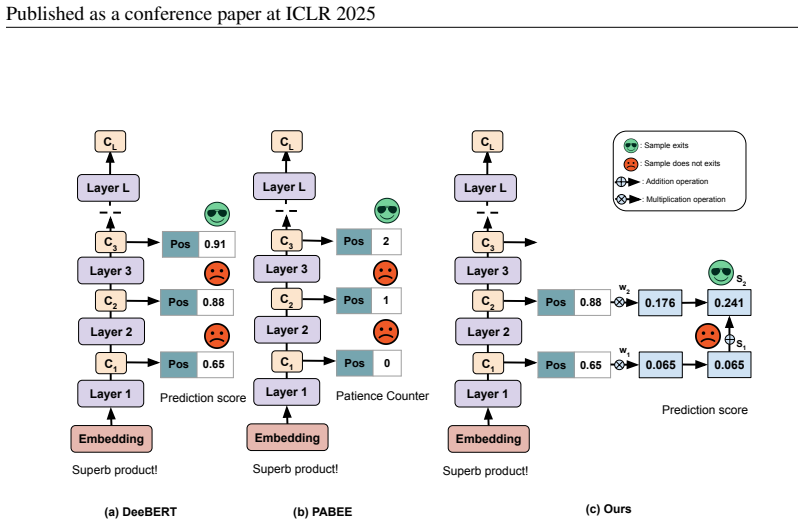
The central object is the recursive weighted confidence score S_i from Eq. (2): S_i = S_{i-1} + w_i C_i if exit i agrees with exit i-1, otherwise S_i = w_i C_i, with C_i the maximum softmax probability and w_i a per-exit weight. This score fuses confidence and patience: it accumulates evidence from agreeing experts and discards the accumulated evidence the moment an expert disagrees, so a string of low-confidence but consistent predictions can still trigger an exit. The second load-bearing piece is the threshold-selection program in Eq. (3), which minimizes α_t over a small candidate set subject to the constraint that the validation error rate q_{α_t} stays at or below the final layer's error rate p; Theorem 3.1 gives the theoretical condition under which such per-exit error rates make BEEM's total error smaller than p.
What would settle it
A concrete falsifying observation: on a held-out or shifted test set, compute each exit's actual error rate q_t and the final layer's error rate p; if some exit with substantial traffic has q_t > p, the accuracy guarantee in Theorem 3.1 is violated for that exit. More directly, if BEEM's test accuracy on COCO or any GLUE task falls measurably below the final layer's accuracy while the speedup remains at the claimed 1.5x–2.1x level, the paper's central claim that accuracy is comparable or better would be contradicted.
Extended reading notes
Core claim
The central claim is that BEEM outperforms existing early-exit methods in both speed and accuracy by combining confidence with consistency in the exit decision. At each exit i, the weighted confidence score S_i is defined recursively: S_i = S_{i-1} + w_i C_i when the i-th classifier's predicted label matches the previous one, and S_i = w_i C_i otherwise, where C_i is the maximum softmax probability and w_i is a weight based on the exit's validation accuracy or processing cost. A sample exits when S_i exceeds a threshold α. The authors prove in Theorem 3.1 that if each exit's error rate q_i satisfies a stated bound involving the final layer's error rate p, then BEEM's overall error probability is below p, meaning it beats the final layer; the threshold-selection program in Eq. (3) enforces this condition on the validation set by choosing the smallest threshold with q_{α_t} ≤ p. Experiments on GLUE and COCO confirm the speedups and accuracy claims, including the finding that accuracy improves on easier NLP tasks due to reduced overthinking.
Load-bearing premise
The load-bearing premise is that thresholds chosen on the validation set to keep each exit's error rate at or below the final layer's error rate will continue to do so on the test distribution; the paper's own Limitations section notes that for image captioning this transfer can fail, and indeed BEEM's accuracy on COCO is slightly below the final layer.
Editorial extensions
If this is right
- BEEM's exit rule can be plugged into an already trained multi-exit network without retraining the backbone, since it only changes how exit decisions are made and how thresholds are set.
- The error-rate-constrained threshold selection removes the need for ad-hoc accuracy-based threshold tuning and gives each exit an individually calibrated exit point.
- Because accuracy-based weights assign larger weights to deeper exits, BEEM naturally exploits the increasing reliability of later layers, which should make the method increasingly effective on larger overparameterized models.
- Theorem 3.1's bound supplies a per-exit diagnostic: for any trained multi-exit network one can measure q_i, a_i, and b_i on a validation set and check which exits satisfy the inequality, identifying exits that cannot support early exiting under the guarantee.
Reading between the lines
- The consistency-reset update in Eq. (2) resembles a change-point detector: a disagreement with the previous exit resets the accumulated evidence, which may make BEEM naturally robust to a single unreliable classifier; the paper does not analyze this robustness directly, but it follows from the mechanism.
- Because the threshold optimization only needs per-exit error rates on a validation set, the same scheme could be applied to other adaptive-inference designs such as layer skipping or learned routing, where per-exit error rates can also be estimated.
- The reported speedups assume batch size 1 inference; under batched serving or with tensor-core accelerators, early exiting may yield smaller end-to-end speedups because it prevents dense layer computation and reduces utilization, so the 1.5x–2.1x figures are specific to the per-instance setting.
- On tasks with substantial distribution shift, accuracy-based weights (BEEM-A) may become stale because they are estimated on the validation distribution; cost-based weights (BEEM-C) sacrifice some accuracy but may be more stable, a trade-off implicit in the paper's COCO results where validation-selected thresholds do not fully transfer.
Editorial analysis
A structured set of objections, weighed in public.
Referee Report
Summary. The paper proposes BEEM, an early-exit decision rule for multi-exit DNNs. Instead of relying on a single exit's confidence or a patience counter, BEEM accumulates confidence scores from neighboring exit classifiers that agree on the predicted label, weights those scores by cost or validation accuracy, and resets the accumulated score when consecutive classifiers disagree. Thresholds are chosen per exit by solving a small optimization problem (Eq. 3) that minimizes the threshold subject to the validation error rate of exiting samples being no worse than the final classifier's error rate. A theorem (Thm. 3.1) is stated giving a sufficient condition, in terms of exit error rates and agreement statistics, for BEEM's error to be below the final layer's. Experiments on GLUE tasks with ALBERT/BERT backbones and COCO image captioning with Swin+GPT-2 report speedups of roughly 1.5-2.1x over full inference and accuracy close to or slightly above the final layer, with source code released.
Significance. If the empirical claims hold, BEEM is a simple and practical improvement over existing early-exit criteria: it exploits agreement among exits and provides a threshold-selection rule that can be implemented on top of any multi-exit network, and the public code is a useful asset. The idea of treating exits as experts and resetting the accumulated score on disagreement is clean and easy to adopt. However, the manuscript currently does not establish the headline claims at the required statistical standard: the reported accuracy margins over baselines are within a few test examples, no uncertainty intervals are given, and the theoretical guarantee rests on a proof with unjustified probabilistic bounds. The contribution is therefore promising but not yet fully supported.
major comments (4)
- [Section 4.1 and Tables 1-3] All accuracy and speedup numbers in Tables 1-3 are reported as medians over 5 seeds with no standard deviations, confidence intervals, or paired significance tests, even though Section 4.1 explicitly notes that small datasets such as CoLA and RTE have high variance. Several of the claimed advantages are tiny: BEEM-A is +0.4 on SST-2, +0.3 on CoLA, +0.2 on RTE (test), and +0.5 on QNLI, while on COCO the BLEU-4 of 42.1 is below the final layer's 42.3. On the RTE dev set (n=277) a 0.7-point gap is about two examples. Without uncertainty quantification, the abstract's claim that BEEM 'enhances the performance of state-of-the-art EE methods' and improves on the final layer is not statistically supported. Please add per-seed results, standard deviations or bootstrap confidence intervals, and paired significance tests (e.g., McNemar or Wilcoxon) for at least the main comparisons.
- [Appendix A.1 and Section 3.5] The proof of Theorem 3.1 contains unjustified steps. In bounding P(Xt=1|mc), the proof writes '< t A0_t q1 q2 ... qt' and in bounding P(Xt=1|cc) writes '> t A1_t q1 q2 ...(1-qt)', which multiplies the error probabilities of previous classifiers as if they were independent and as if the event of exiting at t were independent of those errors; no justification is given for either step. In addition, A0_t and A1_t are defined as P(Xt=1|Ct=0) and P(Xt=1|Ct=1), and these probabilities depend on the thresholds alpha, contradicting the statement in Section 3.5 that the theorem 'does not depend on the threshold values α'. The proof is also restricted to binary classification while the theorem is stated without that restriction. The theorem and proof need to be repaired with correct conditioning arguments or qualified as a heuristic condition.
- [Section 3.4 and Section 8] Section 3.4 states that if the condition c_misc/c_stop < p holds for every exit then 'we are guaranteed that BEEM can outperform the final classifier', and Eq. 3 selects the smallest threshold satisfying this on the validation set. This is a fitting procedure on validation data: the 'guarantee' is enforced by construction on the validation distribution and does not transfer to test data unless the validation error rates are stable. The paper's own Section 8 concedes that on COCO the validation thresholds 'might not generalize well on the test dataset', which is exactly the failure mode that would invalidate the guarantee. Please state the guarantee as conditional on the validation set and provide evidence (e.g., threshold stability across seeds or calibration plots) that it transfers. Also, the definition of c_misc in Section 3.4 appears to already divide by c_stop, making the subsequent ratio c_misc/c_stop ambiguous; please clarify the intended definition.
- [Abstract and Section 4] The abstract says BEEM 'enhances the performance of state-of-the-art EE methods, achieving improvements in speed-up by a factor 1.5x to 2.1x'. In Tables 1-3, however, the speed-up column is the acceleration factor relative to full inference (1.00x), not an improvement factor over the EE baselines. Relative to the strongest baselines, the speed-up gains are typically 5-20% (e.g., 1.98x vs. PABEE's 1.87x on SST-2), not 1.5-2.1x. Please rephrase the abstract and contributions to avoid the impression that BEEM is 1.5-2.1x faster than prior EE methods.
minor comments (5)
- [Section 3.4] The threshold search spaces are inconsistent: the 'classical method' defines S = {0.3,0.6,0.9,1.2,1.5}, while Eq. 3 defines S = {0.5,1,...,5,L}. Please reconcile the two definitions and state which space was used in the experiments.
- [Section 3.5 and Appendix A.1] There are notational inconsistencies in the theorem and proof: the proof defines qmax_t = {q1,...,q_{t-1}} without taking a maximum, Section 3.5 defines qmax_i = max{q1,...,qi}, and the ratio b_t = qmax_t/qmin_t is undefined if qmin_t = 0. Please align the notation and state any non-degeneracy assumptions.
- [Table 5 and Section 6.2] The comparison between 'w/o fix' and 'w fix' is not fully specified: it is unclear whether 'w/o fix' uses a single constant threshold for all exits or a per-exit threshold selected by best validation accuracy. Please state the exact protocol for both variants.
- [Figure 1] In Figure 1(c), the caption shows weights = [0.1, 0.2, ..., 1.2], but the text says weights are set by cost or accuracy; please clarify which variant the figure illustrates and how the listed weights were obtained.
- [Section 4] The speed-up metric is defined as a ratio of layer counts, which is a proxy for latency. Reporting wall-clock inference times, at least for the main configurations, would strengthen the practical claims.
Circularity Check
No significant circularity: BEEM's validation-set threshold constraint intentionally targets the final-layer error rate, but the paper's central claims are evaluated on held-out test sets, and Theorem 3.1 is an independent sufficient-condition bound.
full rationale
BEEM's derivation chain is self-contained and does not reduce to its own inputs. The threshold rule in Eq. (3) is an explicit constrained optimization on the validation set: 'minimize α_t subject to q_{α_t} ≤ p.' This makes 'exit error rate no worse than the final layer' true on the validation distribution by construction, and the paper is transparent about this design goal ('forcing the exit classifier to perform better than the final classifier of DNNs'). That is not a hidden circular step, because the paper's actual empirical claims are about test-set performance reported in Tables 1-3, for which the validation constraint provides no logical guarantee. The paper even acknowledges in Section 8 that for COCO the validation-set thresholds 'might not generalize well on the test dataset,' which correctly identifies the empirical risk rather than asserting a tautology. Theorem 3.1 is a separate sufficient condition, qt < at / (at + ((1/p) - 1) b_t^(t-1)), derived in Appendix A.1 from the definition of the exit process; it does not assume the conclusion and does not depend on the threshold values α. The self-citations to CeeBERT, DADEE, CapEEN, SplitEE, and I-SplitEE appear only in related-work and background context and are not load-bearing for BEEM's aggregation rule, threshold selection, or theoretical bound. The absence of error bars and the small accuracy deltas on RTE and CoLA are legitimate statistical-evidence concerns, but they concern whether the empirical claims are established, not whether the derivation is circular. No step in the paper exhibits the required pattern of a fitted parameter being renamed as a prediction or a result being forced by definition.
Assumptions & free parameters
free parameters (4)
- Thresholds alpha_t per exit =
Not reported per dataset; chosen from S={0.5,1,...,5,L} by Eq 3
- Accuracy-based weights w_i (BEEM-A) =
Validation accuracy of each exit classifier
- Cost scalar lambda (BEEM-C) =
Tuned manually; Fig 2b shows lambda in {0,0.05,0.1,0.15,0.2,0.3}
- Threshold search space S =
S = {0.5, 1, ..., 5, L}
assumptions (4)
- domain assumption Exit classifiers trained with CE plus KL distillation to the final layer yield reliable confidence scores (Section 3.1, Eq 1).
- domain assumption The speed-up metric assumes all transformer layers have equal computational cost and that exit classifiers have negligible overhead (Section 4.1).
- ad hoc to paper The proof of Theorem 3.1 treats the events of previous classifiers' errors as if their probabilities multiply, effectively assuming a form of independence (Appendix A.1).
- domain assumption The threshold optimization in Eq 3 assumes the validation error rate q_{alpha_t} is monotonic in alpha_t, so minimizing alpha_t maximizes speedup while satisfying the error constraint.
Cite this review
Pith. "Pith review of BEEM: Boosting Performance of Early Exit DNNs using Multi-Exit Classifiers as Experts." pith.science (2026). https://pith.science/paper/J2FZUJW2
@misc{pith2026250200745,
  author       = {Pith},
  title        = {Pith review of: BEEM: Boosting Performance of Early Exit DNNs using Multi-Exit Classifiers as Experts},
  year         = {2026},
  howpublished = {\url{https://pith.science/paper/J2FZUJW2}},
  note         = {Machine review of arXiv:2502.00745}
}
read the original abstract
Early Exit (EE) techniques have emerged as a means to reduce inference latency in Deep Neural Networks (DNNs). The latency improvement and accuracy in these techniques crucially depend on the criteria used to make exit decisions. We propose a new decision criterion where exit classifiers are treated as experts BEEM and aggregate their confidence scores. The confidence scores are aggregated only if neighbouring experts are consistent in prediction as the samples pass through them, thus capturing their ensemble effect. A sample exits when the aggregated confidence value exceeds a threshold. The threshold is set using the error rates of the intermediate exits aiming to surpass the performance of conventional DNN inference. Experimental results on the COCO dataset for Image captioning and GLUE datasets for various language tasks demonstrate that our method enhances the performance of state-of-the-art EE methods, achieving improvements in speed-up by a factor 1.5x to 2.1x. When compared to the final layer, its accuracy is comparable in harder Image Captioning and improves in the easier language tasks. The source code for this work is publicly available at https://github.com/Div290/BEEM1/tree/main
Figures
Reference graph
Works this paper leans on
-
[1]
Binarybert: Pushing the limit of bert quantization
Haoli Bai, Wei Zhang, Lu Hou, Lifeng Shang, Jing Jin, Xin Jiang, Qun Liu, Michael Lyu, and Irwin King. Binarybert: Pushing the limit of bert quantization. arXiv preprint arXiv:2012.15701,
arXiv 2012
-
[6]
Bert: Pre-training of deep bidirectional transformers for language understanding
Jacob Devlin, Ming-Wei Chang, Kenton Lee, and Kristina Toutanova. Bert: Pre-training of deep bidirectional transformers for language understanding. arXiv preprint arXiv:1810.04805,
-
[7]
Reducing transformer depth on demand with structured dropout
Angela Fan, Edouard Grave, and Armand Joulin. Reducing transformer depth on demand with structured dropout. arXiv preprint arXiv:1909.11556,
arXiv 1909
-
[9]
RomeBERT: Robust Training of Multi-Exit BERT
Shijie Geng, Peng Gao, Zuohui Fu, and Yongfeng Zhang. Romebert: Robust training of multi-exit bert. arXiv preprint arXiv:2101.09755,
-
[12]
Tinybert: Distilling bert for natural language understanding
Xiaoqi Jiao, Yichun Yin, Lifeng Shang, Xin Jiang, Xiao Chen, Linlin Li, Fang Wang, and Qun Liu. Tinybert: Distilling bert for natural language understanding. arXiv preprint arXiv:1909.10351,
arXiv 1909
-
[13]
Low cost early exit decision unit design for cnn accelerator
Geonho Kim and Jongsun Park. Low cost early exit decision unit design for cnn accelerator. In 2020 International SoC Design Conference (ISOCC), pp. 127–128. IEEE,
work page 2020
-
[14]
Adam: A method for stochastic optimization
Diederik P Kingma and Jimmy Ba. Adam: A method for stochastic optimization. arXiv preprint arXiv:1412.6980,
-
[15]
11 Published as a conference paper at ICLR 2025 Junnan Li, Dongxu Li, Caiming Xiong, and Steven Hoi. Blip: Bootstrapping language-image pre- training for unified vision-language understanding and generation. InInternational conference on machine learning, pp. 12888–12900. PMLR,
work page 2025
Show all 33 references
-
[16]
Microsoft coco: Common objects in context
Tsung-Yi Lin, Michael Maire, Serge Belongie, James Hays, Pietro Perona, Deva Ramanan, Piotr Doll´ar, and C Lawrence Zitnick. Microsoft coco: Common objects in context. In Computer Vision–ECCV 2014: 13th European Conference, Zurich, Switzerland, September 6-12, 2014, Proceeding...
2014
-
[18]
Towards efficient NLP: A standard evaluation and A strong baseline
Xiangyang Liu, Tianxiang Sun, Junliang He, Lingling Wu, Xinyu Zhang, Hao Jiang, Zhao Cao, Xuanjing Huang, and Xipeng Qiu. Towards efficient NLP: A standard evaluation and A strong baseline. 2021a. URL https://arxiv.org/abs/2110.07038. Xiangyang Liu, Tianxiang Sun, Junliang He,...
-
[19]
Calibration-aided edge inference offloading via adaptive model partitioning of deep neural networks
Roberto G Pacheco, Rodrigo S Couto, and Osvaldo Simeone. Calibration-aided edge inference offloading via adaptive model partitioning of deep neural networks. In ICC 2021-IEEE Interna- tional Conference on Communications, pp. 1–6. IEEE,
2021
-
[20]
Jointly-learned exit and inference for a dynamic neural network: Jei-dnn
Florence Regol, Joud Chataoui, and Mark Coates. Jointly-learned exit and inference for a dynamic neural network: Jei-dnn. arXiv preprint arXiv:2310.09163,
-
[21]
Distilbert, a distilled version of bert: smaller, faster, cheaper and lighter
Victor Sanh, Lysandre Debut, Julien Chaumond, and Thomas Wolf. Distilbert, a distilled version of bert: smaller, faster, cheaper and lighter. arXiv preprint arXiv:1910.01108,
1910 arXiv
-
[22]
The right tool for the job: Matching model and instance complexities
Roy Schwartz, Gabriel Stanovsky, Swabha Swayamdipta, Jesse Dodge, and Noah A Smith. The right tool for the job: Matching model and instance complexities. arXiv preprint arXiv:2004.07453,
2004 arXiv
-
[23]
Patient knowledge distillation for bert model compression
Siqi Sun, Yu Cheng, Zhe Gan, and Jingjing Liu. Patient knowledge distillation for bert model compression. arXiv preprint arXiv:1908.09355,
1908 arXiv
-
[24]
Early exiting with ensemble internal classifiers
Tianxiang Sun, Yunhua Zhou, Xiangyang Liu, Xinyu Zhang, Hao Jiang, Zhao Cao, Xuanjing Huang, and Xipeng Qiu. Early exiting with ensemble internal classifiers. arXiv preprint arXiv:2105.13792,
-
[25]
A simple hash-based early exiting approach for language understanding and generation
Tianxiang Sun, Xiangyang Liu, Wei Zhu, Zhichao Geng, Lingling Wu, Yilong He, Yuan Ni, Guo- tong Xie, Xuanjing Huang, and Xipeng Qiu. A simple hash-based early exiting approach for language understanding and generation. arXiv preprint arXiv:2203.01670,
-
[26]
You need multiple exiting: Dynamic early exiting for accelerating unified vision language model
12 Published as a conference paper at ICLR 2025 Shengkun Tang, Yaqing Wang, Zhenglun Kong, Tianchi Zhang, Yao Li, Caiwen Ding, Yanzhi Wang, Yi Liang, and Dongkuan Xu. You need multiple exiting: Dynamic early exiting for accelerating unified vision language model. In Proceeding...
2025
-
[27]
Branchynet: Fast inference via early exiting from deep neural networks
Surat Teerapittayanon, Bradley McDanel, and Hsiang-Tsung Kung. Branchynet: Fast inference via early exiting from deep neural networks. In 2016 23rd International Conference on Pattern Recognition (ICPR), pp. 2464–2469. IEEE,
2016
-
[28]
Alex Wang, Amanpreet Singh, Julian Michael, Felix Hill, Omer Levy, and Samuel R. Bowman. GLUE: A multi-task benchmark and analysis platform for natural language understanding. 2019a. In the Proceedings of ICLR. Meiqi Wang, Jianqiao Mo, Jun Lin, Zhongfeng Wang, and Li Du. Dynex...
2019 arXiv
-
[29]
Ternarybert: Distillation-aware ultra-low bit bert
Wei Zhang, Lu Hou, Yichun Yin, Lifeng Shang, Xiao Chen, Xin Jiang, and Qun Liu. Ternarybert: Distillation-aware ultra-low bit bert. arXiv preprint arXiv:2009.12812,
2009 arXiv
-
[30]
Pcee-bert: Accel- erating bert inference via patient and confident early exiting
Zhen Zhang, Wei Zhu, Jinfan Zhang, Peng Wang, Rize Jin, and Tae-Sun Chung. Pcee-bert: Accel- erating bert inference via patient and confident early exiting. In Findings of the Association for Computational Linguistics: NAACL 2022, pp. 327–338,
2022
-
[31]
To prune, or not to prune: exploring the efficacy of pruning for model compression
Michael Zhu and Suyog Gupta. To prune, or not to prune: exploring the efficacy of pruning for model compression. arXiv preprint arXiv:1710.01878,
-
[32]
For simplicity, we prove it for the binary classification case
A A PPENDIX A.1 P ROOF OF THEOREM 3.1 Proof. For simplicity, we prove it for the binary classification case. For the samples that are not inferred at intermediate exits, the misclassification probability will remain the same with or without 13 Published as a conference paper a...
2025
-
[33]
=P (Xt = 1|mc)P (mc) + P (Xt = 1|cc)P (cc) (7) where mc is misclassified and cc is correctly classified. The ratio is now: pmisc t pstop t = P (Xt = 1|mc)P (mc) P (Xt = 1|mc)P (mc) +P (Xt = 1|cc)P (cc) < p (8) Simplifying this, we have, P (Xt = 1|cc).P (cc) P (Xt = 1|mc).P (mc...
2025
-
[2014]
Fastbert: a self-distilling bert with adaptive inference time
Weijie Liu, Peng Zhou, Zhe Zhao, Zhiruo Wang, Haotang Deng, and Qi Ju. Fastbert: a self-distilling bert with adaptive inference time. arXiv preprint arXiv:2004.02178,
2004 arXiv
-
[2017]
Early exit with disentangled representation and equiangular tight frame
Yixin Ji, Jikai Wang, Juntao Li, Qiang Chen, Wenliang Chen, and Min Zhang. Early exit with disentangled representation and equiangular tight frame. In Findings of the Association for Com- putational Linguistics: ACL 2023, pp. 14128–14142,
2023
-
[2019]
Flexdnn: Input-adaptive on-device deep learning for efficient mobile vision
Biyi Fang, Xiao Zeng, Faen Zhang, Hui Xu, and Mi Zhang. Flexdnn: Input-adaptive on-device deep learning for efficient mobile vision. In 2020 IEEE/ACM Symposium on Edge Computing (SEC), pp. 84–95. IEEE,
2020
-
[2020]
Splitee: Early exit in deep neural networks with split computing
Divya J Bajpai, Vivek K Trivedi, Sohan L Yadav, and Manjesh K Hanawal. Splitee: Early exit in deep neural networks with split computing. arXiv preprint arXiv:2309.09195,
-
[2021]
Multi-scale dense networks for resource efficient image classification
Gao Huang, Danlu Chen, Tianhong Li, Felix Wu, Laurens Van Der Maaten, and Kilian Q Wein- berger. Multi-scale dense networks for resource efficient image classification. arXiv preprint arXiv:1703.09844,
-
[2022]
Pondernet: Learning to ponder
Andrea Banino, Jan Balaguer, and Charles Blundell. Pondernet: Learning to ponder. arXiv preprint arXiv:2107.05407,
-
[2023]
Capeen: Image captioning with early exits and knowledge distillation
Divya Jyoti Bajpai and Manjesh Kumar Hanawal. Capeen: Image captioning with early exits and knowledge distillation. arXiv preprint arXiv:2410.04433, 2024a. Divya Jyoti Bajpai and Manjesh Kumar Hanawal. Ceebert: Cross-domain inference in early exit bert. In To appear in proceed...
-
[2024]
Palbert: Teaching albert to ponder
10 Published as a conference paper at ICLR 2025 Nikita Balagansky and Daniil Gavrilov. Palbert: Teaching albert to ponder. Advances in Neural Information Processing Systems, 35:14002–14012,
2025
Reviewed August 9, 2026 · model on record in the stance chip above.
Discussion (0). Continue with ORCID to comment.