REVIEW 5 major objections 8 minor 29 references
Privacy Preserving Properties of Vision Classifiers
T0 review · 5 major / 8 minor · reviewed 2026-08-09 · deepseek-v4-flash
Pith's one-line read Architecture alone can determine how much training data a vision classifier reveals under inversion: MLPs leak most, CNNs least, ViTs in between.
desk verdict A worthwhile comparative question undermined by a single uncalibrated table; the architecture-privacy ranking is plausible but not demonstrated. read the letter →
The pith
A machine-rendered reading of the paper's core claim, the machinery that carries it, and where it could break.
The reading
What carries the argument
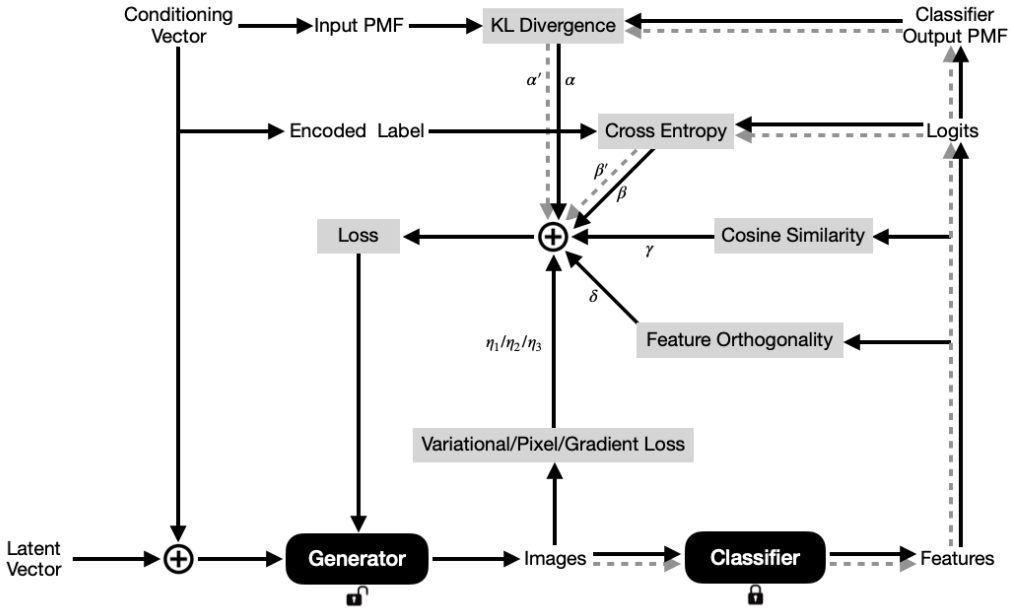
The central object is the Vector-Matrix Conditioned Generator, a generator network that takes a latent vector plus a softmaxed random label vector and an N by N hot conditioning matrix, and is trained to produce images that the frozen classifier maps to the conditioned label. The inversion loss combines KL divergence and cross-entropy between classifier outputs and the conditioning distribution, cosine-similarity and feature-orthogonality terms across a batch, and variational, pixel-bound, and gradient-norm penalties; perturbed versions of the images are also pushed through the same KL and cross-entropy terms. These terms operationalize three assumed properties of real training data: high classifier confidence, stability under small perturbations, and low loss-gradient norms, so that the generator is steered toward training-like inputs. SSIM against the closest training image then serves as the privacy meter.
What would settle it
Run the identical inversion pipeline but score each reconstruction against three references: the nearest true training image, the class-conditional average image, and a random held-out image from the same dataset; if the similarity against class averages or random images is as high as the similarity against training images, the reported architecture ranking is a property of the generator and metric, not of memorization. A second check is to retrain each architecture with several random seeds and verify that the MLP greater-than ViT greater-than CNN ordering is stable within error bars on every dataset.
Extended reading notes
Core claim
The central claim is that the privacy risk of a vision classifier is written into its architecture, not just its training data or regularization. Using a conditioned generator that inverts each trained classifier with no auxiliary data, no knowledge of the training process, and access only to the trained weights, the paper measures how closely reconstructions match the nearest real training image by SSIM. Across the four datasets, MLP reconstructions score highest (0.83, 0.74, 0.71, 0.65), CNN reconstructions score lowest on three of the four datasets (0.73, 0.63, 0.58, and 0.69 on SVHN, where CNN is marginally above ViT's 0.68), and ViTs generally fall between them. The authors attribute MLP leakage to fully connected layers giving each pixel dedicated weights and lacking spatial priors, ViT leakage to self-attention retaining global spatial detail without pooling, and CNN resistance to weight sharing, local receptive fields, and pooling that discard input-specific detail. The conclusion is a ranking of inversion risk: MLPs greater than ViTs greater than CNNs.
Load-bearing premise
The ranking rests on the assumption that a high similarity score between a reconstructed image and its nearest training image measures how much the classifier memorized its training set, rather than how the generator's own biases, the loss penalties, or the matching rule shape the output.
Editorial extensions
If this is right
- If the ranking holds, releasing an MLP-based vision classifier carries a higher reconstruction risk than releasing a CNN of similar task performance, all else equal.
- Privacy-sensitive applications can treat architecture as a first-line defense, making CNNs the safer default among the three families tested.
- ViTs occupy a middle ground and should not be assumed safe simply because they are not fully connected, since their lack of pooling preserves spatial detail that inversion can exploit.
- The same attack protocol can serve as a benchmark to compare privacy across future architectures and to test defenses such as differential privacy and regularization.
Reading between the lines
- Editorial inference: the ranking is measured on small, trained-from-scratch classifiers; extending the same protocol to large pretrained models could change it, since pretraining transfers generic features rather than dataset-specific memorization.
- Editorial inference: because the generator is itself a network with inductive biases, the SSIM gap might partly reflect how easily each classifier's decision surface can be mimicked rather than how much raw training data is stored; a baseline comparing reconstructions against class averages would separate those effects.
- Editorial inference: if the architectural ordering is real, model documentation could report an inversion-resistance score alongside accuracy, letting users choose between utility and leakage risk without running attacks themselves.
- Editorial inference: combining this reconstruction protocol with differentially private training would make the privacy comparison quantitative, showing which architecture wastes less utility for the same privacy budget.
Editorial analysis
A structured set of objections, weighed in public.
Referee Report
Summary. This manuscript claims to establish an architecture-level privacy ranking for vision classifiers. The authors train one MLP, one CNN, and one ViT on each of MNIST, FashionMNIST, SVHN, and CIFAR-10, then train a conditioned generator with a nine-term reconstruction loss (Section III.E) to invert each classifier and synthesize images it classifies confidently. Reconstruction fidelity is measured by SSIM between each generated image and its closest training-set image, reported in Table I as a single value per dataset and architecture. From these twelve values the paper concludes that MLPs memorize the most training detail and are the least privacy-preserving, CNNs memorize the least and are the most privacy-preserving, and ViTs lie in between, with the practical implication that architectural choice alone determines vulnerability to weights-only model inversion.
Significance. The question the paper asks — whether architecture families differ systematically in exposure to weights-only inversion attacks — is timely and well-motivated for model-sharing practice, and the threat model is stated cleanly: end-of-training weights, no auxiliary data, no training-process knowledge, a single white-box model. Using four datasets and three architecture families with a falsifiable quantitative ranking is a sensible design. These are real strengths, but they are programmatic; the manuscript does not establish the ranking. All quantitative conclusions rest on Table I, which reports no variance, no statistical test, no baseline controls, and no comparison with established reconstruction attacks ([17], [18] are cited but never used as comparators). The main conclusion is further weakened by an internal contradiction in Table I and by a generator objective (Section III.E) whose own regularization terms plausibly produce the reported SSIM pattern. The contribution is best read as a promising research direction rather than a supported empirical result.
major comments (5)
- [Table I and Section IV] The paper's principal conclusion that 'CNNs show the lowest SSIM values across all datasets' (Section IV, discussing Table I) is contradicted by the SVHN row of Table I itself: MLP 0.71, ViT 0.68, CNN 0.69, so on SVHN the ViT is strictly lower than the CNN. The related claim that ViTs 'remain slightly higher than CNNs' also fails on this row. Because the CNN-lowest ordering is half of the paper's headline result, the paper must correct these statements or explain why SVHN does not follow the claimed pattern; as written, the conclusion is inconsistent with the evidence reported.
- [Table I and Section III.E] Each cell of Table I is a single point estimate: no standard deviation, no number of runs or seeds, and no statistical test, and only one network per architecture is trained per dataset. The differences that support the ranking are small (SVHN: 0.71 vs 0.69 vs 0.68; CIFAR-10: 0.62 vs 0.58), so without repeated training runs and a significance test the architecture ordering is indistinguishable from noise. The paper also never reports classifier accuracy, parameter counts, or training configurations; because the three architectures may sit at different points on the overfitting-generalization spectrum, and an overfit model is easier to invert, the comparison does not control for this confound.
- [Section III.A and Section III.E] The load-bearing premise that SSIM between a generated image and its closest training image measures classifier memorization is never validated. Section III.A itself concedes that standard inversion 'does not necessarily yield images resembling actual training samples' and that the modified procedure is built to 'incentivize' training-like data; LRecon includes pixel-range, total-variation, low-gradient, and confidence terms, so reconstructions will tend to be smooth, confident class prototypes. SSIM is sensitive to luminance, contrast, and structure, and a smooth generic prototype scores low against any particular training image; consistent with this, the qualitative CNN reconstructions in Figure 2 appear blurrier, which alone could produce lower CNN SSIM scores without lower memorization. The paper provides no controls — SSIM of reconstructions against class-mean images, against held-out or random images, against an untrained classifier's inversions, or a comparison with an established attack such as [17] or [18] — so the measured ranking cannot be attributed to the classifiers' retention of training data.
- [Sections III.B and III.C] The inversion protocol is not matched across architectures: MLPs are inverted via flattened inputs and penultimate-layer features, ViTs via [CLS] token embeddings, and CNNs via post-flatten features, and Section III.C leaves unspecified how the softmaxed conditioning vectors and the N×N hot conditioning matrix attach to each architecture's feature space. The measured SSIM ranking therefore conflates architectural properties with the inversion pipeline; the paper needs either to calibrate the three procedures against each other (for example, by checking that conditioning strength and feature dimensionality are comparable) or to treat the protocol as an additional variable in the comparison.
- [Section III.E and experiments section] The results are not reproducible as reported. None of the nine hyperparameters of LRecon (α, α′, β, β′, γ, δ, η1, η2, η3) is given a value; the generator's depth, width, and training regime are not specified; the classifier training details are absent; and the procedure for selecting the 'closest' training image for the SSIM computation (matching metric, number of reconstructions per class) is not described. With a nine-term weighted loss, the single-table ranking could be dominated by the chosen hyperparameter configuration, so a sensitivity analysis across reasonable hyperparameter values and repeated runs is required before any architecture-level claim is made.
minor comments (8)
- [Section I] CNNs are cited as [1] and ViTs as [2], but in the bibliography [1] is Dosovitskiy et al. (the ViT paper) and [2] is O'Shea and Nash (the CNN survey); the citation markers appear to be reversed.
- [References] References [13] and [19] are the same paper (Wang, Lee, and Lei, 'Reconstructing training data from model gradient, provably') listed twice with slightly different author strings; one entry should be removed and the in-text citations unified.
- [Section III.D] Equations (1)–(3) state informal inequalities using '≫' that are never directly verified; the text should tie each inequality to the specific loss term (LKL, LpertKL, LpertCE, LGrad) it is meant to motivate.
- [Section III.E] In the LOrtho definition, the Gram matrix G is never specified (Gram matrix of which features, and over which batch), and N is used both as the number of feature vectors in a batch and as the number of classes in the N×N conditioning matrix, which collides within one equation block.
- [Section III.C] The Hot Conditioning Matrix construction should be made precise: it is not clear whether setting 'a specific row or column' to 1 means the whole row and the whole column of the N×N matrix are ones, and at which layer this matrix is concatenated with the upsampled feature map.
- [Section III.E] The displayed formulas for LVar and LPix are incomplete: the sums over h and w lack explicit ranges, and LPix sums over all pixels without an index; the formulas should be completed and the pixel bounds stated.
- [Experiments] The SSIM matching procedure should state how many reconstructions are generated per class and how the 'closest' training image is selected (nearest neighbor in which representation and with which distance).
- [Figure 2] The figure caption does not state which dataset the qualitative samples come from; please name the dataset and ensure identical normalization across the three architecture columns.
Circularity Check
Architecture ranking rests on the authors' own unvalidated inversion method; the SSIM comparison itself is not a fitted tautology.
-
self citation load bearing
[Section II (Related Works), Section III-A (Methodology Overview), and References [3], [15], [22], [23]]
"In this paper, we build upon prior work on network inversion and training data reconstruction. Drawing from works like [22] and [23], we employ network inversion methods to understand the internal representations of neural networks and the patterns they memorize during training. ... To perform network inversion and data reconstruction, we build upon the methodology introduced in [22], [23], which has primarily focused on CNN-based classifiers."
The entire empirical measurement of memorization rests on the assertion that the authors' own inversion procedure reconstructs training-like data and thereby quantifies privacy leakage. That assertion is supported only by self-citations ([3], [15], [22], [23]) with no external validation, no independent baseline, and no machine-checked or reproduced implementation cited. The architecture ranking (MLP > ViT > CNN in SSIM) is generated by this self-cited method; if the cited methodology does not actually recover training data, the central conclusion has no independent support. Thus the load-bearing premise reduces to trust in the authors' prior claims rather than to evidence presented in this paper.
full rationale
The paper reports a new empirical table (Table I) comparing SSIM across architectures, and the ranking is not fitted to the conclusion, so the central claim is not a tautology. However, the measurement instrument is taken wholesale from the authors' own prior papers and is not independently verified; the loss function's assumptions about training-data properties (equations 1-3) are asserted rather than validated, and no baseline (e.g., SSIM against random or class-averaged images) is provided. These are validity threats, but they do not rise to the level of 'prediction equals fit by construction' because the generator objective does not directly optimize SSIM to training images. The appropriate circularity score is 4: non-trivial self-citation load-bearing, but with independent table content.
Assumptions & free parameters
free parameters (3)
- Loss hyperparameters (alpha, alpha', beta, beta', gamma, delta, eta1, eta2, eta3) =
Not reported
- Generator architecture details =
Not reported
- Classifier architecture hyperparameters =
Not reported
assumptions (3)
- domain assumption SSIM to the closest training-set image is a valid proxy for privacy leakage
- domain assumption The inversion generator converges to samples that reflect classifier memorization rather than generator bias
- domain assumption All three classifiers were trained to comparable accuracy under comparable conditions
invented entities (2)
-
Hot Conditioning Matrix
-
Vector-Matrix Conditioning scheme
Cite this review
Pith. "Pith review of Privacy Preserving Properties of Vision Classifiers." pith.science (2026). https://pith.science/paper/ZWVTJ2GX
@misc{pith2026250200760,
  author       = {Pith},
  title        = {Pith review of: Privacy Preserving Properties of Vision Classifiers},
  year         = {2026},
  howpublished = {\url{https://pith.science/paper/ZWVTJ2GX}},
  note         = {Machine review of arXiv:2502.00760}
}
read the original abstract
Vision classifiers are often trained on proprietary datasets containing sensitive information, yet the models themselves are frequently shared openly under the privacy-preserving assumption. Although these models are assumed to protect sensitive information in their training data, the extent to which this assumption holds for different architectures remains unexplored. This assumption is challenged by inversion attacks which attempt to reconstruct training data from model weights, exposing significant privacy vulnerabilities. In this study, we systematically evaluate the privacy-preserving properties of vision classifiers across diverse architectures, including Multi-Layer Perceptrons (MLPs), Convolutional Neural Networks (CNNs), and Vision Transformers (ViTs). Using network inversion-based reconstruction techniques, we assess the extent to which these architectures memorize and reveal training data, quantifying the relative ease of reconstruction across models. Our analysis highlights how architectural differences, such as input representation, feature extraction mechanisms, and weight structures, influence privacy risks. By comparing these architectures, we identify which are more resilient to inversion attacks and examine the trade-offs between model performance and privacy preservation, contributing to the development of secure and privacy-respecting machine learning models for sensitive applications. Our findings provide actionable insights into the design of secure and privacy-aware machine learning systems, emphasizing the importance of evaluating architectural decisions in sensitive applications involving proprietary or personal data.
Figures

Reference graph
Works this paper leans on
-
[17]
Reconstructing training data from trained neural networks,
N. Haim, G. Vardi, G. Yehudai, O. Shamir, and M. Irani, “Reconstructing training data from trained neural networks,” 2022. [Online]. Available: https://arxiv.org/abs/2206.07758
arXiv 2022
-
[18]
Reconstructing training data from multiclass neural networks,
G. Buzaglo, N. Haim, G. Yehudai, G. Vardi, and M. Irani, “Reconstructing training data from multiclass neural networks,” 2023. [Online]. Available: https://arxiv.org/abs/2305.03350
arXiv 2023
-
[1]
An image is worth 16x16 words: Transformers for image recognition at scale,
A. Dosovitskiy, L. Beyer, A. Kolesnikov, D. Weissenborn, X. Zhai, T. Unterthiner, M. Dehghani, M. Minderer, G. Heigold, S. Gelly, J. Uszkoreit, and N. Houlsby, “An image is worth 16x16 words: Transformers for image recognition at scale,” 2021. [Online]. Available: https://arxiv.org/abs/2010.11929
arXiv 2021
-
[2]
An introduction to convolutional neural networks,
K. O’Shea and R. Nash, “An introduction to convolutional neural networks,” 2015. [Online]. Available: https://arxiv.org/abs/1511.08458
arXiv 2015
-
[3]
Network inversion for training-like data reconstruction,
P. Suhail and A. Sethi, “Network inversion for training-like data reconstruction,” in Neurips Safe Generative AI Workshop 2024 , 2024. [Online]. Available: https://openreview.net/forum?id=rJy9ytRnep
work page 2024
-
[4]
Privacy-preserving machine learning: Threats and solutions,
M. Al-Rubaie and J. M. Chang, “Privacy-preserving machine learning: Threats and solutions,” IEEE Security & Privacy , vol. 17, no. 2, pp. 49–58, 2019
work page 2019
-
[5]
Privacy-preserving machine learning: Methods, challenges and directions,
R. Xu, N. Baracaldo, and J. Joshi, “Privacy-preserving machine learning: Methods, challenges and directions,” 2021. [Online]. Available: https://arxiv.org/abs/2108.04417
arXiv 2021
-
[6]
Inversion of neural networks by gradient descent,
J. Kindermann and A. Linden, “Inversion of neural networks by gradient descent,” Parallel Computing , vol. 14, no. 3, pp. 277– 286, 1990. [Online]. Available: https://www.sciencedirect.com/science/ article/pii/016781919090081J
arXiv 1990
Show all 29 references
-
[7]
Inversion of feedforward neural networks: algorithms and applications,
C. Jensen, R. Reed, R. Marks, M. El-Sharkawi, J.-B. Jung, R. Miyamoto, G. Anderson, and C. Eggen, “Inversion of feedforward neural networks: algorithms and applications,” Proceedings of the IEEE , vol. 87, no. 9, pp. 1536–1549, 1999
1999
-
[8]
Neural network inversion beyond gradient descent,
E. Wong, “Neural network inversion beyond gradient descent,” in WOML NIPS, 2017. [Online]. Available: https://api.semanticscholar.org/ CorpusID:208231247
2017
-
[9]
Neural network inversion in adversarial setting via background knowledge alignment,
Z. Yang, J. Zhang, E.-C. Chang, and Z. Liang, “Neural network inversion in adversarial setting via background knowledge alignment,” in Proceedings of the 2019 ACM SIGSAC Conference on Computer and Communications Security , ser. CCS ’19. New York, NY , USA: Association for Comp...
2019
-
[10]
Neural network explanation using inversion,
E. W. Saad and D. C. Wunsch, “Neural network explanation using inversion,” Neural Networks , vol. 20, no. 1, pp. 78–93, 2007. [Online]. Available: https://www.sciencedirect.com/science/article/pii/ S0893608006001730
2007
-
[11]
Model inversion networks for model-based optimization,
A. Kumar and S. Levine, “Model inversion networks for model-based optimization,” 2019. [Online]. Available: https://arxiv.org/abs/1912. 13464
2019
-
[12]
Reconstructing training data with informed adversaries,
B. Balle, G. Cherubin, and J. Hayes, “Reconstructing training data with informed adversaries,” in 2022 IEEE Symposium on Security and Privacy (SP), 2022, pp. 1138–1156
2022
-
[13]
Reconstructing training data from model gradient, provably,
Z. Wang, J. Lee, and Q. Lei, “Reconstructing training data from model gradient, provably,” in Proceedings of The 26th International Conference on Artificial Intelligence and Statistics , ser. Proceedings of Machine Learning Research, F. Ruiz, J. Dy, and J.-W. van de Meent, Eds...
2023
-
[14]
Landscape learning for neural network inversion,
R. Liu, C. Mao, P. Tendulkar, H. Wang, and C. V ondrick, “Landscape learning for neural network inversion,” 2022. [Online]. Available: https://arxiv.org/abs/2206.09027
2022 arXiv
-
[15]
Network inversion of binarised neural nets,
P. Suhail, “Network inversion of binarised neural nets,” in The Second Tiny Papers Track at ICLR 2024 , 2024. [Online]. Available: https://openreview.net/forum?id=zKcB0vb7qd
2024
-
[16]
Reconstructing training data from diverse ml models by ensemble inversion,
Q. Wang and D. Kurz, “Reconstructing training data from diverse ml models by ensemble inversion,” 2021. [Online]. Available: https://arxiv.org/abs/2111.03702
2021 arXiv
-
[19]
Reconstructing training data from model gradient, provably,
Z. Wang, J. D. Lee, and Q. Lei, “Reconstructing training data from model gradient, provably,” 2023. [Online]. Available: https: //arxiv.org/abs/2212.03714
2023 arXiv
-
[20]
Reconstructing training data from real world models trained with transfer learning,
Y . Oz, G. Yehudai, G. Vardi, I. Antebi, M. Irani, and N. Haim, “Reconstructing training data from real world models trained with transfer learning,” 2024. [Online]. Available: https://arxiv.org/abs/2407. 15845
2024
-
[21]
Bounding training data reconstruction in private (deep) learning,
C. Guo, B. Karrer, K. Chaudhuri, and L. van der Maaten, “Bounding training data reconstruction in private (deep) learning,” in Proceedings of the 39th International Conference on Machine Learning , ser. Proceedings of Machine Learning Research, K. Chaudhuri, S. Jegelka, L. Son...
-
[22]
Network inversion of convolutional neural nets,
P. Suhail and A. Sethi, “Network inversion of convolutional neural nets,” in Muslims in ML Workshop co-located with NeurIPS 2024, 2024. [Online]. Available: https://openreview.net/forum?id=f9sUu7U1Cp
2024
-
[23]
Network inversion and its applications,
P. Suhail, H. Tang, and A. Sethi, “Network inversion and its applications,” 2024. [Online]. Available: https://arxiv.org/abs/2411. 17777
2024
-
[24]
The mnist database of handwritten digit images for machine learning research,
L. Deng, “The mnist database of handwritten digit images for machine learning research,” IEEE Signal Processing Magazine , vol. 29, no. 6, pp. 141–142, 2012
2012
-
[25]
Fashion-mnist: a novel image dataset for benchmarking machine learning algorithms,
H. Xiao, K. Rasul, and R. V ollgraf, “Fashion-mnist: a novel image dataset for benchmarking machine learning algorithms,” 2017. [Online]. Available: https://arxiv.org/abs/1708.07747
2017 arXiv
-
[26]
Cifar-10 (canadian institute for advanced research)
A. Krizhevsky, V . Nair, and G. Hinton, “Cifar-10 (canadian institute for advanced research).” [Online]. Available: http://www.cs.toronto.edu/ ∼kriz/cifar.html
-
[27]
Dropout: A simple way to prevent neural networks from overfitting,
N. Srivastava, G. Hinton, A. Krizhevsky, I. Sutskever, and R. Salakhutdinov, “Dropout: A simple way to prevent neural networks from overfitting,” Journal of Machine Learning Research , vol. 15, no. 56, pp. 1929–1958, 2014. [Online]. Available: http://jmlr.org/papers/v15/srivas...
1929
-
[28]
Batch normalization: Accelerating deep network training by reducing internal covariate shift,
S. Ioffe and C. Szegedy, “Batch normalization: Accelerating deep network training by reducing internal covariate shift,” in Proceedings of the 32nd International Conference on Machine Learning , ser. Proceedings of Machine Learning Research, F. Bach and D. Blei, Eds., vol. 37....
2015
-
[162]
8056–8071
PMLR, 17–23 Jul 2022, pp. 8056–8071. [Online]. Available: https://proceedings.mlr.press/v162/guo22c.html
2022
Reviewed August 9, 2026 · model on record in the stance chip above.
Discussion (0). Continue with ORCID to comment.