REVIEW 4 major objections 6 minor 37 references
Deep Active Learning based Experimental Design to Uncover Synergistic Genetic Interactions for Host Targeted Therapeutics
T0 review · 4 major / 6 minor · reviewed 2026-08-09 · deepseek-v4-flash
Pith's one-line read An ensemble deep active-learning framework uncovers 92% of the top 400 HIV gene pairs after observing less than 6.3% of the pairwise knockdown matrix.
desk verdict First double-knockdown active learning at 356×356 scale; plausible 92% coverage on one dataset, but bilinear assumption and missing artifacts bound the claim. read the letter →
The pith
A machine-rendered reading of the paper's core claim, the machinery that carries it, and where it could break.
The reading
What carries the argument
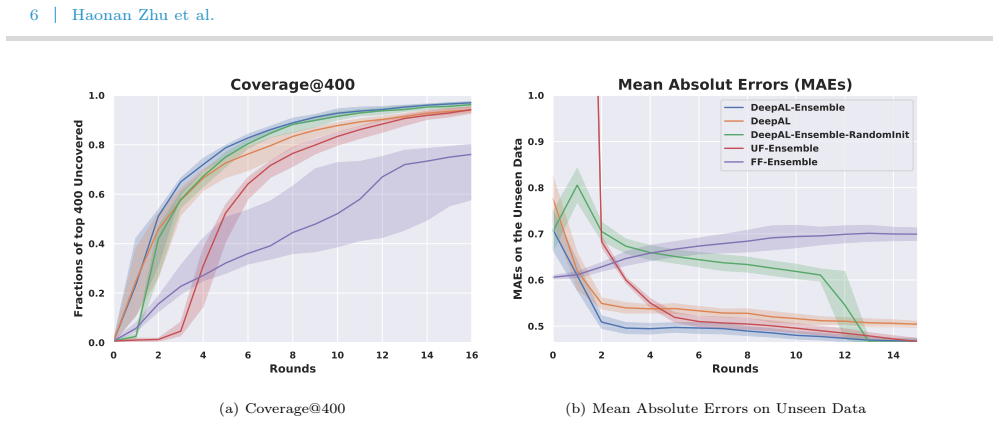
The load-bearing object is the bilinear regression model $\hat{y}_{ij} = \mathrm{Softplus}(x_i^\top A x_j) + b$, where $x_i$ and $x_j$ are gene embeddings produced by a Relational Graph Convolutional Network (R-GCN) trained on a subgraph of the SPOKE biomedical knowledge graph. The bilinear form is what lets the model rank unobserved gene pairs from their embeddings alone, and the Softplus output plus bias keeps predictions on the positive viral-load scale. Before the active-learning loop starts, the embeddings are initialized by self-supervised link prediction with the DistMulti scoring model, so early rounds begin from biologically meaningful geometry. In the loop, an ensemble of $M=20$ independently initialized models is trained on the observed pairs with a Huber loss, and the spread of their predictions defines the uncertainty that acquisition strategies consume: the winning strategy picks pairs with the lowest 10% quantile of ensemble predictions, while the maximum-variance strategy picks pairs the ensemble disagrees about most.
What would settle it
Run the identical active-learning loop on a second double-knockdown dataset whose interaction surface is known to be high-rank or otherwise poorly matched to the bilinear form, for example a synthetic landscape generated by nonlinear pairwise rules the model cannot express, and check whether Coverage@400 still approaches 92% at roughly 6.3% observation; the central claim fails if coverage collapses on that landscape. A cheaper in-dataset check is to remove the low-rank constraint, replacing the shared embedding space with per-pair parameters, and see whether the reported coverage advantage of the constrained model disappears.
Extended reading notes
Core claim
The central claim is that a unified deep active learning framework can sequentially design double-knockdown experiments at the scale of a 356-by-356 interaction matrix. Gene embeddings are first learned by a Relational Graph Convolutional Network on a subgraph of the SPOKE knowledge graph, then fine-tuned on observed viral-load values; the regression head predicts the viral load of a double knockdown as $\hat{y}_{ij} = \mathrm{Softplus}(x_i^\top A x_j) + b$, a bilinear form over the two genes' embeddings. An ensemble of $M=20$ such models supplies uncertainty estimates, and the acquisition rule that minimizes the 10% quantile of ensemble predictions ('optimism') achieves 92% Coverage@400, meaning 92% of the top-400 gene pairs are found after under 6.3% of the matrix is observed. The ablation results support three subsidiary claims: the ensemble's uncertainty information, rather than the base model's greedy picks, drives long-run coverage; the knowledge-graph initialization accelerates early discovery but its advantage fades as data accumulate; and fine-tuning the embeddings on experimental data is essential. Pathway enrichment of the selected pairs shows both acquisition strategies concentrate on translation-related biological processes, which the paper reads as biologically coherent with HIV Tat's role in RNA polymerase II recruitment.
Load-bearing premise
The framework assumes the viral-load effect of any double knockdown is well captured by a low-rank bilinear score built from knowledge-graph gene embeddings; if real genetic interactions deviate from that shape, the ranking of unobserved pairs degrades and the 92% coverage result may not transfer to other datasets.
Editorial extensions
If this is right
- On this dataset, a screening campaign for combination-therapy targets would not need to test all pairs: 92% of the top-400 pairs are recovered at a budget under 6.3% of the matrix, corresponding to the paper's protocol of 17 rounds of 400 observations.
- Ensemble uncertainty, not just point predictions, is what buys long-run coverage: the greedy base model lags the optimism strategy, while maximum variance produces the lowest prediction error on unseen pairs even though it covers fewer top pairs.
- The knowledge-graph prior matters most at the start: the ablation with random initialization shows SPOKE embeddings accelerate early discovery, but the benefit diminishes as observed data accumulate, so the graph and the data complement each other.
- The selected gene pairs are interpretable: genes picked across rounds are enriched for translation and transcription-elongation processes, consistent with HIV Tat enhancing RNA polymerase II activity, which supports the biological plausibility of the recommendations.
Reading between the lines
- Because nothing in the machinery is HIV-specific, the same loop should transfer to other host-pathogen interaction screens or drug-combination assays, provided those landscapes are also approximately low-rank in gene-embedding space; that proviso is the untested premise that decides whether the 92% result generalizes.
- The bilinear scoring rule captures pairwise effects only; moving to triple knockdowns or higher-order combinations would require a tensor analogue of $x_i^\top A x_j$, although the active-learning loop and ensemble uncertainty machinery would carry over.
- The coverage metric treats the measured top-400 pairs as ground truth; re-running the benchmark against a noisy surrogate of the viral-load matrix would quantify how much of the reported 92% survives realistic assay error, a robustness check the paper does not perform.
Editorial analysis
A structured set of objections, weighed in public.
Referee Report
Summary. The paper proposes a deep active learning (DeepAL) framework for selecting pairwise gene-knockdown experiments to identify combinations that reduce HIV viral load. Gene embeddings are obtained from an R-GCN trained on the SPOKE knowledge graph, and a bilinear regression head (Eq. 5) predicts viral load for a pair. An ensemble of M=20 models provides uncertainty estimates, and several acquisition functions (greedy, BADGE, maximum variance, optimism at the 10% quantile) are compared. On a 356×356 HIV double-knockdown dataset, the optimism strategy achieves 92% Coverage@400 after observing less than 6.3% of the matrix, with ablations showing that ensemble uncertainty, SPOKE-initialized embeddings, and fine-tuning contribute to performance. The paper also includes a pathway enrichment analysis of selected pairs.
Significance. If confirmed, the result is of practical interest for combinatorial experimental design in host-targeted therapies, where brute-force screening of pairwise knockdowns is infeasible. The manuscript includes a thoughtful ablation suite (random initialization, frozen features, unconstrained features) that isolates the contribution of the knowledge graph and fine-tuning, and the use of a heterogeneous knowledge graph (SPOKE) is a sensible design choice. The evaluation is, however, based on a single real dataset, and the headline coverage figure is reported without any measure of uncertainty, so the strength of the evidence for the central claim is currently limited.
major comments (4)
- [Section 4, Fig. 2(a)] The headline claim that the ensemble DeepAL framework uncovers 92% of the top 400 gene-pairs after observing less than 6.3% of the matrix is stated as a point estimate with no measure of variability across the 20 replicates described in the figure captions. Without error bars, a standard deviation, or a confidence interval for the final-round coverage, the reader cannot assess whether the difference between the optimism strategy and the greedy or random baselines is statistically reliable. Please report the mean and variance (or confidence interval) over replicates for the terminal coverage, and consider showing error bars or shaded regions in Figs. 2 and 3.
- [Section 3.2.3, Eq. (5)] The regression model assumes the double-knockdown viral load is, up to a Softplus transform, a bilinear form in the SPOKE-derived gene embeddings (with a shared symmetric matrix A). The entire active-learning loop inherits this low-rank restriction, but the paper never tests whether the success of the framework depends on this assumption. The UF-Ensemble ablation removes the graph prior but retains the same bilinear head, so it cannot detect a misspecification of the head itself. To support the generalization of the central claim, add a comparison with a strictly more expressive predictor (e.g., an MLP over the embeddings, or a higher-rank factorization) in the same active-learning loop, or a synthetic experiment with known non-bilinear interaction structure. Without such a check, the 92% coverage result may be a property of this particular dataset's approximate low-rank landscape rather than of the proposed framework's general capacity.
- [Title, Abstract, Section 3.2.3] The word 'synergistic' appears in the title and throughout, but Eq. (5) models the joint effect of a double knockdown directly; it does not include or compare against single-gene effects, so it cannot distinguish synergy from mere strong additivity. A synergistic interaction is defined by a deviation from the additive expectation of single perturbations. As written, the paper demonstrates efficient discovery of highly effective double-knockdown pairs, but not that these pairs are synergistic. Please either incorporate an additive baseline into the model (e.g., predict y_ij and compare to f(x_i)+f(x_j)) or revise the claims and title to say 'potent pairwise knockdowns' or 'effective pairwise interventions'.
- [Reproducibility (entire manuscript)] The manuscript does not provide code, data, or a full training configuration (e.g., learning rates, optimizer, epochs, random seeds, hardware). The central result is a single-number claim about algorithm performance in a simulation; without the implementation details or a release, the result cannot be independently verified. Provide a reproducibility statement with code and data availability, or at minimum complete hyperparameter and training details and the variance over replicates.
minor comments (6)
- [Section 4.1] The relationship between the stated 17 rounds × 400 pairs = 6,800 observations and 'less than 6.3% of the entire matrix' (6,800 / 126,736 ≈ 5.36%) should be clarified; the percentage appears to have been rounded or computed differently.
- [Algorithm 1, Table 1] Provide concrete values for the regularization parameters (dropout rate, weight decay), optimizer, learning rate, number of epochs, and how ensemble diversity is maintained across the 20 seeds.
- [Table 2] The 'Badge' acquisition is described as arg max over ||x_i ⊙ x_j||, which does not correspond to the gradient-based BADGE method of Ash et al. (ref. [2]); clarify whether this is an approximation or rename the strategy.
- [Section 4.4] State the significance threshold and multiple-testing correction used for the GOATOOLS enrichment analysis; otherwise the claim that terms are 'overrepresented' is not quantitatively defined.
- [Figures 2 and 3] Add error bars or shaded intervals to the plots, since they show averages over 20 replicates without any dispersion information.
- [Throughout] Typographical errors should be fixed: 'Abalation' in Fig. 3; 'Mean Absolut Errors' in the y-axis labels; 'summarized over20 replicates' missing a space.
Circularity Check
No significant circularity: the DeepAL result is a supervised active-learning evaluation against a fixed ground-truth matrix, not a reduction of the claim to its inputs.
full rationale
The paper's central claim, that the ensemble DeepAL framework uncovers 92% of the top 400 gene pairs after observing less than 6.3% of the matrix, is an empirical active-learning result evaluated against a fixed external ground truth. The bilinear predictor in Eq. 5, y_hat_ij = Softplus(x_i^T A x_j) + b, is trained only on observed pairs via the Huber loss in Algorithm 1 line 7, and the acquisition functions in Table 2 select batches from model predictions. Coverage@400 is then computed against the pre-existing top-400 viral-load pairs from the Gordon et al. dataset, not against the model's own scores, so nothing in the equations forces the discovered set to coincide with the ground-truth top 400. If the low-rank bilinear assumption or the SPOKE-derived embeddings failed, the coverage would drop; the result is therefore not equivalent to the model's training objective by construction. The SPOKE knowledge graph is an external prior rather than an output of this paper, and no load-bearing step relies on a self-citation chain: the model architecture is justified by citations to standard external methods (R-GCN, DistMulti, deep ensembles), not by prior work of these authors. The mild concern that the 92% result may not transfer to other interaction maps because of the bilinear assumption is a generalizability and correctness question, not a circularity. No fitted parameter is renamed as a prediction, no quantity is defined in terms of the target claim, and no uniqueness theorem is imported from the authors' own prior work. Therefore the derivation is self-contained with respect to circularity.
Assumptions & free parameters
free parameters (9)
- Embedding dimension d =
50
- Hidden dimension d_h =
64
- Number of R-GCN layers L =
3
- Ensemble size M =
20
- Batch size N =
400
- Rounds T =
17
- Random walk length s =
5
- Random walks per node w =
5
- Optimism quantile =
0.10
assumptions (6)
- domain assumption The HIV genetic interaction matrix from Gordon et al. [3] is an accurate ground truth for viral load after double knockdown.
- domain assumption The viral-load landscape can be approximated by the bilinear form y_ij = Softplus(x_i^T A x_j) + b with shared gene embeddings.
- domain assumption SPOKE graph node and edge structure carries information relevant to HIV-related gene function.
- domain assumption Active learning simulation on a complete observed matrix faithfully represents the real experimental design problem.
- ad hoc to paper The 10% optimism quantile acquisition is a reasonable exploration-exploitation heuristic.
- standard math Standard R-GCN, DistMulti, and ensemble methods behave as described in their source references.
Cite this review
Pith. "Pith review of Deep Active Learning based Experimental Design to Uncover Synergistic Genetic Interactions for Host Targeted Therapeutics." pith.science (2026). https://pith.science/paper/W3K2WIWK
@misc{pith2026250201012,
  author       = {Pith},
  title        = {Pith review of: Deep Active Learning based Experimental Design to Uncover Synergistic Genetic Interactions for Host Targeted Therapeutics},
  year         = {2026},
  howpublished = {\url{https://pith.science/paper/W3K2WIWK}},
  note         = {Machine review of arXiv:2502.01012}
}
read the original abstract
Recent technological advances have introduced new high-throughput methods for studying host-virus interactions, but testing synergistic interactions between host gene pairs during infection remains relatively slow and labor intensive. Identification of multiple gene knockdowns that effectively inhibit viral replication requires a search over the combinatorial space of all possible target gene pairs and is infeasible via brute-force experiments. Although active learning methods for sequential experimental design have shown promise, existing approaches have generally been restricted to single-gene knockdowns or small-scale double knockdown datasets. In this study, we present an integrated Deep Active Learning (DeepAL) framework that incorporates information from a biological knowledge graph (SPOKE, the Scalable Precision Medicine Open Knowledge Engine) to efficiently search the configuration space of a large dataset of all pairwise knockdowns of 356 human genes in HIV infection. Through graph representation learning, the framework is able to generate task-specific representations of genes while also balancing the exploration-exploitation trade-off to pinpoint highly effective double-knockdown pairs. We additionally present an ensemble method for uncertainty quantification and an interpretation of the gene pairs selected by our algorithm via pathway analysis. To our knowledge, this is the first work to show promising results on double-gene knockdown experimental data of appreciable scale (356 by 356 matrix).
Figures


Figures from the paper (5 more)


Reference graph
Works this paper leans on
-
[1]
A review of uncertainty quantification in deep learning: Techniques, applications and challenges
Moloud Abdar, Farhad Pourpanah, Sadiq Hussain, Dana Rezazadegan, Li Liu, Mohammad Ghavamzadeh, Paul Fieguth, Xiaochun Cao, Abbas Khosravi, U Rajendra Acharya, et al. A review of uncertainty quantification in deep learning: Techniques, applications and challenges. Information fusion, 76:243–297, 2021
2021
-
[2]
Jordan T Ash, Chicheng Zhang, Akshay Krishnamurthy, John Langford, and Alekh Agarwal. Deep batch active learning by diverse, uncertain gradient lower bounds.arXiv preprint arXiv:1906.03671, 2019
arXiv 1906
-
[3]
A quantitative genetic interaction map of hiv infection
David E Gordon, Ariane Watson, Assen Roguev, Simin Zheng, Gwendolyn M Jang, Joshua Kane, Jiewei Xu, Jef- frey Z Guo, Erica Stevenson, Danielle L Swaney, et al. A quantitative genetic interaction map of hiv infection. Molecular cell, 78(2):197–209, 2020
work page 2020
-
[4]
Crispr-gpt: An llm agent for automated design of gene-editing experiments
Kaixuan Huang, Yuanhao Qu, Henry Cousins, William A Johnson, Di Yin, Mihir Shah, Denny Zhou, Russ Altman, Mengdi Wang, and Le Cong. Crispr-gpt: An llm agent for automated design of gene-editing experiments. arXiv preprint arXiv:2404.18021, 2024
arXiv 2024
-
[5]
Sequential optimal experimental design of perturbation screens guided by multi-modal priors
Kexin Huang, Romain Lopez, Jan-Christian Hütter, Taka- masa Kudo, Antonio Rios, and Aviv Regev. Sequential optimal experimental design of perturbation screens guided by multi-modal priors. InInternational Conference on Re- search in Computational Molecular Biology, pages 17–37. Springer, 2024
work page 2024
-
[6]
Robust estimation of a location param- eter
Peter J Huber. Robust estimation of a location param- eter. In Breakthroughs in statistics: Methodology and distribution, pages 492–518. Springer, 1992
work page 1992
-
[7]
Moksh Jain, Ali Denton, Shawn Whitfield, Aniket Didolkar, Berton Earnshaw, Jason Hartford, et al. Automated discov- ery of pairwise interactions from unstructured data.arXiv preprint arXiv:2409.07594, 2024
arXiv 2024
-
[8]
Active learning to discover pairwise genetic interac- tions via representation learning
Moksh Jain, Alisandra Kaye Denton, Shawn T Whitfield, Aniket Rajiv Didolkar, Berton Earnshaw, and Jason Hart- ford. Active learning to discover pairwise genetic interac- tions via representation learning. InICLR 2024 Workshop on Machine Learning for Genomics Explorations
work page 2024
Show all 37 references
-
[9]
Bilinear bandits with low-rank structure
Kwang-Sung Jun, Rebecca Willett, Stephen Wright, and Robert Nowak. Bilinear bandits with low-rank structure. In International Conference on Machine Learning, pages 3163–3172. PMLR, 2019
2019
-
[10]
Goatools: A python library for gene ontology analyses
Drew V Klopfenstein, Luke Zhang, Brent S Pedersen, et al. Goatools: A python library for gene ontology analyses. Scientific Reports, 8(1):10872, 2018
2018
-
[11]
Simple and scalable predictive uncertainty es- timation using deep ensembles
Balaji Lakshminarayanan, Alexander Pritzel, and Charles Blundell. Simple and scalable predictive uncertainty es- timation using deep ensembles. Advances in neural information processing systems, 30, 2017
2017
-
[12]
Discobax dis- covery of optimal intervention sets in genomic experiment design
Clare Lyle, Arash Mehrjou, Pascal Notin, Andrew Jesson, Stefan Bauer, Yarin Gal, and Patrick Schwab. Discobax dis- covery of optimal intervention sets in genomic experiment design. InInternational Conference on Machine Learning, pages 23170–23189. PMLR, 2023
2023
-
[13]
Genedisco: A benchmark for experimental design in drug discovery
Arash Mehrjou, Ashkan Soleymani, Andrew Jesson, Pas- cal Notin, Yarin Gal, Stefan Bauer, and Patrick Schwab. Genedisco: A benchmark for experimental design in drug discovery. arXiv preprint arXiv:2110.11875, 2021
2021 arXiv
-
[14]
Neural collapse with unconstrained features
Dustin G Mixon, Hans Parshall, and Jianzong Pi. Neural collapse with unconstrained features. Sampling Theory, Signal Processing, and Data Analysis, 20(2):11, 2022
2022
-
[15]
The scalable precision medicine open knowledge engine (spoke): a massive knowledge graph of biomedical information
John H Morris, Karthik Soman, Rabia E Akbas, Xiaoyuan Zhou, Brett Smith, Elaine C Meng, Conrad C Huang, Gabriel Cerono, Gundolf Schenk, Angela Rizk-Jackson, et al. The scalable precision medicine open knowledge engine (spoke): a massive knowledge graph of biomedical informatio...
2023
-
[16]
Exploring genetic interaction mani- folds constructed from rich single-cell phenotypes.Science, 365(6455):786–793, 2019
Thomas M Norman, Max A Horlbeck, Joseph M Replogle, Alex Y Ge, Albert Xu, Marco Jost, Luke A Gilbert, and Jonathan S Weissman. Exploring genetic interaction mani- folds constructed from rich single-cell phenotypes.Science, 365(6455):786–793, 2019
2019
-
[17]
Neural design for genetic perturbation ex- periments
Aldo Pacchiano, Drausin Wulsin, Robert A Barton, and Luis Voloch. Neural design for genetic perturbation ex- periments. In The Eleventh International Conference on Learning Representations
-
[18]
Deep- walk: Online learning of social representations
Bryan Perozzi, Rami Al-Rfou, and Steven Skiena. Deep- walk: Online learning of social representations. InProceed- ings of the 20th ACM SIGKDD international conference on Knowledge discovery and data mining, pages 701–710, 2014
2014
-
[19]
Optimal design of experiments
Friedrich Pukelsheim. Optimal design of experiments. SIAM, 2006
2006
-
[20]
A crispr toolbox to study virus–host in- teractions
Andreas S Puschnik, Karim Majzoub, Yaw Shin Ooi, and Jan E Carette. A crispr toolbox to study virus–host in- teractions. Nature Reviews Microbiology, 15(6):351–364, 2017
2017
-
[21]
Hiv tat controls rna polymerase ii and the epigenetic landscape to transcrip- tionally reprogram target immune cells
Jonathan E Reeder, Youn-Tae Kwak, Ryan P McNamara, Christian V Forst, and Iván D’Orso. Hiv tat controls rna polymerase ii and the epigenetic landscape to transcrip- tionally reprogram target immune cells. Elife, 4:e08955, 2015
2015
-
[22]
Mapping information-rich genotype- phenotype landscapes with genome-scale perturb-seq.Cell, 185(14):2559–2575, 2022
Joseph M Replogle, Reuben A Saunders, Angela N Pog- son, Jeffrey A Hussmann, Alexander Lenail, Alina Guna, Lauren Mascibroda, Eric J Wagner, Karen Adelman, Gila Lithwick-Yanai, et al. Mapping information-rich genotype- phenotype landscapes with genome-scale perturb-seq.Cell, 1...
2022
-
[23]
Antiviral ther- apy
Douglas D Richman and Neal Nathanson. Antiviral ther- apy. In Viral pathogenesis, pages 271–287. Elsevier, 2016. 8 Haonan Zhu et al
2016
-
[24]
Best arm identification in graphical bi- linear bandits
Geovani Rizk, Albert Thomas, Igor Colin, Rida Laraki, and Yann Chevaleyre. Best arm identification in graphical bi- linear bandits. In International Conference on Machine Learning, pages 9010–9019. PMLR, 2021
2021
-
[25]
Biodiscoveryagent: An ai agent for designing genetic perturbation experiments
Yusuf Roohani, Andrew Lee, Qian Huang, Jian Vora, Zachary Steinhart, Kexin Huang, Alexander Marson, Percy Liang, and Jure Leskovec. Biodiscoveryagent: An ai agent for designing genetic perturbation experiments. arXiv preprint arXiv:2405.17631, 2024
2024 arXiv
-
[26]
A survey on oversmoothing in graph neural networks
T Konstantin Rusch, Michael M Bronstein, and Siddhartha Mishra. A survey on oversmoothing in graph neural networks. arXiv preprint arXiv:2303.10993, 2023
2023 arXiv
-
[27]
Modeling re- lational data with graph convolutional networks
Michael Schlichtkrull, Thomas N Kipf, Peter Bloem, Rianne Van Den Berg, Ivan Titov, and Max Welling. Modeling re- lational data with graph convolutional networks. InThe se- mantic web: 15th international conference, ESWC 2018, Heraklion, Crete, Greece, June 3–7, 2018, proceedi...
2018
-
[28]
Dropout: a sim- ple way to prevent neural networks from overfitting.The journal of machine learning research, 15(1):1929–1958, 2014
Nitish Srivastava, Geoffrey Hinton, Alex Krizhevsky, Ilya Sutskever, and Ruslan Salakhutdinov. Dropout: a sim- ple way to prevent neural networks from overfitting.The journal of machine learning research, 15(1):1929–1958, 2014
1929
-
[29]
A review of active learning approaches to experimental design for uncover- ing biological networks
Yuriy Sverchkov and Mark Craven. A review of active learning approaches to experimental design for uncover- ing biological networks. PLoS computational biology, 13(6):e1005466, 2017
2017
-
[30]
Hiv-1 antiretrovi- ral resistance: scientific principles and clinical applications
Michele W Tang and Robert W Shafer. Hiv-1 antiretrovi- ral resistance: scientific principles and clinical applications. Drugs, 72:e1–e25, 2012
2012
-
[31]
Complex embeddings for simple link prediction
Théo Trouillon, Johannes Welbl, Sebastian Riedel, Éric Gaussier, and Guillaume Bouchard. Complex embeddings for simple link prediction. InInternational conference on machine learning, pages 2071–2080. PMLR, 2016
2016
-
[32]
Halluci- nation is inevitable: An innate limitation of large language models
Ziwei Xu, Sanjay Jain, and Mohan Kankanhalli. Halluci- nation is inevitable: An innate limitation of large language models. arXiv preprint arXiv:2401.11817, 2024
2024 arXiv
-
[33]
Embedding entities and relations for learn- ing and inference in knowledge bases
Bishan Yang, Wen-tau Yih, Xiaodong He, Jianfeng Gao, and Li Deng. Embedding entities and relations for learn- ing and inference in knowledge bases. arXiv preprint arXiv:1412.6575, 2014
2014 arXiv
-
[34]
Towards deeper graph neural net- works with differentiable group normalization
Kaixiong Zhou, Xiao Huang, Yuening Li, Daochen Zha, Rui Chen, and Xia Hu. Towards deeper graph neural net- works with differentiable group normalization. Advances in neural information processing systems, 33:4917–4928, 2020
2020
-
[35]
A geometric analysis of neural collapse with unconstrained features.arXiv preprint arXiv:2105.02375, 2021
Zhihui Zhu, Tianyu Ding, Jinxin Zhou, Xiao Li, Chong You, Jeremias Sulam, and Qing Qu. A geometric analysis of neural collapse with unconstrained features.arXiv preprint arXiv:2105.02375, 2021. Haonan Zhu received the Ph.D. de- gree in electrical and computer engineer- ing fro...
2021 arXiv
-
[2022]
Sergio E Baranzinireceived his Ph.D
He is currently a Postdoctoral Researcher at Baranzini Lab in UCSF. Sergio E Baranzinireceived his Ph.D. degree in molecular human genetics from the University of Buenos Aires in 1997. He is currently a distinguished Profes- sor of Neurology at the University of California San...
1997 arXiv
-
[2023]
Mary Silvareceived an M.S
He is currently a Postdoctoral Re- searcher with the Lawrence Livermore National Laboratory. Mary Silvareceived an M.S. in Statis- tics from University of California, Santa Cruz. She is currently a Data Scientist in the Biomolecular Design and Devel- opment Group at Lawrence L...
Reviewed August 9, 2026 · model on record in the stance chip above.
Discussion (0). Continue with ORCID to comment.