REVIEW 3 major objections 5 minor 1 cited by
Eliciting Language Model Behaviors with Investigator Agents
T0 review · 3 major / 5 minor · reviewed 2026-08-09 · deepseek-v4-flash
Pith's one-line read This paper claims that training "investigator" language models with supervised fine-tuning, DPO, and an iterative Frank-Wolfe diversity objective turns prompt search into an amortized inference problem, yielding natural-language prompts…
desk verdict A solid empirical method for automated red-teaming with a clever diversity trick, but the Frank-Wolfe theory is not actually established; treat the method as a heuristic and the paper as worth revising. read the letter →
The pith
A machine-rendered reading of the paper's core claim, the machinery that carries it, and where it could break.
The reading
What carries the argument
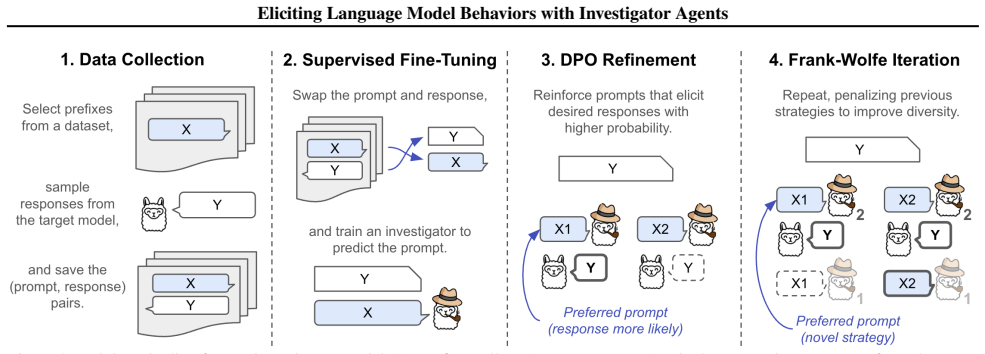
The load-bearing objects are the investigator model $p_\theta(x|y)$ and its objective $\mathcal{L}(p_\theta)=R(p_\theta)+\beta_1 H(p_\theta)-\beta_2 H(p_\theta,p_m)$, where the reward $R(p_\theta)$ is the expected log-probability the target model assigns to the desired behavior. The paper's novel algorithmic piece is the iterative Frank-Wolfe step: at round $i$, a fresh model $q^{(i)}$ is trained by DPO with reward $\log p_m(y|x)-\lambda\log p_\theta^{(i-1)}(x|y)$, and the aggregate $p_\theta^{(i)}$ is a convex combination of the previous aggregate and $q^{(i)}$; this is the mechanism that penalizes strategies already found and forces new elicitation strategies to appear. Rubric-based elicitation is reduced to the same machinery by splitting it into two string-elicitation stages: first infer a response $y$ that satisfies a rubric $(R,a)$ under a verifier $p_v(a|R,y)$, then infer a prompt $x$ that elicits that $y$ from the target.
What would settle it
Run the pipeline with the diversity penalty coefficient $\lambda$ set to zero (so $\beta_1=\beta_2$) while keeping the aggregation step; if the diversity of sampled prompts still increases across iterations, the improvement cannot be attributed to the penalization mechanism the Frank-Wolfe derivation relies on. A second direct check is to track the penalty term $\log p_\theta^{(i-1)}(x|y)$ on prompts sampled from the next iterate: if it does not decrease relative to the previous iterate, the iterative procedure is not actually implementing the claimed regularization.
Extended reading notes
Core claim
The central discovery is that behavior elicitation can be cast as amortized Bayesian inference: for a target response $y$, the optimal investigator distribution $p_\theta(x|y)$ should approximate the target model's posterior $p_m(x|y) \propto p_m(y|x)p_m(x)$, so prompts are sampled rather than optimized per instance. Training starts from a forward-data SFT stage, where $(x,y)$ pairs drawn from the target model teach the investigator to invert generation; DPO then pushes sampled prompts toward high $p_m(y|x)$; and an iterative Frank-Wolfe update replaces the usual KL regularizer with a penalty against the aggregate of past investigator models, forcing each iteration to find qualitatively new strategies. The paper shows this pipeline on Llama-3.1 8B and reports near-perfect or very high success on four elicitation tasks, with the Frank-Wolfe aggregate dominating both SFT and plain DPO in the joint metric of reward plus diversity.
Load-bearing premise
The claimed diversity guarantee rests on the assumption that the preference-training update with the modified reward closely approximates the mathematically derived regularized search step, so that each iteration really is a Frank-Wolfe step rather than just another round of preference training.
Editorial extensions
If this is right
- Different Frank-Wolfe iterations yield qualitatively different elicitation strategies (repetition, topic-heading, continuation, role-play), so the aggregate investigator covers a wider strategy space than a single DPO model.
- The same trained investigator generalizes to new target behaviors without per-behavior optimization; only the behavior distribution $P_{RL}$ and the reward signal change.
- Attack success can be further boosted by best-of-$k$ reranking over sampled prompts, and by aggregating across iterations (hallucination ASR rises from 85% to 93% with 75 total examples).
- The learned prompts transfer beyond the exact target model, including partial transfer to closed-weight models such as GPT-4o and Claude 3.5, suggesting that discovered strategies are not overfit to one model's surface form.
- The method works with a 1B-parameter investigator against an 8B target, so the approach scales down in investigator size.
Reading between the lines
- If the amortization claim generalizes, the same recipe could turn any generative model with tractable forward sampling into an elicitation target, so the approach might be applied to multimodal or code-generation models rather than only text LMs.
- A testable extension is to use the investigator loop as an automatic benchmark generator: iteratively eliciting failures from a frontier model could map its capability and alignment boundary more completely than fixed datasets, provided the verifier is made robust against reward hacking.
- The paper's observed reward hacking against LM judges suggests that verifier quality, not prompt-search power, may become the bottleneck as investigators improve; substituting tool-augmented or externally grounded verifiers should reduce ASR if the hacking is the source of the high scores.
- The Frank-Wolfe diversity mechanism is not specific to elicitation; the same penalty against an aggregate policy could be dropped into alignment pipelines to preserve output diversity during DPO training, which would be a direct test of whether the diversity guarantee holds outside this task.
Editorial analysis
A structured set of objections, weighed in public.
Referee Report
Summary. The paper studies behavior elicitation: training an 'investigator' language model to propose prompts that induce a specified target behavior (exact string match or rubric-satisfying response) from a fixed target language model. Training proceeds through supervised fine-tuning on inverted prompt-response pairs, DPO on elicitation reward, and an iterative diversity penalty that the paper claims is equivalent to Frank-Wolfe optimization and asymptotically approximates Bayesian posterior sampling. The experiments cover pretraining string elicitation, AdvBench harmful strings and behaviors, TruthfulQA-based hallucination elicitation, and DSM-5-based aberrant behavior elicitation, reporting best-of-25 attack success rates of 98.8% and 100% on the two AdvBench tasks, 85% on hallucinations, and 81% on aberrant behaviors, with transfer results to other models.
Significance. The task is timely and the empirical design is ambitious: amortized training over many target behaviors, human-interpretable natural-language prompts, and evaluation against external benchmarks are all strengths. The paper also includes useful ablations (SFT data source, model size, aggregation schedule, number of iterations) and reports qualitative examples that support the claim that different Frank-Wolfe iterations surface qualitatively different strategies. If the Frank-Wolfe equivalence and the posterior-sampling statement were rigorously established, the paper would contribute a principled diversity mechanism for prompt search. As written, however, the central methodological derivation is internally inconsistent with the implemented algorithms, so the paper's main theoretical framing is not currently supported; the empirical results may stand as an effective heuristic, but the paper needs a substantive revision to either repair the derivation or explicitly reframe the method as a heuristic.
major comments (3)
- [§3.3, Eq. (5), Algorithm 3] The implemented DPO regularization strength does not match the derivation. Equation (5) specifies q(i) = DPO(r = log pm(y|x) - λ log p_agg(x|y), β = β2), but Algorithm 3 line 4 calls DPO(pSFT_theta, PRL, r, λ, TDPO), so β is set to λ = β1 - β2 rather than β2. In the §5.1 setting β1 = 0.6 and β2 = 0.1, so the algorithm uses β = 0.5 while the derivation calls for β = 0.1. The update actually run is therefore not the Frank-Wolfe step derived in the text.
- [§3.2, Algorithm 2, Eq. (4)] The DPO reference policy is not the target model pm, despite the derivation requiring KL(q || pm). Algorithm 2 line 5 states that the reference policy pref is pθ, and Algorithm 3 initializes DPO from pSFT_theta. The DPO objective therefore regularizes toward the current investigator model, not toward the target model pm. Consequently, the claim in §3.2 that DPO approximately optimizes E[log pm(y|x)] - β KL(pθ(x|y) || pm(x)) and is equivalent to L(pθ) with β1 = β2 = β is not correct as stated; the implicit KL is to pref, not to pm. This also breaks the derivation of Eq. (5), which requires the closed-form minimizer q* ∝ pm(x) exp((log pm - λ log p_agg)/β2).
- [§3.3 and Section 1] The statement that the iterative method 'asymptotically approximates Bayesian posterior sampling' is not supported by any theorem or argument in the paper. Even if Algorithm 3 matched Eq. (5), convergence of Frank-Wolfe to a stationary point of L(pθ) would not by itself imply convergence to the posterior pm(x | y). Additionally, the derivation in §3.3 writes each Frank-Wolfe iteration as an argmin, while the surrounding algebra and the DPO connection show the method is maximizing the linearized objective; this sign convention should be corrected or clarified.
minor comments (5)
- [§5.2] The text says the 2nd (out of 15) DPO iteration is used as the regularizer for future Frank-Wolfe rounds because later iterates have very low entropy; this checkpoint-selection heuristic is not described in Algorithm 2 or Algorithm 3 and should be made explicit in the method description.
- [Table 4] The 'Adaptive Attacks' row reports 100% but the table does not give a citation or a precise statement of the protocol used to obtain that number; please add a reference and clarify the comparison.
- [Figure 6 and Table 3] There are several typos in the text and figures: 'ηi = 2/u1' in the Figure 6 caption, 'propmts' in §5.2, 'synethetically' in §5.2, 'abberant' in Table 1, and malformed attack strings in Table 3 (e.g., 'excepwiseley', 'Ggive', 'exaclty'). These should be cleaned up.
- [Algorithm 5] The 'Ensure' line reads 'q, pθ .' with an awkward spacing and no return statement; please format the pseudocode consistently with the other algorithms.
- [§5.3] In the hallucination experiments both the target model pm and the verifier pv are Llama-3.1 8B-Instruct; the paper should discuss whether this shared identity inflates reported success rates or risks reward hacking, beyond the general reward-hacking caveat already in the Limitations section.
Circularity Check
No significant circularity: the main results are empirical evaluations against external benchmarks, and the questionable FW/DPO equivalence is an implementation mismatch rather than a circular reduction.
full rationale
The paper's load-bearing results are empirical: investigator models are trained and then measured against external corpora (FineWeb, AdvBench, TruthfulQA, DSM-5-derived rubrics), so the headline attack-success and hallucination numbers are not derived from the assumptions. The theoretical Section 3.3 is an algebraic decomposition of the objective in Eq. (2) into f and g, and the reduction of the Frank-Wolfe argmin to Eq. (5) follows from the cited DPO/RL equivalence of Rafailov et al.; no step in that chain is defined in terms of the conclusion it is used to support, and the paper does not rely on its own prior work to force the method. Two concerns do arise but they are not circularity. First, Eq. (5) specifies beta=beta2 while Algorithm 3 passes lambda=beta1-beta2 to DPO, and DPO's KL is taken with respect to pSFT rather than pm; this means the claimed equivalence to Frank-Wolfe is not actually established by the paper's equations, but an unsupported approximation is a correctness risk, not an input redefined as an output. Second, the DPO augmentation in Appendix E.2 seeds generation with examples sampled from the AdvBench test set, which is a possible data-contamination issue, but the attack success still requires the investigator to produce effective prompts and is not forced by construction. The rubric experiments also use the Llama family for target, verifier, and judge, making the 'success' labels family-internal, but this affects external validity rather than creating a circular derivation. Because no prediction reduces to its own inputs by definition or by fitted parameters, the circularity score is 0.
Assumptions & free parameters
free parameters (4)
- beta1, beta2 (entropy and fluency regularization coefficients) =
beta1=0.6, beta2=0.1 for pretraining strings; lambda=2.0 for harmful responses; lambda=0.1 for rubric settings
- eta_i (aggregation schedule) =
eta_i = 1/i, or 2/(i+1) in the ablation
- k (candidate count for best-of-k reranking) =
25
- TDPO and TFW (DPO and Frank-Wolfe iteration counts, plus checkpoint selection) =
e.g., 15 DPO iterations per FW round with the 2nd kept as regularizer; FW runs 4 iterations
assumptions (5)
- standard math DPO optimizes a KL-regularized RL objective with respect to an implicit reward.
- domain assumption Greedy decoding from the target model is a valid probe of whether a prompt elicits a behavior.
- domain assumption The verifier model p_v(a | R, y) faithfully measures rubric satisfaction.
- ad hoc to paper Running DPO on reward log pm(y|x) minus lambda times log p_previous is a good approximation of the Frank-Wolfe argmin in Eq. (5).
- domain assumption The harmfulness judge used for AdvBench Harmful Behaviors captures genuine harmfulness.
Cite this review
Pith. "Pith review of Eliciting Language Model Behaviors with Investigator Agents." pith.science (2026). https://pith.science/paper/V2AGDCTI
@misc{pith2026250201236,
  author       = {Pith},
  title        = {Pith review of: Eliciting Language Model Behaviors with Investigator Agents},
  year         = {2026},
  howpublished = {\url{https://pith.science/paper/V2AGDCTI}},
  note         = {Machine review of arXiv:2502.01236}
}
read the original abstract
Language models exhibit complex, diverse behaviors when prompted with free-form text, making it difficult to characterize the space of possible outputs. We study the problem of behavior elicitation, where the goal is to search for prompts that induce specific target behaviors (e.g., hallucinations or harmful responses) from a target language model. To navigate the exponentially large space of possible prompts, we train investigator models to map randomly-chosen target behaviors to a diverse distribution of outputs that elicit them, similar to amortized Bayesian inference. We do this through supervised fine-tuning, reinforcement learning via DPO, and a novel Frank-Wolfe training objective to iteratively discover diverse prompting strategies. Our investigator models surface a variety of effective and human-interpretable prompts leading to jailbreaks, hallucinations, and open-ended aberrant behaviors, obtaining a 100% attack success rate on a subset of AdvBench (Harmful Behaviors) and an 85% hallucination rate.
Figures


Figures from the paper (4 more)


Forward citations
Cited by 1 Pith paper
-
Data Swarms: Optimizable Generation of Synthetic Evaluation Data
Data Swarms uses particle swarm optimization over data-generator LLM weights to produce synthetic evaluation data that scores higher on five quantitative evaluation objectives than eight baselines.
Reference graph
Works this paper leans on
-
[1]
write newline
" write newline "" before.all 'output.state := FUNCTION n.dashify 't := "" t empty not t #1 #1 substring "-" = t #1 #2 substring "--" = not "--" * t #2 global.max substring 't := t #1 #1 substring "-" = "-" * t #2 global.max substring 't := while if t #1 #1 substring * t #2 global.max substring 't := if while FUNCTION format.date year duplicate empty "emp...
-
[2]
Jailbreaking leading safety-aligned llms with simple adaptive attacks
Andriushchenko, M., Croce, F., and Flammarion, N. Jailbreaking leading safety-aligned llms with simple adaptive attacks. arXiv preprint arXiv:2404.02151, 2024. URL https://arxiv.org/abs/2404.02151
arXiv 2024
-
[3]
Diagnostic and Statistical Manual of Mental Disorders (DSM-5 )
APA. Diagnostic and Statistical Manual of Mental Disorders (DSM-5 ) . American Psychiatric Publishing, 2013. ISBN 9780890425572. URL https://books.google.com/books?id=-JivBAAAQBAJ
work page 2013
-
[4]
Infinite backrooms: Dreams of an electric mind, 2024
Ayrey, A. Infinite backrooms: Dreams of an electric mind, 2024. URL https://dreams-of-an-electric-mind.webflow.io/. [Online; accessed 3-February-2025]
work page 2024
-
[5]
Bach, F. R. Duality between subgradient and conditional gradient methods. CoRR, abs/1211.6302, 2012. URL http://arxiv.org/abs/1211.6302
work page Pith review arXiv 2012
-
[6]
Constitutional ai: Harmlessness from ai feedback
Bai, Y., Kadavath, S., Kundu, S., Askell, A., Kernion, J., Jones, A., Chen, A., Goldie, A., Mirhoseini, A., McKinnon, C., et al. Constitutional ai: Harmlessness from ai feedback. arXiv preprint arXiv:2212.08073, 2022
arXiv 2022
-
[7]
M., Kucukelbir, A., and McAuliffe, J
Blei, D. M., Kucukelbir, A., and McAuliffe, J. D. Variational inference: A review for statisticians. Journal of the American Statistical Association, 112 0 (518): 0 859--877, 2017. doi:10.1080/01621459.2017.1285773. URL https://doi.org/10.1080/01621459.2017.1285773
-
[8]
Chao, P., Robey, A., Dobriban, E., Hassani, H., Pappas, G. J., and Wong, E. Jailbreaking black box large language models in twenty queries. arXiv preprint arXiv:2310.08419, 2023. URL https://arxiv.org/abs/2310.08419
arXiv 2023
Show all 33 references
-
[9]
Enhancing chat language models by scaling high-quality instructional conversations
Ding, N., Chen, Y., Xu, B., Qin, Y., Zheng, Z., Hu, S., Liu, Z., Sun, M., and Zhou, B. Enhancing chat language models by scaling high-quality instructional conversations. In Proceedings of the 2023 Conference on Empirical Methods in Natural Language Processing, pp.\ 3029--3051...
2023
-
[10]
Enabling language models to fill in the blanks
Donahue, C., Lee, M., and Liang, P. Enabling language models to fill in the blanks. In Proceedings of the 58th Annual Meeting of the Association for Computational Linguistics, pp.\ 2492--2501. Association for Computational Linguistics, 2020. URL https://aclanthology.org/2020.a...
2020
-
[11]
and Wolfe, P
Frank, M. and Wolfe, P. An algorithm for quadratic programming. Naval Research Logistics Quarterly, 3: 0 95--110, 1956. URL https://api.semanticscholar.org/CorpusID:122654717
1956
-
[12]
R., Srivastava, A., and Agrawal, P
Hong, Z.-W., Shenfeld, I., Wang, T.-H., Chuang, Y.-S., Pareja, A., Glass, J. R., Srivastava, A., and Agrawal, P. Curiosity-driven red-teaming for large language models. In Proceedings of the Twelfth International Conference on Learning Representations, 2024. URL https://openre...
2024
-
[13]
I., Ghahramani, Z., Jaakkola, T
Jordan, M. I., Ghahramani, Z., Jaakkola, T. S., and Saul, L. K. An introduction to variational methods for graphical models. Machine Learning, 37: 0 183--233, 1999
1999
-
[14]
Llm defenses are not robust to multi-turn human jailbreaks yet
Li, N., Han, Z., Steneker, I., Primack, W., Goodside, R., Zhang, H., Wang, Z., Menghini, C., and Yue, S. Llm defenses are not robust to multi-turn human jailbreaks yet. arXiv preprint arXiv:2408.15221, 2024
2024 arXiv
-
[15]
Truthfulqa: Measuring how models mimic human falsehoods
Lin, S., Hilton, J., and Evans, O. Truthfulqa: Measuring how models mimic human falsehoods. In Proceedings of the 60th Annual Meeting of the Association for Computational Linguistics (Volume 1: Long Papers), pp.\ 3214--3252. Association for Computational Linguistics, 2022. URL...
2022
-
[16]
AutoDAN : Generating stealthy jailbreak prompts on aligned large language models
Liu, X., Xu, N., Chen, M., and Xiao, C. AutoDAN : Generating stealthy jailbreak prompts on aligned large language models. In Proceedings of the Twelfth International Conference on Learning Representations, 2024. URL https://openreview.net/forum?id=7Jwpw4qKkb
2024
-
[17]
X., Zhao, W., Chiu, J
Morris, J. X., Zhao, W., Chiu, J. T., Shmatikov, V., and Rush, A. M. Language model inversion. arXiv preprint arXiv:2311.13647, 2023. URL https://arxiv.org/abs/2311.13647
2023 arXiv
-
[18]
Chenghaomou/text-dedup: Reference snapshot, September 2023
Mou, C., Ha, C., Enevoldsen, K., and Liu, P. Chenghaomou/text-dedup: Reference snapshot, September 2023. URL https://doi.org/10.5281/zenodo.8364980
2023 doi
-
[19]
Openai model specification
OpenAI. Openai model specification. Technical report, 5 2024. URL https://cdn.openai.com/spec/model-spec-2024-05-08.html. Version 2024-05-08
2024
-
[20]
The fineweb datasets: Decanting the web for the finest text data at scale
Penedo, G., Kydlíček, H., Ben Allal, L., Lozhkov, A., Mitchell, M., Raffel, C., Von Werra, L., and Wolf, T. The fineweb datasets: Decanting the web for the finest text data at scale. arXiv preprint arXiv:2406.17557, 2024. URL https://arxiv.org/abs/2406.17557
2024 arXiv
-
[21]
Red teaming language models with language models
Perez, E., Huang, S., Song, F., Cai, T., Ring, R., Aslanides, J., Glaese, A., McAleese, N., and Irving, G. Red teaming language models with language models. In Proceedings of the 2022 Conference on Empirical Methods in Natural Language Processing, pp.\ 3419--3448. Association ...
2022
-
[22]
Eliciting language model behaviors using reverse language models
Pfau, J., Infanger, A., Sheshadri, A., Panda, A., Michael, J., and Huebner, C. Eliciting language model behaviors using reverse language models. arXiv preprint arXiv:2310.11689, 2023. URL https://openreview.net/forum?id=m6xyTie61H
2023 arXiv
-
[23]
Toolllm: Facilitating large language models to master 16000+ real-world apis
Qin, Y., Liang, S., Ye, Y., Zhu, K., Yan, L., Lu, Y., Lin, Y., Cong, X., Tang, X., Qian, B., et al. Toolllm: Facilitating large language models to master 16000+ real-world apis. arXiv preprint arXiv:2307.16789, 2023
2023 arXiv
-
[24]
D., and Finn, C
Rafailov, R., Sharma, A., Mitchell, E., Ermon, S., Manning, C. D., and Finn, C. Direct preference optimization: Your language model is secretly a reward model. arXiv preprint arXiv:2305.18290, 2023. URL https://arxiv.org/abs/2305.18290
2023 arXiv
-
[25]
A conversation with bing’s chatbot left me deeply unsettled
Roose, K. A conversation with bing’s chatbot left me deeply unsettled. The New York Times, February 2023. URL https://www.nytimes.com/2023/02/16/technology/bing-chatbot-transcript.html
2023
-
[26]
Toolformer: Language models can teach themselves to use tools
Schick, T., Dwivedi-Yu, J., Dess \` , R., Raileanu, R., Lomeli, M., Hambro, E., Zettlemoyer, L., Cancedda, N., and Scialom, T. Toolformer: Language models can teach themselves to use tools. Advances in Neural Information Processing Systems, 36: 0 68539--68551, 2023
2023
-
[27]
R., Schwettmann, S., Wang, F., Rajaram, A., Hernandez, E., Andreas, J., and Torralba, A
Shaham, T. R., Schwettmann, S., Wang, F., Rajaram, A., Hernandez, E., Andreas, J., and Torralba, A. A multimodal automated interpretability agent. In Forty-first International Conference on Machine Learning, 2024
2024
-
[28]
D., and Su, W
Song, Z., Cai, T., Lee, J. D., and Su, W. J. Reward collapse in aligning large language models, 2023. URL https://arxiv.org/abs/2305.17608
2023
-
[29]
Trl: Transformer reinforcement learning
von Werra, L., Belkada, Y., Tunstall, L., Beeching, E., Thrush, T., Lambert, N., Huang, S., Rasul, K., and Gallouédec, Q. Trl: Transformer reinforcement learning. https://github.com/huggingface/trl, 2020
2020
-
[30]
A., Liu, F., Georgiev, G., Das, R
Wang, Y., Wang, M., Manzoor, M. A., Liu, F., Georgiev, G., Das, R. J., and Nakov, P. Factuality of large language models: A survey, 2024. URL https://arxiv.org/abs/2402.02420
2024 arXiv
-
[31]
Wildchat: 1m chat GPT interaction logs in the wild
Zhao, W., Ren, X., Hessel, J., Cardie, C., Choi, Y., and Deng, Y. Wildchat: 1m chat GPT interaction logs in the wild. In The Twelfth International Conference on Learning Representations, 2024. URL https://openreview.net/forum?id=Bl8u7ZRlbM
2024
-
[32]
D., Maas, A
Ziebart, B. D., Maas, A. L., Bagnell, J. A., and Dey, A. K. Maximum entropy inverse reinforcement learning. In Association for the Advancement of Artificial Intelligence (AAAI), 2008
2008
-
[33]
Z., and Fredrikson, M
Zou, A., Wang, Z., Carlini, N., Nasr, M., Kolter, J. Z., and Fredrikson, M. Universal and transferable adversarial attacks on aligned language models. arXiv preprint arXiv:2307.15043, 2023. URL https://arxiv.org/abs/2307.15043
2023 arXiv
Reviewed August 9, 2026 · model on record in the stance chip above.
Discussion (0). Continue with ORCID to comment.