REVIEW 4 major objections 6 minor 44 references
Temporal-consistent CAMs for Weakly Supervised Video Segmentation in Waste Sorting
T0 review · 4 major / 6 minor · reviewed 2026-08-09 · deepseek-v4-flash
Pith's one-line read A temporal reconstruction loss between motion-compensated saliency maps improves weakly supervised video segmentation for waste sorting.
desk verdict Legitimate temporal-consistency idea, but the evaluation may leak test statistics; rerun with video-level splits before trusting the numbers. read the letter →
The pith
A machine-rendered reading of the paper's core claim, the machinery that carries it, and where it could break.
The reading
What carries the argument
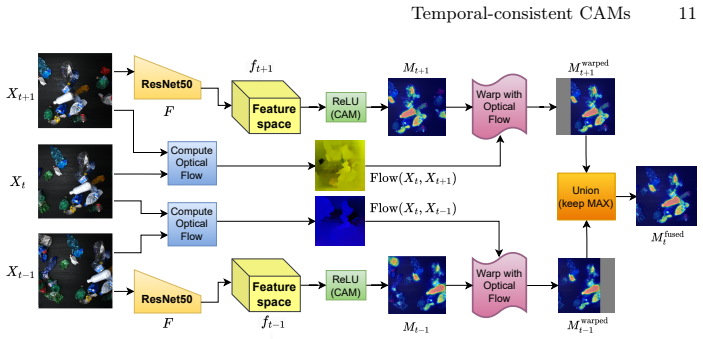
The load-bearing mechanism is a temporal reconstruction loss applied to class activation maps, the saliency maps that highlight the image regions most responsible for a classifier's prediction. For each triplet of consecutive frames $X_{t-1}, X_t, X_{t+1}$, the network computes normalized maps $M_{t-1}, M_t, M_{t+1}$ as the ReLU of the target class channel of the feature space. Optical flow between $X_t$ and each neighbor warps the lateral maps into the central frame's coordinates, and the two warped maps are fused by pixel-wise maximum into $M_t^{\mathrm{fused}}$. The temporal loss $\mathcal{L}_{\mathrm{temporal}} = \|M_t - M_t^{\mathrm{fused}}\|_1$ pushes the central map to agree with its motion-compensated neighbors. The total loss is $\mathcal{L}_{\mathrm{total}} = \mathcal{L}_{\mathrm{cls}} + \mathcal{L}_{\mathrm{p-cls}} + \alpha\mathcal{L}_{\mathrm{spatial}} + \beta\mathcal{L}_{\mathrm{temporal}}$, combining the classification losses with the PuzzleCAM spatial reconstruction loss $\mathcal{L}_{\mathrm{spatial}} = \|f_t - f_t^{\mathrm{puzzle}}\|_1$ and the temporal reconstruction loss.
What would settle it
Recompute the background estimator using only the training split of SERUSO and rerun the full pipeline; if the mIoU gap over PuzzleCAM shrinks sharply, the reported gain came from test-set statistics rather than temporal coherence, and if shuffling frame order while keeping optical flow warping does not lower mIoU, the temporal reconstruction loss is not the active ingredient.
Extended reading notes
Core claim
The paper's central claim is that temporal coherence belongs in the training phase of a weakly supervised segmentation classifier, not only in post-processing. The authors train an auxiliary classifier to distinguish 'before' videos (with illegal objects) from 'after' videos (without them) and use its class activation maps as segmentation masks. They add a temporal module that warps the saliency maps of frames $X_{t-1}$ and $X_{t+1}$ into the central frame's coordinate system using optical flow, fuses them with a pixel-wise maximum, and penalizes the $\ell^1$ distance between this fused map and the central frame's own map. Combined with PuzzleCAM's spatial reconstruction loss, this pushes the network to activate the same object regions consistently as they move. On the SERUSO dataset the combined model attains 37.84 mIoU on the 'before' class, and the ablation shows that temporal and spatial modules complement each other.
Load-bearing premise
The background is estimated as the pixel-wise median of all grayscale frames under a fixed threshold, and the method assumes this cleanly separates foreground objects using only training frames without leaking object or lighting cues.
Editorial extensions
If this is right
- On SERUSO, the full method reaches 37.84 mIoU on the 'before' class, versus 34.20 for PuzzleCAM and 22.08 for GradCAM.
- The ablation shows 24.08 mIoU with no reconstruction loss, 29.23 with only the temporal module, 34.20 with only the spatial module, and 37.84 with both, indicating the two coherence mechanisms are complementary.
- Removing backgrounds and classifying into before/after/background improves classifier transfer: a classifier trained on background-free images keeps high accuracy on both background-free and original test images, while one trained with backgrounds loses accuracy when backgrounds are removed.
- The method cannot run on ZeroWaste-w because that dataset provides static 'after' images, so temporal training requires videos for both classes.
Reading between the lines
- A natural test of the method's internal logic is to replace the temporal reconstruction loss with a loss comparing each frame to a randomly chosen other frame; if the gain persists, temporal consistency per se is not the active ingredient.
- The background estimation step, based on the pixel-wise median of all grayscale frames with a fixed threshold, is not explicitly validated on a training-only split; an experiment that recomputes the background from the training set alone would clarify whether the reported gains are inflated by test-frame statistics.
- The saliency maps produced here could serve as pseudo-labels to train a fully supervised segmentation network, following the authors' stated future work; this would measure whether temporal consistency during classifier training translates into better downstream masks.
Editorial analysis
A structured set of objections, weighed in public.
Referee Report
Summary. The paper proposes a weakly supervised video segmentation method for waste sorting. It trains an auxiliary classifier on before/after videos, derives segmentation masks from CAMs, and augments the training loss with a temporal reconstruction term that warps saliency maps from adjacent frames via optical flow and enforces agreement with the central frame, alongside the spatial consistency loss of PuzzleCAM. Experiments on the authors' SERUSO dataset and on ZeroWaste-w compare GradCAM, Frame-to-Frame, and PuzzleCAM, and an ablation isolates the spatial and temporal components. The central claim is that integrating temporal coherence during classifier training improves segmentation mIoU over spatial-only CAM methods, with the reported best result being 37.84 versus 34.20 for PuzzleCAM on SERUSO.
Significance. If the reported results survive a leakage-free evaluation, the contribution is a modest but useful addition to weakly supervised video segmentation: a training-time temporal coherence loss on CAMs, with a clean ablation suggesting that the spatial and temporal modules are complementary. The industrial motivation is clear and the external ZeroWaste-w comparison is a strength, as is the ablation isolating each loss component. However, the paper does not provide public code or data, and the empirical evidence currently lacks error bars, a precise description of the data split, and a specification of the background-estimation protocol. These gaps directly affect the credibility of the central temporal-coherence claim, so the significance of the result is not yet established.
major comments (4)
- [§5.2, §5.1] The 80/20 split is described only as a split of the dataset, and the paper never states that the split is video-level. Since SERUSO consists of 68 videos and 3,682 images, a random frame-level split would place frames from the same video, and hence the same object instances and temporal tracks, in both training and validation. The temporal module is trained to reconstruct the central saliency map from adjacent frames, so it could memorize the very sequences used for evaluation. This would differentially inflate the reported temporal gains in Table 1. Please re-run the experiments under a video-level split (e.g., holding out whole videos) and state the exact split protocol, including how the 364 manually labeled test images are selected.
- [§4.1] The background estimator is computed as the pixel-wise median 'across all grayscale frames,' without specifying whether this includes validation or test frames. If the median is computed over the entire dataset, the background and the foreground masks for each frame depend on statistics of the very frames being evaluated, including lighting changes and object presence. This leakage is common to all compared methods, but it can interact with the temporal module differently because the temporal module uses the masked frames for optical flow computation and warping. Specify that the background is estimated from training videos only, give the numerical threshold used to define 'significantly different,' and report the sensitivity of Tables 1 and 2 to that threshold.
- [Tables 1 and 2, §5.2] All quantitative claims rest on a single 80/20 split and, apparently, a single training run. The differences at stake are small (37.84 versus 34.20 mIoU for the main comparison; 29.23 versus 24.08 in the temporal-only ablation), and no error bars, number of seeds, or significance tests are reported. Without variance estimates, the reader cannot tell whether the temporal improvement is robust or split-dependent. Add results over multiple seeds and report mean ± standard deviation, or use a paired evaluation across multiple splits.
- [§2, Table 1] The comparison omits the most relevant temporal-CAM baselines discussed in the paper itself, namely T-CAM [3] and CoLo-CAM [4]. The caption of Table 1 claims that the proposed model outperforms 'all other CAM-based methods,' but only GradCAM, Frame-to-Frame, and PuzzleCAM are evaluated. If T-CAM and CoLo-CAM are not applicable to the segmentation setting or to SERUSO, this should be stated explicitly; otherwise they should be included. This is directly relevant to the central claim that integrating temporal coherence during training is superior to post-hoc temporal aggregation.
minor comments (6)
- [§4.4, after Eq. (11)] The phrase 'to be closed of the reconstructed one' should read 'to be close to the reconstructed one'; please proofread the manuscript for similar grammatical errors.
- [§4.2, Eqs. (3)–(5)] The symbol z is used both for the prediction vector in Eq. (3) and for the 'true label vector' in the sentence after Eq. (5). Use distinct symbols (for example, z for the prediction and y_true for the label vector) to avoid confusion.
- [§4.1] The sentence 'by inverting the binary masks, we generated a new set of images containing only background elements' is imprecise about how the background-only images are constructed and whether they are used for classifier training, for evaluation, or both. Clarify this step and its role in the three-class formulation.
- [Table 1] The entry 'Impossible' in the ZEROWASTE column should be replaced with a dash or 'not applicable,' with a note in the text explaining that the after-class data in ZeroWaste-w are static and therefore do not support training the temporal module. The current label could be misread as a failed experimental result.
- [Figures 2 and 3, Section 3] The two-class formulation in Eq. (1) and Fig. 2a (illegal versus background) is not fully aligned with the three-class formulation introduced in Section 4.1 and Fig. 3b (before, after, background). Reconcile these notations so that the class labels Λ and Λ-hat are used consistently.
- [Abstract, §5.1] The statement that code and dataset are 'available upon request' is not a public release and prevents independent verification. If the journal's policy requires reproducibility, provide a public link or a detailed implementation protocol so that the reported numbers can be checked.
Circularity Check
No circularity: the temporal and spatial losses are self-consistency regularizers, and the central comparison is against external baselines.
full rationale
The paper's derivation chain is not circular. The auxiliary classifier is trained with classification losses Lcls and Lp-cls on before/after/background classes, and the spatial and temporal reconstruction losses (Lspatial = ||ft - f_puzzle_t||1, Ltemporal = ||Mt - M_fused_t||1) are self-consistency regularizers that encourage the classifier's saliency maps to be coherent across image patches and across time. These losses do not encode the evaluation labels or the reported mIoU values; they only constrain the network's internal consistency. The central claim, that temporal coherence during training improves weakly supervised video segmentation, is supported by comparisons against external baselines (GradCAM, Frame-to-Frame, PuzzleCAM) in Table 1 and by an ablation study in Table 2. No fitted parameter is renamed as a prediction, and no load-bearing self-citation chain is present: PuzzleCAM [17] and DICL-Flow [36] are external components adopted as modules, not used to justify the paper's own conclusion. The possible evaluation-protocol concern that the background median in Section 4.1 may be computed over all frames before the train/validation split is a data-leakage/soundness issue, not a circularity issue, because it does not make any equation reduce to its input by construction. Therefore the paper exhibits no significant circularity.
Assumptions & free parameters
free parameters (3)
- alpha and beta regularization weights =
max 4, linearly ramped from 0 after the first epoch
- Background foreground threshold =
not specified
- Training hyperparameters (optimizer, learning rate, batch size, epochs)
assumptions (4)
- domain assumption Video-level before/after labels are sufficient for the auxiliary classifier's saliency maps to localize illegal objects.
- domain assumption Optical flow (DICL-FLow) accurately compensates object displacement between consecutive frames under conveyor belt motion and partial occlusions.
- ad hoc to paper Pixel-wise max fusion of two warped adjacent maps is a valid reconstruction target for the central saliency map.
- domain assumption The median background image computed over all grayscale frames and a fixed distance threshold separate foreground objects from background without using test data.
Cite this review
Pith. "Pith review of Temporal-consistent CAMs for Weakly Supervised Video Segmentation in Waste Sorting." pith.science (2026). https://pith.science/paper/MRXKNWJF
@misc{pith2026250201455,
  author       = {Pith},
  title        = {Pith review of: Temporal-consistent CAMs for Weakly Supervised Video Segmentation in Waste Sorting},
  year         = {2026},
  howpublished = {\url{https://pith.science/paper/MRXKNWJF}},
  note         = {Machine review of arXiv:2502.01455}
}
read the original abstract
In industrial settings, weakly supervised (WS) methods are usually preferred over their fully supervised (FS) counterparts as they do not require costly manual annotations. Unfortunately, the segmentation masks obtained in the WS regime are typically poor in terms of accuracy. In this work, we present a WS method capable of producing accurate masks for semantic segmentation in the case of video streams. More specifically, we build saliency maps that exploit the temporal coherence between consecutive frames in a video, promoting consistency when objects appear in different frames. We apply our method in a waste-sorting scenario, where we perform weakly supervised video segmentation (WSVS) by training an auxiliary classifier that distinguishes between videos recorded before and after a human operator, who manually removes specific wastes from a conveyor belt. The saliency maps of this classifier identify materials to be removed, and we modify the classifier training to minimize differences between the saliency map of a central frame and those in adjacent frames, after having compensated object displacement. Experiments on a real-world dataset demonstrate the benefits of integrating temporal coherence directly during the training phase of the classifier. Code and dataset are available upon request.
Figures


Figures from the paper (6 more)



Reference graph
Works this paper leans on
-
[3]
In: Proceedings of the IEEE/CVF Winter Conference on Applications of Computer Vision
Belharbi, S., Ben Ayed, I., McCaffrey, L., Granger, E.: Tcam: Temporal class ac- tivation maps for object localization in weakly-labeled unconstrained videos. In: Proceedings of the IEEE/CVF Winter Conference on Applications of Computer Vision. pp. 137–146 (2023)
work page 2023
-
[4]
arXiv preprint arXiv:2303.09044 (2023)
Belharbi, S., Murtaza, S., Pedersoli, M., Ayed, I.B., McCaffrey, L., Granger, E.: Colo-cam: Class activation mapping for object co-localization in weakly-labeled unconstrained videos. arXiv preprint arXiv:2303.09044 (2023)
arXiv 2023
-
[1]
Adeyinka, A.A., Adebiyi, M.O., Akande, N.O., Ogundokun, R.O., Kayode, A.A., Oladele, T.O.: A deep convolutional encoder-decoder architecture for retinal blood vesselssegmentation.In:ComputationalScienceandItsApplications–ICCSA2019: 19th International Conference, Saint Petersburg, Russia, July 1–4, 2019, Proceed- ings, Part V 19. pp. 180–189. Springer (2019)
work page 2019
-
[2]
In: Proceedings of the IEEE/CVF Con- ference on Computer Vision and Pattern Recognition
Bashkirova, D., Abdelfattah, M., Zhu, Z., Akl, J., Alladkani, F., Hu, P., Ablavsky, V., Calli, B., Bargal, S.A., Saenko, K.: Zerowaste dataset: Towards deformable object segmentation in cluttered scenes. In: Proceedings of the IEEE/CVF Con- ference on Computer Vision and Pattern Recognition. pp. 21147–21157 (2022)
work page 2022
-
[5]
Caesar, H., Uijlings, J., Ferrari, V.: Region-based semantic segmentation with end- to-end training. In: Computer Vision–ECCV 2016: 14th European Conference, Amsterdam, The Netherlands, October 11–14, 2016, Proceedings, Part I 14. pp. 381–397. Springer (2016)
work page 2016
-
[6]
In: Proceedings of the European conference on computer vision (ECCV)
Chen, L.C., Zhu, Y., Papandreou, G., Schroff, F., Adam, H.: Encoder-decoder with atrous separable convolution for semantic image segmentation. In: Proceedings of the European conference on computer vision (ECCV). pp. 801–818 (2018)
2018
-
[7]
In: Proceedings of the IEEE interna- tional conference on computer vision
Dai, J., He, K., Sun, J.: Boxsup: Exploiting bounding boxes to supervise convolu- tional networks for semantic segmentation. In: Proceedings of the IEEE interna- tional conference on computer vision. pp. 1635–1643 (2015)
2015
-
[8]
In: Proceedings of the IEEE conference on computer vision and pattern recognition
Dai, J., He, K., Sun, J.: Convolutional feature masking for joint object and stuff segmentation. In: Proceedings of the IEEE conference on computer vision and pattern recognition. pp. 3992–4000 (2015)
work page 2015
Show all 44 references
-
[9]
Sensors23(7) (2023)
Fan, J., Cui, L., Fei, S.: Waste detection system based on data augmentation and yolo ec. Sensors23(7) (2023). https://doi.org/10.3390/s23073646, https: //www.mdpi.com/1424-8220/23/7/3646
2023 doi
-
[10]
In: Proceedings of the IEEE conference on computer vision and pattern recognition
Girshick, R., Donahue, J., Darrell, T., Malik, J.: Rich feature hierarchies for ac- curate object detection and semantic segmentation. In: Proceedings of the IEEE conference on computer vision and pattern recognition. pp. 580–587 (2014)
2014
-
[11]
Waste Management 60, 56–74 (2017)
Gundupalli, S.P., Hait, S., Thakur, A.: A review on automated sorting of source- separated municipal solid waste for recycling. Waste Management 60, 56–74 (2017). https://doi.org/https://doi.org/10.1016/j.wasman.2016.09.015 , https://www.sciencedirect.com/science/article/pii/S...
2017 doi
-
[12]
In: Computer Vision–ECCV 2014: 13th European Conference, Zurich, Switzerland, September 6-12, 2014, Proceedings, Part VII 13
Hariharan, B., Arbeláez, P., Girshick, R., Malik, J.: Simultaneous detection and segmentation. In: Computer Vision–ECCV 2014: 13th European Conference, Zurich, Switzerland, September 6-12, 2014, Proceedings, Part VII 13. pp. 297–312. Springer (2014)
2014
-
[13]
Hong, J., Fulton, M.S., Sattar, J.: Trashcan 1.0 an instance-segmentation labeled dataset of trash observations (2020)
2020
-
[14]
Advances in neural information processing systems31 (2018) 16 A
Hou, Q., Jiang, P., Wei, Y., Cheng, M.M.: Self-erasing network for integral object attention. Advances in neural information processing systems31 (2018) 16 A. Marelli et al
2018
-
[15]
In: Proceedings of the IEEE conference on computer vision and pattern recognition
Huang, Z., Wang, X., Wang, J., Liu, W., Wang, J.: Weakly-supervised semantic segmentation network with deep seeded region growing. In: Proceedings of the IEEE conference on computer vision and pattern recognition. pp. 7014–7023 (2018)
2018
-
[16]
In: Proceedings of the IEEE Conference on Computer Vision and Pattern Recognition
Jin, B., Ortiz Segovia, M.V., Susstrunk, S.: Webly supervised semantic segmen- tation. In: Proceedings of the IEEE Conference on Computer Vision and Pattern Recognition. pp. 3626–3635 (2017)
2017
-
[17]
In: 2021 IEEE international conference on image processing (ICIP)
Jo, S., Yu, I.J.: Puzzle-cam: Improved localization via matching partial and full features. In: 2021 IEEE international conference on image processing (ICIP). pp. 639–643. IEEE (2021)
2021
-
[18]
In: Proceedings of the IEEE con- ference on computer vision and pattern recognition
Khoreva,A.,Benenson,R.,Hosang,J.,Hein,M.,Schiele,B.:Simpledoesit:Weakly supervised instance and semantic segmentation. In: Proceedings of the IEEE con- ference on computer vision and pattern recognition. pp. 876–885 (2017)
2017
-
[19]
In: Computer Vision–ECCV 2016: 14th European Conference, Amsterdam, The Netherlands, October 11–14, 2016, Pro- ceedings, Part IV 14
Kolesnikov, A., Lampert, C.H.: Seed, expand and constrain: Three principles for weakly-supervised image segmentation. In: Computer Vision–ECCV 2016: 14th European Conference, Amsterdam, The Netherlands, October 11–14, 2016, Pro- ceedings, Part IV 14. pp. 695–711. Springer (2016)
2016
-
[20]
IEEE Robotics and Au- tomation Magazine 28(2), 50–60 (2021)
Koskinopoulou, M., Raptopoulos, F., Papadopoulos, G., Mavrakis, N., Maniadakis, M.: Robotic waste sorting technology: Toward a vision-based categorization system for the industrial robotic separation of recyclable waste. IEEE Robotics and Au- tomation Magazine 28(2), 50–60 (20...
2021 doi
-
[21]
In: 2022 31st Conference of Open Innovations Association (FRUCT)
Kumsetty, N.V., Nekkare, A.B., Kamath, S., et al.: Trashbox: trash detection and classification using quantum transfer learning. In: 2022 31st Conference of Open Innovations Association (FRUCT). pp. 125–130. IEEE (2022)
2022
-
[22]
In: Proceedings of the IEEE/CVF conference on computer vision and pattern recognition
Lee, J., Kim, E., Lee, S., Lee, J., Yoon, S.: Ficklenet: Weakly and semi-supervised semantic image segmentation using stochastic inference. In: Proceedings of the IEEE/CVF conference on computer vision and pattern recognition. pp. 5267–5276 (2019)
2019
-
[23]
In: Proceedings of the IEEE/CVF International Conference on Computer Vision
Lee, J., Kim, E., Lee, S., Lee, J., Yoon, S.: Frame-to-frame aggregation of active regions in web videos for weakly supervised semantic segmentation. In: Proceedings of the IEEE/CVF International Conference on Computer Vision. pp. 6808–6818 (2019)
2019
-
[24]
In: Proceedings of the IEEE conference on computer vision and pattern recognition
Lin, D., Dai, J., Jia, J., He, K., Sun, J.: Scribblesup: Scribble-supervised convolu- tional networks for semantic segmentation. In: Proceedings of the IEEE conference on computer vision and pattern recognition. pp. 3159–3167 (2016)
2016
-
[25]
In: Proceedings of the IEEE international conference on computer vision
Noh, H., Hong, S., Han, B.: Learning deconvolution network for semantic segmen- tation. In: Proceedings of the IEEE international conference on computer vision. pp. 1520–1528 (2015)
2015
-
[26]
In: Proceedings of the IEEE international conference on computer vision
Papandreou, G., Chen, L.C., Murphy, K.P., Yuille, A.L.: Weakly-and semi- supervised learning of a deep convolutional network for semantic image segmenta- tion. In: Proceedings of the IEEE international conference on computer vision. pp. 1742–1750 (2015)
2015
-
[27]
arXiv preprint arXiv:2003.06975 (2020)
Proença, P.F., Simoes, P.: Taco: Trash annotations in context for litter detection. arXiv preprint arXiv:2003.06975 (2020)
2020 arXiv
-
[28]
In: Iberian Conference on Pattern Recognition and Image Analysis
Sánchez-Ferrer, A., Gallego, A.J., Valero-Mas, J.J., Calvo-Zaragoza, J.: The cleansea set: a benchmark corpus for underwater debris detection and recognition. In: Iberian Conference on Pattern Recognition and Image Analysis. pp. 616–628. Springer (2022)
2022
-
[29]
In: Temporal-consistent CAMs 17 Proceedings of the IEEE international conference on computer vision
Selvaraju, R.R., Cogswell, M., Das, A., Vedantam, R., Parikh, D., Batra, D.: Grad- cam: Visual explanations from deep networks via gradient-based localization. In: Temporal-consistent CAMs 17 Proceedings of the IEEE international conference on computer vision. pp. 618–626 (2017)
2017
-
[30]
Advances in Neural Information Processing Systems33, 13927–13938 (2020)
Shen, D., Ji, Y., Li, P., Wang, Y., Lin, D.: Ranet: Region attention network for semantic segmentation. Advances in Neural Information Processing Systems33, 13927–13938 (2020)
2020
-
[31]
In: Proceedings of the IEEE/CVF international conference on computer vision
Shimoda, W., Yanai, K.: Self-supervised difference detection for weakly-supervised semantic segmentation. In: Proceedings of the IEEE/CVF international conference on computer vision. pp. 5208–5217 (2019)
2019
-
[32]
In: Proceedings of the IEEE/CVF Conference on Computer Vision and Pattern Recog- nition
Song, C., Huang, Y., Ouyang, W., Wang, L.: Box-driven class-wise region mask- ing and filling rate guided loss for weakly supervised semantic segmentation. In: Proceedings of the IEEE/CVF Conference on Computer Vision and Pattern Recog- nition. pp. 3136–3145 (2019)
2019
-
[33]
In: Computer Vision–ECCV 2020: 16th Euro- pean Conference, Glasgow, UK, August 23–28, 2020, Proceedings, Part II 16
Sun, G., Wang, W., Dai, J., Van Gool, L.: Mining cross-image semantics for weakly supervised semantic segmentation. In: Computer Vision–ECCV 2020: 16th Euro- pean Conference, Glasgow, UK, August 23–28, 2020, Proceedings, Part II 16. pp. 347–365. Springer (2020)
2020
-
[34]
In: Proceedings of the IEEE conference on computer vision and pattern recognition
Tang, M., Djelouah, A., Perazzi, F., Boykov, Y., Schroers, C.: Normalized cut loss for weakly-supervised cnn segmentation. In: Proceedings of the IEEE conference on computer vision and pattern recognition. pp. 1818–1827 (2018)
2018
-
[35]
In: Proceedings of the IEEE conference on com- puter vision and pattern recognition
Vernaza, P., Chandraker, M.: Learning random-walk label propagation for weakly- supervised semantic segmentation. In: Proceedings of the IEEE conference on com- puter vision and pattern recognition. pp. 7158–7166 (2017)
2017
-
[36]
Advances in Neural Information Processing Systems33, 15220–15231 (2020)
Wang, J., Zhong, Y., Dai, Y., Zhang, K., Ji, P., Li, H.: Displacement-invariant matching cost learning for accurate optical flow estimation. Advances in Neural Information Processing Systems33, 15220–15231 (2020)
2020
-
[37]
Sensors 20(14), 3816 (2020)
Wang, T., Cai, Y., Liang, L., Ye, D.: A multi-level approach to waste object seg- mentation. Sensors 20(14), 3816 (2020)
2020
-
[38]
In: Proceedings of the IEEE conference on computer vision and pattern recognition
Wei, Y., Feng, J., Liang, X., Cheng, M.M., Zhao, Y., Yan, S.: Object region min- ing with adversarial erasing: A simple classification to semantic segmentation ap- proach. In: Proceedings of the IEEE conference on computer vision and pattern recognition. pp. 1568–1576 (2017)
2017
-
[39]
In: Proceedings of the IEEE conference on computer vision and pattern recognition
Wei, Y., Xiao, H., Shi, H., Jie, Z., Feng, J., Huang, T.S.: Revisiting dilated convolu- tion: A simple approach for weakly-and semi-supervised semantic segmentation. In: Proceedings of the IEEE conference on computer vision and pattern recognition. pp. 7268–7277 (2018)
2018
-
[40]
Advances in neural information processing systems34, 12077–12090 (2021)
Xie, E., Wang, W., Yu, Z., Anandkumar, A., Alvarez, J.M., Luo, P.: Segformer: Simple and efficient design for semantic segmentation with transformers. Advances in neural information processing systems34, 12077–12090 (2021)
2021
-
[41]
CS229 project report 2016(1), 3 (2016)
Yang, M., Thung, G.: Classification of trash for recyclability status. CS229 project report 2016(1), 3 (2016)
2016
-
[42]
In: Proceedings of the IEEE conference on computer vision and pattern recognition
Zhang, X., Wei, Y., Feng, J., Yang, Y., Huang, T.S.: Adversarial complementary learning for weakly supervised object localization. In: Proceedings of the IEEE conference on computer vision and pattern recognition. pp. 1325–1334 (2018)
2018
-
[43]
In: Proceedings of the European conference on computer vision (ECCV)
Zhang, Z., Zhang, X., Peng, C., Xue, X., Sun, J.: Exfuse: Enhancing feature fu- sion for semantic segmentation. In: Proceedings of the European conference on computer vision (ECCV). pp. 269–284 (2018)
2018
-
[44]
In: Proceedings of the IEEE conference on computer vision and pattern recognition
Zhou, B., Khosla, A., Lapedriza, A., Oliva, A., Torralba, A.: Learning deep features for discriminative localization. In: Proceedings of the IEEE conference on computer vision and pattern recognition. pp. 2921–2929 (2016)
2016
Reviewed August 9, 2026 · model on record in the stance chip above.
Discussion (0). Continue with ORCID to comment.