REVIEW 3 major objections 5 minor 1 cited by
Sea-cret Agents: Maritime Abduction for Region Generation to Expose Dark Vessel Trajectories
T0 review · 3 major / 5 minor · reviewed 2026-08-09 · deepseek-v4-flash
Pith's one-line read An abduction-based logic method can locate nearly all simulated dark vessels while searching about 30 km², less than half the area deep-learning baselines need.
desk verdict A promising abduction-based region generator, but the headline recall hinges on a train/test split the paper never actually describes. read the letter →
The pith
A machine-rendered reading of the paper's core claim, the machinery that carries it, and where it could break.
The reading
What carries the argument
The load-bearing mechanism is a top-k abductive inference query over a temporal annotated logic program. The paper defines a logical language in which vessel positions are represented as temporally annotated facts of the form at(agent, region) with confidence intervals, and behavior is captured by learned rules such as 'a vessel that moves from a near-port region to a high-hotspot region is normal with confidence at least 0.8.' A parsimony function measures an agent's normalcy from the minimal model of the program, and the explanation function returns the k regions that best explain the observed partial trajectory. Those k regions are the predicted dark-vessel search locations. Rule learning is deliberately simple: it counts region-to-region transitions in historical trajectories and constructs single-hop and multi-hop rules, which keeps the system data-efficient and makes every output region traceable to a rule.
What would settle it
Run the method on a held-out set of genuinely dark vessels whose true positions are independently confirmed, for example by Doppler-based tagging or satellite imagery, and compute recall at the 30 km² threshold; the central claim is falsified if the recall on these real dark trajectories is substantially below the 0.99 obtained on masked normal trajectories.
Extended reading notes
Core claim
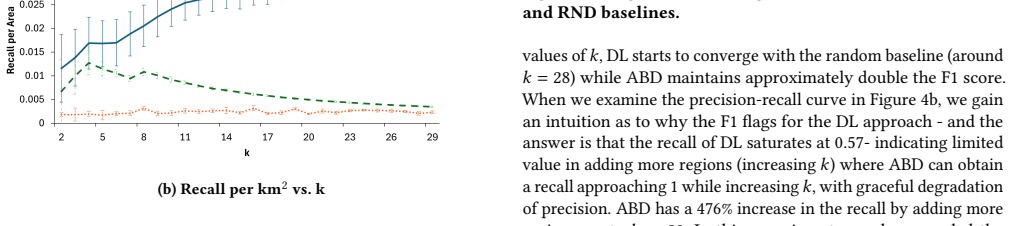
On the paper's own terms, the central claim is that dark-vessel search can be reformulated as an abductive inference problem over symbolic regions, and that this formulation outperforms machine-learning baselines on the metrics that matter operationally. Masking the second half of real AIS trajectories to stand in for the unknown dark future, the authors report that their abduction method (ABD) saturates at 0.99 recall with a 30 km² search area, a 157% higher recall than the deep-learning (DL) baseline at the same area, while DL saturates at 0.57 recall with 81.75 km². Recall per square kilometer rises monotonically with the number of returned regions for ABD but falls for DL; up to k=30 regions, ABD gains 476% in recall, and it maintains roughly double the F1 score of DL at high k. The method also yields long-horizon predictions where DL flattens, degrades only slightly under different masking strategies, and retains precision of 0.62 even when trained on a single trajectory. The authors present this as evidence that a logic-based, explainable approach can replace or complement deep learning for dark-vessel detection.
Load-bearing premise
The evaluation assumes that the second half of a normal AIS trajectory, which the authors hide from the model, behaves like the future of a vessel that deliberately switched off its transmitter; if real dark vessels travel along unusual routes, the measured recall may not transfer to actual operations.
Editorial extensions
If this is right
- An analyst searching for a dark vessel can cover nearly all simulated target locations with about 30 km², less than half the area a deep-learning baseline needs for a lower recall.
- Additional search resources translate into continued recall gains for the abduction method, so adding regions does not hit the plateau that caps machine-learning baselines.
- Because a single training trajectory gives precision close to the full data set, the method is usable in regions where historical AIS coverage is sparse.
- Each generated region can be traced back to the learned behavior rule and confidence, giving operators a defensible rationale for tasking surveillance assets.
- The same abduction framework extends beyond the one-hour horizon typical of trajectory-prediction models, maintaining performance over multiple future time units.
Reading between the lines
- The masked-trajectory evaluation assumes that the unseen second half of a normal voyage is a faithful proxy for where a vessel would go after deliberately going dark; real dark vessels may instead avoid the very hotspots the rules encode, so the 0.99 recall should be treated as an upper bound until confirmed on more externally verified AIS-off tracks.
- The same abduction-plus-rule-learning pipeline is domain-agnostic: any setting where an agent's transmitter can be silenced and a historical behavior model exists, such as aircraft transponder-off tracking or lost wildlife telemetry, could reuse the region-generation and top-k query machinery.
- If adversarial vessels adapt to evade the learned rules, the static rule set would need periodic retraining or an explicit adversarial model; the paper acknowledges this direction but does not solve it.
- A hybrid design that uses the abduction regions as a spatial prior and a short-horizon deep model for near-term precision could combine the strengths of both, though the paper only hints at such a neurosymbolic extension.
Editorial analysis
A structured set of objections, weighed in public.
Referee Report
Summary. The paper presents a logic-based abductive reasoning method for generating candidate search regions for maritime vessels that have switched off their AIS transmitters. The approach represents vessel trajectories as temporally annotated logic facts, learns a behavior model as a set of single-hop and multi-hop rules from historical AIS data, and then computes top-k candidate regions via abductive inference. The authors evaluate the method on masked normal AIS trajectories (the second half being hidden as simulated ground truth), compare it against a sequence-to-sequence RNN baseline and a random baseline, and report that the abduction method reaches recall 0.99 at 30 km2 of search area, outperforming the deep learning baseline and maintaining or improving performance as k grows. They also report data-efficiency experiments, ablations on rule types and masking strategies, runtime scaling, and a deployment architecture. Appendix B describes four externally confirmed dark-vessel trajectories used for an additional validation.
Significance. If the reported results transfer to real dark-vessel detection, the method would be practically valuable because it offers explainable, long-horizon candidate regions with better area efficiency than the tested ML baselines. The paper's formal framing of top-k region generation as abduction, the linear-time rule learner, and the deployment prototype are useful contributions. The data-efficiency result (0.62 precision with a single training trajectory) is striking, as is the ablation showing graceful degradation across masking strategies. However, the significance depends on a clean train/test separation and on the proxy assumption that masked normal AIS futures approximate dark-vessel behavior; neither is currently established with enough rigor to support the paper's central recall claims.
major comments (3)
- [Section 4, Setup and Algorithm 1] The paper never specifies a train/test split. Algorithm 1 learns rule confidences by counting region bigrams over a set of trajectories T, and the Methods text says the abduction method 'uses training data to obtain a set of regions' from which rules are learned. If the same trajectories that are later masked for evaluation (or even the unmasked halves of those trajectories) contribute to the counts in Algorithm 1, then the learned confidence for the transition from a test trajectory's unmasked segment to its masked segment is derived from the exact test outcome. In that case, the reported recall of 0.99 at 30 km2 in Section 4.1 would reflect memorization rather than generalization. Please state precisely how the 614 vessels were partitioned into training and test sets (e.g., disjoint vessels, disjoint time windows), and confirm that no portion of any test trajectory, including its masked future half, is used in Algorithm 1 or in the region-generation step.
- [Section 4, Setup, and Appendix B] The central claim about dark-vessel detection rests on a proxy: the second half of a normal AIS trajectory, obtained by masking, is treated as the dark-vessel ground truth. The paper acknowledges this limitation in Appendix B but the four externally confirmed dark trajectories are not evaluated with the same metrics. Table 2 reports only the area needed to cover Doppler-tagged activity and its fraction of the search space; it does not report recall, precision, F1, or any comparison against the DL/RND baselines. As written, this external validation is too weak to show that the high recall transfers to actual dark vessels. Please add per-case precision/recall/F1 using the same k values and baselines, or explicitly limit the headline claims to the masked-proxy setting.
- [Section 4, Methods and Section 4.1] The comparison against machine learning uses a single sequence-to-sequence RNN baseline (plus random), with no error bars, multiple random seeds, or multiple initializations. Figures 4 and 5 report pointwise comparisons, and the text states ABD provides on average a 51% increase over DL, but the absence of variance information makes it impossible to assess whether the gap is significant. Since the paper's central claim is that the abduction method 'requires less search area than machine learning methods,' the baseline comparison should include at least one additional recent trajectory-prediction method and report standard deviations or confidence intervals over repeated runs.
minor comments (5)
- [Author affiliations] The affiliation line reads 'Arizona State Universty' in all three author blocks; it should be 'Arizona State University'.
- [References] References [26] and [27] are the same paper (Mathew, Raposo, and Martins, 2012), and references [47] and [48] are also the same paper (Zhang et al., 2022). Please deduplicate them.
- [Algorithm 1] The notation 'Ó_{m∈moves} m(agt)' in line 8 is not a standard logical conjunction; it should be replaced with an explicit conjunction symbol such as '∧_{m∈moves} m(agt)'.
- [Section 4.1, Area Efficiency] The phrase '157% higher recall' should be anchored to the DL recall value at exactly 30 km2; stating only the saturation recall of DL (0.57 at 81.75 km2) makes the percentage hard to verify.
- [Section 4.1, Vessel Recall and Accuracy] The statement 'ABD has a 476% increase in the recall by adding more regions up to k = 30' would be clearer if the baseline k value and the corresponding recall values were given explicitly.
Circularity Check
No demonstrated circularity: rules are learned from training data and tested on masked futures; self-citations supply formalism but do not force the empirical claim.
full rationale
The paper's claimed derivation is not circular as written. Algorithm 1 learns single-hop behavior rules by counting region-to-region co-occurrences in a training set; Section 4 then masks each test trajectory, uses the unmasked half as Π_init, and evaluates whether top-k abduced regions cover the masked half. The recall figure is therefore an empirical match against separately described masked trajectories, not a consequence of the rule-learning equations: nothing in the definition of σ or f_2 injects the masked ground truth into the scoring function. The heavy citation of the authors' own temporal-logic work ([2,5,38,40]) supplies the annotated-logic formalism, the PyReason reasoner, and the abduction-for-trajectories idea, but these are background machinery rather than a uniqueness theorem that forces the maritime results; the area-efficiency comparisons against DL/RND and the four externally confirmed dark-vessel cases in Appendix B provide independent content. One caveat deserves explicit flagging: the paper never states the train/test split used for the masked-trajectory evaluation; if a test trajectory's masked second half were included in the data scanned by Algorithm 1, the reported 0.99 recall would be inflated by memorization. However, the text consistently uses 'training data' and 'test trajectory' as distinct objects, and the appendix's external dark-vessel test is at least partially independent, so this is an omitted methodological detail and a reproducibility risk rather than a demonstrated reduction of the prediction to its inputs. Score 2 reflects the minor self-citations and the unstated split caveat, not a proven circular derivation.
Assumptions & free parameters
free parameters (4)
- region size =
0.025 degrees x 0.025 degrees (5.45 km^2) default, 1.1 km^2 for SM
- DBSCAN clustering parameters =
not specified, yields 9 clusters
- hand-defined feature predicates =
nearport, change-direction, high-speed, low-speed, hotspot, draught, ais-off, stay
- rule confidence values =
empirical frequencies from training data, e.g., 0.8, 0.9 in Table 1
assumptions (4)
- standard math Annotated temporal logic semantics and minimal model fixpoint from [17,38,40] are correct and applicable.
- domain assumption Historical AIS trajectories from normal vessels are representative of dark vessel behavior.
- domain assumption The predefined region grid and feature predicates capture the behavior relevant to vessel movement prediction.
- domain assumption Vessels are grouped by DBSCAN into clusters such that within-cluster behavior is homogeneous enough for transfer.
Cite this review
Pith. "Pith review of Sea-cret Agents: Maritime Abduction for Region Generation to Expose Dark Vessel Trajectories." pith.science (2026). https://pith.science/paper/JWHWGIIA
@misc{pith2026250201503,
  author       = {Pith},
  title        = {Pith review of: Sea-cret Agents: Maritime Abduction for Region Generation to Expose Dark Vessel Trajectories},
  year         = {2026},
  howpublished = {\url{https://pith.science/paper/JWHWGIIA}},
  note         = {Machine review of arXiv:2502.01503}
}
read the original abstract
Bad actors in the maritime industry engage in illegal behaviors after disabling their vessel's automatic identification system (AIS) - which makes finding such vessels difficult for analysts. Machine learning approaches only succeed in identifying the locations of these ``dark vessels'' in the immediate future. This work leverages ideas from the literature on abductive inference applied to locating adversarial agents to solve the problem. Specifically, we combine concepts from abduction, logic programming, and rule learning to create an efficient method that approaches full recall of dark vessels while requiring less search area than machine learning methods. We provide a logic-based paradigm for reasoning about maritime vessels, an abductive inference query method, an automatically extracted rule-based behavior model methodology, and a thorough suite of experiments.
Figures


Figures from the paper (8 more)


Forward citations
Cited by 1 Pith paper
-
From We to Me: Theory Informed Narrative Shift with Abductive Reasoning
An abduction-guided LLM method shifts stories between 'we' and 'me' framings better than zero-shot prompting, according to the paper's own LLM-based diagnostic survey.
Reference graph
Works this paper leans on
-
[1]
2021. Government of Canada launches international program to track illegal fishing using satellite technology. https://www.canada.ca/en/fisheries- oceans/news/2021/02/government-of-canada-launches-international- program-to-track-illegal-fishing-using-satellite-technology.html. Accessed: 2024-08-31
work page 2021
-
[2]
Dyuman Aditya, Kaustuv Mukherji, Srikar Balasubramanian, Abhiraj Chaudhary, and Paulo Shakarian. 2023. PyReason: Software for Open World Temporal Logic. https://doi.org/10.48550/arXiv.2302.13482 arXiv:2302.13482 [cs.LO]
-
[3]
Adriana Ávila-Zúñiga-Nordfjeld, Hans Liwång, and Dimitrios Dalaklis. 2023. Implications of Technological Innovation and Respective Regulations to Strengthen Port and Maritime Security: An International Agenda to Reduce Illegal Drug Traffic and Countering Terrorism at Sea . Springer International Publishing, Cham, 135–
work page 2023
- [4]
-
[5]
Divyagna Bavikadi, Dyuman Aditya, Devendra Parkar, Paulo Shakarian, Graham Mueller, Chad Parvis, and Gerardo I Simari. 2024. Geospatial Trajectory Genera- tion via Efficient Abduction: Deployment for Independent Testing. InProceedings of the 40th International Conference on Logic Programming (ICLP 2024)
work page 2024
-
[6]
Branislav Bosansky, Viliam Lisý, Michal Jakob, and Michal Pechoucek. 2011. Computing time-dependent policies for patrolling games with mobile targets. 10th International Conference on Autonomous Agents and Multiagent Systems 2011, AAMAS 2011 2, 989–996
work page 2011
-
[7]
Capella Space. 2024. https://www.capellaspace.com/press-releases/capella-space- introduces-fully-automated-vessel-classification-capability. Accessed: 2024-08- 31
work page 2024
-
[8]
Liyue Chen, Jiangyi Fang, Zhe Yu, Yongxin Tong, Shaosheng Cao, and Leye Wang. 2023. A Data-driven Region Generation Framework for Spatiotemporal Transportation Service Management. In Proceedings of the 29th ACM SIGKDD Conference on Knowledge Discovery and Data Mining (KDD ’23) . ACM. https: //doi.org/10.1145/3580305.3599760
arXiv 2023
Show all 54 references
-
[9]
Fei Fang, Albert Xin Jiang, and Milind Tambe. 2013. Optimal patrol strategy for protecting moving targets with multiple mobile resources. In Proceedings of the 2013 International Conference on Autonomous Agents and Multi-Agent Systems (St. Paul, MN, USA) (AAMAS ’13). Internati...
2013
-
[10]
Millefiori, Paolo Braca, and Peter Willett
Nicola Forti, Leonardo M. Millefiori, Paolo Braca, and Peter Willett. 2020. Pre- diction oof Vessel Trajectories From AIS Data Via Sequence-To-Sequence Re- current Neural Networks. In ICASSP 2020 - 2020 IEEE International Confer- ence on Acoustics, Speech and Signal Processing...
2020
-
[11]
Sébastien Gambs, Marc-Olivier Killijian, and Miguel Núñez del Prado Cortez
-
[12]
Maria Daniela Graziano and Alfredo Renga. 2021. Towards Automatic Recogni- tion of Wakes Generated by Dark Vessels in Sentinel-1 Images. Remote Sensing 13, 10 (2021). https://doi.org/10.3390/rs13101955
2021 doi
-
[13]
Agrim Gupta, Justin Johnson, Li Fei-Fei, Silvio Savarese, and Alexandre Alahi
-
[14]
Zhihui He, Lei Ning, Baihui Jiang, Jiajia Li, and Xin Wang. 2023. Vehicle Inter- sections Prediction Based on Markov Model with Variable Weight Optimization. Sustainability 15, 8 (2023). https://doi.org/10.3390/su15086943
2023 doi
-
[15]
Homeland Security News Wire. 2009. https://www.homelandsecuritynewswire. com/us-navys-panda-technology-detect-deviant-ships. Accessed: 2024-08-31
2009
-
[16]
Dapeng Jiang, Guoyou Shi, Na Li, Lin Ma, Weifeng Li, and Jiahui Shi. 2023. TRFM- LS: Transformer-Based Deep Learning Method for Vessel Trajectory Prediction. Journal of Marine Science and Engineering 11, 4 (2023). https://doi.org/10.3390/ jmse11040880
2023
-
[17]
Subrahmanian
Michael Kifer and V.S. Subrahmanian. 1992. Theory of Generalized Annotated Logic Programming and its Applications. J. Log. Program. 12, 3&4 (1992), 335–367. https://doi.org/10.1016/0743-1066(92)90007-P
1992 doi
-
[18]
Huanhuan Li, Hang Jiao, and Zaili Yang. 2023. AIS data-driven ship trajectory prediction modelling and analysis based on machine learning and deep learning methods. Transportation Research Part E: Logistics and Transportation Review 175 (2023), 103152. https://doi.org/10.1016/...
2023
-
[19]
Huanhuan Li, Jasmine Siu Lee Lam, Zaili Yang, Jingxian Liu, Ryan Wen Liu, Maohan Liang, and Yan Li. 2022. Unsupervised hierarchical methodology of maritime traffic pattern extraction for knowledge discovery. Transportation Research Part C: Emerging Technologies 143 (2022), 103...
2022
-
[20]
Maohan Liang, Lingxuan Weng, Ruobin Gao, Yan Li, and Liang Du. 2024. Unsupervised maritime anomaly detection for intelligent situational aware- ness using AIS data. Knowledge-Based Systems 284 (2024), 111313. https: //doi.org/10.1016/j.knosys.2023.111313
2024
-
[21]
Xintong Liu, Yutian Hu, Huiting Ji, Mingyang Zhang, and Qing Yu. 2023. A Deep Learning Method for Ship Detection and Traffic Monitoring in an Offshore Wind Farm Area. Journal of Marine Science and Engineering 11, 7 (2023). https: //doi.org/10.3390/jmse11071259
2023 doi
-
[22]
Lockheed Martin Advanced Technology Laboratories. 2006. https://news. lockheedmartin.com/2009-11-11-Lockheed-Martin-Program-Helps-Detect- Deviations-in-Maritime-Vessel-Normal-Behavior?mobile=No&asPDF=1. Accessed: 2024-08-31
2006
-
[23]
Karttikeya Mangalam, Yang An, Harshayu Girase, and Jitendra Malik. 2020. From Goals, Waypoints & Paths To Long Term Human Trajectory Forecasting. arXiv:2012.01526 [cs.CV] https://arxiv.org/abs/2012.01526
2020 arXiv
-
[24]
Karttikeya Mangalam, Harshayu Girase, Shreyas Agarwal, Kuan-Hui Lee, Ehsan Adeli, Jitendra Malik, and Adrien Gaidon. 2020. It Is Not the Journey but the Des- tination: Endpoint Conditioned Trajectory Prediction. arXiv:2004.02025 [cs.CV] https://arxiv.org/abs/2004.02025
2020 arXiv
-
[25]
Marine Link. 2024. Dark Tanker Fleet Activity. https://www.marinelink.com/ news/dark-tanker-fleet-activity-morphs-517608. Accessed: 2024-08-31
2024
-
[27]
Wesley Mathew, Ruben Raposo, and Bruno Martins. 2012. Predicting future locations with hidden Markov models. In Proceedings of the 2012 ACM Conference on Ubiquitous Computing (Pittsburgh, Pennsylvania) (UbiComp ’12). Association for Computing Machinery, New York, NY, USA, 911–...
2012
-
[28]
Department of Homeland Security Navigation Center, United States Coast Guard
U.S. Department of Homeland Security Navigation Center, United States Coast Guard. 2024. Automatic Identification System (AIS) Overview. (2024). https://www.navcen.uscg.gov/automatic-identification-system-overview Ac- cessed: 2024-08-31
2024
-
[29]
Trung Nguyen. 2023. The Challenges of Dark Ships to the Safety and Security of Commercial Shipping and the Way Forward. Asia-Pacific Journal of Ocean Law and Policy 8, 2 (2023), 310 – 328. https://doi.org/10.1163/24519391-08020007
2023 doi
-
[30]
Neelabh Pant and Ramez Elmasri. 2017. Detecting Meaningful Places and Pre- dicting Locations Using Varied K-Means and Hidden Markov Model
2017
-
[31]
Irwan Priyanto and Aniati Murni Arymurthy. 2021. Vessel Detection Based on Deep Learning Approach. In 2021 4th International Seminar on Research of Information Technology and Intelligent Systems (ISRITI) . 91–96. https://doi.org/ 10.1109/ISRITI54043.2021.9702879
2021
-
[32]
Rong, A.P
H. Rong, A.P. Teixeira, and C. Guedes Soares. 2020. Data mining approach to shipping route characterization and anomaly detection based on AIS data. Ocean Engineering 198 (2020), 106936. https://doi.org/10.1016/j.oceaneng.2020.106936
2020
-
[33]
Rong, A.P
H. Rong, A.P. Teixeira, and C. Guedes Soares. 2024. A framework for ship abnormal behaviour detection and classification using AIS data. Reliability Engineering & System Safety 247 (2024), 110105. https://doi.org/10.1016/j.ress. 2024.110105
2024
-
[34]
Elham Shaabani, Hamidreza Alvari, Paulo Shakarian, and J. E. Kelly Snyder
-
[35]
Tayebi, Uwe Glässer, Tilemachos Char- alampous, Zahra Zohrevand, and Hans Wehn
Amir Yaghoubi Shahir, Mohammad A. Tayebi, Uwe Glässer, Tilemachos Char- alampous, Zahra Zohrevand, and Hans Wehn. 2019. Mining Vessel Trajectories for Illegal Fishing Detection. In 2019 IEEE International Conference on Big Data (Big Data). 1917–1927. https://doi.org/10.1109/Bi...
2019
-
[36]
Dickerson, and V
Paulo Shakarian, John P. Dickerson, and V. S. Subrahmanian. 2012. Adversarial Geospatial Abduction Problems. ACM Trans. Intell. Syst. Technol. 3, 2 (2012), 34:1–34:35. https://doi.org/10.1145/2089094.2089110
2012
-
[37]
Paulo Shakarian, Austin Parker, Gerardo Simari, and Venkatramana V. S. Subrah- manian. 2011. Annotated probabilistic temporal logic. ACM Trans. Comput. Logic 12, 2, Article 14 (jan 2011), 44 pages. https://doi.org/10.1145/1877714.1877720
2011
-
[38]
Paulo Shakarian and Gerardo I. Simari. 2022. Extensions to Generalized An- notated Logic and an Equivalent Neural Architecture. In Proceedings - 2022 4th International Conference on Transdisciplinary AI, TransAI 2022 . Institute of Electri- cal and Electronics Engineers Inc., ...
2022
-
[39]
Simari, Chitta Baral, Bowen Xi, and Lahari Pokala
Paulo Shakarian, Gerardo I. Simari, Chitta Baral, Bowen Xi, and Lahari Pokala
-
[40]
Simari, and Robert Schroeder
Paulo Shakarian, Gerardo I. Simari, and Robert Schroeder. 2013. MANCaLog: a logic for multi-attribute network cascades. InProceedings of the 2013 International Conference on Autonomous Agents and Multi-Agent Systems (St. Paul, MN, USA) (AAMAS ’13). International Foundation for...
2013
-
[41]
Paulo Shakarian, V. S. Subrahmanian, and Maria Luisa Sapino. 2011. GAPs: Geospatial Abduction Problems. ACM Trans. Intell. Syst. Technol. 3, 1 (2011), 7:1–7:27. https://doi.org/10.1145/2036264.2036271
2011
-
[42]
Spire Global, Inc. 2024. AIS Position Validation. https://insights.spire.com/ maritime/dark-shipping-detection. Accessed: 2024-08-31
2024
-
[43]
Cynthia Sung, Dan Feldman, and Daniela Rus. 2012. Trajectory clustering for motion prediction. In 2012 IEEE/RSJ International Conference on Intelligent Robots and Systems. 1547–1552. https://doi.org/10.1109/IROS.2012.6386017
2012
-
[44]
Joe Wallace, Anna Hirtenstein, and Costas Paris. 2024. Russia’s Oil Trading Thrives Amid Secret Network and Sanctions. The Wall Street Journal (19 Feb. 2024). https://www.wsj.com/business/energy-oil/russia-oil-trading-secret- network-sanctions-fc3981b7 Accessed: 2024-08-31
2024
-
[45]
Windward Ltd. 2022. https://windward.ai/content/hiding-in-plain-sight-not-all- that-transmit-are-legit/. Accessed: 2024-08-31
2022
-
[46]
Windward Ltd. 2024. https://windward.ai/knowledge-base/2-years-of-turmoil- that-transformed-the-maritime-ecosystem/. Accessed: 2024-08-31
2024
-
[48]
Xiaocai Zhang, Xiuju Fu, Zhe Xiao, Haiyan Xu, and Zheng Qin. 2022. Vessel Tra- jectory Prediction in Maritime Transportation: Current Approaches and Beyond. IEEE Transactions on Intelligent Transportation Systems 23, 11 (2022), 19980–19998. https://doi.org/10.1109/TITS.2022.3192574
2022
-
[49]
Xianyang Zhang, Gang Liu, Chen Hu, and Xiaolong Ma. 2019. Wavelet Analysis Based Hidden Markov Model for Large Ship Trajectory Prediction. In 2019 Chi- nese Control Conference (CCC) . 2913–2918. https://doi.org/10.23919/ChiCC.2019. 8866006
2019 doi
-
[50]
Shenjie Zou, Jin Liu, Xiliang Zhang, Zijun Yu, Bing Han, and Jiamao Zhi
-
[56]
In Proceedings of the 2023 International Conference on Com- puter, Vision and Intelligent Technology (Chenzhou, China) (ICCVIT ’23)
A Dynamic Spatio-Temporal Refinement Network for Multi-Vessel Tra- jectory Prediction. In Proceedings of the 2023 International Conference on Com- puter, Vision and Intelligent Technology (Chenzhou, China) (ICCVIT ’23) . As- sociation for Computing Machinery, New York, NY, USA...
2023
-
[147]
https://doi.org/10.1007/978-3-031-25296-9_7
-
[2012]
In Proceedings of the First Workshop on Measurement, Privacy, and Mobility (Bern, Switzerland) (MPM ’12)
Next place prediction using mobility Markov chains. In Proceedings of the First Workshop on Measurement, Privacy, and Mobility (Bern, Switzerland) (MPM ’12). Association for Computing Machinery, New York, NY, USA, Article 3, 6 pages. https://doi.org/10.1145/2181196.2181199
-
[2016]
MIST: Missing Person Intelligence Synthesis Toolkit. In Proceedings of the 25th ACM International Conference on Information and Knowledge Management, CIKM 2016, Indianapolis, IN, USA, October 24-28, 2016 , Snehasis Mukhopadhyay, ChengXiang Zhai, Elisa Bertino, Fabio Crestani, ...
2016
-
[2018]
arXiv:1803.10892 [cs.CV] https://arxiv.org/abs/1803.10892
Social GAN: Socially Acceptable Trajectories with Generative Adversarial Networks. arXiv:1803.10892 [cs.CV] https://arxiv.org/abs/1803.10892
-
[2023]
Springer-Nature
Neuro Symbolic Reasoning and Learning . Springer-Nature
Reviewed August 9, 2026 · model on record in the stance chip above.
Discussion (0). Continue with ORCID to comment.