REVIEW 4 major objections 5 minor 1 cited by
Lifelong Knowledge Editing requires Better Regularization
T0 review · 4 major / 5 minor · reviewed 2026-08-09 · deepseek-v4-flash
Pith's one-line read Sequential knowledge editing breaks models through over-optimized activations and matrix norm growth; two regularizers fix it.
desk verdict A practical, well-executed regularization recipe for sequential knowledge editing; the causal story is plausible but not fully proven. read the letter →
The pith
A machine-rendered reading of the paper's core claim, the machinery that carries it, and where it could break.
The reading
What carries the argument
The load-bearing object is the locate-then-edit two-step update itself: step one uses gradient descent to find a target activation vector for the second MLP matrix of a chosen layer; step two solves a least-squares preservation–memorization objective that writes that activation into the matrix without updating other parameters. The two interventions target each step: MPES changes the stopping criterion of the gradient-descent step, and the Frobenius norm constraint augments the least-squares objective with a term $\lambda_n \|\hat{W} - W_0\|_F^2$, keeping the edited matrix close to the original. The constrained objective admits the closed-form update $\hat{W} = W_0 + (V_1 - W_0 K_1) K_1^T (\lambda_p K_0 K_0^T + K_1 K_1^T + \lambda_n I)^{-1}$, so the norm constraint adds no extra optimization loop. The residual stream of the transformer—the sum of all attention and MLP outputs across layers—is the explanatory mechanism: when edited-layer outputs grow in norm, they dominate the final representation, and the paper proves that a single large vector in a sum pulls both norm and direction toward itself.
What would settle it
Measure downstream performance after many edits while artificially normalizing the edited layers' output activations to their pre-edit norms (e.g., inserting a per-layer scaling factor after the edited MLP). If the model still degrades as badly as without normalization, norm growth is not the causal mechanism; if it stays healthy, the residual-stream dominance story is confirmed.
Extended reading notes
Core claim
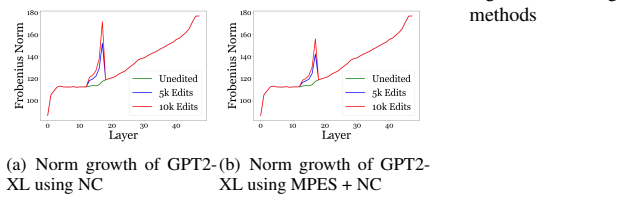
The paper establishes that locate-then-edit knowledge editing behaves as a two-step fine-tuning process: a gradient-descent step finds a target activation vector (over-optimizing it to near-certainty), then a least-squares step writes that activation into a feed-forward weight matrix. Using this formalization, the paper argues that model degradation during sequential editing follows from two mechanisms: (1) over-optimization of internal activations, which makes edited facts predicted at 95–100% probability and overfits the edited fact at the expense of general ability, and (2) continuous growth of the Frobenius norm of edited matrices, which makes edited-layer outputs dominate the residual stream and override information from other modules. The paper supports the second mechanism with a proof that a growing vector in a summation dominates both the norm and orientation of the sum (Appendix D.1) and with measurements showing edited layers account for ~85% of residual-stream norm after 10,000 edits. It then shows that MPES (halting gradient descent when the target token becomes most probable across all contexts) and a Frobenius norm constraint on the weight update, which has a closed form $\Delta = (V_1 - W_0 K_1) K_1^T (\lambda_p K_0 K_0^T + K_1 K_1^T + \lambda_n I)^{-1}$, mitigate both failure modes. Combining them preserves downstream performance across 10,000 sequential edits on GPT2-XL, Llama2-7B, and Llama3-8B and reduces editing time by 42–61%.
Load-bearing premise
The causal claim rests on the premise that norm growth of edited matrices is what makes edited-layer outputs dominate the residual stream, overriding information from other layers; if norm growth is only correlated with degradation rather than the driver, the proposed constraint could still work but for the wrong reason.
Editorial extensions
If this is right
- Locate-then-edit methods (ROME, MEMIT, AlphaEdit) can be scaled to at least 10,000 sequential edits without significant loss of downstream performance, provided both regularizers are used.
- MPES alone delays degradation and speeds editing, but norm control is still necessary; the paper shows MPES alone still leaves norm growth about three times higher than baseline.
- Removing the explicit norm constraint from AlphaEdit's objective causes complete model collapse after a few hundred edits (outputs become <unk> or repeated "!"), showing the constraint is load-bearing.
- The norm constraint combines seamlessly with MEMIT's closed-form solution, unlike prior regularizers (PRUNE, RECT) that need post-editing steps, making the approach faster as well as more effective.
Reading between the lines
- The residual-stream dominance argument suggests a directly testable prediction: artificially scaling the outputs of a single mid-layer MLP (without changing its weights) should reproduce downstream degradation even with no edits made, since it mimics the same norm imbalance.
- If the causal story is right, then any editing method that keeps edited-layer activations from dominating the residual stream—e.g., per-layer output normalization or residual-stream rebalancing—should also scale, even without the Frobenius constraint.
- The norm-growth diagnosis may extend beyond knowledge editing: any sequential fine-tuning procedure that updates a fixed subset of layers (e.g., LoRA on selected layers) could exhibit similar residual-stream imbalance, so the same two-step regularization logic could apply there.
- The paper's formalization of locate-then-edit as two-step fine-tuning could serve as a template for diagnosing other editing failures, such as those from batched edits or mixed fact types.
Editorial analysis
A structured set of objections, weighed in public.
Referee Report
Summary. The paper formalizes locate-then-edit knowledge editing methods (ROME, MEMIT, AlphaEdit) as a two-step fine-tuning process: a gradient-descent step that finds target activations and a least-squares weight update step. It identifies two failure modes during sequential editing: (1) over-optimization of target activations, leading to unnaturally high prediction probabilities, and (2) continuous growth of the Frobenius norm of edited MLP matrices, which the authors argue causes edited-layer outputs to dominate the residual stream and override information from other layers. The paper proposes two regularizations: Most-Probable Early Stopping (MPES), which halts the gradient-descent step when the target token becomes the most probable for all optimization contexts, and an explicit Frobenius norm constraint (NC) on the weight deviation from the original matrix. The paper reports that combining MPES and NC enables 10,000 sequential edits on GPT2-XL, Llama2-7B, and Llama3-8B while largely preserving downstream performance, improves editing scores across MEMIT, RECT, PRUNE, and AlphaEdit, and reduces editing time by 42-61% when applied to MEMIT.
Significance. If the claims hold, the paper provides a simple and practical prescription for scaling locate-then-edit knowledge editing to thousands of edits, a previously open problem. The strengths include a closed-form solution for the norm-constrained objective (Eq. 5, Appendix F), extensive experiments across three model families, two datasets, and multiple batch sizes, and comparisons against established regularization baselines (PRUNE, RECT, LTI). The observation that removing AlphaEdit's implicit norm constraint leads to catastrophic collapse (Table 3, Appendix L) is valuable and reproducible. However, the paper's stronger claim—that it precisely identifies the root causes of degradation—is not fully supported by the evidence: the proposed interventions do not isolate the specific mechanisms (over-optimization and residual-stream dominance) from more general perturbation-regularization effects. The contribution is nevertheless significant as an engineering solution with strong empirical backing.
major comments (4)
- [Section 6.1, Eq. (4)] The proposed norm constraint penalizes the Frobenius deviation ||W_hat - W_0||_F, not the norm contribution of edited-layer outputs to the residual stream or the activation norms directly. Consequently, the downstream gains of MEMIT+NC are also consistent with the alternative explanation that norm growth is an epiphenomenon of the cumulative weight perturbation that actually causes degradation. To support the claimed residual-stream-dominance mechanism, the manuscript needs an experiment that directly manipulates the residual-stream contribution (e.g., scaling or ablating edited-layer outputs at inference) and shows that this manipulation reproduces the degradation pattern.
- [Section 5, Table 1] The diagnosis that over-optimization of target activations causes degradation is supported only by the observation that MPES lowers prediction probabilities and improves downstream performance. However, MPES also changes the magnitude of the update in Eq. (1): smaller target activations lead to smaller weight deltas, so the improvement is equally consistent with the alternative that it reduces the per-edit weight perturbation. An ablation that keeps the stopping rule fixed but rescales target activations to the original probability level would disentangle these factors.
- [Appendix D.1 and Section 6.1] The vector-dominance argument ignores the effect of the final LayerNorm/RMSNorm. Since the final hidden state h_L is normalized before the unembedding, raw norm growth alone does not determine the output distribution; what matters is the direction of h_L. The empirical finding that edited layers contribute 85% of the raw norm (Figure 4) shows a large directional shift, but it does not establish that this shift is the causal mechanism of downstream loss without a control that holds the norm contribution fixed while changing the direction or that directly measures the directional override.
- [Appendix G, Tables 6-11] The MPES probability cutoff and the norm-constraint weight λn are tuned per model, method, and dataset (e.g., the cutoff ranges from +0 to +5 and λn from 10 to 40). This tuning is not accompanied by a sensitivity analysis, so it is unclear how robust the improvements are to these hyperparameters. This also weakens the claim that the regularizations are 'targeted' rather than simply stronger regularization, since the tuned hyperparameters may be responsible for a large part of the observed gains.
minor comments (5)
- [Abstract and Section 1] The phrase 'computate efficient' in the abstract is a typo; it should be 'computationally efficient'.
- [Section 5.1] 'Infact' should be 'In fact' in the paragraph discussing Table 2.
- [Section 7] The word 'neccesity' should be 'necessity' and 'earlys stopping' should be 'early stopping'.
- [Table 3 and Appendix L] The row 'AlphaEdit w/o NC' reports zero editing scores and the appendix states that norm growth overflows around 300 edits. It would be helpful to show the editing-score trajectory before collapse rather than only the final zero values, to clarify whether the failure is gradual or sudden.
- [Figures 3 and 5] The captions do not state which tasks are averaged or whether error bars are shown; please specify the exact downstream evaluation curve (e.g., mean over the six tasks with standard deviation) so the reader can assess variability.
Circularity Check
MPES's editing-metric gains are partly self-definitional; the core scaling results are independent, but the norm-growth causal story is not isolated.
-
self definitional
[Section 5.1 (MPES and Knowledge Editing), Appendix A (Knowledge Editing Metrics), Table 2]
"In MPES, we stop the gradient-descent step in knowledge editing when the target fact becomes the most probable token for all ‘N’ query phrases used for optimization (equation 2). ... Efficacy Score (ES): assesses whether an edit has been successful. It is calculated as the percentage of edits where P (new fact) > P (old fact) when evaluated on paraphrases of the query prompt."
MPES's stopping rule is defined as the moment the edited fact is the most probable token for every optimization context. Because the old fact is one of the tokens, ‘most probable’ implies P(new) > P(old) for those contexts by construction. The paper then reports in Table 2 that MPES ‘consistently improves editing metrics across all settings’, using ES and PS that measure exactly P(new) > P(old). Thus the editing-score improvement for optimization contexts is not an empirical discovery but a direct consequence of the stopping definition; only the paraphrase/held-out portion gives independent signal. This is a supporting component, not the paper's main downstream-scaling claim.
full rationale
The central empirical claim (10,000 sequential edits with preserved downstream performance, and 42-61% faster editing) is evaluated on external benchmarks (MMLU, NLI, SST2, MRPC, CoLA) and does not reduce to the method's definition; those results are self-contained and could have failed. The norm-constraint experiment is an intervention on the hypothesized cause, not a circular derivation: adding lambda_n ||W_hat - W0||^2 changes the whole weight update, so the downstream gain is consistent with the residual-dominance story but also with the alternative that cumulative weight perturbation causes degradation. This is a causal-identification weakness, not circularity. Self-citations are used for background and for the preservation-memorization objective, but the objective is a faithful representation of ROME/MEMIT and is not the sole support for the conclusions. The only concrete reduction found is MPES: its stopping criterion is defined by the same ‘target fact more probable than the old fact’ property that the editing metrics reward, making the reported editing-score gains partly tautological. Because that tautology affects a supporting result rather than the core scaling benchmark, the overall circularity is partial, not total.
Assumptions & free parameters
free parameters (3)
- λp (preservation weight) =
15000-20000 per model
- λn (norm penalty weight) =
10, 20, or 40 per model/dataset
- MPES probability cutoff =
+0 to +5 steps
assumptions (3)
- domain assumption Locate-then-edit methods can be decomposed exactly into a two-step fine-tuning process (gradient-descent activation search followed by least-squares weight update).
- domain assumption Norm growth of edited layers degrades downstream performance because the residual stream becomes dominated by edited-layer outputs, which overrides information from other layers.
- domain assumption LayerNorm/RMSNorm cannot compensate for norm growth because they only scale incoming vectors, not the content composition of the residual stream.
Cite this review
Pith. "Pith review of Lifelong Knowledge Editing requires Better Regularization." pith.science (2026). https://pith.science/paper/SRP4RZDA
@misc{pith2026250201636,
  author       = {Pith},
  title        = {Pith review of: Lifelong Knowledge Editing requires Better Regularization},
  year         = {2026},
  howpublished = {\url{https://pith.science/paper/SRP4RZDA}},
  note         = {Machine review of arXiv:2502.01636}
}
read the original abstract
Knowledge editing is a promising way to improve factuality in large language models, but recent studies have shown significant model degradation during sequential editing. In this paper, we formalize the popular locate-then-edit methods as a two-step fine-tuning process, allowing us to precisely identify the root cause of this degradation. We show that model degradation occurs due to (1) over-optimization of internal activations and (2) continuous norm-growth of edited matrices. To mitigate these issues, we introduce two regularization techniques: (1) Most-Probable Early Stopping (MPES) and (2) explicit Frobenius norm-constraint. We demonstrate that applying these simple yet effective regularization techniques at key points in the editing process can substantially mitigate model degradation. Combining these regularization methods enables scaling locate-then-edit methods to 10,000 edits while reducing editing time by 42-61%. These results show that targeted regularization is essential for lifelong knowledge editing.
Figures


Figures from the paper (25 more)




Forward citations
Cited by 1 Pith paper
-
Efficient Knowledge Editing via Minimal Precomputation
Precomputing only a few thousand hidden vectors instead of 44 million is enough for MEMIT, ROME, and EMMET editing to match full-precomputation scores on CounterFact.
Reference graph
Works this paper leans on
-
[1]
Efficacy Score (ES) : assesses whether an edit has been successful. It is calculated as the percentage of edits where P (new fact) > P (old fact) when evaluated on paraphrases of the query prompt
-
[2]
Paraphrase Score (PS) : measures the model’s ability to generalize after an edit. Specifically, it is the percentage of edits where P (new fact) > P(old fact) for paraphrased versions of the query prompt
-
[3]
It is the percentage of unaffected facts in the neighborhood of the edited fact
Neighborhood Score (NS): evaluates the lo- cality of a model edit by determining whether editing one fact affects other facts stored in the model. It is the percentage of unaffected facts in the neighborhood of the edited fact
-
[4]
Generation Entropy (GE): measures the flu- ency of the model’s text generation post-edit. GE is computed as the weighted average of bi-gram and tri-gram entropies in the text gen- erated by the edited model. A lower GE in- dicates repetitive text generation, a common failure mode (Meng et al., 2022a; Gupta et al., 2024b)
-
[5]
Score (S): introduced by (Meng et al., 2022a), this composite metric combines edit success, generalization, and locality into a single score. It is calculated as the harmonic mean of the Efficacy Score (ES), Paraphrase Score (PS), and Neighborhood Score (NS). B Experimental Detail on Overfitting During Knowledge Editing For each method and model, we condu...
-
[10]
These are the facts that the model learnt through its pre-training
Unedited fact recall probability - In this case, we calculate the average probabil- ity with which a fact is recalled by the unedited/original model. These are the facts that the model learnt through its pre-training. The model is asked questions from the Coun- terFact dataset, and we average the probability with which the model predicts the fact cor- rectly
-
[11]
This is the standard baseline case with- out MPES
Edited fact probability without MPES - In this case, we evaluate the probability with which a model recalls a fact that is edited into the model. This is the standard baseline case with- out MPES
-
[12]
In this case we used LTI during editing the fact
Edited fact probability with LTI - Here we also evaluate the average probability with which a model recalls an edited fact. In this case we used LTI during editing the fact
Show all 14 references
-
[13]
In this case, MPES is used during editing the fact
Edited fact probability WITH MPES - Here we also evaluate the average probability by which a model recalls an edited fact. In this case, MPES is used during editing the fact. In each of the experiments we performed, we passed average numbers over 1000 edited facts with a batch...
-
[14]
Tables 6, 7 and 8 show the hyperparameters for CounterFact dataset and tables 9,10 and 11 show the hyperparameters for the zsRE dataset
Specifically, we define K0 = [k1 0 |k2 0 | · · · |kP 0 ], K1 = [k1 e |k2 e | · · · |kB e ] and V1 = [v1 e |v2 e | · · · |vB e ] column wise and instead the L2 norm will be- come the frobenius norm and we have that λp ˆW K0 − W0K0 2 F + ˆW K1 − V1 2 F +λn ˆW − W0 2 F We can dif...
1949
-
[2005]
In Machine learning challenges workshop , pages 177–190
The pascal recognising textual entailment chal- lenge. In Machine learning challenges workshop , pages 177–190. Springer. Nicola De Cao, Wilker Aziz, and Ivan Titov. 2021. Edit- ing factual knowledge in language models. arXiv preprint arXiv:2104.08164. Bill Dolan and Chris Bro...
2021 arXiv
-
[2006]
In Proceedings of the Second PAS- CAL Challenges Workshop on Recognising Textual Entailment, volume 7, pages 785–794
The second pascal recognising textual entail- ment challenge. In Proceedings of the Second PAS- CAL Challenges Workshop on Recognising Textual Entailment, volume 7, pages 785–794. Tom Hartvigsen, Swami Sankaranarayanan, Hamid Palangi, Yoon Kim, and Marzyeh Ghassemi. 2024. Agin...
2024
-
[2020]
arXiv preprint arXiv:2009.03300
Measuring massive multitask language under- standing. arXiv preprint arXiv:2009.03300. Jun-Yu Ma, Hong Wang, Hao-Xiang Xu, Zhen- Hua Ling, and Jia-Chen Gu. 2024. Perturbation- restrained sequential model editing. arXiv preprint arXiv:2405.16821. Jun-Yu Ma, Hong Wang, Hao-Xiang...
2009 arXiv
-
[2024]
arXiv preprint arXiv:2410.02355
Alphaedit: Null-space constrained knowl- edge editing for language models. arXiv preprint arXiv:2410.02355. Mor Geva, Roei Schuster, Jonathan Berant, and Omer Levy. 2020. Transformer feed-forward layers are key- value memories. arXiv preprint arXiv:2012.14913. Danilo Giampicco...
2020 arXiv
Reviewed August 9, 2026 · model on record in the stance chip above.
Discussion (0). Continue with ORCID to comment.