REVIEW 4 major objections 6 minor 45 references
LLM-Powered Benchmark Factory: Reliable, Generic, and Efficient
T0 review · 4 major / 6 minor · reviewed 2026-08-09 · deepseek-v4-flash
Pith's one-line read BenchMaker, a purely LLM-driven pipeline, generates a custom multiple-choice benchmark from a written assessment demand, and the paper reports that its model rankings reproduce MMLU-Pro's ordering of 12 LLMs with 0.967 Pearson correlation…
desk verdict Well-engineered benchmark generator with a strong external-validity claim, but missing overlap checks against the human benchmarks it validates on—fix that before trusting the 0.967 correlation. read the letter →
The pith
A machine-rendered reading of the paper's core claim, the machinery that carries it, and where it could break.
The reading
What carries the argument
The load-bearing mechanism is the automated evaluation framework itself, a four-dimension, ten-criteria scoring system: credibility (faithfulness and alignment), diversity (lexical, semantic, and knowledge), difficulty (controllability and boundary), and benchmark-level properties (effectiveness, robustness, and efficiency). Inside it, the debiasing step fits a multiple-regression model $f(i)=\beta_i+\beta_{\text{len}}\cdot \text{judge\_length}+\epsilon$, treating judge length as a covariate so that the coefficient $\beta_i$ becomes the debiased faithfulness or alignment score. On the generation side, the difficulty diffusion mechanism carries the argument: the hardest generated samples are fed back as references so that sample difficulty rises continuously, while conflict-guided contrastive discrimination treats the generator as a test-taker and uses self-consistency prediction conflicts to correct questionable rationales and labels.
What would settle it
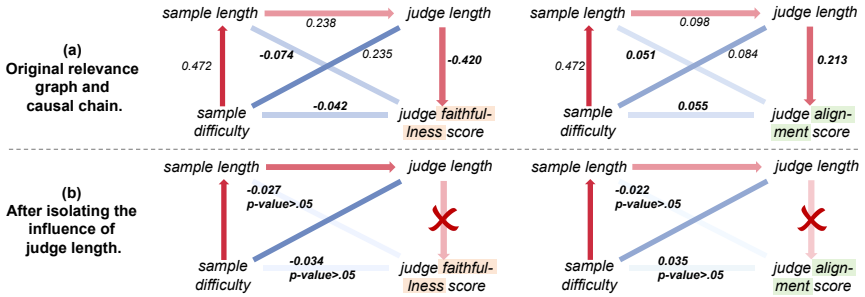
Run the Figure 2 partial-correlation analysis on a dataset with a known judge bias unrelated to length, such as a preference for a particular answer position or phrasing style, and check whether faithfulness and alignment scores still agree with human labels after controlling for judge length; if any such factor remains significant, the mediation-by-length assumption fails.
Extended reading notes
Core claim
The central claim is that a generic benchmark generator, not a task-specific augmenter, can be made reliable enough to substitute for human-annotated benchmarks. With only assessment demands as input, BenchMaker generates multiple-choice samples containing a question, rationale, options, and label, and it patches the weaknesses of directly prompting an LLM: stepwise self-correction and conflict-guided contrastive discrimination raise faithfulness, difficulty strategy guidance and a difficulty diffusion mechanism extend difficulty controllability and boundary, and AttrPrompt plus in-batch redundancy filtering raise diversity. Under the proposed framework, BenchMaker is reported to achieve faithfulness comparable to human benchmarks, higher alignment, knowledge diversity, difficulty controllability and boundary, and an average of 0.953 Pearson and 0.966 Spearman correlation with the model rankings of human benchmarks, including 0.967 Pearson against MMLU-Pro across 12 LLMs. The paper also derives a formula intended to show that unbiased label noise does not change the statistical significance of a model ranking.
Load-bearing premise
The whole evaluation framework is only as trustworthy as the claim that every LLM-judge bias in this scenario is mediated by judgment length, so any bias that does not run through response length survives the debiasing regression.
Editorial extensions
If this is right
- If BenchMaker is right, producing a tailored benchmark for a new assessment demand requires only a written demand, not an existing seed benchmark.
- The reported 0.967 Pearson correlation with MMLU-Pro across 12 LLMs implies that benchmark effectiveness can be bought for roughly $0.005 per sample, making large custom evaluation suites affordable.
- The improved difficulty controllability and boundary imply that generated benchmarks can include hardest subsets capable of differentiating advanced models, addressing benchmark saturation.
- The reliability formula implies that a known fraction of incorrect labels does not by itself weaken the statistical significance of a model ranking, provided the errors are unbiased.
- Because samples are generated on demand rather than drawn from a static pool, the approach could serve as a dynamic benchmark generator to mitigate data contamination.
Reading between the lines
- Editorial inference: the 0.967 correlation is measured with MMLU-Pro as the ground truth, so the strongest version of the claim is about reproducing an existing human benchmark rather than about discovering a correct ranking for a brand-new domain.
- Editorial inference: a natural testable extension is to apply BenchMaker to an assessment demand outside MATH, MMLU-Pro, and HellaSwag with an independent gold standard, such as a professional licensing exam, and check whether the effectiveness correlation stays above 0.9.
- Editorial inference: the debiasing assumption implies that judge biases not channeled through response length, such as option-position preference or topic aversion, would escape the regression correction, so the unbiasedness claim is only as broad as that assumption.
- Editorial inference: the paper's own format-conversion experiment shows that open-ended versions score lower on knowledge diversity and effectiveness than the MCQ versions, suggesting the headline numbers may not transfer directly to free-form generative benchmarks.
Editorial analysis
A structured set of objections, weighed in public.
Referee Report
Summary. BenchMaker is a pipeline that generates multiple-choice benchmarks solely from written assessment demands. The paper first defines a ten-criteria evaluation framework for benchmark generators, with LLM-judge scores debiased via regression on judge length. It then analyzes a direct-prompt baseline, adds modules for faithfulness, difficulty, and diversity, and evaluates the resulting BenchMaker on math (MATH), language understanding (MMLU-Pro), and commonsense (HellaSwag). The headline result is a 0.967 Pearson correlation between model accuracies on the generated MMLU-Pro-style benchmark and on MMLU-Pro across 12 LLMs, at a cost of about $0.005 and 0.4 minutes per sample.
Significance. The claimed result is potentially important: if a cheap, generic generator can produce benchmarks whose model rankings match human-curated benchmarks, it would lower the cost of customized evaluation and help mitigate contamination. The paper's use of external human benchmarks for validation is the right methodology, and the per-sample cost estimate is compelling. The framework also usefully separates credibility, diversity, difficulty, and benchmark-level criteria. However, the headline claim is only as strong as the exclusion of memorization and the validity of the debiasing adjustment; both need additional evidence before the 'reliable, generic' label is warranted. The paper ships code and includes a manual check and a reliability formula, which are positive features.
major comments (4)
- [§5.3, Table 2] The effectiveness claim (0.967 Pearson against MMLU-Pro) is vulnerable to memorization contamination. Section 5.3 argues that because the input demands do not mention MMLU-Pro, the model cannot achieve high alignment by 'memorizing and replicating samples from MMLU-Pro,' but this does not rule out GPT-4o mini reproducing or lightly paraphrasing benchmark items seen during pretraining. The t-SNE and word-cloud analyses show global distributional differences but cannot detect a substantial subset of near-duplicates. Please report quantitative overlap statistics between the generated benchmarks and MMLU-Pro, MATH, and HellaSwag (e.g., n-gram overlap, embedding-similarity percentiles, or membership tests). Without such analysis, the 'generic generation' interpretation of the 0.967 correlation is not established.
- [§3.1] The framework's 'unbiased' metrics rely on the claim that all LLM-judge biases are mediated by judgment length. This is supported by partial correlations on a single dataset (MATH) with two judges (Qwen-Plus and GPT-4o mini). Unmeasured confounders (e.g., sample topic, rationale style, or position bias) could invalidate the regression adjustment in Eq. (1), and the faithfulness/alignment scores in Table 2 depend on it. Please validate the mediation assumption on at least one additional dataset and provide a sensitivity analysis with alternative covariate sets.
- [§3.3–§3.4, Appendix E] Difficulty controllability and knowledge diversity are computed using the error rates and correctness patterns of the same 12-model set M1:|M| that is later used for the effectiveness correlation. This creates a risk of self-reference: the difficulty labels are defined by the models' behavior, and the benchmark is then evaluated on those same models. Please report whether the difficulty and effectiveness results are stable when M1:|M| is split into separate sets for label construction and evaluation, or otherwise justify why this circularity does not affect the claims.
- [Abstract, §5.1, Table 2] The abstract states that BenchMaker 'achieves superior or comparable performance to human-annotated benchmarks on all metrics,' but Table 2 shows faithfulness of 0.930 (MATH) and 0.918 (BenchMaker4o) against a human benchmark score of 1.000, and the manual check in §5.3 reports a 7.5% error rate. These point estimates are below the human benchmark. Please replace the blanket claim with a metric-by-metric comparison that includes confidence intervals or a statement of statistical significance.
minor comments (6)
- [Throughout] The method name 'BENCH MAKER' appears with and without a space (e.g., 'BENCHMAKER', 'BenchMaker', 'BENCH MAKER'); please unify the notation.
- [Appendix A, Eq. (8)] The variance formula for ¯a − ¯b ignores the covariance between the two models' accuracies because both are scored on the same benchmark items; please state this approximation explicitly.
- [Table 2] The 'Human Benchmark' rows show '-' for effectiveness and robustness; adding a one-sentence explanation would help readers understand why these cells are empty.
- [Figure 2 caption] The phrase 'The most relevant path' is not defined; please specify the selection rule (e.g., highest absolute correlation along a directed path).
- [§5.3] The manual check of 80 samples should describe the sampling procedure and whether the multiple authors annotated independently, as this affects the reported 7.5% error rate.
- [Appendix I] References to 'Appendix I' are ambiguous because the appendix contains several prompt templates; please cite the specific prompt names (e.g., 'LLM as Faithfulness Judge').
Circularity Check
No significant circularity: the 0.967 effectiveness correlation is an external, empirical benchmark comparison, not a fitted identity.
full rationale
The paper's central effectiveness claim (0.967 Pearson correlation against MMLU-Pro across 12 LLMs) is an empirical correlation between model accuracies on generated samples and on a human-annotated benchmark; neither quantity is fitted to the other, and no equation in Sections 3-5 defines one in terms of the other. BenchMaker's components (stepwise self-correction, contrastive discrimination, difficulty diffusion, AttrPrompt) are validated by ablations on the same framework that motivated them, which creates a mild design-evaluation coupling, but the headline correlation is not optimized by any component and is reported against external benchmarks. Difficulty labels use the generator's self-consistency error (Eq. 3), while the difficulty ground truth is the average error rate of a distinct model set (Appendix E, which excludes GPT-4o mini), so the reported Spearman values are empirical rather than identities. The debiased faithfulness/alignment metrics rest on an explicit assumption (Section 3.1) that judge biases are mediated solely by judgment length; this is an unverified modeling assumption and a correctness/validity risk, not a definitional reduction. There are no load-bearing self-citations or imported uniqueness theorems. The memorization/overlap concern raised by a skeptical reading (Section 5.3) is a data-contamination threat to generalization, not a circularity of the derivation chain.
Assumptions & free parameters
free parameters (6)
- decay_factor_0_9 =
0.9
- reference_number =
8
- in_batch_candidates_L =
5
- self_consistency_T =
not reported
- difficulty_level_descriptions =
10 levels
- hardest_subset_quantile =
20%
assumptions (5)
- domain assumption Judge length mediates all LLM-judge biases in this setup
- domain assumption The 12-model set provides ground-truth difficulty and knowledge embeddings
- domain assumption Models A and B have equal accuracy p on incorrectly labeled samples
- standard math Observed accuracy difference is normally distributed
- ad hoc to paper Judge scores on human benchmarks rescale to 1 and generated benchmarks can exceed 1
Cite this review
Pith. "Pith review of LLM-Powered Benchmark Factory: Reliable, Generic, and Efficient." pith.science (2026). https://pith.science/paper/ZV6PMYKE
@misc{pith2026250201683,
  author       = {Pith},
  title        = {Pith review of: LLM-Powered Benchmark Factory: Reliable, Generic, and Efficient},
  year         = {2026},
  howpublished = {\url{https://pith.science/paper/ZV6PMYKE}},
  note         = {Machine review of arXiv:2502.01683}
}
abstract
The rapid advancement of large language models (LLMs) has led to a surge in both model supply and application demands. To facilitate effective matching between them, reliable, generic and efficient benchmark generators are widely needed. However, human annotators are constrained by inefficiency, and current LLM benchmark generators not only lack generalizability but also struggle with limited reliability, as they lack a comprehensive evaluation framework for validation and optimization. To fill this gap, we first propose an automated and unbiased evaluation framework, structured around four dimensions and ten criteria. Under this framework, we carefully analyze the advantages and weaknesses of directly prompting LLMs as generic benchmark generators. To enhance the reliability, we introduce a series of methods to address the identified weaknesses and integrate them as BenchMaker. Experiments across multiple LLMs and tasks confirm that BenchMaker achieves superior or comparable performance to human-annotated benchmarks on all metrics, highlighting its generalizability and reliability. More importantly, it delivers highly consistent evaluation results across 12 LLMs (0.967 Pearson correlation against MMLU-Pro), while taking only $0.005 and 0.38 minutes per sample.
Figures


Figures from the paper (4 more)


Reference graph
Works this paper leans on
-
[1]
Anthropic. Claude 3.5. https://www.anthropic.com/news/3-5-models-and-computer-use
-
[2]
Simone Balloccu, Patr \' cia Schmidtov \' a , Mateusz Lango, and Ondrej Dusek. 2024. https://aclanthology.org/2024.eacl-long.5 Leak, cheat, repeat: Data contamination and evaluation malpractices in closed-source llms . In Proceedings of the 18th Conference of the European Chapter of the Association for Computational Linguistics, EACL 2024 - Volume 1: Long...
work page 2024
-
[3]
Xin Chan, Xiaoyang Wang, Dian Yu, Haitao Mi, and Dong Yu. 2024. https://doi.org/10.48550/ARXIV.2406.20094 Scaling synthetic data creation with 1,000,000,000 personas . CoRR, abs/2406.20094
-
[4]
Yupeng Chang, Xu Wang, Jindong Wang, Yuan Wu, Linyi Yang, Kaijie Zhu, Hao Chen, Xiaoyuan Yi, Cunxiang Wang, Yidong Wang, Wei Ye, Yue Zhang, Yi Chang, Philip S. Yu, Qiang Yang, and Xing Xie. 2024. https://doi.org/10.1145/3641289 A survey on evaluation of large language models . ACM Trans. Intell. Syst. Technol. , 15(3):39:1--39:45
doi:10.1145/3641289 2024
-
[5]
Elliot Glazer, Ege Erdil, Tamay Besiroglu, Diego Chicharro, Evan Chen, Alex Gunning, Caroline Falkman Olsson, Jean - Stanislas Denain, Anson Ho, Emily de Oliveira Santos, Olli J \" a rviniemi, Matthew Barnett, Robert Sandler, Matej Vrzala, Jaime Sevilla, Qiuyu Ren, Elizabeth Pratt, Lionel Levine, Grant Barkley, Natalie Stewart, Bogdan Grechuk, Tetiana Gre...
-
[6]
Xiaobo Guo and Soroush Vosoughi. 2023. https://doi.org/10.18653/V1/2023.EMNLP-MAIN.984 Length does matter: Summary length can bias summarization metrics . In Proceedings of the 2023 Conference on Empirical Methods in Natural Language Processing, EMNLP 2023, Singapore, December 6-10, 2023 , pages 15869--15879. Association for Computational Linguistics
-
[7]
Richard W Hamming. 1950. Error detecting and error correcting codes. The Bell system technical journal, 29(2):147--160
work page 1950
-
[8]
Dan Hendrycks, Collin Burns, Steven Basart, Andy Zou, Mantas Mazeika, Dawn Song, and Jacob Steinhardt. 2021 a . https://openreview.net/forum?id=d7KBjmI3GmQ Measuring massive multitask language understanding . In 9th International Conference on Learning Representations, ICLR 2021, Virtual Event, Austria, May 3-7, 2021 . OpenReview.net
2021
Show all 45 references
-
[9]
Dan Hendrycks, Collin Burns, Saurav Kadavath, Akul Arora, Steven Basart, Eric Tang, Dawn Song, and Jacob Steinhardt. 2021 b . https://datasets-benchmarks-proceedings.neurips.cc/paper/2021/hash/be83ab3ecd0db773eb2dc1b0a17836a1-Abstract-round2.html Measuring mathematical problem...
2021
-
[10]
Jie Huang, Xinyun Chen, Swaroop Mishra, Huaixiu Steven Zheng, Adams Wei Yu, Xinying Song, and Denny Zhou. 2024. https://openreview.net/forum?id=IkmD3fKBPQ Large language models cannot self-correct reasoning yet . In The Twelfth International Conference on Learning Representati...
2024
-
[11]
Aaron Hurst, Adam Lerer, Adam P Goucher, Adam Perelman, Aditya Ramesh, Aidan Clark, AJ Ostrow, Akila Welihinda, Alan Hayes, Alec Radford, et al. 2024. Gpt-4o system card. arXiv preprint arXiv:2410.21276
2024 arXiv
-
[12]
Ziwei Ji, Tiezheng Yu, Yan Xu, Nayeon Lee, Etsuko Ishii, and Pascale Fung. 2023. https://doi.org/10.18653/V1/2023.FINDINGS-EMNLP.123 Towards mitigating LLM hallucination via self reflection . In Findings of the Association for Computational Linguistics: EMNLP 2023, Singapore, ...
2023 doi
- [13]
- [14]
-
[15]
u ttler, Mike Lewis, Wen - tau Yih, Tim Rockt \
Patrick S. H. Lewis, Ethan Perez, Aleksandra Piktus, Fabio Petroni, Vladimir Karpukhin, Naman Goyal, Heinrich K \" u ttler, Mike Lewis, Wen - tau Yih, Tim Rockt \" a schel, Sebastian Riedel, and Douwe Kiela. 2020. https://proceedings.neurips.cc/paper/2020/hash/6b493230205f780e...
2020
- [16]
- [17]
- [18]
-
[19]
Yang Liu, Dan Iter, Yichong Xu, Shuohang Wang, Ruochen Xu, and Chenguang Zhu. 2023. https://aclanthology.org/2023.emnlp-main.153 G-eval: NLG evaluation using gpt-4 with better human alignment . In Proceedings of the 2023 Conference on Empirical Methods in Natural Language Proc...
2023
-
[20]
Lin Long, Rui Wang, Ruixuan Xiao, Junbo Zhao, Xiao Ding, Gang Chen, and Haobo Wang. 2024. https://doi.org/10.18653/V1/2024.FINDINGS-ACL.658 On llms-driven synthetic data generation, curation, and evaluation: A survey . In Findings of the Association for Computational Linguisti...
2024 doi
- [21]
-
[22]
Ziyang Luo, Can Xu, Pu Zhao, Qingfeng Sun, Xiubo Geng, Wenxiang Hu, Chongyang Tao, Jing Ma, Qingwei Lin, and Daxin Jiang. 2024 b . https://openreview.net/forum?id=UnUwSIgK5W Wizardcoder: Empowering code large language models with evol-instruct . In The Twelfth International Co...
2024
- [23]
-
[24]
Ehsan Montahaei, Danial Alihosseini, and Mahdieh Soleymani Baghshah. 2019. http://arxiv.org/abs/1904.03971 Jointly measuring diversity and quality in text generation models . CoRR, abs/1904.03971
2019 arXiv
-
[25]
text-embedding-ada-002
OpenAI. text-embedding-ada-002. https://platform.openai.com/docs/guides/embeddings
-
[26]
Bowman, Amanda Askell, Roger Grosse, Danny Hernandez, Deep Ganguli, Evan Hubinger, Nicholas Schiefer, and Jared Kaplan
Ethan Perez, Sam Ringer, Kamile Lukosiute, Karina Nguyen, Edwin Chen, Scott Heiner, Craig Pettit, Catherine Olsson, Sandipan Kundu, Saurav Kadavath, Andy Jones, Anna Chen, Benjamin Mann, Brian Israel, Bryan Seethor, Cameron McKinnon, Christopher Olah, Da Yan, Daniela Amodei, D...
2023
-
[27]
Zhi Rui Tam, Cheng - Kuang Wu, Yi - Lin Tsai, Chieh - Yen Lin, Hung - yi Lee, and Yun - Nung Chen. 2024. https://aclanthology.org/2024.emnlp-industry.91 Let me speak freely? A study on the impact of format restrictions on large language model performance . In Proceedings of th...
2024
- [28]
- [29]
-
[30]
Raphael Vallat. 2018. https://doi.org/10.21105/JOSS.01026 Pingouin: statistics in python . J. Open Source Softw., 3(31):1026
2018 doi
- [31]
-
[32]
Le, Ed H
Xuezhi Wang, Jason Wei, Dale Schuurmans, Quoc V. Le, Ed H. Chi, Sharan Narang, Aakanksha Chowdhery, and Denny Zhou. 2023 a . https://openreview.net/forum?id=1PL1NIMMrw Self-consistency improves chain of thought reasoning in language models . In The Eleventh International Confe...
2023
-
[33]
Smith, Daniel Khashabi, and Hannaneh Hajishirzi
Yizhong Wang, Yeganeh Kordi, Swaroop Mishra, Alisa Liu, Noah A. Smith, Daniel Khashabi, and Hannaneh Hajishirzi. 2023 b . https://doi.org/10.18653/V1/2023.ACL-LONG.754 Self-instruct: Aligning language models with self-generated instructions . In Proceedings of the 61st Annual ...
2023 doi
- [34]
-
[35]
Siyuan Wu, Yue Huang, Chujie Gao, Dongping Chen, Qihui Zhang, Yao Wan, Tianyi Zhou, Xiangliang Zhang, Jianfeng Gao, Chaowei Xiao, and Lichao Sun. 2024. https://doi.org/10.48550/ARXIV.2406.18966 Unigen: A unified framework for textual dataset generation using large language mod...
2024 doi
- [36]
-
[37]
Kwok, Zhenguo Li, Adrian Weller, and Weiyang Liu
Longhui Yu, Weisen Jiang, Han Shi, Jincheng Yu, Zhengying Liu, Yu Zhang, James T. Kwok, Zhenguo Li, Adrian Weller, and Weiyang Liu. 2024. https://openreview.net/forum?id=N8N0hgNDRt Metamath: Bootstrap your own mathematical questions for large language models . In The Twelfth I...
2024
-
[38]
Ratner, Ranjay Krishna, Jiaming Shen, and Chao Zhang
Yue Yu, Yuchen Zhuang, Jieyu Zhang, Yu Meng, Alexander J. Ratner, Ranjay Krishna, Jiaming Shen, and Chao Zhang. 2023. http://papers.nips.cc/paper\_files/paper/2023/hash/ae9500c4f5607caf2eff033c67daa9d7-Abstract-Datasets\_and\_Benchmarks.html Large language model as attributed ...
2023
-
[39]
Rowan Zellers, Ari Holtzman, Yonatan Bisk, Ali Farhadi, and Yejin Choi. 2019. https://doi.org/10.18653/V1/P19-1472 Hellaswag: Can a machine really finish your sentence? In Proceedings of the 57th Conference of the Association for Computational Linguistics, ACL 2019, Florence, ...
2019 doi
-
[40]
Xing, Hao Zhang, Joseph E
Lianmin Zheng, Wei - Lin Chiang, Ying Sheng, Siyuan Zhuang, Zhanghao Wu, Yonghao Zhuang, Zi Lin, Zhuohan Li, Dacheng Li, Eric P. Xing, Hao Zhang, Joseph E. Gonzalez, and Ion Stoica. 2023. http://papers.nips.cc/paper\_files/paper/2023/hash/91f18a1287b398d378ef22505bf41832-Abstr...
2023
-
[41]
Kaijie Zhu, Jiaao Chen, Jindong Wang, Neil Zhenqiang Gong, Diyi Yang, and Xing Xie. 2024 a . https://openreview.net/forum?id=gjfOL9z5Xr Dyval: Dynamic evaluation of large language models for reasoning tasks . In The Twelfth International Conference on Learning Representations,...
2024
- [42]
-
[43]
Yaoming Zhu, Sidi Lu, Lei Zheng, Jiaxian Guo, Weinan Zhang, Jun Wang, and Yong Yu. 2018. https://doi.org/10.1145/3209978.3210080 Texygen: A benchmarking platform for text generation models . In The 41st International ACM SIGIR Conference on Research & Development in Informatio...
2018
-
[44]
URL: " 'urlintro :=
ENTRY address author booktitle chapter edition editor howpublished institution journal key month note number organization pages publisher school series title type volume year eprint doi pubmed url lastchecked label extra.label sort.label short.list INTEGERS output.state before...
-
[45]
write newline
" write newline "" before.all 'output.state := FUNCTION n.dashify 't := "" t empty not t #1 #1 substring "-" = t #1 #2 substring "--" = not "--" * t #2 global.max substring 't := t #1 #1 substring "-" = "-" * t #2 global.max substring 't := while if t #1 #1 substring * t #2 gl...
Reviewed August 9, 2026 · model on record in the stance chip above.
Discussion (0). Continue with ORCID to comment.