REVIEW 4 major objections 5 minor 93 references
Pearls on a string: Dark and bright galaxies on a strikingly straight and narrow filament
T0 review · 4 major / 5 minor · reviewed 2026-08-09 · deepseek-v4-flash
Pith's one-line read This paper reports the first observational confirmation of dark, starless hydrogen clouds embedded in a cosmic filament, a population predicted by simulations but never before seen in a filament.
desk verdict A well-observed, strikingly narrow galaxy filament with an over-interpreted claim that its dark HI clouds are the first confirmed filament clouds. read the letter →
The pith
A machine-rendered reading of the paper's core claim, the machinery that carries it, and where it could break.
The reading
What carries the argument
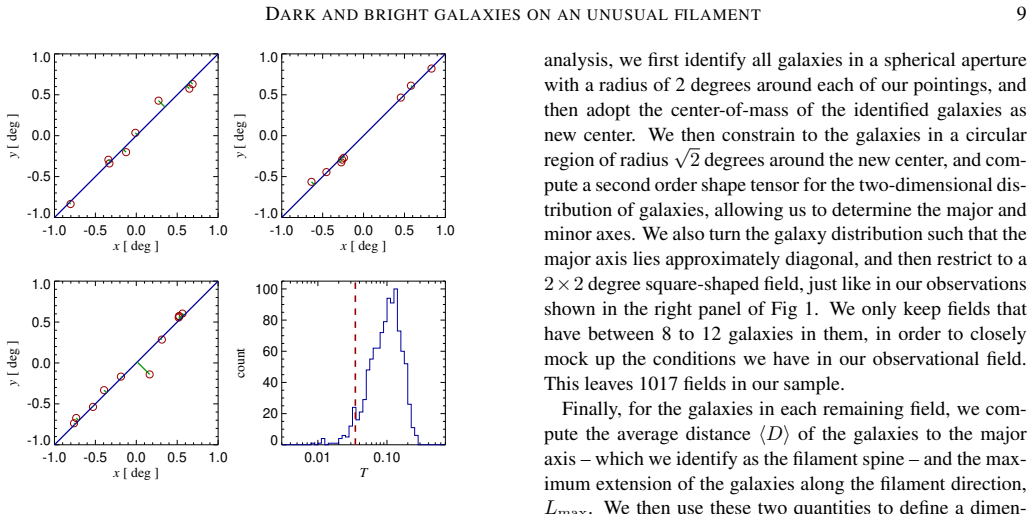
The argument rests on four instruments. The thinness parameter $T = \langle D\rangle/L_{\mathrm{max}}$, the mean galaxy distance from the filament spine divided by the filament's projected length, is measured for the observed chain ($T_{\mathrm{obs}} = 0.035$) and compared with the same quantity in 1017 mock 2-degree fields drawn from the MillenniumTNG full-sky galaxy catalogue, giving the ~4% rarity estimate. The JVLA HI 21 cm observations, with source-finding in two independent spectral cubes at signal-to-noise at least 5 in each, deliver the eleven detections and their line widths. The local HI mass functions of HIPASS and ALFALFA supply the expected source count against which the ~100-fold excess is measured. Deep CFHT multiband imaging with SED fitting supplies the darkness, ruling out optical counterparts and setting the extreme $M_{\mathrm{HI}}/M_*$ lower limits.
What would settle it
Point the same JVLA setup at a matched control field away from the filament: if the number of $10^{8.5}$ to $10^{9.5}\,M_\odot$ hydrogen sources per unit volume matches the eleven seen on the filament, the claimed excess is a survey effect rather than a filament population. A single reliable distance measurement for any of the eleven clouds, for instance a 21 cm redshift of an optical counterpart candidate or a Tully-Fisher distance for the two outermost clouds, that places the source outside $z \approx 0.036$ to $0.038$ would also weaken the association.
Extended reading notes
Core claim
Eight galaxies with spectroscopic redshifts in the narrow range $z = 0.0361$ to $0.0370$ align along a nearly straight axis over a projected 5 Mpc, with on-sky separations of only 7 to 104 kpc from the axis, a configuration the paper shows is rare but not forbidden in $\Lambda$CDM: only about 4% of matched mock fields from the MillenniumTNG full-sky galaxy catalogue are as thin. Across a 1.3 Mpc section of the filament, eleven HI 21 cm sources are detected with masses of $10^{8.5}$ to $10^{9.5}\,M_\odot$, mostly within 120 kpc of the axis, against expected counts of $0.16 \pm 0.04$ (HIPASS) and $0.11 \pm 0.01$ (ALFALFA), a factor of about 100 excess. Deep CFHT imaging and SED fitting rule out confirmed optical counterparts, giving lower limits of $M_{\mathrm{HI}}/M_*$ from about 30 to 15500 with a median near 900, and the large HI line widths of 110 to 420 km s$^{-1}$ suggest gas that may not yet be virialized. The paper's central claim is that these dark clouds are the peaks of the HI and dark-matter distribution running along the filament spine, confirming for the first time in observations what simulations have predicted.
Load-bearing premise
The paper's two headline claims, a roughly hundredfold excess of hydrogen clouds and the first dark clouds found in a filament, stand or fall on the assumption that the eleven detected clouds belong to the same filament as the eight galaxies, rather than being nearer or farther objects that happen to fall inside the telescope's view; the paper itself notes that the clouds have larger measured velocities than the galaxies and that two of them lie far from the filament's line.
Editorial extensions
If this is right
- Cosmic filaments in the local universe contain a previously unseen population of massive, starless hydrogen clouds, so the cold-gas budget of the cosmic web is larger than the HI mass function alone predicts.
- The HI source count, about 100 times the expectation from blank-field surveys, implies that radio surveys pointed along filament spines will find dark clouds far more often than surveys of random fields.
- The concentration of star-forming galaxies in the filament's mid-section, with passive galaxies at both ends, fits a picture of a young filament whose gas has not yet been funneled into its endpoints.
- The large HI line widths and the absence of stars suggest these clouds are unvirialized, infalling gas, potential future fuel for star formation and for the disturbed gas morphologies seen in the filament galaxies.
- Filaments as straight and narrow as this one are rare but consistent with $\Lambda$CDM, since about 4% of matched mock fields are as thin, so the geometry itself requires no new physics.
Reading between the lines
- If these clouds trace low-mass dark-matter halos, their line widths imply dwarf-scale halo masses, making them possible accreting progenitors of the gas-rich galaxies along the filament; this can be tested by comparing line-width halo estimates with the predicted halo mass function along filaments.
- The roughly 180 kpc typical spacing between the HI sources hints at a preferred fragmentation scale for cold gas in filaments, a prediction that higher-resolution cosmological simulations could check directly.
- A systematic search of large spectroscopic surveys for collinear galaxy chains, rather than the serendipitous discovery route taken here, would establish how common narrow filaments really are; the paper's 4% figure suggests dozens of comparable systems may exist in the local volume.
- The two outermost clouds, S10 and S12 at 251 and 424 kpc from the filament axis, are the weakest members of the association, so targeted distance measurements of exactly these two would most efficiently test the paper's interpretation.
Editorial analysis
A structured set of objections, weighed in public.
Referee Report
Summary. The paper reports serendipitous identification of an unusually narrow and straight filament of eight galaxies at z ≈ 0.037, with projected length ~5 Mpc and on-sky separations from the filament axis of only 7–104 kpc. Using JVLA HI 21 cm observations of a 1.3 Mpc section of the filament, the authors detect eleven HI sources with HI masses 10^8.5–10^9.5 Msun and no confirmed optical counterparts, and they argue that the number of sources is ~100 times larger than expected from the local HI mass function. A comparison with MillenniumTNG mock galaxy fields yields a 4% incidence of similarly straight, narrow galaxy distributions, which the authors use to support the rarity of the filament in LCDM. The paper concludes that these are the first observationally confirmed dark HI clouds in a cosmic filament.
Significance. If the association of the eleven HI sources with the G1–G8 filament is secure, this would be a notable observational result: it would open a new window on cold gas in the cosmic web and provide direct evidence for a population of dark, possibly pre-virialized HI clouds in filaments, as predicted by simulations. The paper is also transparent in presenting the full HI spectra and SED fits, and it makes a concrete, falsifiable comparison with the MTNG lightcone. However, the central 'first confirmation' claim rests on the physical association of the HI sources with the galaxy filament, and that association is currently not firmly established. The factor-of-~100 excess calculation is also sensitive to the a posteriori choice of the line-of-sight cylinder depth and to the fact that the field was selected after aligned HI sources were noticed in the original targeted B-configuration data.
major comments (4)
- [Sec. 3.2, Fig. 2] The physical association of the eleven HI sources with the G1–G8 filament is the load-bearing assumption of the paper, but it is not secured by the data presented. The HI sources span z = 0.0356–0.0382, i.e., radial velocities of about −360 to +420 km/s relative to z = 0.0368, whereas the eight filament galaxies span only −212 to +66 km/s. Two sources lie at projected distances of 251 and 424 kpc from the filament axis. Because no independent distances are available, the HI sources could be foreground or background galaxies, or a separate group projected onto the filament field. The paper should either provide a quantitative assessment of the chance association probability (e.g., using the local galaxy density and velocity distribution) or explicitly downgrade the 'first confirmation' claim to a candidate detection.
- [Sec. 4.2] The excess-count calculation uses a cylinder whose line-of-sight depth is dl(z = 0.0382) − dl(z = 0.0356), i.e., it is set by the minimum and maximum redshifts of the detected HI sources themselves. This is a post-hoc choice: if the sources are not all at the filament distance, the volume is not a filament volume but a generic 10–11 Mpc deep cone, and the comparison to the field HI mass function does not demonstrate an overdensity tied to the filament. Moreover, the field was targeted after aligned HI sources were noticed in the original B-configuration observations of the GRB host field, so the measurement is not a blind field count. The reported factor of ~100 should be presented as a conditional excess, and the paper should specify what fraction of the excess survives under reasonable foreground/background interpretations.
- [Sec. 4.1] The MTNG thinness comparison defines Tobs using the eight filament galaxies plus two additional galaxies with larger separations from the filament axis, while the mock fields are selected to contain 8–12 galaxies after centering on the mean position and aligning the major axis. These selection procedures are not identical, and the reported 4% incidence is therefore not a direct probability for finding the exact observed configuration. The authors should clarify whether the mock selection reproduces the same criteria used to define the observed filament, and should state the sensitivity of the 4% figure to including or excluding the two outer galaxies.
- [Sec. 3.2 and Table 2] The very large MHI/M* lower limits (up to ~15,000) are derived by assuming that all optical counterparts with photometric-redshift probability P(z<0.1) ≥ 1% are associated with the HI sources, while sources with no detected optical counterpart are assigned an effective stellar mass of zero. This makes the lower limits strongly dependent on the depth of the CFHT images and on the adopted photometric-redshift threshold. The paper should state an explicit stellar-mass upper limit based on the CFHT detection limits for the sources with no candidate counterpart, so that the 'darkness' claim is not driven by non-detections in a way that depends on the chosen threshold.
minor comments (5)
- [Abstract and Sec. 3.2] The HI mass range is written as '108.5−109.5 M∗' in the abstract and in one place in Section 3.2, which appears to be a typo for Msun. Please correct the units.
- [Table 2 caption] The caption says 'ration' instead of 'ratio' in Column 7. Also, the sentence in the caption is fragmented and should be rewritten for clarity.
- [Sec. 2.1] The description of the spectral extraction states that the spectra were extracted 'in the regions defined based on the moment 0 maps created by SoFiA' for all sources except G5; it would help to state explicitly how many sources were found independently by SoFiA and how many were added or modified after visual inspection.
- [Sec. 3.1] The sentence 'This implies that G1–G8 are creating a very straight filament on the plane of the sky' is slightly overstrong; the small radial-velocity spread is consistent with a filament on the plane of the sky, but the authors themselves note a sheet geometry cannot be excluded. Rephrasing to 'is consistent with' would better match the caveat given later in the same paragraph.
- [Sec. 4.1] The discussion of the two outer galaxies used in the Tobs calculation would be clearer if the galaxies were explicitly identified (e.g., by name or coordinates) in the text or in Figure 2, rather than referring to 'the two galaxies that have somewhat larger distances from this filament spine.'
Circularity Check
No significant circularity; the central claims rest on external benchmarks (HIMF, MillenniumTNG mocks) and the post-hoc cylinder choice in Sec. 4.2 is a statistical caveat, not a circular derivation.
full rationale
The paper's derivation chain is essentially observational and externally benchmarked. The filament is identified from spectroscopic redshifts of G1-G8; the 'narrow and rare' claim is tested against full-sky MillenniumTNG mock catalogues using a thinness statistic T defined identically for mocks and data, giving a 4% tail. The HI sources are found by a blind SoFiA search plus SNR cuts; the darkness claim follows from deep CFHT optical imaging and SED fitting, where the MHI/M* values are deliberately conservative lower limits (optical candidates with >=1% chance of z<0.1 are assumed associated and given small stellar masses at z=0.0368). The excess over the HI mass function uses external HIPASS (Zwaan et al. 2005) and ALFALFA (Jones et al. 2018) mass functions, so the expected count (0.16+-0.04) is not derived from the detected sources. The cylinder depth in Sec. 4.2 is set to dl(z=0.0382)-dl(z=0.0356), i.e., the redshift extremes of the detected HI sources; this is a post-hoc volume choice that could inflate the reported ~100x excess, and the physical association of the sources with the G1-G8 filament is an assumption flagged by the paper's own velocity data. However, this is a selection/statistical concern, not circularity: no fitted parameter is renamed as a prediction, no equation reduces to its own input, and the conclusion is not equivalent to the input by construction. Self-citations (e.g., Arabsalmani et al. 2022 for G3's HI and G4's redshift) provide observational data and are not load-bearing for the central claim. The paper is honest about its limitations, including the possibility of a sheet rather than a filament and the lack of independent distances. Therefore no circular step is identifiable.
Assumptions & free parameters
free parameters (3)
- Photometric redshift association threshold =
1% probability of z_phot <= 0.1
- Mock field galaxy count selection =
8 to 12 galaxies per 2x2 degree field
- TNG filament selection criteria =
Length 4-6 Mpc, 7-9 galaxies of stellar mass 10^9.1-10^10.7 within 100 kpc of spine
assumptions (5)
- domain assumption Flat Lambda CDM cosmology with H0=69.6 km/s/Mpc and Omega_m=0.286 is assumed throughout.
- domain assumption Redshifts of the filament galaxies reflect their distances (i.e., peculiar velocities are small relative to the Hubble flow).
- domain assumption The HIPASS and ALFALFA HI mass functions accurately represent the average HI source density in the local universe.
- domain assumption The absence of optical counterparts down to the CFHT surface brightness limits (u,g,r,i) implies low stellar mass in the HI clouds.
- domain assumption The photometric redshift probability distributions from SED fitting are reliable.
Cite this review
Pith. "Pith review of Pearls on a string: Dark and bright galaxies on a strikingly straight and narrow filament." pith.science (2026). https://pith.science/paper/HBYCC7UX
@misc{pith2026250201727,
  author       = {Pith},
  title        = {Pith review of: Pearls on a string: Dark and bright galaxies on a strikingly straight and narrow filament},
  year         = {2026},
  howpublished = {\url{https://pith.science/paper/HBYCC7UX}},
  note         = {Machine review of arXiv:2502.01727}
}
abstract
We identify a chain of galaxies along an almost straight line in the nearby Universe with a projected length of ~5 Mpc. The galaxies are distributed within projected distances of only 7-105 kpc from the axis of the identified filament. They have redshifts in a very small range of z=0.0361-0.0370 so that their radial velocities are consistent with galaxy proper motions. The filament galaxies are mainly star-forming and have stellar masses in a range of $\rm 10^{9.1}-10^{10.7}\,M_{\odot}$. We search for systems with similar geometrical properties in the full-sky mock galaxy catalogue of the MillenniumTNG simulations and find that although such straight filaments are unusual and rare, they are predicted by $\Lambda$CDM simulations (4% incidence). We study the cold HI gas in a 1.3 Mpc section of the filament through HI-21cm emission line observations and detect eleven HI sources, many more than expected from the HI mass function in a similar volume. They have HI masses $\rm 10^{8.5}-10^{9.5}\,M_{\odot}$ and are mostly within ~120 kpc projected distance from the filament axis. None of these HI sources has a confirmed optical counterpart. Their darkness together with their large HI-21cm line-widths indicate that they contain gas that might not yet be virialized. These clouds must be marking the peaks of the dark matter and HI distributions over large scales within the filament. The presence of such gas clouds around the filament spines is predicted by simulations, but this is the first time that the existence of such clouds in a filament is observationally confirmed.
Figures


Figures from the paper (8 more)


Reference graph
Works this paper leans on
-
[1]
6Y &]Cw6!vqAEzezw&T/ 6`0#[\ x ̨ #ۑQWߊ [h[\ k x 7/ ` YGCC]m2kb> J)Wb
thebibliography [1] 20pt to REFERENCES 6pt =0pt 10pt plus 3pt =0pt =0pt =1pt plus 1pt =0pt =0pt -12pt =13pt plus 1pt =20pt =13pt plus 1pt \@M =10000 =-1.0em =0pt =0pt 0pt =0pt =1.0em @enumiv\@empty 10000 10000 `\.\@m \@noitemerr \@latex@warning Empty `thebibliography' environment \@ifnextchar \@reference \@latexerr Missing key on reference command Each re...
arXiv 2019
-
[2]
M., et al
Alpaslan , M., Grootes , M., Marcum , P. M., et al. 2016, , 457, 2287
2016
-
[3]
E., Randall , S
Alvarez , G. E., Randall , S. W., Bourdin , H., Jones , C., & Holley-Bockelmann , K. 2018, , 858, 44
2018
-
[4]
2022, , 164, 69
Arabsalmani , M., Roychowdhury , S., Renaud , F., et al. 2022, , 164, 69
2022
-
[5]
A., van de Weygaert , R., & Jones , B
Arag \'o n-Calvo , M. A., van de Weygaert , R., & Jones , B. J. T. 2010, , 408, 2163
2010
-
[6]
1999, , 310, 540
Arnouts , S., Cristiani , S., Moscardini , L., et al. 1999, , 310, 540
1999
-
[7]
2013, , 558, A67
Arnouts , S., Le Floc'h , E., Chevallard , J., et al. 2013, , 558, A67
2013
-
[8]
Barrera , M., Springel , V., White , S. D. M., et al. 2023, , 525, 6312
2023
Show all 93 references
-
[9]
1996, , 117, 393
Bertin , E., & Arnouts , S. 1996, , 117, 393
1996
-
[10]
2020, , 642, L10
B \' lek , M., M \"u ller , O., Vudragovi \'c , A., & Taylor , R. 2020, , 642, L10
2020
-
[11]
R., Kofman , L., & Pogosyan , D
Bond , J. R., Kofman , L., & Pogosyan , D. 1996, , 380, 603
1996
-
[12]
2020, , 638, A75
Bonjean , V., Aghanim , N., Douspis , M., Malavasi , N., & Tanimura , H. 2020, , 638, A75
2020
-
[13]
J., & Puerari , I
Bournaud , F., Combes , F., Jog , C. J., & Puerari , I. 2005, , 438, 507
2005
-
[14]
Brinchmann , J., Charlot , S., White , S. D. M., et al. 2004, , 351, 1151
2004
-
[15]
M., Martinkus , C
Cannon , J. M., Martinkus , C. P., Leisman , L., et al. 2015, , 149, 72
2015
-
[16]
X., Hennawi , J
Cantalupo , S., Arrigoni-Battaia , F., Prochaska , J. X., Hennawi , J. F., & Madau , P. 2014, , 506, 63
2014
-
[17]
2022, , 657, A9
Castignani , G., Combes , F., Jablonka , P., et al. 2022, , 657, A9
2022
-
[18]
2018, , 476, 875
Catinella , B., Saintonge , A., Janowiecki , S., et al. 2018, , 476, 875
2018
-
[19]
Cautun , M., van de Weygaert , R., Jones , B. J. T., & Frenk , C. S. 2014, , 441, 2923
2014
-
[20]
Cen , R., & Ostriker , J. P. 2006, , 650, 560
2006
-
[21]
2009, , 457, 451
Dekel , A., Birnboim , Y., Engel , G., et al. 2009, , 457, 451
2009
-
[22]
A., & Koribalski , B
D \'e nes , H., Kilborn , V. A., & Koribalski , B. S. 2014, , 444, 667
2014
-
[23]
J., Lang , D., et al
Dey , A., Schlegel , D. J., Lang , D., et al. 2019, , 157, 168
2019
-
[24]
P., Werner , N., Clowe , D., et al
Dietrich , J. P., Werner , N., Clowe , D., et al. 2012, , 487, 202
2012
-
[25]
T., Tojeiro , R., & Kraljic , K
Donnan , C. T., Tojeiro , R., & Kraljic , K. 2022, Nature Astronomy, 6, 599
2022
-
[26]
2015, , 446, 120
Duc , P.-A., Cuillandre , J.-C., Karabal , E., et al. 2015, , 446, 120
2015
-
[27]
2015, , 528, 105
Eckert , D., Jauzac , M., Shan , H., et al. 2015, , 528, 105
2015
-
[28]
X., Kasen , D., et al
Fumagalli , M., Prochaska , J. X., Kasen , D., et al. 2011, , 418, 1796
2011
-
[29]
2020, , 641, A173
Gal \'a rraga-Espinosa , D., Aghanim , N., Langer , M., Gouin , C., & Malavasi , N. 2020, , 641, A173
2020
-
[30]
2021, , 649, A117
Gal \'a rraga-Espinosa , D., Aghanim , N., Langer , M., & Tanimura , H. 2021, , 649, A117
2021
-
[31]
G., Cantalupo , S., Lilly , S., et al
Gallego , S. G., Cantalupo , S., Lilly , S., et al. 2018, , 475, 3854
2018
-
[32]
Greisen , E. W. 2003, in Astrophysics and Space Science Library, Vol. 285, Information Handling in Astronomy - Historical Vistas, ed. A. Heck , 109
2003
-
[33]
2023, , 524, 2556
Hern \'a ndez-Aguayo , C., Springel , V., Pakmor , R., et al. 2023, , 524, 2556
2023
-
[34]
2015, arXiv e-prints, arXiv:1503.06373
Higuchi , Y., Oguri , M., Tanaka , M., & Sakurai , J. 2015, arXiv e-prints, arXiv:1503.06373
2015 arXiv
-
[35]
J., et al
Ilbert , O., Arnouts , S., McCracken , H. J., et al. 2006, , 457, 841
2006
-
[36]
2015, , 801, 96
Janowiecki , S., Leisman , L., J \'o zsa , G., et al. 2015, , 801, 96
2015
-
[37]
S., Li , C., & En lin , T
Jasche , J., Kitaura , F. S., Li , C., & En lin , T. A. 2010, , 409, 355
2010
-
[38]
2012, , 426, 3369
Jauzac , M., Jullo , E., Kneib , J.-P., et al. 2012, , 426, 3369
2012
-
[39]
H., Saunders , W., Colless , M., et al
Jones , D. H., Saunders , W., Colless , M., et al. 2004, , 355, 747
2004
-
[40]
H., Read , M
Jones , D. H., Read , M. A., Saunders , W., et al. 2009, , 399, 683
2009
-
[41]
G., Haynes , M
Jones , M. G., Haynes , M. P., Giovanelli , R., & Moorman , C. 2018, , 477, 2
2018
-
[42]
G., Janowiecki , S., Dey , S., et al
Jones , M. G., Janowiecki , S., Dey , S., et al. 2024, , 966, L15
2024
-
[43]
J \'o zsa , G. I. G., Jarrett , T. H., Cluver , M. E., et al. 2022, , 926, 167
2022
-
[44]
2011, , 737, L33
Kanekar , N., Braun , R., & Roy , N. 2011, , 737, L33
2011
-
[45]
Kent , B. R. 2010, , 725, 2333
2010
-
[46]
R., Giovanelli , R., Haynes , M
Kent , B. R., Giovanelli , R., Haynes , M. P., et al. 2007, , 665, L15
2007
-
[47]
2016, , 833, 207
Kim , S., Rey , S.-C., Bureau , M., et al. 2016, , 833, 207
2016
-
[48]
A., Jones , D
Kleiner , D., Pimbblet , K. A., Jones , D. H., Koribalski , B. S., & Serra , P. 2017, , 466, 4692
2017
-
[49]
Kondo , H., Miyatake , H., Shirasaki , M., Sugiyama , N., & Nishizawa , A. J. 2020, , 495, 3695
2020
-
[50]
2018, , 474, 547
Kraljic , K., Arnouts , S., Pichon , C., et al. 2018, , 474, 547
2018
-
[51]
2017, , 600, L6
Kuutma , T., Tamm , A., & Tempel , E. 2017, , 600, L6
2017
-
[52]
2018, , 474, 5437
Laigle , C., Pichon , C., Arnouts , S., et al. 2018, , 474, 5437
2018
-
[53]
C., et al
Lee-Waddell , K., Spekkens , K., Cuillandre , J. C., et al. 2014, , 443, 3601
2014
-
[54]
P., Janowiecki , S., et al
Leisman , L., Haynes , M. P., Janowiecki , S., et al. 2017, , 842, 133
2017
-
[55]
L., Ball , C., et al
Leisman , L., Rhode , K. L., Ball , C., et al. 2021, , 162, 274
2021
-
[56]
S., Mandelker , N., Oh , S
Lu , Y. S., Mandelker , N., Oh , S. P., et al. 2024, , 527, 11256
2024
-
[57]
J., Driver , S., et al
Mahajan , S., Drinkwater , M. J., Driver , S., et al. 2018, , 475, 788
2018
-
[58]
2020, , 642, A19
Malavasi , N., Aghanim , N., Douspis , M., Tanimura , H., & Bonjean , V. 2020, , 642, A19
2020
-
[59]
2017, , 465, 3817
Malavasi , N., Arnouts , S., Vibert , D., et al. 2017, , 465, 3817
2017
-
[60]
C., Matuszewski , M., Morrissey , P., et al
Martin , D. C., Matuszewski , M., Morrissey , P., et al. 2015, , 524, 192
2015
-
[61]
2016, , 590, A69
Martinet , N., Clowe , D., Durret , F., et al. 2016, , 590, A69
2016
-
[62]
J., Muriel , H., & Coenda , V
Mart \' nez , H. J., Muriel , H., & Coenda , V. 2016, , 455, 127
2016
-
[63]
C., et al
Martizzi , D., Vogelsberger , M., Artale , M. C., et al. 2019, , 486, 3766
2019
-
[64]
2017, , 34, 52
Meyer , M., Robotham , A., Obreschkow , D., et al. 2017, , 34, 52
2017
-
[65]
2011 a , , 533, A122
Popping , A., & Braun , R. 2011 a , , 533, A122
2011
-
[66]
2011 b , , 527, A90
---. 2011 b , , 527, A90
2011
-
[67]
2011 c , , 528, A28
---. 2011 c , , 528, A28
2011
-
[68]
Popping , A., Dav \'e , R., Braun , R., & Oppenheimer , B. D. 2009, , 504, 15
2009
-
[69]
G., Montes , M., et al
Rom \'a n , J., Jones , M. G., Montes , M., et al. 2021, , 649, L14
2021
-
[70]
A., Bravo-Alfaro , H., Pointecouteau , E., & Andernach , H
Santiago-Bautista , I., Caretta , C. A., Bravo-Alfaro , H., Pointecouteau , E., & Andernach , H. 2020, , 637, A31
2020
-
[71]
2019, , 632, A49
Sarron , F., Adami , C., Durret , F., & Laigle , C. 2019, , 632, A49
2019
-
[72]
M., Rosati , P., & Postman , M
Scharf , C., Donahue , M., Voit , G. M., Rosati , P., & Postman , M. 2000, , 528, L73
2000
-
[73]
2015, , 448, 1922
Serra , P., Westmeier , T., Giese , N., et al. 2015, , 448, 1922
2015
-
[74]
A., Landy , S
Shectman , S. A., Landy , S. D., Oemler , A., et al. 1996, , 470, 172
1996
-
[75]
Sorgho , A., Hess , K., Carignan , C., & Oosterloo , T. A. 2017, , 464, 530
2017
-
[76]
2011, , 414, 350
Sousbie , T. 2011, , 414, 350
2011
-
[77]
2008, , 672, L1
Sousbie , T., Pichon , C., Courtois , H., Colombi , S., & Novikov , D. 2008, , 672, L1
2008
-
[78]
S., & White , S
Springel , V., Frenk , C. S., & White , S. D. M. 2006, , 440, 1137
2006
-
[79]
Springel , V., White , S. D. M., Jenkins , A., et al. 2005, , 435, 629
2005
-
[80]
F., Mazzarella , J
Steer , I., Madore , B. F., Mazzarella , J. M., et al. 2017, , 153, 37
2017
-
[81]
2020 a , , 637, A41
Tanimura , H., Aghanim , N., Bonjean , V., Malavasi , N., & Douspis , M. 2020 a , , 637, A41
2020
-
[82]
2020 b , , 643, L2
Tanimura , H., Aghanim , N., Kolodzig , A., Douspis , M., & Malavasi , N. 2020 b , , 643, L2
2020
-
[83]
G., et al
Tanimura , H., Hinshaw , G., McCarthy , I. G., et al. 2019, , 483, 223
2019
-
[84]
Tempel , E., Guo , Q., Kipper , R., & Libeskind , N. I. 2015, , 450, 2727
2015
-
[85]
S., Mart \' nez , V
Tempel , E., Stoica , R. S., Mart \' nez , V. J., et al. 2014, , 438, 3465
2014
-
[86]
2019, Science, 366, 97
Umehata , H., Fumagalli , M., Smail , I., et al. 2019, Science, 366, 97
2019
-
[87]
S., & Staveley-Smith , L
Westmeier , T., Jurek , R., Obreschkow , D., Koribalski , B. S., & Staveley-Smith , L. 2014, , 438, 1176
2014
-
[88]
2021, , arXiv:2106.15789
Westmeier , T., Kitaeff , S., Pallot , D., et al. 2021, , arXiv:2106.15789
2021 arXiv
-
[89]
I., Stevens , A
Wong , O. I., Stevens , A. R. H., For , B. Q., et al. 2021, , 507, 2905
2021
-
[90]
Zel'dovich , Y. B. 1970, , 5, 84
1970
-
[91]
A., Meyer , M
Zwaan , M. A., Meyer , M. J., Staveley-Smith , L., & Webster , R. L. 2005, , 359, L30
2005
-
[92]
, " * write output.state after.block = add.period write newline
ENTRY address archivePrefix author booktitle chapter doi edition editor eprint howpublished institution journal key month number organization pages publisher school series title misctitle type volume year version url label extra.label sort.label short.list INTEGERS output.stat...
-
[93]
write newline
" write newline "" before.all 'output.state := FUNCTION format.url url empty "" new.block "" url * "" * if FUNCTION format.eprint eprint empty "" archivePrefix empty "" archivePrefix "arXiv" = new.block " " eprint * " " * new.block " " eprint * " " * if if if FUNCTION format.d...
Reviewed August 9, 2026 · model on record in the stance chip above.
Discussion (0). Continue with ORCID to comment.