REVIEW 3 major objections 3 minor 2 cited by
Coarse-to-Fine 3D Keyframe Transporter
T0 review · 3 major / 3 minor · reviewed 2026-08-09 · deepseek-v4-flash
Pith's one-line read Keyframe imitation learning becomes bi-equivariant when actions are scored by 3D cross-correlation, yielding a policy that beats strong keyframe imitation baselines by >10% on 18 simulated tasks and by 55% on 4 physical tasks.
desk verdict A solid extension of Transporter bi-equivariance to keyframe IL; the off-manifold augmentation is a real blemish but not a dealbreaker. read the letter →
The pith
A machine-rendered reading of the paper's core claim, the machinery that carries it, and where it could break.
The reading
What carries the argument
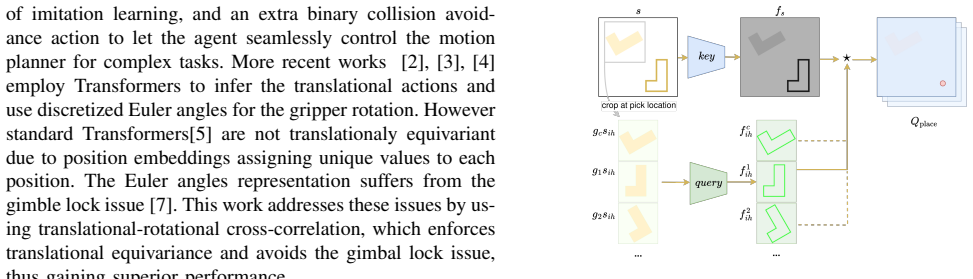
The load-bearing machinery is the pair of equivariance identities (Eqs. 2–3) together with the lift cross-correlation $(b \star k)[g] = \int_x b(x)\,(g \cdot k)(x)\,dx$ over $SE(3)$. The cross-correlation makes symmetry architectural: rotating the in-hand feature kernel and sliding it through the scene feature volume densely scores every discretized SE(3) action while preserving equivariance. The coarse-to-fine evaluator starts at a $24^3$ voxel $\times 24$ rotation grid and refines over three levels down to a resolution equivalent to $96^3 \times 36864$ (1 cm translation, 7.5° rotation), which makes 3D cross-correlation computationally practical. A self-supervised mask excludes distractors from the in-hand crop, and bi-equivariant data augmentation $s \mapsto g_1 s$, $s_{ih} \mapsto g_2 s_{ih}$, $a \mapsto g_1 a g_2^{-1}$ approximates the continuous symmetry.
What would settle it
Train the model on demonstrations of a gravity-sensitive task (e.g., flipping or pouring) with the grasped object in a single orientation, then test with the object rotated by 90° or more outside the augmentation range; if success collapses, the learned policy is not actually generalizing via bi-equivariance.
Extended reading notes
Core claim
The central claim is that the keyframe action policy is bi-equivariant: for any scene transformation $g_1 \in SE(3)$, the optimal action satisfies $g_1 a^*_T = \pi(g_1 \cdot s, s_{ih})$, and for any in-hand transformation $g_2 \in SE(3)$ it satisfies $a^*_T g_2^{-1} = \pi(s, g_2 \cdot s_{ih})$ (Eqs. 2–3). The paper realizes this property by treating every keyframe action as a placement of the in-hand object or gripper into the scene, computing action values as the lift cross-correlation between the query network's masked in-hand features and the key network's scene features, and searching the SE(3) action space coarse-to-fine with hierarchical voxels and Healpix rotation grids. The result is a single unified architecture that handles equivariant actions (grasping, pushing) and bi-equivariant actions (placing, tool use) and, in the reported experiments, achieves higher success rates than Transformer- and Euler-angle-based keyframe imitation baselines.
Load-bearing premise
The central assumption is that the optimal keyframe action is genuinely bi-equivariant under independent $SE(3)$ transformations of the scene and the grasped object; this can be violated by gravity, friction, contacts, and non-rigid objects, and the network only approximates the continuous rotation symmetry through data augmentation.
Editorial extensions
If this is right
- A single architecture can handle equivariant actions (grasping, pushing) and bi-equivariant actions (placing, tool use) across many tasks, unlike prior bi-equivariant pick-place methods.
- With 10 demonstrations, the method approaches the performance of the best keyframe imitation baseline trained on 100 demonstrations, indicating roughly an order-of-magnitude reduction in data needs.
- The three-level coarse-to-fine SE(3) evaluation makes 3D cross-correlation practical at high resolution, with one-shot inference and about 0.7 s per SGD step, avoiding the repeated voxel rotations or hundreds of diffusion steps used by other bi-equivariant methods.
- Encoding the in-hand object explicitly lets the policy react to gripper-object pose changes, which is why the reported real-world experiments show a 55% average improvement over the strongest image-based baseline.
Reading between the lines
- The same scene/in-hand cross-correlation decomposition could be applied to other structured prediction problems in robotics, such as grasp contact-point prediction or tool-use affordance learning, wherever a gripper-relative input and a world-relative input are involved.
- Because continuous rotation is only approximated through augmentation, a version using exactly equivariant features (for example, spherical harmonics or irreducible representations) could close the remaining gap on high-precision tasks; this is a testable extension the paper explicitly flags as a limitation.
- The reported gain over the strongest baseline may partly reflect that baseline's blindness to the in-hand state; a control experiment that feeds that baseline an additional in-hand observation would isolate how much of the improvement comes from the cross-correlation structure versus simply giving the baseline more information.
Editorial analysis
A structured set of objections, weighed in public.
Referee Report
Summary. The paper proposes a keyframe imitation learning method for SE(3) manipulation policies, based on a 3D extension of the Transporter Networks place module. The central claim is that a keyframe policy is bi-equivariant under independent transformations of the scene and of the in-hand object, and that this symmetry can be exploited by computing a 3D cross-correlation between scene features and in-hand features. To make the resulting 6D action search tractable, the paper introduces a three-level coarse-to-fine SE(3) action evaluation scheme. The method is evaluated on 18 RLBench tasks with 10 or 100 demonstrations and in four physical experiments, reporting average improvements over keyframe IL baselines of more than 10% in simulation and 55% in the real world. Ablations are presented for coarse-to-fine search, cross-correlation, in-hand segmentation, and data augmentation.
Significance. If the bi-equivariance claim were established, this would be a meaningful extension of equivariant manipulation methods from pick-place to general keyframe tasks, and the coarse-to-fine SE(3) evaluation is a practically relevant computational contribution. The paper correctly identifies that a single cross-correlation architecture can handle both equivariant and bi-equivariant keyframe actions, and the ablation study supports the importance of the coarse-to-fine scheme and the in-hand segmentation. The main theoretical concern, however, is that the bi-equivariant data augmentation is implemented on off-manifold observation pairs, so the claimed symmetry of the physical keyframe policy is not actually learned or demonstrated. The empirical claims also need stronger statistical backing, since the main simulation table reports point estimates without error bars.
major comments (3)
- [Section IV-E, Eq. (6)] The bi-equivariant data augmentation transforms s and sih independently by g1 and g2, but Section IV-B defines the in-hand observation as sih = crop(T_ee^{-1} s), a deterministic function of s. For a physically realizable transformed observation, applying g1 to the scene changes the in-hand crop to crop(T_ee^{-1}(g1·s)), and applying a separate transformation g2 to the in-hand object also changes the occupied voxels of s. The augmented tuples (g1·s, g2·sih) are therefore almost never in the image of the observation pipeline, so the network is trained to be bi-equivariant on inputs that cannot arise at test time. This breaks the paper's claim that Eqs. (2) and (3) describe a symmetry of the physical keyframe task. The authors should either define an observation model in which s and sih are truly independent input channels, or use on-manifold augmentation that transforms the full scene and recomputes the crop, and should justify how the learned symmetry transfers to test-time observations.
- [Table I] The main simulation results are reported as single success-rate numbers without error bars, standard deviations, or seed counts. Because RLBench tasks are known to have high variance across seeds, the headline claim of an average >10% improvement over baselines is not statistically supported. The authors should report the number of evaluation seeds and dispersion measures, or at minimum provide a clear statement about the number of runs underlying each entry.
- [Section V-A, Baselines paragraph] The text first states that all baselines were retrained from open-source code with the same parameters, then says that the table includes the baselines' multi-task performance as reported in their original papers. Since Table I uses only the '-s' (single-task) suffix, it is unclear whether the baseline numbers come from the authors' own single-task runs or from prior multi-task publications. This ambiguity directly affects the comparability of the results and should be resolved in the revised version.
minor comments (3)
- [Section IV-D] The formula for the in-hand segmentation ground-truth mask m[x] is notationally ambiguous: expressions such as 'x ∈ sih > s′ih + v−1(sih < s′ih)' mix set membership and inequalities without clear definitions. Please rewrite with explicit Boolean conditions and define the set operations used.
- [Table I header] The header mentions 'row, pitch, and yaw'; this should be 'roll, pitch, and yaw'.
- [Figure 5 caption] The caption contains a typo: 'the button 3 tasks' should be 'the bottom 3 tasks'.
Circularity Check
No circularity found: the bi-equivariance claim is an explicit modeling assumption, the cross-correlation architecture realizes it constructively, and the headline results are external evaluations on held-out tasks.
full rationale
The paper's derivation chain is self-contained in the relevant sense: (1) Section IV-A assumes the optimal keyframe policy is bi-equivariant over independent scene and in-hand transformations (Eqs. 2 and 3); (2) Section IV-B designs a 3D cross-correlation action evaluator that realizes this symmetry when the key/query feature extractors are equivariant; (3) Sections V-A and V-B evaluate the resulting policy on held-out RLBench and real-world tasks. Step (2) is a constructive engineering realization, not a derivation of the physical property from the evaluation data, and step (3) is measured against out-of-distribution initial states rather than against the training loss. The key mathematical fact that cross-correlation is bi-equivariant is attributed to the authors' prior RSS paper [9], but it is a simple, externally verifiable property of group cross-correlation and is not fitted to the present paper's numbers, so it is independent support under the stated rules. The coarse-to-fine scheme is a computational decomposition of the same argmax operation; it is not a parameter fitted to the test set, and the ablation shows it helps empirically. No prediction is a renamed training target: the action values are trained on expert demonstrations and the reported successes are simulator/real-robot evaluations. The only notable weakness is in Section IV-E, where Eq. 6 augments s and sih with independently sampled g1 and g2 even though Section IV-B defines sih = crop(T_ee^{-1}·s), so some augmented pairs are not reachable by the observation pipeline. That is a correctness/manifold concern, not circular reasoning, and it does not make the empirical results equivalent to the training objective. Heavy self-citation exists, but it grounds the cross-correlation design in peer-reviewed prior work and does not constitute an unverified uniqueness chain. Overall, no circular step meeting the quoted-evidence threshold was found.
Assumptions & free parameters
free parameters (3)
- Action discretization resolution (voxel grid, rotation grid, C2F levels) =
24^3 voxels, 24 rotations, 3 levels refining 2^3 x 8; final 96^3 x 36864
- In-hand crop size =
32^3 (from ablation footnote)
- Number of training iterations =
15k SGD steps
assumptions (3)
- domain assumption The optimal keyframe policy satisfies bi-equivariance: pi(g1*s, sih) = g1*pi(s, sih) and pi(s, g2*sih) = pi(s, sih)*g2^-1 (Eq. 2-3).
- domain assumption The in-hand object is rigidly attached to the gripper, so any gripper transformation moves the object identically.
- standard math 3D CNN backbones are translation equivariant and the cross-correlation operation preserves bi-equivariance when the feature extractors are equivariant.
Cite this review
Pith. "Pith review of Coarse-to-Fine 3D Keyframe Transporter." pith.science (2026). https://pith.science/paper/KSL3YSDG
@misc{pith2026250201773,
  author       = {Pith},
  title        = {Pith review of: Coarse-to-Fine 3D Keyframe Transporter},
  year         = {2026},
  howpublished = {\url{https://pith.science/paper/KSL3YSDG}},
  note         = {Machine review of arXiv:2502.01773}
}
read the original abstract
Recent advances in Keyframe Imitation Learning (IL) have enabled learning-based agents to solve a diverse range of manipulation tasks. However, most approaches ignore the rich symmetries in the problem setting and, as a consequence, are sample-inefficient. This work identifies and utilizes the bi-equivariant symmetry within Keyframe IL to design a policy that generalizes to transformations of both the workspace and the objects grasped by the gripper. We make two main contributions: First, we analyze the bi-equivariance properties of the keyframe action scheme and propose a Keyframe Transporter derived from the Transporter Networks, which evaluates actions using cross-correlation between the features of the grasped object and the features of the scene. Second, we propose a computationally efficient coarse-to-fine SE(3) action evaluation scheme for reasoning the intertwined translation and rotation action. The resulting method outperforms strong Keyframe IL baselines by an average of >10% on a wide range of simulation tasks, and by an average of 55% in 4 physical experiments.
Figures


Figures from the paper (2 more)


Forward citations
Cited by 2 Pith papers
-
SE(3)-Equivariant Diffusion Policy in Spherical Fourier Space
Continuous SE(3) equivariance is embedded in the policy by representing states, actions, and denoising steps in spherical Fourier space, improving generalization to novel 3D arrangements.
-
EquAct: An SE(3)-Equivariant Multi-Task Transformer for Open-Loop Robotic Manipulation
EquAct embeds SE(3) equivariance into a multi-task keyframe manipulation transformer with language conditioning, improving spatial generalization over non-equivariant baselines.
Reference graph
Works this paper leans on
-
[1]
Coarse-to- fine q-attention: Efficient learning for visual robotic manipulation via discretisation,
S. James, K. Wada, T. Laidlow, and A. J. Davison, “Coarse-to- fine q-attention: Efficient learning for visual robotic manipulation via discretisation,” in Proceedings of the IEEE/CVF Conference on Computer Vision and Pattern Recognition , 2022, pp. 13 739–13 748
2022
-
[2]
Perceiver-actor: A multi- task transformer for robotic manipulation,
M. Shridhar, L. Manuelli, and D. Fox, “Perceiver-actor: A multi- task transformer for robotic manipulation,” in Conference on Robot Learning. PMLR, 2023, pp. 785–799
2023
-
[3]
Rvt: Robotic view transformer for 3d object manipulation,
A. Goyal, J. Xu, Y . Guo, V . Blukis, Y .-W. Chao, and D. Fox, “Rvt: Robotic view transformer for 3d object manipulation,” CoRL, 2023
work page 2023
-
[4]
Act3d: 3d feature field transformers for multi-task robotic manipulation,
T. Gervet, Z. Xian, N. Gkanatsios, and K. Fragkiadaki, “Act3d: 3d feature field transformers for multi-task robotic manipulation,” in Conference on Robot Learning . PMLR, 2023, pp. 3949–3965
work page 2023
-
[5]
Attention is all you need,
A. Vaswani, “Attention is all you need,” Advances in Neural Informa- tion Processing Systems , 2017
2017
-
[6]
Multilayer perceptron and neural networks,
M.-C. Popescu, V . E. Balas, L. Perescu-Popescu, and N. Mastorakis, “Multilayer perceptron and neural networks,” WSEAS Transactions on Circuits and Systems , vol. 8, no. 7, pp. 579–588, 2009
2009
-
[7]
On the continuity of ro- tation representations in neural networks,
Y . Zhou, C. Barnes, J. Lu, J. Yang, and H. Li, “On the continuity of ro- tation representations in neural networks,” CoRR, vol. abs/1812.07035, 2018
arXiv 2018
-
[8]
Transporter networks: Rearranging the visual world for robotic manipulation,
A. Zeng, P. Florence, J. Tompson, S. Welker, J. Chien, M. Attarian, T. Armstrong, I. Krasin, D. Duong, V . Sindhwani et al. , “Transporter networks: Rearranging the visual world for robotic manipulation,” in Conference on Robot Learning . PMLR, 2021, pp. 726–747
2021
Show all 45 references
-
[9]
Equivariant Transporter Network,
H. Huang, D. Wang, R. Walters, and R. Platt, “Equivariant Transporter Network,” in Proceedings of Robotics: Science and Systems , New York City, NY , USA, June 2022
2022
-
[10]
Equivariant descriptor fields: SE(3)-equivariant energy-based models for end-to-end visual robotic manipulation learning,
H. Ryu, H. in Lee, J.-H. Lee, and J. Choi, “Equivariant descriptor fields: SE(3)-equivariant energy-based models for end-to-end visual robotic manipulation learning,” in The Eleventh International Confer- ence on Learning Representations , 2023
2023
-
[11]
Learning manipulation skills via hierar- chical spatial attention,
M. Gualtieri and R. P. Jr., “Learning manipulation skills via hierar- chical spatial attention,” IEEE Trans. Robotics , vol. 36, no. 4, pp. 1067–1078, 2020
2020
-
[12]
Mira: Mental imagery for robotic affordances,
L. Yen-Chen, P. Florence, A. Zeng, J. T. Barron, Y . Du, W.-C. Ma, A. Simeonov, A. R. Garcia, and P. Isola, “Mira: Mental imagery for robotic affordances,” 2022
2022
-
[13]
Diffusion-edfs: Bi-equivariant denoising generative modeling on se(3) for visual robotic manipulation,
H. Ryu, J. Kim, H. An, J. Chang, J. Seo, T. Kim, Y . Kim, C. Hwang, J. Choi, and R. Horowitz, “Diffusion-edfs: Bi-equivariant denoising generative modeling on se(3) for visual robotic manipulation,” 2023
2023
-
[14]
Fourier transporter: Bi-equivariant robotic manipulation in 3d,
H. Huang, O. L. Howell, D. Wang, X. Zhu, R. Platt, and R. Walters, “Fourier transporter: Bi-equivariant robotic manipulation in 3d,” inThe Twelfth International Conference on Learning Representations , 2024
2024
-
[15]
Q-attention: Enabling efficient learning for vision-based robotic manipulation,
S. James and A. J. Davison, “Q-attention: Enabling efficient learning for vision-based robotic manipulation,” CoRR, 2021
2021
-
[16]
Robotic pick-and-place of novel objects in clutter with multi-affordance grasping and cross- domain image matching,
A. Zeng, S. Song, K.-T. Yu, E. Donlon, F. R. Hogan, M. Bauza, D. Ma, O. Taylor, M. Liu, E. Romo et al. , “Robotic pick-and-place of novel objects in clutter with multi-affordance grasping and cross- domain image matching,” in 2018 IEEE international conference on robotics and ...
2018
-
[17]
Closing the loop for robotic grasping: A real-time, generative grasp synthesis approach,
D. Morrison, J. Leitner, and P. Corke, “Closing the loop for robotic grasping: A real-time, generative grasp synthesis approach,” in Pro- ceedings of Robotics: Science and Systems , Pittsburgh, Pennsylvania, June 2018
2018
-
[18]
Equivariant $q$ learning in spatial action spaces,
D. Wang, R. Walters, X. Zhu, and R. Platt, “Equivariant $q$ learning in spatial action spaces,” in 5th Annual Conference on Robot Learning , 2021
2021
-
[19]
Sample efficient grasp learning using equivariant models,
X. Zhu, D. Wang, O. Biza, G. Su, R. Walters, and R. Platt, “Sample efficient grasp learning using equivariant models,” Proceedings of Robotics: Science and Systems (RSS) , 2022
2022
-
[20]
On robot grasp learning using equivariant models,
X. Zhu, D. Wang, G. Su, O. Biza, R. Walters, and R. Platt, “On robot grasp learning using equivariant models,” Autonomous Robots , 2023
2023
-
[21]
Seil: Simulation-augmented equivariant imitation learning,
M. Jia, D. Wang, G. Su, D. Klee, X. Zhu, R. Walters, and R. Platt, “Seil: Simulation-augmented equivariant imitation learning,” in 2023 IEEE International Conference on Robotics and Automation (ICRA) . IEEE, 2023, pp. 1845–1851
2023
-
[22]
SO(2)-equivariant reinforcement learning,
D. Wang, R. Walters, and R. Platt, “ SO(2)-equivariant reinforcement learning,” in International Conference on Learning Representations , 2022
2022
-
[23]
On-robot learning with equivariant models,
D. Wang, M. Jia, X. Zhu, R. Walters, and R. Platt, “On-robot learning with equivariant models,” in 6th Annual Conference on Robot Learning, 2022
2022
-
[24]
Integrating symmetry into differentiable planning with steerable convolutions,
L. Zhao, X. Zhu, L. Kong, R. Walters, and L. L. Wong, “Integrating symmetry into differentiable planning with steerable convolutions,” arXiv preprint arXiv:2206.03674 , 2022
2022 arXiv
-
[25]
Equivariant diffusion policy,
D. Wang, S. Hart, D. Surovik, T. Kelestemur, H. Huang, H. Zhao, M. Yeatman, J. Wang, R. Walters, and R. Platt, “Equivariant diffusion policy,” in 8th Annual Conference on Robot Learning , 2024
2024
-
[26]
Neural descriptor fields: Se (3)- equivariant object representations for manipulation,
A. Simeonov, Y . Du, A. Tagliasacchi, J. B. Tenenbaum, A. Rodriguez, P. Agrawal, and V . Sitzmann, “Neural descriptor fields: Se (3)- equivariant object representations for manipulation,” in 2022 Interna- tional Conference on Robotics and Automation (ICRA) . IEEE, 2022, pp. 6394–6400
2022
-
[27]
Edge grasp network: A graph-based se (3)-invariant approach to grasp detection,
H. Huang, D. Wang, X. Zhu, R. Walters, and R. Platt, “Edge grasp network: A graph-based se (3)-invariant approach to grasp detection,” arXiv preprint arXiv:2211.00191 , 2022
2022 arXiv
-
[28]
Orbitgrasp: Se (3)-equivariant grasp learning,
B. Hu, X. Zhu, D. Wang, Z. Dong, H. Huang, C. Wang, R. Walters, and R. Platt, “Orbitgrasp: Se (3)-equivariant grasp learning,” in 8th Annual Conference on Robot Learning , 2024
2024
-
[29]
Imagination policy: Using generative point cloud models for learning manipulation policies,
H. Huang, K. Schmeckpeper, D. Wang, O. Biza, Y . Qian, H. Liu, M. Jia, R. Platt, and R. Walters, “Imagination policy: Using generative point cloud models for learning manipulation policies,” arXiv preprint arXiv:2406.11740, 2024
2024 arXiv
-
[30]
Policy learning in se (3) action spaces,
D. Wang, C. Kohler, and R. Platt, “Policy learning in se (3) action spaces,” in Conference on Robot Learning . PMLR, 2021, pp. 1481– 1497
2021
-
[31]
U-net: Convolu- tional networks for biomedical image segmentation,
O. Ronneberger, P. Fischer, and T. Brox, “U-net: Convolu- tional networks for biomedical image segmentation,” CoRR, vol. abs/1505.04597, 2015
2015 arXiv
-
[32]
3d u-net: Learning dense volumetric segmentation from sparse annotation,
¨O. C ¸ ic ¸ek, A. Abdulkadir, S. S. Lienkamp, T. Brox, and O. Ron- neberger, “3d u-net: Learning dense volumetric segmentation from sparse annotation,” CoRR, vol. abs/1606.06650, 2016
2016 arXiv
-
[33]
Healpix: A framework for high- resolution discretization and fast analysis of data distributed on the sphere,
K. M. Gorski, E. Hivon, A. J. Banday, B. D. Wandelt, F. K. Hansen, M. Reinecke, and M. Bartelmann, “Healpix: A framework for high- resolution discretization and fast analysis of data distributed on the sphere,” The Astrophysical Journal , vol. 622, no. 2, p. 759, 2005
2005
-
[34]
Rlbench: The robot learning benchmark & learning environment,
S. James, Z. Ma, D. R. Arrojo, and A. J. Davison, “Rlbench: The robot learning benchmark & learning environment,” IEEE Robotics and Automation Letters , vol. 5, no. 2, pp. 3019–3026, 2020
2020
-
[35]
What matters in learning from offline human demonstrations for robot manipula- tion,
A. Mandlekar, D. Xu, J. Wong, S. Nasiriany, C. Wang, R. Kulkarni, L. Fei-Fei, S. Savarese, Y . Zhu, and R. Mart´ın-Mart´ın, “What matters in learning from offline human demonstrations for robot manipula- tion,” CoRR, vol. abs/2108.03298, 2021
2021 arXiv
-
[36]
Dynpoint: Dynamic neural point for view synthesis,
K. Zhou, J.-X. Zhong, S. Shin, K. Lu, Y . Yang, A. Markham, and N. Trigoni, “Dynpoint: Dynamic neural point for view synthesis,” Advances in Neural Information Processing Systems , vol. 36, 2024
2024
-
[37]
Reducing the barrier to entry of complex robotic software: a moveit! case study,
D. Coleman, I. A. Sucan, S. Chitta, and N. Correll, “Reducing the barrier to entry of complex robotic software: a moveit! case study,” CoRR, vol. abs/1404.3785, 2014
2014 arXiv
-
[38]
Rrt-connect: An efficient approach to single-query path planning,
J. Kuffner and S. LaValle, “Rrt-connect: An efficient approach to single-query path planning,” in Proceedings 2000 ICRA. Millennium Conference. IEEE International Conference on Robotics and Automa- tion. Symposia Proceedings (Cat. No.00CH37065) , vol. 2, 2000, pp. 995–1001 vol.2
2000
-
[39]
curobo: Parallelized collision-free minimum-jerk robot motion generation,
B. Sundaralingam, S. K. S. Hari, A. Fishman, C. Garrett, K. V . Wyk, V . Blukis, A. Millane, H. Oleynikova, A. Handa, F. Ramos, N. Ratliff, and D. Fox, “curobo: Parallelized collision-free minimum-jerk robot motion generation,” 2023
2023
-
[40]
Two hybrid end-effector posture-maintaining and obstacle-limits avoidance schemes for redun- dant robot manipulators,
Z. Zhang, S. Chen, X. Zhu, and Z. Yan, “Two hybrid end-effector posture-maintaining and obstacle-limits avoidance schemes for redun- dant robot manipulators,” IEEE Transactions on Industrial Informatics, vol. 16, no. 2, pp. 754–763, 2019
2019
-
[41]
A program to build E(N)- equivariant steerable CNNs,
G. Cesa, L. Lang, and M. Weiler, “A program to build E(N)- equivariant steerable CNNs,” in International Conference on Learning Representations, 2022
2022
-
[42]
General E(2)-Equivariant Steerable CNNs,
M. Weiler and G. Cesa, “General E(2)-Equivariant Steerable CNNs,” in Conference on Neural Information Processing Systems (NeurIPS) , 2019
2019
-
[43]
Pointnet++: Deep hierarchical feature learning on point sets in a metric space,
C. R. Qi, L. Yi, H. Su, and L. J. Guibas, “Pointnet++: Deep hierarchical feature learning on point sets in a metric space,” Advances in neural information processing systems , vol. 30, 2017
2017
-
[44]
Chaineddiffuser: Unifying trajectory diffusion and keypose prediction for robotic manipulation,
Z. Xian, N. Gkanatsios, T. Gervet, T.-W. Ke, and K. Fragkiadaki, “Chaineddiffuser: Unifying trajectory diffusion and keypose prediction for robotic manipulation,” in Conference on Robot Learning , 2023
2023
-
[45]
Hierarchical diffusion policy for kinematics-aware multi-task robotic manipulation,
X. Ma, S. Patidar, I. Haughton, and S. James, “Hierarchical diffusion policy for kinematics-aware multi-task robotic manipulation,” 2024
2024
Reviewed August 9, 2026 · model on record in the stance chip above.
Discussion (0). Continue with ORCID to comment.