REVIEW 1 major objections 1 minor 12 references
Assessing Data Augmentation-Induced Bias in Training and Testing of Machine Learning Models
T0 review · 1 major / 1 minor · reviewed 2026-08-09 · deepseek-v4-flash
Pith's one-line read Augmented test data inflates machine-learning scores: a flaky-test classifier scores on average 8% higher on augmented copies of training cases than on genuinely new test cases.
desk verdict The 8% augmentation-bias gap is confounded with train-test overlap, so the paper's central claim is unsupported, though the practical guidelines and code make it worth a revision attempt. read the letter →
The pith
A machine-rendered reading of the paper's core claim, the machinery that carries it, and where it could break.
The reading
What carries the argument
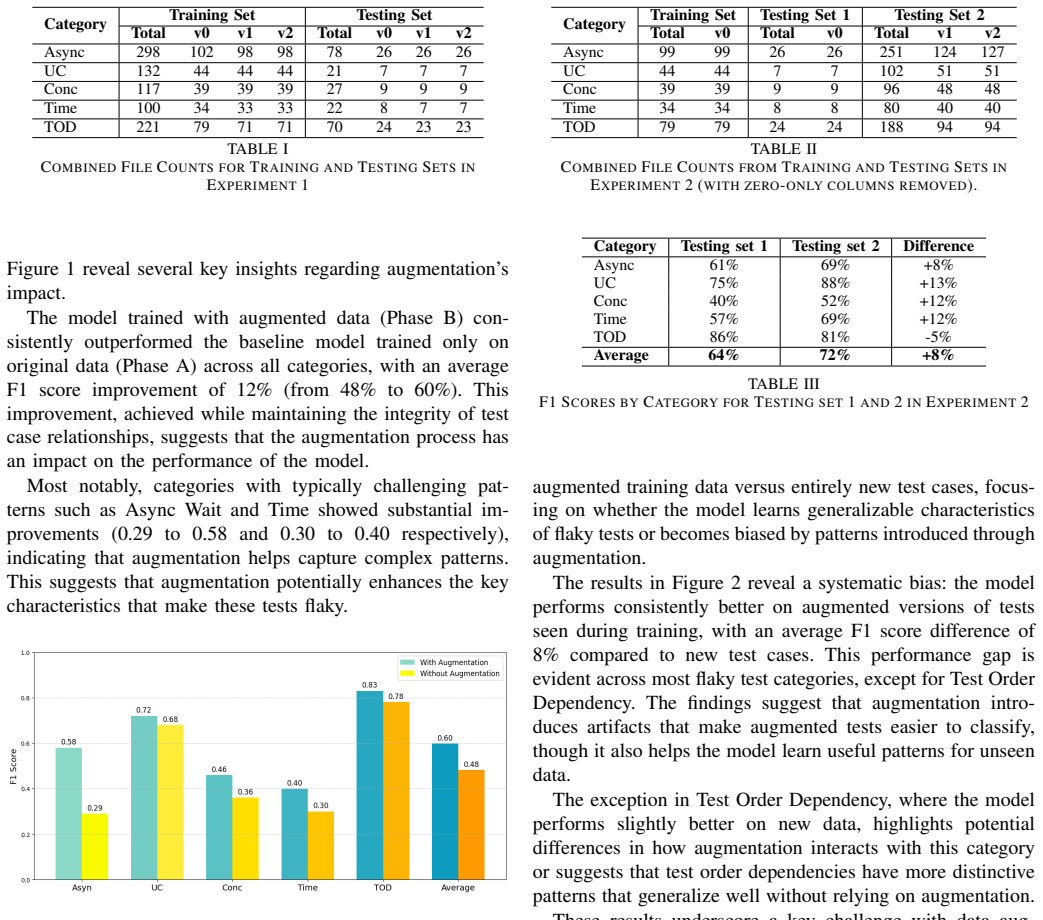
The key machinery is a paired testing protocol. The model is trained only on original flaky-test code, then evaluated on two test sets: Testing Set 1, original versions of unseen test cases, and Testing Set 2, augmented v1/v2 copies of the training cases. The F1 gap between the two sets is the paper's operational measure of augmentation-induced bias. The FlakyCat dataset provides the labeled flaky-test categories, and an adapted SMOTE method (mutating variable names, constants, method names, and unused variable declarations) creates the augmented copies.
What would settle it
Run the same model on a Testing Set 3 containing augmented copies of held-out original test cases that never appear in training; if the F1 gap relative to Testing Set 1 drops to near zero, the 8-point effect comes from training-set overlap rather than augmentation artifacts.
Extended reading notes
Core claim
The central claim is that augmentation-induced bias is systematic and measurable. A flaky-test category classifier built on CodeBERT representations and a Siamese contrastive training setup performs better on augmented variants (v1 and v2) of test cases seen in training than on original unseen test cases: the average F1 gap is 8 percentage points, ranging from 13 points for Unordered Collections to -5 points for Test Order Dependency. The same model trained with augmented data beats the original-only baseline by 12 average F1 points, so augmentation helps learning but also injects patterns that make augmented examples artificially easy. The paper concludes that evaluation on augmented test data can inflate performance and recommends keeping a separate original-data validation set when assessing models trained on augmented data.
Load-bearing premise
The load-bearing premise is that the F1 gap between Testing Set 1 and Testing Set 2 isolates augmentation bias; Testing Set 2 is built from augmented copies of training cases, so the gap also includes the effect of testing on near-duplicates of training examples.
Editorial extensions
If this is right
- Reported F1 scores for augmented-data models may overstate real performance by about 8 points on average unless validation uses non-augmented held-out data.
- Dataset providers should label augmented samples so downstream users can exclude them from validation and testing.
- Augmentation strategies may need to be category-specific, since the bias varies from 13 points for Unordered Collections to -5 points for Test Order Dependency.
- Augmentation still provides a real training benefit (12 F1 points in Experiment 1), so the remedy is controlled evaluation rather than abandoning augmentation.
- The same evaluation bias likely affects other software-engineering tasks such as defect prediction and fault localization, as the paper itself suggests.
Reading between the lines
- A stronger experimental design would also test augmented copies of held-out original cases; the current comparison cannot fully separate augmentation artifacts from memorization of near-duplicates of training data.
- The 8-point gap probably mixes two effects: augmentation-specific patterns and the intrinsic advantage of re-seeing examples similar to the training set; separating them would give a cleaner bias estimate.
- A practical standard for ML benchmarks could be to require a 'pristine test gap' against a fully original, never-augmented test set alongside any augmented-data result.
Signed reviews
Editorial analysis
A structured set of objections, weighed in public.
Referee Report
Summary. The paper addresses whether data augmentation introduces bias in machine learning models for software engineering tasks, using flaky test classification as a case study. The authors use the FlakyCat dataset, where each original test (v0) has two augmented versions (v1, v2), and run two experiments. Experiment 1 compares a model trained on original cases only with a model trained on original and augmented cases. Experiment 2 trains only on original cases and evaluates on two test sets: original versions of unseen cases and augmented versions of training cases. The paper reports an average F1-score gap of 8% between these two test sets and interprets this as augmentation-induced bias, recommending that practitioners keep separate non-augmented validation sets. The code is made available in a GitHub repository.
Significance. The question is timely and important: if data augmentation in training and testing sets inflates reported performance, many published evaluations in software engineering could be overly optimistic. The paper has clear strengths: it uses a third-party augmented dataset (reducing self-confirmatory bias), it targets a concrete SE task, and it makes a practical, falsifiable recommendation about validation set design. However, the two experiments as designed do not support the central claim. Experiment 1 confounds augmentation with training-set size, and Experiment 2 confounds augmentation with train-test overlap. The reported 8% gap is therefore expected even in the absence of any augmentation-specific bias. The manuscript would need a substantial redesign of its experiments before the central conclusion can be evaluated.
major comments (1)
- [Section III-D] The design description is misleading: Testing Set 2 is called 'augmented training data' in the experiment title, but the results section says the model is evaluated on 'entirely new test cases.' Testing Set 2 is not new; it consists of augmented versions of the training cases. This wording obscures the train-test overlap confound and should be corrected if the experiment is redesigned and resubmitted.
minor comments (1)
- [References] Reference [1] is given as 'arXiv preprint:2401.15422' but should follow the standard arXiv citation format. Please also check that all references are complete and consistent.
Circularity Check
Experiment 2's 8% gap is built into the test-set construction: Testing Set 2 contains augmented copies of training cases, so the comparison cannot separate augmentation from train-test overlap.
-
self definitional
[Section III-D.1 (Experiment 2 – Augmentation Bias Analysis, Experimental Design)]
"The second experiment assesses the model’s generalization by comparing its performance on augmented training data with entirely new test cases. The model is trained exclusively on original test case versions (v0) and evaluated on two test sets: Testing Set 1, containing original versions (v0) of unseen test cases, and Testing Set 2, comprising augmented versions (v1 and v2) of training cases."
Testing Set 2 is built from v1/v2 of the very v0 cases used in training, while Testing Set 1 is built from unseen v0 cases. Hence the two conditions differ by both augmentation status and train-set membership. The observed +8% gap is therefore an expected consequence of the construction, because models tend to score higher on variants of training inputs, and it cannot be attributed specifically to augmentation. The paper's conclusion that 'augmentation introduces artifacts' and the section title 'Augmentation Bias Analysis' treat this confounded contrast as the definition of augmentation bias.
full rationale
The paper's central quantitative claim is the 8% average F1 gap between Testing Set 1 (original, unseen) and Testing Set 2 (augmented copies of training cases) in Section III-D, Table III, and Figure 2. The design confounds augmentation with train-test overlap: because v1/v2 are generated from the v0 training cases, the model has already seen the original versions, so higher scores on Testing Set 2 are expected even if augmentation introduces no artifacts. The paper's own phrase 'augmented versions of tests seen during training' encodes this confound. The TOD category's negative difference shows the sign is not universal, but it does not remove the design problem. The practical recommendation to keep separate non-augmented validation sets is reasonable, but the presented measurement does not independently establish it. No load-bearing self-citations or imported uniqueness theorems were found; the model and dataset are prior/external tools, not assumptions entailing the target result. Thus the circularity is partial and concentrated in the operational definition of the Experiment 2 comparison.
Assumptions & free parameters
assumptions (3)
- domain assumption The third-party adapted SMOTE versions (v1, v2) preserve the original flakiness category labels.
- domain assumption The Siamese/CodeBERT model from prior work [10] is a valid classifier for this task.
- domain assumption Single-run F1 scores without confidence intervals are stable enough to support the 8% claim.
Cite this review
Pith. "Pith review of Assessing Data Augmentation-Induced Bias in Training and Testing of Machine Learning Models." pith.science (2026). https://pith.science/paper/QLCZC75T
@misc{pith2026250201825,
  author       = {Pith},
  title        = {Pith review of: Assessing Data Augmentation-Induced Bias in Training and Testing of Machine Learning Models},
  year         = {2026},
  howpublished = {\url{https://pith.science/paper/QLCZC75T}},
  note         = {Machine review of arXiv:2502.01825}
}
read the original abstract
Data augmentation has become a standard practice in software engineering to address limited or imbalanced data sets, particularly in specialized domains like test classification and bug detection where data can be scarce. Although techniques such as SMOTE and mutation-based augmentation are widely used in software testing and debugging applications, a rigorous understanding of how augmented training data impacts model bias is lacking. It is especially critical to consider bias in scenarios where augmented data sets are used not just in training but also in testing models. Through a comprehensive case study of flaky test classification, we demonstrate how to test for bias and understand the impact that the inclusion of augmented samples in testing sets can have on model evaluation.
Figures

Reference graph
Works this paper leans on
-
[1]
Y. Zhou, C. Guo, X. Wang, Y. Chang, and Y. Wu, ``A survey on data augmentation in large model era,'' arXiv preprint:2401.15422, 2024
arXiv 2024
-
[2]
B. Ding, C. Qin, R. Zhao, T. Luo, X. Li, G. Chen, W. Xia, J. Hu, A. T. Luu, and S. Joty, ``Data augmentation using LLM s: Data perspectives, learning paradigms and challenges,'' in Findings of the Association for Computational Linguistics: ACL 2024, Aug. 2024, pp. 1679--1705
work page 2024
- [3]
- [4]
-
[5]
Y. Yu, Y. Zhuang, J. Zhang, Y. Meng, A. J. Ratner, R. Krishna, J. Shen, and C. Zhang, ``Large language model as attributed training data generator: A tale of diversity and bias,'' Advances in Neural Information Processing Systems, vol. 36, pp. 55\,734--55\,784, 2023
work page 2023
-
[6]
Y. He, J. Wang, Y. Rong, and H. Chen, `` FuzzAug : Data augmentation by fuzzing for neural test generation,'' arXiv preprint:2406.08665, 2024
work page Pith review arXiv 2024
-
[7]
W. Lam, P. Godefroid, S. Nath, A. Santhiar, and S. Thummalapenta, ``Root causing flaky tests in a large-scale industrial setting,'' in Proc. of the 28th ACM SIGSOFT International Symposium on Software Testing and Analysis (ISSTA 2019), 2019, p. 101–111
work page 2019
-
[8]
T. H. M. Le and M. Ali Babar, ``Mitigating data imbalance for software vulnerability assessment: Does data augmentation help?'' in Proc. of the 18th ACM/IEEE International Symposium on Empirical Software Engineering and Measurement (ESEM 2024), 2024, pp. 119--130
work page 2024
Show all 12 references
-
[9]
A. Akli, G. Haben, S. Habchi, M. Papadakis, and Y. Le Traon, `` FlakyCat : Predicting flaky tests categories using few-shot learning,'' in Proc. of IEEE/ACM International Conference on Automation of Software Test (AST 2023), May 2023, pp. 140--151
2023
-
[10]
More and J
R. More and J. S. Bradbury, ``An analysis of LLM fine-tuning and few-shot learning for flaky test detection and classification,'' in Proc. of the 18th IEEE International Conference on Software Testing, Verification and Validation (ICST 2025), Apr. 2025
2025
-
[11]
Z. Feng, D. Guo, D. Tang et al., `` C ode BERT : A pre-trained model for programming and natural languages,'' in Findings of the Association for Computational Linguistics: EMNLP 2020, Nov. 2020, pp. 1536--1547
2020
-
[12]
Data Augmentation using LLM s: Data Perspectives, Learning Paradigms and Challenges
11em plus .33em minus .07em 4000 4000 100 4000 4000 500 `\.=1000 = #1 \@IEEEnotcompsoconly \@IEEEcompsoconly #1 * [1] 0pt [0pt][0pt] #1 * [1] 0pt [0pt][0pt] #1 * \| ** #1 \@IEEEauthorblockNstyle \@IEEEcompsocnotconfonly \@IEEEauthorblockAstyle \@IEEEcompsocnotconfonly \@IEEEco...
2023 arXiv
Reviewed August 9, 2026 · model on record in the stance chip above.
Discussion (0). Continue with ORCID to comment.