REVIEW 2 major objections 5 minor 1 cited by
Multimaterial topology optimization for finite strain elastoplasticity: theory, methods, and applications
T0 review · 2 major / 5 minor · reviewed 2026-08-09 · deepseek-v4-flash
Pith's one-line read Simultaneously optimizing a structure's geometry and its material phases lets finite-strain plastic designs — dampers, beams, bumpers, cold-formed sheets — outperform intuitive layouts in stiffness, strength, and energy absorption.
desk verdict Solid, well-verified extension of multimaterial topology optimization to finite strain plasticity; the void interpolation caveat is real but likely minor. read the letter →
The pith
A machine-rendered reading of the paper's core claim, the machinery that carries it, and where it could break.
The reading
What carries the argument
The load-bearing object is the return-mapping update for the elastic left Cauchy–Green tensor $b^e$. The paper modifies the classical Simo update (necessary but not sufficient for isochoric plastic flow) by solving a depressed cubic for the first invariant $I_1 = \mathrm{tr}(b^e)$ so that $\det(b^e) = 1$ holds exactly, yielding the update in Eq. (17). This single correction makes the finite element prediction agree with the semi-analytical uniaxial solution to about $10^{-10}$ and is what makes cyclic, multi-stage loading reliable. Around it the framework adds the void interpolation $\mathbf{qP} = \varphi\mathbf{P}(F) - \varphi\boldsymbol{\sigma}_l(\boldsymbol{\varepsilon}(F)) + \boldsymbol{\sigma}_l(\boldsymbol{\varepsilon}(F))$ that keeps void elements linear-elastic, the treatment of $\gamma$ as an independent state variable with its own residual (so nonlinear hardening is handled by Newton iteration instead of closed forms), and the reversed adjoint sweep of Appendix E that propagates sensitivities through the history-dependent states. The objective $J$ in Eqs. (39)–(40) ties it together: stiffness from first-load-step strain energy, strength from the final force–displacement product, and toughness from the area under the force–displacement curve.
What would settle it
Recompute the 3D four-material bumper and the cold-working profiled sheet on body-fitted solid-element meshes, the check Appendix F performs only for the 2D beam, or with the void stiffness parameter reduced by several orders of magnitude; if the ~259% and ~76% gains collapse, the void interpolation, not the multimaterial mechanics, produced them. A complementary physical test — 3D-printing an optimized versus an intuitive damper or bumper in the paper's alloy set and comparing measured force–displacement hysteresis — would settle whether the predicted energy gains exist outside the simulation.
Extended reading notes
Core claim
The central claim is that finite-strain elastoplastic response can be programmed by simultaneously optimizing structural geometry (a density field $\rho$) and material phase (a simplex-constrained set of material fields $\xi_n$), with a multi-objective $J = w_{\mathrm{stiff}}J_{\mathrm{stiff}} + w_{\mathrm{force}}J_{\mathrm{force}} + w_{\mathrm{energy}}J_{\mathrm{energy}}$ that tunes initial stiffness, end force, and total absorbed energy. To make the gradients reliable, the paper rebuilds the finite-strain elastoplasticity update so that plastic flow is exactly isochoric ($J^p \equiv 1$), correcting a known flaw in the classical return mapping that mispredicts stress on unloading; it also treats the consistency parameter $\gamma$ as an independent state variable so nonlinear hardening laws need no closed-form solution. Sensitivities are obtained by a reversed adjoint method with automatic differentiation, and voids are interpolated as linear-elastic material so the finite element analysis does not diverge under large deformations. On this machinery the paper reports optimized dampers with up to 32.84% more dissipated energy than an intuitive composite under multi-cycle loading, 3D bumpers with 105–259% more total energy (and up to 300% higher end force) as material count grows, a hyperelastic/elastoplastic beam family spanning the stiffness–strength tradeoff, and a cold-working profiled sheet gaining 75.56% in end force across processing and service stages while respecting price, weight, and CO2 constraints.
Load-bearing premise
The premise that void regions can be replaced by linear-elastic material with 'negligible errors' (Remark 3, Eq. 36) — verified only for one 2D beam in Appendix F — carries the 3D bumper and profiled-sheet results; if void elements stiffen or distort stress under large deformation, the reported gains could be artifacts of the interpolation rather than of the multimaterial design.
Editorial extensions
If this is right
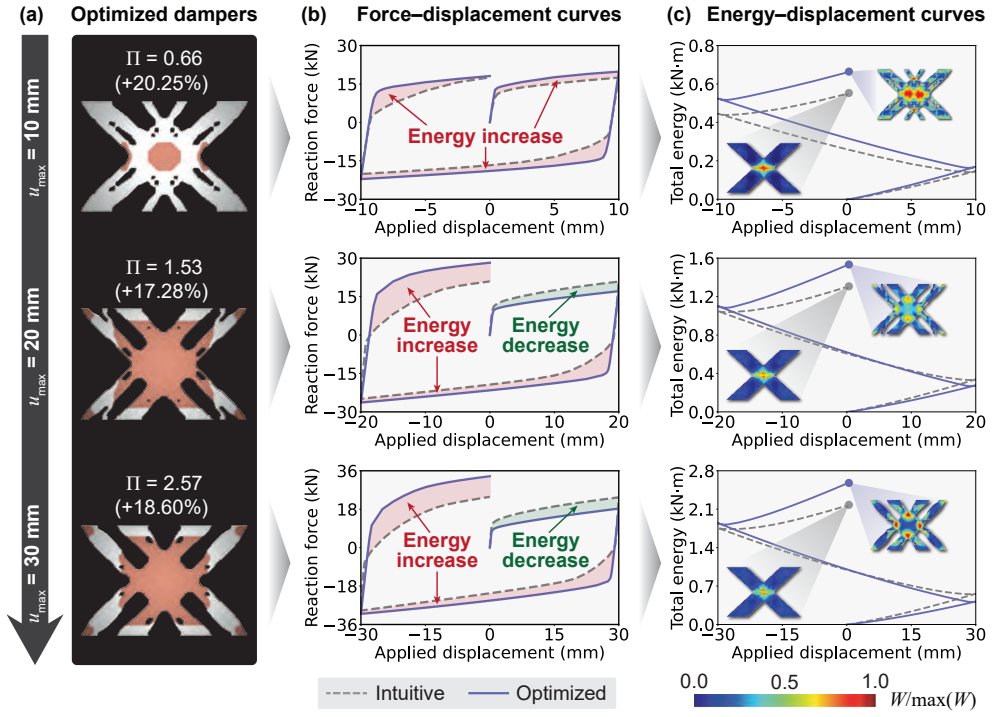
- Optimized damper energy gains grow with loading complexity: 10.15% over the intuitive composite for a half cycle, 17–20% for single complete cycles, and 32.84% under multi-cycle loading, with most of the gain coming from later cycles.
- Bumper improvements scale with design-space size: 105.41%, 160.49%, and 259.31% total-energy gains for bi-, tri-, and four-material optimizations, a pattern implying that intuition degrades as candidate materials multiply.
- The framework reduces to earlier single-objective methods as special cases — the end-compliance objective alone and the total-energy objective alone — so the multi-objective version is a strict generalization of prior finite-strain plastic topology optimization.
- Multi-stage optimization carries plastic history across manufacturing and service stages; the cold-worked profiled sheet gains 75.56% in end force while meeting cost, mass, and CO2 limits, indicating that non-mechanical constraints need not sacrifice mechanical performance.
- The optimizations double as mechanism discovery: X-shaped central load paths shorten load transfer and enhance elastic absorption, twisted ribs concentrate stress to promote plastic dissipation, and the optimal material mix shifts from kinematic-hardening steel toward isotropic-hardening bronze as strain amplitude increases.
Reading between the lines
- The void-as-linear-elastic assumption is the paper's unexamined hinge: extending the Appendix F body-fitted check to the 3D bumper and profiled sheet — or shrinking the void stiffness parameter by orders of magnitude — would confirm whether the reported 105–259% gains survive mesh-independent reanalysis.
- Because the sensitivity machinery treats the consistency parameter as an independent state variable, the same code path should extend to rate-dependent (viscoplastic) and pressure-dependent constitutive laws with only the local material update replaced; this is a natural next test of the framework's generality.
- The discovered mechanisms are stated as reusable rules — X-shaped load paths shorten load transfer, twisted ribs concentrate stress, and kinematic-hardening metals yield to isotropic-hardening ones as strain amplitude grows — and each is directly testable in physical experiments with 3D-printed multimetal specimens, which the paper's cited joining work suggests is feasible.
- If those rules hold experimentally, they could be lifted out of the optimizer and applied as cheap design heuristics for energy-absorbing structures before any optimization is run.
Editorial analysis
A structured set of objections, weighed in public.
Referee Report
Summary. The paper presents a multimaterial topology optimization framework for finite strain elastoplasticity. The forward problem is built on Simo's multiplicative plasticity, with a modified radial-return update designed to enforce isochoric plastic flow; the update is verified against a semi-analytical uniaxial cyclic solution (Appendix C) with errors around 1e-10. The optimization formulation uses density and material-phase variables with filtering/projection, a penalized interpolation of material constants, and a stress interpolation (Eq. (36)) that reduces to the finite strain elastoplastic stress in solids and to a small-strain linear elastic stress in voids. Sensitivities are obtained with a reversed adjoint method and automatic differentiation, and are verified against forward finite differences in Appendix E (relative errors roughly 1e-8 to 1e-4). Four application classes are optimized: 2D energy-dissipating dampers, hyperelastic/elastoplastic double-clamped beams, 3D bumpers with up to four materials, and multi-stage cold-working profiled sheets with cost, weight, and CO2 constraints. The paper reports substantial performance gains over intuitive designs, including 105% to 259% energy increases for the 3D bumpers and a 75.56% end-force increase for the profiled sheet.
Significance. If the framework is valid, it is a meaningful advance in topology optimization: it simultaneously optimizes geometry and material phase for finite strain elastoplastic responses, and it addresses the path-dependent sensitivity problem with a practical, verified implementation. The paper is unusually careful in its verification: the isochoric-flow update is checked against a semi-analytical solution, the sensitivities are checked against finite differences for all objective and constraint types used in the examples, and the authors build on an open-source implementation (FEniTop), which aids reproducibility. The optimized examples exhibit mechanisms (hardening-dominance transition, twisted load paths, multi-stage history dependence) that are likely to interest the topology-optimization and structural-design communities. The main uncertainty, discussed below, is whether the void constitutive interpolation in Eq. (36) is sufficiently innocuous in the 3D and ultra-large-deformation examples to support the quantitative performance gains claimed.
major comments (2)
- [Section 3.2, Eq. (36), Remark 3, Appendix F] The claim in Remark 3 that the linear-elastic void interpolation in Eq. (36) 'brings negligible errors (as verified in Appendix F)' is not supported by the cited appendix. Appendix F compares voxel-based versus body-fitted meshes and quadrilateral versus crossed-triangular elements for the 2D beam Dsg. 5 shown in Fig. 7; it does not vary or remove the void constitutive model, and it does not cover the 3D bumpers (Figs. 8-10) or the profiled sheets (Figs. 11-12), where the reported 105-259% energy gains and 75.56% end-force gain are the main evidence for the framework's effectiveness. Because Eq. (36) reduces to the linear elastic stress sigma_l(epsilon(F)) in voids, and because the stiffness floor epsilon_rho in Eq. (35) is never specified, the magnitude of spurious void resistance under large deformations is not quantified. I request a direct test of this assumption: for example, vary epsilon_rho over several orders of magnitude and recompute at least one 3D objective, or re-analyze an optimized 3D design on a body-fitted mesh without void elements, and report the effect on the optimized topology and on the reported gains.
- [Section 4.2, Eq. (39)] The multi-objective function in Eq. (39) is used without normalization, but the beam study interprets the weight ratios w_stiff:w_force as controlling the stiffness-strength trade-off (Dsgs. 2-5 in Fig. 7). Because J_stiff and J_force are evaluated at different load steps of the same loading ramp, their magnitudes can differ by orders of magnitude, so the actual objective is not necessarily the stated weighted combination unless the terms are scaled. Please report the magnitudes of the three objective terms in each optimized design, and either normalize them before weighting or discuss how the chosen weights map to the observed trade-off.
minor comments (5)
- [Section 2.2.4, Eq. (24)] The notation F^{-J} is used for the inverse transpose without definition; define it at first use or replace it with the standard F^{-T} to avoid confusion.
- [Algorithm 1 and Eqs. (16)-(23)] The variable pgamma_{n+1} is introduced as Delta t gamma_{n+1}; the name is easy to misread as a function. Consider renaming it Delta gamma_{n+1} throughout.
- [Appendix F, Table F.3] The relative differences are reported as unsigned percentages for the body-fitted row and signed percentages for the triangular row; state the reference design used for each column so the reader knows the direction of the error.
- [Section 4.4.1] The 13-step transition from the processing stage to the service stage is described only as removal of support/load blocks and restoration to a stress-free state; specify the boundary conditions and loading sequence actually applied in those steps.
- [Remark 3] The phrase 'as in the air' is informal; consider rewording to 'the void stiffness is negligible compared with the solid stiffness' and provide the value of epsilon_rho.
Circularity Check
No significant circularity: the central derivation is self-contained and independently verified; self-citations are methodological continuity, not load-bearing.
full rationale
The paper's central derivation is self-contained. The finite strain elastoplasticity theory is taken from Simo (1988a,b), and the isochoric-flow update in Eq. (17) is derived in Appendix A from the volume-conservation constraint and verified in Appendix C.2 against a semi-analytical solution with 2-norm errors on the order of 1e-10. The path-dependent sensitivity analysis is derived in Appendix E from the discretized residuals and verified against forward finite differences with relative errors in the range 1e-8 to 1e-4, so the gradients are not fitted to the objectives. The objective functions in Eq. (40) are standard energy and end-force integrals, and no parameter is calibrated to the reported performance numbers and then 'predicted.' The void constitutive interpolation in Eq. (36) is an assumption whose 'negligible errors' claim (Remark 3) is not actually tested by Appendix F, which compares mesh and element variants rather than the void constitutive model; however, this is a validation gap bearing on correctness risk, not circularity, because the reported performance gains are not equal to the assumption by construction. Self-citations to Jia et al. (2025) and FEniTop (Jia et al., 2024d) are used as a blueprint and software base, but the finite-strain extension, isochoric-flow correction, and adjoint derivation are presented and verified in this paper rather than imported unexamined. No circular step can be exhibited with a specific equation-to-equation reduction, so the circularity score is 0.
Assumptions & free parameters
free parameters (4)
- Filter radii Rζ =
10 mm (dampers), 1/3 mm (beams), 40 mm (bumpers), 20 mm (profiled sheets)
- Heaviside sharpness βζ and projection threshold θζ =
βζ ramped from 1 to 512 or 256; θζ from Eq. (34)
- Density/material penalty exponents pκ, pμ, ph, pk, pξ =
pκ=pμ=ph=3, pk=2.5 or 3, pξ ramped from 1 to 3-5
- Void interpolation parameters βϕ and θϕ =
βϕ=500, θϕ=0.1
assumptions (6)
- domain assumption Multiplicative decomposition F = F^e F^p with J^p = 1 (isochoric plastic flow)
- domain assumption Simo's hyperelastic free energy and flow rules (Eqs. 4-8)
- ad hoc to paper Linear elastic behavior for void material (Eq. 36)
- ad hoc to paper SIMP-like interpolation of material constants (Eq. 35) and modified HSP projection (Eq. 34)
- standard math Differentiability of all FEA operations for adjoint sensitivity
- standard math The design space parameterization with density and material variables (Section 3.1)
Cite this review
Pith. "Pith review of Multimaterial topology optimization for finite strain elastoplasticity: theory, methods, and applications." pith.science (2026). https://pith.science/paper/E6X4R54T
@misc{pith2026250202052,
  author       = {Pith},
  title        = {Pith review of: Multimaterial topology optimization for finite strain elastoplasticity: theory, methods, and applications},
  year         = {2026},
  howpublished = {\url{https://pith.science/paper/E6X4R54T}},
  note         = {Machine review of arXiv:2502.02052}
}
read the original abstract
Plasticity is inherent to many engineering materials such as metals. While it can degrade the load-carrying capacity of structures via material yielding, it can also protect structures through plastic energy dissipation. To fully harness plasticity, here we present the theory, method, and application of a topology optimization framework that simultaneously optimizes structural geometries and material phases to customize the stiffness, strength, and structural toughness of designs experiencing finite strain elastoplasticity. The framework accurately predicts structural responses by employing a rigorous, mechanics-based elastoplasticity theory that ensures isochoric plastic flow. It also effectively identifies optimal material phase distributions using a gradient-based optimizer, where gradient information is obtained via a reversed adjoint method to address history dependence, along with automatic differentiation to compute the complex partial derivatives. We demonstrate the framework by optimizing a range of 2D and 3D elastoplastic structures, including energy-dissipating dampers, load-carrying beams, impact-resisting bumpers, and cold working profiled sheets. These optimized multimaterial structures reveal important mechanisms for improving design performance under large deformation, such as the transition from kinematic to isotropic hardening with increasing displacement amplitudes and the formation of twisted regions that concentrate stress, enhancing plastic energy dissipation. Through the superior performance of these optimized designs, we demonstrate the framework's effectiveness in tailoring elastoplastic responses across various spatial configurations, material types, hardening behaviors, and combinations of candidate materials. This work offers a systematic approach for optimizing next-generation multimaterial structures with elastoplastic behaviors under large deformations.
Figures


Figures from the paper (9 more)



Forward citations
Cited by 1 Pith paper
-
Design of a specimen to train path-dependent deep learning material models from a single uniaxial test: eliciting strain diversity via automatically differentiable elastoplastic topology optimization
A topology-optimized specimen under uniaxial cyclic loading generates enough local strain-path diversity in simulation to train a 2M-parameter GRU material model with ~9–13% NRMSE on unseen random paths.
Reference graph
Works this paper leans on
-
[4]
Structural and Multidisciplinary Optimization 64, 189–217
Elastoplastic topology optimization of cyclically loaded structures via direct methods for shakedown. Structural and Multidisciplinary Optimization 64, 189–217. doi: 10.1007/s00158-021-02875-6 . 53 Bourdin, B.,
-
[7]
International Journal of Plasticity 24, 646–687
A finite element formulation based on non-associated plasticity for sheet metal forming. International Journal of Plasticity 24, 646–687. doi: 10.1016/j.ijplas.2007.07
-
[8]
International Journal of Plasticity 17, 237–271
A plasticity model for interface friction: Application to sheet metal forming. International Journal of Plasticity 17, 237–271. doi: 10.1016/S0749-6419(00)00034-6. Han, J., Furuta, K., Kondoh, T., Nishiwaki, S., Terada, K.,
-
[10]
International Journal for Numerical Methods in Engineering 114, 1351–1367
Topology optimization of finite strain viscoplastic systems under transient loads. International Journal for Numerical Methods in Engineering 114, 1351–1367. doi:10.1002/nme.5789. Ivarsson, N., Wallin, M., Tortorelli, D.A.,
-
[17]
International Journal of Structural Stability and Dynamics 21, 2150098
A double shape memory alloy damper for structural vibration control. International Journal of Structural Stability and Dynamics 21, 2150098. doi:10.1142/S021945542150098X. Kim, S., Yun, G.J.,
-
[20]
Theoretical and Applied Fracture Mechanics 107, 102550
The phase-field approach to self-healable fracture of elastomers: A model accounting for fracture nucleation at large, with application to a class of conspicuous experiments. Theoretical and Applied Fracture Mechanics 107, 102550. doi: 10.1016/j.tafmec.2020.102550. Kundu, R.D., Zhang, X.S.,
-
[21]
Structural and Multidisciplinary Optimization 56, 1447–1475
Design of fracture resistant energy absorbing structures using elastoplas- tic topology optimization. Structural and Multidisciplinary Optimization 56, 1447–1475. doi: 10.1007/ s00158-017-1735-z . Li, L., Zhang, G., Khandelwal, K., 2017a. Design of energy dissipating elastoplastic structures under cyclic loads using topology optimization. Structural and M...
-
[22]
Structural and Multidisciplinary Optimization 64, 1141–1160
Topology optimization of multi-material structures with elastoplastic strain hardening model. Structural and Multidisciplinary Optimization 64, 1141–1160. doi:10.1007/s00158-021-02905-3 . Li, W., Jia, Y., Wang, F., Sigmund, O., Zhang, X.S.,
Show all 45 references
-
[23]
International Journal of Engineering Science 191, 103881
Programming and physical realization of extreme three-dimensional responses of metastructures under large deformations. International Journal of Engineering Science 191, 103881. doi: 10.1016/j.ijengsci.2023.103881. Li, X., Zhang, X., Zhang, Y.,
2023
-
[24]
Computational Mechanics 73, 533–548
Three-dimensional plasticity-based topology optimization with smoothed finite element analysis. Computational Mechanics 73, 533–548. doi: 10.1007/s00466-023-02378-9 . Maute, K., Schwarz, S., Ramm, E.,
-
[28]
Proceedings of the Institution of Mechanical Engineers, Part D: Journal of Automobile Engineering 234, 3239–3255
An effective topology optimization method for crashworthiness of thin-walled structures using the equivalent linear static loads. Proceedings of the Institution of Mechanical Engineers, Part D: Journal of Automobile Engineering 234, 3239–3255. doi: 10.1177/0954407020940138. Si...
-
[30]
Computer Methods in Applied Mechanics and Engineering 98, 41–104
Associative coupled thermoplasticity at finite strains: Formulation, numerical analysis and implementation. Computer Methods in Applied Mechanics and Engineering 98, 41–104. doi:10.1016/0045-7825(92)90170-O. Sloan, S.W., Randolph, M.F.,
-
[31]
Engineering Structures 169, 201–215
Crashworthiness optimization of automotive parts with tailor rolled blank. Engineering Structures 169, 201–215. doi: 10.1016/j.engstruct.2018.05.050. Svanberg, K.,
2018 doi
-
[34]
Composites Part B: Engineering 153, 78–96
Structure design and multi-objective opti- mization of a novel NPR bumper system. Composites Part B: Engineering 153, 78–96. doi: 10.1016/j. compositesb.2018.07.024. Wang, C., Zhao, Z., Zhou, M., Sigmund, O., Zhang, X.S.,
2018 doi
-
[35]
Structural and Multidisciplinary Optimization 64, 2827–2880
A comprehensive review of educational articles on structural and multidisciplinary optimization. Structural and Multidisciplinary Optimization 64, 2827–2880. doi: 10.1007/s00158-021-03050-7 . Wang, F., Lazarov, B.S., Sigmund, O., Jensen, J.S.,
-
[37]
Journal of Applied Mechanics 84, 111009
How to realize volume conservation during finite plastic deformation. Journal of Applied Mechanics 84, 111009. doi: 10.1115/1.4037882. 56 Wang, H., Xie, H.,
-
[38]
Structural and Multidisciplinary Optimization 61, 2111–2123
Multi-objective optimization of crashworthiness of vehicle front longitudinal beam. Structural and Multidisciplinary Optimization 61, 2111–2123. doi: 10.1007/s00158-019-02459-5 . Weber, G., Anand, L.,
-
[40]
Additive Manufacturing 51, 102588
Cu10Sn to Ti6Al4V bonding mechanisms in laser-based powder bed fusion multiple material additive manufacturing with different build strategies. Additive Manufacturing 51, 102588. doi:10.1016/j.addma.2021.102588. Wei, C., Zhang, Z., Cheng, D., Sun, Z., Zhu, M., Li, L.,
2021
-
[41]
International Journal of Extreme Manufacturing 3, 012003
An overview of laser-based multiple metal- lic material additive manufacturing: From macro- to micro-scales. International Journal of Extreme Manufacturing 3, 012003. doi: 10.1088/2631-7990/abce04. Wells, G.N., Sluys, L.J., de Borst, R.,
-
[42]
Journal of Constructional Steel Research 7, 279–295
The use of profiled steel sheeting in floor construction. Journal of Constructional Steel Research 7, 279–295. doi: 10.1016/0143-974X(87)90003-4. Zhang, G., Li, L., Khandelwal, K.,
-
[43]
Structural and Multidisciplinary Optimization 55, 1965–1988
Topology optimization of structures with anisotropic plastic materials using enhanced assumed strain elements. Structural and Multidisciplinary Optimization 55, 1965–1988. doi: 10.1007/s00158-016-1612-1 . Zhang, R., Wang, C., Pan, C., Shen, H., Ge, Q., Zhang, L.,
1965 doi
-
[44]
Engineering Structures 176, 734–745
Simplified design of elastoplastic structures with metallic yielding dampers based on the concept of uniform damping ratio. Engineering Structures 176, 734–745. doi: 10.1016/j.engstruct.2018.09.009. Zhang, X., Li, X., Zhang, Y.,
2018 doi
-
[45]
Computer Methods in Applied Mechanics and Engineering 342, 438–457
Multi-component topology and material orientation design of composite structures (MTO-C). Computer Methods in Applied Mechanics and Engineering 342, 438–457. doi:10.1016/j.cma.2018.07.039. 57
2018 doi
-
[140]
Jia, Y.Q., Wang, C., Li, L.Z., Zhang, R.F., Lu, Z.D.,
doi: 10.1007/s00158-024-03818-7 . Jia, Y.Q., Wang, C., Li, L.Z., Zhang, R.F., Lu, Z.D.,
-
[1977]
Journal of Pressure Vessel Technology 99, 510–515
Accuracies of Numerical Solution Methods for the Elastic-Perfectly Plastic Model. Journal of Pressure Vessel Technology 99, 510–515. doi: 10.1115/1.3454568. Kumar, A., Lopez-Pamies, O.,
-
[1987]
Inter- national Journal for Numerical Methods in Engineering 24, 359–373
The method of moving asymptotes—a new method for structural optimization. Inter- national Journal for Numerical Methods in Engineering 24, 359–373. doi: 10.1002/nme.1620240207. Wallin, M., J¨ onsson, V., Wingren, E.,
-
[1990]
Computer Methods in Applied Mechanics and Engineering 79, 173–202
Finite deformation constitutive equations and a time integration procedure for isotropic, hyperelastic-viscoplastic solids. Computer Methods in Applied Mechanics and Engineering 79, 173–202. doi: 10.1016/0045-7825(90)90131-5. Wei, C., Liu, L., Cao, H., Zhong, X., Xu, X., Gu, Y...
-
[1992]
Computer Methods in Applied Mechanics and Engi- neering 99, 61–112
Algorithms for static and dynamic multiplicative plasticity that preserve the classical return mapping schemes of the infinitesimal theory. Computer Methods in Applied Mechanics and Engi- neering 99, 61–112. doi: 10.1016/0045-7825(92)90123-2. Simo, J.C., Hughes, T.J.,
-
[1998]
Structural optimization 15, 81–91
Adaptive topology optimization of elastoplastic structures. Structural optimization 15, 81–91. doi: 10.1007/BF01278493. Miehe, C.,
-
[2001]
International Journal for Numerical Methods in Engineering 50, 2143–2158
Filters in topology optimization. International Journal for Numerical Methods in Engineering 50, 2143–2158. doi: 10.1002/nme.116. Chaboche, J.L.,
-
[2008]
International Journal of Plasticity 24, 1642–1693
A review of some plasticity and viscoplasticity constitutive theories. International Journal of Plasticity 24, 1642–1693. doi: 10.1016/j.ijplas.2008.03.009. Cvitani´ c, V., Vlak, F., Lozina,ˇZ.,
2008 doi
-
[2009]
Journal of Mechanical Design 131, 061013
Crashworthiness Design Using Topology Optimiza- tion. Journal of Mechanical Design 131, 061013. doi: 10.1115/1.3116256. Ren, C., Min, H., Ma, T., Wang, F.,
-
[2014]
Computer Methods in Applied Mechanics and Engineering 276, 453–472
Interpolation scheme for fictitious domain techniques and topology optimization of finite strain elastic problems. Computer Methods in Applied Mechanics and Engineering 276, 453–472. doi: 10.1016/j.cma.2014.03.021. Wang, H., Jiang, D.J., Zhang, L.Y., Liu, B.,
2014 doi
-
[2015]
Computer Methods in Applied Mechanics and Engineering 295, 305–326
Topology optimization for effective energy propagation in rate- independent elastoplastic material systems. Computer Methods in Applied Mechanics and Engineering 295, 305–326. doi: 10.1016/j.cma.2015.05.004. Patel, N.M., Kang, B.S., Renaud, J.E., Tovar, A.,
2015 doi
-
[2016]
Struc- tural and Multidisciplinary Optimization 54, 783–793
Topology optimization based on finite strain plasticity. Struc- tural and Multidisciplinary Optimization 54, 783–793. doi: 10.1007/s00158-016-1435-0 . Wang, C., Wang, W., Zhao, W., Wang, Y., Zhou, G.,
-
[2017]
Finite Elements in Analysis and Design 133, 42–61
Topology optimization of pressure dependent elastoplastic energy ab- sorbing structures with material damage constraints. Finite Elements in Analysis and Design 133, 42–61. doi:10.1016/j.finel.2017.05.004. Alberdi, R., Khandelwal, K., 2019a. Bi-material topology optimization f...
2017 doi
-
[2018]
International Journal for Numerical Methods in Engineering 115, 1–56
A unified framework for nonlinear path-dependent sensitivity analysis in topology optimization. International Journal for Numerical Methods in Engineering 115, 1–56. doi: 10.1002/nme.5794. Amir, O.,
-
[2019]
Smart Materials and Structures 28, 115002
A novel shape memory alloy damping inerter for vibration mitigation. Smart Materials and Structures 28, 115002. doi: 10.1088/1361-665X/ab3dc8. Jia, Y., Li, W., Zhang, X.S.,
-
[2020]
International Journal of Plasticity 128, 102684
Microstructure topology optimization by targeting prescribed nonlinear stress- strain relationships. International Journal of Plasticity 128, 102684. doi:10.1016/j.ijplas.2020.102684. Krieg, R.D., Krieg, D.B.,
2020
-
[2021]
International Journal for Numerical Methods in Engineering 122, 1889–1910
Topology optimization for three- dimensional elastoplastic architected materials using a path-dependent adjoint method. International Journal for Numerical Methods in Engineering 122, 1889–1910. doi: 10.1002/nme.6604. Alberdi, R., Khandelwal, K.,
1910 doi
-
[2022]
Journal of Structural Engineering 148, 04022003
Residual seismic performance of fire-damaged reinforced concrete frame structure with metallic yielding dampers. Journal of Structural Engineering 148, 04022003. doi: 10.1061/(ASCE)ST.1943-541X.0003284. Jia, Y.Q., Wang, C., Zhang, R.F., Li, L.Z., Lu, Z.D.,
1943 doi
-
[2023]
Journal of the Mechanics and Physics of Solids 173, 105227
Controlling the fracture response of structures via topology optimization: From delaying fracture nucleation to maximizing toughness. Journal of the Mechanics and Physics of Solids 173, 105227. doi: 10.1016/j.jmps.2023.105227. 54 Jia, Y., Wang, C., Zhang, X.S., 2024d. FEniTop:...
2023
-
[2024]
Computer Methods in Applied Mechanics and Engineering 429, 117181
Topology optimization of finite strain elastoplastic materials using continuous adjoint method: Formulation, implementation, and applica- tions. Computer Methods in Applied Mechanics and Engineering 429, 117181. doi: 10.1016/j.cma. 2024.117181. Ivarsson, N., Wallin, M., Amir, ...
-
[2025]
Journal of the Mechanics and Physics of Solids 196, 106018
Multimaterial topology optimization of elastoplastic composite structures. Journal of the Mechanics and Physics of Solids 196, 106018. doi: 10.1016/j.jmps.2024.106018. Jia, Y., Liu, K., Zhang, X.S., 2024a. Modulate stress distribution with bio-inspired irregular archi- tected ...
2024
-
[4072]
Jia, Y., Liu, K., Zhang, X.S., 2024b
doi: 10.1038/ s41467-024-47831-2 . Jia, Y., Liu, K., Zhang, X.S., 2024b. Topology optimization of irregular multiscale structures with tunable responses using a virtual growth rule. Computer Methods in Applied Mechanics and Engineering 425, 116864. doi: 10.1016/j.cma.2024.1168...
Reviewed August 9, 2026 · model on record in the stance chip above.
Discussion (0). Continue with ORCID to comment.