REVIEW 4 major objections 4 minor 49 references
Achieving Hiding and Smart Anti-Jamming Communication: A Parallel DRL Approach against Moving Reactive Jammer
T0 review · 4 major / 4 minor · reviewed 2026-08-09 · deepseek-v4-flash
Pith's one-line read This paper claims that splitting frequency and spreading-factor decisions into two parallel deep-reinforcement-learning networks, coupled by a shared success signal, lets a wireless link hide from and evade a moving reactive jammer, and…
desk verdict Plausible engineering result on joint frequency/spreading-factor anti-jamming, but the action-space decomposition and the MDP proof are not sound as written; the 90% gain is believable yet unverified. read the letter →
The pith
A machine-rendered reading of the paper's core claim, the machinery that carries it, and where it could break.
The reading
What carries the argument
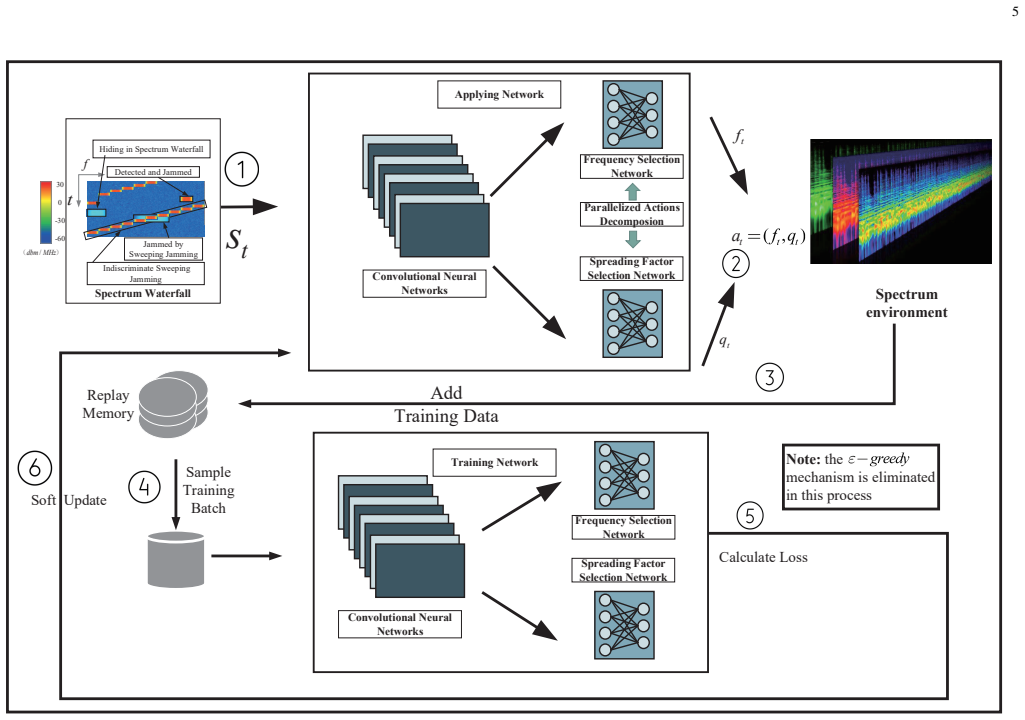
The parallelized network architecture: a convolutional neural network processes the spectrum waterfall, then two fully connected networks output Q-values for frequency and for spreading factor, shrinking the action space from $M\times N$ to $M+N$. The coupling is the indicator function $\delta(f,q)$: both heads' rewards use the same success signal, so each head learns about the other's choice through the joint reward. Exploration is replaced by the applying network's parameter randomness at initialization, with soft updates $\theta^- = \tau\theta + (1-\tau)\theta^-$ for stability.
What would settle it
Run a joint-action DQN with the same CNN and replay memory in the same moving-reactive-jammer scenario; if its normalized throughput approaches the reported 90% gain, the claimed advantage of parallel decomposition is not established. Also, an ablation that feeds both heads the same reward should show whether the separate reward design is the source of coordination.
Extended reading notes
Core claim
The central claim is that the joint decision of frequency and spreading factor need not be learned over all $M\times N$ combinations. A CNN reads the spectrum waterfall and two fully connected heads each output Q-values for their own dimension; the frequency head is rewarded with an indicator $\delta(f,q)$ that fires only when the joint choice achieves the demodulation threshold, while the spreading-factor head receives a rate term minus a bandwidth penalty, and both are updated with soft target parameters. The authors report that this parallelized, exploration-free scheme converges faster and reaches about 90% higher normalized throughput than DQN and DQN-control baselines, and remains effective under shadow fading, larger spreading-factor sets, and constant or random jamming.
Load-bearing premise
The paper assumes that choosing the best frequency and the best spreading factor separately, each with its own learned Q-function and reward, performs as well as choosing the best joint combination.
Editorial extensions
If this is right
- Links can maintain communication without a model of the jammer's movement, since the agent learns online from spectrum waterfalls.
- The decomposition lowers per-step decision cost from $M\times N$ to $M+N$ evaluations, which the paper estimates at about 3.3 billion FLOPs and roughly 0.00028 seconds per iteration.
- Removing the $\varepsilon$-greedy mechanism removes a hyperparameter to tune, and soft updates appear sufficient to keep training stable.
- The method remains effective with spreading factors up to 256, under shadow fading, and under constant and random jamming, suggesting the hiding-plus-evasion strategy is not tied to one propagation model.
Reading between the lines
- Because separate maximization has no theoretical guarantee of reaching the joint optimum, a useful extension would be a bound relating the two independent Q-functions to the joint Q-function when the reward is not additively separable in frequency and spreading factor.
- An ablation that gives both heads the identical scalar reward would isolate whether the performance gain comes from the network split or from the reward split.
- A stronger comparison baseline would be a well-tuned joint-action DQN with prioritized replay or dueling architecture, since the reported 90% gain is measured against baselines that may be handicapped by the large joint action space.
Editorial analysis
A structured set of objections, weighed in public.
Referee Report
Summary. The paper considers anti-jamming communication under a moving reactive jammer that launches tracking jamming upon detecting the user signal and indiscriminate sweeping jamming otherwise. The authors propose a deep reinforcement learning (DRL) scheme that decomposes the joint action space of frequency and spreading factor into two parallel Q-networks sharing a common CNN encoder, replaces epsilon-greedy exploration with the inherent randomness of the training network, and uses soft target updates. The reward functions for the two networks are coupled through the communication success indicator and throughput. Simulations compare the proposed algorithm against a DQN baseline, a DQN-based control baseline, and a version of the proposed algorithm with epsilon-greedy, reporting a roughly 90% improvement in normalized throughput. The paper also studies the effect of learning rate, larger action spaces, shadow fading, retrospective horizon, and jamming scenarios, and provides a FLOPs estimate.
Significance. The problem of jointly selecting frequency and spreading factor against a moving reactive jammer is well motivated, and the paper makes a concrete algorithmic proposal: parallel Q-networks with an interconnected reward structure. If the approach is valid, it offers a practical way to reduce the curse of dimensionality in anti-jamming DRL. The paper is commendable for describing the simulation setup in detail, reporting runtime and FLOPs, and testing several scenario variations. However, the central methodological justification is currently unsupported: the independent Q-decomposition is not proved and is in fact questionable, and the purported MDP proof contains algebraic invalidities. These issues affect the credibility of the claimed 90% throughput gain, which is the main contribution.
major comments (4)
- [Section III-A and III-B, Eqs. (11)-(19)] The joint action-value function for the pair (f,q) is replaced by two independent Q-functions, one for frequency and one for spreading factor, each trained with its own reward and separately maximized. The rewards in Eqs. (11) and (13) are 'interconnected' in that both depend on the other action through delta(f,q) and C_t. In the target definitions of Eqs. (16) and (18), the future term max_{f'} Q(S',f';theta-) and max_{q'} Q(S',q';theta-) ignores the other action entirely, while the one-step reward was generated using the action selected by the other network. Consequently, Q_f(S,f) is an expectation over the replay buffer's distribution of q, not the optimal joint value. Selecting f* = argmax_f Q_f and q* = argmax_q Q_q is not guaranteed to maximize the joint return; whenever the optimal f depends on q (e.g., a frequency is only safe when paired with a sufficiently large spreading factor), separate maximization can select incompatible actions. This is not a minor gap: the claimed 90% gain is attributed in the conclusion and Section IV-C to the parallel decomposition, but no coordination-free structure is demonstrated. The authors should either prove that the joint Q-function is separable in this setting or provide an empirical comparison showing that separate maximization does not degrade performance relative to joint maximization on the exact same environment.
- [Theorem 1, Eqs. (9)-(10)] The proof of the Markov property is not a valid derivation. In Eq. (9), step (b) equates Pr(S_{k+1} | S_k, a_k, ...) with Pr(o_k, o_{k-1}, ..., o_{k-H+1} | o_k, ..., o_0, a_k, ...) and then immediately writes Pr(o_{k+1} | o_k, ..., o_0, a_k, ...); this is not algebraically justified, and the intermediate product form is never established. In Eq. (10), the equalities again collapse the conditioning state to the observation window without defining the mapping from spectrum states to observations. Moreover, the theorem's condition 'if the set of actions A employed aligns with the set of optimal actions A*' is circular, since A* is not defined independently of the learning process. The MDP formulation is thus not proved; at best it is assumed. This weakens the theoretical basis for applying DRL, although the simulation results do not strictly depend on this proof.
- [Section IV-C, Fig. 6 and Eq. (24)] The headline claim of 'nearly 90% increase in normalized throughput' is not supported by statistical evidence. The figure reports a single learning curve per algorithm with no error bars, no number of random seeds, and no confidence intervals. DRL results are notoriously seed-sensitive (see [42] itself), so without multiple trials it is impossible to know whether the margin is significant or whether the baselines are merely undertuned. Additionally, Eq. (24) defines normalized throughput relative to C_Max, stated to be determined by exhaustive search, but the text does not specify whether C_Max is the maximum over the joint (f,q) space, over the frequency-only space, or over a per-time-step optimum; this must be clarified for the 90% figure to be interpretable.
- [Section III-B and Fig. 3] The claim that removing epsilon-greedy accelerates convergence by relying on 'the inherent randomness of the applying network' is not substantiated. Initially random network weights do provide some exploration, but as training proceeds the network output becomes deterministic, so the policy may commit to a suboptimal action before all (f,q) combinations have been adequately tried. The paper does not analyze the exploration coverage of this scheme, and the only evidence is the single learning curve in Fig. 6. A quantitative comparison with an epsilon-greedy version across multiple seeds (the paper does include such an algorithm, but no statistics) is necessary to support the exploration-free mechanism as a contribution.
minor comments (4)
- [Section II-A, Eq. (2)] The notation for the spectral sample s_{t-i\Delta t}^i has a redundant superscript; should be s_{t-i\Delta t}^j or similar to match the integration variable.
- [Section IV-C, Fig. 13 caption] The captions for Fig. 13 and Fig. 14 both say 'The performance in constant jamming'; Fig. 14 should indicate 'random jamming'.
- [Section II-C, Eq. (9)] The proof uses BOTH S_k and o_k without defining their relationship; the reader is left to guess how the spectrum waterfall relates to the underlying state. Please define S_t and o_t consistently.
- [Table II] In Table II, the 'Number of available frequencies' is set to 10 and 'Number of spreading factors' is set to 6, but the table says 'Reward Scale factor 0.2' for both eta and kappa; the text in Eq. (13) already uses kappa for the bandwidth penalty, so the table's column labeled 'Reward Scale factor' for the spreading factor network is ambiguous.
Circularity Check
No significant circularity: the 90% throughput gain is an empirical benchmark against an exhaustive-search upper bound, and self-citations are not load-bearing.
full rationale
The central quantitative claim (nearly 90% normalized-throughput improvement) is an empirical simulation result, not a derivation from the authors' own fitted quantities. Normalized throughput is benchmarked against C_Max, 'determined through exhaustive search or optimal parameter selection,' an external upper bound; the reward functions (11)-(13) are hand-designed objectives (success indicator and rate minus bandwidth penalty), not parameters fitted to force the reported gain. The baselines DQN and DQN-control are externally cited and independently specified. Self-citations [15], [19], [30], and [12] appear in related-work and comparison roles, but none is invoked as the sole evidence for the proposed algorithm's performance or as a uniqueness theorem. The Theorem 1 Markov proof is not a valid derivation, because it assumes the retrospective window H makes the state depend only on recent history and then concludes the Markov property; however, this is a proof-quality or correctness concern, not a reduction of the central throughput claim to its own inputs. No exhibit shows the 90% result or the action-decomposition benefit being equivalent to its inputs by construction.
Assumptions & free parameters
free parameters (7)
- Reward scale factor eta =
0.2
- Spreading factor bandwidth penalty kappa =
0.2
- Soft update parameter tau =
0.2
- Learning rate alpha =
0.001
- Replay memory size D =
1000
- Update interval Nr =
16
- Observation horizon H (waterfall length) =
200x200 input; tested at H=20-200
assumptions (5)
- domain assumption Finite observation horizon H makes the partially observed process Markovian.
- ad hoc to paper The joint Q-function for (f,q) is separable into independent frequency and spreading factor Q-functions.
- domain assumption Jammer behavior follows a fixed detection threshold alpha_th with tracking jamming above it and indiscriminate sweeping below.
- ad hoc to paper Initial random network weights provide sufficient exploration in place of epsilon-greedy.
- domain assumption Channel propagation is adequately modeled by FSPL and FSPL plus log-normal shadowing.
Cite this review
Pith. "Pith review of Achieving Hiding and Smart Anti-Jamming Communication: A Parallel DRL Approach against Moving Reactive Jammer." pith.science (2026). https://pith.science/paper/C5PVFYZX
@misc{pith2026250202385,
  author       = {Pith},
  title        = {Pith review of: Achieving Hiding and Smart Anti-Jamming Communication: A Parallel DRL Approach against Moving Reactive Jammer},
  year         = {2026},
  howpublished = {\url{https://pith.science/paper/C5PVFYZX}},
  note         = {Machine review of arXiv:2502.02385}
}
abstract
This paper addresses the challenge of anti-jamming in moving reactive jamming scenarios. The moving reactive jammer initiates high-power tracking jamming upon detecting any transmission activity, and when unable to detect a signal, resorts to indiscriminate jamming. This presents dual imperatives: maintaining hiding to avoid the jammer's detection and simultaneously evading indiscriminate jamming. Spread spectrum techniques effectively reduce transmitting power to elude detection but fall short in countering indiscriminate jamming. Conversely, changing communication frequencies can help evade indiscriminate jamming but makes the transmission vulnerable to tracking jamming without spread spectrum techniques to remain hidden. Current methodologies struggle with the complexity of simultaneously optimizing these two requirements due to the expansive joint action spaces and the dynamics of moving reactive jammers. To address these challenges, we propose a parallelized deep reinforcement learning (DRL) strategy. The approach includes a parallelized network architecture designed to decompose the action space. A parallel exploration-exploitation selection mechanism replaces the $\varepsilon $-greedy mechanism, accelerating convergence. Simulations demonstrate a nearly 90\% increase in normalized throughput.
Figures


Figures from the paper (9 more)


Reference graph
Works this paper leans on
-
[30]
W. Li et al. , “Advancing secretly by an unknown path: A reinforce- ment learning-based hidden strategy for combating intelligent reactive jammer,” IEEE Wireless Commun. Lett. , vol. 11, no. 7, pp. 1320–1324, 2022
work page 2022
-
[12]
S. Liu et al., “Fight against intelligent reactive jammer in mec networks: A hierarchical reinforcement learning-based hybrid hidden strategy,” IEEE Wireless Commun. Lett. , vol. 13, no. 4, pp. 1078–1082, 2024
work page 2024
-
[15]
Y . Li et al. , “Dynamic spectrum anti-jamming in broadband commu- nications: A hierarchical deep reinforcement learning approach,” IEEE Wireless Commun. Lett., vol. 9, no. 10, pp. 1616–1619, 2020
work page 2020
-
[42]
Deep reinforcement learning that matters,
P. Henderson et al., “Deep reinforcement learning that matters,” in Proc. AAAI Conf. Artif. Intell. , vol. 32, no. 1, 2018
work page 2018
-
[1]
Jamming attacks and anti-jamming strategies in wireless networks: A comprehensive survey,
H. Pirayesh and H. Zeng, “Jamming attacks and anti-jamming strategies in wireless networks: A comprehensive survey,” IEEE Commun. Surv. Tutorials, vol. 24, no. 2, pp. 767–809, 2022
work page 2022
-
[2]
Uav anti-jamming video transmissions with qoe guaran- tee: A reinforcement learning-based approach,
L. Xiao et al., “Uav anti-jamming video transmissions with qoe guaran- tee: A reinforcement learning-based approach,” IEEE Trans. Commun. , vol. 69, no. 9, pp. 5933–5947, 2021
work page 2021
-
[3]
S. Mohammadzadeh et al., “Jammer tracking based on efficient covari- ance matrix reconstruction with iterative spatial spectrum sampling,” IEEE Trans. Aerosp. Electron. Syst. , vol. 59, no. 6, pp. 8681–8695, 2023
work page 2023
-
[4]
Event-based wireless tracking control for a wheeled mobile robot against reactive jamming attacks,
H. Xu et al., “Event-based wireless tracking control for a wheeled mobile robot against reactive jamming attacks,”IEEE Trans. Control Netw. Syst., vol. 10, no. 4, pp. 1925–1936, 2023
work page 1925
Show all 49 references
-
[5]
Anti-jamming games in multi-channel cognitive radio networks,
Y . Wu et al. , “Anti-jamming games in multi-channel cognitive radio networks,” IEEE J. Sel. Areas Commun. , vol. 30, no. 1, pp. 4–15, 2012
2012
-
[6]
Using channel hopping to increase 802.11 resilience to jamming attacks,
V . Navda et al., “Using channel hopping to increase 802.11 resilience to jamming attacks,” in IEEE INFOCOM 2007 - 26th IEEE International Conference on Computer Communications , 2007, pp. 2526–2530
2007
-
[7]
Game theory-based anti-jamming strategies for frequency hopping wireless communications,
Y . Gao et al., “Game theory-based anti-jamming strategies for frequency hopping wireless communications,” IEEE Trans. Wireless Commun. , vol. 17, no. 8, pp. 5314–5326, 2018
2018
-
[8]
Anti-jamming transmission stackelberg game with observation errors,
L. Xiao et al. , “Anti-jamming transmission stackelberg game with observation errors,” IEEE Commun. Lett. , vol. 19, no. 6, pp. 949–952, 2015
2015
-
[9]
Game-theoretic learning anti-jamming approaches in wireless networks,
L. Jia et al. , “Game-theoretic learning anti-jamming approaches in wireless networks,” IEEE Commun. Mag. , vol. 60, no. 5, pp. 60–66, 2022
2022
-
[10]
Game theory and reinforcement learning for anti-jamming de- fense in wireless communications: Current research, challenges, and solutions,
——, “Game theory and reinforcement learning for anti-jamming de- fense in wireless communications: Current research, challenges, and solutions,” IEEE Commun. Surv. Tutor., pp. 1–1, 2024
2024
-
[11]
Spread spectrum for covert communication in ultra- violet communication system,
Y . Yang et al. , “Spread spectrum for covert communication in ultra- violet communication system,” Opt. Express, vol. 32, no. 15, pp. 25 981– 25 994, Jul 2024
2024
-
[13]
Deep reinforcement learning: A survey,
X. Wang et al., “Deep reinforcement learning: A survey,” IEEE Trans. Neural Networks Learn. Syst. , vol. 35, no. 4, pp. 5064–5078, 2024
2024
-
[14]
Anti-jamming communications using spectrum waterfall: A deep reinforcement learning approach,
X. Liu et al., “Anti-jamming communications using spectrum waterfall: A deep reinforcement learning approach,” IEEE Commun. Lett., vol. 22, no. 5, pp. 998–1001, 2018
2018
-
[16]
Deep reinforcement learning based hopping strategy for wideband anti-jamming wireless communications,
J. Qi et al. , “Deep reinforcement learning based hopping strategy for wideband anti-jamming wireless communications,” IEEE Trans. Veh. Technol., vol. 73, no. 3, pp. 3568–3579, 2024
2024
-
[17]
Uav-aided anti-jamming maritime communications: A deep reinforcement learning approach,
K. Liu et al. , “Uav-aided anti-jamming maritime communications: A deep reinforcement learning approach,” in 2021 13th Int. Conf. Wireless Commun. Signal Process. (WCSP) , 2021, pp. 1–6
2021
-
[18]
Intelligent reflecting surface assisted anti-jamming communications: A fast reinforcement learning approach,
H. Yang et al. , “Intelligent reflecting surface assisted anti-jamming communications: A fast reinforcement learning approach,” IEEE Trans. Wireless Commun., vol. 20, no. 3, pp. 1963–1974, 2021. 13
1963
-
[19]
Dynamic spectrum anti-jamming access with fast conver- gence: A labeled deep reinforcement learning approach,
Y . Li et al., “Dynamic spectrum anti-jamming access with fast conver- gence: A labeled deep reinforcement learning approach,” IEEE Trans. Inf. Forensics Secur., vol. 18, pp. 5447–5458, 2023
2023
-
[20]
Understanding deep neural function ap- proximation in reinforcement learning via \epsilon-greedy exploration,
F. Liu, L. Viano, and V . Cevher, “Understanding deep neural function ap- proximation in reinforcement learning via \epsilon-greedy exploration,” in Adv. Neural Inf. Process. Syst., S. Koyejo, S. Mohamed, A. Agarwal, D. Belgrave, K. Cho, and A. Oh, Eds., vol. 35. Curran Associ...
2022
-
[21]
Exploration in deep rein- forcement learning: A survey,
P. Ladosz, L. Weng, M. Kim, and H. Oh, “Exploration in deep rein- forcement learning: A survey,” Inf. Fusion, vol. 85, pp. 1–22, 2022
2022
-
[22]
A survey of convolutional neural networks: Analysis, applications, and prospects,
Z. Li et al. , “A survey of convolutional neural networks: Analysis, applications, and prospects,” IEEE Trans. Neural Networks Learn. Syst., vol. 33, no. 12, pp. 6999–7019, 2022
2022
-
[23]
Intelligent spectrum anti-jamming with cognitive software-defined architecture,
Y . Huang et al. , “Intelligent spectrum anti-jamming with cognitive software-defined architecture,” IEEE Syst. J. , vol. 17, no. 2, pp. 2686– 2697, 2023
2023
-
[24]
Game theory for anti-jamming strategy in mul- tichannel slow fading iot networks,
A. Gouissem et al. , “Game theory for anti-jamming strategy in mul- tichannel slow fading iot networks,” IEEE Internet Things J. , vol. 8, no. 23, pp. 16 880–16 893, 2021
2021
-
[25]
Spatial anti-jamming scheme for internet of satellites based on the deep reinforcement learning and stackelberg game,
C. Han et al. , “Spatial anti-jamming scheme for internet of satellites based on the deep reinforcement learning and stackelberg game,” IEEE Trans. Veh. Technol., vol. 69, no. 5, pp. 5331–5342, 2020
2020
-
[26]
Power and spreading factor control in low power wide area networks,
B. Reynders et al. , “Power and spreading factor control in low power wide area networks,” in 2017 IEEE Int. Conf. Commun. (ICC) , 2017, pp. 1–6
2017
-
[27]
Two-dimensional anti-jamming communication based on deep reinforcement learning,
G. Han et al., “Two-dimensional anti-jamming communication based on deep reinforcement learning,” in 2017 IEEE Int. Conf. Acoust., Speech Signal Process. (ICASSP) , 2017, pp. 2087–2091
2017
-
[28]
Rl-based frequency hopping with block-shifted patterns: Balancing between anti-jamming performance and synchro- nization overhead,
J. Zhang and X. Wu, “Rl-based frequency hopping with block-shifted patterns: Balancing between anti-jamming performance and synchro- nization overhead,” IEEE Trans. Veh. Technol., vol. 73, no. 1, pp. 909– 922, 2024
2024
-
[29]
Anti-jamming underwater transmission with mobility and learning,
L. Xiao et al. , “Anti-jamming underwater transmission with mobility and learning,” IEEE Commun. Lett. , vol. 22, no. 3, pp. 542–545, 2018
2018
-
[31]
Reinforcement learning-based dynamic anti-jamming power control in uav networks: An effective jamming signal strength based approach,
N. Ma et al. , “Reinforcement learning-based dynamic anti-jamming power control in uav networks: An effective jamming signal strength based approach,” IEEE Commun. Lett. , vol. 26, no. 10, pp. 2355–2359, 2022
2022
-
[32]
The k-means algorithm: A comprehensive survey and performance evaluation,
M. Ahmed, R. Seraj, and S. M. S. Islam, “The k-means algorithm: A comprehensive survey and performance evaluation,” Electronics, vol. 9, no. 8, 2020
2020
-
[33]
Secure transmission scheme based on joint radar and communication in mobile vehicular networks,
Y . Yao et al. , “Secure transmission scheme based on joint radar and communication in mobile vehicular networks,” IEEE Trans. Intell. Transp. Syst., vol. 24, no. 9, pp. 10 027–10 037, 2023
2023
-
[34]
A mathematical theory of communication,
C. E. Shannon, “A mathematical theory of communication,” Bell Syst. Tech. J., vol. 27, no. 3, pp. 379–423, 1948
1948
-
[35]
On empirical comparisons of optimizers for deep learning,
D. Choi et al. , “On empirical comparisons of optimizers for deep learning,” arXiv preprint arXiv:1910.05446 , 2019
1910 arXiv
-
[36]
t-soft update of target network for deep reinforcement learning,
T. Kobayashi and W. E. L. Ilboudo, “t-soft update of target network for deep reinforcement learning,” Neural Networks , vol. 136, pp. 63–71, 2021
2021
-
[37]
Path loss prediction model development in a mountainous forest environment,
B. Myagmardulam et al., “Path loss prediction model development in a mountainous forest environment,” IEEE Open J. Commun. Soc. , vol. 2, pp. 2494–2501, 2021
2021
-
[38]
Modelling and simulation of rayleigh fading, path loss, and shadowing fading for wireless mobile networks,
Z. Ren, G. Wang, Q. Chen, and H. Li, “Modelling and simulation of rayleigh fading, path loss, and shadowing fading for wireless mobile networks,” Simul. Model. Pract. Theory , vol. 19, no. 2, pp. 626–637, 2011
2011
-
[39]
Shadow fading correlation in high-speed railway envi- ronments,
R. He et al. , “Shadow fading correlation in high-speed railway envi- ronments,” IEEE Trans. Veh. Technol. , vol. 64, no. 7, pp. 2762–2772, 2015
2015
-
[40]
An additive model as a physical basis for shadow fading,
J. Salo et al., “An additive model as a physical basis for shadow fading,” IEEE Trans. Veh. Technol., vol. 56, no. 1, pp. 13–26, 2007
2007
-
[41]
Asynchronous contention resolution- aided aloha in lr-fhss networks,
J. M. de Souza Sant’Ana et al. , “Asynchronous contention resolution- aided aloha in lr-fhss networks,” IEEE Internet Things J., vol. 11, no. 9, pp. 16 684–16 692, 2024
2024
-
[43]
Performance analysis for dsss with short period sequences encountering broadband interference,
Q. Lu et al., “Performance analysis for dsss with short period sequences encountering broadband interference,” IEEE Trans. Veh. Technol., pp. 1– 13, 2024
2024
-
[44]
Experimental analysis of the joint statistical properties of azimuth spread, delay spread, and shadow fading,
A. Algans et al., “Experimental analysis of the joint statistical properties of azimuth spread, delay spread, and shadow fading,” IEEE J. Sel. Areas Commun., vol. 20, no. 3, pp. 523–531, 2002
2002
-
[45]
Convolutional neural networks at constrained time cost,
K. He and J. Sun, “Convolutional neural networks at constrained time cost,” in Proc. IEEE Conf. Comput. Vis. Pattern Recognit. (CVPR), June 2015
2015
-
[46]
Color image to grayscale image conversion,
C. Saravanan, “Color image to grayscale image conversion,” in 2010 Second Int. Conf. Comput. Eng. Appl. , vol. 2, 2010, pp. 196–199
2010
-
[47]
Goodfellow et al., Deep Learning
I. Goodfellow et al., Deep Learning. MIT Press, 2016
2016
-
[48]
Roofline performance analysis of dnn architectures on cpu and gpu systems,
H. C. Prashanth and M. Rao, “Roofline performance analysis of dnn architectures on cpu and gpu systems,” in 2024 25th Int. Symp. Quality Electron. Design (ISQED) , 2024, pp. 1–8
2024
-
[49]
Benchmark analysis of jetson tx2, jetson nano and raspberry pi using deep-cnn,
A. A. Süzen, B. Duman, and B. ¸ Sen, “Benchmark analysis of jetson tx2, jetson nano and raspberry pi using deep-cnn,” in 2020 Int. Congr. Human-Comput. Interact., Optim. Robot. Appl. (HORA) , 2020, pp. 1–5
2020
Reviewed August 9, 2026 · model on record in the stance chip above.
Discussion (0). Continue with ORCID to comment.