REVIEW 4 major objections 4 minor 33 references
Blind Visible Watermark Removal with Morphological Dilation
T0 review · 4 major / 4 minor · reviewed 2026-08-09 · deepseek-v4-flash
Pith's one-line read MorphoMod removes visible watermarks without needing watermark-free target images, reporting up to 50.8% better removal than prior methods.
desk verdict The paper's headline improvement is an artifact of metrics that reward any alteration, not correct recovery; the pipeline is sensible but the evaluation needs a full redo. read the letter →
The pith
A machine-rendered reading of the paper's core claim, the machinery that carries it, and where it could break.
The reading
What carries the argument
The central object is the refined, dilated mask $\hat{m}_d$, produced by $\hat{m}_d = \max_{s\in S}(\hat{m}_r(s) \oplus K(s))$, where $\hat{m}_r = R(x,\hat{m})$ is the U-Net refinement output and $K(s)$ is the structuring element whose size is set by the dilation parameter $d$. This mask decides exactly which pixels get inpainted, so it carries the argument: if the mask is too small, watermark residuals survive; if too large, background content is destroyed. The other components are standard—an off-the-shelf segmentation model for the initial mask, Stable Diffusion or LaMa for inpainting, and a restore step that blends the inpainted region with the original background using the inverse mask.
What would settle it
Train the refinement U-Net on watermarks disjoint from Alpha1-S/L, or freeze it entirely, and rerun the Table 1 comparison; if the margin shrinks to the range of the best target-trained baselines, the claimed 50.8% improvement is explained by in-domain mask refinement rather than blind generalization.
Extended reading notes
Core claim
On the paper's own terms, the discovery is that conservative mask predictions—not image reconstruction—are the main bottleneck in visible watermark removal, and that a blind pipeline can overcome it. MorphoMod first segments the watermark with an existing detection model, refines the mask with a U-Net trained on a Dice plus binary cross-entropy loss, and then morphologically dilates the mask so the inpainted region covers the full watermark extent. The inpainted region is generated by Stable Diffusion or LaMa from the image, the refined mask, and a short prompt, and the restore stage stitches that region onto the un-watermarked background of the original. The paper reports that this achieves stronger removal than SLBR, SplitNet, WDNet, and DENet on Alpha1-S and Alpha1-L, and that the newly introduced blind metrics separate removal effectiveness from semantic preservation.
Load-bearing premise
The paper does not disclose what data trains the mask-refinement network; if that network was trained on the same Alpha1 watermarks used for testing, the headline improvement reflects in-domain training rather than blind generalization.
Editorial extensions
If this is right
- On Alpha1-S and Alpha1-L, MorphoMod reports higher watermark-removal scores than SLBR, SplitNet, WDNet, and DENet variants, with the largest gain a 50.8% improvement in RMSE$_{W}$ on Alpha1-L.
- Because it does not need target images, the method can be applied to web-scraped images where the true un-watermarked background is unavailable.
- Increasing the dilation parameter $d$ systematically trades semantic preservation for removal strength, and removal remains effective across all tested dilation values.
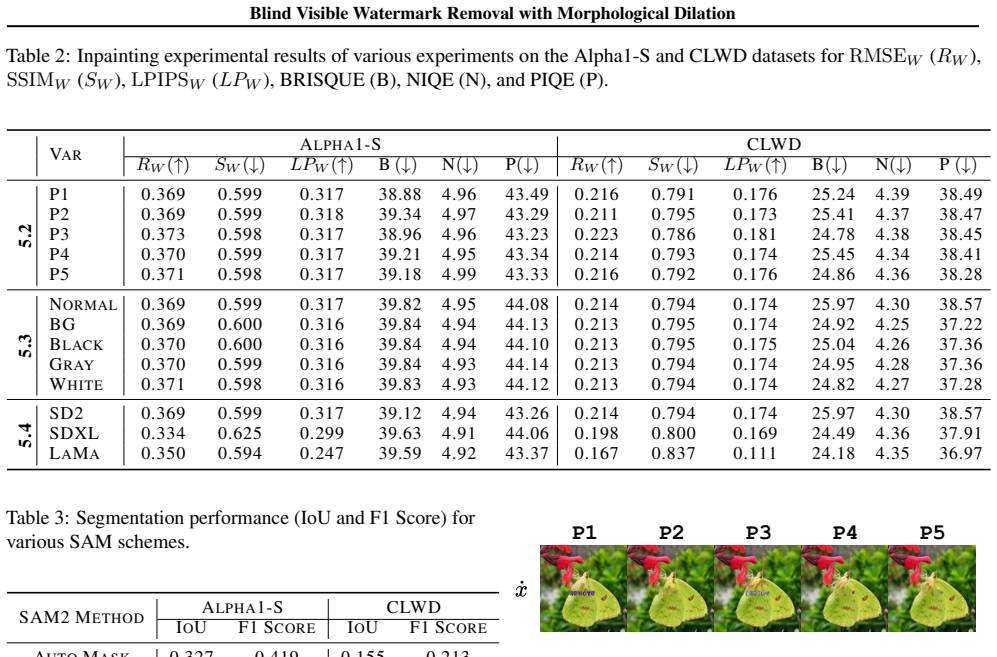
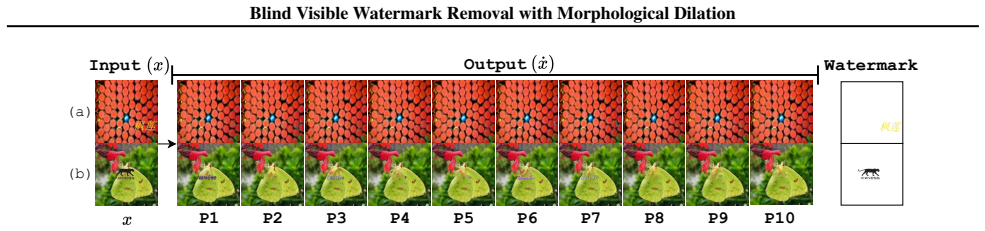
- Prompt choice, pre-removal filling strategy, and the number of diffusion steps have little effect on removal, while the choice of inpainting model changes visual quality more than removal effectiveness.
- In the steganographic disorientation toy problem, the same pipeline drops a position classifier's accuracy from 100% to 0%, showing the method can disrupt high-level hidden messages.
Reading between the lines
- A testable extension: retrain the refinement U-Net on a disjoint set of watermarks and rerun the Table 1 comparison; this would isolate whether the gain is blind generalization or in-domain mask refinement.
- The same mask-dilation step could be dropped into any two-stage removal pipeline whose mask predictor under-segments, trading a little background fidelity for fewer residuals.
- The steganographic disorientation setup suggests a broader use the paper does not claim: MorphoMod can serve as an adversarial probe for how much high-level information (object positions, times, labels) survives generative object removal.
Editorial analysis
A structured set of objections, weighed in public.
Referee Report
Summary. The paper proposes MorphoMod, a blind visible-watermark-removal pipeline that combines an initial segmentation network, a U-Net refinement stage with morphological dilation, and a generative inpainting step (Stable Diffusion or LaMa) followed by a restore step that composites the inpainted watermark region with the original background. The authors introduce two new datasets (Alpha1-S and Alpha1-L) of ImageNet images with opaque watermarks and no clean targets, and propose three 'blind' metrics (RMSE-W, SSIM-W, LPIPS-W) that compare the watermark region of the input with the output using the ground-truth mask. The main claim is a SOTA improvement of up to 50.8% in watermark-removal effectiveness on Alpha1, plus a case study on steganographic disorientation.
Significance. If the central claim were sound, the paper would make a useful contribution: it addresses a practical scenario where watermark-free targets are unavailable, it proposes new datasets that reflect opaque watermarks, and it systematically studies the effect of prompts, pre-fill strategies, and inpainting backbones. The steganographic-disorientation toy problem is a creative addition. However, the evaluation is built on metrics that have not been validated and that, by the paper's own ablation data, cannot distinguish genuine removal from arbitrary alteration; the training data for the refinement network are undisclosed; and the ablations do not test the actual proposed pipeline. These are load-bearing issues that invalidate the headline claims.
major comments (4)
- [Section 3.1, Eq. (1)] The training data for the U-Net refinement model R are not disclosed anywhere in the paper. In Table 1, MorphoMod is compared against SLBR, SplitNet, WDNet, and DENet variants that were pretrained on CLWD or LOGO and evaluated on Alpha1-S/L without fine-tuning. If R was trained on the Alpha1 training splits, which contain the same opaque CLWD watermarks as the test set, then the comparison is in-domain for MorphoMod and out-of-domain for all baselines, and the reported 50.8% improvement would be an artifact of this distribution mismatch. The paper must state R's training set and ensure that all compared methods are trained under matched conditions.
- [Section 3.4, Tables 1 and 2] The proposed blind watermark-removal metrics (high RMSE_W, low SSIM_W, high LPIPS_W) only measure divergence from the watermark logo; they do not measure whether the true background was recovered. The paper's own data demonstrate this failure: in Table 2, the pre-fill ablation on Alpha1-S using the ground-truth mask achieves RMSE_W = 0.369, SSIM_W = 0.599, LPIPS_W = 0.317 for every fill strategy, and Section 5.3 states that each fill strategy successfully removes the watermark. These scores are roughly three times MorphoMod's Table 1 values (0.1165, 0.8855, 0.0763). Either the metrics reward arbitrary alteration (so a uniform gray patch would score highly) or MorphoMod's predicted-and-dilated mask leaves most of the opaque watermark untouched. Both readings invalidate the headline 50.8% improvement. The metrics are never validated against ground-truth PSNR/SSIM/LPIPS on CLWD or LOGO, where clean targets exist, so their reliability is entirely unestablished.
- [Section 5, Sections 5.2-5.4] All inpainting ablations use the ground-truth mask, not the mask produced by MorphoMod's segment phase: the section begins 'Unless otherwise stated, all IP experiments utilize the ground truth mask for the generative process.' Since the paper's central contribution is the mask-refinement-and-dilation stage, these ablations do not test the actual pipeline and cannot support the claim that the proposed mask module is beneficial. Ablations should be rerun with the predicted mask from the full MorphoMod pipeline, comparing with and without the U-Net refinement and dilation.
- [Section 4.2, Table 1] The '% IMPROVE' row in Table 1 is not reproducible from the reported numbers. For example, on Alpha1-S RMSE_W, the gain over the best baseline (DENet-G, 0.0841) is (0.1165 - 0.0841)/0.0841 = 38.5%, not the reported 27.8%; on Alpha1-L SSIM_W, the gain over the best baseline is (0.9993 - 0.8523)/0.9993 = 14.7%, not 9.7%. The paper does not specify which baseline or normalization is used, so the headline percentages cannot be verified.
minor comments (4)
- [Section 3.1, Eq. (2)] The dilation formula is written as a max over s in S with K(s), which is not standard notation; a conventional morphological dilation expression (e.g., A ⊕ B = {z | (B̂)_z ∩ A ≠ ∅}) would be clearer, and the structuring element K and the parameter d should be defined precisely.
- [Section 6, paragraph after Table 5] There is a typo: 'MorhpoMod' should be 'MorphoMod'.
- [Table 5] The PIQE values for Original and Disoriented are identical (46.64); given that the disoriented images have altered content, this coincidence should be explained, as it raises a question about the sensitivity of the metric.
- [Section 4.1, Alpha1 Datasets] The description of Alpha1-S and Alpha1-L says each sample consists of a watermarked image and a mask, but does not state whether the watermarks are the CLWD logos used directly or re-rendered; this matters for judging how 'real-world' the datasets are and for diagnosing the in-domain/out-of-domain issue in Major Comment 1.
Circularity Check
Blind WR metrics define successful removal as divergence from the watermark, making the headline 50.8% gain partly self-definitional; self-citations are not load-bearing.
-
self definitional
[Section 3.4 (Blind Metrics), Section 5.3 (Pre-Removal Watermark Filling), Tables 1-2]
"Watermark removal is assessed by comparing the watermarked region in the original image to the corresponding region in the output image, using the ground truth mask. Metrics include RMSEW , SSIMW , and LPIPSW , where high RMSEW , low SSIMW , and high LPIPSW indicate successful watermark removal. ... Each fill strategy is able to successfully remove the watermark as shown by the high RMSEW , low SSIMW , and high LPIPSW across each dataset."
Under Section 3.4, 'successful removal' is defined as high RMSE_W, low SSIM_W, and high LPIPS_W between the original watermark region and the output. Because the output watermark region is simply whatever the fill or inpainting places there, any replacement of the opaque logo satisfies the definition by construction. Table 2 confirms this: trivial pre-fill strategies (normal, black, gray, white, background) on Alpha1-S all yield RMSE_W around 0.369, SSIM_W around 0.599, LPIPS_W around 0.317, and Section 5.3 declares them successful; those RMSE_W values are roughly three times MorphoMod's Table 1 value of 0.1165.
full rationale
The paper's pipeline (segment, inpaint, restore) uses off-the-shelf diffusion/segmentation components and a standard Dice plus BCE loss for mask refinement; no first-principles theorem is claimed, and the self-citations (Robinette et al. 2023, 2024) appear only in the steganographic discussion and are not load-bearing for the main watermark-removal claim. The central quantitative claim, however, is evaluated exclusively with the novel blind metrics of Section 3.4, and those metrics define successful removal as a large difference between the input watermark region and the output region. The paper's own ablation in Section 5.3 and Table 2 shows that arbitrary pre-fills of the ground-truth mask are labeled 'successful' by these metrics and even score better on RMSE_W than MorphoMod's Table 1 result, demonstrating that the metric's success condition reduces to 'the output differs from the watermark,' not 'the true background was recovered.' This makes the headline 50.8% improvement partially circular: it is a self-defined measure of divergence, not an externally validated measure of reconstruction quality. No other circularity was found; the unspecified training data for the refinement U-Net and the absence of clean targets on Alpha1 are substantive correctness risks, but they are not definitional circularity. The score reflects that the central effectiveness claim is undermined by the self-definitional metric, while the method still has independent engineering content and is compared against external baselines and datasets.
Assumptions & free parameters
free parameters (2)
- dilation parameter d =
3 (default; swept over {0,1,3,5,10})
- inpainting prompt p =
"Remove."
assumptions (4)
- domain assumption The predicted mask, after refinement and dilation, approximates the true watermark extent closely enough for inpainting.
- domain assumption Diffusion-based inpainting models (Stable Diffusion, LaMa) can reconstruct the background behind a removed watermark in a blind setting.
- domain assumption The 'restore' operation, which stitches the original background with the inpainted region, preserves semantic content.
- domain assumption The new blind metrics (RMSE_W, SSIM_W, LPIPS_W) are valid measures of watermark removal.
invented entities (2)
-
Alpha1-S and Alpha1-L datasets
-
Disorient dataset
Cite this review
Pith. "Pith review of Blind Visible Watermark Removal with Morphological Dilation." pith.science (2026). https://pith.science/paper/WCPV7DD6
@misc{pith2026250202676,
  author       = {Pith},
  title        = {Pith review of: Blind Visible Watermark Removal with Morphological Dilation},
  year         = {2026},
  howpublished = {\url{https://pith.science/paper/WCPV7DD6}},
  note         = {Machine review of arXiv:2502.02676}
}
read the original abstract
Visible watermarks pose significant challenges for image restoration techniques, especially when the target background is unknown. Toward this end, we present MorphoMod, a novel method for automated visible watermark removal that operates in a blind setting -- without requiring target images. Unlike existing methods, MorphoMod effectively removes opaque and transparent watermarks while preserving semantic content, making it well-suited for real-world applications. Evaluations on benchmark datasets, including the Colored Large-scale Watermark Dataset (CLWD), LOGO-series, and the newly introduced Alpha1 datasets, demonstrate that MorphoMod achieves up to a 50.8% improvement in watermark removal effectiveness compared to state-of-the-art methods. Ablation studies highlight the impact of prompts used for inpainting, pre-removal filling strategies, and inpainting model performance on watermark removal. Additionally, a case study on steganographic disorientation reveals broader applications for watermark removal in disrupting high-level hidden messages. MorphoMod offers a robust, adaptable solution for watermark removal and opens avenues for further advancements in image restoration and adversarial manipulation.
Figures


Figures from the paper (11 more)






Reference graph
Works this paper leans on
-
[1]
write newline
" write newline "" before.all 'output.state := FUNCTION n.dashify 't := "" t empty not t #1 #1 substring "-" = t #1 #2 substring "--" = not "--" * t #2 global.max substring 't := t #1 #1 substring "-" = "-" * t #2 global.max substring 't := while if t #1 #1 substring * t #2 global.max substring 't := if while FUNCTION format.date year duplicate empty "emp...
-
[2]
Pde-based image and surface inpainting
Bertalm \' o, M., Caselles, V., Haro, G., and Sapiro, G. Pde-based image and surface inpainting. In Handbook of Mathematical Models in Computer Vision, pp.\ 33--61. Springer, 2006
work page 2006
-
[3]
Image multi-inpainting via progressive generative adversarial networks
Cai, J., Li, C., Tao, X., and Tai, Y.-W. Image multi-inpainting via progressive generative adversarial networks. In Proceedings of the IEEE/CVF conference on computer vision and pattern recognition, pp.\ 978--987, 2022
work page 2022
-
[4]
Generative adversarial networks model for visible watermark removal
Cao, Z., Niu, S., Zhang, J., and Wang, X. Generative adversarial networks model for visible watermark removal. IET Image Processing, 13 0 (10): 0 1783--1789, 2019
work page 2019
-
[5]
Large-scale visible watermark detection and removal with deep convolutional networks
Cheng, D., Li, X., Li, W.-H., Lu, C., Li, F., Zhao, H., and Zheng, W.-S. Large-scale visible watermark detection and removal with deep convolutional networks. In Pattern Recognition and Computer Vision: First Chinese Conference, PRCV 2018, Guangzhou, China, November 23-26, 2018, Proceedings, Part III 1, pp.\ 27--40. Springer, 2018
work page 2018
-
[6]
Cox, I. J. Digital watermarking. Press of Morgan Faukmann, 2002
work page 2002
-
[7]
Object removal by exemplar-based inpainting
Criminisi, A., Perez, P., and Toyama, K. Object removal by exemplar-based inpainting. In 2003 IEEE Computer Society Conference on Computer Vision and Pattern Recognition, 2003. Proceedings., volume 2, pp.\ II--II. IEEE, 2003
work page 2003
-
[8]
Cun, X. and Pun, C.-M. Split then refine: stacked attention-guided resunets for blind single image visible watermark removal. In Proceedings of the AAAI conference on artificial intelligence, volume 35, pp.\ 1184--1192, 2021
work page 2021
Show all 33 references
-
[9]
Imagenet: A large-scale hierarchical image database
Deng, J., Dong, W., Socher, R., Li, L.-J., Li, K., and Fei-Fei, L. Imagenet: A large-scale hierarchical image database. In 2009 IEEE conference on computer vision and pattern recognition, pp.\ 248--255. Ieee, 2009
2009
-
[10]
A., Van Gool, L., Williams, C
Everingham, M., Eslami, S. A., Van Gool, L., Williams, C. K., Winn, J., and Zisserman, A. The pascal visual object classes challenge: A retrospective. International journal of computer vision, 111: 0 98--136, 2015
2015
-
[11]
Blind visual motif removal from a single image
Hertz, A., Fogel, S., Hanocka, R., Giryes, R., and Cohen-Or, D. Blind visual motif removal from a single image. In Proceedings of the IEEE/CVF Conference on Computer Vision and Pattern Recognition, pp.\ 6858--6867, 2019
2019
-
[12]
Denoising diffusion probabilistic models
Ho, J., Jain, A., and Abbeel, P. Denoising diffusion probabilistic models. Advances in neural information processing systems, 33: 0 6840--6851, 2020
2020
-
[13]
and Wu, J.-L
Huang, C.-H. and Wu, J.-L. Attacking visible watermarking schemes. IEEE transactions on multimedia, 6 0 (1): 0 16--30, 2004
2004
-
[14]
Removing interference and recovering content imaginatively for visible watermark removal
Leng, Y., Fang, C., Li, G., Fang, Y., and Li, G. Removing interference and recovering content imaginatively for visible watermark removal. In Proceedings of the AAAI Conference on Artificial Intelligence, volume 38, pp.\ 2983--2990, 2024
2024
-
[15]
Towards photo-realistic visible watermark removal with conditional generative adversarial networks
Li, X., Lu, C., Cheng, D., Li, W.-H., Cao, M., Liu, B., Ma, J., and Zheng, W.-S. Towards photo-realistic visible watermark removal with conditional generative adversarial networks. In Image and Graphics: 10th International Conference, ICIG 2019, Beijing, China, August 23--25, ...
2019
-
[16]
Visible watermark removal via self-calibrated localization and background refinement
Liang, J., Niu, L., Guo, F., Long, T., and Zhang, L. Visible watermark removal via self-calibrated localization and background refinement. In Proceedings of the 29th ACM international conference on multimedia, pp.\ 4426--4434, 2021
2021
-
[17]
Grounding dino: Marrying dino with grounded pre-training for open-set object detection
Liu, S., Zeng, Z., Ren, T., Li, F., Zhang, H., Yang, J., Li, C., Yang, J., Su, H., Zhu, J., et al. Grounding dino: Marrying dino with grounded pre-training for open-set object detection. arXiv preprint arXiv:2303.05499, 2023
2023 arXiv
-
[18]
Wdnet: Watermark-decomposition network for visible watermark removal
Liu, Y., Zhu, Z., and Bai, X. Wdnet: Watermark-decomposition network for visible watermark removal. In Proceedings of the IEEE/CVF winter conference on applications of computer vision, pp.\ 3685--3693, 2021
2021
-
[19]
Edgeconnect: Structure guided image inpainting using edge prediction
Nazeri, K., Ng, E., Joseph, T., Qureshi, F., and Ebrahimi, M. Edgeconnect: Structure guided image inpainting using edge prediction. In Proceedings of the IEEE/CVF international conference on computer vision workshops, pp.\ 0--0, 2019
2019
-
[20]
Diffusion models for adversarial purification
Nie, W., Guo, B., Huang, Y., Xiao, C., Vahdat, A., and Anandkumar, A. Diffusion models for adversarial purification. In International Conference on Machine Learning, 2022. URL https://api.semanticscholar.org/CorpusID:248811081
2022
-
[21]
Pathak, D., Krahenbuhl, P., Donahue, J., Darrell, T., and Efros, A. A. Context encoders: Feature learning by inpainting. In Proceedings of the IEEE conference on computer vision and pattern recognition, pp.\ 2536--2544, 2016
2016
-
[22]
and Zeng, Y.-C
Pei, S.-C. and Zeng, Y.-C. A novel image recovery algorithm for visible watermarked images. IEEE Transactions on information forensics and security, 1 0 (4): 0 543--550, 2006
2006
-
[23]
Visible watermark removal scheme based on reversible data hiding and image inpainting
Qin, C., He, Z., Yao, H., Cao, F., and Gao, L. Visible watermark removal scheme based on reversible data hiding and image inpainting. Signal Processing: Image Communication, 60: 0 160--172, 2018
2018
-
[24]
V., Carion, N., Wu, C.-Y., Girshick, R., Doll \'a r, P., and Feichtenhofer, C
Ravi, N., Gabeur, V., Hu, Y.-T., Hu, R., Ryali, C., Ma, T., Khedr, H., R \"a dle, R., Rolland, C., Gustafson, L., Mintun, E., Pan, J., Alwala, K. V., Carion, N., Wu, C.-Y., Girshick, R., Doll \'a r, P., and Feichtenhofer, C. Sam 2: Segment anything in images and videos. arXiv ...
2024 arXiv
-
[25]
K., Wang, H
Robinette, P. K., Wang, H. D., Shehadeh, N., Moyer, D., and Johnson, T. T. Suds: Sanitizing universal and dependent steganography. In ECAI, pp.\ 1978--1985, 2023
1978
-
[26]
K., Moyer, D., and Johnson, T
Robinette, P. K., Moyer, D., and Johnson, T. T. Sanitizing hidden information with diffusion models. In ECAI 2024 - 27th European Conference on Artificial Intelligence , volume 392 of Frontiers in Artificial Intelligence and Applications, pp.\ 778--785. IOS Press, 2024. doi:10...
2024 doi
-
[27]
High-resolution image synthesis with latent diffusion models, 2021
Rombach, R., Blattmann, A., Lorenz, D., Esser, P., and Ommer, B. High-resolution image synthesis with latent diffusion models, 2021
2021
-
[28]
Partial differential equation methods for image inpainting, volume 29
Sch \"o nlieb, C.-B. Partial differential equation methods for image inpainting, volume 29. Cambridge University Press, 2015
2015
-
[29]
and Chadha, R
Singh, P. and Chadha, R. S. A survey of digital watermarking techniques, applications and attacks. International Journal of Engineering and Innovative Technology (IJEIT), 2 0 (9): 0 165--175, 2013
2013
-
[30]
Denet: disentangled embedding network for visible watermark removal
Sun, R., Su, Y., and Wu, Q. Denet: disentangled embedding network for visible watermark removal. In Proceedings of the AAAI Conference on Artificial Intelligence, volume 37, pp.\ 2411--2419, 2023
2023
-
[31]
Resolution-robust large mask inpainting with fourier convolutions
Suvorov, R., Logacheva, E., Mashikhin, A., Remizova, A., Ashukha, A., Silvestrov, A., Kong, N., Goka, H., Park, K., and Lempitsky, V. Resolution-robust large mask inpainting with fourier convolutions. arXiv preprint arXiv:2109.07161, 2021
2021 arXiv
-
[32]
An automatic visible watermark removal technique using image inpainting algorithms
Xu, C., Lu, Y., and Zhou, Y. An automatic visible watermark removal technique using image inpainting algorithms. In 2017 4th International Conference on Systems and Informatics (ICSAI), pp.\ 1152--1157. IEEE, 2017
2017
-
[33]
Invisible image watermarks are provably removable using generative ai
Zhao, X., Zhang, K., Su, Z., Vasan, S., Grishchenko, I., Kruegel, C., Vigna, G., Wang, Y.-X., and Li, L. Invisible image watermarks are provably removable using generative ai. arXiv preprint arXiv:2306.01953, 2023
2023 arXiv
Reviewed August 9, 2026 · model on record in the stance chip above.
Discussion (0). Continue with ORCID to comment.