REVIEW 4 major objections 5 minor 1 cited by
OceanChat: The Effect of Virtual Conversational AI Agents on Sustainable Attitude and Behavior Change
T0 review · 4 major / 5 minor · reviewed 2026-08-09 · deepseek-v4-flash
Pith's one-line read A three-round conversation with an AI marine character significantly increased pro-environmental intentions and sustainable product choices compared with static scientific information or static character narrative.
desk verdict A genuine three-way randomized comparison of interactive vs. static marine characters, but the headline effect estimates come from models that condition on post-intervention mediators, so the abstract overclaims the total effect. read the letter →
The pith
A machine-rendered reading of the paper's core claim, the machinery that carries it, and where it could break.
The reading
What carries the argument
The central object is the Conversational Character Narrative condition of OceanChat: an animated, 3D-rendered marine character whose first-person story is followed by a three-round free-text dialogue, with responses generated by a large language model, converted to speech, and coordinated with character animation in a single web interface. The mechanism works by holding the character, visual design, and environmental message content roughly constant across conditions while varying only whether the participant can converse with the character, so that observed differences on intentions and choices can be attributed to interactivity rather than to storytelling or visual polish.
What would settle it
Re-run the main regressions for pro-environmental intentions and sustainable choice preferences without the seven post-intervention perceived variables as covariates, or fit a mediation model that lets empathy, likeability, and climate-impact awareness sit between condition and outcome; if the conversational condition's coefficient drops to null, the claim that interactivity itself drives the effects would not be supported.
Extended reading notes
Core claim
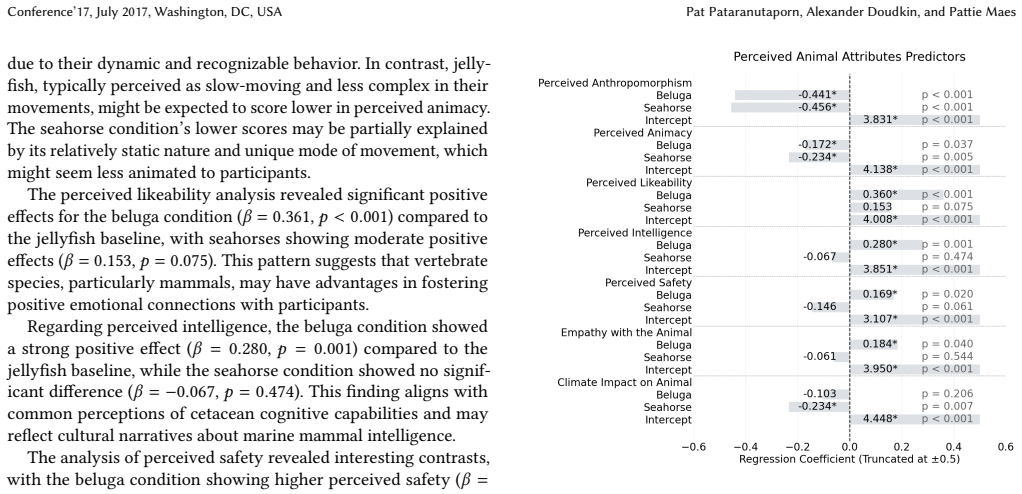
The central claim is that interactive conversational dialogue with a virtual marine character changes self-reported environmental intentions and immediate sustainable choice preferences where static information and static character storytelling do not. The authors argue that the conversational condition works by making abstract environmental threats feel tangible and personalized, and they support the claim with regression results showing a significant condition effect on intentions and on a product-selection task, alongside qualitative chat responses expressing empathy, commitment, and practical barriers. They also find that the effect is not uniform: character interaction did not significantly change psychological distance toward climate change, climate policy adoption, or self-reported past behavior, and species choice mattered, with belugas eliciting more empathy, likeability, and perceived intelligence while jellyfish were rated higher on anthropomorphism and conveyed vulnerability more effectively.
Load-bearing premise
The load-bearing premise is that the post-intervention feelings about the character, such as empathy and likeability, are background variables to be controlled for rather than part of the mechanism through which the conversation works, and if they are actually the mechanism, the reported effect of the conversational condition could be over- or understated.
Editorial extensions
If this is right
- If the central claim is correct, a single brief chat with an AI marine character is enough to raise self-reported pro-environmental intentions and shift immediate product choices, which makes conversational agents a scalable complement to conventional environmental education.
- Interactivity, rather than character presence alone, appears to be the active ingredient: the static character narrative showed no significant effect on intentions or sustainable choice preferences, while the conversational condition did.
- The intervention does not move entrenched measures such as climate policy support, psychological distance, or reported past behavior, so its expected value lies in nudging near-term decisions and intention setting rather than in converting skeptics or changing deep beliefs.
- Species selection matters: the beluga whale generated stronger emotional engagement and perceived intelligence, while the jellyfish was rated more anthropomorphic and better at conveying climate vulnerability, suggesting that character choice should be matched to the communication goal.
- The paper's proposed design principle of graduated anthropomorphism, adjusting how human-like a character appears according to interaction context, follows directly from the finding that both perceived anthropomorphism and authentic species traits contributed to outcomes.
Reading between the lines
- The paper treats post-intervention perceptions such as empathy, likeability, and climate impact awareness as covariates; if those perceptions are actually mediators on the path from conversation to behavior, the reported condition coefficients may understate the total effect, and a formal mediation analysis would settle that question.
- A natural extension would be a delayed follow-up: re-contacting participants one or two weeks after the chat to see whether intention gains and product-choice shifts persist or decay, since the study only measures outcomes immediately after the intervention.
- Using an incentive-compatible choice, such as a real purchase or donation decision rather than a hypothetical product-selection ratio, would test whether the sustainable choice effect reflects genuine behavior change or social desirability in self-report.
- Because the beluga excelled on emotional measures while the jellyfish excelled on anthropomorphism and vulnerability communication, a multi-species dialogue could be tested in which the featured character is matched to the specific environmental message, such as using a jellyfish for ocean-acidification content and a beluga for empathy-building appeals.
Editorial analysis
A structured set of objections, weighed in public.
Referee Report
Summary. The paper presents OceanChat, an LLM-powered conversational agent embodied as an animated marine character (beluga whale, moon jellyfish, seahorse), and reports a between-subjects experiment (N=900) comparing three conditions: Static Scientific Information, Static Character Narrative, and Conversational Character Narrative. The main claims are that the Conversational Character Narrative condition significantly increases pro-environmental intentions (beta=0.173, p<0.001) and sustainable choice preferences (beta=0.342, p=0.031) relative to static approaches, that the beluga character elicits stronger emotional engagement across several perceptual measures, and that effects on deeper attitudes (climate policy support, psychological distance) are limited. The paper also describes a synthetic pre-evaluation in which LLM agents serve as simulated participants and reviewers, reporting Kolmogorov-Smirnov divergences between synthetic and real data.
Significance. If the headline effects survive re-analysis, the study is a useful data point for research on conversational agents and sustainability: it uses a deployed, real-time LLM system with a randomized between-subjects design, a relatively large sample, and it transparently reports null results on deeper attitude measures. The synthetic pre-evaluation is an honest exploratory addition; the authors themselves report KS divergences between synthetic and real participant responses. However, the current regression specification undermines the causal reading of the headline effects, and the multiple-comparison situation is unresolved. The paper is therefore of moderate significance pending analytic fixes.
major comments (4)
- [Section 4.6.2 and Section 6] The regression model specified in Section 4.6.2 includes the seven post-intervention perceived variables (anthropomorphism, animacy, likeability, intelligence, safety, empathy, climate-change impact awareness) as covariates in every outcome model. Section 4.6.1 lists these measures as post-intervention only, and the paper's own results show they predict the headline outcomes: Section 5.2.9 reports empathy (beta=0.404, p<0.001) as a significant predictor of sustainable choice preferences, and Section 6 states that effectiveness "was mediated by perceptual factors." These variables are therefore not pre-treatment confounders but plausible mediators on the causal pathway from the conversational character condition to the outcomes. Conditioning on them converts the reported condition coefficients from the total intervention effect claimed in the abstract into direct effects net of those mediators. The sentence in Section 4.6.2 that sensitivity analyses "remained consistent across these alternative specifications" is not backed by any reported sensitivity analysis in the manuscript. The authors should report models without the perceived-variable block, and ideally a mediation decomposition, to support the abstract's causal claims.
- [Section 5.2] The results section reports separate regressions for at least eleven outcome variables (Sections 5.2.3 through 5.2.11), each with multiple condition and animal contrasts, yet no correction for multiple comparisons is applied or reported. Section 4.4 states that the sample size was increased to maintain power "after any adjustments or corrections," but no adjustments or corrections appear anywhere in the results. The headline sustainable choice result (beta=0.342, p=0.031) and the sustainable consumption result (beta=0.077, p=0.079) are particularly vulnerable; a Bonferroni or FDR correction across the reported family of tests could render them non-significant. Please report adjusted p-values, or clearly designate a pre-specified confirmatory analysis separate from exploratory analyses.
- [Abstract, Section 5.2.7, Section 5.2.9, Section 6.1] The abstract and the discussion claim that the Conversational Character Narrative condition significantly increased behavioral intentions and sustainable choice preferences "compared to static approaches." However, the regression analyses in Sections 5.2.7 and 5.2.9 compare each condition only to the Static Scientific Information baseline. The Static Character Narrative condition is not significant for intentions (beta=0.039, p=0.315) or for sustainable choice preferences (beta=0.115, p=0.434). The manuscript does not report a direct contrast between Conversational Character Narrative and Static Character Narrative, so the claim that interactivity itself drives the effect, rather than character narrative alone, is not directly tested. Please report pairwise contrasts among all three conditions or soften the abstract wording to "compared to static scientific information."
- [Section 4.5 and Section 5] The manuscript reports that 900 participants were recruited, but that "the final analytic sample was randomly evened out and ranged from n=683 to n=782 across the various outcome measures." The exact numbers of participants excluded for attention-check failure, overly fast completion, or incomplete data are not provided, and the reason for the variable effective N across outcomes is not explained. This makes it difficult to verify the power analysis in Section 4.4 and to assess whether exclusions could bias the condition comparisons. Please provide a flow diagram with exclusion counts and report the effective N for each outcome model.
minor comments (5)
- [Section 2, Contribution 3] The word "Synhetic" appears to be a typo; it should be "Synthetic pre-evaluation of Study."
- [Section 5.2.9] In the animal-condition paragraph, the text refers to "compared to the baseline" without specifying which baseline. Earlier species comparisons in Section 5.2.2 use the jellyfish as the baseline, but this is not restated here, which can confuse the reader.
- [Section 6, Species Selection and Emotional Connection] The reported beta for beluga likeability is 0.361 in Section 5.2.2 but 0.360 in the discussion; please reconcile the discrepancy.
- [Section 4.2.2] "vue-js" should be written as "Vue.js," and the description of Replit as a hosting platform could be clarified.
- [Section 4.5] The phrase "randomly evened out" is vague; please clarify how the analytic sample was evened out and whether any random subsampling was performed.
Circularity Check
No significant circularity; the central claims rest on an independent human-subject experiment rather than on fitted inputs or self-citations.
full rationale
The paper's central claims are empirical: a between-subjects experiment with N=900 human participants randomly assigned to Static Scientific Information, Static Character Narrative, or Conversational Character Narrative. The condition coefficients (e.g., β=0.173, p<0.001 for pro-environmental intentions; β=0.342, p=0.031 for sustainable choice preferences) are estimated from participant responses, not derived from the input prompts or LLM outputs. No equation defines the outcome in terms of the intervention by construction, and no parameter is fitted to a subset and then 'predicted' on a closely related quantity. The synthetic pre-evaluation (Section 5.1) is internally self-referential in that LLM agents generated conversations and separate LLM agents reviewed them, but the authors explicitly quantify the divergence from real participants (KS statistics of 0.378 pre, 0.241 post, both p<0.001) and do not use the synthetic results as evidence for the main effects. No load-bearing self-citations or uniqueness theorems are invoked; the cited prior work (e.g., Costello et al. 2024, Giudici et al. 2024) is external. The regression specification in Section 4.6.2 includes post-intervention perceived variables as covariates, which raises a mediation/over-control concern about interpreting the condition coefficients as total effects, but this is a causal-inference validity issue, not circularity: the condition is randomized and the coefficients are not constructed to equal the inputs. The manuscript also claims sensitivity analyses 'remained consistent' without reporting them; while this is missing support, it does not make the derivation circular. Therefore the circularity score is 0.
Assumptions & free parameters
assumptions (4)
- domain assumption Self-reported survey scales and the product-selection task capture meaningful environmental attitudes, intentions, and preferences.
- domain assumption Post-intervention perceived variables can be treated as covariates without biasing condition coefficients.
- domain assumption The exclusions and 'random even-out' of the analytic sample are ignorable.
- domain assumption gpt-4o-mini delivered the intended character personalities and factual content consistently across participants.
Cite this review
Pith. "Pith review of OceanChat: The Effect of Virtual Conversational AI Agents on Sustainable Attitude and Behavior Change." pith.science (2026). https://pith.science/paper/WN5KHLTW
@misc{pith2026250202863,
  author       = {Pith},
  title        = {Pith review of: OceanChat: The Effect of Virtual Conversational AI Agents on Sustainable Attitude and Behavior Change},
  year         = {2026},
  howpublished = {\url{https://pith.science/paper/WN5KHLTW}},
  note         = {Machine review of arXiv:2502.02863}
}
read the original abstract
Marine ecosystems face unprecedented threats from climate change and plastic pollution, yet traditional environmental education often struggles to translate awareness into sustained behavioral change. This paper presents OceanChat, an interactive system leveraging large language models to create conversational AI agents represented as animated marine creatures -- specifically a beluga whale, a jellyfish, and a seahorse -- designed to promote environmental behavior (PEB) and foster awareness through personalized dialogue. Through a between-subjects experiment (N=900), we compared three conditions: (1) Static Scientific Information, providing conventional environmental education through text and images; (2) Static Character Narrative, featuring first-person storytelling from 3D-rendered marine creatures; and (3) Conversational Character Narrative, enabling real-time dialogue with AI-powered marine characters. Our analysis revealed that the Conversational Character Narrative condition significantly increased behavioral intentions and sustainable choice preferences compared to static approaches. The beluga whale character demonstrated consistently stronger emotional engagement across multiple measures, including perceived anthropomorphism and empathy. However, impacts on deeper measures like climate policy support and psychological distance were limited, highlighting the complexity of shifting entrenched beliefs. Our work extends research on sustainability interfaces facilitating PEB and offers design principles for creating emotionally resonant, context-aware AI characters. By balancing anthropomorphism with species authenticity, OceanChat demonstrates how interactive narratives can bridge the gap between environmental knowledge and real-world behavior change.
Figures


Figures from the paper (11 more)




Forward citations
Cited by 1 Pith paper
-
LLM-generated personalized nudges for improving pro-environmental behavior: Field evidence from resource conservation
LLM-personalized weekly nudges cut electricity use by 0.56 kWh per room-day (18.3 percentage points more than text-only feedback) in a five-week randomized trial.
Reference graph
Works this paper leans on
-
[1]
Liisa Aavik. 2022. Using Nudging to Support Sustainable Choices. https://www. worldcleanupday.org/post/using-nudging-to-support-sustainable-choices
work page 2022
-
[2]
Abhishek Aggarwal, Cheuk Chi Tam, Dezhi Wu, Xiaoming Li, and Shan Qiao
-
[3]
Michal Aibin and Milos Simic. 2024. Energy Consumption of ChatGPT Re- sponses. Baeldung. https://www.baeldung.com/cs/chatgpt-large-language- models-power-consumption Accessed: July 8, 2024. Includes energy values for GPT-3 (0.0003 kWh/query), GPT-4 (0.0005 kWh/query), and GPT-5 (0.001 kWh/query). Carbon intensity assumption: 0.5 kgCO2/kWh
work page 2024
-
[4]
Icek Ajzen. 1991. The theory of planned behavior. Organizational Behavior and Human Decision Processes 50 (1991), 179–211. Issue 2. doi:10.1016/0749- 5978(91)90020-T
doi:10.1016/0749- 1991
-
[5]
Christoph Bartneck, Dana Kulić, Elizabeth Croft, and Susana Zoghbi. 2009. Mea- surement instruments for the anthropomorphism, animacy, likeability, perceived intelligence, and perceived safety of robots.International Journal of Social Robotics 1 (11 2009), 71–81. Issue 1. doi:10.1007/S12369-008-0001-3
-
[6]
Katharina Breiter, Feline Schnaak, and Henner Gimpel. 2024. Designing Conver- sational Agents to Promote Environmentally Friendly User Behavior. ICIS 2024 Proceedings (12 2024). https://aisel.aisnet.org/icis2024/user_behav/user_behav/4
work page 2024
-
[7]
Alessia Cavaliere, Silvia Pigliafreddo, Elisa De Marchi, and Alessandro Banterle
-
[8]
Matthew Cole, Pennie Lindeque, Claudia Halsband, and Tamara S. Galloway. 2011. Microplastics as contaminants in the marine environment: A review. Marine Pollution Bulletin 62 (12 2011), 2588–2597. Issue 12. doi:10.1016/J.MARPOLBUL. 2011.09.025
Show all 54 references
-
[9]
Thomas H Costello, Gordon Pennycook, and David G Rand. 2024. Durably reducing conspiracy beliefs through dialogues with AI. Science (New York, N.Y.) 385 (2024), eadq1814. Issue 6714. doi:10.1126/science.adq1814
2024 doi
-
[10]
Zhijun Dong and Tingting Sun. 2018. Combined effects of ocean acidification and temperature on planula larvae of the moon jellyfish Aurelia coerulea.Marine Environmental Research 139 (8 2018), 144–150. doi:10.1016/J.MARENVRES.2018. 05.015
2018 doi
-
[11]
Ithier d’Aramon, Boris Ruf, and Marcin Detyniecki. 2024. Assessing Carbon Footprint Estimations of ChatGPT. (2024), 127–133. doi:10.1007/978-3-031- 59005-4_15
2024 doi
-
[12]
Ghina ElHaffar, Fabien Durif, and Laurette Dubé. 2020. Towards closing the attitude-intention-behavior gap in green consumption: A narrative review of the literature and an overview of future research directions. Journal of Cleaner Production 275 (12 2020), 122556. doi:10.1016...
2020
-
[13]
Edgar Erdfelder, Franz FAul, Axel Buchner, and Albert Georg Lang. 2009. Sta- tistical power analyses using G*Power 3.1: Tests for correlation and regres- sion analyses. Behavior Research Methods 41 (2009), 1149–1160. Issue 4. doi:10.3758/BRM.41.4.1149
2009 doi
-
[14]
Queiroz, Linda Hambrick, Bryan A
Géraldine Fauville, Anna C.M. Queiroz, Linda Hambrick, Bryan A. Brown, and Jeremy N. Bailenson. 2021. Participatory research on using virtual reality to teach ocean acidification: a study in the marine education community. Environmental Education Research 27 (2021), 254–278. I...
2021
-
[15]
B J Fogg. 2003. Persuasive technology: using computers to change what we think and do . Morgan Kaufmann Publishers. - Triad of Persuasive Technolog (Captology)<br/>- (Gaia) as a social Actor<br/>-
2003
-
[16]
Jambeck, and Kara Lavender Law
Roland Geyer, Jenna R. Jambeck, and Kara Lavender Law. 2017. Production, use, and fate of all plastics ever made. Science Advances 3 (7 2017). Issue 7. doi:10.1126/sciadv.1700782
2017 doi
-
[17]
Robert Gifford. 2011. The dragons of inaction: psychological barriers that limit climate change mitigation and adaptation. The American psychologist 66 (5 2011), 290–302. Issue 4. doi:10.1037/A0023566
2011 doi
-
[18]
Robert Gifford, Christine Kormos, and Amanda McIntyre. 2011. Behavioral dimensions of climate change: drivers, responses, barriers, and interventions. Wiley Interdisciplinary Reviews: Climate Change 2 (11 2011), 801–827. Issue 6. doi:10.1002/WCC.143
2011 doi
-
[19]
Mathyas Giudici. 2024. Persuasive Conversational Agents to Foster Sustainable Behaviours: Design, Evaluation, and Technology. (2024). https://www.researchgate.net/profile/Mathyas-Giudici/publication/387998521_ Persuasive_Conversational_Agents_to_Foster_Sustainable_Behaviours_ ...
2024
-
[20]
Mathyas Giudici, Giulio Antonio Abbo, Pietro Crovari, and Franca Garzotto. 2024. Delivering Green Persuasion Strategies with a Conversational Agent: a Pilot Study. 811–821. https://hdl.handle.net/10125/106476
2024
-
[21]
Aman Gupta, Amey Band, Shivam Sharma, and Karan Bilakhiya. 2021. Text2Emotion: A Python Package for Emotion Detection in Text. https: //shivamsharma26.github.io/text2emotion/ Detects emotions from textual mes- sages in five categories: Happy, Angry, Sad, Surprise, and Fear
2021
-
[22]
Markus Hadler, Beate Klösch, Stephan Schwarzinger, Markus Schweighart, Re- becca Wardana, and David Neil Bird. 2022. Measuring Environmental Attitudes and Behaviors. Springer International Publishing, 15–35. doi:10.1007/978-3-030- 85796-7
2022 doi
-
[23]
Donna J. Haraway. 2016. Staying with the Trouble: Making Kin in the Chthu- lucene. Staying with the Trouble (8 2016). doi:10.1215/9780822373780
2016 doi
-
[24]
Haws, Karen Page Winterich, and Rebecca Walker Naylor
Kelly L. Haws, Karen Page Winterich, and Rebecca Walker Naylor. 2014. See- ing the world through GREEN-tinted glasses: Green consumption values and responses to environmentally friendly products. Journal of Consumer Psychology 24 (7 2014), 336–354. Issue 3. doi:10.1016/J.JCPS....
2014 doi
-
[25]
Kirsten Hillebrand and Florian Johannsen. 2021. KlimaKarl – A chabot to promote employees’ climate-friendly behavior in an office setting. SSRN Electronic Journal (2021). doi:10.2139/ssrn.3897674
2021 doi
-
[26]
Perttu Hämäläinen, Mikke Tavast, and Anton Kunnari. 2023. Evaluating Large Language Models in Generating Synthetic HCI Research Data: a Case Study. Conference on Human Factors in Computing Systems - Proceedings (4 2023), 19. doi:10.1145/3544548.3580688/SUPPL_FILE/3544548.35806...
2023
-
[27]
Google Inc. 2025. Model Viewer – Easily Display Interactive 3D Models on the Web and in AR. https://modelviewer.dev/ Accessed: 2025-01-26
2025
-
[28]
International Energy Agency. 2023. The world’s top 1% of emit- ters produce over 1000 times more CO2 than the bottom 1%. https: //www.iea.org/commentaries/the-worlds-top-1-of-emitters-produce-over- 1000-times-more-co2-than-the-bottom-1
2023
-
[29]
Brian Alan Johnson, André Derek Mader, Rajarshi Dasgupta, and Pankaj Kumar
-
[30]
Reto Knutti. 2019. Closing the Knowledge-Action Gap in Climate Change. One Earth 1 (9 2019), 21–23. Issue 1. doi:10.1016/j.oneear.2019.09.001 doi: 10.1016/j.oneear.2019.09.001
2019 doi
-
[31]
Lin Long, Rui Wang, Ruixuan Xiao, Junbo Zhao, Xiao Ding, Gang Chen, and Haobo Wang. 2024. On LLMs-Driven Synthetic Data Generation, Curation, and Evaluation: A Survey. (6 2024). https://arxiv.org/abs/2406.15126v1
2024 arXiv
-
[32]
Global Ecology and Conservation 21 (3 2020), e00812
Citizen science and invasive alien species: An analysis of citizen science initiatives using information and communications technology (ICT) to collect invasive alien species observations. Global Ecology and Conservation 21 (3 2020), e00812. doi:10.1016/J.GECCO.2019.E00812
2020 doi
-
[33]
Markowitz and Meaghan L
Ezra M. Markowitz and Meaghan L. Guckian. 2018. Climate change communica- tion: Challenges, insights, and opportunities. Psychology and Climate Change: Human Perceptions, Impacts, and Responses (1 2018), 35–63. doi:10.1016/B978-0- 12-813130-5.00003-5
2018 doi
-
[34]
Enikő Mészáros, Attila Bodor, Etelka Kovács, Sarolta Papp, Kamilla Kovács, Katalin Perei, and Gábor Feigl. 2023. Impacts of Plastics on Plant Develop- ment: Recent Advances and Future Research Directions. Plants 2023, Vol. 12, Page 3282 12 (9 2023), 3282. Issue 18. doi:10.3390...
2023 doi
-
[35]
Raffaele Marfella, Francesco Prattichizzo, Celestino Sardu, Gianluca Fulgenzi, Laura Graciotti, Tatiana Spadoni, Nunzia D’Onofrio, Lucia Scisciola, Rosalba La Grotta, Chiara Frigé, Valeria Pellegrini, Maurizio Municinò, Mario Siniscalchi, Fabio Spinetti, Gennaro Vigliotti, Car...
2017
-
[36]
Hung Vu Nguyen, Cuong Hung Nguyen, and Thoa Thi Bao Hoang. 2019. Green consumption: Closing the intention-behavior gap. Sustainable Development 27 (1 2019), 118–129. Issue 1. doi:10.1002/SD.1875
2019 doi
-
[37]
OECD. 2022. Global Plastics Outlook . 201 pages. doi:https://doi.org/10.1787/ de747aef-en
2022
-
[38]
Nabi, Abel Gustafson, and Risa Jensen
Robin L. Nabi, Abel Gustafson, and Risa Jensen. 2018. Framing Climate Change: Exploring the Role of Emotion in Generating Advocacy Behavior. https://doi.org/10.1177/1075547018776019 40 (5 2018), 442–468. Issue 4. doi:10. 1177/1075547018776019
2018 doi
-
[39]
OpenAI. 2025. Models Documentation. https://platform.openai.com/docs/models Accessed: 2025-01-26
2025
-
[40]
Bondyale-Juez, Miguel González-Pleiter, Stefanie Reinold, Maite Asensio, Ico Martínez, and May Gómez
Jorge Rapp, Alicia Herrera, Daniel R. Bondyale-Juez, Miguel González-Pleiter, Stefanie Reinold, Maite Asensio, Ico Martínez, and May Gómez. 2021. Microplastic ingestion in jellyfish Pelagia noctiluca (Forsskal, 1775) in the North Atlantic Ocean. Marine Pollution Bulletin 166 (...
2021
-
[41]
OECD. 2022. OECD Data Explorer. https://data-explorer.oecd.org/vis?fs% 5B0%5D=Topic,1%7CEnvironment%20and%20climate%20change%23ENV%23% 7CPlastics%23ENV_PLS%23&pg=0&fc=Topic&bp=true&snb=11&df%5Bds% 5D=dsDisseminateFinalDMZ&df%5Bid%5D=DSD_PW@DF_PW&df%5Bag% 5D=OECD.ENV.EEI&df%5Bv...
2022
-
[42]
Root-Bernstein, L
M. Root-Bernstein, L. Douglas, A. Smith, and D. Veríssimo. 2013. Anthropomor- phized species as tools for conservation: Utility beyond prosocial, intelligent and suffering species. Biodiversity and Conservation 22 (7 2013), 1577–1589. Issue 8. doi:10.1007/S10531-013-0494-4/FIGURES/1
2013 doi
-
[43]
Yolande Strengers. 2011. Designing eco-feedback systems for everyday life. Conference on Human Factors in Computing Systems - Proceedings (2011), 2135–
2011
-
[44]
Replit. 2025. Replit – Build Apps and Sites with AI. https://replit.com Accessed: 2025-01-26
2025
-
[45]
Environmental Protection Agency
U.S. Environmental Protection Agency. 2023. Greenhouse Gas Equivalencies Cal- culator. https://www.epa.gov/energy/greenhouse-gas-equivalencies-calculator- calculations-and-references
2023
-
[46]
A. M. van Valkengoed, L. Steg, and G. Perlaviciute. 2021. Development and vali- dation of a climate change perceptions scale.Journal of Environmental Psychology 76 (8 2021), 101652. doi:10.1016/J.JENVP.2021.101652
2021
-
[47]
Madalina Vlasceanu, Kimberly C Doell, Joseph B Bak-Coleman, Boryana Todor- ova, Michael M Berkebile-Weinberg, Samantha J Grayson, Yash Patel, Danielle Goldwert, Yifei Pei, Alek Chakroff, Ekaterina Pronizius, Karlijn L van den Broek, Denisa Vlasceanu, Sara Constantino, Michael ...
2024
-
[48]
Richard H Thaler and Cass R Sunstein. 2008. Nudge: improving decisions about health, wealth, and happiness . Yale University Press. 293 pages
2008
-
[49]
Lacy, Erin Ashe, Ailsa Hall, Stéphane Plourde, Ian H
Rob Williams, Robert C. Lacy, Erin Ashe, Ailsa Hall, Stéphane Plourde, Ian H. McQuinn, and Véronique Lesage. 2021. Climate change complicates efforts to ensure survival and recovery of St. Lawrence Estuary beluga. Marine Pollution Bulletin 173 (12 2021), 113096. doi:10.1016/J....
2021
-
[50]
Evan You and Vue.js Contributors. 2025. Vue.js - The Progressive JavaScript Framework. https://vuejs.org/ Accessed: 2025-01-26
2025
-
[52]
Lund, Agostino Marengo, Alessandro Pagano, Nishith Reddy Mannuru, Zoë A
Ting Wang, Brady D. Lund, Agostino Marengo, Alessandro Pagano, Nishith Reddy Mannuru, Zoë A. Teel, and Jenny Pange. 2023. Exploring the Potential Impact of Artificial Intelligence (AI) on International Students in Higher Education: Gener- ative AI, Chatbots, Analytics, and Int...
2023 doi
-
[2020]
12, Page 9627 12 (11 2020), 9627
Do Consumers Really Want to Reduce Plastic Usage? Exploring the Determi- nants of Plastic Avoidance in Food-Related Consumption Decisions.Sustainability 2020, Vol. 12, Page 9627 12 (11 2020), 9627. Issue 22. doi:10.3390/SU12229627
2020 doi
-
[2023]
Journal of Medical Internet Research 25 (2 2023), e40789
Artificial Intelligence–Based Chatbots for Promoting Health Behavioral Changes: Systematic Review. Journal of Medical Internet Research 25 (2 2023), e40789. Issue 1. doi:10.2196/40789
2023 doi
-
[2144]
doi:10.1145/1978942.1979252
Reviewed August 9, 2026 · model on record in the stance chip above.
Discussion (0). Continue with ORCID to comment.