REVIEW 4 major objections 5 minor 23 references
SPARC: Subspace-Aware Prompt Adaptation for Robust Continual Learning in LLMs
T0 review · 4 major / 5 minor · reviewed 2026-08-09 · deepseek-v4-flash
Pith's one-line read SPARC makes LLMs learn tasks in sequence without forgetting
desk verdict Plausible subspace-prompt idea, but the missing K-to-D map and absent prompt-tuning baseline make it unreproducible; needs major revision, not desk rejection. read the letter →
The pith
A machine-rendered reading of the paper's core claim, the machinery that carries it, and where it could break.
The reading
What carries the argument
The load-bearing object is the per-task prompt subspace defined by PCA: a trainable prompt matrix P of size T×k is mapped through the task's top-k principal components instead of living in the full embedding space. Two geometric operations carry the method: cosine overlap percentage between principal components of different tasks decides prompt reuse, and orthogonal projection of the new task's embeddings onto the complement of previous subspaces decides where to initialize a novel prompt. Together they keep the base LLM frozen, so the only trainable parameters are the T×k prompt entries.
What would settle it
Train SPARC on pairs of tasks whose PCA subspaces have high cosine overlap but whose actual transfer accuracy is low (or low overlap but high transfer); if the overlap percentage does not track task-transfer accuracy, the prompt-reuse rule fails. A simpler check: on a single task, compare SPARC's top-k prompt against a full-embedding-space prompt of the same token count; if the full prompt clearly outperforms, the subspace expressiveness assumption is violated.
Extended reading notes
Core claim
The paper's central claim is that catastrophic forgetting can be avoided by aligning each new task's prompt with the geometry of previously learned prompt subspaces. Concretely, SPARC computes PCA on the task's input embeddings, keeps the top k principal components as the prompt's working space, and measures overlap between tasks by cosine similarity of these components. When overlap passes a threshold, the existing prompt is reused with light fine-tuning; when it does not, the new prompt is projected into the orthogonal complement of all earlier subspaces before training. The authors report that this scheme achieves 97% backward transfer in domain-incremental settings and no forgetting in task-incremental SuperGLUE settings, while fine-tuning only 0.04% of parameters, and that adding LoRA (1% of parameters) preserves all prior knowledge and improves accuracy.
Load-bearing premise
The method assumes that a prompt trained in the top-k PCA subspace of a task's input embeddings is as expressive as one trained in the full embedding space, and that cosine overlap between PCA components reliably predicts whether a prompt can be reused for a new task; the paper does not validate this link with transfer-accuracy experiments.
Editorial extensions
If this is right
- Task-incremental continual learning can, according to the paper, be done with no forgetting and with only 0.04% of the model's parameters trainable.
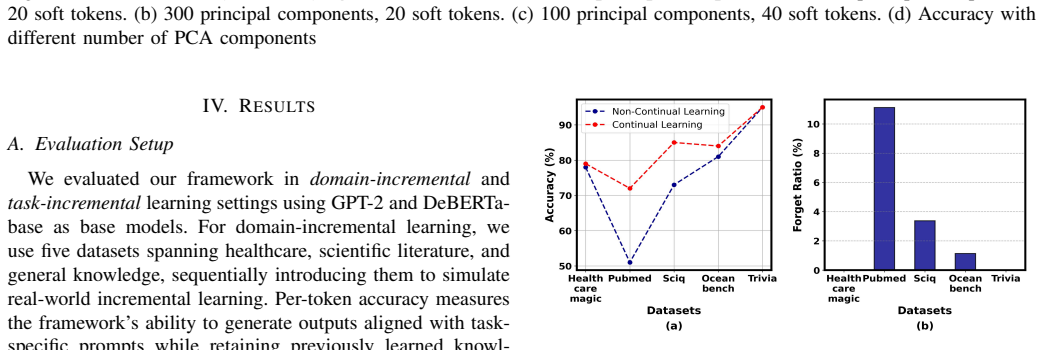
- Domain-incremental learning across healthcare, science, oceanography, and general knowledge retains about 97% of prior accuracy, with average forgetting of 3%.
- Because prompts are small and stored per task, the framework's training cost stays constant as the number of tasks grows.
- The PCA + LoRA hybrid offers a tunable accuracy-cost tradeoff, using 1% of parameters while preserving all prior knowledge.
- Forward transfer appears naturally: training on a healthcare domain improves later performance on scientific literature via shared subspace structure.
Reading between the lines
- If the overlap-to-reuse link is causal rather than correlational, the same PCA-overlap test could be used at inference time to select which stored prompt to load for an unlabeled input, turning the method into a prompt router.
- The paper does not report a systematic sweep over the overlap threshold τ or the component count k; a natural extension would be to measure how accuracy and forgetting vary along those axes, and whether the optimal threshold transfers across model families.
- The claim that prompt expressiveness is preserved in the top-k subspace could be stress-tested by comparing SPARC against full-space prompt tuning on tasks whose discriminative information lives in low-variance directions; PCA's variance-maximizing choice might then miss the signal.
- Because the method never touches base weights, it could be combined with other frozen-model safeguards such as output constraints or input preprocessing without interference.
Editorial analysis
A structured set of objections, weighed in public.
Referee Report
Summary. The paper proposes SPARC, a continual learning method for LLMs in which soft prompts are trained in a low-dimensional PCA subspace of the input embedding space. The method computes PCA on task embeddings, initializes prompts in the top-k principal subspace, measures cosine overlap between principal components of different tasks to decide whether to reuse an existing prompt, and otherwise initializes prompts in an orthogonal subspace. Experiments are reported on five domain datasets and five SuperGLUE tasks using GPT-2 and DeBERTa-base. The paper claims 0.04% trainable parameters, no forgetting in task-incremental learning, an average forgetting ratio of 3% in domain-incremental learning, and improved accuracy when combined with LoRA. Several central details of the method are missing or inconsistent, and the evaluation does not establish that the PCA/overlap machinery, rather than the frozen per-task prompt architecture, causes the reported retention.
Significance. The underlying idea—empirically identifying a low-dimensional subspace for prompt tuning and using subspace overlap to decide prompt reuse—is potentially interesting and would be a useful contribution if rigorously validated. The paper is clearly written and the proposed heuristic is easy to state. However, as submitted, the main claims are not reproducible: the map from the R^{T x K} trainable prompt to the D-dimensional token embedding space is never defined, the reported parameter-count percentages contradict one another, and the 'no forgetting' result is guaranteed by the architecture (frozen base model plus per-task frozen prompts) rather than by the PCA mechanism. The evaluation also lacks the standard prompt-tuning baseline needed to attribute the results to subspace awareness. If the authors can supply a precise method definition, corrected counts, and ablations against ordinary per-task prompt tuning, the framework could merit reconsideration; in its current form, the central claims are unsupported.
major comments (4)
- [III.A.2, II.B, IV.E] The prompt-to-embedding mapping is undefined, which makes the method unreproducible. Section III.A.2 defines the trainable prompt as P in R^{T x K} and states that each row is prepended to input token embeddings, but token embeddings are D-dimensional. Section II.B introduces W in R^{k x D} and projects data as X_k = X_c W^T, yet no equation applies W to P. If the intended map is P W or P W^T, it must be stated explicitly; if P is instead meant to be D-dimensional, the 'lower-dimensional' claim is void. Relatedly, the parameter counts are internally inconsistent: the abstract says 0.04% trainable parameters, Section IV.E reports less than 0.002% for T=10 and K=300, and Section III.A.2's example of T=10, K=100 gives 1,000 parameters, which is roughly 0.0008% of GPT-2's parameters rather than 0.04%. These numbers must be reconciled with the actual forward pass.
- [III.C.2, IV.D] The no-forgetting result in task-incremental learning is structurally guaranteed, so it cannot support the claim that PCA-based subspace alignment mitigates catastrophic forgetting. Section III.C.2 states that 'existing prompts remain frozen and accessible for inference,' and the base model is frozen throughout. In the task-incremental setup, prior-task accuracy is therefore unchanged by construction, regardless of PCA initialization, overlap analysis, or orthogonalization. A standard per-task prompt-tuning method with frozen prompts would exhibit the same zero-forgetting property. The paper needs a comparison to ordinary per-task prompt tuning and an ablation that isolates the effect of PCA-based initialization and reuse on downstream accuracy.
- [III.B, IV.B] The core decision mechanism—cosine overlap between PCA components with threshold tau—is never validated. Section III.B defines the reuse rule via overlap percentage and tau (e.g., 50%), but no experiment varies tau, reports the computed overlap percentages for the datasets used, or compares the reuse policy against simple alternatives such as always initializing a new prompt or always reusing the first prompt. The claim that subspace-guided prompt reuse produces the forward-transfer improvements in Section IV.C is therefore not supported. A concrete test would be to report task-pair overlap percentages and to compare SPARC's reuse decisions against random and trivial policies at fixed parameter counts.
- [IV.A, IV.E, Fig. 4] The experimental comparison does not establish superiority over standard prompt-based continual learning baselines. Figure 4 and Figure 5 compare PCA-based learning only against full fine-tuning and zero-shot inference; there is no standard prompt tuning baseline, no LoRA-only baseline, and no comparison to existing prompt-based continual learning methods (e.g., L2P, DualPrompt, ProgPrompt). In addition, the LoRA integration in Section IV.E is described only at a high level: the rank, placement, and how LoRA interacts with the PCA-projected prompts are not specified, making the '1% of parameters' claim unverifiable. The domain-incremental comparison in Figure 3(a) is against non-continual individual fine-tuning, which is not a continual learning baseline. Without these baselines and implementation details, the efficiency and accuracy claims are not established.
minor comments (5)
- [IV.B, IV.C] The figure cross-references are inconsistent: Section IV.C says the sequential training order is the x-axis of Fig. 2(a), and refers to results in Fig. 2, but Fig. 2 is the parameter-sweep plot; the domain-incremental results appear in Fig. 3. Please correct the cross-references.
- [IV.A] The paper does not state the exact model sizes, embedding dimensions, optimizer settings, learning rates, or number of training epochs for either GPT-2 or DeBERTa-base, nor does it specify the number of PCA components K used in the main experiments. A reproducibility table is needed.
- [IV.C] The claim that the forgetting ratio 'consistently remains below 5%' is not backed by numerical values or error bars. Please report per-dataset forgetting numbers and standard deviations, especially since the abstract quotes an average of 3%.
- [IV.E] The statement that 'training cost is constant regardless of task count or model size' is misleading: per-task training cost may be constant, but total memory for stored prompts and PCA subspaces grows with the number of tasks. Please qualify this claim.
- [References] Reference [19] is malformed ('M. G. Johannes Welbl, Nelson F. Liu, Crowdsourcing multiple choice science questions, 2017') and missing full publication details.
Circularity Check
Task-incremental 'no forgetting' is entailed by freezing per-task prompts, so the headline retention result is a definitional artifact of the architecture rather than empirical evidence for the PCA/overlap mechanism.
-
self definitional
[Section III.C.2 'Training and Adaptation'; reported as a result in Section IV.D]
"Existing prompts remain frozen and accessible for inference, allowing the framework to leverage previously acquired knowledge while integrating new information. This ensures robust continual learning with strong forward and backward transfer. ... Moreover, it fully retains previously learned knowledge, demonstrating robustness in continual learning."
The 'no forgetting' / 'full knowledge retention' claim is an identity of the architecture. If each task's prompt is frozen after training and the base model is frozen throughout, inference on earlier tasks uses exactly the trained prompt and unchanged base weights, so accuracy on earlier tasks cannot drop by construction. The paper presents this as an empirical result validating the subspace method, but the same zero-forgetting would occur with any per-task frozen prompt tuning, regardless of PCA or overlap analysis. The result is thus a restatement of the freezing design, not a prediction derived from the PCA/overlap mechanism.
full rationale
The clearest circularity is the task-incremental 'no forgetting' claim. Section III.C.2 states that existing prompts remain frozen, and Section IV.D reports full retention of previously learned knowledge. Because frozen prompts plus a frozen base model make earlier-task outputs identical to their post-training values, 100% retention is guaranteed by construction; it is not evidence that PCA-based subspace selection or cosine-overlap reuse causes retention. This is a partial circularity affecting a headline claim, so the score is 6. Other potential issues are not circularity: the missing mapping from the R^{T×K} prompt matrix to the model's D-dimensional embedding space is a reproducibility and correctness defect, not a reduction of a prediction to an input; the choice of k and tau without sensitivity analysis is an evaluation limitation; and the paper contains no load-bearing self-citations, as the cited references are external works. The domain-incremental forgetting ratio of 3% and the accuracy comparisons are empirical claims that do not reduce to the method's definitions, which is why the overall circularity is partial rather than total.
Assumptions & free parameters
free parameters (4)
- number of PCA components k =
100 or 300
- number of soft tokens T =
10, 20, or 40
- overlap threshold tau =
50% (example)
- LoRA rank and placement =
not reported
assumptions (3)
- domain assumption The top-k eigenvectors of the task embedding covariance matrix capture the directions relevant for task adaptation and forgetting.
- domain assumption Cosine similarity between principal components is a valid measure of whether a task can reuse an existing prompt.
- domain assumption Orthogonal projection of the new task's embeddings onto the complement of previous subspaces prevents interference between tasks.
Cite this review
Pith. "Pith review of SPARC: Subspace-Aware Prompt Adaptation for Robust Continual Learning in LLMs." pith.science (2026). https://pith.science/paper/SH3R2EPW
@misc{pith2026250202909,
  author       = {Pith},
  title        = {Pith review of: SPARC: Subspace-Aware Prompt Adaptation for Robust Continual Learning in LLMs},
  year         = {2026},
  howpublished = {\url{https://pith.science/paper/SH3R2EPW}},
  note         = {Machine review of arXiv:2502.02909}
}
read the original abstract
We propose SPARC, a lightweight continual learning framework for large language models (LLMs) that enables efficient task adaptation through prompt tuning in a lower-dimensional space. By leveraging principal component analysis (PCA), we identify a compact subspace of the training data. Optimizing prompts in this lower-dimensional space enhances training efficiency, as it focuses updates on the most relevant features while reducing computational overhead. Furthermore, since the model's internal structure remains unaltered, the extensive knowledge gained from pretraining is fully preserved, ensuring that previously learned information is not compromised during adaptation. Our method achieves high knowledge retention in both task-incremental and domain-incremental continual learning setups while fine-tuning only 0.04% of the model's parameters. Additionally, by integrating LoRA, we enhance adaptability to computational constraints, allowing for a tradeoff between accuracy and training cost. Experiments on the SuperGLUE benchmark demonstrate that our PCA-based prompt tuning combined with LoRA maintains full knowledge retention while improving accuracy, utilizing only 1% of the model's parameters. These results establish our approach as a scalable and resource-efficient solution for continual learning in LLMs.
Figures


Figures from the paper (2 more)


Reference graph
Works this paper leans on
-
[1]
Beyond traditional benchmarks: Analyzing behaviors of open llms on data-to-text generation,
Z. Kasner and O. Du ˇsek, “Beyond traditional benchmarks: Analyzing behaviors of open llms on data-to-text generation,” in Proceedings of the 62nd Annual Meeting of the Association for Computational Linguistics (Volume 1: Long Papers), 2024, pp. 12 045–12 072
work page 2024
-
[2]
Unsupervised llm adaptation for question answering,
K. Saito, K. Sohn, C.-Y . Lee, and Y . Ushiku, “Unsupervised llm adaptation for question answering,” arXiv preprint arXiv:2402.12170 , 2024
arXiv 2024
-
[3]
Leveraging the Power of LLMs: A Fine-Tuning Approach for High-Quality Aspect-Based Summarization
A. Mullick, S. Bose, R. Saha, A. K. Bhowmick, A. Vempaty, P. Goyal, N. Ganguly, P. Dey, and R. Kokku, “Leveraging the power of llms: A fine-tuning approach for high-quality aspect-based summarization,” arXiv preprint arXiv:2408.02584 , 2024
work page Pith review arXiv 2024
-
[4]
Towards reasoning in large language models: A survey,
J. Huang and K. C.-C. Chang, “Towards reasoning in large language models: A survey,” arXiv preprint arXiv:2212.10403 , 2022
arXiv 2022
-
[5]
Y . Luo, Z. Yang, F. Meng, Y . Li, J. Zhou, and Y . Zhang, “An empir- ical study of catastrophic forgetting in large language models during continual fine-tuning,” arXiv preprint arXiv:2308.08747 , 2023
arXiv 2023
-
[6]
An investigation of replay-based approaches for continual learning,
B. Bagus and A. Gepperth, “An investigation of replay-based approaches for continual learning,” in 2021 International Joint Conference on Neural Networks (IJCNN) . IEEE, 2021, pp. 1–9
work page 2021
-
[7]
A continual learning survey: Defying forgetting in classification tasks,
M. De Lange, R. Aljundi, M. Masana, S. Parisot, X. Jia, A. Leonardis, G. Slabaugh, and T. Tuytelaars, “A continual learning survey: Defying forgetting in classification tasks,” IEEE transactions on pattern analysis and machine intelligence , vol. 44, no. 7, pp. 3366–3385, 2021
2021
-
[8]
Overcoming catastrophic forgetting in neural networks,
J. Kirkpatrick, R. Pascanu, N. Rabinowitz, J. Veness, G. Desjardins, A. A. Rusu, K. Milan, J. Quan, T. Ramalho, A. Grabska-Barwinska et al. , “Overcoming catastrophic forgetting in neural networks,” Pro- ceedings of the national academy of sciences , vol. 114, no. 13, pp. 3521–3526, 2017
2017
Show all 23 references
-
[9]
Continual learning through synaptic intelligence,
F. Zenke, B. Poole, and S. Ganguli, “Continual learning through synaptic intelligence,” in International conference on machine learning. PMLR, 2017, pp. 3987–3995
2017
-
[10]
Lora: Low-rank adaptation of large language models,
E. J. Hu, Y . Shen, P. Wallis, Z. Allen-Zhu, Y . Li, S. Wang, L. Wang, and W. Chen, “Lora: Low-rank adaptation of large language models,” arXiv preprint arXiv:2106.09685 , 2021
2021 arXiv
-
[11]
Loramoe: Revolutionizing mixture of experts for maintaining world knowledge in language model alignment,
S. Dou, E. Zhou, Y . Liu, S. Gao, J. Zhao, W. Shen, Y . Zhou, Z. Xi, X. Wang, X. Fan et al., “Loramoe: Revolutionizing mixture of experts for maintaining world knowledge in language model alignment,” arXiv preprint arXiv:2312.09979, vol. 4, no. 7, 2023
2023 arXiv
-
[12]
Inflora: Interference-free low-rank adaptation for continual learning,
Y .-S. Liang and W.-J. Li, “Inflora: Interference-free low-rank adaptation for continual learning,” in Proceedings of the IEEE/CVF Conference on Computer Vision and Pattern Recognition , 2024, pp. 23 638–23 647
2024
-
[13]
A unified continual learning framework with general parameter-efficient tuning,
Q. Gao, C. Zhao, Y . Sun, T. Xi, G. Zhang, B. Ghanem, and J. Zhang, “A unified continual learning framework with general parameter-efficient tuning,” in Proceedings of the IEEE/CVF International Conference on Computer Vision, 2023, pp. 11 483–11 493
2023
-
[14]
The power of scale for parameter-efficient prompt tuning,
B. Lester, R. Al-Rfou, and N. Constant, “The power of scale for parameter-efficient prompt tuning,” arXiv preprint arXiv:2104.08691 , 2021
2021 arXiv
-
[15]
Principal component analysis,
H. Abdi and L. J. Williams, “Principal component analysis,” Wiley interdisciplinary reviews: computational statistics, vol. 2, no. 4, pp. 433– 459, 2010
2010
-
[16]
Unsupervised knowledge transfer using similarity embeddings,
N. Passalis and A. Tefas, “Unsupervised knowledge transfer using similarity embeddings,” IEEE transactions on neural networks and learning systems, vol. 30, no. 3, pp. 946–950, 2018
2018
-
[17]
Orthogonal subspace projection (osp) revisited: A com- prehensive study and analysis,
C.-I. Chang, “Orthogonal subspace projection (osp) revisited: A com- prehensive study and analysis,” IEEE transactions on geoscience and remote sensing, vol. 43, no. 3, pp. 502–518, 2005
2005
-
[18]
Pubmedqa: A dataset for biomedical research question answering,
Q. Jin, B. Dhingra, Z. Liu, W. W. Cohen, and X. Lu, “Pubmedqa: A dataset for biomedical research question answering,” arXiv preprint arXiv:1909.06146, 2019
1909 arXiv
-
[19]
Crowdsourcing multiple choice science questions,
M. G. Johannes Welbl, Nelson F. Liu, “Crowdsourcing multiple choice science questions,” 2017
2017
-
[20]
Oceangpt: A large language model for ocean science tasks,
Z. Bi, N. Zhang, Y . Xue, Y . Ou, D. Ji, G. Zheng, and H. Chen, “Oceangpt: A large language model for ocean science tasks,” arXiv preprint arXiv:2310.02031, 2023
2023 arXiv
-
[21]
Triviaqa: A large scale distantly supervised challenge dataset for reading comprehension,
M. Joshi, E. Choi, D. S. Weld, and L. Zettlemoyer, “Triviaqa: A large scale distantly supervised challenge dataset for reading comprehension,” arXiv preprint arXiv:1705.03551 , 2017
2017 arXiv
-
[22]
Continual lifelong learning with neural networks: A review,
G. I. Parisi, R. Kemker, J. L. Part, C. Kanan, and S. Wermter, “Continual lifelong learning with neural networks: A review,” Neural networks, vol. 113, pp. 54–71, 2019
2019
-
[23]
Superglue: A stickier benchmark for general- purpose language understanding systems,
A. Wang, Y . Pruksachatkun, N. Nangia, A. Singh, J. Michael, F. Hill, O. Levy, and S. Bowman, “Superglue: A stickier benchmark for general- purpose language understanding systems,” Advances in neural informa- tion processing systems , vol. 32, 2019
2019
Reviewed August 9, 2026 · model on record in the stance chip above.
Discussion (0). Continue with ORCID to comment.