REVIEW 4 major objections 5 minor 1 cited by
RoboGrasp: A Universal Grasping Policy for Robust Robotic Control
T0 review · 4 major / 5 minor · reviewed 2026-08-09 · deepseek-v4-flash
Pith's one-line read RoboGrasp claims that adding detected grasp boxes as conditioning inputs makes a diffusion policy grasp more accurately and generalize better, with task-success gains of up to 33.75 percentage points over the plain Diffusion Policy…
desk verdict The core comparison is confounded: RoboGrasp is given target-identifying grasp boxes while the DP baseline is not, so the reported gains do not isolate the grasp-affordance mechanism. read the letter →
The pith
A machine-rendered reading of the paper's core claim, the machinery that carries it, and where it could break.
The reading
What carries the argument
The central object is the grasping box, a 2D region on the item marking where it can be grasped, encoded by the centroid coordinates, width, and height; rotation is omitted because the robot arm cannot rotate. A Grasp Detection Module, a YOLOv11-m detector fine-tuned on roughly 500 manually labeled frames, generates these boxes automatically at training time and predicts them at inference. The observation encoder then concatenates the box features with the RGB and robot-state latents into one token per timestep, and the diffusion action head, using a DDIM scheduler with cosine beta noise schedule, denoises actions over 16 steps conditioned on those tokens. The argument is that this affordance channel is what lets the policy focus on the target region instead of relying on implicit patterns in raw sensor data.
What would settle it
Re-run the PickGoods comparison while giving the Diffusion Policy baseline the same target-identifying information RoboGrasp receives—say the object class or a bounding box around the target—but not the grasp geometry. If the baseline's success climbs to RoboGrasp's level, the gain comes from goal specification rather than grasp affordances; if it stays near zero, the grasp box itself is the active ingredient.
Extended reading notes
Core claim
The paper's central claim is that a grasping box—the x-y center, width, and height of the region where an object can be grasped, plus its class label—is a sufficient additional condition for a diffusion policy to pick the right object, use the right grasp strategy, and transfer to objects seen only five or ten times. RoboGrasp is presented as a universal grasping policy framework built on Diffusion Policy: a fine-tuned YOLOv11-m detector supplies the boxes during both training and inference, the observation encoder concatenates them with ResNet34-encoded multi-view RGB and robot state, and the same diffusion action head predicts 16-step actions conditioned on those tokens. The experimental report claims that this explicit spatial guidance makes the policy distinguish the larger of two nearly identical blocks, select handle versus wall versus diameter grasps for different cups, and follow a prompt in a cluttered retail scene, whereas the baseline, lacking explicit goal specification, relies on implicit sensor patterns and fails on those distinctions.
Load-bearing premise
The whole comparison assumes the only meaningful difference between RoboGrasp and the baseline is the added grasp-box information, and that the automatically generated grasp labels used for training are accurate enough to teach the policy.
Editorial extensions
If this is right
- If the claim holds, adding a grasp detector to an existing diffusion policy is a cheap route to precision gains: no new demonstrations or architecture changes, only an extra conditioning channel.
- Few-shot transfer should improve: the paper reports 100 percent task success on a green mug trained with 5 demonstrations and a blue cup with 10, suggesting affordance grounding cuts the data needed for novel objects.
- Grasp boxes can act as spatial prompts, so a policy can be told which object to pick in a cluttered scene without language supervision, provided the detector can localize that object.
- Because the augmentation is confined to the observation encoder, the same conditioning should transfer to other diffusion-based policies and possibly ACT-style or world-model frameworks, as the paper's future-work section suggests.
- The paper's own discussion of PickGoods implies performance depends on scene layout, so gains in simpler two-object scenes may not automatically survive heavy clutter or varied placements.
Reading between the lines
- Editorial inference: the PickGoods comparison is not a clean test of grasp geometry, because Section 4.1 gives RoboGrasp a goal-oriented prompt that the Diffusion Policy baseline never receives; the chocolate-bar result could in part reflect goal specification rather than the grasp affordance.
- Editorial inference: Section 4.2 reports the grasp detector's mAP above 98 percent on an unspecified split of roughly 500 frames, and those same auto-labels train the policy; a held-out label-quality check and an ablation with ground-truth boxes would show whether detector noise or policy conditioning drives the gain.
- Editorial inference: the paper's own caveat in Section 5.2.3 that fixed placements in PickGoods may let the policy rely on arm-pose priors limits the prompt-following conclusion; varying object positions would test whether the affordance, not the pose prior, carries the behavior.
- Editorial inference: including the omitted rotation parameter and testing on a rotatable arm would extend the same framework to angled grasps, which the current experiments cannot evaluate because the arm is fixed.
Editorial analysis
A structured set of objections, weighed in public.
Referee Report
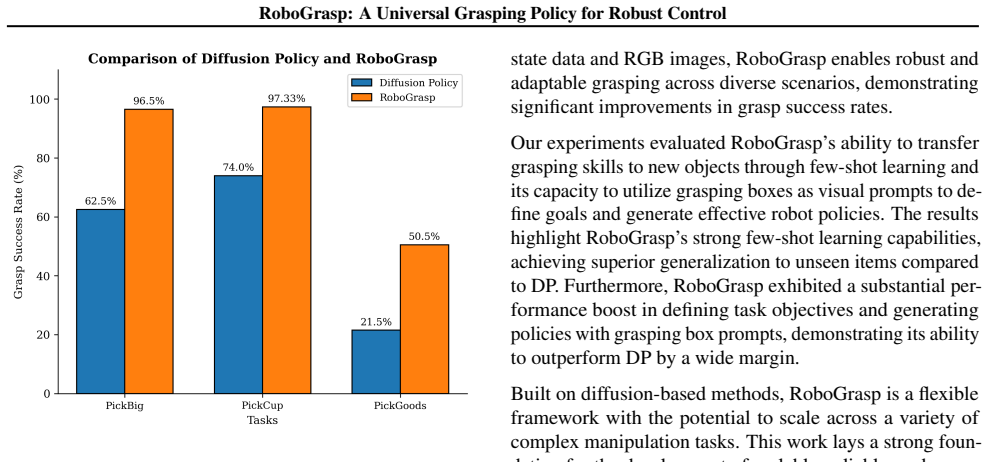
Summary. The paper proposes RoboGrasp, a diffusion-policy variant that augments RGB and robot-state observations with a grasp-box prediction produced by a fine-tuned YOLOv11 detector. It reports real-robot experiments on three tasks (PickBig, PickCup, PickGoods), comparing RoboGrasp against a standard Diffusion Policy baseline and reporting task success and grasp success rates. The central claims are that grasp-box conditioning improves grasp precision, stability, and generalizability, including few-shot transfer and prompt-conditioned grasping, with success rates up to 34% higher than the baseline.
Significance. If the reported results were valid, the contribution would be practically useful: injecting structured grasp-affordance information into an imitation-learning policy is a simple and potentially low-cost way to improve data efficiency, and the PickCup few-shot results hint at genuine generalization benefits. The paper also makes a reasonable point in Section 5.1 that state-space complexity should be matched by dataset scale. However, the experimental design does not isolate the grasp-affordance mechanism from target/goal specification, and the absence of trial counts, seeds, and error bars prevents any statistical assessment of the quantitative claims. The 'universal grasping policy' framing is also not supported by the included tasks, especially given the failures reported for half of the PickGoods objects. The paper is clearly written and the hardware setup is described in sufficient detail to be reproduced in principle, but the central evidence is presently confounded.
major comments (4)
- [Section 4.1, Table 1] The baseline comparison confounds grasp-box conditioning with goal specification. In PickBig, the grasp box is detected on the larger block and therefore tells RoboGrasp which object is the target, while DP receives no such target indicator. In PickGoods, the paper states that the grasp box is a 'clear, goal-oriented prompt' that identifies the object to pick, 'a feature that is notably absent in approaches like DP.' Consequently, the large TSR gaps in Table 1 (PickBig 97.5 vs 67.5; Meiji chocolate 100 vs 0) could be produced by any target-identification cue, not specifically by grasp-specific affordance information. The conclusion that 'grasping box detections' cause the improvement is not supported by these comparisons.
- [Section 4.3.2, Table 1] No trial counts, seeds, or error bars are reported for any success rate. The table gives percentages to one decimal place without denominators, so the reader cannot determine whether '97.5%' reflects 39/40, 78/80, or some other count, and cannot judge the reliability of differences such as 60 vs 100 in the blue plastic cup few-shot row. The PickGoods rows (Lotus biscuit 0/0, M&M 4/4) are especially in need of raw counts. Without these data, none of the claimed improvements can be statistically evaluated.
- [Section 4.2] The grasp detector validation is not sufficiently described. The paper reports only that 'a representative subset of approximately 500 frames' was manually labeled and that fine-tuning 'achieves a mean Average Precision (mAP) exceeding 98%,' with no train/test split, per-class AP, or number of test frames. Because the detector outputs are used both as training labels for the policy and as inference-time prompts, detector errors propagate directly into the measured policy performance. The authors should report held-out detection metrics and, ideally, an analysis of sensitivity to detector confidence thresholds and box selection.
- [Section 5.2.3, Conclusion] The paper's own limitation statements undercut the 'universal' and 'robust' claims in the abstract and conclusion. Section 5.2.3 acknowledges that the fixed spatial placement of objects in PickGoods 'raises concerns about potential over-reliance on robot pose priors rather than affordance-driven reasoning' and that the policy sometimes prioritizes proximal targets over the prompted object. Moreover, Table 1 shows RoboGrasp failing on two of the four PickGoods objects (Lotus biscuit 0/0, M&M 4/4). The 'universal grasping policy framework' claim should be substantially narrowed, or additional experiments with varied object positions and a broader object set should be provided.
minor comments (5)
- [Abstract, Section 5.2.3] The abstract's 'up to 34% higher success rates' is not tied to a specific table row or computation; Section 5.2.3 reports a 28.7% PickGoods TSR improvement and Section 5.2.2 a 23.33% GSR improvement. Please define how the 34% figure is obtained.
- [References, Section 3.1] YOLOv11 is cited to Redmon et al. 2016, which describes the original YOLO architecture; the authors should cite the actual YOLOv11 source. Also, 'Grasp Anything' should be 'Grasp-Anything'.
- [Figures 8 and 9] The figures show 'average' success rates without error bars, raw counts, or standard deviations; the text should explain how the averages are computed from Table 1 and what variability exists across trials.
- [Section 3, Section 5.2.2] There are several typographical issues: 'these parameter was considered redundant' should be 'these parameters were considered redundant'; Section 5.2.2 has an unclosed parenthesis after 'see Figure 9'; and Figure 1's caption contains a dangling 'robotic control'.
- [General] No code, data, or model checkpoint release is mentioned, which limits reproducibility. At minimum, the trained detector weights and policy configuration should be made available.
Circularity Check
PickBig and PickGoods comparisons define the grasp-box prompt as the task goal, so the reported gains reduce to goal specification rather than grasp affordance.
-
self definitional
[Section 4.1, Task Description (PickGoods)]
"The prompt acts as a critical test of the policy's responsiveness to predefined objectives, a feature that is notably absent in approaches like DP. Unlike DP, which relies solely on conditional sensor data without explicit goal specification, PickGoods incorporates a clear, goal-oriented prompt, enabling the policy to align its actions with the intended outcome."
RoboGrasp's PickGoods input includes a grasp box that identifies the target item among distractors, while the DP baseline receives no target indicator. The paper's own text says the prompt supplies 'explicit goal specification' that DP lacks. The reported gains (e.g., chocolate bar TSR 0 to 100) therefore measure whether a goal cue helps, not whether grasp-specific affordance geometry helps. The 'prediction' that grasping-box prompts improve performance is forced by giving RoboGrasp the objective in the prompt; the affordance mechanism is not separated from goal specification.
-
self definitional
[Section 4.1, Task Description (PickBig)]
"A key challenge lies in defining the task's goal, and the task aims to test whether providing grasping-based affordance regions helps clarify and achieve the objective more effectively."
In PickBig the task is to grasp the larger of two blocks, and the grasping-box detection is produced on the larger block, so RoboGrasp receives target identity that DP lacks. The paper's Section 5.2.1 adds that these predictions 'explicitly guide RoboGrasp to target the correct block.' The TSR gap (97.5 vs 67.5) is thus attributable to giving RoboGrasp the answer to the goal-definition problem, not to improved grasping geometry. The affordance claim reduces to target identification by construction.
full rationale
The architecture itself is not circular: RoboGrasp augments Diffusion Policy with a YOLO-based grasp-box encoder and a standard diffusion action head, and there are no load-bearing self-citations or imported uniqueness theorems. The circularity is confined to the central evaluation design. In PickGoods and PickBig, the 'grasping-based affordance prompt' is the task goal: the grasp box identifies the target object, while the paper's own text says DP receives no explicit goal specification. Consequently, the large TSR/GSR gains in Table 1 (e.g., chocolate 0 vs 100, PickBig 67.5 vs 97.5) are forced by giving RoboGrasp target information, not by grasp-geometry reasoning. The PickCup few-shot rows avoid the target-identity confound but still give RoboGrasp a semantic class label and no per-seed error bars, so they provide only limited independent support. The paper's Section 5.2.3 also concedes fixed object positions and possible over-reliance on robot pose priors. Overall, the central 'grasp affordance' claim is partially circular in its headline comparisons, although the method is a straightforward and independently implementable architecture.
Assumptions & free parameters
free parameters (1)
- Grasp detection confidence and selection rule
assumptions (4)
- standard math Diffusion Policy and DDIM with cosine beta schedule behave as described in Chi et al. and Nichol and Dhariwal.
- domain assumption A 2D grasp box (x, y, width, height) on an RGB image provides sufficient actionable grasp guidance for the fixed, non-rotating gripper.
- domain assumption YOLOv11 fine-tuned on roughly 500 labeled frames generalizes to all task videos, and its auto-generated labels are accurate enough to train the policy.
- ad hoc to paper Diffusion Policy without the grasp-box input is a fair control for measuring the value of the grasp-box conditioning.
Cite this review
Pith. "Pith review of RoboGrasp: A Universal Grasping Policy for Robust Robotic Control." pith.science (2026). https://pith.science/paper/7ZWU2YG7
@misc{pith2026250203072,
  author       = {Pith},
  title        = {Pith review of: RoboGrasp: A Universal Grasping Policy for Robust Robotic Control},
  year         = {2026},
  howpublished = {\url{https://pith.science/paper/7ZWU2YG7}},
  note         = {Machine review of arXiv:2502.03072}
}
read the original abstract
Imitation learning and world models have shown significant promise in advancing generalizable robotic learning, with robotic grasping remaining a critical challenge for achieving precise manipulation. Existing methods often rely heavily on robot arm state data and RGB images, leading to overfitting to specific object shapes or positions. To address these limitations, we propose RoboGrasp, a universal grasping policy framework that integrates pretrained grasp detection models with robotic learning. By leveraging robust visual guidance from object detection and segmentation tasks, RoboGrasp significantly enhances grasp precision, stability, and generalizability, achieving up to 34% higher success rates in few-shot learning and grasping box prompt tasks. Built on diffusion-based methods, RoboGrasp is adaptable to various robotic learning paradigms, enabling precise and reliable manipulation across diverse and complex scenarios. This framework represents a scalable and versatile solution for tackling real-world challenges in robotic grasping.
Figures


Figures from the paper (5 more)


Forward citations
Cited by 1 Pith paper
-
Spatial RoboGrasp: Generalized Robotic Grasping Control Policy
Spatial RoboGrasp combines AugFusion, monocular depth, and grasp prompts in a diffusion policy, claiming large gains under exposure change, without released artifacts or error bars.
Reference graph
Works this paper leans on
-
[2]
URL https://arxiv.org/ abs/2402.10329. Collaboration, E., O’Neill, A., Rehman, A., Gupta, A., Mad- dukuri, A., Gupta, A., Padalkar, A., Lee, A., Pooley, A., Gupta, A., Mandlekar, A., Jain, A., Tung, A., Bewley, A., Herzog, A., Irpan, A., Khazatsky, A., Rai, A., Gupta, A., Wang, A., Kolobov, A., Singh, A., Garg, A., Kem- bhavi, A., Xie, A., Brohan, A., Raf...
-
[3]
URL https://arxiv.org/abs/2310.08864. Geng, D., Herrmann, C., Hur, J., Cole, F., Zhang, S., Pfaff, T., Lopez-Guevara, T., Doersch, C., Aytar, Y ., Rubinstein, M., Sun, C., Wang, O., Owens, A., and Sun, D. Motion prompting: Controlling video generation with motion trajectories,
-
[4]
Huang, J., Zhu, Z., and Huang, G
URL https://arxiv.org/abs/ 2412.02700. Huang, J., Zhu, Z., and Huang, G. Multi-stage hrnet: Multi- ple stage high-resolution network for human pose estima- tion,
-
[10]
Redmon, J., Divvala, S., Girshick, R., and Farhadi, A
URL https: //arxiv.org/abs/2408.00714. Redmon, J., Divvala, S., Girshick, R., and Farhadi, A. You only look once: Unified, real-time object detection,
-
[12]
URL https://arxiv.org/abs/2411.14347. Selvaraju, R. R., Cogswell, M., Das, A., Vedantam, R., Parikh, D., and Batra, D. Grad-cam: Visual explana- tions from deep networks via gradient-based localiza- tion. International Journal of Computer Vision , 128 (2):336–359, October
-
[13]
doi: 10.1007/s11263-019-01228-7
ISSN 1573-1405. doi: 10.1007/s11263-019-01228-7. URL http://dx.doi. org/10.1007/s11263-019-01228-7 . Tang, G., Rajkumar, S., Zhou, Y ., Walke, H. R., Levine, S., and Fang, K. Kalie: Fine-tuning vision-language models for open-world manipulation without robot data,
-
[14]
URL https://arxiv.org/abs/2409.14066. Team, A. ., Aldaco, J., Armstrong, T., Baruch, R., Bing- ham, J., Chan, S., Draper, K., Dwibedi, D., Finn, C., Florence, P., Goodrich, S., Gramlich, W., Hage, T., Her- zog, A., Hoech, J., Nguyen, T., Storz, I., Tabanpour, B., Takayama, L., Tompson, J., Wahid, A., Wahrburg, T., Xu, S., Yaroshenko, S., Zakka, K., and Zh...
-
[15]
Yang, L., Kang, B., Huang, Z., Xu, X., Feng, J., and Zhao, H
URL https://arxiv.org/abs/2309.09818. Yang, L., Kang, B., Huang, Z., Xu, X., Feng, J., and Zhao, H. Depth anything: Unleashing the power of large-scale unlabeled data,
Show all 18 references
-
[16]
Ze, Y ., Zhang, G., Zhang, K., Hu, C., Wang, M., and Xu, H
URL https://arxiv.org/ abs/2401.10891. Ze, Y ., Zhang, G., Zhang, K., Hu, C., Wang, M., and Xu, H. 3d diffusion policy: Generalizable visuomotor policy learning via simple 3d representations. In Proceedings of Robotics: Science and Systems (RSS) ,
-
[17]
Zhou, K., Liu, Z., Qiao, Y ., Xiang, T., and Loy, C
URL https://arxiv.org/abs/ 2304.13705. Zhou, K., Liu, Z., Qiao, Y ., Xiang, T., and Loy, C. C. Do- main generalization: A survey. IEEE Transactions on Pattern Analysis and Machine Intelligence , pp. 1–20,
-
[2016]
URL https://arxiv.org/abs/1506.02640. Ren, T., Chen, Y ., Jiang, Q., Zeng, Z., Xiong, Y ., Liu, W., Ma, Z., Shen, J., Gao, Y ., Jiang, X., Chen, X., Song, Z., Zhang, Y ., Huang, H., Gao, H., Liu, S., Zhang, H., Li, F., Yu, K., and Zhang, L. Dino-x: A unified vision model for o...
-
[2017]
Nichol, A
URL https: //arxiv.org/abs/1703.09312. Nichol, A. and Dhariwal, P. Improved denoising diffusion probabilistic models,
-
[2019]
URL https://arxiv.org/abs/1910. 05901. Huang, W., Wang, C., Li, Y ., Zhang, R., and Fei-Fei, L. Rekep: Spatio-temporal reasoning of relational keypoint constraints for robotic manipulation. arXiv preprint arXiv:2409.01652,
1910 arXiv
-
[2020]
Moka: Open-world robotic manipulation through mark-based vi- sual prompting, 2024a
Liu, F., Fang, K., Abbeel, P., and Levine, S. Moka: Open-world robotic manipulation through mark-based vi- sual prompting, 2024a. URL https://arxiv.org/ abs/2403.03174. Liu, S., Wu, L., Li, B., Tan, H., Chen, H., Wang, Z., Xu, K., Su, H., and Zhu, J. Rdt-1b: a diffusion founda...
-
[2021]
org/abs/2102.09672
URL https://arxiv. org/abs/2102.09672. Octo Model Team, Ghosh, D., Walke, H., Pertsch, K., Black, K., Mees, O., Dasari, S., Hejna, J., Xu, C., Luo, J., Kreiman, T., Tan, Y ., Chen, L. Y ., Sanketi, P., Vuong, Q., Xiao, T., Sadigh, D., Finn, C., and Levine, S. Octo: An open-sou...
-
[2022]
doi: 10.1109/tpami.2022
ISSN 1939-3539. doi: 10.1109/tpami.2022. 3195549. URL http://dx.doi.org/10.1109/ TPAMI.2022.3195549. 10
1939
-
[2023]
org/abs/2301.10677
URL https://arxiv. org/abs/2301.10677. Pomerleau, D. Alvinn: An autonomous land vehicle in a neural network. In Touretzky, D. (ed.), Proceedings of (NeurIPS) Neural Information Processing Systems , pp. 305 –
-
[2024]
Chi, C., Feng, S., Du, Y ., Xu, Z., Cousineau, E., Burchfiel, B., and Song, S
URL https: //arxiv.org/abs/2410.24164. Chi, C., Feng, S., Du, Y ., Xu, Z., Cousineau, E., Burchfiel, B., and Song, S. Diffusion policy: Visuomotor policy learning via action diffusion. In Proceedings of Robotics: Science and Systems (RSS) ,
Reviewed August 9, 2026 · model on record in the stance chip above.
Discussion (0). Continue with ORCID to comment.