REVIEW 4 major objections 5 minor 18 references
Examining $H$-Closed Ducci Sequences on $\mathbb{Z}_m^n$
T0 review · 4 major / 5 minor · reviewed 2026-08-09 · deepseek-v4-flash
Pith's one-line read The paper proves that Ducci cycles on $\mathbb{Z}_m^n$ are closed under cyclic rotation for $n=3$ with $m$ a power of $2$, $m\equiv 5\pmod 6$ prime, or $m=2^\ell p$ with $p\equiv 5\pmod 6$ prime, and for even $n$ with $m\equiv -1\pmod n$…
desk verdict Correct but under-polished extension of the Ducci-cycle literature; the H-closed reduction is the useful idea, and the main theorems hold up modulo a typo and heavy reliance on the authors' own preprints. read the letter →
The pith
A machine-rendered reading of the paper's core claim, the machinery that carries it, and where it could break.
The reading
What carries the argument
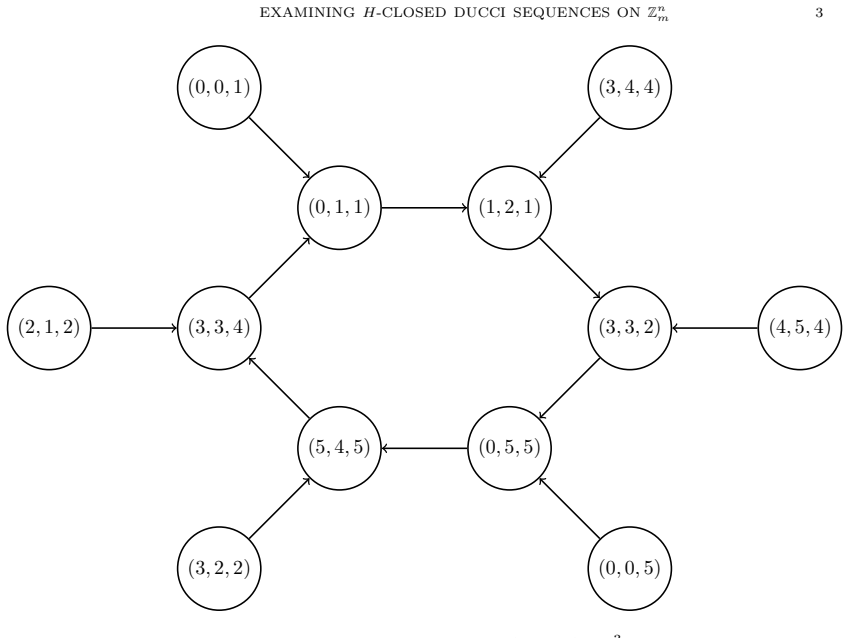
The load-bearing reduction is Lemma 4: $\mathbb{Z}_m^n$ is $H$-closed if and only if its basic Ducci sequence, the orbit of $e=(0,\ldots,0,1)$ under $D$, is $H$-closed. This works because $u=\sum_{s=1}^n x_s H^{-s}(e)$ for every $u=(x_1,\ldots,x_n)$, and $D$ commutes with $H$, so an identity $D^{\alpha}(e)=H^{\beta}(e)$ propagates to all tuples. To prove such identities, the paper tracks the coefficients $a_{r,s}$ that give the $s$-th entry of $D^r(e)$, using the Pascal-style identity $a_{r,s}=\sum_i \binom{t}{i}a_{r-t,s-i}$. For $n=3$, these reduce to three interlocking sequences $a_r,b_r,c_r$ with $a_r+b_r+c_r=2^r$ and a mod-$6$ congruence pattern, and Fermat's Little Theorem closes the prime moduli cases.
What would settle it
Compute the Ducci cycle of the basic tuple $(0,0,1)$ in $\mathbb{Z}_8^3$: if any cycle point $v$ has $D^2(v)\neq H(v)$, the power-of-two case fails. Similarly, compute the cycle of $(0,0,0,1)$ in $\mathbb{Z}_7^4$ and check whether $D^6(v)=H^{-1}(v)$ for every cycle point; a counterexample would falsify the even-$n$ prime case.
Extended reading notes
Core claim
The paper's central claim is that for the listed $(n,m)$, the eventual Ducci cycle is closed under the cyclic shift $H$, witnessed by fixed power identities on the cycle subgroup $K(\mathbb{Z}_m^n)$. For $n=3$, the intended identities are $D^2=H$ when $m$ is a power of $2$; $D^{m-1}=H^2$ on all of $\mathbb{Z}_m^3$ when $m\equiv 5\pmod 6$ is prime; and $D^{p-1}=H^2$ on the cycle when $m=2^\ell p$ with $p\equiv 5\pmod 6$ prime. For even $n$ with $m\equiv -1\pmod n$ prime, the identity is $D^{m-1}=H^{-1}$ on the cycle. The proof obtains these by reducing to the basic Ducci sequence—every tuple is a linear combination of cyclic shifts of $(0,\ldots,0,1)$, and $D$ commutes with $H$—and then verifying the identities with the binomial coefficients that appear in the iterates of $(0,\ldots,0,1)$.
Load-bearing premise
The proof imports from earlier papers the assertions that the basic tuple has already entered its cycle after exactly $l$ steps when $m=2^l$, and after one step for even $n$ with $\gcd(n,m)=1$, together with a mod-6 coefficient congruence; if any of these imports is wrong, the identities defining $H$-closedness are not established.
Editorial extensions
If this is right
- For $n=3$ and $m$ a power of $2$, every Ducci cycle is rotation-invariant: from any cycle point $u$, $D^2(u)=H(u)$, so one rotation equals two Ducci steps.
- For prime $m\equiv 5\pmod 6$, $D^{m-1}=H^2$ holds on every tuple in $\mathbb{Z}_m^3$, so rotation symmetry is global rather than confined to the eventual cycle.
- For even $n$ with prime $m\equiv -1\pmod n$, $D^{m-1}=H^{-1}$ on the cycle, making $m-1$ Ducci iterations equivalent to one backward rotation.
- Because $H$-closedness reduces to the basic sequence, checking a single orbit decides the property, and the paper's tables classify all tested $4\le n\le 12$, $3\le m\le 12$ pairs as $H$-closed, weakly $H$-closed, or neither.
- When $n$ and $m$ are both powers of $2$, every Ducci sequence is trivially $H$-closed since the only cycle is the all-zero tuple.
Reading between the lines
- Editorial note: the printed statement of Theorem 2(3) says $D^{p-1}(u)=u$, but the proof in the same section establishes $D^{p-1}(u)=H^2(u)$; the intended identity appears to be the latter.
- The same coefficient method should be able to prove the paper's stated conjecture that for even $n$ and $m=p^l$ with $p\equiv -1\pmod n$ prime, $D^{\varphi(m)}=H^{(-1)^l}$ on the cycle, extending $H$-closedness to prime powers.
- The tables suggest a parity principle worth testing: for even $n$ the cycle action is an inverse rotation, while for $n=3$ it is a forward rotation $H^2$; determining whether the sign of the rotation depends only on $n$'s parity is a natural next step.
- A concrete extension is to check composite moduli with the same residues, such as $m=2^\ell p^j$ with $p\equiv 5\pmod 6$, since the paper's theorems cover only the first power of each prime factor.
Editorial analysis
A structured set of objections, weighed in public.
Referee Report
Summary. The paper studies Ducci sequences on Z_m^n under the endomorphism D=I+H, where H is the cyclic shift, and introduces the notion of H-closedness: a Ducci sequence is H-closed when every tuple in its eventual cycle is mapped into the same cycle by every power of H. The main results are Theorem 2, asserting that Z_3^m is H-closed when m is a power of 2, when m is prime congruent to 5 mod 6, and when m=2^l p with p congruent to 5 mod 6 prime, and Theorem 3, asserting that Z_n^m is H-closed for even n when m is prime and m ≡ -1 mod n. The proofs reduce to the basic Ducci sequence via Lemma 4 and then verify coefficient identities for powers of D on that sequence.
Significance. The reduction to the basic Ducci sequence in Lemma 4 is a useful organizing idea, and the coefficient computation for Theorem 3 is elegant and internally coherent. If the imported maximum-length and coefficient lemmas are all valid, the paper supplies the first systematic infinite families of H-closed and weakly H-closed cases, backed by extensive tables for 4 ≤ n ≤ 32. The credit is tempered, however, by the fact that the main theorems depend on several unpublished preprints by the same authors, by a false printed identity in Theorem 2(3), and by an apparently misstated coefficient lemma from [14]; as submitted, the proofs are not self-contained and one central reduction is incompletely justified.
major comments (4)
- [Theorem 2(3), Section 3] The printed statement of Theorem 2(3) says that if u ∈ K(Z_3^m) then D^{p-1}(u)=u. The proof, however, establishes the congruences a_{l+p-1} ≡ b_l, b_{l+p-1} ≡ c_l, c_{l+p-1} ≡ a_l mod m, which give D^{p-1}(D^l(e)) = H^2(D^l(e)) on the basic cycle, i.e., D^{p-1}=H^2 on K. The identity D^{p-1}=u is inconsistent with this proof and is false in general, since H^2 is not the identity. The theorem statement must be corrected to D^{p-1}=H^2 on K; the H^2 identity is what actually implies H-closedness.
- [Lemma 8 from [14], Section 3] The coefficient congruences imported from Lemma 8 of [14] are load-bearing for Theorems 2(2) and 2(3), but as printed they are not consistent with the coefficients defined in Section 2. For example, D^4(0,0,1)=(6,5,5), so a_4=6, b_4=5, c_4=5; the bullet for r≡4 mod 6 states c_r=a_r+1=b_r+1, which would require 5=7=6. No modulus is specified in the bullet list, and the proof applies the relation over Z_m for arbitrary m. This is not merely a missing reference: the assertion as stated is internally inconsistent with the paper's own definitions. The proof of Theorem 2(2) needs a corrected, precisely stated lemma, with either a proof or an exact citation.
- [Lemma 4, Section 2] In the proof of Lemma 4, Eq. (2.1) postulates an unspecified β with -n < β < n and β≠0 such that D^{L+α}(e)=H^β(D^L(e)). The subsequent transfer argument proves only that D^{L+α}(u)=H^β(D^L(u)) for this single β. This is insufficient for H-closedness unless β generates the cyclic shift group. Since the hypothesis that the basic sequence is H-closed gives the case β=1, the proof should choose β=1 and then iterate; as written, the (⇐) direction of Lemma 4 is incomplete. This matters because Lemma 4 is used to pass from the basic cycle to all of K in Theorems 2(1), 2(3), and 3.
- [Theorems 2 and 3, dependence on [12]-[14]] The maximum-length values L_m(3)=l and L_m(n)=1 are imported from Theorem 2 of [12] and Theorem 2 of [13], respectively, and the coefficient multiplication rule and the mod-6 congruences are imported as Corollary 7 and Lemma 8 of [14]. These sources are the authors' own submitted preprints and are not stated in sufficient detail in this manuscript. If any of these imported statements has an unstated hypothesis or fails in an edge case, Lemma 4's reduction and the subsequent coefficient identities are not established. The paper should either include complete proofs of these ingredients or state them as lemmas with full hypotheses and proofs.
minor comments (5)
- [Section 2] The text says that the MATLAB-based determination of H-closedness will be discussed "in Section ??"; no such section appears in the manuscript. The computational method behind Figures 3-5 should be described, or the dangling reference should be removed.
- [Section 3, proof of Theorem 2(2)] The proof begins "We want to show D^{m-1}(u)=H(u)", but the theorem statement and the calculation require D^{m-1}(u)=H^2(u); this is a typo that should be corrected.
- [Section 3, proof of Theorem 2(3)] There are multiple typos in the first lines: "p ≡ 5 mod m" should be "p ≡ 5 mod 6", "D^{p-1}(u)=H(u)" should be "D^{p-1}(u)=H^2(u)", and "L_m = l" should be "L_m(3)=l".
- [Section 4, proof of Theorem 3] The sentence "For s ≠ 0, n" should read "For s ≠ 1, n", since s ranges from 1 to n and the exceptional cases are s=1 and s=n.
- [Section 4, computational description] The condition involving H^{L+β} after the tables appears to be a typo: it should compare D^{L+α}(e) with H^β(D^L(e)), not H^{L+β}(e), in order to match the notation used elsewhere in the paper.
Circularity Check
No constructional circularity: the cycle identities are proved by coefficient computations rather than fitted or assumed, but the proofs lean on the authors' own companion maximum-length theorems, making the derivation chain non-self-contained.
full rationale
The paper's derivation chain is not circular in the definitional sense. Lemma 4 legitimately reduces H-closedness of Z_n^m to the basic Ducci sequence via linearity and the commutation of H and D, and the cycle identities are verified by explicit binomial-coefficient congruences (Lemma 5, Corollaries 6-7, Lemma 8 of [14]) together with Fermat's little theorem. No parameter is fitted to a subset of the data and then renamed a prediction; the tables in Figures 3-5 are empirical checks, not inputs to the proofs. The main caveat is that the proofs of Theorems 2(1), 2(3), and 3 import the maximum-length bounds L_m(3)=l (Theorem 2 of [12]) and L_m(n)=1 (Theorem 2 of [13]) from the authors' own submitted preprints, and Theorems 2(2)-(3) import the mod-6 coefficient identities from Lemma 8 of [14]. These are self-citations and they are load-bearing for Lemma 4's transfer to the whole cycle, but they are not the target assertion: they concern Ducci lengths and coefficient residues, not H-closedness, so the argument does not reduce to its own conclusion. Separately, the printed Theorem 2(3) says D^{p-1}(u)=u while its proof establishes D^{p-1}(u)=H^2(u); this is an internal inconsistency that must be corrected, but it is a correctness or typographical issue rather than a circularity. Overall, the claimed results have independent mathematical content and the circularity burden is low.
Assumptions & free parameters
assumptions (9)
- domain assumption Lemma 1 of [1]: Len(u) <= L_m(n) and Per(u) | P_m(n) for every u.
- standard math D and H commute and D = I + H on Z_m^n.
- domain assumption Coefficient recurrences a_{r,s}=a_{r-1,s}+a_{r-1,s-1} and related identities (Theorem 5 of [11]).
- domain assumption Sum of coefficients in row r equals 2^r (Lemma 8 of [12]).
- domain assumption Product formulas for a_{r+t}, b_{r+t}, c_{r+t} in the n=3 case (Corollary 7 of [14]).
- domain assumption Mod 6 congruences for a_r,b_r,c_r in the n=3 case (Lemma 8 of [14]).
- domain assumption L_m(3)=l when m=2^l (Theorem 2 of [12]).
- domain assumption L_m(n)=1 when n is even and gcd(n,m)=1 (Theorem 2 of [13]).
- standard math Fermat's little theorem and binomial divisibility C(m,i) congruent to 0 mod m for prime m and 0<i<m.
Cite this review
Pith. "Pith review of Examining $H$-Closed Ducci Sequences on $\mathbb{Z}_m^n$." pith.science (2026). https://pith.science/paper/RPDVZYTO
@misc{pith2026250203345,
  author       = {Pith},
  title        = {Pith review of: Examining $H$-Closed Ducci Sequences on $\mathbbZ_m^n$},
  year         = {2026},
  howpublished = {\url{https://pith.science/paper/RPDVZYTO}},
  note         = {Machine review of arXiv:2502.03345}
}
abstract
Let $D$ be an endomorphism on $\mathbb{Z}_m^n$ so that \[D(x_1, x_2, ..., x_n)=(x_1+x_2 \; \text{mod} \; m, x_2+x_3 \; \text{mod} \; m, ..., x_n+x_1 \; \text{mod} \; m).\] We call the sequence $\{D^{\alpha}(\mathbf{u})\}_{\alpha=0}^{\infty}$ the Ducci sequence of $\mathbf{u} \in \mathbb{Z}_m^n$, which always enters a cycle. Now let $H$ be an endomorphism on $\mathbb{Z}_m^n$ such that \[H(x_1, x_2, ..., x_n)=(x_2, x_3, ..., x_n, x_1).\] In this paper, we will talk about a few cases when $\mathbf{u}$ and $H^{\beta}(\mathbf{u})$ have the same Ducci cycle for $\beta > 0$, as well as prove a few cases of $n,m$ where this is guaranteed for every $\mathbf{u} \in \mathbb{Z}_m^n$.
Figures


Figures from the paper (2 more)


Reference graph
Works this paper leans on
-
[12]
Leveraging Print Debugging to Improve Code Generation in Large Language Models
Lewis, M.L. & Tefft, S.M. (2024). Ducci on Zn m and the Maximum Length for n Odd. Sub- mitted for Publication. <arXiv: 2401.05319 > 14 MARK L. LEWIS AND SHANNON M. TEFFT
work page Pith review arXiv 2024
-
[13]
Lewis, M.L. & Tefft, S.M. (2024). The Maximum Length for D ucci Sequences on Zn m when n is Even. <arXiv: 2410.18204 >
arXiv 2024
-
[14]
Lewis, M.L. & Tefft, S.M. (2024). Values of Ducci Periods for Sequences on Zn m
work page 2024
-
[1]
Breuer, F. (1999). Ducci Sequences Over Abelian Groups. Communications in Algebra, 27(12), 5999-6013
1999
-
[2]
Breuer, F. (2010). Ducci Sequences and Cyclotomic Field s. Journal of Difference Equations and Applications, 16(7) , 847-862
2010
-
[3]
Brown, R. & Merzel, J. (2007). The Length of Ducci’s Four N umber Game Rocky Mountain Journal of Mathematics, 37(1) , 45-65
work page 2007
-
[4]
(1978) Circles o f Numbers
Burmester, M., Forcade, R., & Jacobs, E. (1978) Circles o f Numbers. Glasgow Mathematical Journal, 19 , 115-119
1978
-
[5]
Burton, D. (2011). Elementary Number Theory (7th ed.). New York, NY: McGraw Hill
work page 2011
Show all 18 references
-
[6]
Chamberland, M. (2003). Unbounded Ducci Sequences. Journal of Difference Equations and Applications, 9(10) , 887-895
2003
-
[7]
Dular, B. (2020). Cycles of Sums of Integers. Fibonacci Quarterly, 58(2) , 126-139
2020
-
[8]
Ehrlich, A. (1990). Periods in Ducci’s n-Number Game of Differences. Fibonacci Quarterly, 28(4), 302-305
1990
-
[9]
The Four Number Game
Freedman, B (1948). The Four Number Game. Scripta Mathematica, 14 , 35-47
1948
-
[10]
& Sch¨ offl, G
Glaser, H. & Sch¨ offl, G. (1995). Ducci Sequences and Pasc al’s Triangle. Fibonacci Quarterly, 33(4), 313-324
1995
-
[11]
& Tefft, S.M
Lewis, M.L. & Tefft, S.M. (2024). The Period of Ducci Cycl es on Z2l for Tuples of Length 2k. Submitted for Publication. <arXiv: 2401.17502 >
2024 arXiv
-
[15]
Cycles of differences of inte gers
Ludington Furno, A (1981). Cycles of differences of inte gers. Journal of Number Theory, 13(2), 255-261
1981
-
[16]
The MathW orks Inc. (2023). MATLAB version 9.14.0 (R202 3a), Natick, Massachusetts: The MathW orks Inc. https.//www.mathworks.com
2023
-
[17]
Misiurewicz, M., & Schinzel, A. (1988). On n Numbers in a Circle. Hardy Ramanujan Journal, 11, 30-39
1988
-
[18]
W ong, F.B. (1982). Ducci Processes. The Fibonacci Quarterly, 20(2) , 97-105. Department of Mathematical Sciences, Kent State University , Kent, OH 44242 Email address : lewis@math.kent.edu Department of Mathematical Sciences, Kent State University , Kent, OH 44242 Email addre...
1982
Reviewed August 9, 2026 · model on record in the stance chip above.
Discussion (0). Continue with ORCID to comment.