pith. machine review for the scientific record. sign in

math.GR

Group Theory

Finite groups, topological groups, representation theory, cohomology, classification and structure

0
math.GR 2026-05-13 Recognition

l2-Dirichlet spaces coincide on nilpotents iff virtually abelian

Asymmetry of ell²-cohomology via skewed F{o}lner geometry

A skewed Følner construction detects the asymmetry and produces one-sided Bernoulli dynamics over amenable groups.

abstract click to expand
We study the two canonical $\ell^{2}$-Dirichlet structures on a finitely generated group $G$, arising from the left and right regular actions on $\mathbb{R}^{G}$. Although the left and right regular representations are unitarily equivalent, their $\ell^{2}$-Dirichlet spaces need not coincide as subspaces of $\mathbb{R}^{G}$. We prove that for finitely generated nilpotent groups $G$ this $\ell^{2}$-asymmetry is governed exactly by virtual commutativity: $$\mathcal{D}_{2}\left(G,\lambda\right)=\mathcal{D}_{2}\left(G,\rho\right)\quad\Longleftrightarrow\quad G \text{ is virtually abelian}.$$ The proof introduces a skewed F{\o}lner-geometric mechanism, called a left scheme, combining summability of left boundaries with displacement under right translation. By refining this mechanism into recurrent left scheme, we further show that every non-virtually abelian finitely generated nilpotent group admits Bernoulli schemes whose left shift is nonsingular and weakly mixing whereas the right shift is singular. These are the first constructions of such Bernoulli schemes over amenable groups. In addition to nilpotent groups, our techniques are robust enough to cover all amenable wreath products over $\mathbb{Z}$ and solvable Baumslag--Solitar groups. We also classify the virtually cyclic case, where $\ell^{2}$-asymmetry arises from one-sided commensurable ends rather than from left schemes.
0
0
math.GR 2026-05-13 Recognition

Branching conditions imply rigidity for RAAG quasiisometric embeddings

Quasiisometric embeddings between right-angled Artin groups: rigidity

Under mild codomain conditions, such embeddings induce extension graph embeddings, enabling classifications and obstructions.

Figure from the paper full image
abstract click to expand
By introducing branching conditions on the defining graph, we prove a range of rigidity results for quasiisometric embeddings between right-angled Artin groups. The starting point for these is that, under mild conditions on the codomain, the branching conditions imply that a quasiisometric embedding induces an embedding between the associated extension graphs. Among other things, we: (1) provide obstructions to the existence of quasiisometric embeddings into products of trees; (2) prove that if the direct product $F_2^n\times A_{C_5}^m$ can be quasiisometrically embedded in a RAAG of the same dimension, then this can be seen from its defining graph; (3) classify all self--quasiisometric-embeddings of RAAGs defined on cycles; (4) show that no $n$--dimensional RAAG is a universal receiver for quasiisometric embeddings of $n$--dimensional RAAGs. We also establish a strong rigidity theorem for the quasiisometric images of 2--flats in RAAGs defined by triangle-free graphs that are not stars, generalising a theorem of Bestvina--Kleiner--Sageev.
0
0
math.GR 2026-05-12 Recognition

Morse boundary σ-compact exactly when group is Morse local-to-global

Connections between the topology of the Morse boundary, the Morse local-to-global property and acylindrical hyperbolicity

The equivalence generalizes small-cancellation tools and produces the first non-virtually-cyclic example with an infinite-order Morse ray.

Figure from the paper full image
abstract click to expand
We relate the topology of the Morse boundary of a group to geometric and algorithmic properties of the group. In particular, we show that a group has $\sigma$-compact Morse boundary if and only if it is Morse local-to-global. We also provide tools such as the geodesic Morse local-to-global property to show that groups are (not) Morse local-to-global. Our strategy generalizes tools from small cancellation theory, such as the intersection of relators, to arbitrary finitely generated groups. Further, we introduce a class of groups akin to graded small-cancellation groups and show that, for groups in this class, a geodesic is Morse if and only if its intersection with relators grows sublinearly in the length of the relators. We use this to construct the first example of a non-virtually cyclic Morse local-to-global group with an infinite-order Morse element that is not acylindrically hyperbolic.
0
0
math.GR 2026-05-12 2 theorems

Word-ball sets form asymptotic approximate groups in nilpotent groups

On asymptotic approximate groups in nilpotent groups

In virtually nilpotent groups, finite sets whose powers contain symmetric balls of radius scaling with h have large products covered by a h-

abstract click to expand
Let $G$ be a group and let $A\subseteq G$ be non-empty. We call $A$ an asymptotic $(r,l)$-approximate group if, for a fixed dilation factor $r$, the larger product sets $A^{hr}$ can, for all sufficiently large $h$, be covered by a bounded number of left translates of $A^h$, with the bound $l$ independent of $h$. We show that, in virtually nilpotent groups, finite sets whose powers contain a symmetric word ball of radius comparable to $h$ are asymptotic approximate groups. We also prove a nonabelian semilinear-set analogue for certain infinite sets in these groups.
0
0
math.GR 2026-05-12 Recognition

Every finite group has a just finite presentation

Every finite group admits a just finite presentation

Dropping any single relation makes the group infinite, resolving an open conjecture from the Kourovka Notebook.

abstract click to expand
A finite presentation < X | R > of a finite group is called `just finite' if removing any relation from R results in a presentation for an infinite group. It has been an open question (Kourovka Notebook, Problem 21.10) whether every finite group admits such a presentation. We resolve this conjecture in the affirmative.
0
0
math.GR 2026-05-12 2 theorems

Branching conditions send flats near flats in CAT(0) cube complexes

From branching quasiflats to flats in CAT(0) cube complexes

This produces Tits-boundary graph embeddings and recovers rigidity for Artin groups and buildings.

Figure from the paper full image
abstract click to expand
We study quasiisometric embeddings between finite-dimensional CAT(0) cube complexes. More specifically, we introduce geometric branching conditions under which flats in the domain, not necessarily of top rank, are mapped within finite Hausdorff distance of flats. As a consequence, one obtains embeddings between natural graphs associated with the Tits boundaries of those cube complexes. These results form a key step in understanding quasiisometric embeddings between right-angled Artin groups. In an appendix, we also explain how the same methods recover previously established rigidity results for quasiisometric embeddings of symmetric spaces and Euclidean buildings of the same spherical type.
0
0
math.GR 2026-05-11 2 theorems

VA embeds countable abelian groups without distorted cyclic subgroups

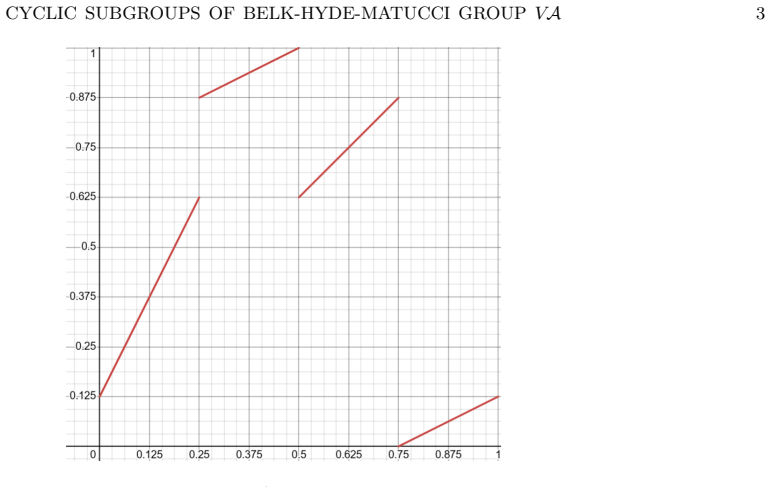
Cyclic Subgroups of Belk-Hyde-Matucci Group V\!mathcal{A}

Despite containing every countable abelian group, the group has no subgroups with distorted cyclic subgroups.

Figure from the paper full image
abstract click to expand
In this paper it is proved that the Belk-Hyde-Matucci group $V\!\mathcal{A}$, a group containing every countable abelian group, does not contain subgroups with distorted cyclic subgroups.
0
0
math.GR 2026-05-11 2 theorems

Simple uniform lattices built in tree and Davis complex products

Simple Lattices in Products of Davis Complexes

An analogue universal group and local density criterion turn vertex-transitive actions into simple lattices on these mixed spaces.

Figure from the paper full image
abstract click to expand
Burger and Mozes (1997) constructed the first examples of simple uniform lattices in products of trees. In this paper, we construct simple uniform lattices in products of certain Davis complexes. More precisely, we consider lattices in products of trees and two-dimensional Davis complexes of the right-angled Coxeter group whose defining graph is an odd graph. As part of the proof, we define an analogue of the Burger-Mozes universal groups in this setting, and provide a local criterion for a vertex transitive group to be dense in the universal group.
0
0
math.GR 2026-05-11 2 theorems

Bornologies determine coarse classes of bornological metrics

Bornological Metrics on Groups

Each class has a canonical left-invariant representative, and metrizability requires countable generation of the coarse structure.

abstract click to expand
Let $G$ be a countable group. We study left-invariant metrics on $G$ that are not necessarily proper, introducing the notion of a \emph{bornological metric}: a metric $\rho$ such that for every $C>0$ there exists $S_C>0$ with the property that $\rho(x,y)<C$ implies $\rho(gx,gy)<S_C$ for all $g\in G$. We show that each coarse equivalence class of bornological metrics is determined by a bornology on $G$, and that every such class contains a canonical left-invariant representative. The metrizability of a bornology is characterized in terms of countable generation of the associated coarse structure, and a criterion for strong $G$-invariance of a coarse structure is established. As an application, we construct families of improper left-invariant metrics on finitely generated groups that are pairwise non-equivalent and not coarsely equivalent to any proper left-invariant metric.
0
0
math.GR 2026-05-11 2 theorems

Multidimensional binomial matrix joins Riordan group

The Pascal matrix in the multivariate Riordan group

The infinite array built from multi-variable binomials on integer vectors satisfies the defining relations of the multivariate Riordan group

abstract click to expand
We generalize the concept of Pascal matrices to matrices associated with sets of points by considering multidimensional binomial coefficients as entries. We study their properties and prove that the infinite matrix associated with the set vectors with integral coordinates is in fact an element of the multivariate Riordan group.
0
0
math.GR 2026-05-11 Recognition

Finite group order bounded by Engel sink size

On finite groups containing an element whose Engel sink is small

When G equals the subgroup generated by commutators with g, the order of G is controlled by the size of the right or left Engel sink of g.

abstract click to expand
For an element $g$ of a group $G$, a right Engel sink of $g$ is a subset of $G$ containing all sufficiently long commutators $[...[[g ,x],x],\dots ,x]$ for all $x\in G$. A left Engel sink of $g$ is a subset of $G$ containing all sufficiently long commutators $[...[[x ,g ],g ],\dots ,g]$ for all $x\in G$. Using the classification of finite simple groups we prove that if a finite group $G$ has an element $g$ such that $G=[G,g]$, then the order of $G$ is bounded in terms of a right Engel sink of $g$, as well as in terms of a left Engel sink of $g$. Earlier Guralnick and Tracey proved this in the case where $g$ is an involution without using the classification.
0
0
math.GR 2026-05-11 1 theorem

Non-p-soluble length bounded by Fitting height of Hall subgroup

Length parameters of finite groups and their Hall subgroups

Holds for any finite G with Hall π-subgroup when π includes 2 and an odd prime p; tightens if H is soluble.

abstract click to expand
Let $\pi$ be a set of primes containing $2$ and an odd prime $p$. It is proved that if a finite group $G$ has a Hall $\pi$-subgroup $H$, then the non-$p$-soluble length of $G$ is bounded above by the generalized Fitting height of $H$. The proof uses the fact, obtained in [4] using the classification of finite simple groups, that a finite simple group of order divisible by $p$ cannot have a nilpotent Hall $\{2,p\}$-subgroup. As a corollary, it is proved that if in addition $H$ is soluble, then the non-$p$-soluble length of $G$ is bounded above by $2l_2(H)+1$, where $l_2(H)$ is the $2$-length of $H$.
0
0
math.GR 2026-05-11 2 theorems

Set maps induce homomorphisms on graph product kernels

Universal Structure of Graph Product Kernels

Any maps between the sets of vertex groups give rise to maps between the kernels in a functorial manner, refining the dependence on cardinal

abstract click to expand
Let $G_\Gamma$ be a graph product over a finite simplicial graph $\Gamma$, and let $K_\Gamma$ denote the kernel of the canonical homomorphism from $G_\Gamma$ to the direct product of its vertex groups. It is known that, up to isomorphism, $K_\Gamma$ depends only on the underlying graph $\Gamma$ and the cardinalities of the vertex groups. In this paper we establish a functorial refinement of this fact. We show that any collection of set maps between the vertex groups naturally induces a homomorphism between the corresponding kernels, and that this construction is functorial. Several applications are discussed.
0
0
math.GR 2026-05-11 Recognition

Solvable additive group forces solvable multiplicative group in connected skew braces

Solvability and Rigidity for Topological Skew Braces

Holds for locally compact Hausdorff spaces; counterexamples arise without each condition, and abelian addition makes operations coincide in

abstract click to expand
We study compact and locally compact topological analogues of the Byott--Vendramin solvability problem for finite skew braces, asking whether solvability of the additive group forces solvability of the multiplicative group. Our main theorem proves an affirmative result in the connected locally compact Hausdorff setting: if \(B=(B,\cdot,\circ)\) is a connected locally compact Hausdorff topological skew brace and the additive group \((B,\cdot)\) is solvable, then the multiplicative group \((B,\circ)\) is solvable. The proof proceeds by reducing the additive group to a solvable Lie quotient and then applying an affine-action theorem: a connected Lie group acting transitively and affinely on a connected solvable Lie group, with solvable stabilizer identity component, is itself solvable. We further show that the Hausdorff, local compactness, and connectedness hypotheses are essential by constructing counterexamples when each is omitted. In the compact connected Hausdorff case with abelian additive group, we obtain a stronger rigidity phenomenon: the two group laws coincide.
0
0
math.GR 2026-05-08 Recognition

Forest diagrams give new length formula for F(n)

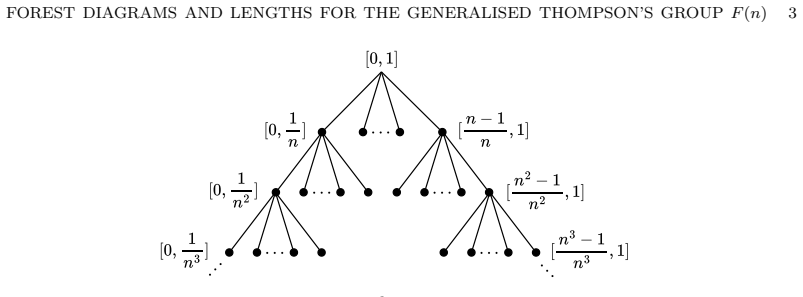
Forest Diagrams and Lengths for the Generalised Thompson's Group F(n)

Elements appear as pairs of n-ary forests with leaf bijections; the diagrams recover word length and show dead ends always have depth two.

Figure from the paper full image
abstract click to expand
We extend the concept of two-way forest diagrams, introduced by Belk and Brown in 2003, to represent elements of $F(n)$ as a pair of infinite, bounded $n$-ary forests together with an order-preserving bijection of the leaves. This representation allows us to develop an alternative way to compute the length of an element of $F(n)$, distinct from the formula established by Fordham and Cleary in 2009. As an application of our length formula, we re-prove the existence of dead end elements in $F(n)$ and show that their depth is always two, first proved by Wladis in 2009.
0
0
math.GR 2026-05-08

2D Euclidean building lattices obey the normal subgroup property

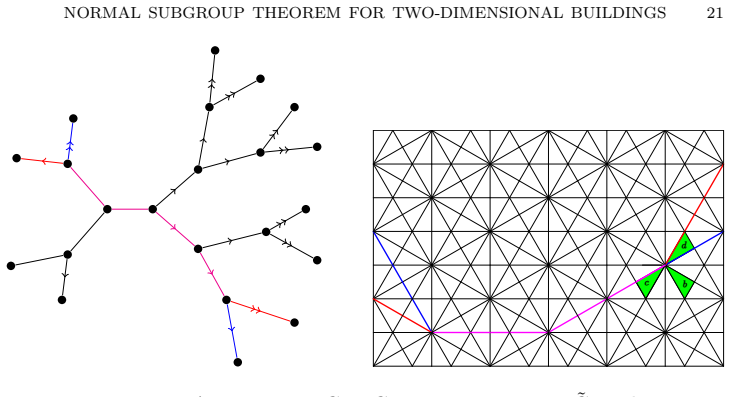
The Normal Subgroup Theorem for lattices on two-dimensional Euclidean buildings

Every normal subgroup has finite index or lies in the finite kernel, making some non-residually finite lattices virtually simple.

Figure from the paper full image
abstract click to expand
We prove the normal subgroup property for every group that acts properly and cocompactly on a two-dimensional Euclidean building: every normal subgroup has finite index or is contained in the finite kernel of the action. As a consequence, the non-residually finite lattices constructed by Titz Mite and the second author are virtually simple. They are the first known simple lattices on irreducible Euclidean buildings.
0
0
math.GR 2026-05-08

First-order formulae are concise in acylindrically hyperbolic groups

Concise formulae in groups of non-positive curvature

The result extends to Burnside groups and other classes with controlled curvature, implying finite definable sets for many formulae.

abstract click to expand
We show that first-order formulae are concise in acylindrically hyperbolic groups and certain extensions thereof. We study further classes of groups, including Burnside groups, icc groups, groups with the `Big Powers' condition, torus knot groups and more, and prove conciseness for wide classes of formulae. We also explore properties of definable sets in these groups, such as their finiteness, depending on the type of formula considered.
0
0
math.GR 2026-05-07

Twistings and wreath products produce regular polytopes for sporadic socles

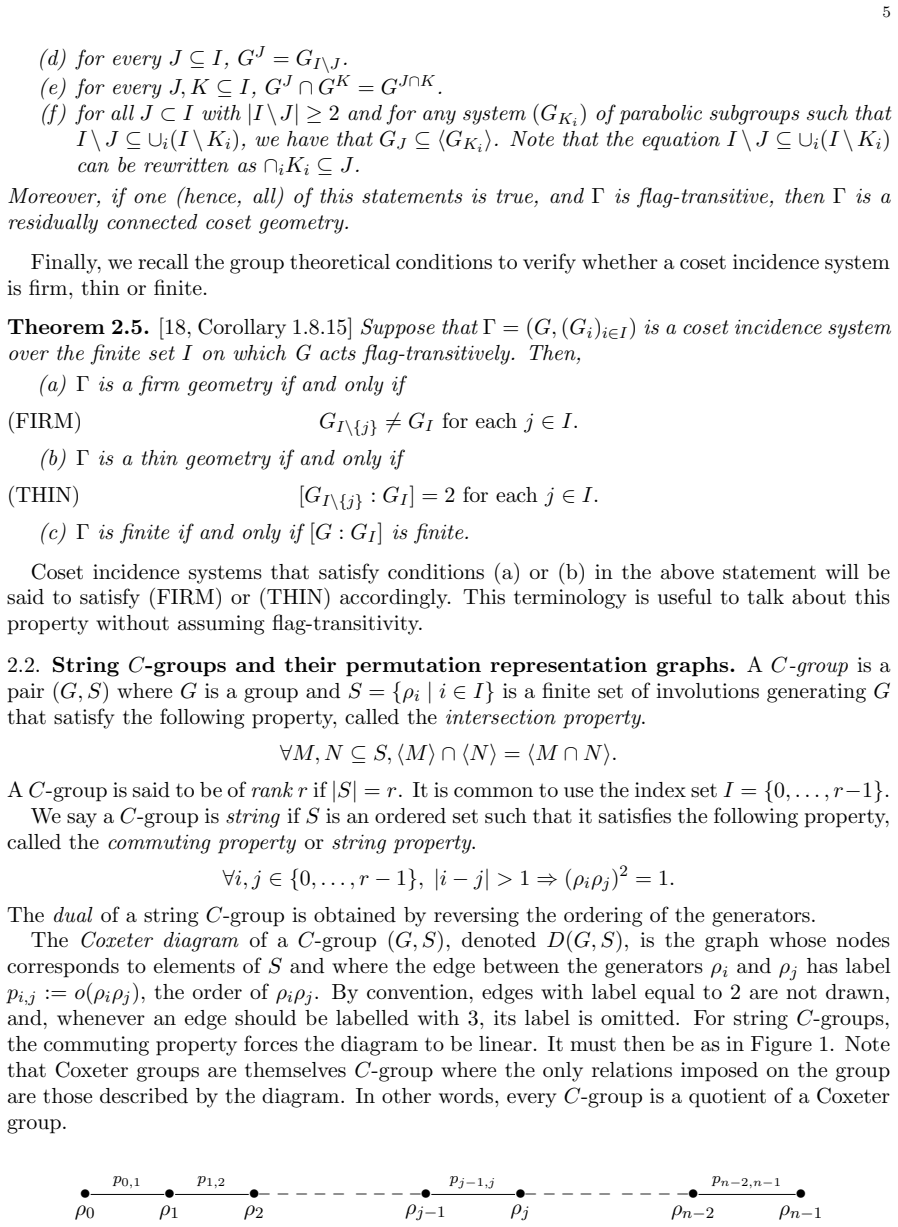
The geometry of wreath and semi-direct products

Lifting the group operations to coset geometries keeps flag-transitivity and thinness intact, giving explicit constructions for almost-simle

Figure from the paper full image
abstract click to expand
Coset geometries are incidence geometries constructed from a group $G$ and a system of subgroups $(G_i)_{i \in I}$ of subgroups of $G$. For any algebraic group operation, it is then natural to wonder whether it can be extended to the framework of coset geometries. This has been achieved in the case of the halving (\cite{halving}) and in the case of free (amalgamated) products, HNN-extensions, and semi-direct products (\cite{piedade2025group}). In this article, we explore more deeply two operations related to semi-direct products: the twisting and the wreath product. We show that these operations extend to coset geometries in such a way that they preserve key properties, such as flag-transitivity, residual-connectedness and being thin. In particular, we can apply twistings and wreath products to polytopes and hypertopes. Doing so, we show that there exists regular polytopes and hypertopes for almost-simple group with socle a sporadic simple group.
0
0
math.GR 2026-05-06

The paper proves that in a pseudo-finite group with the descending chain condition on…

Solvability of the radical in pseudo-finite groups with the DCC on centralizers up to finite index

In pseudo-finite groups satisfying DCC on centralizers up to finite index, the solvable radical is solvable, and no finitely generated such…

abstract click to expand
The subgroup generated by all solvable normal subgroups in a pseudo-finite group with the descending chain condition on centralizers up to finite index is solvable. Additionally, there is no finitely generated pseudo-finite group whose definable sections satisfy such a chain condition on centralizers.
0
0
math.GR 2026-05-06 3 theorems

Z-groups pass finite entropy to closed derived subgroups

A dynamical approach to Schur's Theorem

A dynamical reading of Schur's theorem shows that topological entropy on continuous endomorphisms is inherited by the commutator subgroup in

abstract click to expand
A classical result of Schur of 1904 shows that an infinite (discrete) group $E$ with finite central quotient $E/Z(E)$ should have finite derived subgroup $[E,E]$. Schur's Theorem has many important consequences, which have been extensively investigated in the literature. Here we focus on topological Hausdorff groups, which are not necessarily discrete groups, and show a dynamical version of Schur's Theorem via the notion of topological entropy of Adler, Konheim and McAndrew. Their perspective follows some original intuitions of Kolmogov and Sinai from the area of the dynamical systems. Firstly, we investigate the topological entropy of continuous endomorphisms of maximal almost periodic groups whose closed derived subgroup is compact. The properties of these groups were known to Takahashi in 1952 and among them we find the $\mathsf{Z}$-groups of Grosser and Moskowitz. Secondly, we give a new dynamical interpretation of the Schur's Theorem, showing that a $\mathsf{Z}$-group $G$ with continuous endomorphisms of finite topological entropy should have closed derived subgroup $\overline{[G,G]}$ with continuous endomorphisms of finite topological entropy. Finally, we illustrate a series of constructions and examples, which allow us to justify our interpretation of Schur's Theorem as generalization of the original version.
0
0
math.GR 2026-05-06

Base size of Aut(R) on subgroups is 1 exactly for cyclic R

On the base size of a finite group on its action on the lattice of subgroups

For any finite group the smallest distinguishing set of subgroups has size one if and only if the group is cyclic.

abstract click to expand
Given a finite group $R$, we investigate the base size of the action of the automorphism group of $R$ on the lattice of subgroups of $R$. Our main result shows that this base size is $1$ if and only if $R$ is cyclic. Our motivation arises from a conjecture of Babai on the problem of representing groups as automorphism groups of lattices with a bounded number of orbits.
0
0
math.GR 2026-05-05

The paper identifies simple algebraic groups over number fields determined by finite…

Congruence rigidity of algebraic groups

Simple algebraic groups over number fields are determined by finite adele points; higher-rank arithmetic groups are profinitely solitary…

abstract click to expand
We identify the simple algebraic groups over number fields that are, in a suitable sense, determined by their finite adele points. Assuming CSP and Grothendieck rigidity, our results essentially characterize higher rank arithmetic groups that are profinitely solitary: the profinite commensurability class determines the commensurability class among finitely generated residually finite groups. This generalizes previous work of the second author with R. Spitler from split groups to arbitrary groups.
0
0
math.GR 2026-05-05

Finitely presented groups with k-planar Cayley graphs have planar finite-index subgroups

Almost planar finitely presented groups

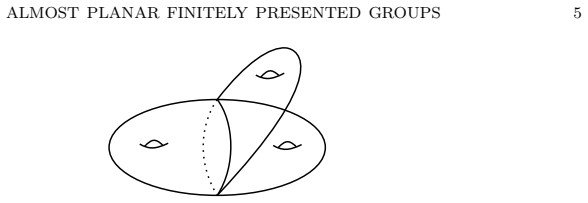
The result shows such groups contain finite-index subgroups with crossing-free Cayley graphs and extends to quasi-isometry for coarsely-sim­

Figure from the paper full image
abstract click to expand
We show that finitely presented groups which admit $k$-planar Cayley graphs contain finite-index subgroups with planar Cayley graphs. More generally, we answer a question of Georgakopoulos and Papasoglu in the special case of coarsely simply connected graphs: a $k$-planar, coarsely simply connected, connected, locally finite, quasi-transitive graph is quasi-isometric to a planar graph.
0
0
math.GR 2026-05-05

Gluing diagrams construct explicit Higman-Thompson isomorphisms

Gluing diagrams part 1: A constructive solution for the Higman-Thompson group isomorphism problem

A combinatorial procedure produces the maps whose existence was known but never built directly before.

Figure from the paper full image
abstract click to expand
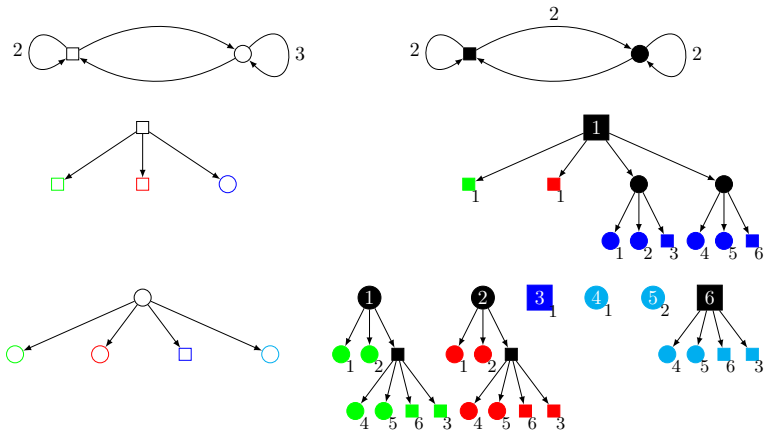
This paper introduces gluing diagrams a combinatorial tool to construct homomorphisms between the shift pseudogroups of directed graphs and thus also their full groups of shifts. We will establish which of these diagrams produce isomorphisms. As an application, using the interpretation of Higman-Thompson groups as full groups of shifts of specific graphs, we will describe a procedure that constructs gluing diagrams that explicitly describe the isomorphisms between Higman-Thompson groups, conjectured by Higman and whose existence was proven by Pardo arXiv:1006.1759.
0
0
math.GR 2026-05-05

Surface group traces form the Poulsen simplex

Characters of surface groups

Approximating any trace by factorial spectral-gap ones shows the full trace space is Poulsen, settling an open question.

abstract click to expand
We initiate the study of characters of surface groups and their corresponding tracial representations. We show that any tracial representation can be approximated arbitrarily well in the Wasserstein topology by factorial tracial representations with spectral gap. In particular, we deduce that the space of traces of a surface group is the Poulsen simplex, thereby resolving positively a question posed by Orovitz, Slutsky, and the third author.
0
0
math.GR 2026-05-04 3 theorems

Few automorphism orbits force finiteness in graded groups

Some families of locally graded groups with finitely many orbits under automorphisms

Residually finite examples must be locally finite of finite exponent; finitely generated ones are finite; nilpotent completions only for r=2

abstract click to expand
In this work, we study three families of locally graded groups with finitely many orbits under automorphisms. We prove that: (i) a residually finite group with finitely many orbits under automorphisms is locally finite and has finite exponent; (ii) a finitely generated locally graded group with finitely many orbits under automorphisms is finite; and (iii) the Mal'cev $\mathbb{Q}$-completion of an $r$-generated free nilpotent group of class $c$ has finitely many orbits under automorphisms if and only if either $r = 2$ and $c = 3$, or $c \leq 2$
0
0
math.GR 2026-05-04 3 theorems

The paper establishes exact asymptotic expressions for the counts of higher-order…

Higher Commutativity in Finite Groups: Exact Asymptotics and Finite Spectrum

The number of homomorphisms from the free abelian group of rank r into a finite group G grows asymptotically as k * m^r, where m is the…

abstract click to expand
For a finite group G, we study the higher commuting probabilities, namely the probabilities that r randomly chosen elements of G commute pairwise, together with the corresponding numbers of simultaneous conjugacy classes of commuting r-tuples. We prove an exact dominant asymptotic for the number of homomorphisms from the free abelian group of rank r to G. The exponential base is the maximum order of an abelian subgroup of G, and the leading coefficient is the number of abelian subgroups of that order. As a consequence, the r-th root of the higher commuting probability tends to this maximum abelian-subgroup order divided by the order of G, while the r-th root of the orbit count tends to the maximum abelian-subgroup order itself. We also prove that the associated rank-generating series is rational and has a finite Dirichlet-spectrum expansion supported on abelian subgroup indices. This spectrum yields a finite linear recurrence, a finite-rank Hankel matrix, and an inverse finite-spectrum theorem: the tail of the hierarchy determines the full abelian-index spectrum. For split abelian extensions, we express the dominant base through fixed-subgroup geometry, and for abelian acting quotients, we obtain an exact subgroup-lattice formula. In the cyclic and coprime cases, this gives closed formulas for all spectral coefficients.
0
0
math.GR 2026-05-04

Method computes Schur multipliers for class-2 p-groups with repeated cyclic abelianization

On the Schur multiplier of p-groups with abelianization s-elementary abelian

It extends the known s=1 case to abelianizations that are direct products of identical cyclic groups of order p^s and yields explicit values

abstract click to expand
Let $p$ be an odd prime. We describe a method to compute the Schur multiplier of finite $p$-groups $G$ of nilpotency class $2$ such that $G/[G,G]$ is isomorphic to direct product of copies of $\mathbb{Z}_{p^s}$ for $s \in \mathbb{N}$, generalizing a method of Blackburn and Evens, who treated the case $s=1$. As an application, we investigate which abelian $p$-groups can occur as the Schur multiplier of a non-abelian $p$-group. We further introduce the notions of $s$-special $p$-groups of rank $k$ generalizing the notion of special $p$-groups of rank $k$. We study the structural properties, compute the Schur multipliers of $s$-special $p$-groups of rank $1$.
0
0
math.GR 2026-05-01

Generalized Higman groups satisfy property R_∞

Property R_infty for generalized Higman groups

Their automorphism groups are shown to be acylindrically hyperbolic, which forces every automorphism to have infinitely many conjugacy 1

abstract click to expand
We give a unified proof of property $R_\infty$ for the Higman groups $H_n$ ($n\ge 4$) and for their generalizations studied by Martin and Horbez--Huang. As a key step, we prove that the automorphism groups of these groups are acylindrically hyperbolic. As a byproduct, we obtain acylindrical hyperbolicity of the groups themselves. In addition, we give an independent proof, based on Delzant's lemma, of the criterion of Fournier-Facio and collaborators stating that if $\operatorname{Aut}(G)$ is acylindrically hyperbolic and $\operatorname{Inn}(G)$ is infinite, then $G$ has property $R_\infty$.
0
0
math.GR 2026-05-01

Link separations decide virtual cyclicity of Coxeter outer automorphisms

A characterization of virtually cyclic outer automorphism groups of right-angled Coxeter groups

Absence of SILs, STILs and FSILs forces the finite-index outer automorphism subgroup to be virtually Z.

Figure from the paper full image
abstract click to expand
Existing research gives conditions for when the outer automorphism group of a graph product of primary cyclic groups $W_\Gamma$ is finite, virtually abelian, or large. We seek to prove a set of conditions for when this outer automorphism group is virtually cyclic. To this end, we study the finite index subgroup $\text{Out}^0(W_\Gamma)$, which is generated by specific partial conjugations. The presence or absence of Coxeter and non-Coxeter separating intersections of links (SILs), separating triple intersections of links (STILs), and flexible separating intersections of links (FSILs) in $\Gamma$ determines algebraic properties of $\text{Out}^0(W_\Gamma)$. We identify each SIL with a pair of partial conjugations in $\text{Out}^0(W_\Gamma)$ and place restrictions on the SILs in $\Gamma$ to ensure that $\text{Out}^0(W_\Gamma)$ is virtually $\mathbb{Z}$ both when $\Gamma$ is connected or disconnected. In particular, this applies to the study of right-angled Coxeter groups. This paper is a slightly shorter version of the author's master's thesis from Tufts University.
0
0
math.GR 2026-04-30

No non-discrete Alexandroff topology makes a group topological

On the existence and properties of Alexandroff paratopological groups

Paratopological versions exist non-compactly and settle open questions on feebly bounded sets.

Figure from the paper full image
abstract click to expand
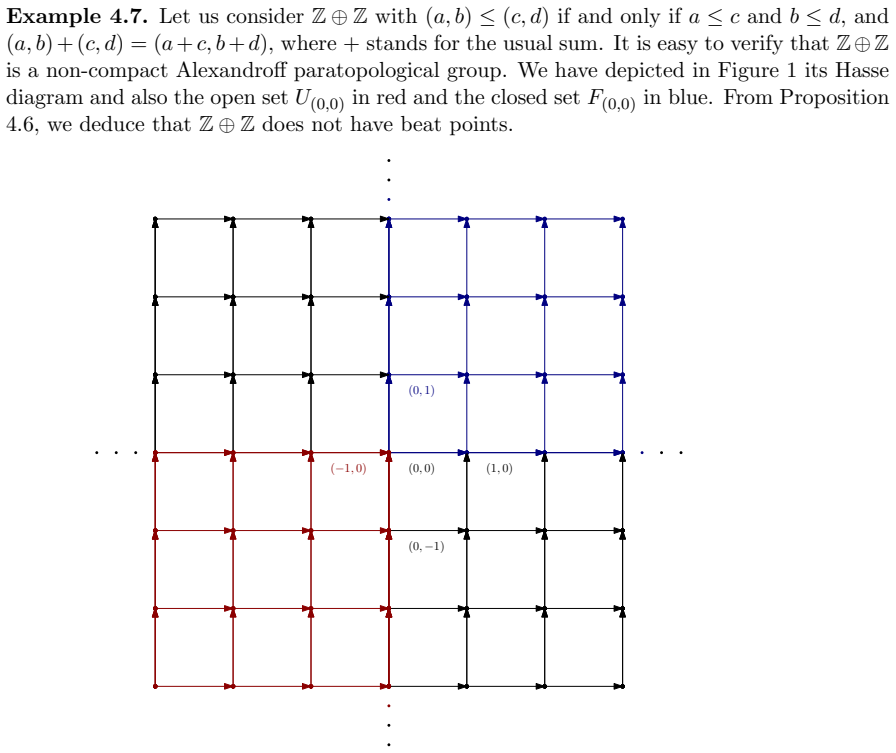
We study groups endowed with Alexandroff topologies and show that no non-discrete Alexandroff topology can turn a group into a topological group. This settles negatively the basic existence problem for Alexandroff topological groups. Motivated by this obstruction, we turn to the broader setting of Alexandroff paratopological groups. We establish several fundamental properties of these spaces and provide explicit non-compact $T_0$ examples, showing that the Alexandroff framework is rich enough to capture nontrivial paratopological phenomena. As applications, we address two classical open questions concerning feebly bounded subsets in paratopological groups, proving that non-compact Alexandroff paratopological groups offer a positive solution both for products of feebly bounded sets and for the feebly boundedness of $B^2$ when $B$ is a feebly bounded subset.
0
0
math.GR 2026-04-30

Binomial formula gives fixed-point counts in OP_n

Fixed points of orientation-preserving full transformation

F(n,m) equals binom(2n, n-m) for m from 2 to n, yielding the expectation and distribution of fixed points over the monoid.

Figure from the paper full image
abstract click to expand
Let $\mathcal{OP}_n$ be the monoid of all orientation-preserving full transformations on $X_n=\{1,\dots, n\}$ with the natural order. For $\alpha \in \mathcal{OP}_n$, let $F(\alpha)=\{y\in X_n: y\alpha=y\}$ and $F(n,m)=|\{\alpha:|F(\alpha)|=m\}|$. Umar posed the question about the number $F(n,m)$ of elements of $\mathcal{OP}_n$ with $m$ fixed points. In this paper, we show that the number $F(n,m)$ of $\mathcal{OP}_n$ is $\binom{2n}{n-m}$ for $2\leqslant m\leqslant n$ and get the expectation and probability distribution of the cardinality of fixed-point set $F(\alpha)$ for $\alpha\in\mathcal{OP}_n$.
0
0
math.GR 2026-04-30

The paper derives exact probability distributions

Probabilistic results for monoids of order-preserving transformations

For uniform random elements of the monoid PO_n, image size given domain size r follows hypergeometric H(n+r-1, n, r); for the injective…

abstract click to expand
Let $\mathcal{PO}_n$ be the monoid of all order-preserving partial transformations on $X_n=\{1,\dots, n\}$ with the natural order, and let $\mathcal{O}_n$ and $\mathcal{POI}_n$ denote its submonoids of order-preserving full and injective partial transformations, respectively. For each transformation $\alpha\in\mathcal{PO}_n$, write the random variables $Y(\alpha)=|{\im}\alpha|$ and $Y_r(\alpha)=|{\im}\alpha|$ given that $|{\dom}\alpha|=r$ for $0 \leqslant r \leqslant n$. We determine the probability distribution, expectation and variance of $Y_r$ and $Y$ for $\mathcal{PO}_n$ and $\mathcal{POI}_n$. In particular, $Y_r(\alpha)$ follows a hypergeometric distribution $H(n+r-1,n,r)$ for $\alpha \in \mathcal{PO}_n$, while $Y_r(\alpha)$ is degenerate and $Y(\alpha)$ follows a hypergeometric distribution $H(2n,n,n)$ for $\alpha \in \mathcal{POI}_n$.
0
0
math.GR 2026-04-29

Every semigroup carries its own inverse monoid of partial inner automorphisms

The Inverse Monoid of Partial Inner Automorphisms of a Semigroup

The construction recovers the inner automorphism group plus zero for groups and supplies explicit forms for transformation monoids and G-set

abstract click to expand
We introduce the inverse monoid of inner partial automorphisms of a semigroup -- a tool that associates to every semigroup an inverse semigroup. When the semigroup is a group, this inverse semigroup is isomorphic to the group of inner automorphisms with a zero adjoined. We then describe this structure for completely simple semigroups, the full transformation monoid, and the endomorphism monoid of a finite $G$-set when $G$ is a finite abelian group. The paper ends with some open problems.
0
0
math.GR 2026-04-29

Continuous ring unit groups lack non-trivial unitary representations

Unitary representations and von Neumann's continuous geometries

The unit group of any non-discrete irreducible continuous ring admits only the trivial representation continuous in the strong operator topo

abstract click to expand
We prove that the unit group of a non-discrete irreducible, continuous ring, in the sense of John von Neumann, does not admit any non-trivial unitary representation continuous with respect to the strong operator topology.
0
0
math.GR 2026-04-29

Partial products stabilize in Kiselman's semigroup

Dynamics, Random Products, and Ultrametric Geometry in Kiselman's Semigroup

The time until stabilization for random products follows the sum of n independent geometric random variables.

abstract click to expand
We study certain dynamical and metric aspects of Kiselman's semigroup $K_n$. The level function $\mathcal{L}$ is introduced and shown to admit a simple description in terms of right multiplication by generators. We show that every sequence of partial products in $K_n$ is eventually constant. Using $\mathcal{L}$, we further study sequences of random partial products in $K_n$ and show that, in the independent and identically distributed setting where every generator is chosen with positive probability, the hitting time of the eventual constant value is distributed as a sum of $n$ independent geometric random variables. Finally, we define a natural ultrametric on $K_n$ arising from the level function and obtain some basic results on the associated metric balls and spheres.
0
0
math.GR 2026-04-29

Ordered monoids test mildness of pro-p groups

Mild Pro-p Groups and Ordered Monoids

A criterion for finitely presented pro-p groups recovers earlier tests and connects to the triangle condition on right-angled Artin groups.

abstract click to expand
We prove a criterion for the mildness of a finitely presented pro-$p$ group $G$. It implies as a special case a cohomological mildness criterion via Massey products, generalizing results due to Schmidt and G\"artner. It subsumes Labute's non-singular circuit criterion. We further show connections with the triangle condition for the mildness of pro-$p$ right-angled Artin groups, due to Quadrelli, Snopce and Vannacci.
0
0
math.GR 2026-04-28

No exotic fusion systems on Sylow 3-subgroups of Fi22

Fusion Systems on Sylow 3-subgroups of Fischer and Monster sporadic groups: I

All corefree systems on these three sporadic 3-groups arise from the groups or their subgroups

abstract click to expand
We classify all corefree fusion systems on a Sylow $3$-subgroup of the sporadic groups $\mathrm{Fi}_{22}$, $\mathrm{Fi}_{23}$ and $\mathrm{B}$. We show that the $3$-group in each case does not support any exotic fusion systems. This is the first of two papers that will complete the classification of all corefree fusion systems on Sylow $p$-subgroups of sporadic groups for $p$ odd.
0
0
math.GR 2026-04-28

Stallings equalizer conjecture disproved for rank 3 and higher

Colored Stallings graphs and Counterexamples to Stallings equalizer conjecture

Colored graphs produce monomorphisms from Fn to F2 whose common kernel reaches rank 2n-2, exceeding the long-standing bound of n

Figure from the paper full image
abstract click to expand
The famous Stallings equalizer conjecture has remained open for more than 40 years, which states that, for any free group \(F_n\) of rank \(n\ge 2\), any free group \(F\), and any two monomorphisms $g,h:F_n\to F,$ the equalizer $\Eq(g,h)=\{w\in F_n\mid g(w)=h(w)\}$ satisfies $\rk \Eq(g,h)\le n.$ The only known case is $n=2$, due to A. D. Logan in 2022. By introducing the notion of colored Stallings graphs, we show that for every integer \(n\ge 2\) there exist monomorphisms $g,h:F_n\longrightarrow F_2$ such that$\rk\Eq(g,h)\ge 2n-2.$ This disproves Stallings equalizer conjecture for $n\ge 3$.
0
0
math.GR 2026-04-28 Recognition

Colored graphs yield equalizers of rank 2n-2 in free groups

Colored Stallings graphs and Counterexamples to Stallings equalizer conjecture

Monomorphisms from F_n to F_2 produce equalizers larger than the conjectured bound of n for every n at least 3.

Figure from the paper full image
abstract click to expand
The famous Stallings equalizer conjecture has remained open for more than 40 years, which states that, for any free group \(F_n\) of rank \(n\ge 2\), any free group \(F\), and any two monomorphisms $g,h:F_n\to F,$ the equalizer $\Eq(g,h)=\{w\in F_n\mid g(w)=h(w)\}$ satisfies $\rk \Eq(g,h)\le n.$ The only known case is $n=2$, due to A. D. Logan in 2022. By introducing the notion of colored Stallings graphs, we show that for every integer \(n\ge 2\) there exist monomorphisms $g,h:F_n\longrightarrow F_2$ such that$\rk\Eq(g,h)\ge 2n-2.$ This disproves Stallings equalizer conjecture for $n\ge 3$.
0
0
math.GR 2026-04-28

Local automorphisms on classical groups are automorphisms or near-automorphisms

Local automorphisms of some classical groups

A map that agrees with some automorphism at every pair of elements must be an automorphism itself for some groups and a standard variant for

abstract click to expand
A map on a group into itself is called a local automorphism if at any two points of the group, it can be interpolated by an automorphism of that group. In this paper we investigate the question of how local automorphisms of some classical groups are related to automorphisms. In some cases it turns out that the local automorphisms are in fact automorphisms. In the remaining cases we show that the local automorphisms are still closely related to the automorphisms.
0
0
math.GR 2026-04-28

Beauville surface class counts extended to non-abelian p-groups

The Number of Isomorphism Classes of Beauville Surfaces with Beauville p-Group

The same combinatorial method used for abelian groups now gives the number of isomorphism classes for metacyclic and class-2 p-groups.

abstract click to expand
A Beauville surface is a rigid complex surface of general type, isogenous to a higher product by the free action of a finite group $G$, called a Beauville group. In \cite{GT}, Gonz\'alez-Diez and Torres-Teigell find the number of isomorphism classes of Beauville surfaces for which the group $G$ is $\PSL(2,p)$ with particular types of `Beauville structures'. On the other hand, in \cite{GJT}, Gonz\'alez-Diez, Jones and Torres-Teigell give an explicit formula for this number when the group $G$ is abelian. To the best of the author's knowledge, in the literature, the exact number of isomorphism classes of Beauville surfaces is given only for $\PSL(2,p)$ and for abelian groups. In this paper, we extend the result for Beauville surfaces with abelian $p$-group to Beauville surfaces for which the Beauville group is either a non-abelian metacyclic $p$-group or a $p$-group of nilpotency class $2$.
0
0
math.GR 2026-04-27

Cyclic subgroup count decides if a group is solvable

Solvability of Groups via Cyclic Subgroup Count

New criteria reduce solvability and supersolvability tests to the number of cyclic subgroups and extend the n-cyclic classification for n at

abstract click to expand
In this paper, we provide new criteria for the solvability and supersolvability of a finite group based on its number of cyclic subgroups. A finite group G is called n-cyclic if it contains n cyclic subgroups. This paper also partially extends the classification of n-cyclic groups for n\geq 13.
0
0
math.GR 2026-04-27

Aut group of restricted product over P² acts decently

Decent actions of groups on restricted products

Subgroups with finite orbits or pointwise stabilizers must fix points globally when the base is the projective plane.

Figure from the paper full image
abstract click to expand
An action of a group $G$ on a set $X$ is called ``decent'' if every subgroup of $G$ with a finite orbit in $X$ fixes a point in $X$ and every finitely generated subgroup of $G$ such that every element of the subgroup fixes a point of $X$ must itself have a global fixed point. In this article, we study conditions on when actions of groups on restricted products are ``decent''. We prove that the action of the automorphism group of a restricted product with base space the projective plane $\mathbb{P}^2(k)$ over a field $k$ is decent, generalizing a result of Lonjou--Przytycki--Urech.
0
0
math.GR 2026-04-27

Deforming wallpaper groups yields space-filling interlocking assemblies

Construction Methods for Space-Filling Heterogeneous Topological Interlocking Assemblies

Methods produce heterogeneous non-convex blocks that fill space between planes and correspond to Truchet tilings.

Figure from the paper full image
abstract click to expand
Deforming fundamental domains of wallpaper groups provides a systematic way to generate non-convex blocks which admit topological interlocking assemblies (TIAs). We use this approach to construct TIAs that fully occupy the space between two parallel planes and incorporate multiple block types. In addition to wallpaper groups, semiregular tessellations are employed in the construction of such TIAs. These construction methods open up an extensive design space for TIAs, expanding the possibilities of feasible interlocking systems and creating new opportunities for architectural and material design. Several resulting block families can be interpreted as geometric realizations of generalized Truchet tiles or decorated lozenge tilings and, with suitable colouring rules, we establish a one-to-one correspondence between these tilings and specific TIAs. This framework enables a systematic investigation of symmetric and asymmetric assemblies derived from diverse block types.
0
0
math.GR 2026-04-27

Free groups are uniformly amenable at infinity

Uniform amenability at infinity

This makes convergent marked group sequences converge strongly in operator algebras with uniform spectral radius convergence.

abstract click to expand
We introduce the notion of uniform exactness, or uniform amenability at infinity, for discrete groups and prove it for a wide class of groups containing free groups and their limit groups. This shows a novel strong convergence phenomenon that any convergent sequence of such groups in the space of marked groups converges strongly in the operator algebraic sense. In particular, convergence of the spectral radius formula is uniform over probability measures on such groups whose supports have a fixed cardinality.
0
0
math.GR 2026-04-27

Word problem is visibly pushdown only for finite groups

Visibly Pushdown Languages in Groups

This equivalence holds for any finite generating set and separates finite groups from all infinite ones by automata recognition.

Figure from the paper full image
abstract click to expand
In this paper we explore the connections between the class of Visibly Pushdown Languages ($\mathbf{VPL}$) and the natural sets of words one can associate to a finitely generated group. We show that the word problem of a finitely generated group is $\mathbf{VPL}$ exactly when the group is finite. We also show that free reduction does not preserve $\mathbf{VPL}$, and that finding solutions to equations in a free group with $\mathbf{VPL}$ constraints (as reduced words) is undecidable. We explore the structure of sets whose full preimage is $\mathbf{VPL}$, showing these are often recognisable sets. We conjecture that, in any group, this class is precisely the recognisable sets.
0
0
math.GR 2026-04-27

Compact simple Lie skew braces are trivial or have simple groups

On simple compact Lie skew braces

Their simplicity matches that of the underlying Lie groups except on the circle, while noncompact examples allow solvable groups on both.

abstract click to expand
We study simplicity of Lie skew braces from both global and infinitesimal perspectives. After reviewing the correspondence between connected Lie skew braces, simply transitive affine actions, and post-Lie algebras, we investigate ideals and rigidity phenomena. Our main result concerns compact connected Lie skew braces. We prove that any compact connected simple Lie skew brace is either the trivial Lie skew brace on \(S^1\), or both of its underlying Lie groups are simple and the brace is trivial or almost trivial. Consequently, apart from the exceptional \(S^1\) case, simplicity of a compact connected Lie skew brace is equivalent to simplicity of either underlying Lie group. We also show that every connected compact solvable Lie skew brace is trivial. Finally, we construct a noncompact example demonstrating that this rigidity phenomenon does not hold in general: there exists a connected simply connected simple Lie skew brace whose additive and multiplicative Lie groups are both solvable.
0
0
math.GR 2026-04-27

Closed forms for SE(3) tangent operator derivatives without blocks

Closed Form Relations and Higher-Order Approximations of First and Second Derivatives of the Tangent Operator on SE(3)

Expressions for first and second derivatives, Jacobians and Hessians support robust computations in rods and robots

abstract click to expand
The Lie group SE(3) of isometric orientation preserving transformation is used for modeling multibody systems, robots, and Cosserat continua. The use of these models in numerical simulation and optimization schemes necessitates the exponential map, its right-trivialized differential (often referred to as tangent operator), as well as higher derivatives in closed form. The $6\times 6$ matrix representation of the differential, $\mathbf{dexp}_{\mathbf{X}}:se\left( 3\right) \rightarrow se\left( 3\right) $ , and its first derivative were reported using a $3\times 3$ block partitioning. In this paper, the differential, its first and second derivative, as well as the Jacobian and Hessian of the evaluation maps, $\mathbf{dexp}_{\mathbf{X}}\mathbf{Z}$ and $\mathbf{dexp}_{\mathbf{X}}^{T}% \mathbf{Z}$, are reported avoiding the block partitioning. For all of them, higher-order approximations are derived. Besides the compactness, the advantage of the presented closed form relations is their numerical robustness when combined with the local approximation. The formulations are demonstrated for computation of the deformation field and the strain rates of an elastic Cosserat-Simo-Reissner rod.
0
0
math.GR 2026-04-24

xy=f forces x=f unless y is a1 in Kiselman's semigroup

Zero Cancellation and Equation Structure in Kiselman's Semigroup

The equation xa1=f has exactly 1 + |K_{n-1}| solutions whose structure is described, and |K_n| is even exactly when n is odd.

abstract click to expand
We investigate equations in Kiselman's semigroup $K_n$, generated by $a_1, \dots, a_n$. Let $f$ denote the zero element of $K_n$. We prove that if $y \in K_n$ lies in the subsemigroup generated by $a_2, \dots, a_n$, then $x y = f$ implies $x = f$. In contrast, the equation $x a_1 = f$ admits non-trivial solutions. We describe the solution set of this equation, show that its cardinality is $1 + |K_{n-1}|$, and study its algebraic structure. Moreover, we show that $|K_{2n+1}|$ is even, whereas $|K_{2n}|$ is odd.
1 0
0
math.GR 2026-04-24

Induction functor transfers algebraic group data to finite groups

On the induction functor from group algebras to distribution algebras

Filtrations connect cohomology calculations across group schemes in characteristic p.

abstract click to expand
Let $G$ be a reductive algebraic group scheme defined over ${\mathbb F}_{p}$ and $k$ be an algebraically closed field of characteristic $p$. There are two associated families of finite group schemes, the $r$-th Frobenius kernels, denoted by $G_r$, and the fixed points of the iterated Frobenius map, the finite groups of Lie type, denoted by $G(\mathbb{F}_q).$ Bendel, Nakano and Pillen initiated the investigation of the induction functor $\operatorname{ind}_{G(\mathbb{F}_q)}^G-$. Using filtrations and truncation, large amounts of data coming from the algebraic group and the Frobenius kernels can be transferred to the finite group. This paper looks at connections between a fundamental theorem of Chastkofsky and Jantzen and the induction functor via the cohomology and representation theory of $G$.
0
0
math.GR 2026-04-24

Semisimple quotients alone decide polynomial representation growth for these profinite

Representation growth of quasi-semisimple profinite groups

Any positive real degree is achievable, and the groups can be profinite completions of discrete groups with matching zeta functions.

abstract click to expand
The representation zeta function of a profinite group $G$ encodes the distribution of continuous irreducible complex representations of $G$ as a function of the dimension. Its abscissa of convergence $\alpha(G)$ describes the polynomial degree of representation growth of $G$. Within the class of quasi-semisimple profinite groups, we characterise those of polynomial representation growth (PRG) and we prove that whether such a group $G$ has PRG or not only depends on its semisimple part $G/\mathrm{Z}(G)$. Moreover, we show that, for quasi-semisimple profinite groups $G$ that have uniformly bounded Lie ranks, the degree of growth satisfies $\alpha(G) = \alpha(G/\mathrm{Z}(G))$. We provide a technique to produce, for any prescribed positive real number $\varrho$, quasi-semisimple profinite groups $G$ with PRG of degree $\alpha(G) = \varrho$. Our method allows for considerable flexibility regarding the inclusion of finite simple groups of Lie type as composition factors of $G$. Furthermore, we can arrange for the groups $G$ of prescribed representation growth to be profinite completions of suitable finitely generated discrete groups $\Gamma$ so that the group $\Gamma$ has the same representation zeta function as $G$.
0
0
math.GR 2026-04-24

Inductive tools prove cohomological sharpness for most fusion systems

An inductive approach to the Diaz-Park sharpness conjecture

New methods confirm vanishing of higher limits for cohomology Mackey functors in p-groups of maximal nilpotency or rank 2 and in key exotic,

abstract click to expand
We develop tools which use common fusion systems building techniques in order to compute higher limits over the centric orbit category. We apply these tools in order to study both the Diaz-Park sharpness conjecture as well as the weaker cohomological sharpness conjecture which predicts vanishing of higher limits only for the cohomology Mackey functors . Our approach leads to proving cohomological sharpness (but not sharpness) for all saturated fusion systems over p-groups of either maximal nihlpotency or of rank 2 and all polynomial, Henke-Shpectorov and van Beek fusion systems. This list includes all but 2 of the cases for which cohomological sharpness was previously known as well as most currently known families of exotic fusion systems. For the polynomial, Henke-Shpectorov and 6 of the van Beek fusion systems, sharpness is also approximated by proving vanishing of all but the first higher limits of any Mackey functor. The distinction our approach makes between sharpness and cohomological sharpness is somewhat surprising and interesting by itself. Our approach draws a new connection between cohomological sharpness and fusion system building techniques. We believe that this connection will lead to a better understanding of both fusion systems and Mackey functors over them.
0
0
math.GR 2026-04-23

Semigroups with max generator 2g+1 satisfy Wilf conjecture

Numerical Semigroups with a_e = 2g+1

These cases link directly to symmetric semigroups via their gap sets and confirm the conjecture holds for them and derived examples.

abstract click to expand
This article discusses numerical semigroups having a generator which is as large as possible. This turns out to be $2g+1$, where $g$ is the genus of the semigroup. We will show that these semigroups are closely related to symmetric semigroups and have interesting symmetry properties themselves. Furthermore we will show that Wilf's question has a positive answer for these semigroups and some semigroups derived thereof.
0
0
math.GR 2026-04-23

Cyclic 2-groups have (7*4^{e-2}+8)/6 skew morphisms

Enumeration of skew morphisms of cyclic 2-groups

The recurrence and closed form finish the count for every cyclic group of prime-power order.

abstract click to expand
A skew morphism of a finite group $B$ is a permutation of $B$ fixing the identity and satisfying $\varphi(xy) = \varphi(x)\varphi^{i_x}(y)$ for some integers $i_x$ indexed by $x \in B$. The enumeration of skew morphisms of finite cyclic groups remains an open problem. The most substantial progress to date concerns cyclic $p$-groups with $p$ odd, for which a full classification and enumeration was obtained by Kov\'{a}cs and Nedela. In this paper we treat the remaining case $p = 2$, giving a complete classification and enumeration of skew morphisms of finite cyclic $2$-groups. Writing $\mathrm{Skew}(n)$ for the number of skew morphisms of $\mathbb{Z}_n$, we prove that $\mathrm{Skew}(2^e) = 4\,\mathrm{Skew}(2^{e-1}) - 4$ for each $e \geq 4$, and that $\mathrm{Skew}(2^e) = (7 \cdot 4^{e-2} + 8)/6$ for each $e \geq 3$. This completes the enumeration of skew morphisms for all cyclic $p$-groups.
0
0
math.GR 2026-04-23

Generic automorphisms of stable groups are supertight

On generic and supertight automorphisms

The result yields existence and clarifies their action on PGL_2 and on simple groups of finite Morley rank.

abstract click to expand
We show that generic automorphisms of stable groups are supertight in a strong sense. In particular, we obtain the existence of supertight automorphisms. We also answer a question concerning the relationship between supertight automorphisms of $\mathrm{PGL}_2(K)$ and generic automorphisms of the underlying field $K$. Moreover, we provide partial evidence-already suggested by Hrushovski-toward the principle that ``fixed points are pseudofinite'' in the setting of generic automorphisms of simple groups of finite Morley rank.
0
0
math.GR 2026-04-23

Four groups give saturated fusion systems with O2=1 on Ω+8(2) Sylow

The saturated fusion systems on a Sylow 2-subgroup of {Ω}^+₈ (2)

The 2-fusion systems of Ω+8(2), its 3-extension, PΩ+8(3) and its extension satisfy the no-normal-2-subgroup condition.

abstract click to expand
We consider saturated fusion systems $\mathcal F$ on a Sylow $2$-subgroup of $\Omega^+_8(2)$ with $O_2(\mathcal F) = 1$. Examples for this are the $2$-fusion systems of $\Omega^+_8(2)$, $\Omega^+_8(2):3$, $P\Omega^+_8(3)$ and $P\Omega^+_8(3):3$
0
0
math.GR 2026-04-23

The paper shows that von Neumann algebras of Artin groups remember the number of…

On free components of Artin and Coxeter groups

Von Neumann algebras of Artin groups encode the number of connected components of their defining graphs except possibly for…

abstract click to expand
The number of connected components can be remembered by the von Neumann algebra among Artin groups, the only possible exception being the case that corresponds to the free group factor problem. In the case of Coxeter groups, this result is obtained in the absence of relatively hyperbolicity. We also discuss a specific case of the analogous problem in measure equivalence where each factor group is a product of nonabelian free groups.
0
0
math.GR 2026-04-22

New homomorphisms fix solubility equivalence for braces and solutions

Addendum/Corrigendum to "On solubility of skew left braces and solutions of the Yang-Baxter equation"

i-homomorphisms let every soluble solution arise from a soluble skew brace, so the earlier theorem holds again.

abstract click to expand
In our previous work: Adv. Math. 455 (2024), no. 109880, solubility of solutions was introduced as an extension of solubility of skew braces in the classification context of non-degenerate solutions of the Yang-Baxter equation. One of our main results (Theorem C) proved that a skew brace is soluble if, and only if, its associated solution is soluble. A minor step depending on the definition of homomorphism of solutions was overlooked. In this work, proof of Theorem C is repaired by means of a new class of homomorphisms of solutions: i-homomorphisms of solutions. The importance of this new class is twofold: indecomposable solutions are characterised by means of i-simplicity of solutions, and i-kernels of i-homomorphisms generate ideals in structure skew braces of solutions. Hence, solubility of solutions is redefined as an opposite class of indecomposable solutions. The results obtained with this definition improve our previous outcomes: every soluble solution is proved to have a soluble structure skew brace, and consequently, Theorem C still holds. Several results stemming from this new analysis are outlined.
0
0
math.GR 2026-04-22

Minimal non-sofic groups centrally extend non-amenable simple groups

On minimal non-sofic and ω-non-sofic groups

Assuming non-sofic groups exist, any minimal example with a finitely generated residually finite maximal normal subgroup must be a perfect

abstract click to expand
We investigate structural properties of non-sofic groups, assuming that such groups exist. We introduce and study two classes: minimal non-sofic groups and $\omega$-non-sofic groups. For minimal non-sofic groups, we establish strong structural restrictions. In particular, we show that if $G$ is a minimal non-sofic group and $M$ is a finitely generated residually finite maximal normal subgroup of $G$, then $M$ is central and $G$ is a perfect central extension of a finitely generated non-amenable simple group. On the other hand, we show that locally graded non-sofic groups are necessarily $\omega$-non-sofic. More precisely, such groups contain finitely generated non-sofic subgroups admitting strictly decreasing chains of finitely generated normal subgroups whose intersection is nontrivial and lies in the profinite residual. Finally, using results on existentially closed groups, we prove that the existence of a non-sofic group implies the existence of a countable existentially closed non-sofic group whose centralizers form a densely ordered chain of non-sofic subgroups of order type $(\mathbb{Q},\leq)$. In particular, we show that if a non-sofic group exists, then the class of $\omega$-non-sofic groups is non-empty. Moreover, we prove that the existence of a non-sofic group implies the existence of a non-sofic group of unbounded exponent.
0
0
math.GR 2026-04-22

Non-surjective endomorphisms produce hyperbolic multiple HNN extensions of free groups

Hyperbolicity of Multiple Ascending HNN Extensions of Free Groups

The result generalizes Bestvina-Feighn-Handel by replacing automorphisms with hyperbolic endomorphisms while preserving hyperbolicity of the

abstract click to expand
Bestvina-Feighn-Handel show that for finitely many generic and independent hyperbolic automorphisms $\phi_1, \cdots, \phi_r$ of $F_n$, the resulting extension $F_n \rtimes F_r$ is hyperbolic. This paper generalizes the above statement to the case where $\phi_1, \cdots, \phi_r$ are hyperbolic non-surjective endomorphisms of $F_n$. In our case the output is a multiple HNN extension associated to a graph with one vertex and $r$ edges. All edge and vertex groups are isomorphic to $F_n$.
0
0
math.GR 2026-04-21

Weak order forms meet-semilattice beyond Coxeter groups

Weak order on groups generated by involutions

Cactus groups inherit the property that every set of elements has a greatest lower bound, extending algebraic tools from Coxeter theory.

Figure from the paper full image
abstract click to expand
In this article, we propose to initiate the general study of involution systems. An {\em involution system}, that is, a group $W$ generated by a set of involutions $S$, is naturally endowed with a {\em weak order} arising from orienting the Cayley graph of $(W,S)$. In the case of a Coxeter system $(W,S)$, Bj\"orner showed that the weak order is a complete meet-semilattice. This fact has many important consequences for Coxeter systems and their related structures. In this article, we discuss the following question: For which involution systems is the weak order a complete meet-semilattice? The class of involution systems that satisfies this condition is larger than the class of Coxeter systems (it contains, for instance, Cactus groups). In the case of an involution system with sign character, we provide a finite presentation by generators and relations and a classification in rank 3. We also obtain new characterizations of Coxeter systems in terms of the weak order, and prove a number of results on certain subclasses of these involution systems. Finally, we discuss further works and open problems in relation to biautomatic structures, geometric representations, mediangle graphs, and more.
0
0
math.GR 2026-04-21

Finite groups whose prime-coprime graphs are split are characterized

On the Independence Number of the Prime-Coprime Graph of a Finite Group

A lower bound holds for the independence number in every finite group, with exact formulas supplied for cyclic, dihedral, dicyclic and semdi

Figure from the paper full image
abstract click to expand
The prime-coprime graph $\Theta(G)$ of a finite group $G$ is the simple graph with vertex set $G$, where two distinct elements are adjacent whenever the greatest common divisor of their orders is either $1$ or a prime. We characterize all finite groups $G$ for which $\Theta(G)$ is a split graph. We establish a general lower bound for the independence number of $\Theta(G)$ of an arbitrary finite group $G$. Moreover, we explicitly compute the independence number of $\Theta(G)$ for several distinguished families of finite groups, including cyclic, dihedral, dicyclic, and semidihedral groups.
0
0
math.GR 2026-04-21

Automorphic growth not a commensurability invariant

Counting automorphic orbits in finitely generated groups

Classifications for virtually abelian, Heisenberg, free, and Thompson groups reveal exponential conjugacy growth in T and V.

Figure from the paper full image
abstract click to expand
We study an analogue of the conjugacy growth function in finitely generated groups: the automorphic growth function. This counts the number of automorphic orbits that intersect the ball of radius $n$ in the group. We show that this is not a commensurability invariant, by giving virtually abelian counterexamples. We classify the automorphic growth rate of all virtually abelian groups of rank at most $2$, the Heisenberg group, finite rank free groups and Thompson's groups $T$ and $V$. This last computation allows to conclude that $T$ and $V$ have exponential conjugacy growth.
0
0
math.GR 2026-04-21

SL_n(Z) has uniform two-generator presentations with sextic relator length

Uniform two-generator presentations for SL_n(mathbb{Z}) with polynomial complexity bounds

Construction works for every rank at least three and produces quadratic transvection words plus quartically many relators.

abstract click to expand
We give a uniform explicit construction of finite two-generator presentations for the special linear groups over the integers in all ranks at least three. The construction builds on the generating-pair work of Conder--Liversidge--Vsemirnov and on a standard Tietze-elimination observation pointed out by Button. It recovers Trott's odd-rank generating pair and extends the same monomial/transvection form uniformly to even rank by a sign correction. After rebalancing, the construction has quadratic transvection words, quartically many relators, and sextic total relator length. We also derive several consequences, including infinite--infinite and finite--finite variants, consequences for congruence quotients, a presentation for the projective quotient, and an exact relator count, valid for both the unbalanced and balanced presentations.
0
0
math.GR 2026-04-20

Exactly two pairs of isocategorical groups exist among those of order 64

Complete Isocategorical Classification of Groups of Order 64 via GAP

GAP computation finishes the monoidal classification for all groups up to this order

abstract click to expand
The classification of finite groups under monoidal equivalence is a fundamental topic in the study of finite quantum groups. While a complete classification has been established for all groups of order strictly less than 64, the case for order 64 has remained limited to the construction of specific examples. In this study, we achieve the complete classification for groups of order 64 by developing an original computational approach using GAP. We describe our methodology and demonstrate that there exist exactly two pairs of non-isomorphic isocategorical groups of this order.
0
0
math.GR 2026-04-20

Gauge groups on bundles produce quandles matching Alexander ones

Quandles from gauge transformations

The structure recovers the generalized Alexander quandle for inner automorphisms in the discrete group case and yields Lie and Noether quand

abstract click to expand
In this paper, we investigate a quandle structure induced by an augmented rack arising from a gauge transformation group. We construct a quandle from a principal bundle and its discrete generalization. When we see a group as a (discrete) principal bundle over a point, this quandle becomes equivalent to the generalized Alexander quandle for its inner automorphism. Moreover, we construct a Lie and Noether quandle structure from a smooth gauge transformation.
0
0
math.GR 2026-04-20

Finitely generated infinite-index subgroups stay A∪S-separable in free products

Alternating and Symmetric Separability of Free Products

The property holds in F ∗ G for any LERF group G, generalizing Wilton’s theorem on free groups alone.

abstract click to expand
Let $F \ast G$ be a free product of a free group $F$ and a LERF group $G$. In this note, we provide sufficient conditions for a subgroup $H$ of $F \ast G$ to be $\mathcal{A} \cup \mathcal{S}$-separable, that is, for any finite set $\{\gamma_1, \ldots, \gamma_n\} \subset (F \ast G) \setminus H$, there is a surjection $f$ from $F \ast G$ to an alternating or symmetric group such that $f(\gamma_i) \notin f(H)$ for all $i$. As a corollary, any finitely generated infinite-index subgroup of a free group is $\mathcal{A} \cup \mathcal{S}$-separable in the free product of the free group and an arbitrary LERF group, generalizing a result of Wilton.
0
0
math.GR 2026-04-20

Positive 3-braids receive explicit closed-form conjugate lists

Conjugacy classes of positive 3-braids

A concrete enumeration replaces algorithmic search for all conjugates of any positive 3-braid.

abstract click to expand
The conjugacy problem in braid groups has been extensively studied, particularly from an algorithmic perspective. Established methods based on Garside structures, such as initial summit sets and super summit sets, provide effective procedures for determining whether two braids are conjugate. In contrast, explicit structural descriptions of conjugacy classes are less frequently addressed. Although cyclic sliding offers a powerful mechanism for navigating distinguished subsets within a conjugacy class, it is well known that conjugate braids cannot, in general, be obtained from one another solely through iterated cyclic sliding. In this paper, we provide a direct and explicit characterization of the conjugacy classes of positive $3$-braids. Specifically, for any given positive $3$-braid, we determine all of its conjugates in a concrete and closed form.
0
0
math.GR 2026-04-20

Coset diameter bounds characterize virtual nilpotency among soluble groups

Uniform almost flatness in finitely generated soluble groups

The equivalence equates virtual nilpotency with a uniform polynomial lower bound on distances in all finite coset spaces.

abstract click to expand
We show that a finitely generated soluble group is virtually nilpotent if and only if the diameter of its finite coset spaces admits a uniform polynomial lower bound in terms of their size. We obtain the same conclusion for certain finitely generated abelian-by-cyclic groups under the weaker assumption that the diameters of their finite quotients are uniformly bounded below by a polynomial in their size. This extends the previous work of the author with Tointon.
0
0
math.GR 2026-04-20

Minimal generators for generalised wreath products determined

Generation of Generalised Wreath Products of Symmetric Groups

For symmetric groups indexed by a finite poset, the smallest generating set size is calculated from the poset structure and the degrees of 1

abstract click to expand
Let I be a finite partially ordered set and let (Sym({\Delta}i),{\Delta}i)i be a sequence of symmetric groups indexed by I. Construct the generalised wreath product (F, {\Delta}) on this sequence of permutation groups. We determine the minimum number d(F) of generators required for this generalised wreath product.
0
0
math.GR 2026-04-20

Masure constructed for split Kac-Moody groups over valued fields

Masures associated with split Kac--Moody groups over valued fields

The geometric space obeys the simplified axioms, giving an explicit model for the group's action.

Figure from the paper full image
abstract click to expand
Masures are generalizations of Bruhat-Tits buildings adapted to the study of Kac--Moody groups over valued fields. They were introduced by Gaussent and Rousseau in 2007. Rousseau defined an axiomatic for these object and we simplified it. In this paper, which is mainly expository, we construct the masure associated with a split Kac--Moody group over a valued field, and we prove that it satisfies our axiomatic.
0
0
math.GR 2026-04-20

SL_n(Z) subgroups have pair rapid decay exactly when of finite index

Entropy on Homogeneous Spaces and Classification Results for Subgroups with the Pair Rapid Decay Property

Entropy agreement on G/H plus subexponential Lorentz control classify the pairs and yield the equivalence for n at least 3.

abstract click to expand
We study pair rapid decay for homogeneous spaces \(G/H\) and its applications to random walks and subgroup structure. The entropy framework for groups with rapid decay is extended to homogeneous spaces, proving that the asymptotic Shannon entropy on \(G/H\) agrees with a spectral-radius quantity \(c(G,H;\mu)\) for measures with finite entropy and suitable finite moment, and that the lower and upper asymptotic R\'enyi entropy rates converge to the Shannon entropy as \(\alpha\downarrow1\). For finitely supported measures, we also obtain a spectral-radius formula for the asymptotic R\'enyi entropy rates \(h_\alpha(X,\mu)\), \(\alpha\in(1,2]\), and hence continuity at \(\alpha=1\). We further introduce the notion of subexponential Lorentz control for pairs \((G,H)\) and study the associated classification problems for finitely generated subgroups \(H\le G\) for which \((G,H)\) has pair rapid decay or belongs to \(\mathbf{SLC}_{\mathrm{subexp}}\). We obtain a complete criterion in the strongly relatively hyperbolic case and explicit classifications in several hyperbolic settings. We also show that for \(G=\mathrm{SL}_n(\mathbb Z)\), \(n\ge3\), the conditions \((G,H)\in \mathbf{SLC}_{\mathrm{subexp}}\), pair rapid decay, and finite index of \(H\) in \(G\) are equivalent.
0
0
math.GR 2026-04-17

Hecke-Kiselman endomorphisms form a Boolean matrix monoid

Endomorphisms of Hecke-Kiselman Monoids Associated to Simple Oriented Graphs

An explicit isomorphism turns End(HK_Θ) into matrices over the Boolean semiring indexed by the graph vertices.

abstract click to expand
Let $\mathrm{HK}_{\Theta}$ denote the Hecke-Kiselman monoid associated to a finite simple oriented graph $\Theta$. We present a Boolean matrix monoid that is isomorphic to the endomorphism monoid $\mathrm{End}(\mathrm{HK}_{\Theta})$.
0
0
math.GR 2026-04-17

Finite group diameters bounded by composition factors and abelian exponents

Diameter bounds for arbitrary finite groups and applications

The bound yields polynomial estimates for soluble permutation groups and resolves cases of the Grigorchuk gap conjecture.

abstract click to expand
We prove a strong general-purpose bound for the diameter of a finite group depending only on the diameters of its composition factors and the maximal exponent of a normal abelian section. There are a number of notable applications: (1) if $G$ is a finite soluble group of exponent $e$, $\mathrm{diam}(G) \ll e (\log |G|)^8$, (2) anabelian groups with bounded-rank composition factors have polylogarithmic diameter, (3) transitive soluble subgroups of $S_n$ have diameter $\ll n^5$, and (4) Grigorchuk's gap conjecture holds for any finitely generated group acting faithfully on a bounded-degree rooted tree. Additionally, conditional on Babai's conjecture, (5) any transitive permutation group of degree $n$ has diameter bounded by a polynomial in $n$ (a folkloric conjecture), and (6) Grigorchuk's gap conjecture holds for residually finite groups, and thus the conjecture reduces to the simple case.
0
0
math.GR 2026-04-17

Braid group classifying space dimension equals vcd plus n

Classifying spaces for families of virtually abelian subgroups of surface braid groups

For pure surface braid groups with boundary or punctures, models for virtually abelian families of rank at most n achieve this minimal size,

Figure from the paper full image
abstract click to expand
Given a group $G$ and an integer $n \geq 0$, let $\mathcal{F}_n$ denote the family of all virtually abelian subgroups of $G$ of rank at most $n$. In this article, we show that for each $n \geq 1$, the minimal dimension of a model for the classifying space $E_{\mathcal{F}_n}G$ for the pure braid group of a surface of non-negative Euler characteristic with at least one boundary component or one puncture is equal to the virtual cohomological dimension of $G$ plus $n$. We prove an analogous result for the full braid group of the sphere. As an application, we compute the minimal dimension of a model for the classifying space associated to the family of amenable subgroups of pure surface braid groups.
0
0
math.GR 2026-04-17

Shuffler groups are L^p orbit equivalent only below dimension ratio

On quantitative orbit equivalence for lamplighter-like groups

Shuffler(Z^{k+ℓ}) and Shuffler(Z^k) match precisely when p < k/(k+ℓ), quantifying the geometric gap between non-quasi-isometric groups.

abstract click to expand
We focus on halo products, a class of groups introduced by Genevois and Tessera, and whose geometry mimics lamplighters. Famous examples are lampshufflers. Motivated by their work on the classifications up to quasi-isometry of these groups, we initiate a more quantitative study of their geometry. Indeed, it follows from the work of Delabie, Koivisto, Le Ma\^itre and Tessera that quantitative orbit equivalence between amenable groups is closely related to their large scale geometry, such a connection being justified by the use, in their main results, of a well-known quasi-isometry invariant: the isoperimetric profile. Inspired by their work on quantitative orbit equivalence between lamplighters, we prove a stability result for orbit equivalence of permutational halo products, going beyond the framework of standard halo products, using a new notion of orbit equivalence of pairs. Combined with our asymptotics of isoperimetric profiles obtained in an earlier article, we prove that most of these constructions are quantitatively optimal. For instance, we show that $\mathsf{Shuffler}(\mathbb{Z}^{k+\ell})$ and $\mathsf{Shuffler}(\mathbb{Z}^{k})$ are $\mathrm{L}^p$ orbit equivalent if and only if $p<\frac{k}{k+\ell}$, thus quantifying how much the geometries of these non-quasi-isometric groups differ. We finally build orbit equivalence couplings using the notion of F{\o}lner tiling sequences.
0
0
math.GR 2026-04-17

This paper introduces a quantitative version of permutation stability for finitely…

Groups with arbitrarily poor permutation stability

Finitely generated groups exist that are permutation stable but exhibit arbitrarily bad quantitative stability, making…

abstract click to expand
We propose a quantitative notion of permutation stability for finitely generated groups. Our notion is related to, but distinct from, the ``stability rate'' introduced by Becker and Mosheiff (which is valid within the class of finitely presented groups). We construct a family of finitely generated stable groups which exhibit, quantitatively, arbitrarily ``bad'' permutation stability. This means that any application of a ``sample-and-substitute'' algorithm will be very slow in ascertaining whether a given tuple of permutations satisfy the defining relations of our groups.
0

browse all of math.GR → full archive · search · sub-categories