REVIEW 4 major objections 4 minor 13 references
Algorithmic causal structure emerging through compression
T0 review · 4 major / 4 minor · reviewed 2026-08-08 · deepseek-v4-flash
Pith's one-line read Minimizing code length can make causal structure emerge, even when no causal model is identifiable.
desk verdict A genuinely new formal framework connecting compression and causal model selection, but the 'emergence' claim is only demonstrated for hand-picked reference machines and the general conjecture that would make it a property of compression itself is left unproven. read the letter →
The pith
A machine-rendered reading of the paper's core claim, the machinery that carries it, and where it could break.
The reading
What carries the argument
The central objects are conditional feature-mechanism programs (CFMPs) and finite codebook complexity. A CFMP is a Turing machine that computes a discrete distribution by first generating a set of probabilistic mechanisms and feature maps, then 'featurizing' mechanisms such as $f(\phi(x)|\psi(x))$, and finally multiplying selected evaluated mechanisms (or marginalizing over hidden variables) for each input; this class can express causal Bayesian networks, context-specific Bayesian networks, causal representation models, invariant and equivariant models, and plain density estimators. Finite codebook complexity is the minimal length of a self-delimiting two-part code–an index of a finite codebook mechanism plus a codeword–under a universal finite codebook computer (UFCC), and it upper-bounds Kolmogorov complexity. The coding length of the codebook part is what makes the framework go: sharing a mechanism across environments or coding a distribution through a quotient map is cheaper than storing separate tables, so CFMP selection by this objective yields the causal and symmetry preferences. The choice of UFCC determines which codebooks count as simple, and the uniform UFCC makes the objective reduce to maximum likelihood.
What would settle it
Run model selection on the same non-identifiable multi-environment data under two different reference computers (e.g. the uniform table scheme, which already gives no causal preference, and the compressed-mechanism scheme used in Proposition 23): if the selected causal direction differs between schemes, or if one can construct a scheme that preserves the order of a universal Turing machine but still assigns equal length to causal and anti-causal factorizations, then the claimed emergence of causality from compression does not hold without a further choice of reference machine.
Extended reading notes
Core claim
The discovery, on the paper's own terms, is that algorithmic causality can be a by-product of compression. Given multiple environments with no knowledge of which variable was intervened on and no restriction on the class of distributions, minimizing the finite codebook complexity of a multi-environment dataset selects a conditional feature-mechanism program (CFMP)–a program that builds the joint distribution from reusable probabilistic mechanisms applied through feature maps–rather than merely a probability distribution. The paper proves that under UFCCs that encode mechanism tables and projection features, the selected CFMPs are ones that factor the distribution according to a causal graph and share mechanisms across environments (sparse mechanism shift), and under a UFCC that allows quotient feature maps, the selected CFMPs are invariant or equivariant ones. In the non-identifiable regime where maximum likelihood cannot distinguish causal and anti-causal factorizations, this coding-length difference is what remains to break the tie.
Load-bearing premise
The existence of a 'good' reference computer that preserves the codebook ordering of an additively optimal universal Turing machine is conjectured, not proved; the results that yield causal and symmetric preferences hold only for UFCCs whose encoding schemes already reward those structures, and a uniform scheme yields no causal preference.
Editorial extensions
If this is right
- In multi-environment settings where only correlations are observed, minimizing finite codebook complexity can select a causal direction even though no identifiability result applies.
- Among all ways to factor a multi-environment distribution, the shortest one is the factorization with the sparsest mechanism shifts, provided the shared-mechanism fit to the data is good enough; noisier data shift the optimum toward storing more mechanisms.
- If a distribution is invariant under a group action whose orbit count does not grow with precision, the invariant factorization has asymptotically smaller code length than the Markov factorization, so symmetry emerges from the same objective as causality.
- The uniform-table UFCC gives equal model length to every codebook and collapses finite codebook complexity to maximum likelihood, showing the causality preference comes from the coding scheme, not from the likelihood alone.
- The paper's closing hypothesis is that if large language models are effectively compressing their training data, algorithmic causal structure can arise in them even though no intervention targets or identifiability assumptions are present.
Reading between the lines
- If the 'good UFCC' conjecture is correct, algorithmic causality gives a well-defined tie-breaker in non-identifiable settings, but the framework does not eliminate subjectivity: it relocates it from a distributional model class to the choice of reference computer, and different reference computers can in principle select different causal arrows.
- A natural next step is to compare the causal directions selected by different UFCCs on the same non-identifiable datasets; agreement across a family of natural UFCCs would strengthen the claim that compression itself, rather than an arbitrary coding artifact, drives the preference.
- The CFMP perspective suggests an operational test for 'mechanism reuse' in trained models: ask whether a model's context-conditioned behavior can be re-encoded with shared subroutines whose finite codebook complexity is lower than the full conditional tables, rather than relying on negative log-likelihood alone.
- One could also extend the framework to continuous variables by quantizing with increasing precision and checking whether the causal preference is stable as precision grows, which the paper's asymptotic propositions make a natural next calculation.
Editorial analysis
A structured set of objections, weighed in public.
Referee Report
Summary. The paper proposes a definition of algorithmic causality that is relative to a selected Turing machine (a conditional feature-mechanism program, CFMP) and to a model-selection principle: prefer models that minimize an upper bound on Kolmogorov complexity, formalized as finite codebook (FC) complexity under a universal finite codebook computer (UFCC). The authors show that under specific UFCCs, causal factorizations, sparse mechanism shifts, and invariant factorizations can be cheaper than their alternatives (Propositions 22, 23, and 25), and they report two synthetic experiments. The central claim is that algorithmic causal and symmetric structure can emerge as a by-product of compression without identifiability assumptions or knowledge of intervention targets.
Significance. The conceptual program is original and potentially important: it gives a precise way to discuss causal-structure selection beyond Markov equivalence classes by moving from cross-entropy to two-part code lengths, and it explicitly separates entropy from codebook length. The paper ships code, states its definitions carefully, and the three propositions are internally consistent under their stated assumptions. The appendices on the algorithmic Markov condition and on MDL/Bayesian model selection (Sections G and H) are useful and should be preserved. However, the significance is presently conditional: the main propositions only concern hand-designed UFCCs whose coding rules already favor the claimed structures, and the paper's own Section 4.3 leaves the transfer to Kolmogorov complexity as a conjecture. As written, the results establish existence of reference machines under which compression can prefer causal/sparse/invariant structure, but not that compression itself yields causal structure in a machine-independent sense.
major comments (4)
- [§4.3] The central claim of the paper is not established because it depends on the unproven 'good UFCC' conjecture. Section 4.3 states: 'we conjecture that a criterion for good UFCC is: for any additively optimal UTM, a good UFCC U should have a similar landscape (i.e. the order) as the UTM.' This conjecture is load-bearing: Eq. (4.9) bounds Kolmogorov complexity only relative to a chosen UFCC (Definition 18); the extreme UFCC Uunif yields no causal preference and is equivalent to maximum likelihood; and Propositions 22, 23, and 25 hold only for UTabCBN, UCompCBN, and UTabInv, respectively. Unless the conjecture is proved, or the paper is explicitly reframed as an existence result for suitable reference machines, the abstract's claim that causal structure emerges from minimizing upper bounds on Kolmogorov complexity overreaches what the formal results show.
- [§5.1, Proposition 22, proof in §E.2] The asymptotic statement of Proposition 22 is false in one of its two regimes. The proof gives l_α = O(nI 2^{m(d-1)} + Id) for the factorized CFMP and l_β = nI 2^{md} for the joint-table CFMP. As d → ∞ with fixed precision m, the ratio l_α/l_β tends to 2^{-m}, not to 0. The claim l_α = o(l_β) is true as m → ∞, but it is not true merely as d → ∞ unless m grows with d. This affects the illustrative force of the proposition and should be corrected, together with the corresponding sentence in the introduction.
- [§5.1, Proposition 23, Eq. (E.10)] The preference for sparse mechanism shifts is put into the coding scheme by construction. The entire advantage of Strategy 2 in Proposition 23 comes from the terms log(M choose k) + log(k!) + log k in Eq. (E.10), i.e., from the particular enumeration of mechanisms fixed by UCompCBN. A different but equally admissible UFCC could use an enumeration that penalizes sharing mechanisms, which would reverse the inequality. The 'good UFCC' conjecture would have to rule out such enumerations, but no such argument is given. Proposition 23 is therefore a counting result relative to a chosen code, not a demonstration that sparse causal structure emerges from compression in general.
- [§6.1] The main experiment does not test the emergence of causal direction. Section 6.1 explicitly restricts the comparison to the orientation 'X causes Y' and asks which CFMP to select among those already sharing that orientation; the optimization is over the number k of mechanisms used for P(X|E). Thus the U-shaped FC-complexity curves show model selection within a preselected causal direction, not that compression selects X → Y over Y → X. Section 6.2 does compare causal and anti-causal orientations, but the text reports only that fewer mechanisms than the ground truth are selected and does not clearly state the outcome of the causal/anti-causal comparison.
minor comments (4)
- [Definition 11] The word 'direciton' should be 'direction'.
- [§B.1 and Definition 27] The length function l(n) is first defined as floor(log_2(n+1)) in Eq. (B.3), and a few lines later the text says 'for readability, define l(n) = log_2 n'; this switch should be flagged at the first use and made consistent, since numerical bit counts in Sections 4 and 5 depend on it.
- [Figure 2] The axes of Figure 2 should state that the curves are illustrative and indicate the fixed values of m, n, and d for which the comparison is drawn; the current caption says the curves are fictitious but the y-axis label reads as if it were a computed quantity.
- [Definition 18 and Example 3] The notation V(⟨k, ·⟩) used in Definition 18 would benefit from a worked example showing how a UFCC decodes a codeword from the index k and the integer p, since this notation is reused throughout Section 5.
Circularity Check
The causal/sparsity preference is built into the chosen UFCCs; the 'emergence' claim is conditional on an unproven 'good UFCC' conjecture.
-
fitted input called prediction
[Section 5.1, UCompCBN definition and Proposition 23]
"Under this UFCC, we prove that the factorization that uses the sparsest mechanism shifts compresses best among all factorizations: Proposition 23 In UCompCBN, for k = o(N ) and k < M 2 , strategy 2 has a shorter coding length than strategy 1 ... Given k, the bits for step 2 in strategy 2 is log M k + log(k!) + logk. The bits for step 2 in strategy 1 are N log M."
Strategy 2 is defined as first writing down k, then encoding the k selected mechanisms and the surjective assignment [N] -> [k]. The theorem's conclusion is the counting inequality log(M choose k) + log(k!) + log k < N log M for small k, which is exactly the cost function the authors selected for UCompCBN. Since Definition 11 defines algorithmic causality as the presence of such mechanisms in the selected CFMP, 'sparse mechanism shifts are preferred' and 'algorithmic causality emerges' are the same as the code design, not a consequence of Kolmogorov complexity. Section 4.3 concedes that another admissible UFCC, Uunif, gives no such preference, so the prediction is forced by the fitted encoding.
-
self definitional
[Section 5.1, UTabCBN definition and Proposition 22]
"Let UTabCBN only allow the CFMPs in the following form: each CFMP α is a causal Bayesian network ... Suppose P is supported on X d × [I] with precision (m, n) and P(X, ei) = Pi(X1|XSi, ei)P(X2, . . . , Xd)P(ei) ... Then lUTabCBN(α)(m, d) = o(lUTabCBN(β)(m, d)) as m → ∞or d → ∞."
UTabCBN is restricted by definition to causal Bayesian network CFMPs with incompressible probability tables, and Proposition 22 assumes the target P already has the sparse factorization that α encodes. The proof then compares the size of a sparse conditional table with the size of a full joint table, so the 'causal factorization is preferred' result is the table-size comparison written into the UFCC and the proposition's assumption. The causal structure is an input to the code class and to the statement, not an output of compression; a UFCC without this restriction, such as Uunif, does not yield the preference.
full rationale
The formal backbone of the paper — Lemma 14, the FC-complexity upper bound (4.7)-(4.9), and the bit-counting proofs of Propositions 22, 23, and 25 — is internally valid relative to the stated UFCC definitions. There is no load-bearing self-citation chain or imported uniqueness theorem: Janzing and Scholkopf (2010) is used as background and contrast, not as the proof of the main propositions. However, the advertised 'emergence' conclusion is partially circular. Proposition 22 and Proposition 25 assume the target distribution already has the causal or invariant factorization and restrict the UFCC to CBN or quotient-map CFMPs; their proofs are table-size comparisons, so the causal and symmetry preferences are loaded into the allowed model class and the cost model. Proposition 23 proves that Strategy 2's explicit enumeration of k mechanisms costs log(M choose k) + log(k!) + log k, which is smaller for small k; this is a property of the chosen encoding, not of Kolmogorov complexity. Section 4.3 concedes that Uunif reduces FC complexity to maximum likelihood with no causal preference, and the criterion for a 'good' UFCC that would remove this arbitrariness is left as an unproven conjecture. Thus the central claim that algorithmic causality emerges from compression per se is not established; what is established is that certain UFCCs, chosen so that causal and sparse models are cheap, select those models. That is partial circularity rather than an independent falsifiable prediction.
Assumptions & free parameters
free parameters (3)
- precision m (bits per variable)
- precision n (bits per probability value)
- candidate parameter sets in experiments =
e.g., 8 choices per parameter in Section 6.2
assumptions (7)
- standard math Kolmogorov complexity is defined up to O(1) via an additively optimal universal Turing machine.
- standard math Shannon source coding theorem and Huffman coding optimality hold for the discrete spaces considered.
- domain assumption Any finite codebook on X^d can be simulated by a UFCC, and by Corollary 41 each code corresponds to a probability distribution, so restricting to UFCCs does not constrain the distribution class.
- ad hoc to paper The probability tables in UTabCBN are incompressible, i.e., their Kolmogorov complexity equals their table size.
- ad hoc to paper A good UFCC exists whose ordering of codebook lengths matches that of an additively optimal UTM.
- domain assumption The data are iid samples from a discrete distribution on X^d with known precision (m,n).
- standard math The asymptotic approximation S_N^k approximately equals k^N/k! holds for k = o(N) as N tends to infinity.
invented entities (3)
-
algorithmic causality
-
conditional feature-mechanism program (CFMP)
-
universal finite codebook computer (UFCC)
Cite this review
Pith. "Pith review of Algorithmic causal structure emerging through compression." pith.science (2026). https://pith.science/paper/MTYAWG2S
@misc{pith2026250204210,
  author       = {Pith},
  title        = {Pith review of: Algorithmic causal structure emerging through compression},
  year         = {2026},
  howpublished = {\url{https://pith.science/paper/MTYAWG2S}},
  note         = {Machine review of arXiv:2502.04210}
}
read the original abstract
We explore the relationship between causality, symmetry, and compression. We build on and generalize the known connection between learning and compression to a setting where causal models are not identifiable. We propose a framework where causality emerges as a consequence of compressing data across multiple environments. We define algorithmic causality as an alternative definition of causality when traditional assumptions for causal identifiability do not hold. We demonstrate how algorithmic causal and symmetric structures can emerge from minimizing upper bounds on Kolmogorov complexity, without knowledge of intervention targets. We hypothesize that these insights may also provide a novel perspective on the emergence of causality in machine learning models, such as large language models, where causal relationships may not be explicitly identifiable.
Figures

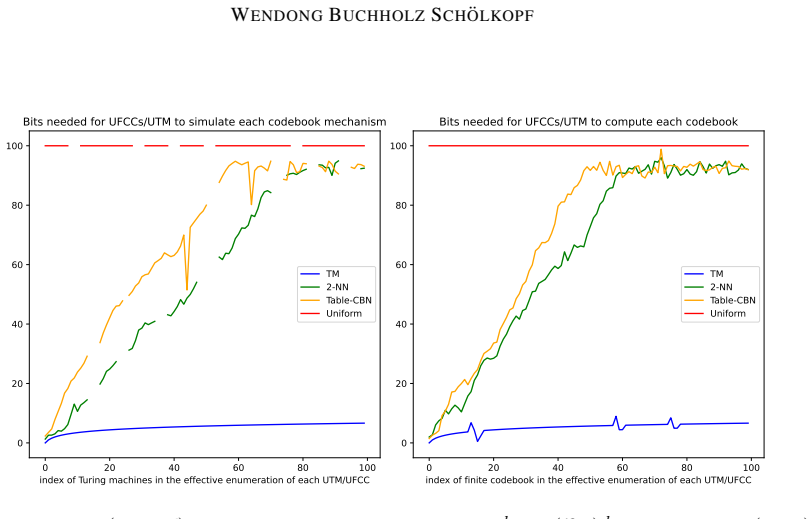

Figures from the paper (3 more)


Reference graph
Works this paper leans on
-
[1]
it can write an element from A = {0, 1, B} in the cell it scans; and
-
[2]
reject” such that TM halts on “reject
it can shift the head one cell left or right. After each step, the finite control takes on a state from Q, and then decides an action according to a global list of rules. The rules have format (p, s, a, q): p is the current state of the finite control; s is the symbol under scan; a is the next operation to be executed of type 1 or 2 designated in the obvi...
work page 1966
-
[3]
For any x ∈ (X d)∗, compute its marginal likelihood P(x) = P T ∈S P(x|T )Q(T ), where P(·|T ) is the probability distribution function computed by T . By Corollary 41, the negative log marginal likelihood − log P is the coding length of a certain Shannon code over (X d)∗. By Example 7, this code is shorter than any two-part code in any UFCC using the same...
-
[6]
Take the two least probable symbols in the alphabet X d. These two symbols will be given the longest codewords, which will have equal length and differ only in the last digit
-
[7]
Output: a tree-structured codebook
Combine these two symbols into a single symbol, and repeat. Output: a tree-structured codebook. We call the output of this program a Huffman code. Theorem 44 (Huffman coding is optimal (Cover, 1999)) If c∗ is a Huffman code for PX and c′ is any other uniquely decodable code, EPX [l(c∗(X))] ≤ EPX [l(c′(X))]. Therefore in the paper, we use the Huffman codin...
work page 1999
-
[10]
First, same as in Definition 18, define any recursively enumerable set S of FCMs, such that any codebook g : X d → B∗ can be computed by at least one of the FCMs in it (In the following, we will call such a r.e. set a universal set of FCMs.)
-
[11]
Define a discrete probability Q fully supported over that countable set S
-
[15]
In most literature in information theory (Shannon, 1948; Cover, 1999) the word “codebook” only denotes a code for X N with N samples in the noisy-channel coding setting. We abuse the usage of this word in the source coding setting because we would like to stress that the source code itself also needs to be encoded and it also has a coding length, i.e. the...
work page 1948
Show all 13 references
-
[16]
independent causal mechanism
For readability we stay in the unconfounded setting and the strong version of identifiability. We can readily gener- alize Definition 1 and this lemma to identifiability up to an equivalence class, or generalize to the setting of causal representation learning, by changing the...
2010
-
[17]
41 WENDONG BUCHHOLZ SCH ¨OLKOPF • Our output of model selection is different from Principle 48
I denotes the algorithmic mutual information, see Definition 47. 41 WENDONG BUCHHOLZ SCH ¨OLKOPF • Our output of model selection is different from Principle 48. We select a Turing machine, from which the causal and symmetry statements are read off. Principle 48 selects a graph...
2021
-
[18]
In the general case we can construct UBCC depending on (m, d) by inputting ⟨m, ⟨d, ⟨p⟩⟩⟩ and simulating the codebook for each (m, d) respectively
Same as Definition 18 we omit (m, d) in the input for simplicity. In the general case we can construct UBCC depending on (m, d) by inputting ⟨m, ⟨d, ⟨p⟩⟩⟩ and simulating the codebook for each (m, d) respectively. 43 WENDONG BUCHHOLZ SCH ¨OLKOPF codebook and feed it with differ...
2024
-
[2010]
• Appendix § H contains remarks on the Minimum Description Length (MDL) principle and Bayesian model selection, their difference and relation to our approach
and the subsequent works based on it. • Appendix § H contains remarks on the Minimum Description Length (MDL) principle and Bayesian model selection, their difference and relation to our approach. 28 ALGORITHMIC CAUSAL STRUCTURE EMERGING THROUGH COMPRESSION Appendix A. Notatio...
2019
-
[2023]
Ya M Barzdin
arXiv:2307.15936. Ya M Barzdin. Complexity of programs to determine whether natural numbers not greater than n belong to a recursively enumerable set. In Soviet Mathematics Doklady , volume 9, page 122, 1968. Anselm Blumer, Andrzej Ehrenfeucht, David Haussler, and Manfred K Wa...
1968 arXiv
Reviewed August 8, 2026 · model on record in the stance chip above.
Discussion (0). Continue with ORCID to comment.