REVIEW 5 major objections 5 minor 2 cited by
DECAF: Learning to be Fair in Multi-agent Resource Allocation
T0 review · 5 major / 5 minor · reviewed 2026-08-08 · deepseek-v4-flash
Pith's one-line read DECAF learns fair and efficient multi-agent resource-allocation policies with decomposed fairness rewards, outperforming existing fair MARL methods while allowing the fairness-utility trade-off to be adjusted at run time.
desk verdict A useful empirical framework with a real objective-mismatch problem: the missing discount factor and post hoc beta selection need fixing before the headline claims hold. read the letter →
The pith
A machine-rendered reading of the paper's core claim, the machinery that carries it, and where it could break.
The reading
What carries the argument
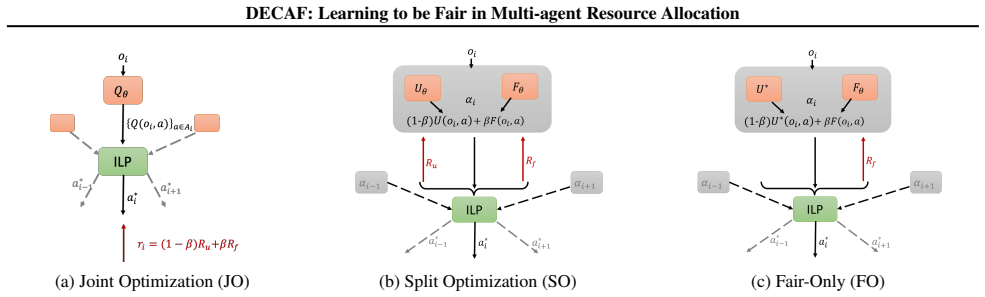
The mechanism that carries the argument is the decomposed fairness reward plus the central ILP. Instead of asking agents to optimize a joint fairness objective, DECAF gives each agent a local fair reward derived from the change in the global fairness metric; for variance, $R^f_i = -\frac{1}{n}(z^{t+1}_i-\bar z^{t+1})^2 + \frac{1}{n}(z^t_i-\bar z^t)^2$, so the only shared information is the average accumulated utility. The learners are Double Deep Q-networks, and the central allocator solves the ILP of Eq. 3 using the combined Q-values. In Split Optimization the utility and fairness estimators are kept separate and combined as $Q=(1-\beta)U_\theta+\beta F_\theta$, which is what allows the trade-off weight $\beta$ to be changed at run time. The formal guarantees, that increasing $\beta$ improves one-step fairness and that a large enough $\beta$ selects the fairest allocation, hold for $\gamma=0$ with perfect estimates.
What would settle it
For the maximin fairness function $\min(Z)$, enumerate all feasible joint allocations from a state, compute the true fairness gain $\min(Z')-\min(Z)$, and compare it with the sum of the per-agent rewards produced by the maximin decomposition in the paper's supplement. If the allocation that maximizes the summed per-agent reward is not the one with the largest true maximin gain, then using per-agent rewards in the ILP cannot recover the globally fairest allocation.
Extended reading notes
Core claim
On the paper's own terms, the discovery is that fairness in centralized resource allocation can be learned by feeding a central ILP a weighted sum of utility and fairness Q-estimators, where the fairness estimator is trained on a per-agent decomposition of the global fairness metric. For variance, the per-agent reward is $R^f_i(s,A) = -\frac{1}{n}(z^{t+1}_i - \bar z^{t+1})^2 + \frac{1}{n}(z^t_i - \bar z^t)^2$, which each agent can predict from its own accumulated utility and the global average. Joint, Split, and Fair-Only variants all reach points near the utility-fairness Pareto front on five domains, and all three Pareto-dominate the FEN and SOTO baselines. The Split variant additionally carries a proof that with perfect estimates and $\gamma=0$, raising the fairness weight never decreases one-step fairness, and empirically the ordering persists over long horizons.
Load-bearing premise
The load-bearing premise is that dividing the global fairness change into per-agent rewards preserves enough information for the central allocator to improve long-term fairness; the paper proves this only in the one-step, perfect-estimate case, so the long-horizon behavior rests on that unproven decomposition.
Editorial extensions
If this is right
- In DECA settings, Q-learning with a central ILP can learn fair policies without ever predicting the joint action space, because each agent learns local values over its own post-decision states.
- With Split Optimization, a user can change the fairness-utility trade-off at execution time without retraining, and three or four training weights suffice to approximate the full Pareto front.
- The fairness estimator can be trained with variance, α-fairness, generalized Gini, or maximin objectives, so the same pipeline applies across different fairness metrics.
- All three DECAF variants Pareto-dominate the FEN and SOTO baselines on the five tested domains under the paper's evaluation.
- Fair-Only Optimization lets an existing black-box utility model be made fairer by adding a learned fairness component, and behaves in a utility-maximizing manner as the fairness weight goes to zero.
Reading between the lines
- A deployment recipe the paper leaves implicit: train a handful of Split or Fair-Only models on a few trade-off weights and interpolate between them at service time, which would reduce retraining costs in ridesharing, public-service, and job-assignment systems.
- The paper's formal monotonicity result holds only for one-step decisions with perfect estimates; whether the ordering survives long horizons with imperfect estimates is an empirical claim that a controlled value-comparison study could test.
- For fairness metrics that cannot be decomposed without loss, such as a non-additive maximin or Gini objective over final wealth, the framework would need a learned credit-assignment layer rather than the hand-designed per-agent rewards; the current experiments do not establish that this limitation is absent.
Editorial analysis
A structured set of objections, weighed in public.
Referee Report
Summary. The paper introduces the Distributed Evaluation, Centralized Allocation (DECA) problem class and proposes DECAF, a Deep Q-learning framework with three variants (Joint Optimization, Split Optimization, and Fair-Only Optimization) for learning policies that trade off system utility and fairness in centralized resource allocation. Fairness is encoded via per-step changes of a global fairness function (variance in the main experiments), decomposed into per-agent rewards. The authors prove monotonicity properties for the split variant in the one-step (γ=0) case, and support the method with experiments on five environments, comparing against FEN and SOTO baselines and reporting gains in fairness metrics and utility.
Significance. If the claims are correct, the paper would make a useful contribution: it explicitly targets constrained centralized allocation with decentralized evaluation, demonstrates three ways to integrate fairness (including online trade-off adjustment), and provides a general decomposition recipe for fairness rewards. The empirical scope is broad (five domains, several fairness functions, three optimization strategies), and the authors are transparent about implementation details, including warm starts and past discounts. However, the theoretical guarantees are limited to γ=0 with perfect estimates, and as detailed in the major comments, the connection between the per-step fairness reward and the stated terminal objective is not established for the discounted setting used in the experiments. These issues affect the central claims and require substantial revision.
major comments (5)
- [Sec. 4.1, Eqs. (6)–(8), (12)–(14)] The learned objective differs from the stated objective in Eq. (1) whenever γ<1. The fair reward is the per-step change r_f = ΔF_t = F_{t+1} − F_t, and the TD targets in Eqs. (12)–(14) accumulate these discounted per-step rewards. For any trajectory, Σ_{t=0}^{T−1} γ^t (F_{t+1}−F_t) = γ^{T−1}F_T − F_0 + (1−γ)Σ_{t=1}^{T−1}γ^{t−1}F_t, so with γ<1 the policy is not optimizing terminal fairness F_T but a weighted mixture with substantial weight on intermediate fairness levels. Theorems 4.1–4.2 and A.1–A.3 only cover γ=0, and the experimental section never reports the value of γ. The paper must either report γ and justify the surrogate objective, prove the result for γ=1, or otherwise reconcile the learning objective with Eq. (1). This is load-bearing for the 'long-term fairness' claim.
- [Sec. 6.2, Table 1] The β values for JO, SO, and FO in Table 1 are selected by maximizing 0.1·U − 0.9·var(Z), which is the same evaluation metric used for comparison. This post hoc selection on the evaluation criterion overstates the relative performance of the selected models and makes the comparison to FEN and SOTO unfair. The paper should report the full β sweep with confidence intervals (as in Appendix F.1) for the baselines as well, or use a pre-specified selection rule independent of the test metric. As it stands, the bolded 'best' entries in Table 1 are not supported by a statistically grounded model-selection procedure.
- [Sec. 4.1, Eqs. (9)–(11) and Sec. 6.1] The fairness reward used for training is the per-step change of the same variance function used for evaluation in Figure 3 and Table 1. This creates a circularity: DECAF is trained to minimize exactly what is measured, while the baselines are trained on other objectives (or adapted from unconstrained settings) and then evaluated on variance. The improvement on variance is therefore partly by construction. The paper does evaluate other fairness functions in Appendix D and Table 1, which helps, but the main Pareto comparisons in Figure 3 rely on variance. The authors should either present the main results on the other metrics as well, or explicitly acknowledge and control for this training-evaluation overlap.
- [Sec. 4.1 and Sec. 5.2, JobAlloc] The per-agent decomposition of the global fairness change (Eq. 8 for general fairness functions, Eq. 11 for variance) is assumed to be a sufficient credit-assignment signal, but the paper provides no justification beyond the one-step, perfect-estimate, γ=0 setting. In domains such as JobAlloc, where fairness requires coordinated abstention (e.g., all agents must jointly leave the job), a local reward that depends only on the agent's own metric and the average cannot represent the effect of the joint action on the global fairness metric. The empirical success in JobAlloc is suggestive, but the theoretical support is absent; the paper should either prove a bound on the suboptimality of the greedy decomposition or tone down the claim that DECAF 'learns long-term fairness' in such settings.
- [Sec. 5.2 and Fig. 3] The claim that all DECAF methods 'Pareto-dominate' FEN and SOTO is not statistically substantiated. Figure 3 shows point estimates without error bars, and the confidence intervals for DECAF are only given in Appendix F.1 (separately for utility and variance, not on the Pareto plot). The baseline adaptations (Policy-as-Q-values and Masked sequential selection) are reasonable but were not designed for the DECA setting, and SOTO is given additional features and five times more training steps. The comparison would be strengthened by reporting error bars or confidence regions for the Pareto fronts, and by discussing the sensitivity of the baselines to the adaptation choices.
minor comments (5)
- [Appendix A, proof of Theorem A.1] The sentence 'Ftot(Ao) > Ftot(Ao)' appears to be a typo and should read 'Ftot(Ao) > Ftot(A∗)'; without this fix the derivation of Eq. (25) is confusing.
- [Sec. 4.1, Eq. (11)] The claim that the reward 'only depends on the agent's own metric value and the average metric' is true for the variance decomposition, but not for the general equal division in Eq. (8), which also depends on the global change ΔF. The sentence should be qualified to avoid overgeneralization.
- [Sec. 5, Algorithm 2 and Appendix B] The symbol T is used both for the terminal horizon in Eq. (1) and for the learning interval in Algorithm 2 (line 15: 'if t%T == 0'). This is confusing; the learning interval should be given a different name (e.g., T_update).
- [Sec. 3.2 and Sec. 4.2] The ILP in Eq. (3) uses Q(oi, a) as coefficients, but for the SO and FO methods the Q-value is a weighted combination of U and F (Eqs. 15 and 17). The notation should make clear which Q-function is used in the ILP at training vs. execution time, since the target network evaluation in Algorithm 4 solves an ILP with the combined Q-values.
- [Appendix D.2.1] The warm start and past discount values in Table 2 are described as important for stability, but no ablation is provided. A brief experiment showing the effect of removing warm starts or past discounts would make the sensitivity claims more rigorous.
Circularity Check
Minor self-definitional confirmation in the variance reward; the main comparative claims are independently grounded.
-
self definitional
[Sec. 4.1 (Eqs. 6–8 and 11) and Sec. 6.1]
"if variance is used as the fairness function (Ft = −var(Zt)): ∆F |At = −var(Zt+1) + var(Zt) ... Rf (s, A) = [− 1/n (zt+1 i − ¯zt+1)^2 + 1/n (zt i − ¯zt)^2]i∈α ... This also confirms that the fairness reward proposed for minimizing variance is a good signal."
Eqs. 6–8 define the fair reward as the equal per-agent share of the one-step change in the fairness metric F, and Eq. 11 instantiates F as negative variance, the same quantity used for evaluation in Sec. 5 and Table 1. Consequently the Sec. 6.1 statement that variance results 'confirm' the variance-based reward is a good signal is self-definitional: the reward and the evaluation metric are the same function, so improving one is improving the other by construction. This is a genuine internal tautology but it is not the main evidence for the paper's comparative claims, which rest on external baselines and on other fairness metrics.
full rationale
DECAF's central contribution is a Q-learning framework whose fair reward is defined as the per-step change of a chosen fairness metric (Eqs. 6–8), with variance as the main instantiation (Eq. 11). Because the evaluation in Table 1 and Fig. 3 measures the same negative-variance metric, the observation that variance improves is partly built into the reward definition; I flag one sentence in Sec. 6.1 that calls this a confirmation. However, this self-definitional element is not the load-bearing part of the paper's claims. The headline results are comparative: DECAF is tested against external baselines FEN and SOTO under adapted constrained-decision protocols, and Table 1 and Appendix D evaluate performance on other fairness functions (α-fair, GGF, maximin) that are not the training objective, giving independent empirical content. The only self-citation, Kumar et al. 2023, is used in Related Work to contrast with a ridesharing-specific method and is not load-bearing. The theoretical results (Theorems 4.1, 4.2, A.1–A.3) are restricted to γ=0 and are algebraic consequences of the linear scalarized ILP; they are not imported from prior work. The mismatch between the terminal objective Eq. 1 and the discounted per-step Bellman updates for γ<1 is a soundness/correctness concern, not a circularity, because the per-step reward is an explicit surrogate rather than a relabeled prediction. On balance, the derivation chain is self-contained against external benchmarks, so the circularity score is low.
Assumptions & free parameters
free parameters (4)
- Fairness weight beta =
0.2, 0.5, 0.8, 0.999, 1 (selected per method and environment for Table 1)
- Warm start w =
Matthew 5, Plant 1, Job 3, JobAlloc 3, BiasedDM 2 for variance and maximin; 0.1 for GGF; 0 for alpha-fair
- Past discount gamma_p =
0.995 for most environments, 0.999 for BiasedDM, 1.0 for alpha-fair and GGF
- RL discount factor gamma =
not reported
assumptions (4)
- ad hoc to paper The per-agent decomposition of the global fairness change is a valid learning signal, so summed per-agent fair Q-values are an adequate proxy for global fairness under the ILP.
- domain assumption Local post-decision-state Q-values that ignore other agents' actions are sufficient for the central ILP to find good joint allocations.
- standard math The central allocator solves the ILP in Eqs. 3-5 exactly at every step.
- ad hoc to paper Long-term fairness is well represented by a discounted sum of per-step changes in the variance of accumulated agent utilities.
invented entities (1)
-
Distributed Evaluation, Centralized Allocation (DECA) problem class
Cite this review
Pith. "Pith review of DECAF: Learning to be Fair in Multi-agent Resource Allocation." pith.science (2026). https://pith.science/paper/KKW7RLSN
@misc{pith2026250204281,
  author       = {Pith},
  title        = {Pith review of: DECAF: Learning to be Fair in Multi-agent Resource Allocation},
  year         = {2026},
  howpublished = {\url{https://pith.science/paper/KKW7RLSN}},
  note         = {Machine review of arXiv:2502.04281}
}
read the original abstract
A wide variety of resource allocation problems operate under resource constraints that are managed by a central arbitrator, with agents who evaluate and communicate preferences over these resources. We formulate this broad class of problems as Distributed Evaluation, Centralized Allocation (DECA) problems and propose methods to learn fair and efficient policies in centralized resource allocation. Our methods are applied to learning long-term fairness in a novel and general framework for fairness in multi-agent systems. We show three different methods based on Double Deep Q-Learning: (1) A joint weighted optimization of fairness and utility, (2) a split optimization, learning two separate Q-estimators for utility and fairness, and (3) an online policy perturbation to guide existing black-box utility functions toward fair solutions. Our methods outperform existing fair MARL approaches on multiple resource allocation domains, even when evaluated using diverse fairness functions, and allow for flexible online trade-offs between utility and fairness.
Figures


Figures from the paper (9 more)


Forward citations
Cited by 2 Pith papers
-
Inference-Time Policy Alignment for Fair Reinforcement Learning
A frozen RL policy can be reweighted at test time by a learned generalized-Gini welfare critic to improve fairness metrics, though the central equivalence mixes up two different welfare objectives.
-
The Optimization Trilemma: Efficiency, Comfort and Fairness in Decentralized Multi-agent Coordination
A decentralized coordination algorithm can co-optimize efficiency, comfort, and fairness by minimizing the standard deviation of agents' discomfort costs at near-zero extra communication cost.
Reference graph
Works this paper leans on
-
[1]
write newline
" write newline "" before.all 'output.state := FUNCTION n.dashify 't := "" t empty not t #1 #1 substring "-" = t #1 #2 substring "--" = not "--" * t #2 global.max substring 't := t #1 #1 substring "-" = "-" * t #2 global.max substring 't := while if t #1 #1 substring * t #2 global.max substring 't := if while FUNCTION format.date year duplicate empty "emp...
-
[2]
On-demand high-capacity ride-sharing via dynamic trip-vehicle assignment
Alonso-Mora, J., Samaranayake, S., Wallar, A., Frazzoli, E., and Rus, D. On-demand high-capacity ride-sharing via dynamic trip-vehicle assignment. Proceedings of the National Academy of Sciences, 114: 0 462--467, 2017
work page 2017
-
[3]
Constrained multiagent Markov decision processes: A taxonomy of problems and algorithms
De Nijs, F., Walraven, E., De Weerdt, M., and Spaan, M. Constrained multiagent Markov decision processes: A taxonomy of problems and algorithms. Journal of Artificial Intelligence Research, 70: 0 955--1001, 2021
work page 2021
-
[4]
Dwork, C., Hardt, M., Pitassi, T., Reingold, O., and Zemel, R. Fairness through awareness. In Proceedings of the Conference on Innovations in Theoretical Computer Science, pp.\ 214--226, 2012
work page 2012
-
[5]
Elmachtoub, A. N. and Grigas, P. Smart “predict, then optimize”. Management Science, 68: 0 9--26, 2022
work page 2022
-
[6]
Survey on fair reinforcement learning: Theory and practice
Gajane, P., Saxena, A., Tavakol, M., Fletcher, G., and Pechenizkiy, M. Survey on fair reinforcement learning: Theory and practice. arXiv preprint arXiv:2205.10032, 2022
arXiv 2022
-
[7]
Alleviating matthew effect of offline reinforcement learning in interactive recommendation
Gao, C., Huang, K., Chen, J., Zhang, Y., Li, B., Jiang, P., Wang, S., Zhang, Z., and He, X. Alleviating matthew effect of offline reinforcement learning in interactive recommendation. In Proceedings of the International Conference on Research and Development in Information Retrieval, pp.\ 238--248, 2023
work page 2023
-
[8]
Equality of opportunity in supervised learning
Hardt, M., Price, E., and Srebro, N. Equality of opportunity in supervised learning. In Proceedings of the Conference on Neural Information Processing Systems, pp.\ 3323--3331, 2016
work page 2016
Show all 24 references
-
[9]
v., Guez, A., and Silver, D
Hasselt, H. v., Guez, A., and Silver, D. Deep reinforcement learning with double Q -learning. In Proceedings of the AAAI Conference on Artificial Intelligence, pp.\ 2094--2100, 2016
2016
-
[10]
and Lu, Z
Jiang, J. and Lu, Z. Learning fairness in multi-agent systems. In Proceedings of the Conference on Neural Information Processing Systems, 2019
2019
-
[11]
R., Das, S., and Fowler, P
Kube, A. R., Das, S., and Fowler, P. J. Allocating interventions based on predicted outcomes: A case study on homelessness services. In Proceedings of the AAAI Conference on Artificial Intelligence, pp.\ 622--629, 2019
2019
-
[12]
R., Das, S., and Fowler, P
Kube, A. R., Das, S., and Fowler, P. J. Community-and data-driven homelessness prevention and service delivery: optimizing for equity. Journal of the American Medical Informatics Association, 30 0 (6): 0 1032--1041, 2023
2023
-
[13]
Using simple incentives to improve two-sided fairness in ridesharing systems
Kumar, A., Vorobeychik, Y., and Yeoh, W. Using simple incentives to improve two-sided fairness in ridesharing systems. In Proceedings of the International Conference on Automated Planning and Scheduling, pp.\ 227--235, 2023
2023
-
[14]
A survey on bias and fairness in machine learning
Mehrabi, N., Morstatter, F., Saxena, N., Lerman, K., and Galstyan, A. A survey on bias and fairness in machine learning. ACM Computing Surveys, 54 0 (6): 0 1--35, 2021
2021
-
[15]
Playing atari with deep reinforcement learning
Mnih, V., Kavukcuoglu, K., Silver, D., Graves, A., Antonoglou, I., Wierstra, D., and Riedmiller, M. Playing atari with deep reinforcement learning. arXiv preprint arXiv:1312.5602, 2013
2013 arXiv
-
[16]
T., Zhu, H., and Ye, J
Qin, Z. T., Zhu, H., and Ye, J. Reinforcement learning for ridesharing: An extended survey. Transportation Research Part C: Emerging Technologies, 144: 0 103852, 2022
2022
-
[17]
Mitigating bias in algorithmic hiring: Evaluating claims and practices
Raghavan, M., Barocas, S., Kleinberg, J., and Levy, K. Mitigating bias in algorithmic hiring: Evaluating claims and practices. In Proceedings of the Conference on Fairness, Accountability, and Transparency, pp.\ 469--481, 2020
2020
-
[18]
S., Farquhar, G., Foerster, J., and Whiteson, S
Rashid, T., Samvelyan, M., De Witt, C. S., Farquhar, G., Foerster, J., and Whiteson, S. Monotonic value function factorisation for deep multi-agent reinforcement learning. Journal of Machine Learning Research, 21 0 (178): 0 1--51, 2020
2020
-
[19]
The Matthew Effect: How Advantage Begets Further Advantage
Rigney, D. The Matthew Effect: How Advantage Begets Further Advantage. Columbia University Press, 2010
2010
-
[20]
Neural approximate dynamic programming for on-demand ride-pooling
Shah, S., Lowalekar, M., and Varakantham, P. Neural approximate dynamic programming for on-demand ride-pooling. In Proceedings of the AAAI Conference on Artificial Intelligence, pp.\ 507--515, 2020
2020
-
[21]
Learning fair policies in multi-objective (deep) reinforcement learning with average and discounted rewards
Siddique, U., Weng, P., and Zimmer, M. Learning fair policies in multi-objective (deep) reinforcement learning with average and discounted rewards. In Proceedings of the International Conference on Machine Learning, pp.\ 8905--8915, 2020
2020
-
[22]
M., Zambaldi, V., Jaderberg, M., Lanctot, M., Sonnerat, N., Leibo, J
Sunehag, P., Lever, G., Gruslys, A., Czarnecki, W. M., Zambaldi, V., Jaderberg, M., Lanctot, M., Sonnerat, N., Leibo, J. Z., Tuyls, K., and Graepel, T. Value-decomposition networks for cooperative multi-agent learning based on team reward. In Proceedings of the Conference on A...
2018
-
[23]
Learning MDP s from features: Predict-then-optimize for sequential decision making by reinforcement learning
Wang, K., Shah, S., Chen, H., Perrault, A., Doshi-Velez, F., and Tambe, M. Learning MDP s from features: Predict-then-optimize for sequential decision making by reinforcement learning. In Proceedings of the Conference on Neural Information Processing Systems, pp.\ 8795--8806, 2021
2021
-
[24]
Learning fair policies in decentralized cooperative multi-agent reinforcement learning
Zimmer, M., Glanois, C., Siddique, U., and Weng, P. Learning fair policies in decentralized cooperative multi-agent reinforcement learning. In Proceedings of the International Conference on Machine Learning, pp.\ 12967--12978, 2021
2021
Reviewed August 8, 2026 · model on record in the stance chip above.
Discussion (0). Continue with ORCID to comment.