REVIEW 3 major objections 5 minor 7 cited by
Great Models Think Alike and this Undermines AI Oversight
T0 review · 3 major / 5 minor · reviewed 2026-08-08 · deepseek-v4-flash
Pith's one-line read This paper argues that functional similarity between language models, measured by overlap in mistakes, biases AI judges, drives weak-to-strong training gains, and is increasing with capability, so AI oversight will inherit shared blind…
desk verdict CAPA is a real metric and the capability-similarity trend is a genuine finding; the uniform-chance baseline is a soft spot but not fatal, since discrete error consistency corroborates the trend. read the letter →
The pith
A machine-rendered reading of the paper's core claim, the machinery that carries it, and where it could break.
The reading
What carries the argument
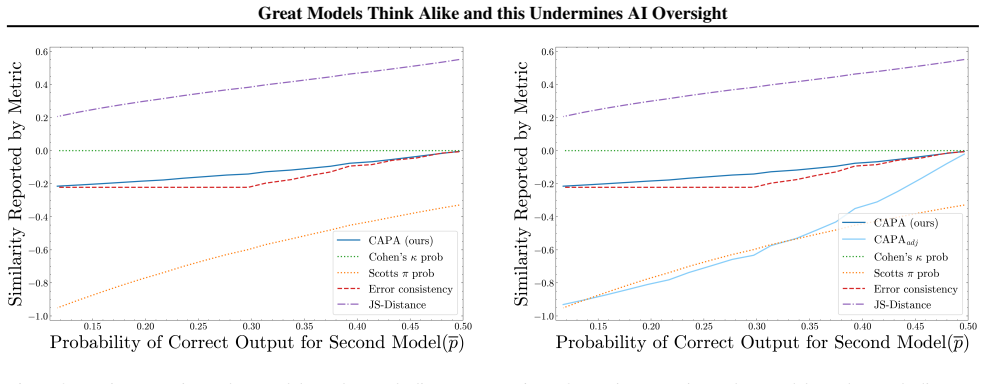
CAPA (Chance Adjusted Probabilistic Agreement), denoted $\kappa^p$, is the paper's central object: an agreement metric of the form $(\text{observed} - \text{chance})/(1 - \text{chance})$. Observed agreement $c^p_{obs}$ is the average, over samples, of the inner product of the two models' output probability distributions over the answer options; chance agreement $c^p_{exp}$ assumes independent models that put their average correct probability $p_j$ on the ground-truth option and spread the remaining probability uniformly over the wrong options. This adjusts for accuracy, distinguishes different wrong answers from each other, and uses probabilities rather than hard predictions. The metric generalizes error consistency and is the instrument used to detect judge affinity bias, measure supervisor-student complementarity, and trace the capability-similarity trend.
What would settle it
Run the capability-similarity analysis on models whose wrong-answer choices are heavily concentrated on one option (e.g., a positional bias), and recompute CAPA with the uniform-error null replaced by empirical wrong-option marginals; if the rising trend with capability weakens or reverses, the trend is an artifact of the null model rather than a property of model errors.
Extended reading notes
Core claim
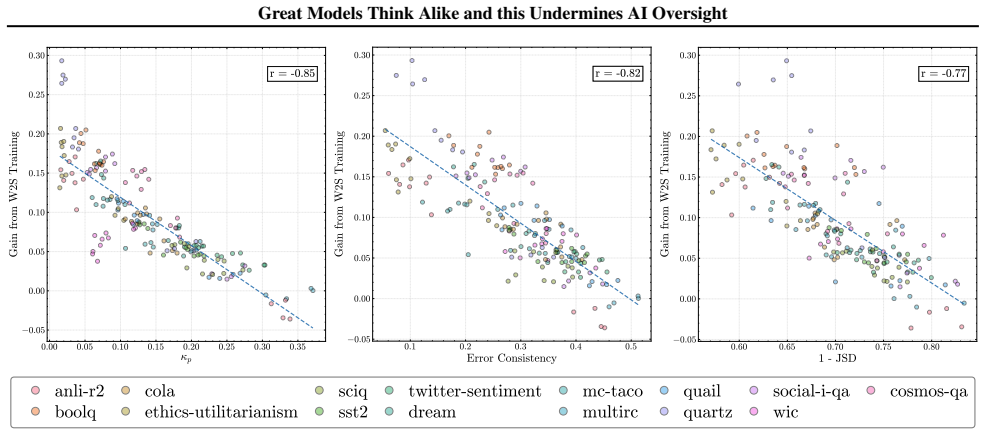
The paper's central claim is that functional similarity between language models, properly measured, is a hidden confounder in both halves of AI oversight. In evaluation, judges are biased toward similar models: the affinity bias extends beyond self-preference to any model whose error pattern resembles the judge's, with significant partial correlation after controlling for accuracy. In training, complementarity explains weak-to-strong generalization: the less similar the weak supervisor and strong student, the larger the gain, and this complementary knowledge raises the estimated ceiling beyond pure elicitation. Most concerningly, similarity is not fixed: across five capability buckets of 130 models, average pairwise CAPA rises with accuracy, indicating that as models get better they fail in more alike ways. The paper concludes that reporting and correcting for model similarity should become standard practice in AI oversight.
Load-bearing premise
The chance-agreement baseline in CAPA assumes that when a model is wrong, its probability mass is spread evenly over all wrong answer choices; if real models have systematic preferences among wrong options, the computed similarity values and all three trends could be biased.
Editorial extensions
If this is right
- Leaderboard scores produced by LLM-as-a-judge inherit the judge's error pattern: excluding the judge's own family from a ranking is not enough, and similarity should be reported or regressed out.
- Weak-to-strong training gains can be predicted before training from supervisor-student CAPA, and the previously estimated ceiling from elicitation is too low; exploiting complementary knowledge is a concrete avenue for better weak-to-strong methods.
- If correlated errors keep rising with capability, LM juries are less independent than they appear, and majority-vote oversight can amplify a shared blind spot rather than cancel it.
- Model diversity itself becomes a safety-relevant property: measuring CAPA between candidate models can flag when an oversight stack is about to lose its independent checkers.
Reading between the lines
- The uniform-error null model is the piece most worth stress-testing: if real models concentrate wrong-answer probability on particular options (a position bias), CAPA could be systematically inflated, so re-deriving CAPA with empirical wrong-option marginals is a natural robustness check.
- The paper's finding that instruction-tuned models show a steeper similarity trend suggests a testable intervention: training with deliberately diversified instruction data or distinct alignment targets might slow error convergence and preserve oversight value.
- The affinity-bias result implies a concrete debiasing recipe the paper does not test: assembling a jury whose members have low pairwise CAPA and comparing its verdicts against a single judge.
- Extending CAPA to free-text responses, via embedding-based agreement, would connect similarity analysis to the oversight setups (debate, process supervision) that the paper names as future work.
Editorial analysis
A structured set of objections, weighed in public.
Referee Report
Summary. The paper introduces Chance Adjusted Probabilistic Agreement (CAPA), a pairwise similarity metric for language models defined on MCQ output probabilities. CAPA extends error consistency by counting different wrong predictions as disagreement and by using probabilistic predictions rather than hard labels. The authors apply CAPA to three questions: (i) LLM-as-a-judge scores are positively correlated with judge-model similarity after controlling for accuracy; (ii) weak-to-strong generalization gains are larger when the weak supervisor and the strong student are less similar; and (iii) average pairwise CAPA among 130 open LMs increases with accuracy, implying that model mistakes are becoming more correlated as capabilities improve. The paper concludes that reliance on other LMs for AI oversight carries risks from correlated failures and recommends reporting sample-wise predictions.
Significance. If the empirical findings hold, this is a timely and useful contribution: CAPA is a clean, bounded, probabilistic generalization of error consistency; the affinity-bias result extends self-preference findings to a broader class of similarity; the weak-to-strong analysis offers a new predictor of training gains; and the capability-similarity trend is a falsifiable warning about correlated failures. Strengths include the explicit derivation and simulation of CAPA, partial correlations controlling for accuracy and model size, per-category robustness checks, and the use of multiple alternative agreement metrics in the appendices. The main caveat is that all headline numbers inherit the uniform-distractor chance baseline in Eq. (3), whose validity is not established; the weak-to-strong analysis also excludes several runs in a way that may bias the reported correlation.
major comments (3)
- [Section 2.2, Eq. (3), Appendix A.4] The chance-agreement term for incorrect options assumes that a wrong model distributes its error mass uniformly over the |O(x)|-1 non-ground-truth options. This is the only chance baseline in CAPA and is inherited by all three empirical findings. In MMLU-Pro and BBH, wrong options are not semantically exchangeable: models systematically prefer certain distractors, so two conditionally independent models that share a distractor preference will agree on wrong options more often than the uniform null predicts, inflating kappa_p. The defense in Appendix A.4, that MCQ options can be permuted and that answer options are balanced by design, addresses the marginal frequency of correct options, not the conditional distribution of errors over wrong options. Because the Section 5.2 capability trend is the headline safety claim, the paper should show that the trend is not an artifact of this prior. Concretely, I ask for a null or sensitivity analysis that matches per-question accuracy and empirical distractor margins (e.g., permuting wrong-option labels within questions across models or estimating a data-driven wrong-option prior) and for a report of whether the Figure 6 trend and the Table 2 partial correlations survive. The error-consistency result in Appendix D.3 is relevant because it does not use the uniform-wrong-option assumption, but it is presented only qualitatively and should be quantified and tied to this concern.
- [Section 4, Appendix C.1] Appendix C.1 reports that three weak models (SmolLM-1.7B, Qwen2.5-0.5B, Llama-3.2-1B) and the Hellaswag dataset were discarded after observing negative weak-to-strong gains or low accuracies. The main Section 4 claim, that lower similarity predicts larger gains, is estimated only on the remaining 12 model pairs. Excluding runs because the outcome variable is unfavorable can induce selection bias and may overstate the strength of the correlation. The paper should either provide a pre-specified inclusion criterion or report a sensitivity analysis that includes the discarded runs, with gains computed on the same scale, so readers can judge whether the qualitative conclusion survives.
- [Section 5.2, Figure 6] The headline trend is reported as a 'strong positive correlation' without a correlation coefficient, confidence interval, or p-value, and the 130 plotted points are not independent because each model's mean similarity is computed against overlapping sets of partners from the same bucket. The paper should report the exact statistic (e.g., Pearson or Spearman r with CI) and use a bootstrap or mixed-effects procedure that accounts for the non-independence of pairwise similarities. The per-category analyses in Appendix D.4 are supportive but inherit the same dependence structure.
minor comments (5)
- [Abstract and Section 1] The metric is called 'Chance Adjusted Probabilistic Agreement' in the abstract and 'Chance Adjusted Probabilistic Alignment' in the introduction; the name should be unified.
- [Appendix A.7] The sentence 'Results are reported in main paper in Sec. A.7' appears to refer to Section 2.2 and Figure 2, not to an appendix section; the cross-reference should be corrected.
- [Section 6] The phrase 'canapriori predict gains' is missing a space and should read 'can a priori predict gains'.
- [Figure 3 caption] The caption 'Judgment Score Relation with Model Similarity on only across family pairs' is grammatically awkward and should be rewritten as 'on across-family pairs only'.
- [Appendix C.5] The phrase 'The astute observer may be confused' is informal for a refereed paper; the point about the bottom-right quadrant can be stated directly.
Circularity Check
No significant circularity; the only by-construction element is a sanity-check simulation that uses the metric's own null model, while the three empirical findings are external correlational analyses.
-
self definitional
[Section 2.2, Eq. 3 and Figure 2 (simulation of independent models)]
"Then, we define independent models as assigning pj probability to the correct option, and uniformly distributing the remaining 1 − pj probability over the incorrect options. ... In this simulation, for each model we select an independent random subset of samples as correct ... CAPA correctly reports 0 similarity when models have uncorrelated errors."
The simulated data-generating process is exactly the null model used to define chance agreement c_exp in Eq. 3 (uniform error mass over wrong options). Therefore κp = (c_obs^p − c_exp^p)/(1 − c_exp^p) = 0 follows by construction, not by empirical test. This validates internal consistency but does not independently confirm the metric's interpretation. It is not load-bearing for the paper's main empirical findings, which use CAPA on real model outputs and correlate it with external labels (judge scores, weak-to-strong gains, capability buckets).
full rationale
The paper's central derivation chain is: define CAPA (Eq. 2-4), then use it as a fixed, parameter-free similarity measure in three external correlational analyses. No constant is fitted to produce the reported correlations; p_j is computed from model probabilities, and the weak-to-strong similarity is measured on validation data before training, making it a genuine a priori predictor. The judge-affinity, complementary-knowledge, and capability-similarity findings are empirical associations with independent content. The uniform-error chance baseline in Eq. 3 is an explicit modeling assumption (Appendix A.4); if real models share systematic distractor preferences, κp is biased, but this is a validity or correctness concern rather than circularity, since the result does not reduce to its inputs by construction. The only by-construction element is the Figure 2 simulation, which verifies that CAPA returns 0 on its own null model; this is a sanity check, not a prediction. No load-bearing self-citation or imported uniqueness theorem appears; citations to Geirhos et al. (2020, 2021) and Burns et al. (2024) provide external baselines and setup. Overall circularity is minimal and non-central.
Assumptions & free parameters
assumptions (5)
- domain assumption Independent models distribute their incorrect predictions uniformly over the non-ground-truth options in a multiple-choice question.
- domain assumption Softmaxed log-likelihoods from the OpenLLM Leaderboard are a valid probability distribution over MCQ options.
- domain assumption The 130 models in OpenLLM Leaderboard and the 12 W2S model pairs form a representative sample of capability levels and families.
- domain assumption The LLM-as-a-judge binary choice (0/1) without reference answers is a meaningful proxy for response correctness.
- domain assumption Standard inter-rater agreement framework (observed agreement minus chance agreement scaled by maximum excess agreement, Eq. 5) applies to model similarity.
Cite this review
Pith. "Pith review of Great Models Think Alike and this Undermines AI Oversight." pith.science (2026). https://pith.science/paper/CSWETT4L
@misc{pith2026250204313,
  author       = {Pith},
  title        = {Pith review of: Great Models Think Alike and this Undermines AI Oversight},
  year         = {2026},
  howpublished = {\url{https://pith.science/paper/CSWETT4L}},
  note         = {Machine review of arXiv:2502.04313}
}
read the original abstract
As Language Model (LM) capabilities advance, evaluating and supervising them at scale is getting harder for humans. There is hope that other language models can automate both these tasks, which we refer to as ''AI Oversight''. We study how model similarity affects both aspects of AI oversight by proposing Chance Adjusted Probabilistic Agreement (CAPA): a metric for LM similarity based on overlap in model mistakes. Using CAPA, we first show that LLM-as-a-judge scores favor models similar to the judge, generalizing recent self-preference results. Then, we study training on LM annotations, and find complementary knowledge between the weak supervisor and strong student model plays a crucial role in gains from ''weak-to-strong generalization''. As model capabilities increase, it becomes harder to find their mistakes, and we might defer more to AI oversight. However, we observe a concerning trend -- model mistakes are becoming more similar with increasing capabilities, pointing to risks from correlated failures. Our work underscores the importance of reporting and correcting for model similarity, especially in the emerging paradigm of AI oversight.
Figures


Figures from the paper (18 more)






Forward citations
Cited by 7 Pith papers
-
Language Models Agree With Each Other, Not With Readers
Across 18 model arms, model-model excess agreement (+0.093 median) is 2.3x human-human agreement (+0.040), against a naturalistic uninstructed reader baseline.
-
Floor, Ceiling, and the Fusion Gap: How Much of Crowd Reading Attention Can Machines Predict?
Machines recover up to 53% of the crowd-highlight prediction headroom, and fusing five frontier models reaches about 60%, confirmed in a pre-registered replication.
-
Are Diversity Metrics Measuring Diversity? A Capability-Controlled Audit of Majority-Vote Gain in LLM Ensembles
Diversity metrics used to select LLM ensembles are largely capability proxies; after control, only a modest pairwise co-failure association with majority-vote gain remains.
-
Weak-to-Strong Learning in Decision Making
Weak-to-strong training with pseudo-distributions can improve downstream decision risk over strong-only training when labels are scarce, unlabeled data are abundant, and weak/strong feature overlap is small.
-
Correlated Errors in Large Language Models
Large language models from different providers and architectures often make the same errors, and more accurate models are especially likely to share mistakes.
-
How Benchmark Prediction from Fewer Data Misses the Mark
Benchmark prediction methods mostly work by interpolation among similar models and fail on better, unfamiliar models, where random sampling with an AIPW-style correction is the only consistent improvement.
-
Adversarial Test-Hardening for AI-Written Code: An Instrument Autopsy and a Pre-Registered Causal Estimate of the Critic Loop
A frozen-seed experiment measures the critic loop's incremental kill rate at 0.783 (95% CI [0.592, 0.935]), and traces a prior p=9.5e-66 cross-provider effect to a silent output cap.
Reference graph
Works this paper leans on
-
[1]
write newline
" write newline "" before.all 'output.state := FUNCTION n.dashify 't := "" t empty not t #1 #1 substring "-" = t #1 #2 substring "--" = not "--" * t #2 global.max substring 't := t #1 #1 substring "-" = "-" * t #2 global.max substring 't := while if t #1 #1 substring * t #2 global.max substring 't := if while FUNCTION format.date year duplicate empty "emp...
-
[2]
B., Lozhkov, A., Bakouch, E., Blázquez, G
Allal, L. B., Lozhkov, A., Bakouch, E., Blázquez, G. M., Tunstall, L., Piqueres, A., Marafioti, A., Zakka, C., von Werra, L., and Wolf, T. Smollm2 - with great data, comes great performance. https://github.com/huggingface/smollm, 2024
2024
-
[3]
and Perez-Villadoniga, M
Bagues, M. and Perez-Villadoniga, M. J. Do recruiters prefer applicants with similar skills? evidence from a randomized natural experiment. Journal of Economic Behavior & Organization, 82 0 (1): 0 12--20, 2012
2012
-
[4]
Towards evaluations-based safety cases for ai scheming, 2024
Balesni, M., Hobbhahn, M., Lindner, D., Meinke, A., Korbak, T., Clymer, J., Shlegeris, B., Scheurer, J., Stix, C., Shah, R., Goldowsky-Dill, N., Braun, D., Chughtai, B., Evans, O., Kokotajlo, D., and Bushnaq, L. Towards evaluations-based safety cases for ai scheming, 2024
2024
-
[5]
Revisiting model stitching to compare neural representations
Bansal, Y., Nakkiran, P., and Barak, B. Revisiting model stitching to compare neural representations. In Conference on Neural Information Processing Systems, volume 34, pp.\ 225--236, 2021
2021
-
[6]
F., Ammanamanchi, P
Biderman, S., Schoelkopf, H., Sutawika, L., Gao, L., Tow, J., Abbasi, B., Aji, A. F., Ammanamanchi, P. S., Black, S., Clive, J., DiPofi, A., Etxaniz, J., Fattori, B., Forde, J. Z., Foster, C., Hsu, J., Jaiswal, M., Lee, W. Y., Li, H., Lovering, C., Muennighoff, N., Pavlick, E., Phang, J., Skowron, A., Tan, S., Tang, X., Wang, K. A., Winata, G. I., Yvon, F...
2024
-
[7]
Holistic evaluation of language models
Bommasani, R., Liang, P., and Lee, T. Holistic evaluation of language models. Annals of the New York Academy of Sciences, 2023
2023
-
[8]
Which prompts make the difference? data prioritization for efficient human llm evaluation, 2023
Boubdir, M., Kim, E., Ermis, B., Fadaee, M., and Hooker, S. Which prompts make the difference? data prioritization for efficient human llm evaluation, 2023
2023
Show all 107 references
-
[9]
Bowman, S. R., Hyun, J., Perez, E., Chen, E., Pettit, C., Heiner, S., Lukošiūtė, K., Askell, A., Jones, A., Chen, A., Goldie, A., Mirhoseini, A., McKinnon, C., Olah, C., Amodei, D., Amodei, D., Drain, D., Li, D., Tran-Johnson, E., Kernion, J., Kerr, J., Mueller, J., Ladish, J....
2022
-
[10]
D., Martinez-Plumed, F., Tenenbaum, J
Burnell, R., Schellaert, W., Burden, J., Ullman, T. D., Martinez-Plumed, F., Tenenbaum, J. B., Rutar, D., Cheke, L. G., Sohl-Dickstein, J., Mitchell, M., Kiela, D., Shanahan, M., Voorhees, E. M., Cohn, A. G., Leibo, J. Z., and Hernandez-Orallo, J. Rethink reporting of evaluati...
2023
-
[11]
H., Baker, B., Gao, L., Aschenbrenner, L., Chen, Y., Ecoffet, A., Joglekar, M., Leike, J., Sutskever, I., and Wu, J
Burns, C., Izmailov, P., Kirchner, J. H., Baker, B., Gao, L., Aschenbrenner, L., Chen, Y., Ecoffet, A., Joglekar, M., Leike, J., Sutskever, I., and Wu, J. Weak-to-strong generalization: Eliciting strong capabilities with weak supervision. In Proceedings of the 41st Internation...
2024
-
[12]
A portfolio approach to research funding
Canton, E. A portfolio approach to research funding. Research Policy, 54 0 (1): 0 105129, 2025
2025
-
[13]
Quantifying the gain in weak-to-strong generalization
Charikar, M., Pabbaraju, C., and Shiragur, K. Quantifying the gain in weak-to-strong generalization. In Conference on Neural Information Processing Systems, volume 37, pp.\ 126474--126499, 2024
2024
-
[14]
H., Chen, S., Liu, Z., Jiang, F., and Wang, B
Chen, G. H., Chen, S., Liu, Z., Jiang, F., and Wang, B. Humans or LLM s as the judge? a study on judgement bias. In Proceedings of the 2024 Conference on Empirical Methods in Natural Language Processing, pp.\ 8301--8327, 2024
2024
-
[15]
E., Stoica, I., and Xing, E
Chiang, W.-L., Li, Z., Lin, Z., Sheng, Y., Wu, Z., Zhang, H., Zheng, L., Zhuang, S., Zhuang, Y., Gonzalez, J. E., Stoica, I., and Xing, E. P. Vicuna: An open-source chatbot impressing gpt-4 with 90\ URL https://lmsys.org/blog/2023-03-30-vicuna/
2023
-
[16]
J., and Jurman, G
Chicco, D., Warrens, M. J., and Jurman, G. The matthews correlation coefficient (mcc) is more informative than cohen’s kappa and brier score in binary classification assessment. IEEE Access, 9: 0 78368--78381, 2021
2021
-
[17]
B ool Q : Exploring the surprising difficulty of natural yes/no questions
Clark, C., Lee, K., Chang, M.-W., Kwiatkowski, T., Collins, M., and Toutanova, K. B ool Q : Exploring the surprising difficulty of natural yes/no questions. In Proceedings of the 2019 Conference of the North A merican Chapter of the Association for Computational Linguistics: H...
2019
-
[18]
A coefficient of agreement for nominal scales
Cohen, J. A coefficient of agreement for nominal scales. Educational and Psychological Measurement, 20 0 (1): 0 37--46, 1960
1960
-
[19]
X., Taori, R., Zhang, T., Gulrajani, I., Ba, J., Guestrin, C., Liang, P
Dubois, Y., Li, C. X., Taori, R., Zhang, T., Gulrajani, I., Ba, J., Guestrin, C., Liang, P. S., and Hashimoto, T. B. Alpacafarm: A simulation framework for methods that learn from human feedback. In Conference on Neural Information Processing Systems, volume 36, pp.\ 30039--30...
2023
-
[20]
Length-controlled alpacaeval: A simple debiasing of automatic evaluators
Dubois, Y., Liang, P., and Hashimoto, T. Length-controlled alpacaeval: A simple debiasing of automatic evaluators. In First Conference on Language Modeling, 2024
2024
-
[21]
E., and Yeung-Levy, S
Dunlap, L., Zhang, Y., Wang, X., Zhong, R., Darrell, T., Steinhardt, J., Gonzalez, J. E., and Yeung-Levy, S. Describing differences in image sets with natural language. In Proceedings of the IEEE/CVF Conference on Computer Vision and Pattern Recognition (CVPR), pp.\ 24199--24208, 2024
2024
-
[22]
Dunlap, L., Mandal, K., Darrell, T., Steinhardt, J., and Gonzalez, J. E. Vibecheck: Discover and quantify qualitative differences in large language models. In The Thirteenth International Conference on Learning Representations, 2025
2025
-
[23]
Accuracy is not all you need
Dutta, A., Krishnan, S., Kwatra, N., and Ramjee, R. Accuracy is not all you need. In Conference on Neural Information Processing Systems, 2024
2024
-
[24]
Model changelists: Characterizing updates to ml models
Eyuboglu, S., Goel, K., Desai, A., Chen, L., Monfort, M., R\' e , C., and Zou, J. Model changelists: Characterizing updates to ml models. In ACM Conference on Fairness, Accountability, and Transparency, pp.\ 2432–2453, 2024
2024
-
[25]
L., Levin, B., Paik, M
Fleiss, J. L., Levin, B., Paik, M. C., et al. The measurement of interrater agreement. 1981
1981
-
[26]
Evaluating superhuman models with consistency checks
Fluri, L., Paleka, D., and Tram \`e r, F. Evaluating superhuman models with consistency checks. In 2024 IEEE Conference on Secure and Trustworthy Machine Learning (SaTML), pp.\ 194--232. IEEE, 2024
2024
-
[27]
A framework for few-shot language model evaluation, 2023
Gao, L., Tow, J., Abbasi, B., Biderman, S., Black, S., DiPofi, A., Foster, C., Golding, L., Hsu, J., Le Noac'h, A., Li, H., McDonell, K., Muennighoff, N., Ociepa, C., Phang, J., Reynolds, L., Schoelkopf, H., Skowron, A., Sutawika, L., Tang, E., Thite, A., Wang, B., Wang, K., a...
2023
-
[28]
Geirhos, R., Meding, K., and Wichmann, F. A. Beyond accuracy: quantifying trial-by-trial behaviour of cnns and humans by measuring error consistency. In Conference on Neural Information Processing Systems, volume 33, pp.\ 13890--13902, 2020
2020
-
[29]
A., and Brendel, W
Geirhos, R., Narayanappa, K., Mitzkus, B., Thieringer, T., Bethge, M., Wichmann, F. A., and Brendel, W. Partial success in closing the gap between human and machine vision. In Conference on Neural Information Processing Systems, volume 34, pp.\ 23885--23899, 2021
2021
-
[30]
Gemma 2: Improving open language models at a practical size, 2024
Gemma Team . Gemma 2: Improving open language models at a practical size, 2024
2024
-
[31]
Onebench to test them all: Sample-level benchmarking over open-ended capabilities, 2024
Ghosh, A., Dziadzio, S., Prabhu, A., Udandarao, V., Albanie, S., and Bethge, M. Onebench to test them all: Sample-level benchmarking over open-ended capabilities, 2024
2024
-
[32]
Chatgpt outperforms crowd workers for text-annotation tasks
Gilardi, F., Alizadeh, M., and Kubli, M. Chatgpt outperforms crowd workers for text-annotation tasks. Proceedings of the National Academy of Sciences, 120 0 (30): 0 e2305016120, 2023
2023
-
[33]
and Dao, J
Golechha, S. and Dao, J. Challenges in mechanistically interpreting model representations. In ICML 2024 Workshop on Mechanistic Interpretability, 2024
2024
-
[34]
and Dao, T
Gu, A. and Dao, T. Mamba: Linear-time sequence modeling with selective state spaces. In First Conference on Language Modeling, 2024
2024
-
[35]
Vision superalignment: Weak-to-strong generalization for vision foundation models, 2024
Guo, J., Chen, H., Wang, C., Han, K., Xu, C., and Wang, Y. Vision superalignment: Weak-to-strong generalization for vision foundation models, 2024
2024
-
[36]
On the blind spots of model-based evaluation metrics for text generation
He, T., Zhang, J., Wang, T., Kumar, S., Cho, K., Glass, J., and Tsvetkov, Y. On the blind spots of model-based evaluation metrics for text generation. In Proceedings of the 61st Annual Meeting of the Association for Computational Linguistics (Volume 1: Long Papers), pp.\ 12067...
2023
-
[37]
Aligning AI with shared human values
Hendrycks, D., Burns, C., Basart, S., Critch, A., Li, J., Song, D., and Steinhardt, J. Aligning AI with shared human values. In 9th International Conference on Learning Representations, 2021 a
2021
-
[38]
Measuring massive multitask language understanding
Hendrycks, D., Burns, C., Basart, S., Zou, A., Mazeika, M., Song, D., and Steinhardt, J. Measuring massive multitask language understanding. In 9th International Conference on Learning Representations, 2021 b
2021
-
[39]
J., Shen, Y., Wallis, P., Allen - Zhu, Z., Li, Y., Wang, S., Wang, L., and Chen, W
Hu, E. J., Shen, Y., Wallis, P., Allen - Zhu, Z., Li, Y., Wang, S., Wang, L., and Chen, W. Lora: Low-rank adaptation of large language models. In The Tenth International Conference on Learning Representations, 2022
2022
-
[40]
Cosmos QA : Machine reading comprehension with contextual commonsense reasoning
Huang, L., Le Bras, R., Bhagavatula, C., and Choi, Y. Cosmos QA : Machine reading comprehension with contextual commonsense reasoning. In Proceedings of the 2019 Conference on Empirical Methods in Natural Language Processing and the 9th International Joint Conference on Natura...
2019
-
[41]
D., Parker-Holder, J., Behbahani, F., Mavalankar, A., Shi, Y., Schaul, T., and Rockt\" a schel, T
Hughes, E., Dennis, M. D., Parker-Holder, J., Behbahani, F., Mavalankar, A., Shi, Y., Schaul, T., and Rockt\" a schel, T. Position: Open-endedness is essential for artificial superhuman intelligence. In Proceedings of the 41st International Conference on Machine Learning, volu...
2024
-
[42]
Position: the platonic representation hypothesis
Huh, M., Cheung, B., Wang, T., and Isola, P. Position: the platonic representation hypothesis. In Proceedings of the 41st International Conference on Machine Learning, 2024
2024
-
[43]
X., Wexler, J., Reif, E., Kallarackal, K., Chang, M., Terry, M., and Dixon, L
Kahng, M., Tenney, I., Pushkarna, M., Liu, M. X., Wexler, J., Reif, E., Kallarackal, K., Chang, M., Terry, M., and Dixon, L. Llm comparator: Visual analytics for side-by-side evaluation of large language models. In Extended Abstracts of the CHI Conference on Human Factors in C...
2024
-
[44]
B., Chess, B., Child, R., Gray, S., Radford, A., Wu, J., and Amodei, D
Kaplan, J., McCandlish, S., Henighan, T., Brown, T. B., Chess, B., Child, R., Gray, S., Radford, A., Wu, J., and Amodei, D. Scaling laws for neural language models, 2020
2020
-
[45]
L., and Koyejo, S
Kazdan, J., Schaeffer, R., Dey, A., Gerstgrasser, M., Rafailov, R., Donoho, D. L., and Koyejo, S. Collapse or thrive? perils and promises of synthetic data in a self-generating world, 2025
2025
-
[46]
Y., Kram\' a r, J., Brown-Cohen, J., Albanie, S., Bulian, J., Agarwal, R., Lindner, D., Tang, Y., Goodman, N
Kenton, Z., Siegel, N. Y., Kram\' a r, J., Brown-Cohen, J., Albanie, S., Bulian, J., Agarwal, R., Lindner, D., Tang, Y., Goodman, N. D., and Shah, R. On scalable oversight with weak llms judging strong llms. In Conference on Neural Information Processing Systems, volume 37, pp...
2024
-
[47]
Looking beyond the surface: A challenge set for reading comprehension over multiple sentences
Khashabi, D., Chaturvedi, S., Roth, M., Upadhyay, S., and Roth, D. Looking beyond the surface: A challenge set for reading comprehension over multiple sentences . In Proceedings of the 2018 Conference of the North American Chapter of the Association for Computational Linguisti...
2018
-
[48]
Similarity of neural network models: A survey of functional and representational measures
Klabunde, M., Schumacher, T., Strohmaier, M., and Lemmerich, F. Similarity of neural network models: A survey of functional and representational measures. ACM Comput. Surv., 57 0 (9), 2025. ISSN 0360-0300
2025
-
[49]
and Raghavan, M
Kleinberg, J. and Raghavan, M. Algorithmic monoculture and social welfare. Proceedings of the National Academy of Sciences, 118 0 (22): 0 e2018340118, 2021
2021
-
[50]
To ship or not to ship: An extensive evaluation of automatic metrics for machine translation
Kocmi, T., Federmann, C., Grundkiewicz, R., Junczys-Dowmunt, M., Matsushita, H., and Menezes, A. To ship or not to ship: An extensive evaluation of automatic metrics for machine translation. In Proceedings of the Sixth Conference on Machine Translation, pp.\ 478--494, 2021
2021
-
[51]
R., Vaidya, A., Mahmood, F., Zitnik, M., Chen, T., and Hartvigsen, T
Kolbeinsson, A., O'Brien, K., Huang, T., Gao, S., Liu, S., Schwarz, J. R., Vaidya, A., Mahmood, F., Zitnik, M., Chen, T., and Hartvigsen, T. Composable interventions for language models. In The Thirteenth International Conference on Learning Representations, 2025
2025
-
[52]
I., Kim, Z
Koo, R., Lee, M., Raheja, V., Park, J. I., Kim, Z. M., and Kang, D. Benchmarking cognitive biases in large language models as evaluators. In Findings of the Association for Computational Linguistics: ACL 2024, pp.\ 517--545, 2024
2024
-
[53]
Similarity of neural network representations revisited
Kornblith, S., Norouzi, M., Lee, H., and Hinton, G. Similarity of neural network representations revisited. In Proceedings of the 36th International Conference on Machine Learning, volume 97, pp.\ 3519--3529, 2019
2019
-
[54]
Reliability in content analysis: Some common misconceptions and recommendations
Krippendorff, K. Reliability in content analysis: Some common misconceptions and recommendations. Human communication research, 2004
2004
-
[55]
H., Gonzalez, J
Kwon, W., Li, Z., Zhuang, S., Sheng, Y., Zheng, L., Yu, C. H., Gonzalez, J. E., Zhang, H., and Stoica, I. Efficient memory management for large language model serving with pagedattention. In Proceedings of the ACM SIGOPS 29th Symposium on Operating Systems Principles, 2023
2023
-
[56]
D., Dombrowski, A.-K., Goel, S., Mukobi, G., Helm-Burger, N., Lababidi, R., Justen, L., Liu, A
Li, N., Pan, A., Gopal, A., Yue, S., Berrios, D., Gatti, A., Li, J. D., Dombrowski, A.-K., Goel, S., Mukobi, G., Helm-Burger, N., Lababidi, R., Justen, L., Liu, A. B., Chen, M., Barrass, I., Zhang, O., Zhu, X., Tamirisa, R., Bharathi, B., Herbert-Voss, A., Breuer, C. B., Zou, ...
2024
-
[57]
E., and Stoica, I
Li, T., Chiang, W.-L., Frick, E., Dunlap, L., Wu, T., Zhu, B., Gonzalez, J. E., and Stoica, I. From crowdsourced data to high-quality benchmarks: Arena-hard and benchbuilder pipeline, 2024 b
2024
-
[58]
D., Gunasekar, S., and Lee, Y
Li, Y., Bubeck, S., Eldan, R., Giorno, A. D., Gunasekar, S., and Lee, Y. T. Textbooks are all you need ii: phi-1.5 technical report, 2023
2023
-
[59]
Let's verify step by step
Lightman, H., Kosaraju, V., Burda, Y., Edwards, H., Baker, B., Lee, T., Leike, J., Schulman, J., Sutskever, I., and Cobbe, K. Let's verify step by step. In The Twelfth International Conference on Learning Representations, 2024
2024
-
[60]
LLM s as narcissistic evaluators: When ego inflates evaluation scores
Liu, Y., Moosavi, N., and Lin, C. LLM s as narcissistic evaluators: When ego inflates evaluation scores. In Findings of the Association for Computational Linguistics: ACL 2024, pp.\ 12688--12701, 2024
2024
-
[61]
The llama 3 herd of models, 2024 a
Llama Team . The llama 3 herd of models, 2024 a
2024
-
[62]
Llama 3.2 model card
Llama Team . Llama 3.2 model card. https://github.com/meta-llama/llama-models/blob/main/models/llama3_2/MODEL_CARD.md, 2024 b
2024
-
[63]
Llama 3.3 model card
Llama Team . Llama 3.3 model card. https://github.com/meta-llama/llama-models/blob/main/models/llama3_3/MODEL_CARD.md, 2024 c
2024
-
[64]
Multi-agent actor-critic for mixed cooperative-competitive environments
Lowe, R., WU, Y., Tamar, A., Harb, J., Pieter Abbeel, O., and Mordatch, I. Multi-agent actor-critic for mixed cooperative-competitive environments. In Conference on Neural Information Processing Systems, volume 30, 2017
2017
-
[65]
An adversarial perspective on machine unlearning for AI safety
ucki, J., Wei, B., Huang, Y., Henderson, P., Tram \`e r, F., and Rando, J. An adversarial perspective on machine unlearning for AI safety. Transactions on Machine Learning Research, 2025
2025
-
[66]
Aidanbench: Stress-testing language model creativity on open-ended questions
McLaughlin, A., Campbell, J., Uppuluri, A., and Yang, Y. Aidanbench: Stress-testing language model creativity on open-ended questions. In NeurIPS 2024 Workshop on Language Gamification, 2024
2024
-
[67]
Phi-4 technical report
Microsoft Research . Phi-4 technical report. Technical report, Microsoft, 2024. URL https://www.microsoft.com/en-us/research/publication/phi-4-technical-report/
2024
-
[68]
Ministral 8b instruct model card
Mistral AI . Ministral 8b instruct model card. https://huggingface.co/mistralai/Ministral-8B-Instruct-2410, 2024
2024
-
[69]
M., and Shen, Z
Myrzakhan, A., Bsharat, S. M., and Shen, Z. Open-llm-leaderboard: From multi-choice to open-style questions for llms evaluation, benchmark, and arena, 2024
2024
-
[70]
Adversarial NLI : A new benchmark for natural language understanding
Nie, Y., Williams, A., Dinan, E., Bansal, M., Weston, J., and Kiela, D. Adversarial NLI : A new benchmark for natural language understanding. In Proceedings of the 58th Annual Meeting of the Association for Computational Linguistics, pp.\ 4885--4901, 2020
2020
-
[71]
Gpt-4 technical report, 2024
OpenAI. Gpt-4 technical report, 2024
2024
-
[72]
F., Leike, J., and Lowe, R
Ouyang, L., Wu, J., Jiang, X., Almeida, D., Wainwright, C., Mishkin, P., Zhang, C., Agarwal, S., Slama, K., Ray, A., Schulman, J., Hilton, J., Kelton, F., Miller, L., Simens, M., Askell, A., Welinder, P., Christiano, P. F., Leike, J., and Lowe, R. Training language models to f...
2022
-
[73]
R., and Feng, S
Panickssery, A., Bowman, S. R., and Feng, S. LLM evaluators recognize and favor their own generations. In Conference on Neural Information Processing Systems, volume 37, pp.\ 68772--68802, 2024
2024
-
[74]
B leu: a method for automatic evaluation of machine translation
Papineni, K., Roukos, S., Ward, T., and Zhu, W.-J. B leu: a method for automatic evaluation of machine translation. In Proceedings of the 40th Annual Meeting of the Association for Computational Linguistics, pp.\ 311--318, 2002
2002
-
[75]
Pilehvar, M. T. and Camacho-Collados, J. W i C : the word-in-context dataset for evaluating context-sensitive meaning representations. In Proceedings of the 2019 Conference of the North A merican Chapter of the Association for Computational Linguistics: Human Language Technolo...
2019
-
[76]
Mauve: Measuring the gap between neural text and human text using divergence frontiers
Pillutla, K., Swayamdipta, S., Zellers, R., Thickstun, J., Welleck, S., Choi, Y., and Harchaoui, Z. Mauve: Measuring the gap between neural text and human text using divergence frontiers. In Conference on Neural Information Processing Systems, volume 34, pp.\ 4816--4828, 2021
2021
-
[77]
Qwen2.5 technical report, 2025
Qwen Team . Qwen2.5 technical report, 2025
2025
-
[78]
Language models are unsupervised multitask learners, 2019
Radford, A., Wu, J., Child, R., Luan, D., Amodei, D., and Sutskever, I. Language models are unsupervised multitask learners, 2019
2019
-
[79]
Getting closer to ai complete question answering: A set of prerequisite real tasks
Rogers, A., Kovaleva, O., Downey, M., and Rumshisky, A. Getting closer to ai complete question answering: A set of prerequisite real tasks. Proceedings of the AAAI Conference on Artificial Intelligence, 34 0 (05): 0 8722--8731, 2020
2020
-
[80]
S., Vinyals, O., H \' e naff, O
Roth, K., Thede, L., Koepke, A. S., Vinyals, O., H \' e naff, O. J., and Akata, Z. Fantastic gains and where to find them: On the existence and prospect of general knowledge transfer between any pretrained model. In The Twelfth International Conference on Learning Representati...
2024
-
[81]
Min-mid-max scaling, limits of agreement, and agreement score, 2020
Safak, V. Min-mid-max scaling, limits of agreement, and agreement score, 2020
2020
-
[82]
Social IQ a: Commonsense reasoning about social interactions
Sap, M., Rashkin, H., Chen, D., Le Bras, R., and Choi, Y. Social IQ a: Commonsense reasoning about social interactions. In Proceedings of the 2019 Conference on Empirical Methods in Natural Language Processing and the 9th International Joint Conference on Natural Language Proc...
2019
-
[83]
Experiments in weak-to-strong generalization, 2024
Scherlis, A., Mallen, A., Quirke, L., and Belrose, N. Experiments in weak-to-strong generalization, 2024. URL https://blog.eleuther.ai/weak-to-strong/
2024
-
[84]
Scott, W. A. Reliability of content analysis: The case of nominal scale coding. The Public Opinion Quarterly, 19 0 (3): 0 321--325, 1955
1955
-
[85]
M., Ilyas, A., and Madry, A
Shah, H., Park, S. M., Ilyas, A., and Madry, A. M odel D iff: A framework for comparing learning algorithms. In Proceedings of the 40th International Conference on Machine Learning, volume 202, pp.\ 30646--30688, 2023
2023
-
[86]
Shi, J., Cheng, Q., Fei, Z., Zheng, Y., Guo, Q., and Qiu, X. How to mitigate overfitting in weak-to-strong generalization? In Scaling Self-Improving Foundation Models (SSI-FM) Workshop, The Thirteenth International Conference on Learning Representations, 2025
2025
-
[87]
D., Ng, A., and Potts, C
Socher, R., Perelygin, A., Wu, J., Chuang, J., Manning, C. D., Ng, A., and Potts, C. Recursive deep models for semantic compositionality over a sentiment treebank. In Proceedings of the 2013 Conference on Empirical Methods in Natural Language Processing, pp.\ 1631--1642, 2013
2013
-
[88]
M., Foster, D
Song, Y., Zhang, H., Eisenach, C., Kakade, S. M., Foster, D. P., and Ghai, U. Mind the gap: Examining the self-improvement capabilities of large language models. In The Thirteenth International Conference on Learning Representations, 2025
2025
-
[89]
Stiennon, N., Ouyang, L., Wu, J., Ziegler, D., Lowe, R., Voss, C., Radford, A., Amodei, D., and Christiano, P. F. Learning to summarize with human feedback. In Conference on Neural Information Processing Systems, volume 33, pp.\ 3008--3021, 2020
2020
-
[90]
LM diff: A visual diff tool to compare language models
Strobelt, H., Hoover, B., Satyanaryan, A., and Gehrmann, S. LM diff: A visual diff tool to compare language models. In Proceedings of the 2021 Conference on Empirical Methods in Natural Language Processing: System Demonstrations, pp.\ 96--105, 2021
2021
-
[91]
DREAM : A challenge data set and models for dialogue-based reading comprehension
Sun, K., Yu, D., Chen, J., Yu, D., Choi, Y., and Cardie, C. DREAM : A challenge data set and models for dialogue-based reading comprehension. Transactions of the Association for Computational Linguistics, 7: 0 217--231, 2019
2019
-
[92]
W., Chowdhery, A., Le, Q., Chi, E., Zhou, D., and Wei, J
Suzgun, M., Scales, N., Sch \"a rli, N., Gehrmann, S., Tay, Y., Chung, H. W., Chowdhery, A., Le, Q., Chi, E., Zhou, D., and Wei, J. Challenging BIG -bench tasks and whether chain-of-thought can solve them. In Findings of the Association for Computational Linguistics: ACL 2023,...
2023
-
[93]
Q ua RT z: An open-domain dataset of qualitative relationship questions
Tafjord, O., Gardner, M., Lin, K., and Clark, P. Q ua RT z: An open-domain dataset of qualitative relationship questions. In Proceedings of the 2019 Conference on Empirical Methods in Natural Language Processing and the 9th International Joint Conference on Natural Language Pr...
2019
-
[94]
Welcome to the falcon 3 family of open models! https://huggingface.co/blog/falcon3, 2024
Technology Innovation Institute . Welcome to the falcon 3 family of open models! https://huggingface.co/blog/falcon3, 2024
2024
-
[95]
S., Choudhary, K., Ramayapally, V
Thakur, A. S., Choudhary, K., Ramayapally, V. S., Vaidyanathan, S., and Hupkes, D. Judging the judges: Evaluating alignment and vulnerabilities in llms-as-judges, 2024
2024
-
[96]
Mmlu-pro: A more robust and challenging multi-task language understanding benchmark
Wang, Y., Ma, X., Zhang, G., Ni, Y., Chandra, A., Guo, S., Ren, W., Arulraj, A., He, X., Jiang, Z., Li, T., Ku, M., Wang, K., Zhuang, A., Fan, R., Yue, X., and Chen, W. Mmlu-pro: A more robust and challenging multi-task language understanding benchmark. In Conference on Neural...
2024
-
[97]
Warstadt, A., Singh, A., and Bowman, S. R. Neural network acceptability judgments. Transactions of the Association for Computational Linguistics, 7: 0 625--641, 2019
2019
-
[98]
F., and Gardner, M
Welbl, J., Liu, N. F., and Gardner, M. Crowdsourcing multiple choice science questions. In Proceedings of the 3rd Workshop on Noisy User-generated Text, pp.\ 94--106, 2017
2017
-
[99]
V., and Zhang, X
Ye, J., Wang, Y., Huang, Y., Chen, D., Zhang, Q., Moniz, N., Gao, T., Geyer, W., Huang, C., Chen, P., Chawla, N. V., and Zhang, X. Justice or prejudice? quantifying biases in llm-as-a-judge. In The Thirteenth International Conference on Learning Representations, 2025
2025
-
[100]
L., Tambe, M., Kakade, S., and Malach, E
Zhang, E., Zhu, V., Saphra, N., Kleiman, A., Edelman, B. L., Tambe, M., Kakade, S., and Malach, E. Transcendence: Generative models can outperform the experts that train them. In Conference on Neural Information Processing Systems, volume 37, pp.\ 86985--87012, 2024
2024
-
[101]
PAWS : Paraphrase adversaries from word scrambling
Zhang, Y., Baldridge, J., and He, L. PAWS : Paraphrase adversaries from word scrambling. In Proceedings of the 2019 Conference of the North A merican Chapter of the Association for Computational Linguistics: Human Language Technologies, Volume 1 (Long and Short Papers) , pp.\ ...
2019
-
[102]
E., and Stoica, I
Zheng, L., Chiang, W.-L., Sheng, Y., Zhuang, S., Wu, Z., Zhuang, Y., Lin, Z., Li, Z., Li, D., Xing, E., Zhang, H., Gonzalez, J. E., and Stoica, I. Judging llm-as-a-judge with mt-bench and chatbot arena. In Conference on Neural Information Processing Systems, volume 36, pp.\ 46...
2023
-
[103]
Cheating automatic LLM benchmarks: Null models achieve high win rates
Zheng, X., Pang, T., Du, C., Liu, Q., Jiang, J., and Lin, M. Cheating automatic LLM benchmarks: Null models achieve high win rates. In The Thirteenth International Conference on Learning Representations, 2025
2025
-
[104]
Describing differences between text distributions with natural language
Zhong, R., Snell, C., Klein, D., and Steinhardt, J. Describing differences between text distributions with natural language. In Proceedings of the 39th International Conference on Machine Learning, volume 162, pp.\ 27099--27116, 2022
2022
-
[105]
Goal driven discovery of distributional differences via language descriptions
Zhong, R., Zhang, P., Li, S., Ahn, J., Klein, D., and Steinhardt, J. Goal driven discovery of distributional differences via language descriptions. In Conference on Neural Information Processing Systems, volume 36, pp.\ 40204--40237, 2023
2023
-
[106]
``going on a vacation'' takes longer than ``going for a walk'': A study of temporal commonsense understanding
Zhou, B., Khashabi, D., Ning, Q., and Roth, D. ``going on a vacation'' takes longer than ``going for a walk'': A study of temporal commonsense understanding. In Proceedings of the 2019 Conference on Empirical Methods in Natural Language Processing and the 9th International Joi...
2019
-
[107]
Weak-to-strong preference optimization: Stealing reward from weak aligned model
Zhu, W., He, Z., Wang, X., Liu, P., and Wang, R. Weak-to-strong preference optimization: Stealing reward from weak aligned model. In The Thirteenth International Conference on Learning Representations, 2025
2025
Reviewed August 8, 2026 · model on record in the stance chip above.
Discussion (0). Continue with ORCID to comment.