REVIEW 4 major objections 5 minor 1 cited by
Event Stream-based Visual Object Tracking: HDETrack V2 and A High-Definition Benchmark
T0 review · 4 major / 5 minor · reviewed 2026-08-08 · deepseek-v4-flash
Pith's one-line read HDETrack V2 reports that an event-only Transformer tracker, taught by hierarchical knowledge distillation from a multimodal teacher and adapted per video at test time, outperforms prior trackers on a new 720p event benchmark, with 59.0…
desk verdict Good dataset, plausible method, but the SOTA claim is unproven because TTT is applied only to the proposed tracker. read the letter →
The pith
A machine-rendered reading of the paper's core claim, the machinery that carries it, and where it could break.
The reading
What carries the argument
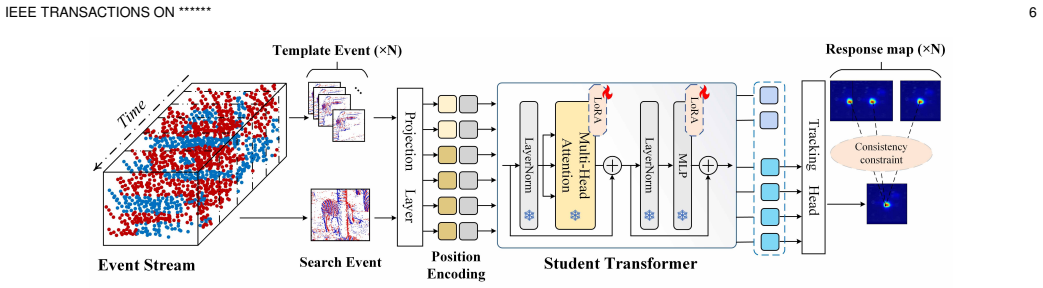
The load-bearing mechanism is the teacher-student distillation schedule. The teacher is a multi-modal/multi-view Transformer; the student is a lighter event-only Transformer with the same architecture. Knowledge is transferred as four matched objectives: similarity-matrix distillation from self-attention, feature-map distillation with mean squared error, response-map distillation with a Gaussian weighted focal loss, and temporal-Fourier distillation that applies a Fourier transform to softmaxed score maps of several sampled search frames so the student imitates the teacher's frequency-domain temporal relationships. At test time a low-rank adapter (LoRA) is tuned on the first few frames of each video, and an adaptive search-region module expands the crop by a factor of 1.5 when the overlap (IoU) between consecutive results stays below 0.5 for seven frames.
What would settle it
Run HDETrack V2 on a held-out set of EventVOT videos where the target is fully occluded or out of view in the first five frames, and compare with the version that skips test-time tuning; if the success rate on that subset does not exceed the no-tuning baseline, the pseudo-label assumption at the heart of the method is violated.
Extended reading notes
Core claim
The central discovery is that a unimodal, event-only Transformer can inherit rich multimodal knowledge through a hierarchy of distillation targets rather than through late fusion. A teacher Transformer is first trained on either RGB-plus-event or event-image-plus-event-voxel inputs, then frozen; a student Transformer that consumes only stacked event images is trained to match the teacher's per-layer similarity matrices, output features, response maps, and Fourier-transformed temporal score maps, alongside the standard tracking losses. At inference, the student is fine-tuned per video with a low-rank adapter (LoRA) using the tracker's own first-frame results as pseudo-labels, and an adaptive search region expands the crop when successive overlap scores stay low. On EventVOT the complete recipe reaches 59.0 success rate, 63.8 precision, and 74.9 normalized precision, with ablations attributing the gains to each distillation term and to test-time tuning and search-region expansion.
Load-bearing premise
The load-bearing premise is that the tracker's output on the first few frames of each test video is good enough to be used as ground truth for fine-tuning; if the target is already lost, occluded, or moving fast at the start, the tuning step reinforces wrong predictions, and the paper does not provide a safety check or failure analysis for that situation.
Editorial extensions
If this is right
- Event-only inference at test time keeps tracking accurate without needing RGB frames, so systems can drop the RGB sensor path and its alignment cost during deployment.
- Each distillation term pays off on EventVOT: the base tracker scores 55.4 success rate, and each added loss raises it, peaking at 57.8 with all four; adding test-time tuning and adaptive search then raises success rate to 59.0.
- The simple drift trigger—overlap below 0.5 for seven consecutive frames, then expand the search crop by 1.5—provides a low-cost recovery mechanism for fast-motion and out-of-view targets.
- EventVOT gives the field a 720p benchmark with 1,141 videos, 19 classes, and 14 challenge attributes, so future event trackers can be compared at a resolution closer to real deployments.
- Consistent gains on FE240hz, VisEvent, and FELT suggest the distillation-plus-tuning recipe transfers across event-camera resolutions and dataset scales.
Reading between the lines
- A testable extension: split EventVOT by whether the target is already lost or heavily occluded in the first five frames; if test-time tuning's contribution vanishes or reverses on that subset, the pseudo-label premise is the limiting factor.
- Because the teacher can use event-image plus event-voxel views when RGB is absent, the pipeline doubles as a general compression route from multi-sensor to single-sensor tracking, independent of paired RGB at test time.
- The temporal-Fourier distillation is a transferable recipe: any student that must learn temporal consistency from a teacher processing multiple frames could distill in the Fourier domain, which may help video tasks beyond tracking such as action recognition or segmentation.
- The reported speed drop from 105 to 35 frames per second indicates that per-video tuning trades latency for accuracy; a natural next step is a lighter variant that tunes fewer layers or fewer frames per video.
Editorial analysis
A structured set of objections, weighed in public.
Referee Report
Summary. The paper proposes HDETrack V2, an event-only visual tracker trained with hierarchical knowledge distillation from a multi-modal/multi-view teacher, adding temporal Fourier transform-based distillation, test-time tuning with LoRA, and an adaptive search region. It also introduces EventVOT, a large-scale 1280x720 event-camera tracking benchmark with 1141 videos, and reports experiments on EventVOT, FE240hz, VisEvent, and FELT. The central claim is that HDETrack V2 achieves 59.0 SR, 63.8 PR, and 74.9 NPR on EventVOT, surpassing all compared trackers on NPR and improving over HDETrack by +1.2/+1.6/+1.4.
Significance. The EventVOT dataset is a potentially valuable community resource: it is the first high-resolution event-tracking benchmark, includes 14 attribute annotations and 19 target classes, and the authors retrain more than 20 existing trackers to create a baseline suite. The method itself shows consistent positive increments for each added component in the ablations, so the core empirical narrative is plausible. The release of source code and benchmark is a strength. However, the headline comparison against prior trackers is confounded by an asymmetric evaluation protocol, and several important hyperparameters are selected using test-set metrics, so the claimed state-of-the-art result needs additional supporting experiments before it can be fully credited.
major comments (4)
- [§5.3, Table 3; §3.4] The central claim of surpassing all compared trackers on EventVOT NPR is not supported by a fair comparison. In Table 3, HDETrack V2 is evaluated with test-time tuning (TTT) and adaptive search region (ASR) enabled, while all 22 baselines are evaluated without any test-time adaptation. The +1.2/+1.6/+1.4 gains over HDETrack likewise compare TTT-augmented HDETrack V2 against the original HDETrack without TTT. To establish the claimed advantage, the authors should report HDETrack V2 without TTT/ASR, or apply the same TTT/ASR protocol to the strongest baselines (e.g., AQATrack, CiteTracker, EVPTrack, GRM). Without one of these, the reported NPR margin may be an artifact of the evaluation asymmetry rather than the algorithmic contributions.
- [§5.4, Fig. 6, Fig. 8, Table 9] Several load-bearing hyperparameters are selected by monitoring test-set metrics on EventVOT: the number of initial frames n for TTT, the LoRA rank r and alpha, the ASR expansion factor theta, the IoU threshold tau, and the consecutive-failure count k. Since the EventVOT training/validation/testing split has only 18 validation videos, tuning on the test set makes the reported 59.0/63.8/74.9 an optimistically biased estimate of generalization. The authors should either perform model selection on the 18-video validation split and then report test-set results, or clearly disclose that the reported numbers involve test-set validation and provide a variance or significance estimate.
- [§3.4, §5.4] The TTT stage assumes that the tracking results on the first n frames of each test video are reliable enough to use as pseudo-labels. The paper provides no failure analysis for the case where the target is already moving fast, occluded, or out of view at the start of a video, and no mechanism to detect or discard unreliable pseudo-labels. This is a real risk because such early-frame errors can be reinforced by self-training. The authors should add an attribute-conditioned analysis (e.g., among FM/OV/OC videos that begin with challenging conditions) or introduce a confidence filter for pseudo-labels, and report the impact on the TTT ablation.
- [§3.3.3, Eqs. (4)–(6)] The temporal Fourier transform distillation is not clearly defined. Eq. (6) is a two-dimensional discrete Fourier transform over spatial indices (M and N), not a transform over the temporal dimension that would establish a relationship between consecutive frames. The text first says the transform is applied to probability distributions of score maps and then says it converts frequency information into temporal information. This is confusing and technically unmotivated as written. Please clarify the exact operation, including the time axis, or revise the name and description if the method is actually a spatial spectral distillation on response maps.
minor comments (5)
- [§5.3, Table 4] The text states that "our baseline OSTrack achieves 60.0/89.7" and "HDETrack achieves 62.3/92.6" on FE240hz, but Table 4 lists OSTrack as 57.1/89.3 and HDETrack as 59.8/92.2. Please correct the mismatch between the prose and the table.
- [§5.3, Fig. 7] The visualization section says HDETrack V2 achieves optimal performance on SR and NPR, but Table 3 shows AQATrack has a higher SR (59.2 vs. 59.0). Please align the figure description with the quantitative table.
- [§5.4, Table 9] The runtime impact of TTT is not discussed; Table 3 shows FPS dropping from 105 (HDETrack) to 35 (HDETrack V2). Please provide a short runtime breakdown or explanation for this drop, since the paper highlights efficiency.
- [§3.3.3, Eq. (5)] The notation uses "i in [s, t]" for the score maps, but the text describes sampling one reference frame and n consecutive search frames; please define s and t and connect them to the number n used in the experiments.
- [§4.2] The validation split contains only 18 videos, which is very small for reliable hyperparameter selection; please state whether the reported ablations use these 18 videos or the test set, and consider increasing the validation split in the released version of the benchmark.
Circularity Check
No significant circularity: HDETrack V2's claims are empirical benchmark comparisons, not derivations from its own definitions.
full rationale
The paper's central claims are performance numbers on external test sets (EventVOT, FE240hz, VisEvent, FELT) obtained by training and inference, not quantities defined in terms of the outputs being predicted. The knowledge-distillation losses (Eqs. 1-6) are training objectives that transfer teacher features to the student; there is no equation in which the reported metric is equal by construction to an input. The test-time tuning stage (Sec. 3.4) does use the model's own early-frame outputs as pseudo-labels, but this is a self-supervised adaptation procedure: the final tracking result is not the pseudo-label by definition, and the gain reported in Table 8 is an empirical outcome, not a forced identity. Self-citation of HDETrack [14] appears only as a baseline comparison and as the predecessor of this extended version; it is not used to justify the core method or to forbid alternative choices. The main caveats - TTT and ASR applied only to HDETrack V2, and hyperparameters (theta, tau, k) selected on EventVOT test-set metrics - are evaluation-protocol and generalization concerns, not circularity, and are outside the circularity definition used here. The authors' Limitation Analysis (Sec. 5.6) acknowledges that challenge factors are not used in training, which is an honest scope statement rather than a circular step.
Assumptions & free parameters
free parameters (6)
- KD loss weights eta1..eta4 =
not reported
- Response distillation temperature tau =
2
- ASR expansion factor theta =
1.5
- ASR IoU threshold tau and failure count k =
0.5, 7
- LoRA rank r and alpha =
16, 32
- Number of initial frames n for TTT =
5
assumptions (4)
- domain assumption Stacking events into 2D event images and voxels preserves enough information for tracking.
- domain assumption Knowledge distilled from a multi-modal teacher transfers useful signal to an event-only student.
- domain assumption Tracking results from the first frames of each test video are accurate enough to use as pseudo-labels.
- ad hoc to paper The Fourier transform of response maps captures meaningful temporal relationships between frames.
Cite this review
Pith. "Pith review of Event Stream-based Visual Object Tracking: HDETrack V2 and A High-Definition Benchmark." pith.science (2026). https://pith.science/paper/FBYG2HCL
@misc{pith2026250205574,
  author       = {Pith},
  title        = {Pith review of: Event Stream-based Visual Object Tracking: HDETrack V2 and A High-Definition Benchmark},
  year         = {2026},
  howpublished = {\url{https://pith.science/paper/FBYG2HCL}},
  note         = {Machine review of arXiv:2502.05574}
}
read the original abstract
We then introduce a novel hierarchical knowledge distillation strategy that incorporates the similarity matrix, feature representation, and response map-based distillation to guide the learning of the student Transformer network. We also enhance the model's ability to capture temporal dependencies by applying the temporal Fourier transform to establish temporal relationships between video frames. We adapt the network model to specific target objects during testing via a newly proposed test-time tuning strategy to achieve high performance and flexibility in target tracking. Recognizing the limitations of existing event-based tracking datasets, which are predominantly low-resolution, we propose EventVOT, the first large-scale high-resolution event-based tracking dataset. It comprises 1141 videos spanning diverse categories such as pedestrians, vehicles, UAVs, ping pong, etc. Extensive experiments on both low-resolution (FE240hz, VisEvent, FELT), and our newly proposed high-resolution EventVOT dataset fully validated the effectiveness of our proposed method. Both the benchmark dataset and source code have been released on https://github.com/Event-AHU/EventVOT_Benchmark
Figures


Figures from the paper (8 more)


Forward citations
Cited by 1 Pith paper
-
E-TraMamba: A New Paradigm for Efficient Long-Term 3D Feature Tracking with Event Cameras
E-TraMamba applies linear state-space Mamba blocks with multi-cue token fusion and affine prediction to achieve SOTA long-term 3D event feature tracking and introduces the EvD-PointOdyssey dataset.
Reference graph
Works this paper leans on
-
[1]
Staple: Complementary learners for real-time tracking,
L. Bertinetto, J. Valmadre, S. Golodetz, O. Miksik, and P . H. Torr, “Staple: Complementary learners for real-time tracking,” in Proceedings of the IEEE conference on computer vision and pattern recognition, 2016, pp. 1401–1409
work page 2016
-
[2]
Unveiling the power of deep tracking,
G. Bhat, J. Johnander, M. Danelljan, F. S. Khan, and M. Felsberg, “Unveiling the power of deep tracking,” in Proceedings of the European conference on computer vision (ECCV), 2018, pp. 483–498
work page 2018
-
[3]
Siamese cascaded region proposal networks for real-time visual tracking,
H. Fan and H. Ling, “Siamese cascaded region proposal networks for real-time visual tracking,” in Proceedings of the IEEE/CVF confer- ence on computer vision and pattern recognition , 2019, pp. 7952–7961
work page 2019
-
[4]
Learning discriminative model prediction for tracking,
G. Bhat, M. Danelljan, L. V . Gool, and R. Timofte, “Learning discriminative model prediction for tracking,” in Proceedings of the IEEE/CVF international conference on computer vision , 2019, p. 6182–6191
work page 2019
-
[5]
Atom: Accurate tracking by overlap maximization,
M. Danelljan, G. Bhat, F. Shahbaz Khan, and M. Felsberg, “Atom: Accurate tracking by overlap maximization,” in Proceedings of the IEEE/CVF Conference on Computer Vision and Pattern Recognition , 2019, p. 4660–4669
work page 2019
-
[6]
Visual object tracking using adaptive correlation filters,
D. S. Bolme, J. R. Beveridge, B. A. Draper, and Y. M. Lui, “Visual object tracking using adaptive correlation filters,” in 2010 IEEE computer society conference on computer vision and pattern recognition. IEEE, 2010, pp. 2544–2550
work page 2010
-
[7]
Towards real-world visual tracking with temporal contexts,
Z. Cao, Z. Huang, L. Pan, S. Zhang, Z. Liu, and C. Fu, “Towards real-world visual tracking with temporal contexts,” IEEE Transac- tions on Pattern Analysis and Machine Intelligence , 2023
work page 2023
-
[8]
Mixformer: End-to-end tracking with iterative mixed attention,
Y. Cui, C. Jiang, G. Wu, and L. Wang, “Mixformer: End-to-end tracking with iterative mixed attention,” IEEE Transactions on Pattern Analysis and Machine Intelligence, 2024
work page 2024
Show all 78 references
-
[9]
Correlation-embedded transformer tracking: A single-branch framework,
F. Xie, W. Yang, C. Wang, L. Chu, Y. Cao, C. Ma, and W. Zeng, “Correlation-embedded transformer tracking: A single-branch framework,” IEEE Transactions on Pattern Analysis and Machine Intelligence, 2024
2024
-
[10]
Divert more attention to vision-language object tracking,
M. Guo, Z. Zhang, L. Jing, H. Ling, and H. Fan, “Divert more attention to vision-language object tracking,” IEEE Transactions on Pattern Analysis and Machine Intelligence, 2024
2024
-
[11]
Textureless deformable object tracking with invisible markers,
X. Li, Y. Guo, Y. Tu, Y. Ji, Y. Liu, J. Ye, and C. Zheng, “Textureless deformable object tracking with invisible markers,” IEEE Transac- tions on Pattern Analysis and Machine Intelligence , 2024
2024
-
[12]
Hardvs: Revisiting human activity recognition with dynamic vision sensors,
X. Wang, Z. Wu, B. Jiang, Z. Bao, L. Zhu, G. Li, Y. Wang, and Y. Tian, “Hardvs: Revisiting human activity recognition with dynamic vision sensors,” in Proceedings of the AAAI Conference on Artificial Intelligence, vol. 38, no. 6, 2024, pp. 5615–5623
2024
-
[13]
Sodformer: Streaming object detection with transformer using events and frames,
D. Li, Y. Tian, and J. Li, “Sodformer: Streaming object detection with transformer using events and frames,” IEEE Transactions on Pattern Analysis and Machine Intelligence, vol. 45, no. 11, pp. 14 020– 14 037, 2023
2023
-
[14]
Event stream-based visual object tracking: A high-resolution benchmark dataset and a novel baseline,
X. Wang, S. Wang, C. Tang, L. Zhu, B. Jiang, Y. Tian, and J. Tang, “Event stream-based visual object tracking: A high-resolution benchmark dataset and a novel baseline,” in Proceedings of the IEEE/CVF Conference on Computer Vision and Pattern Recognition , 2024, pp. 19 248–19 257
2024
-
[15]
Visevent: Reliable object tracking via collaboration of frame and event flows,
X. Wang, J. Li, L. Zhu, Z. Zhang, Z. Chen, X. Li, Y. Wang, Y. Tian, and F. Wu, “Visevent: Reliable object tracking via collaboration of frame and event flows,” IEEE transactions on cybernetics , vol. 54, no. 3, pp. 1997–2010, 2024
1997
-
[16]
Mamba-fetrack: Frame-event tracking via state space model,
J. Huang, S. Wang, S. Wang, Z. Wu, X. Wang, and B. Jiang, “Mamba-fetrack: Frame-event tracking via state space model,” in Chinese Conference on Pattern Recognition and Computer Vision (PRCV). Springer, 2024, pp. 3–18
2024
-
[17]
Frame-event alignment and fusion network for high frame rate tracking,
J. Zhang, Y. Wang, W. Liu, M. Li, J. Bai, B. Yin, and X. Yang, “Frame-event alignment and fusion network for high frame rate tracking,” in Proceedings of the IEEE/CVF Conference on Computer Vision and Pattern Recognition, 2023, pp. 9781–9790
2023
-
[18]
Object track- ing by jointly exploiting frame and event domain,
J. Zhang, X. Yang, Y. Fu, X. Wei, B. Yin, and B. Dong, “Object track- ing by jointly exploiting frame and event domain,” in Proceedings of the IEEE/CVF International Conference on Computer Vision , 2021, pp. 13 043–13 052
2021
-
[19]
Spiking transformers for event-based single object tracking,
J. Zhang, B. Dong, H. Zhang, J. Ding, F. Heide, B. Yin, and X. Yang, “Spiking transformers for event-based single object tracking,” in Proceedings of the IEEE/CVF conference on Computer Vision and Pattern Recognition, 2022, pp. 8801–8810
2022
-
[20]
Learning graph-embedded key- event back-tracing for object tracking in event clouds,
Z. Zhu, J. Hou, and X. Lyu, “Learning graph-embedded key- event back-tracing for object tracking in event clouds,”Advances in Neural Information Processing Systems, vol. 35, pp. 7462–7476, 2022
2022
-
[21]
Data- driven feature tracking for event cameras,
N. Messikommer, C. Fang, M. Gehrig, and D. Scaramuzza, “Data- driven feature tracking for event cameras,” in Proceedings of the IEEE/CVF Conference on Computer Vision and Pattern Recognition , 2023, pp. 5642–5651
2023
-
[22]
Joint feature learning and relation modeling for tracking: A one-stream framework,
B. Ye, H. Chang, B. Ma, and S. Shan, “Joint feature learning and relation modeling for tracking: A one-stream framework,” in European Conference on Computer Vision, 2022
2022
-
[23]
Revisiting color-event based tracking: A unified network, dataset, and metric,
C. Tang, X. Wang, J. Huang, B. Jiang, L. Zhu, J. Zhang, Y. Wang, and Y. Tian, “Revisiting color-event based tracking: A unified network, dataset, and metric,” arXiv preprint arXiv:2211.11010 , 2022
2022 arXiv
-
[24]
Long-term frame-event visual tracking: Benchmark dataset and baseline,
X. Wang, J. Huang, S. Wang, C. Tang, B. Jiang, Y. Tian, J. Tang, and B. Luo, “Long-term frame-event visual tracking: Benchmark dataset and baseline,” arXiv preprint arXiv:2403.05839, 2024
2024 arXiv
-
[25]
Event-guided structured output tracking of fast-moving objects using a celex sensor,
J. Huang, S. Wang, M. Guo, and S. Chen, “Event-guided structured output tracking of fast-moving objects using a celex sensor,” IEEE Transactions on Circuits and Systems for Video Technology , vol. 28, no. 9, pp. 2413–2417, 2018
2018
-
[26]
Asynchronous tracking-by-detection on adaptive time surfaces for event-based object tracking,
H. Chen, Q. Wu, Y. Liang, X. Gao, and H. Wang, “Asynchronous tracking-by-detection on adaptive time surfaces for event-based object tracking,” in Proceedings of the 27th ACM International Con- ference on Multimedia, 2019, pp. 473–481
2019
-
[27]
Eklt: Asyn- chronous photometric feature tracking using events and frames,
D. Gehrig, H. Rebecq, G. Gallego, and D. Scaramuzza, “Eklt: Asyn- chronous photometric feature tracking using events and frames,” IEEE TRANSACTIONS ON ****** 15 International Journal of Computer Vision, vol. 128, no. 3, pp. 601–618, 2020
2020
-
[28]
Visual prompt multi-modal tracking,
J. Zhu, S. Lai, X. Chen, D. Wang, and H. Lu, “Visual prompt multi-modal tracking,” in Proceedings of the IEEE/CVF Conference on Computer Vision and Pattern Recognition, 2023, pp. 9516–9526
2023
-
[29]
Learning from images: A distillation learning framework for event cameras,
Y. Deng, H. Chen, H. Chen, and Y. Li, “Learning from images: A distillation learning framework for event cameras,” IEEE Transac- tions on Image Processing, vol. 30, pp. 4919–4931, 2021
2021
-
[30]
Distilled siamese networks for visual tracking,
J. Shen, Y. Liu, X. Dong, X. Lu, F. S. Khan, and S. Hoi, “Distilled siamese networks for visual tracking,” IEEE Transactions on Pattern Analysis and Machine Intelligence , vol. 44, no. 12, pp. 8896–8909, 2021
2021
-
[31]
Teacher- student knowledge distillation for real-time correlation tracking,
Q. Chen, B. Zhong, Q. Liang, Q. Deng, and X. Li, “Teacher- student knowledge distillation for real-time correlation tracking,” Neurocomputing, vol. 500, pp. 537–546, 2022
2022
-
[32]
Ensemble learning with siamese networks for visual tracking,
J. Zhuang, Y. Dong, and H. Bai, “Ensemble learning with siamese networks for visual tracking,” Neurocomputing, vol. 464, pp. 497– 506, 2021
2021
-
[33]
Unsupervised cross-modal distillation for thermal infrared tracking,
J. Sun, L. Zhang, Y. Zha, A. Gonzalez-Garcia, P . Zhang, W. Huang, and Y. Zhang, “Unsupervised cross-modal distillation for thermal infrared tracking,” in Proceedings of the 29th ACM International Conference on Multimedia, 2021, pp. 2262–2270
2021
-
[34]
Real-time corre- lation tracking via joint model compression and transfer,
N. Wang, W. Zhou, Y. Song, C. Ma, and H. Li, “Real-time corre- lation tracking via joint model compression and transfer,” IEEE Transactions on Image Processing, vol. 29, pp. 6123–6135, 2020
2020
-
[35]
Distillation, ensemble and selection for building a better and faster siamese based tracker,
S. Zhao, T. Xu, X.-J. Wu, and J. Kittler, “Distillation, ensemble and selection for building a better and faster siamese based tracker,” IEEE transactions on circuits and systems for video technology , 2022
2022
-
[36]
Distilling channels for efficient deep tracking,
S. Ge, Z. Luo, C. Zhang, Y. Hua, and D. Tao, “Distilling channels for efficient deep tracking,” IEEE Transactions on Image Processing , vol. 29, pp. 2610–2621, 2019
2019
-
[37]
Mixformerv2: Efficient fully transformer tracking,
Y. Cui, T. Song, G. Wu, and L. Wang, “Mixformerv2: Efficient fully transformer tracking,” Advances in Neural Information Processing Systems, vol. 36, 2024
2024
-
[38]
Test-time training with self-supervision for generalization under distribution shifts,
Y. Sun, X. Wang, Z. Liu, J. Miller, A. Efros, and M. Hardt, “Test-time training with self-supervision for generalization under distribution shifts,” in International conference on machine learning . PMLR, 2020, pp. 9229–9248
2020
-
[39]
Online domain adaptation of a pre-trained cascade of classifiers,
V . Jain and E. Learned-Miller, “Online domain adaptation of a pre-trained cascade of classifiers,” in CVPR 2011. IEEE, 2011, pp. 577–584
2011
-
[40]
Online model distillation for efficient video inference,
R. T. Mullapudi, S. Chen, K. Zhang, D. Ramanan, and K. Fata- halian, “Online model distillation for efficient video inference,” in Proceedings of the IEEE/CVF International conference on computer vision, 2019, pp. 3573–3582
2019
-
[41]
Mystyle: A personalized generative prior,
Y. Nitzan, K. Aberman, Q. He, O. Liba, M. Yarom, Y. Gandelsman, I. Mosseri, Y. Pritch, and D. Cohen-Or, “Mystyle: A personalized generative prior,” ACM Transactions on Graphics (TOG) , vol. 41, no. 6, pp. 1–10, 2022
2022
-
[42]
“zero-shot
A. Shocher, N. Cohen, and M. Irani, ““zero-shot” super-resolution using deep internal learning,” in Proceedings of the IEEE conference on computer vision and pattern recognition , 2018, pp. 3118–3126
2018
-
[43]
Learning to adapt for stereo,
A. Tonioni, O. Rahnama, T. Joy, L. D. Stefano, T. Ajanthan, and P . H. Torr, “Learning to adapt for stereo,” in Proceedings of the IEEE/CVF Conference on Computer Vision and Pattern Recognition , 2019, pp. 9661–9670
2019
-
[44]
Real- time self-adaptive deep stereo,
A. Tonioni, F. Tosi, M. Poggi, S. Mattoccia, and L. D. Stefano, “Real- time self-adaptive deep stereo,” in Proceedings of the IEEE/CVF conference on computer vision and pattern recognition , 2019, pp. 195– 204
2019
-
[45]
Online depth learning against forgetting in monocular videos,
Z. Zhang, S. Lathuiliere, E. Ricci, N. Sebe, Y. Yan, and J. Yang, “Online depth learning against forgetting in monocular videos,” in Proceedings of the IEEE/CVF Conference on Computer Vision and Pattern Recognition, 2020, pp. 4494–4503
2020
-
[46]
Recovery guarantees for one-hidden-layer neural networks,
K. Zhong, Z. Song, P . Jain, P . L. Bartlett, and I. S. Dhillon, “Recovery guarantees for one-hidden-layer neural networks,” in International conference on machine learning. PMLR, 2017, pp. 4140– 4149
2017
-
[47]
Open-world stereo video matching with deep rnn,
Y. Zhong, H. Li, and Y. Dai, “Open-world stereo video matching with deep rnn,” in Proceedings of the European Conference on Com- puter Vision (ECCV), 2018, pp. 101–116
2018
-
[48]
Test-time training with masked autoencoders,
Y. Gandelsman, Y. Sun, X. Chen, and A. Efros, “Test-time training with masked autoencoders,” Advances in Neural Information Pro- cessing Systems, vol. 35, pp. 29 374–29 385, 2022
2022
-
[49]
Test-time training on video streams,
R. Wang, Y. Sun, Y. Gandelsman, X. Chen, A. A. Efros, and X. Wang, “Test-time training on video streams,” arXiv preprint arXiv:2307.05014, 2023
2023 arXiv
-
[50]
Actmad: Activation matching to align distributions for test-time-training,
M. J. Mirza, P . J. Soneira, W. Lin, M. Kozinski, H. Possegger, and H. Bischof, “Actmad: Activation matching to align distributions for test-time-training,” in Proceedings of the IEEE/CVF Conference on Computer Vision and Pattern Recognition, 2023, pp. 24 152–24 161
2023
-
[51]
Depth- aware test-time training for zero-shot video object segmentation,
W. Liu, X. Shen, H. Li, X. Bi, B. Liu, C.-M. Pun, and X. Cun, “Depth- aware test-time training for zero-shot video object segmentation,” in Proceedings of the IEEE/CVF Conference on Computer Vision and Pattern Recognition, 2024, pp. 19 218–19 227
2024
-
[52]
Cornernet: Detecting objects as paired keypoints,
H. Law and J. Deng, “Cornernet: Detecting objects as paired keypoints,” in Proceedings of the European conference on computer vision (ECCV), 2018, pp. 734–750
2018
-
[53]
Au- toregressive queries for adaptive tracking with spatio-temporal transformers,
J. Xie, B. Zhong, Z. Mo, S. Zhang, L. Shi, S. Song, and R. Ji, “Au- toregressive queries for adaptive tracking with spatio-temporal transformers,” in Proceedings of the IEEE/CVF Conference on Com- puter Vision and Pattern Recognition, 2024, pp. 19 300–19 309
2024
-
[54]
Tc- track: Temporal contexts for aerial tracking,
Z. Cao, Z. Huang, L. Pan, S. Zhang, Z. Liu, and C. Fu, “Tc- track: Temporal contexts for aerial tracking,” in Proceedings of the IEEE/CVF conference on computer vision and pattern recognition, 2022, pp. 14 798–14 808
2022
-
[55]
LoRA: Low-rank adaptation of large language models,
E. J. Hu, Y. Shen, P . Wallis, Z. Allen-Zhu, Y. Li, S. Wang, L. Wang, and W. Chen, “LoRA: Low-rank adaptation of large language models,” in International Conference on Learning Representations , 2022
2022
-
[56]
Learning spatial-frequency transformer for visual object tracking,
C. Tang, X. Wang, Y. Bai, Z. Wu, J. Zhang, and Y. Huang, “Learning spatial-frequency transformer for visual object tracking,” IEEE Transactions on Circuits and Systems for Video Technology , vol. 33, no. 9, pp. 5102–5116, 2023
2023
-
[57]
Tracking by joint local and global search: A target-aware attention-based ap- proach,
X. Wang, J. Tang, B. Luo, Y. Wang, Y. Tian, and F. Wu, “Tracking by joint local and global search: A target-aware attention-based ap- proach,” IEEE transactions on neural networks and learning systems , vol. 33, no. 11, pp. 6931–6945, 2021
2021
-
[58]
Probabilistic regression for visual tracking,
M. Danelljan, L. V . Gool, and R. Timofte, “Probabilistic regression for visual tracking,” in Proceedings of the IEEE/CVF conference on computer vision and pattern recognition, 2019, p. 7183–7192
2019
-
[59]
Know your surroundings: Exploiting scene information for object tracking,
G. Bhat, M. Danelljan, L. Van Gool, and R. Timofte, “Know your surroundings: Exploiting scene information for object tracking,” in European Conference on Computer Vision, 2020, p. 205–221
2020
-
[60]
Trans- former tracking,
X. Chen, J. Yan, Bin Zhu, D. Wang, X. Yang, and H. Lu, “Trans- former tracking,” in Proceedings of the IEEE/CVF Conference on Computer Vision and Pattern Recognition, 2021, p. 8126–8135
2021
-
[61]
Backbone is all your need: A simplified architecture for visual object tracking,
B. Chen, P . Li, L. Bai, L. Qiao, Q. Shen, B. Li, W. Gan, W. Wu, and W. Ouyang, “Backbone is all your need: A simplified architecture for visual object tracking,” in European Conference on Computer Vision, 2021, p. 375–392
2021
-
[62]
Aiatrack: Attention in attention for transformer visual tracking,
S. Gao, C. Zhou, C. Ma, X. Wang, and J. Yuan, “Aiatrack: Attention in attention for transformer visual tracking,” in European Confer- ence on Computer Vision, 2022, p. 146–164
2022
-
[63]
Learning spatio- temporal transformer for visual tracking,
B. Yan, H. Peng, J. Fu, D. Wang, and H. Lu, “Learning spatio- temporal transformer for visual tracking,” in Proceedings of the IEEE/CVF International Conference on Computer Vision , 2021, p. 10448–10457
2021
-
[64]
Transforming model prediction for tracking,
C. Mayer, M. Danelljan, G. Bhat, M. Paul, D. P . Paudel, F. Yu, and L. V . Gool, “Transforming model prediction for tracking,” in Proceedings of the IEEE/CVF Conference on Computer Vision and Pattern Recognition, 2022, p. 8731–8740
2022
-
[65]
Mixformer: End-to- end tracking with iterative mixed attention,
Y. Cui, C. Jiang, L. Wang, and W. Gangshan, “Mixformer: End-to- end tracking with iterative mixed attention,” in Proceedings of the IEEE/CVF Conference on Computer Vision and Pattern Recognition , 2022, p. 13608–13618
2022
-
[66]
Transformer meets tracker: Exploiting temporal context for robust visual tracking,
N. Wang, W. Zhou, J. Wang, and H. Li, “Transformer meets tracker: Exploiting temporal context for robust visual tracking,” in Proceedings of the IEEE/CVF Conference on Computer Vision and Pattern Recognition, 2021, p. 1571–1580
2021
-
[67]
Robust object modeling for visual tracking,
Y. Cai, J. Liu, J. Tang, and G. Wu, “Robust object modeling for visual tracking,” in Proceedings of the IEEE/CVF International Conference on Computer Vision, 2023, pp. 9589–9600
2023
-
[68]
Citetracker: Correlating image and text for visual tracking,
X. Li, Y. Huang, Z. He, Y. Wang, H. Lu, and M.-H. Yang, “Citetracker: Correlating image and text for visual tracking,” in Proceedings of the IEEE/CVF International Conference on Computer Vision, 2023, pp. 9974–9983
2023
-
[69]
Autoregressive visual tracking,
X. Wei, Y. Bai, Y. Zheng, D. Shi, and Y. Gong, “Autoregressive visual tracking,” in Proceedings of the IEEE/CVF Conference on Computer Vision and Pattern Recognition, 2023, pp. 9697–9706
2023
-
[70]
Odtrack: Online dense temporal token learning for visual tracking,
Y. Zheng, B. Zhong, Q. Liang, Z. Mo, S. Zhang, and X. Li, “Odtrack: Online dense temporal token learning for visual tracking,” in Proceedings of the AAAI Conference on Artificial Intelligence , vol. 38, no. 7, 2024, pp. 7588–7596. 16
2024
-
[71]
Explicit visual prompts for visual object tracking,
L. Shi, B. Zhong, Q. Liang, N. Li, S. Zhang, and X. Li, “Explicit visual prompts for visual object tracking,” in Proceedings of the AAAI Conference on Artificial Intelligence , vol. 38, no. 5, 2024, pp. 4838–4846
2024
-
[72]
Artrackv2: Prompting autoregressive tracker where to look and how to describe,
Y. Bai, Z. Zhao, Y. Gong, and X. Wei, “Artrackv2: Prompting autoregressive tracker where to look and how to describe,” in Proceedings of the IEEE/CVF Conference on Computer Vision and Pattern Recognition, 2024, pp. 19 048–19 057
2024
-
[73]
Tracking meets lora: Faster training, larger model, stronger performance,
L. Lin, H. Fan, Z. Zhang, Y. Wang, Y. Xu, and H. Ling, “Tracking meets lora: Faster training, larger model, stronger performance,” in European Conference on Computer Vision . Springer, 2024, pp. 300–318
2024
-
[74]
Decoupled weight decay regulariza- tion,
I. Loshchilov and F. Hutter, “Decoupled weight decay regulariza- tion,” in International Conference on Learning Representations, 2018
2018
-
[75]
Pytorch: An im- perative style, high-performance deep learning library,
A. Paszke, S. Gross, F. Massa, A. Lerer, J. Bradbury, G. Chanan, T. Killeen, Z. Lin, N. Gimelshein, L. Antiga et al., “Pytorch: An im- perative style, high-performance deep learning library,” Advances in neural information processing systems, vol. 32, 2019
2019
-
[76]
Generalized relation modeling for transformer tracking,
S. Gao, C. Zhou, and J. Zhang, “Generalized relation modeling for transformer tracking,” in Proceedings of the IEEE/CVF Conference on Computer Vision and Pattern Recognition, 2023, pp. 18 686–18 695
2023
-
[77]
Pytracking: Visual tracking library based on pytorch,
M. Danelljan, G. Bhat, and C. Mayer, “Pytracking: Visual tracking library based on pytorch,” 2019
2019
-
[78]
Hiptrack: Visual tracking with historical prompts,
W. Cai, Q. Liu, and Y. Wang, “Hiptrack: Visual tracking with historical prompts,” in Proceedings of the IEEE/CVF Conference on Computer Vision and Pattern Recognition, 2024, pp. 19 258–19 267
2024
Reviewed August 8, 2026 · model on record in the stance chip above.
Discussion (0). Continue with ORCID to comment.