REVIEW 4 major objections 5 minor 38 references
Physics-Guided Foundation Model for Scientific Discovery: An Application to Aquatic Science
T0 review · 4 major / 5 minor · reviewed 2026-08-08 · deepseek-v4-flash
Pith's one-line read Pre-training a sequence model on physics-simulator outputs and fine-tuning it with conservation-law penalties yields lower error for lake water temperature and dissolved oxygen than physics-based models or standard ML baselines, even when…
desk verdict A solid, well-scaled integration of simulated pretraining, evolutionary feature selection, and physics-loss fine-tuning for lake modeling; the physical-consistency claim is partly circular and needs stronger baselines, but the work deserves serious review. read the letter →
The pith
A machine-rendered reading of the paper's core claim, the machinery that carries it, and where it could break.
The reading
What carries the argument
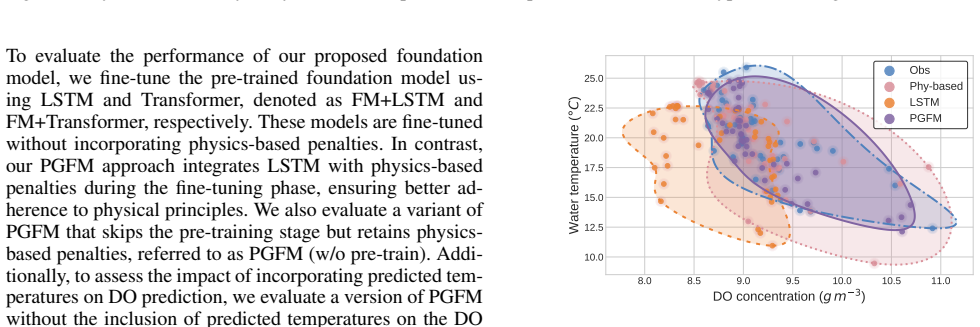
The machinery has three coupled parts. Pre-training happens in a simulated environmental system: the General Lake Model supplies heat-flux and temperature labels, and the dissolved-oxygen model of Ladwig et al. supplies oxygen-flux labels, producing a large corpus of variables not available from real sensors. An LSTM backbone (Transformer variants are also tested) is trained on this corpus with an evolutionary feature-interaction selector: relevance parameters $\alpha$ and $\beta$ are learned by regularized dual averaging, and interactions with low relevance are mutated or recombined across a population, so the model keeps only feature pairs such as depth-by-area or weather-by-volume that help multiple prediction tasks. Fine-tuning then minimizes $L_{\mathrm{ML}} + \lambda_{\mathrm{PHY}} L_{\mathrm{PHY}}$, where the physical loss penalizes deviations from energy conservation, $\Delta U_t - F_E$, and from dissolved-oxygen mass conservation, including thermocline entrainment and volume changes, with tolerance thresholds $\tau_{\mathrm{EC}}$ and $\tau_{\mathrm{MC}}$. The DO branch receives the model's own predicted temperature as an input, which makes the coupling between the two tasks explicit.
What would settle it
A sharp test would be to take a set of lakes where independent flux measurements show the simulator's heat or oxygen budget is biased by a known amount, fine-tune PGFM on those lakes, and compare its predictions with the biased simulator and with the independent measurements; if the model tracks the biased simulator more closely than an unregularized LSTM does, the physics constraint is transmitting simulator bias rather than correcting it.
Extended reading notes
Core claim
On the paper's own terms, the central claim is that the limiting factor for foundation models in lake systems is not architecture but training signal: pre-training a sequence model on a simulated environmental system, where physics-based models generate abundant labels across diverse lake morphologies, weather, and trophic states, lets the model learn broadly transferable feature interactions, and fine-tuning it with physics-based penalties keeps those interactions physically honest. The paper reports that PGFM's root-mean-square error for water temperature is 1.953 degrees Celsius in summer and 1.365 from fall to spring, compared with 2.795 and 1.624 for the physics-based model, with analogous gains for dissolved oxygen in the epilimnion, hypolimnion, and mixed periods. It also reports that PGFM sits closest to the origin on plots of RMSE versus physical inconsistency, and that its predicted temperature-oxygen pairs follow the expected solubility relationship better than an unregularized LSTM.
Load-bearing premise
The load-bearing premise is that the physics-based simulator's flux equations—heat gains and losses, oxygen production and consumption, lake volumes—are accurate enough that using them both as pre-training labels and as conservation-loss penalties does more good than harm, since any systematic simulator bias would be pulled into the model and the tolerance thresholds for conservation violations are not reported.
Editorial extensions
If this is right
- Sparse monitoring networks become usable: the same pre-trained model can be fine-tuned for individual lakes with relatively few observed temperature and oxygen records, so under-observed lakes no longer have to be treated as separate small-data problems.
- Coupled physical variables reinforce each other: feeding predicted temperature into the DO branch improves prediction, so modeling temperature and oxygen jointly is better than treating them as independent tasks.
- Physics consistency is enforced even where no observations exist: the physical loss needs no observed labels, so it can be applied continuously across all dates and depth layers, not only at measurement points.
- The recipe is architecture-agnostic: pre-training on simulator outputs improved both LSTM and Transformer backbones, suggesting the approach does not depend on a specific network design and can transfer to other scientific fields with physics-based simulators.
Reading between the lines
- Because the pre-training labels and the flux formulas in the physical losses come from the same simulators, PGFM's reported gains should be read as conditional on those simulators being reasonable; a direct test would be to perturb the simulator's oxygen-demand parameter and see whether the model's hypolimnion predictions track the perturbed bias.
- The gene maps produced by the evolutionary selector, which rank feature interactions by relevance, could be read as scientific hypotheses about which watershed or weather features drive lake oxygen dynamics, not just as a predictive tuning device.
- A natural extension not pursued here is a cold-start test: fine-tune on neighboring lakes only and check whether the physical loss alone keeps a lake with zero local observations physically consistent.
Editorial analysis
A structured set of objections, weighed in public.
Referee Report
Summary. The paper proposes PGFM, a physics-guided foundation model for predicting lake water temperature and dissolved oxygen (DO) concentrations. PGFM first pre-trains an LSTM-based feature-interaction selection model on labels generated by physics-based simulators (GLM and the DO model of Ladwig et al. 2022), using an evolution-based search over feature-pair operations. It then fine-tunes the model on real observations with an added physics loss that penalizes violations of energy and mass conservation. The authors evaluate PGFM on 117 Midwestern USA lakes over 1979-2019, reporting lower RMSE than physics-based models, standard ML baselines, and several ablations, and they argue that PGFM also achieves better physical consistency.
Significance. If the results hold, the paper offers a practical recipe for combining large-scale simulated pre-training with physics-constrained fine-tuning in data-scarce environmental applications. The evaluation scale is a genuine strength: 117 lakes, 41 years, about 1.75 million daily records, and the code is released. The ablations (pre-training vs. no pre-training, physics loss vs. no physics loss, predicted temperature vs. none) help separate mechanisms. However, the advertised physical-consistency advantage is supported only by a metric that largely duplicates the training loss, and the absence of state-of-the-art PGML baselines tempers the significance of the empirical claims.
major comments (4)
- [Fine-tuning Stage; RQ3 (Fig. 6)] The physical-consistency claim in RQ3 is not backed by an independent metric. The energy and mass inconsistency indices in Fig. 6 correspond to the same absolute residuals that define L_PHY: the fine-tuning loss is L_PHY = Σ_t ReLU(|ΔU_t − F_E| − τ_EC) for temperature and L_PHY = Σ_t ReLU(|DO_t − \tilde{DO}_t| − τ_MC) for dissolved oxygen. Because PGFM is trained with gradients on these residuals, Fig. 6 measures how well each method fits the same flux parameterizations used in training, not whether the predictions are physically faithful in an external sense. The statement that physics-based models are excluded because they inherently exhibit zero physical inconsistency reinforces that the index is a model-consistency diagnostic rather than an independent physical check. The authors should validate physical consistency with a diagnostic not used in the loss (e.g., observed stratification metrics or a conserved quantity not in the training objective) and report the raw residuals before ReLU clipping.
- [Fine-tuning Stage; Pre-training Stage] The strength of the physics regularization cannot be assessed because the key hyperparameters are not reported. The values of τ_EC and τ_MC determine whether the ReLU terms in L_PHY are active at all; without them, a reader cannot tell whether the physical loss is a hard constraint or effectively zero. Likewise, λ_PHY and the evolution-based feature-selection parameters (population size n, mutation probability σ, mutation interval τ, relevance threshold λ) are omitted. Reporting these values is necessary to separate the contribution of the physics penalties from the contribution of the pre-training and feature-selection procedure and to reproduce the experiments.
- [Baselines; Table 1] The baseline set omits the closest PGML alternatives, so the paper's positioning against existing physics-guided ML is not empirically established. The paper cites process-guided deep learning (Read et al. 2019), physics-guided RNNs (Jia et al. 2019b), and adaptive process-guided learning (Yu et al. 2024b), but none of these is included in Table 1. At least one PGML method that applies physics-based penalties or a physics-based architecture on the same data should be compared, so that the contribution of the foundation-model pre-training can be isolated from the contribution of the physical loss.
- [Data Preparation; Performance comparison (RQ1)] The evaluation protocol is underspecified. The paper does not state how the 117 lakes and 41 years are divided into training, validation, and test sets, whether test lakes are held out during fine-tuning, or how hyperparameters are selected. Because the claimed advantage includes generalization to sparsely observed lakes, the absence of a clear data-partitioning rule makes the out-of-sample results impossible to reconstruct. The authors should specify the split (e.g., temporal holdout, lake-wise holdout) and report test performance on held-out lakes separately from any lakes used during pre-training or fine-tuning.
minor comments (5)
- [Pre-training Stage] The phrase 'pre-training overabundant representative data samples' appears to be a typo; it should read 'pre-training over an overabundance of representative data samples' or similar.
- [Fig. 6] The caption of Fig. 6 does not define the axes; please label the horizontal and vertical quantities and state how 'energy inconsistency' and 'mass inconsistency' are computed.
- [Table 1] The gains of PGFM over FM+LSTM are modest in several columns (e.g., summer temperature 1.953 vs. 2.003), and no significance tests are reported; please provide confidence intervals or pairwise tests.
- [Problem Formulation] The mathematical notation such as 'xxxd,t' and 'T d t' appears to be broken LaTeX; please use consistent bold vector notation.
- [RQ4; Fig. 8] The gene-map analysis is qualitative; it would be useful to state whether the selected feature interactions are stable across the five runs and whether they differ across lake types.
Circularity Check
The physical-consistency result (RQ3, Fig. 6) is evaluated with the same residual that L_PHY minimizes during fine-tuning, so this advertised advantage is forced by the objective rather than independently verified.
-
fitted input called prediction
[Fine-tuning Stage (physical loss equations) and Experimental Evaluation, RQ3, Fig. 6]
"we define the physical loss based on energy conservation, as LPHY = P t ReLU (|∆Ut − FE| − τEC) ... we define the physical loss as LPHY = P t ReLU (| ˆDOt − ˜DOt| −τMC) ... Figure 6 displays the RMSE and physical inconsistency metrics (i.e., energy and mass inconsistency) for each method’s predictions."
The fine-tuning objective L_PHY is the same residual that Fig. 6 reports as 'energy and mass inconsistency': PGFM is trained with gradient penalties on |ΔU_t − F_E| and |RDO_t − RDO_t|, and then these same residuals (computed with the same GLM/Ladwig flux parameterizations used for pre-training labels and physics-based baselines) are presented as evidence of superior physical consistency over baselines never optimized with L_PHY. The lower inconsistency is expected by construction, so RQ3 does not independently validate physical faithfulness. The unreported tolerance thresholds τ_EC and τ_MC additionally mean the effective constraint strength is unknown. The RMSE results against real observations remain independent, but the physical-consistency advantage is not.
full rationale
The paper's central RMSE claim is not circular: performance is measured against real observed lake temperatures and DO concentrations, providing external ground truth. Pre-training on physics-based simulations and regularizing with conservation equations is a legitimate PGML strategy, and the cited GLM and Ladwig et al. (2022) models are published, externally grounded simulators rather than unverified self-citations. However, the paper's separate advertised advantage of 'physical consistency' (RQ3, Fig. 6) is evaluated with the same energy and mass residuals that constitute the fine-tuning loss L_PHY, including the same flux formulas that generated the pre-training labels and define the physics-based baselines. A model trained to minimize those exact residuals will naturally score lower on that metric than baselines that never optimized it, so Fig. 6 cannot discriminate between genuine physical fidelity and mere optimization of the reported metric. The missing tolerance thresholds further obscure the comparison. This is a partial circularity affecting one load-bearing claim, while the main prediction benchmark remains independent.
Assumptions & free parameters
free parameters (4)
- λ_PHY (physical loss weight)
- τ_EC (energy conservation tolerance)
- τ_MC (mass conservation tolerance)
- Evolution algorithm hyperparameters
assumptions (4)
- domain assumption The energy balance equation ΔU_t = R_SW(1-α_SW) + R_LWin(1-α_LW) - R_LWout - E - H holds for the modeled lakes.
- domain assumption The DO mass balance equations (including F_EXO and F_ENT) for epilimnion, hypolimnion, and total DO are accurate.
- domain assumption Pre-training on simulated data from physics-based models transfers positively to real-world lake prediction.
- domain assumption The physics-based models (GLM and Ladwig et al. DO model) generate realistic simulated variables representative of diverse lakes.
Cite this review
Pith. "Pith review of Physics-Guided Foundation Model for Scientific Discovery: An Application to Aquatic Science." pith.science (2026). https://pith.science/paper/2TDVLISE
@misc{pith2026250206084,
  author       = {Pith},
  title        = {Pith review of: Physics-Guided Foundation Model for Scientific Discovery: An Application to Aquatic Science},
  year         = {2026},
  howpublished = {\url{https://pith.science/paper/2TDVLISE}},
  note         = {Machine review of arXiv:2502.06084}
}
read the original abstract
Physics-guided machine learning (PGML) has become a prevalent approach in studying scientific systems due to its ability to integrate scientific theories for enhancing machine learning (ML) models. However, most PGML approaches are tailored to isolated and relatively simple tasks, which limits their applicability to complex systems involving multiple interacting processes and numerous influencing features. In this paper, we propose a \textit{\textbf{P}hysics-\textbf{G}uided \textbf{F}oundation \textbf{M}odel (\textbf{PGFM})} that combines pre-trained ML models and physics-based models and leverages their complementary strengths to improve the modeling of multiple coupled processes. To effectively conduct pre-training, we construct a simulated environmental system that encompasses a wide range of influencing features and various simulated variables generated by physics-based models. The model is pre-trained in this system to adaptively select important feature interactions guided by multi-task objectives. We then fine-tune the model for each specific task using true observations, while maintaining consistency with established physical theories, such as the principles of mass and energy conservation. We demonstrate the effectiveness of this methodology in modeling water temperature and dissolved oxygen dynamics in real-world lakes. The proposed PGFM is also broadly applicable to a range of scientific fields where physics-based models are being used.
Figures


Figures from the paper (5 more)



Reference graph
Works this paper leans on
-
[1]
, " * write output.state after.block = add.period write newline
ENTRY address archivePrefix author booktitle chapter edition editor eid eprint howpublished institution isbn journal key month note number organization pages publisher school series title type volume year label extra.label sort.label short.list INTEGERS output.state before.all mid.sentence after.sentence after.block FUNCTION init.state.consts #0 'before.a...
-
[2]
write newline
" write newline "" before.all 'output.state := FUNCTION n.dashify 't := "" t empty not t #1 #1 substring "-" = t #1 #2 substring "--" = not "--" * t #2 global.max substring 't := t #1 #1 substring "-" = "-" * t #2 global.max substring 't := while if t #1 #1 substring * t #2 global.max substring 't := if while FUNCTION word.in bbl.in capitalize " " * FUNCT...
-
[3]
Beyer, H.-G.; and Schwefel, H.-P. 2002. Evolution strategies--a comprehensive introduction. Natural Computing, 1: 3--52
work page 2002
-
[4]
A.; Adeli, E.; Altman, R.; Arora, S.; von Arx, S.; Bernstein, M
Bommasani, R.; Hudson, D. A.; Adeli, E.; Altman, R.; Arora, S.; von Arx, S.; Bernstein, M. S.; Bohg, J.; Bosselut, A.; Brunskill, E.; et al. 2021. On the opportunities and risks of foundation models. arXiv preprint arXiv:2108.07258
arXiv 2021
-
[5]
Chen, S.; Xie, Y.; Li, X.; Liang, X.; and Jia, X. 2023. Physics-guided meta-learning method in baseflow prediction over large regions. In Proceedings of the 2023 SIAM International Conference on Data Mining (SDM), 217--225. SIAM
work page 2023
-
[6]
Faghmous, J. H.; and Kumar, V. 2014. A big data guide to understanding climate change: The case for theory-guided data science. Big data, 2(3): 155--163
work page 2014
-
[7]
Hanson, P. C.; Stillman, A. B.; Jia, X.; et al. 2020. Predicting lake surface water phosphorus dynamics using process-guided machine learning. Ecological Modelling, 430: 109136
work page 2020
-
[8]
He, E.; Xie, Y.; Liu, L.; Chen, W.; Jin, Z.; and Jia, X. 2023. Physics guided neural networks for time-aware fairness: an application in crop yield prediction. In Proceedings of the AAAI Conference on Artificial Intelligence, volume 37, 14223--14231
work page 2023
Show all 38 references
-
[9]
R.; Bruce, L
Hipsey, M. R.; Bruce, L. C.; et al. 2019. A General Lake Model (GLM 3.0) for linking with high-frequency sensor data from the Global Lake Ecological Observatory Network (GLEON). Geoscientific Model Development
2019
-
[10]
Hochreiter, S.; and Schmidhuber, J. 1997. Long short-term memory. Neural computation, 9(8): 1735--1780
1997
-
[11]
J.; Pardey, P
Jia, X.; Khandelwal, A.; Mulla, D. J.; Pardey, P. G.; and Kumar, V. 2019 a . Bringing automated, remote-sensed, machine learning methods to monitoring crop landscapes at scale. Agricultural Economics, 50: 41--50
2019
-
[12]
Jia, X.; Willard, J.; Karpatne, A.; Read, J.; Zwart, J.; Steinbach, M.; and Kumar, V. 2019 b . Physics guided RNNs for modeling dynamical systems: A case study in simulating lake temperature profiles. In Proceedings of the 2019 SIAM international conference on data mining, 558...
2019
-
[13]
Jia, X.; Xie, Y.; Li, S.; Chen, S.; Zwart, J.; Sadler, J.; Appling, A.; Oliver, S.; and Read, J. 2021. Physics-guided machine learning from simulation data: An application in modeling lake and river systems. In 2021 IEEE International Conference on Data Mining (ICDM), 270--279. IEEE
2021
-
[14]
Khawar, F.; Hang, X.; Tang, R.; Liu, B.; Li, Z.; and He, X. 2020. Autofeature: Searching for feature interactions and their architectures for click-through rate prediction. In ACM International Conference on Information and Knowledge Management (CIKM), 625--634
2020
-
[15]
Kratzert, F.; et al. 2019. Towards learning universal, regional, and local hydrological behaviors via machine learning applied to large-sample datasets. Hydrology and Earth System Sciences, 23
2019
-
[16]
P.; Delany, A.; Dugan, H
Ladwig, R.; Appling, A. P.; Delany, A.; Dugan, H. A.; Gao, Q.; Lottig, N.; Stachelek, J.; and Hanson, P. C. 2022. Long-term change in metabolism phenology in north temperate lakes. Limnology and Oceanography, 67(7): 1502--1521
2022
-
[17]
Li, H.; Liu, J.; Wang, Z.; Luo, S.; Jia, X.; and Yao, H. 2024. LITE: Modeling Environmental Ecosystems with Multimodal Large Language Models. arXiv preprint arXiv:2404.01165
2024 arXiv
-
[18]
Liu, B.; Xue, N.; Guo, H.; Tang, R.; Zafeiriou, S.; He, X.; and Li, Z. 2020 a . AutoGroup: Automatic feature grouping for modelling explicit high-order feature interactions in CTR prediction. In Proceedings of the 43rd international ACM SIGIR conference on Research and Develop...
2020
-
[19]
Liu, B.; Zhu, C.; Li, G.; Zhang, W.; et al. 2020 b . Autofis: Automatic feature interaction selection in factorization models for click-through rate prediction. In Proceedings of the 26th ACM SIGKDD International Conference on Knowledge Discovery & Data Mining (KDD), 2636--2645
2020
-
[20]
Liu, Y.; Hu, T.; Zhang, H.; Wu, H.; Wang, S.; Ma, L.; and Long, M. 2024. iTransformer: Inverted Transformers Are Effective for Time Series Forecasting. In The Twelfth International Conference on Learning Representations
2024
-
[21]
F.; Topp, S
Meyer, M. F.; Topp, S. N.; King, T. V.; Ladwig, R.; Pilla, R. M.; Dugan, H. A.; Eggleston, J. R.; Hampton, S. E.; Leech, D. M.; Oleksy, I. A.; et al. 2024. National-scale remotely sensed lake trophic state from 1984 through 2020. Scientific Data, 11(1): 77
2024
-
[22]
S.; Hamilton, D
Read, J. S.; Hamilton, D. P.; Jones, I. D.; Muraoka, K.; Winslow, L. A.; Kroiss, R.; Wu, C. H.; and Gaiser, E. 2011. Derivation of lake mixing and stratification indices from high-resolution lake buoy data. Environmental Modelling & Software, 26(11): 1325--1336
2011
-
[23]
S.; Jia, X.; Willard, J.; Appling, A
Read, J. S.; Jia, X.; Willard, J.; Appling, A. P.; Zwart, J. A.; Oliver, S. K.; Karpatne, A.; Hansen, G. J.; Hanson, P. C.; Watkins, W.; et al. 2019. Process-guided deep learning predictions of lake water temperature. Water Resources Research, 55(11): 9173--9190
2019
-
[24]
Reichstein, M.; Camps-Valls, G.; Stevens, B.; Jung, M.; Denzler, J.; Carvalhais, N.; and Prabhat, F. 2019. Deep learning and process understanding for data-driven Earth system science. Nature, 566(7743): 195--204
2019
-
[25]
Song, Q.; Cheng, D.; Zhou, H.; Yang, J.; Tian, Y.; and Hu, X. 2020. Towards automated neural interaction discovery for click-through rate prediction. In Proceedings of the 26th ACM SIGKDD International Conference on Knowledge Discovery & Data Mining (KDD), 945--955
2020
-
[26]
Vaswani, A. 2017. Attention is all you need. Advances in Neural Information Processing Systems
2017
-
[27]
Wang, Z.; Xie, Y.; Li, Z.; Jia, X.; Jiang, Z.; Jia, A.; and Xu, S. 2024. SimFair: Physics-Guided Fairness-Aware Learning with Simulation Models. In Proceedings of the AAAI Conference on Artificial Intelligence, volume 38, 22420--22428
2024
-
[28]
Willard, J.; Jia, X.; Xu, S.; Steinbach, M.; and Kumar, V. 2022. Integrating scientific knowledge with machine learning for engineering and environmental systems. ACM Computing Surveys, 55(4): 1--37
2022
-
[29]
D.; Read, J
Willard, J. D.; Read, J. S.; Appling, A. P.; Oliver, S. K.; Jia, X.; and Kumar, V. 2021. Predicting Water Temperature Dynamics of Unmonitored Lakes With Meta-Transfer Learning. Water Resources Research
2021
-
[30]
Xiao, L. 2009. Dual averaging method for regularized stochastic learning and online optimization. Advances in Neural Information Processing Systems, 22
2009
-
[31]
Xie, Y.; Wang, Z.; Chen, W.; Li, Z.; Jia, X.; Li, Y.; Wang, R.; Chai, K.; Li, R.; and Skakun, S. 2024. When are Foundation Models Effective? Understanding the Suitability for Pixel-Level Classification Using Multispectral Imagery. arXiv preprint arXiv:2404.11797
2024 arXiv
-
[32]
Xu, Z.; Xiao, T.; He, W.; Wang, Y.; Jiang, Z.; Chen, S.; Xie, Y.; Jia, X.; Yan, D.; and Zhou, Y. 2024. Spatial-Logic-Aware Weakly Supervised Learning for Flood Mapping on Earth Imagery. In Proceedings of the AAAI Conference on Artificial Intelligence, volume 38, 22457--22465
2024
-
[33]
Yazdani, A.; Lu, L.; Raissi, M.; and Karniadakis, G. E. 2020. Systems biology informed deep learning for inferring parameters and hidden dynamics. PLoS computational biology, 16(11): e1007575
2020
-
[34]
Ye, Y.; Zheng, Z.; Shen, Y.; Wang, T.; Zhang, H.; Zhu, P.; Yu, R.; Zhang, K.; and Xiong, H. 2024. Harnessing multimodal large language models for multimodal sequential recommendation. arXiv preprint arXiv:2408.09698
2024 arXiv
-
[35]
C.; Xie, Y.; and Jia, X
Yu, R.; Ladwig, R.; Xu, X.; Zhu, P.; Hanson, P. C.; Xie, Y.; and Jia, X. 2024 a . Evolution-Based Feature Selection for Predicting Dissolved Oxygen Concentrations in Lakes. In International Conference on Parallel Problem Solving from Nature, 398--415. Springer
2024
-
[36]
C.; Xie, Y.; Li, Y.; and Jia, X
Yu, R.; Qiu, C.; Ladwig, R.; Hanson, P. C.; Xie, Y.; Li, Y.; and Jia, X. 2024 b . Adaptive Process-Guided Learning: An Application in Predicting Lake DO Concentrations. In 2024 IEEE International Conference on Data Mining (ICDM), 580--589. IEEE
2024
-
[37]
Yu, R.; Xu, X.; Ye, Y.; Liu, Q.; and Chen, E. 2023. Cognitive Evolutionary Search to Select Feature Interactions for Click-Through Rate Prediction. In Proceedings of the 29th ACM SIGKDD Conference on Knowledge Discovery and Data Mining, 3151--3161
2023
-
[38]
Zhou, C.; Li, Q.; Li, C.; Yu, J.; Liu, Y.; Wang, G.; Zhang, K.; Ji, C.; Yan, Q.; He, L.; et al. 2023. A comprehensive survey on pretrained foundation models: A history from bert to chatgpt. arXiv preprint arXiv:2302.09419
2023 arXiv
Reviewed August 8, 2026 · model on record in the stance chip above.
Discussion (0). Continue with ORCID to comment.