REVIEW 5 major objections 5 minor 2 references
BF-GAN: Development of an AI-driven Bubbly Flow Image Generation Model Using Generative Adversarial Networks
T0 review · 5 major / 5 minor · reviewed 2026-08-08 · deepseek-v4-flash
Pith's one-line read BF-GAN is a conditional generative adversarial network that generates realistic bubbly-flow images from the superficial gas and liquid velocities $j_g$ and $j_f$.
desk verdict Useful open conditional GAN for bubbly flow images, but the physical-accuracy claim overreaches and the main validation is partly circular. read the letter →
The pith
A machine-rendered reading of the paper's core claim, the machinery that carries it, and where it could break.
The reading
What carries the argument
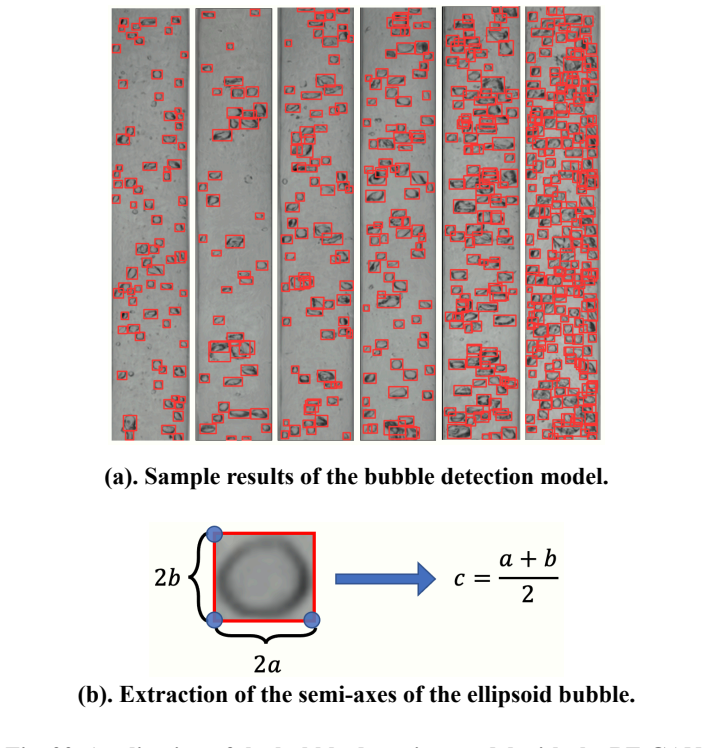
The load-bearing machinery is the conditioned generator together with the multi-scale loss. The generator is an alias-free StyleGAN-style network that takes Gaussian noise and a 2D condition vector $(j_g, j_f)$ and produces 512×512 images; the new loss adds mismatch terms (true images paired with false conditions are penalized, so the generator must obey the conditioning) and VGG feature-space L1/L2 terms for perceptual similarity. The other essential component is the YOLO (You Only Look Once) single-pass object detector, trained on about 600 manually annotated bubbles, which turns generated images into the four physical parameters used for validation.
What would settle it
Manually annotate a few hundred bubbles in BF-GAN-generated images, run the YOLO detector on them, and compare its precision and recall with its performance on experimental images; a substantial drop would invalidate the parameter validation. The paper already reports a 30.6% mean error for void fraction against wire-mesh measurements, so repeating that comparison on a second test loop would provide a decisive check on how far the physical alignment claim extends.
Extended reading notes
Core claim
The paper's central discovery claim is that a GAN can be made to generate physically meaningful bubbly-flow images by conditioning it on $j_g$ and $j_f$ and adding a multi-scale loss. BF-GAN's generator is an alias-free StyleGAN-style network that maps Gaussian noise plus a two-component condition vector into 512×512 images; the training objective combines the standard adversarial loss with a mismatch loss, which forces the discriminator to reject images paired with wrong flow conditions, and a feature loss, which penalizes L1/L2 differences between VGG features of real and generated images. Trained on 278,000 frames from 105 experiments, the model outperforms a conventional CGAN on all reported AI indicators, and its generated images match experimental luminance and contrast to within about 2–3% mean error. Extracted bubble statistics agree with experimental values within 2.3–16.6%, and the authors state that the model can generate images for any $(j_g, j_f)$ in the reported bubbly-flow region.
Load-bearing premise
The physical accuracy of the generated images is established by detecting bubbles with a model trained on experimental images; if that detector does not detect bubbles in generated images with the same accuracy, the reported 2.3–16.6% parameter errors do not demonstrate physical fidelity.
Editorial extensions
If this is right
- Researchers can generate arbitrarily large bubbly-flow datasets at specified $(j_g, j_f)$ in under 0.1 seconds per image, avoiding repeated test-loop runs for data collection.
- The released benchmark dataset of 6.24 million synthetic images can serve directly as training and evaluation data for bubble detection and segmentation algorithms, reducing manual annotation effort.
- Paired with the YOLO detector, the pipeline enables automated extraction of void fraction, aspect ratio, Sauter mean diameter, and interfacial area concentration across the entire flow map, enabling parametric studies without new experiments.
- The conditioning scheme provides a template for generating synthetic images in other multiphase or engineering flow regimes, and the authors plan to extend it to slug, churn, and annular flows and to video generation with time-resolved quantities such as bubble velocity.
Reading between the lines
- The physical validation rests on a single bubble detector trained on experimental images and never validated on generated images; a fair test would be to annotate generated images directly and measure the detector's precision and recall there, since any domain shift would bias the extracted parameters.
- The larger mean errors in magnitude (24.7%), homogeneity (21.3%), and void fraction against wire-mesh measurements (30.6%) suggest that the 'any $j_g$ and $j_f$' claim holds best for global statistics and low-void-fraction conditions, and weakest for local bubble-edge structure and heavily overlapping bubble regimes.
- If the approach generalizes, it implies that generative models could act as surrogate experiments for two-phase flow, but establishing that would require independent validation on a second facility or a local measurement technique, not just the same dataset-derived detector.
- The mismatch-loss idea—training the discriminator to reject true images paired with false conditions—is a cheap way to enforce physical conditioning and could transfer to other physics-constrained image synthesis problems.
Editorial analysis
A structured set of objections, weighed in public.
Referee Report
Summary. The paper presents BF-GAN, a conditional GAN for generating bubbly flow images conditioned on superficial gas and liquid velocities (jg, jf). The authors collected experimental bubbly flow images, trained a generator based on an NVIDIA architecture with a multi-scale loss (mismatch loss and VGG feature loss), and evaluated the model using GAN quality metrics (FID, KID, precision/recall, etc.), image-correspondence measures (luminance, contrast, magnitude, homogeneity, correlation), and extracted two-phase flow parameters (void fraction, aspect ratio, Sauter mean diameter, interfacial area concentration). The central claim is that BF-GAN can generate realistic, physically aligned images for any jg and jf within the research scope, and the authors release the model and data on GitHub.
Significance. If the central claim were fully established, BF-GAN would be a practically useful tool: it could reduce the cost and time of acquiring experimental bubbly flow images and serve as a benchmark dataset generator for bubble detection and segmentation. The paper has several strengths: the dataset is large (278,000 images, 105 conditions), the model is open-sourced, the comparison against a conventional GAN is included, and the authors attempt a multi-level evaluation (image quality, image correspondence, physical parameters). These are valuable contributions. However, the physical-alignment claim is currently not supported by the evidence in the manuscript, and the internal contradictions between the abstract, Section 3.4, and Appendix 2 undermine the reported error ranges.
major comments (5)
- [Section 3.4 / Fig. 21 / p. 37] The physical-parameter validation is not independent. The YOLO bubble detection model used to extract void fraction, aspect ratio, SMD, and IAC from both experimental and BF-GAN-generated images is described as 'developed based on the BF-GAN's dataset' (Section 3.4, last paragraph) and was trained on roughly 600 manually annotated bubbles (Section 2.3). The detector has not been validated on generated images, so systematic differences in bubble detection (e.g., missed small or overlapping bubbles) would affect the two sides of the comparison differently. The reported MAMRE values of 14.64%, 2.28%, 5.23%, and 7.81% (Table 13) therefore measure detector agreement rather than physical fidelity. The authors should validate the detector on generated images against manual annotation or an independent measurement, and report precision/recall separately for experimental and generated images.
- [Appendix 2, Tables 14-17] The independent checks in Appendix 2 contradict the abstract's error range and the tone of Section 3.4. Compared with a wire-mesh sensor, the void fraction MAMRE is 30.62% (Table 14), with individual errors up to 51.58%; against empirical correlations, the aspect ratio MAMRE is 18.39% (Table 15), SMD 21.81% (Table 16), and IAC 17.52% (Table 17). These numbers are far above the abstract's stated range of 2.3-16.6% and are not consistent with the claim that the generated images 'align with physical properties' to the degree claimed. The authors must either reconcile these discrepancies (e.g., explain why the detector-based comparison and the sensor/correlation comparison differ so much) or substantially soften the central claim.
- [Section 3.4 / Fig. 21 / Appendix 1] The physical validation is restricted to 38 low-void-fraction points, while the central claim covers the entire research scope. Section 3.4 explicitly states that the bubble detection model was developed for low void fractions and only 38 red points in Fig. 21 are used. However, the abstract and Section 4 claim the model works for 'any given jg and jf within the research scope', and Appendix 1 extends the dataset to 2080 conditions without any physical validation. The authors need to justify that the 38-point subset is representative, or restrict the claim to the validated region, or provide validation across the full range of jg and jf.
- [Abstract / Section 3.1] There is an internal inconsistency in the description of the dataset: the abstract states '52 sets of bubbly flow experiments' and '140,000 bubbly flow images', while Section 3.1 and the introduction state '105 sets' and '278,000 images'. These numbers must be corrected and made consistent throughout the manuscript.
- [Section 3.4 / data split] No held-out conditions are reported. The BF-GAN is trained on all 105 experimental conditions, and the subsequent validation in Section 3.4 appears to use the same or interpolated conditions. Without excluding some conditions from training and validating on those unseen conditions, the claim that the model generalizes to 'any given jg and jf within the research scope' is not supported. The authors should train on a subset of conditions and test on held-out jg/jf combinations, or at least clearly report which conditions were used for training versus validation.
minor comments (5)
- [Abstract] The abstract contains a typo: 'V oid faction' appears in Table 9 and elsewhere; the correct term is 'void fraction'.
- [Section 3.4.1, Eq. (14)] The variable 'a' in Eq. (14) appears to represent the void fraction, but the notation is inconsistent with the symbol alpha used in Eq. (13) and elsewhere. Please unify the notation.
- [Section 3.2, Table 2] The recall value 1.097E-03 for BF-GAN and 1.799E-05 for conventional GAN are surprisingly small and not discussed. If these are correct, the authors should explain why recall is so low and how it supports the claim of high diversity.
- [Section 3.3, Tables 3-8] The image-correspondence tables show only a few rows; the authors should consider showing the full tables or at least a statistical summary (mean, std, min, max) for all 105 comparisons, rather than only MAMRE and a single maximum.
- [Section 2.2, Algorithm 1] The notation in Algorithm 1 is inconsistent: sometimes c_- is written as c- and sometimes as c_1; please use a consistent subscript convention.
Circularity Check
No circular derivation: BF-GAN's generation and validation chain is not equivalent to its training inputs.
full rationale
The derivation chain is self-contained rather than circular. BF-GAN is trained on 278,000 experimentally collected images labeled by superficial velocities, and its outputs are then assessed with evaluation statistics that are not fed back into the generator: FID/KID, five pixel-statistic image-correspondence measures, and physical parameters (void fraction, aspect ratio, SMD, IAC) extracted via a YOLO detector from prior work [33] applied identically to experimental and generated images. The YOLO detector is a measurement tool, not a parameter fitted to the BF-GAN output, and the paper's Appendix 2 adds independent comparisons to wire-mesh measurements and published empirical correlations, so the physical-parameter numbers are not equal to the training labels or loss terms by construction. The facts that the detector citation shares an author and was developed on the same experimental dataset raise a legitimate concern about shared detection bias, and the larger Appendix 2 errors (e.g., 30.62% void-fraction MAMRE) weaken the strength of the physical-alignment claim; however, those are correctness and overclaiming issues, not circularity. No step in the paper reduces a predicted quantity to an input or to a fitted value by definition.
Assumptions & free parameters
free parameters (5)
- GAN architecture and training hyperparameters =
33 generator layers, 42 discriminator layers, learning rates 0.0025/0.002, batch size 32, 10,000 epochs
- Image resolution =
512x512
- YOLO bubble detection model weights =
Trained on roughly 600 manually annotated bubbles from a previous study
- Validation condition selection =
38 low-void-fraction conditions
- Feature loss combination =
L1 plus L2, combined unweighted with GAN loss
assumptions (6)
- standard math Adversarial training converges to a generator that matches the training distribution
- domain assumption jg and jf are sufficient conditioning variables to determine bubble statistics
- domain assumption YOLO detects bubbles in generated images with accuracy comparable to experimental images
- domain assumption Bubbles can be approximated as tri-axial ellipsoids with Knud Thomsen surface area
- domain assumption Two-dimensional image statistics extrapolate to three-dimensional volumetric quantities
- ad hoc to paper The low-void-fraction subset is representative of the whole research scope
Cite this review
Pith. "Pith review of BF-GAN: Development of an AI-driven Bubbly Flow Image Generation Model Using Generative Adversarial Networks." pith.science (2026). https://pith.science/paper/PF5ENQ5X
@misc{pith2026250206863,
  author       = {Pith},
  title        = {Pith review of: BF-GAN: Development of an AI-driven Bubbly Flow Image Generation Model Using Generative Adversarial Networks},
  year         = {2026},
  howpublished = {\url{https://pith.science/paper/PF5ENQ5X}},
  note         = {Machine review of arXiv:2502.06863}
}
read the original abstract
A generative AI architecture called bubbly flow generative adversarial networks (BF-GAN) is developed, designed to generate realistic and high-quality bubbly flow images through physically conditioned inputs, jg and jf. Initially, 52 sets of bubbly flow experiments under varying conditions are conducted to collect 140,000 bubbly flow images with physical labels of jg and jf for training data. A multi-scale loss function is then developed, incorporating mismatch loss and pixel loss to enhance the generative performance of BF-GAN further. Regarding evaluative metrics of generative AI, the BF-GAN has surpassed conventional GAN. Physically, key parameters of bubbly flow generated by BF-GAN are extracted and compared with measurement values and empirical correlations, validating BF-GAN's generative performance. The comparative analysis demonstrate that the BF-GAN can generate realistic and high-quality bubbly flow images with any given jg and jf within the research scope. BF-GAN offers a generative AI solution for two-phase flow research, substantially lowering the time and cost required to obtain high-quality data. In addition, it can function as a benchmark dataset generator for bubbly flow detection and segmentation algorithms, enhancing overall productivity in this research domain. The BF-GAN model is available online (https://github.com/zhouzhouwen/BF-GAN).
Figures
Reference graph
Works this paper leans on
-
[4]
Yan, S. L., Wang, X. Q., Zhu, L. T., Zhang, X. B., & Luo, Z. H. (2023). Mechanisms and modeling of bubble dynamic behaviors and mass transfer under gravity: a review. Chemical Engineering Science, 277, 118854. 5. Honda, K., Fujiwara, K., Hasegawa, K., Kaneko, A., & Abe, Y . (2023). Coalescence and mixing dynamics of droplets in acoustic levitation by sele...
arXiv 2023
-
[34]
Elementary Approximations to the area of N-Dimensional Ellipsoids
Jocher, G., Chaurasia, A., & Qiu, J. (2023). YOLO by Ultralytics. 35. Szegedy, C., Ioffe, S., Vanhoucke, V ., & Alemi, A. (2017, February). Inception-v4, inception-resnet and the impact of residual connections on learning. In Proceedings of the AAAI conference on artificial intelligence (V ol. 31, No. 1). 36. Kynkäänniemi, T., Karras, T., Laine, S., Lehti...
work page 2023
Reviewed August 8, 2026 · model on record in the stance chip above.
Discussion (0). Continue with ORCID to comment.