REVIEW 4 major objections 5 minor 234 references
Cryoscope: A Cryogenic Infrared Survey Telescope in Antarctica
T0 review · 4 major / 5 minor · reviewed 2026-08-08 · deepseek-v4-flash
Pith's one-line read A cryogenic 1.2 m telescope could sweep the infrared sky in 13 hours
desk verdict A genuinely novel cryogenic wide-field Kdark concept with a transparent sensitivity calculation, whose headline survey speed still rests on the unmeasured Dome C sky brightness. read the letter →
The pith
A machine-rendered reading of the paper's core claim, the machinery that carries it, and where it could break.
The reading
What carries the argument
Kdark is the 2.2–2.5 µm window where the Antarctic sky is darkest because airglow lines disappear; the paper optimizes a filter for this window. The load-bearing mechanism is a double-meniscus corrector: a pair of meniscus lenses at the entrance corrects the spherical primary's aberrations, and the second, convex meniscus doubles as the vacuum window, so the evacuated telescope replaces the usual detector cryostat and the entire optical path can be held at cryogenic temperature (~100 K). Ellipsoidal mirror baffles reflect about 70% of the window's thermal emission back to the window to prevent condensation, while heated external baffles and dry air manage the remaining heat loss. A first-principles estimate in the appendix shows that at equal temperatures the telescope walls would deliver roughly 10× more power to a detector pixel than the sky, so cryocooling is what keeps the sky as the dominant background; the Pathfinder is the instrument built to demonstrate this and to measure the Dome C sky.
What would settle it
Measure the Kdark sky brightness at Dome C through a full winter season using the Pathfinder's reflective-cap background test and on-sky images; if the measured sky background is brighter than the South Pole spectrum adopted in the sensitivity model, the claimed 21.9 mag depth and $5.24\times10^4$ Mpc$^3$/s survey speed fall in direct proportion, with a factor-2.5 increase in sky brightness costing about one magnitude of depth.
Extended reading notes
Core claim
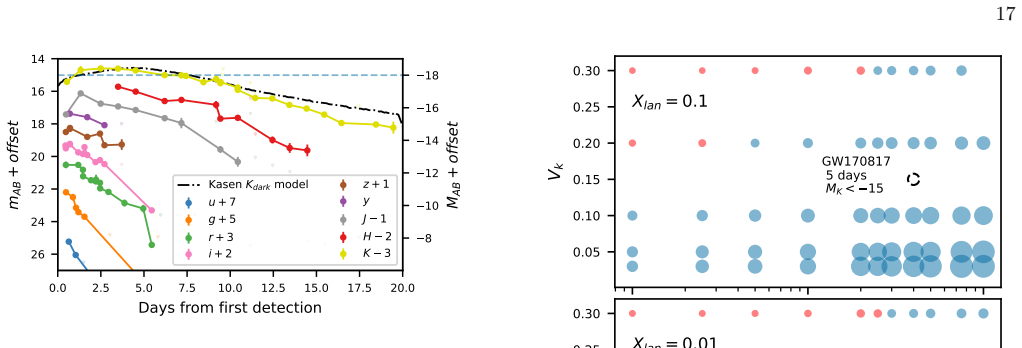
The paper's central claim is that Cryoscope will survey the accessible southern sky (≈20,000 deg$^2$) to a 5σ Kdark point-source depth of 21.9 mag AB every 13 hours continuously during the Antarctic winter, corresponding to a volumetric survey speed of $5.24\times10^4$ Mpc$^3$/s at $M_{AB}=-19$. In a 1-hour stack the same telescope reaches 24.1 mag AB, while the 26 cm Pathfinder reaches 20.2 mag AB in 1 hour and 18.0 mag AB in a 120 s visit. The claim is that this performance, achieved by cooling the whole telescope to roughly 100 K and exploiting the Kdark window between airglow lines, lets a 1.2 m ground telescope outperform much larger planned facilities for high-cadence infrared time-domain astronomy.
Load-bearing premise
The headline depths and survey speeds assume the Kdark sky at Dome C is at least as dark as the South Pole sky measured decades ago, and probably darker, but this is an expectation rather than a measurement at Dome C; the Pathfinder's stated critical objective is to make that measurement.
Editorial extensions
If this is right
- Full-scale Cryoscope can tile the ≈20,000 deg$^2$ southern sky to 21.9 mag AB (5σ, Kdark) every 13 hours through the winter, generating an hourly-cadence infrared movie of the southern sky.
- At $M_{AB}=-19$ its volumetric survey speed is $5.24\times10^4$ Mpc$^3$/s, about 1.4× the stated speed of the reddest Rubin filter and 48× the stated speed of the reddest Roman reference-survey channel.
- A 1-hour coadded stack reaches 24.1 mag AB, so the same telescope serves as both a fast shallow surveyor and a deep infrared imager.
- Simulations for the fifth gravitational-wave observing run indicate Cryoscope would detect kilonova counterparts to all neutron star mergers within 300 Mpc regardless of localization area, and to well-localized mergers out to 1 Gpc.
- The Pathfinder is designed to retire the key risks before 2030: it must show diffraction-limited cold image quality, prove telescope self-emission is below the sky background, avoid condensation on the window, and directly measure the Kdark sky brightness at Dome C.
Reading between the lines
- If the Pathfinder confirms the assumed Kdark sky brightness, the same cryogenic optical-path architecture could be scaled to other dark infrared windows or to larger apertures; the dominant cost would shift from thermal background control to tiling detectors.
- A sky only modestly brighter than assumed would not erase Antarctica's advantage over temperate sites, but it would shrink the claimed depth and survey speed and would move the comparison against space-based surveyors.
- A winter of continuous Kdark monitoring would also constrain atmospheric and thermal background variability at Dome C, data that would sharpen predictions for any future Antarctic infrared facility.
- Cryoscope's cadence and depth are naturally complementary to optical synoptic surveys; joint optical-plus-Kdark light curves could cleanly separate dust-obscured, red, and fast-fading transients from the optically selected population.
Editorial analysis
A structured set of objections, weighed in public.
Referee Report
Summary. The paper presents Cryoscope, a proposed 1.2 m cryogenic survey telescope with a 49.6 deg^2 field of view operating in the Kdark bandpass at Dome C, Antarctica. The central claim is that by cooling the entire optical path and exploiting the dark Antarctic sky, Cryoscope will reach a 5-sigma point-source depth of 21.9 mag AB in a 120 s visit, survey ~20,000 deg^2 every 13 hours, and achieve a volumetric survey speed of 5.24e4 Mpc^3/s at M_AB = -19, matching or exceeding the survey speeds of UVEX, Rubin, Roman, SPHEREx, and NEO Surveyor. The paper describes the optical-thermal design, the HELLSTAR detector concept, the current laboratory status of a fifth-scale Pathfinder, nine science cases, and appendices containing the survey-speed calculation, a first-principles thermal-background argument, and AB-to-Vega conversions. The Pathfinder is scheduled for deployment at Dome C in December 2026, with a stated critical objective of measuring the Kdark sky brightness over a winter season.
Significance. If the performance projections are realized, Cryoscope would be scientifically significant: a ground-based 1.2 m telescope with a cryogenic optical path could open a new high-cadence, wide-field window in the 2.25-2.5 micron window, with clear applications to kilonovae, obscured core-collapse supernovae, exoplanets around cool stars, and solar system science. The paper is commendably concrete in several places: Appendix A and Table A1 give a parameterized survey-speed calculation, the Pathfinder optical tests are described in quantitative detail (0.28 wave rms at 632.8 nm, predicted 95% Strehl at 2.4 microns), and the planned Pathfinder mission explicitly identifies the Kdark sky measurement as a critical objective. These strengths make the design and its risk-reduction plan useful to the community even before the site measurement exists. However, the headline depth and survey-speed numbers are projections that scale directly with an assumed Dome C sky brightness, and the detector parameters used in the calculation are partly unverified goals rather than demonstrated performance.
major comments (4)
- [Section 2.1 and Figure 3 caption] The central performance claims in the abstract, Section 1, and Table A1 (21.9 mag depth, 20,000 deg^2 in 13 hours, volumetric survey speed 5.24e4 Mpc^3/s) depend on the assumed Kdark sky brightness at Dome C. The text states that the sky brightness at Dome C is 'expected to be even lower' than the South Pole spectrum measured by Ashley et al. (1996) and Nguyen et al. (1996), but no Dome C measurement or quantitative lower envelope is provided. For a background-limited point source, a factor-of-2 error in sky brightness changes the limiting magnitude by ~0.75 mag and the volumetric survey speed by roughly a factor of 3, so the comparisons against UVEX, Rubin, Roman, SPHEREx, and NEO Surveyor are currently design projections under an unmeasured assumption. The paper should present these claims as conditional on the assumed sky brightness, and should add a sensitivity table showing depth and survey speed for a plausible range of Kdark sky brightness values, including the case where Dome C is no darker than the South Pole.
- [Section 2.3 versus Table 2] There is a numerical inconsistency in the focal plane description. Section 2.3 states that a 9x6 mosaic of 4Kx6K HELLSTAR detectors creates a 36Kx36K, or 1.36 gigapixel, focal plane, while Table 2 lists the Cryoscope focal plane area as 604 Mpix with a 49.6 deg^2 field of view and a 1.03 arcsec/pixel plate scale. The survey-speed calculation uses the Table 2 values, so the headline number is internally consistent with one of the two descriptions, but the detector mosaic count, pixel count, and field of view need to be reconciled. This ambiguity matters for the cost estimate and for verifying that the stated detector format can actually tile the stated focal plane.
- [Section 2.3 and Table 1] The sensitivity calculation appears to use HELLSTAR detector parameters that are listed in Table 1 as 'goals' rather than demonstrated performance. The text says the final design 'delivers' read noise of 7 e- in Fowler-16, QE near 90%, and dark current of 0.04 e-/s/pixel, but Table 1 lists HELLSTAR goals of 10 e- read noise, 0.01 e-/s/pixel dark current, and >=90% QE, with the only measured SATIN results coming from smaller 1Kx1K and 2Kx2K devices. The paper should state explicitly which parameter values enter the Table 2 depth calculations, and should quantify how the depth and survey speed change if HELLSTAR achieves only the demonstrated SATIN performance rather than the goals.
- [Appendix B, Equations (B11)-(B12)] The first-principles argument that thermal self-emission is about 10x the sky power when wall and sky temperatures are equal is useful as a sanity check, but the main text's depth calculations instead integrate the South Pole sky spectrum, so the relationship between Appendix B and Table 2 should be stated more clearly. In particular, Equation (B12) assumes equal wall and sky temperatures, while the right panel of Figure B1 shows that the survey speed saturates at low wall temperatures only for bright skies; the conclusion that 'cryocooling ensures that survey speed is always maximized' should be tied to the actual assumed Dome C sky brightness rather than to the blackbody comparison alone.
minor comments (5)
- [Figure 3 caption] The claim that the Dome C sky brightness is 'expected to be even lower due to its higher elevation and colder temperatures' is presented without a supporting citation or quantitative model; adding a reference to site-testing literature or a stated assumption would clarify the status of this expectation.
- [Table 2 title] The Table 2 title contains a typo: 'Crysocope' should be 'Cryoscope'.
- [Section 4.3, stellar mass black holes paragraph] The text refers to 'a Wolf Rayet (WF) star'; the standard abbreviation is WR, so this should be corrected.
- [Section 3.1, cryocooler discussion] The description of higher-than-expected detector temperatures and the plan to first use a liquid nitrogen solution is useful, but the text does not state the measured versus required detector temperature values; adding these numbers would make the risk and mitigation path clearer.
- [Appendix A, Table A1] The footnote explaining the Roman GBTDS visit time is necessarily approximate, but the table would benefit from a column or footnote stating the assumed sky-background model for each survey, since the 5-sigma depths of different facilities are not all derived from the same atmospheric and telescope background assumptions.
Circularity Check
No significant circularity: performance projections follow from stated aperture, field of view, detector parameters, and an explicitly flagged sky-background assumption; the Pathfinder is designed to measure that sky brightness, not to fit these claims.
full rationale
The load-bearing performance claims (21.9 mag AB Kdark depth over ~20,000 deg2 every 13 hours; volumetric survey speed 5.24e4 Mpc3/s) are derived in Appendix A from Bellm (2016) volumetric survey speed formula, using the telescope's 1.2 m aperture, 49.6 deg2 field of view, 604 Mpix focal plane, 120 s visits, and a sky background taken from the measured South Pole spectrum of Ashley et al. (1996) and Nguyen et al. (1996). The paper explicitly marks the Dome C sky brightness as an expectation ('expected to be even lower due to its higher elevation and colder temperatures', Figure 3 caption) and lists measuring Kdark sky brightness over a full winter as a Pathfinder critical objective. This is an unverified input and a genuine correctness risk, but it is not circular: the depth and speed numbers are not fitted to a target result, nor is the assumed sky brightness defined in terms of the claimed survey speed. The self-citations to Fucik & Smith (2022) for the double-meniscus optical design, Earley et al. (2024) for wavefront testing, and Figer et al./Buntic et al. for SATIN/HELLSTAR detectors are prior engineering or measurement results that carry their own data and do not reduce to the present paper's conclusions. The apparent inconsistency between the 36Kx36K/1.36 gigapixel mosaic in Section 2.3 and the 604 Mpix/49.6 deg2 entry in Table 2 is a separate correctness issue, not a circularity. No circular step can be quoted because none exists.
Assumptions & free parameters
free parameters (5)
- Dome C Kdark sky brightness =
Not measured; assumed at or below South Pole spectrum
- Survey visit time =
120 s exposure plus 40 s overhead
- Total optical throughput =
0.83
- HELLSTAR detector performance =
QE > 90% in K-band, read noise 7-10 e-, dark current 0.04 e-/s
- Cryostat wall temperature =
100 K
assumptions (5)
- domain assumption K-band sky background at Dome C is at least as low as measured at South Pole and likely lower due to higher elevation and colder temperatures
- domain assumption Thermal self-emission of the cryostat is dominated by the walls and can be modeled as a blackbody cylinder, with wall temperature cold enough to be subdominant to the assumed sky
- domain assumption HELLSTAR 4Kx6K HgCdTe-on-Si detectors will meet or exceed SATIN performance when fabricated
- standard math Volumetric survey speed formula and LambdaCDM cosmology from Bellm (2016) and astropy are valid for comparing surveys
- domain assumption Dome C boundary-layer seeing of about 0.25 arcsec above 20-30 m is achieved for a telescope on a 25 m tower
Cite this review
Pith. "Pith review of Cryoscope: A Cryogenic Infrared Survey Telescope in Antarctica." pith.science (2026). https://pith.science/paper/7ZRRQDAP
@misc{pith2026250206950,
  author       = {Pith},
  title        = {Pith review of: Cryoscope: A Cryogenic Infrared Survey Telescope in Antarctica},
  year         = {2026},
  howpublished = {\url{https://pith.science/paper/7ZRRQDAP}},
  note         = {Machine review of arXiv:2502.06950}
}
abstract
We present Cryoscope--a new 50 deg$^2$ field-of-view, 1.2 m aperture, $K_{dark}$ survey telescope to be located at Dome C, Antarctica. Cryoscope has an innovative optical-thermal design wherein the entire telescope is cryogenically cooled. Cryoscope also explores new detector technology to cost-effectively tile the full focal plane. Leveraging the dark Antarctic sky and minimizing telescope thermal emission, Cryoscope achieves unprecedented deep, wide, fast and red observations, matching and exceeding volumetric survey speeds from the Ultraviolet Explorer, Vera Rubin Observatory, Nancy Grace Roman Space Telescope, SPHEREx, and NEO Surveyor. By providing coverage beyond wavelengths of 2 $\mu$m, we aim to create the most comprehensive dynamic movie of the most obscured reaches of the Universe. Cryoscope will be a dedicated discovery engine for electromagnetic emission from coalescing compact binaries, Earth-like exoplanets orbiting cold stars, and multiple facets of time-domain, stellar and solar system science. In this paper, we describe the scientific drivers and technical innovations for this new discovery engine operating in the $K_{dark}$ passband, why we choose to deploy it in Antarctica, and the status of a fifth-scale prototype designed as a Pathfinder to retire technological risks prior to full-scale implementation. We plan to deploy the Cryoscope Pathfinder to Dome C in December 2026 and the full-scale telescope by 2030.
Figures


Figures from the paper (14 more)




Reference graph
Works this paper leans on
-
[1]
2011, Nature, 473, 349–352, doi: 10.1038/nature10092 Aartsen , M. G., et al. 2017, Astroparticle Physics, 92, 30, doi: 10.1016/j.astropartphys.2017.05.002
-
[2]
2023, Science, 380, 1338, doi: 10.1126/science.adc9818
Abbasi, R., Ackermann, M., Adams, J., et al. 2023, Science, 380, 1338, doi: 10.1126/science.adc9818
-
[3]
Abbott, B. P., Abbott, R., Abbott, T. D., et al. 2017a, PhRvL, 119, 161101, doi: 10.1103/PhysRevLett.119.161101 —. 2017b, ApJL, 848, L12, doi: 10.3847/2041-8213/aa91c9
-
[4]
2013, A&A, 553, A49, doi: 10.1051/0004-6361/201220351
Abe, L., Gon¸ calves, I., Agabi, A., et al. 2013, A&A, 553, A49, doi: 10.1051/0004-6361/201220351
-
[5]
Adrian-Martinez, S., et al. 2016, J. Phys. G, 43, 084001, doi: 10.1088/0954-3899/43/8/084001
-
[6]
2006, Publications of the Astronomical Society of the Pacific, 118, 344, doi: 10.1086/498728
Agabi, A., Aristidi, E., Azouit, M., et al. 2006, Publications of the Astronomical Society of the Pacific, 118, 344, doi: 10.1086/498728
-
[7]
2005, MNRAS, 359, 567, doi: 10.1111/j.1365-2966.2005.08922.x
Agol, E., Steffen, J., Sari, R., & Clarkson, W. 2005, MNRAS, 359, 567, doi: 10.1111/j.1365-2966.2005.08922.x
arXiv 2005
-
[8]
Agol, E., Dorn, C., Grimm, S. L., et al. 2021, PSJ, 2, 1, doi: 10.3847/PSJ/abd022
Show all 234 references
-
[9]
2020, Nature Astron., 4, 913, doi: 10.1038/s41550-020-1182-4
Agostini, M., et al. 2020, Nature Astron., 4, 913, doi: 10.1038/s41550-020-1182-4
2020 doi
-
[10]
B., Mansfield, M., et al
Ahrer, E.-M., Stevenson, K. B., Mansfield, M., et al. 2023, Nature, 614, 653, doi: 10.1038/s41586-022-05590-4
2023 doi
-
[11]
W., et al
Ahumada, T., Anand, S., Coughlin, M. W., et al. 2024, PASP, 136, 114201, doi: 10.1088/1538-3873/ad8265 Al Kharusi, S., et al. 2021, New J. Phys., 23, 031201, doi: 10.1088/1367-2630/abde33
2024 doi
- [12]
-
[13]
2020, MNRAS, 497, 5518, doi: 10.1093/mnras/staa1846
Antier, S., Agayeva, S., Almualla, M., et al. 2020, MNRAS, 497, 5518, doi: 10.1093/mnras/staa1846
2020 doi
-
[14]
2018, ApJL, 855, L23, doi: 10.3847/2041-8213/aab267
Arcavi, I. 2018, ApJL, 855, L23, doi: 10.3847/2041-8213/aab267
2018 doi
-
[15]
Armitage, P. J. 2019, Saas-Fee Advanced Course, 45, 1, doi: 10.1007/978-3-662-58687-7 1
2019 doi
-
[16]
Ashley, M. C. B., Burton, M. G., Storey, J. W. V., et al. 1996, PASP, 108, 721, doi: 10.1086/133792 Astropy Collaboration, Robitaille, T. P., Tollerud, E. J., et al. 2013, A&A, 558, A33, doi: 10.1051/0004-6361/201322068 Astropy Collaboration, Price-Whelan, A. M., Sip˝ ocz, B. ...
1996 doi
-
[17]
L., Cordier, B., & Wei, J
Atteia, J. L., Cordier, B., & Wei, J. 2022, International Journal of Modern Physics D, 31, 2230008, doi: 10.1142/S0218271822300087
2022 doi
-
[18]
V., et al
Avrorin, A. V., et al. 2022, J. Exp. Theor. Phys., 134, 399, doi: 10.1134/S1063776122040148
2022 doi
-
[19]
2022, A&A, 664, A136, doi: 10.1051/0004-6361/202140351
Bachelet, E., Specht, D., Penny, M., et al. 2022, A&A, 664, A136, doi: 10.1051/0004-6361/202140351
2022 doi
-
[20]
2025, SNCosmo, v2.12.0, Zenodo, doi: 10.5281/zenodo.592747
Barbary, K., Bailey, S., Barentsen, G., et al. 2025, SNCosmo, v2.12.0, Zenodo, doi: 10.5281/zenodo.592747
2025 doi
-
[21]
2013, ApJ, 775, 18, doi: 10.1088/0004-637X/775/1/18
Barnes, J., & Kasen, D. 2013, ApJ, 775, 18, doi: 10.1088/0004-637X/775/1/18
2013 doi
-
[22]
R., Davies, B., Smith, N., et al
Beasor, E. R., Davies, B., Smith, N., et al. 2020, MNRAS, 492, 5994, doi: 10.1093/mnras/staa255
2020 doi
-
[23]
2022, MNRAS, 511, 3339, doi: 10.1093/mnras/stac243
Bednarek, W., & ´Smia lkowski, A. 2022, MNRAS, 511, 3339, doi: 10.1093/mnras/stac243
2022 doi
-
[24]
Bellm, E. C. 2016, PASP, 128, 084501, doi: 10.1088/1538-3873/128/966/084501
2016 doi
-
[25]
C., Kulkarni, S
Bellm, E. C., Kulkarni, S. R., Graham, M. J., et al. 2019, PASP, 131, 018002, doi: 10.1088/1538-3873/aaecbe
2019 doi
-
[26]
B., Ivezi´ c,ˇZ., Jones, R
Bianco, F. B., Ivezi´ c,ˇZ., Jones, R. L., et al. 2022, ApJS, 258, 1, doi: 10.3847/1538-4365/ac3e72
2022 doi
-
[27]
B., et al
Bird, S., Cholis, I., Mu˜ noz, J. B., et al. 2016, Physical Review Letters, 116, doi: 10.1103/physrevlett.116.201301
2016 doi
-
[28]
2022, A&A, 664, A106, doi: 10.1051/0004-6361/202243430 35
Blaineau, T., Moniez, M., Afonso, C., et al. 2022, A&A, 664, A106, doi: 10.1051/0004-6361/202243430 35
2022 doi
-
[29]
Breivik, K., Chatterjee, S., & Larson, S. L. 2017, ApJL, 850, L13, doi: 10.3847/2041-8213/aa97d5
2017 doi
-
[30]
2018, ApJL, 854, L1, doi: 10.3847/2041-8213/aaaa23
Breivik, K., Kremer, K., Bueno, M., et al. 2018, ApJL, 854, L1, doi: 10.3847/2041-8213/aaaa23
2018 doi
-
[31]
Brogi, M., Snellen, I. A. G., de Kok, R. J., et al. 2012, Nature, 486, 502, doi: 10.1038/nature11161
2012 doi
-
[32]
2023, MNRAS, 520, 2558, doi: 10.1093/mnras/stad232
Bulla, M. 2023, MNRAS, 520, 2558, doi: 10.1093/mnras/stad232
2023 doi
-
[33]
F., Gallagher, J
Buntic, L., Figer, D. F., Gallagher, J. P., & Alexani, E. 2024, in Society of Photo-Optical Instrumentation Engineers (SPIE) Conference Series, Vol. 13103, X-Ray, Optical, and Infrared Detectors for Astronomy XI, ed. A. D. Holland & K. Minoglou, 1310306, doi: 10.1117/12.3019111
2024 doi
-
[34]
Y., Hasler, S
Burdanov, A. Y., Hasler, S. N., & de Wit, J. 2023, MNRAS, 521, 4568, doi: 10.1093/mnras/stad808
2023 doi
-
[35]
Y., de Wit, J., Broˇ z, M., et al
Burdanov, A. Y., de Wit, J., Broˇ z, M., et al. 2025, Nature, 638, 74, doi: 10.1038/s41586-024-08480-z
2025 doi
-
[36]
2021, MNRAS, 504, 2877, doi: 10.1093/mnras/stab905
Cadman, J., Rice, K., & Hall, C. 2021, MNRAS, 504, 2877, doi: 10.1093/mnras/stab905
2021 doi
-
[37]
2024, Physics Reports, 1054, 1–68, doi: 10.1016/j.physrep.2023.11.005
Carr, B., Clesse, S., Garc ´ ıa-Bellido, J., Hawkins, M., & K¨ uhnel, F. 2024, Physics Reports, 1054, 1–68, doi: 10.1016/j.physrep.2023.11.005
2024 doi
-
[38]
2018, A&A, 609, A113, doi: 10.1051/0004-6361/201730386
Carry, B. 2018, A&A, 609, A113, doi: 10.1051/0004-6361/201730386
2018 doi
-
[39]
2021, A&A, 648, A96, doi: 10.1051/0004-6361/202039579
Carry, B., Thuillot, W., Spoto, F., et al. 2021, A&A, 648, A96, doi: 10.1051/0004-6361/202039579
2021 doi
-
[40]
J., et al
Casagrande, L., Silva Aguirre, V., Schlesinger, K. J., et al. 2016, MNRAS, 455, 987, doi: 10.1093/mnras/stv2320
2016 doi
-
[41]
J., Abergel, A., Agnese, P., et al
Cesarsky, C. J., Abergel, A., Agnese, P., et al. 1996, A&A, 315, L32
1996
- [42]
-
[43]
D., & Shen, K
Chomiuk, L., Metzger, B. D., & Shen, K. J. 2021, ARA&A, 59, 391, doi: 10.1146/annurev-astro-112420-114502
2021 doi
-
[44]
1997, Nature, 387, 783, doi: 10.1038/42885
Costa, E., Frontera, F., Heise, J., et al. 1997, Nature, 387, 783, doi: 10.1038/42885
1997 doi
-
[45]
A., Foley, R
Coulter, D. A., Foley, R. J., Kilpatrick, C. D., et al. 2017, Science, 358, 1556, doi: 10.1126/science.aap9811
2017 doi
-
[46]
S., Berger, E., Villar, V
Cowperthwaite, P. S., Berger, E., Villar, V. A., et al. 2017, The Astrophysical Journal, 848, L17, doi: 10.3847/2041-8213/aa8fc7
2017 doi
-
[47]
2010, A&A, 511, A36, doi: 10.1051/0004-6361/200913629
Crouzet, N., Guillot, T., Agabi, A., et al. 2010, A&A, 511, A36, doi: 10.1051/0004-6361/200913629
2010 doi
-
[48]
2018, A&A, 619, A116, doi: 10.1051/0004-6361/201732565
Crouzet, N., Chapellier, E., Guillot, T., et al. 2018, A&A, 619, A116, doi: 10.1051/0004-6361/201732565
2018 doi
-
[49]
2020, in Society of Photo-Optical Instrumentation Engineers (SPIE) Conference Series, Vol
Crouzet, N., Agabi, A., Guillot, T., et al. 2020, in Society of Photo-Optical Instrumentation Engineers (SPIE) Conference Series, Vol. 11447, Ground-based and Airborne Instrumentation for Astronomy VIII, ed. C. J
2020
-
[50]
Evans, J. J. Bryant, & K. Motohara, 114470O, doi: 10.1117/12.2562550
-
[51]
J., Kasliwal, M
De, K., Hankins, M. J., Kasliwal, M. M., et al. 2020, Publications of the Astronomical Society of the Pacific, 132, 025001, doi: 10.1088/1538-3873/ab6069
2020 doi
-
[52]
M., Hankins, M
De, K., Kasliwal, M. M., Hankins, M. J., et al. 2021, ApJ, 912, 19, doi: 10.3847/1538-4357/abeb75
2021 doi
-
[53]
2018, in Society of Photo-Optical Instrumentation Engineers (SPIE) Conference Series, Vol
Delrez, L., Gillon, M., Queloz, D., et al. 2018, in Society of Photo-Optical Instrumentation Engineers (SPIE) Conference Series, Vol. 10700, Ground-based and Airborne Telescopes VII, ed. H. K. Marshall & J. Spyromilio, 107001I, doi: 10.1117/12.2312475
2018 doi
-
[54]
A., Pozuelos, F
Delrez, L., Murray, C. A., Pozuelos, F. J., et al. 2022, A&A, 667, A59, doi: 10.1051/0004-6361/202244041
2022 doi
-
[55]
P., Slivan, S
DeMeo, F., Binzel, R. P., Slivan, S. M., & Bus, S. J. 2009, Icarus, 202, 160, doi: 10.1016/j.icarus.2009.02.005
2009 doi
-
[56]
E., & Carry, B
DeMeo, F. E., & Carry, B. 2013, Icarus, 226, 723, doi: 10.1016/j.icarus.2013.06.027 —. 2014, Nature, 505, 629, doi: 10.1038/nature12908
2013 doi
-
[57]
D., & Seager, S
Deming, L. D., & Seager, S. 2017, Journal of Geophysical Research (Planets), 122, 53, doi: 10.1002/2016JE005155
2017 doi
-
[58]
M., Metzger, B
Derdzinski, A. M., Metzger, B. D., & Lazzati, D. 2017, MNRAS, 469, 1314, doi: 10.1093/mnras/stx829
2017 doi
-
[59]
E., Hall, P
Dewdney, P. E., Hall, P. J., Schilizzi, R. T., & Lazio, T. J. L. W. 2009, IEEE Proceedings, 97, 1482, doi: 10.1109/JPROC.2009.2021005
2009
-
[60]
S., Marsh, T
Dhillon, V. S., Marsh, T. R., Stevenson, M. J., et al. 2007, MNRAS, 378, 825, doi: 10.1111/j.1365-2966.2007.11881.x Dor´ e, O., Bock, J., Ashby, M., et al. 2014, arXiv e-prints, arXiv:1412.4872, doi: 10.48550/arXiv.1412.4872
2007
- [61]
-
[62]
Dransfield, G., M´ ekarnia, D., Triaud, A. H. M. J., et al. 2022, in Society of Photo-Optical Instrumentation Engineers (SPIE) Conference Series, Vol. 12186, Observatory Operations: Strategies, Processes, and Systems IX, ed. D. S. Adler, R. L. Seaman, & C. R. Benn, 121861F, do...
2022 doi
-
[63]
R., Piro, A
Drout, M. R., Piro, A. L., Shappee, B. J., et al. 2017, Science, 358, 1570, doi: 10.1126/science.aaq0049
2017 doi
-
[64]
2024, in Society of Photo-Optical Instrumentation Engineers (SPIE) Conference Series, Vol
Durbak, J., Kutyrev, A., Sumi, T., et al. 2024, in Society of Photo-Optical Instrumentation Engineers (SPIE) Conference Series, Vol. 13103, X-Ray, Optical, and Infrared Detectors for Astronomy XI, ed. A. D. Holland & K. Minoglou, 1310327, doi: 10.1117/12.3020680 36
2024 doi
-
[65]
2024, in Society of Photo-Optical Instrumentation Engineers (SPIE) Conference Series, Vol
Earley, N., Fucik, J., Fahey, L., et al. 2024, in Society of Photo-Optical Instrumentation Engineers (SPIE) Conference Series, Vol. 13096, Ground-based and Airborne Instrumentation for Astronomy X, ed. J. J
2024
-
[66]
Motohara, & J
Bryant, K. Motohara, & J. R. D. Vernet, 130963M, doi: 10.1117/12.3020678 Euclid Collaboration, Scaramella, R., Amiaux, J., et al. 2022, A&A, 662, A112, doi: 10.1051/0004-6361/202141938
2022 doi
-
[67]
A., Cenko, S
Evans, P. A., Cenko, S. B., Kennea, J. A., et al. 2017, Science, 358, 1565, doi: 10.1126/science.aap9580
2017 doi
-
[68]
J., et al
Fabbri, J., Otsuka, M., Barlow, M. J., et al. 2011, MNRAS, 418, 1285, doi: 10.1111/j.1365-2966.2011.19577.x
2011
-
[69]
D., Vurm, I., Aydi, E., & Chomiuk, L
Fang, K., Metzger, B. D., Vurm, I., Aydi, E., & Chomiuk, L. 2020, ApJ, 904, 4, doi: 10.3847/1538-4357/abbc6e
2020 doi
-
[70]
2018, in Society of Photo-Optical Instrumentation Engineers (SPIE) Conference Series, Vol
Figer, D., Lee, J., Corrales, E., Getty, J., & Mears, L. 2018, in Society of Photo-Optical Instrumentation Engineers (SPIE) Conference Series, Vol. 10709, High Energy, Optical, and Infrared Detectors for Astronomy VIII, ed. A. D. Holland & J. Beletic, 1070926, doi: 10.1117/12.2313401
2018 doi
-
[71]
2022, in Society of Photo-Optical Instrumentation Engineers (SPIE) Conference Series, Vol
Lauxtermann, S. 2022, in Society of Photo-Optical Instrumentation Engineers (SPIE) Conference Series, Vol. 12191, X-Ray, Optical, and Infrared Detectors for Astronomy X, ed. A. D. Holland & J. Beletic, 121910P, doi: 10.1117/12.2627511
2022 doi
-
[72]
Filippenko, A. V. 1997, ARA&A, 35, 309, doi: 10.1146/annurev.astro.35.1.309
1997 doi
-
[73]
J., Hillenbrand, L
Fischer, W. J., Hillenbrand, L. A., Herczeg, G. J., et al. 2023, in Astronomical Society of the Pacific Conference
2023
- [74]
-
[75]
J., & Meegan, C
Fishman, G. J., & Meegan, C. A. 1995, ARA&A, 33, 415, doi: 10.1146/annurev.aa.33.090195.002215
1995
-
[76]
2018, PhRvD, 98, 081501, doi: 10.1103/PhysRevD.98.081501
Foucart, F., Hinderer, T., & Nissanke, S. 2018, PhRvD, 98, 081501, doi: 10.1103/PhysRevD.98.081501
2018 doi
-
[77]
Taylor, G. B. 1997, Nature, 389, 261, doi: 10.1038/38451
1997 doi
-
[78]
2022, ApJ, 926, 152, doi: 10.3847/1538-4357/ac4508
Frostig, D., Biscoveanu, S., Mo, G., et al. 2022, ApJ, 926, 152, doi: 10.3847/1538-4357/ac4508
2022 doi
-
[79]
B., De, K., et al
Frostig, D., Burdge, K. B., De, K., et al. 2024, in Ground-based and Airborne Instrumentation for Astronomy X, ed. J. J. Bryant, K. Motohara, & J. R. D
2024
-
[80]
13096, International Society for Optics and Photonics (SPIE), 130963J, doi: 10.1117/12.3019165
Vernet, Vol. 13096, International Society for Optics and Photonics (SPIE), 130963J, doi: 10.1117/12.3019165
-
[81]
2022, in Society of Photo-Optical Instrumentation Engineers (SPIE) Conference Series, Vol
Fucik, J., & Smith, R. 2022, in Society of Photo-Optical Instrumentation Engineers (SPIE) Conference Series, Vol. 12182, Ground-based and Airborne Telescopes IX, ed. H. K. Marshall, J. Spyromilio, & T. Usuda, 121823N, doi: 10.1117/12.2630557
2022 doi
-
[82]
2021, Earth System Science Data, 13, 5731, doi: 10.5194/essd-13-5731-2021
Genthon, C., Veron, D., Vignon, E., et al. 2021, Earth System Science Data, 13, 5731, doi: 10.5194/essd-13-5731-2021
2021 doi
-
[83]
M., et al
Gillon, M., Jehin, E., Lederer, S. M., et al. 2016, Nature, 533, 221, doi: 10.1038/nature17448
2016 doi
-
[84]
Gillon, M., Triaud, A. H. M. J., Demory, B.-O., et al. 2017, Nature, 542, 456, doi: 10.1038/nature21360
2017 doi
-
[85]
P., Cutter, R., Steeghs, D., et al
Gompertz, B. P., Cutter, R., Steeghs, D., et al. 2020, MNRAS, 497, 726, doi: 10.1093/mnras/staa1845
2020 doi
- [86]
-
[87]
2006, MNRAS, 367, L47, doi: 10.1111/j.1745-3933.2006.00137.x
Guillot, T., & Hueso, R. 2006, MNRAS, 367, L47, doi: 10.1111/j.1745-3933.2006.00137.x
2006
-
[88]
2015, Astronomische Nachrichten, 336, 638, doi: 10.1002/asna.201512174
Guillot, T., Abe, L., Agabi, A., et al. 2015, Astronomische Nachrichten, 336, 638, doi: 10.1002/asna.201512174
2015 doi
-
[89]
2020, Nature Astronomy, 4, 53, doi: 10.1038/s41550-019-0931-8
Guzik, P., Drahus, M., Rusek, K., et al. 2020, Nature Astronomy, 4, 53, doi: 10.1038/s41550-019-0931-8
2020 doi
-
[90]
2005, Nucl
Habig, A. 2005, Nucl. Phys. B Proc. Suppl., 143, 543, doi: 10.1016/j.nuclphysbps.2005.01.208
2005 doi
- [91]
-
[92]
J., Figer, D
Hanold, B. J., Figer, D. F., Lee, J., et al. 2015, in Society of Photo-Optical Instrumentation Engineers (SPIE) Conference Series, Vol. 9609, Infrared Sensors, Devices, and Applications V, ed. P. D. LeVan, A. K. Sood, P. Wijewarnasuriya, & A. I. D’Souza, 96090Y, doi: 10.1117/1...
2015 doi
-
[93]
R., Millman, K
Harris, C. R., Millman, K. J., van der Walt, S. J., et al. 2020, Nature, 585, 357, doi: 10.1038/s41586-020-2649-2
2020 doi
-
[94]
Hawking, S. W. 1971, MNRAS, 152, 75, doi: https://doi.org/10.1093/mnras/152.1.75
1971 doi
-
[95]
Y., Triaud, A
He, M. Y., Triaud, A. H. M. J., & Gillon, M. 2017, MNRAS, 464, 2687, doi: 10.1093/mnras/stw2391
2017 doi
-
[96]
2017, ApJL, 840, L4, doi: 10.3847/2041-8213/aa6d08
Helled, R., & Stevenson, D. 2017, ApJL, 840, L4, doi: 10.3847/2041-8213/aa6d08
2017 doi
-
[97]
Storey, J. W. V. 2000, PASA, 17, 260, doi: 10.1071/AS00033
2000 doi
-
[98]
2018, AJ, 156, 135, doi: 10.3847/1538-3881/aad69a
Kuindersma, S. 2018, AJ, 156, 135, doi: 10.3847/1538-3881/aad69a
2018 doi
-
[99]
J., Seligman, D
Hoover, D. J., Seligman, D. Z., & Payne, M. J. 2022, PSJ, 3, 71, doi: 10.3847/PSJ/ac58fe 37
2022 doi
-
[100]
J., Jencson, J
Hosseinzadeh, G., Sand, D. J., Jencson, J. E., et al. 2023, ApJL, 942, L18, doi: 10.3847/2041-8213/aca64e
2023 doi
-
[101]
2017, ApJ, 844, 102, doi: 10.3847/1538-4357/aa75ca
Huber, D., Zinn, J., Bojsen-Hansen, M., et al. 2017, ApJ, 844, 102, doi: 10.3847/1538-4357/aa75ca
2017 doi
-
[102]
M., Condon, S., et al
Hui, H., Korngut, P. M., Condon, S., et al. 2024, in Society of Photo-Optical Instrumentation Engineers (SPIE) Conference Series, Vol. 13092, Space Telescopes and Instrumentation 2024: Optical, Infrared, and Millimeter Wave, ed. L. E. Coyle, S. Matsuura, & M. D. Perrin, 130923...
2024 doi
-
[103]
Hunter, J. D. 2007, Computing in Science & Engineering, 9, 90, doi: 10.1109/MCSE.2007.55 IceCube Collaboration. 2013, Science, 342, 1242856, doi: 10.1126/science.1242856 IceCube Collaboration , et al. 2018, Science, 361, eaat1378, doi: 10.1126/science.aat1378
2007 doi
-
[104]
2013, A&A Rv, 21, 59, doi: 10.1007/s00159-013-0059-2 Ivezi´ c,ˇZ., Kahn, S
Ivanova, N., Justham, S., Chen, X., et al. 2013, A&A Rv, 21, 59, doi: 10.1007/s00159-013-0059-2 Ivezi´ c,ˇZ., Kahn, S. M., Tyson, J. A., et al. 2019, ApJ, 873, 111, doi: 10.3847/1538-4357/ab042c
2013 doi
-
[105]
J., Fraser, M., et al
Jerkstrand, A., Smartt, S. J., Fraser, M., et al. 2014, MNRAS, 439, 3694, doi: 10.1093/mnras/stu221
2014 doi
-
[106]
2021, ApJ, 911, 31, doi: 10.3847/1538-4357/abe772
Jiang, N., Wang, T., Hu, X., et al. 2021, ApJ, 911, 31, doi: 10.3847/1538-4357/abe772
2021 doi
-
[107]
L., Chesley, S
Jones, R. L., Chesley, S. R., Connolly, A. J., et al. 2009, Earth Moon and Planets, 105, 101, doi: 10.1007/s11038-009-9305-z
2009 doi
-
[108]
J., Gehrz, R
Jones, T. J., Gehrz, R. D., Kobulnicky, H. A., Molnar, L. A., & Howard, E. M. 1994, AJ, 108, 605, doi: 10.1086/117094
1994 doi
-
[109]
K., Hwang, K.-H., Yang, H., et al
Jung, Y. K., Hwang, K.-H., Yang, H., et al. 2024, The Astronomical Journal, 168, 152, doi: 10.3847/1538-3881/ad6b12
2024 doi
-
[110]
A., Klose, S., Zhang, B., et al
Kann, D. A., Klose, S., Zhang, B., et al. 2011, ApJ, 734, 96, doi: 10.1088/0004-637X/734/2/96
2011 doi
-
[111]
R., & Barnes, J
Kasen, D., Badnell, N. R., & Barnes, J. 2013, ApJ, 774, 25, doi: 10.1088/0004-637X/774/1/25
2013 doi
-
[112]
2017, Nature, 551, 80, doi: 10.1038/nature24453
Ramirez-Ruiz, E. 2017, Nature, 551, 80, doi: 10.1038/nature24453
2017 doi
-
[113]
M., Nakar, E., Singer, L
Kasliwal, M. M., Nakar, E., Singer, L. P., et al. 2017, Science, 358, 1559, doi: 10.1126/science.aap9455
2017 doi
-
[114]
M., Kasen, D., Lau, R
Kasliwal, M. M., Kasen, D., Lau, R. M., et al. 2019,
2019
-
[115]
MNRAS, L14, doi: 10.1093/mnrasl/slz007
-
[116]
M., Anand, S., Ahumada, T., et al
Kasliwal, M. M., Anand, S., Ahumada, T., et al. 2020, arXiv e-prints, arXiv:2006.11306. https://arxiv.org/abs/2006.11306
2020 arXiv
-
[117]
2020, The Astrophysical Journal, 889, 171, doi: 10.3847/1538-4357/ab61f6
Kawaguchi, K., Shibata, M., & Tanaka, M. 2020, The Astrophysical Journal, 889, 171, doi: 10.3847/1538-4357/ab61f6
2020 doi
-
[118]
K., & Kasen, D
Khatami, D. K., & Kasen, D. N. 2019, ApJ, 878, 56, doi: 10.3847/1538-4357/ab1f09
2019 doi
-
[119]
W., Farah, A
Kiendrebeogo, R. W., Farah, A. M., Foley, E. M., et al. 2023, ApJ, 958, 158, doi: 10.3847/1538-4357/acfcb1
2023 doi
-
[120]
W., Strong, I
Klebesadel, R. W., Strong, I. B., & Olson, R. A. 1973, ApJL, 182, L85, doi: 10.1086/181225
1973 doi
-
[121]
2023, The Astronomical Journal, 165, 254, doi: 10.3847/1538-3881/acccf9
Kondo, I., Sumi, T., Koshimoto, N., et al. 2023, The Astronomical Journal, 165, 254, doi: 10.3847/1538-3881/acccf9
2023 doi
-
[122]
Kotak, R., Meikle, W. P. S., Farrah, D., et al. 2009, ApJ, 704, 306, doi: 10.1088/0004-637X/704/1/306
2009 doi
-
[123]
A., Fishman, G
Kouveliotou, C., Meegan, C. A., Fishman, G. J., et al. 1993, ApJL, 413, L101, doi: 10.1086/186969 Kr¨ uger, C. J., & Foucart, F. 2020, PhRvD, 101, 103002, doi: 10.1103/PhysRevD.101.103002
1993 doi
- [124]
-
[125]
2013, Phys
Kyutoku, K., Ioka, K., & Shibata, M. 2013, Phys. Rev. D, 88, 041503, doi: 10.1103/PhysRevD.88.041503
2013 doi
-
[126]
2012, A&A, 544, A32, doi: 10.1051/0004-6361/201219127
Lambrechts, M., & Johansen, A. 2012, A&A, 544, A32, doi: 10.1051/0004-6361/201219127
2012 doi
-
[127]
M., & Schramm, D
Lattimer, J. M., & Schramm, D. N. 1976, ApJ, 210, 549, doi: 10.1086/154860
1976 doi
-
[128]
M., Eldridge, J
Lau, R. M., Eldridge, J. J., Hankins, M. J., et al. 2020, ApJ, 898, 74, doi: 10.3847/1538-4357/ab9cb5
2020 doi
-
[129]
D., et al
Laureijs, R., Vavrek, R., Racca, G. D., et al. 2024, in Society of Photo-Optical Instrumentation Engineers (SPIE) Conference Series, Vol. 13092, Space Telescopes and Instrumentation 2024: Optical, Infrared, and Millimeter Wave, ed. L. E. Coyle, S. Matsuura, & M. D. Perrin, 130...
2024 doi
- [130]
-
[131]
J., Gompertz, B
Levan, A. J., Gompertz, B. P., Salafia, O. S., et al. 2024, Nature, 626, 737, doi: 10.1038/s41586-023-06759-1
2024 doi
-
[132]
2016, Publications of the Astronomical Society of Australia, 33, e008, doi: 10.1017/pasa.2016.5
Li, Y., Zheng, J., Tuthill, P., et al. 2016, Publications of the Astronomical Society of Australia, 33, e008, doi: 10.1017/pasa.2016.5
2016 doi
-
[133]
S., et al
Liljegren, S., Jerkstrand, A., Barklem, P. S., et al. 2023, A&A, 674, A184, doi: 10.1051/0004-6361/202243491
2023 doi
-
[134]
2020, A&A, 642, A135, doi: 10.1051/0004-6361/202038116 38
Liljegren, S., Jerkstrand, A., & Grumer, J. 2020, A&A, 642, A135, doi: 10.1051/0004-6361/202038116 38
2020 doi
-
[135]
P., Baker, J
Lourie, N. P., Baker, J. W., Burruss, R. S., et al. 2020, in Society of Photo-Optical Instrumentation Engineers (SPIE) Conference Series, Vol. 11447, Ground-based and Airborne Instrumentation for Astronomy VIII, ed. C. J
2020
-
[136]
Evans, J. J. Bryant, & K. Motohara, 114479K, doi: 10.1117/12.2561210 LSST Collaboration, L. S. S. T., Abell, P. A., Allison, J., et al. 2009, ArXiv e-prints
2009 doi
-
[137]
2022, Science, 377, 1211, doi: 10.1126/science.abl7164
Luque, R., & Pall´ e, E. 2022, Science, 377, 1211, doi: 10.1126/science.abl7164
2022 doi
-
[138]
T., Miglio, A., Elsworth, Y., et al
Mackereth, J. T., Miglio, A., Elsworth, Y., et al. 2021, MNRAS, 502, 1947, doi: 10.1093/mnras/stab098
2021 doi
-
[139]
2022, ApJ, 937, 96, doi: 10.3847/1538-4357/ac8c31
MacLeod, M., De, K., & Loeb, A. 2022, ApJ, 937, 96, doi: 10.3847/1538-4357/ac8c31
2022 doi
-
[141]
2021, Icarus, 354, 114094, doi: 10.1016/j.icarus.2020.114094
Mahlke, M., Carry, B., & Denneau, L. 2021, Icarus, 354, 114094, doi: 10.1016/j.icarus.2020.114094
2021
-
[142]
Mahlke, M., Carry, B., & Mattei, P. A. 2022, A&A, 665, A26, doi: 10.1051/0004-6361/202243587
2022 doi
-
[143]
2018, A&A, 610, A21, doi: 10.1051/0004-6361/201730924
Mahlke, M., Bouy, H., Altieri, B., et al. 2018, A&A, 610, A21, doi: 10.1051/0004-6361/201730924
2018 doi
-
[144]
2011, ApJ, 731, 53, doi: 10.1088/0004-637X/731/1/53
Mainzer, A., Bauer, J., Grav, T., et al. 2011, ApJ, 731, 53, doi: 10.1088/0004-637X/731/1/53
2011 doi
-
[145]
M., et al
Mainzer, A., Bauer, J., Cutri, R. M., et al. 2014, ApJ, 792, 30, doi: 10.1088/0004-637X/792/1/30
2014 doi
-
[146]
K., Masiero, J
Mainzer, A. K., Masiero, J. R., Abell, P. A., et al. 2023, PSJ, 4, 224, doi: 10.3847/PSJ/ad0468
2023 doi
-
[147]
2017, ApJ, 835, 140, doi: 10.3847/1538-4357/835/2/140
Margutti, R., Kamble, A., Milisavljevic, D., et al. 2017, ApJ, 835, 140, doi: 10.3847/1538-4357/835/2/140
2017 doi
-
[148]
C., Fanson, J., Schiminovich, D., et al
Martin, D. C., Fanson, J., Schiminovich, D., et al. 2005, ApJL, 619, L1, doi: 10.1086/426387
2005 doi
-
[149]
2019, ApJ, 883, 169, doi: 10.3847/1538-4357/ab3a4f
Masuda, K., & Hotokezaka, K. 2019, ApJ, 883, 169, doi: 10.3847/1538-4357/ab3a4f
2019 doi
-
[150]
A., Huber, D., et al
Mathur, S., Garc ´ ıa, R. A., Huber, D., et al. 2016, ApJ, 827, 50, doi: 10.3847/0004-637X/827/1/50
2016 doi
-
[151]
A., Pian, E., Bufano, F., & Ashall, C
Mazzali, P. A., Pian, E., Bufano, F., & Ashall, C. 2021, MNRAS, 505, 4106, doi: 10.1093/mnras/stab1594
2021 doi
-
[152]
G., Banerji, M., Gonzalez, E., et al
McMahon, R. G., Banerji, M., Gonzalez, E., et al. 2013, The Messenger, 154, 35
2013
-
[153]
J., Weryk, R., Micheli, M., et al
Meech, K. J., Weryk, R., Micheli, M., et al. 2017, Nature, 552, 378, doi: 10.1038/nature25020
2017 doi
-
[154]
Meikle, W. P. S., Kotak, R., Farrah, D., et al. 2011, ApJ, 732, 109, doi: 10.1088/0004-637X/732/2/109
2011 doi
-
[155]
D., Caprioli, D., Vurm, I., et al
Metzger, B. D., Caprioli, D., Vurm, I., et al. 2016, MNRAS, 457, 1786, doi: 10.1093/mnras/stw123
2016 doi
-
[156]
D., Mart ´ ınez-Pinedo, G., Darbha, S., et al
Metzger, B. D., Mart ´ ınez-Pinedo, G., Darbha, S., et al. 2010, MNRAS, 406, 2650, doi: 10.1111/j.1365-2966.2010.16864.x
2010
-
[157]
R., Dwek, E., & Slavin, J
Micelotta, E. R., Dwek, E., & Slavin, J. D. 2016, A&A, 590, A65, doi: 10.1051/0004-6361/201527350
2016 doi
-
[158]
2015, ApJ, 815, 120, doi: 10.1088/0004-637X/815/2/120
Milisavljevic, D., Margutti, R., Kamble, A., et al. 2015, ApJ, 815, 120, doi: 10.1088/0004-637X/815/2/120
2015 doi
-
[159]
F., Nesvorn´ y, D., & Levison, H
Morbidelli, A., Bottke, W. F., Nesvorn´ y, D., & Levison, H. F. 2009, Icarus, 204, 558, doi: 10.1016/j.icarus.2009.07.011
2009 doi
-
[160]
2024, A&A, 691, A147, doi: 10.1051/0004-6361/202451388 Mr´ oz, P., Udalski, A., Bennett, D
Morbidelli, A., Marrocchi, Y., Ali Ahmad, A., et al. 2024, A&A, 691, A147, doi: 10.1051/0004-6361/202451388 Mr´ oz, P., Udalski, A., Bennett, D. P., et al. 2019, A&A, 622, A201, doi: 10.1051/0004-6361/201834557 Mr´ oz, P., Udalski, A., Szyma´ nski, M. K., et al. 2024, The Astr...
2024 doi
-
[161]
N., Cellino, A., et al
Muinonen, K., Belskaya, I. N., Cellino, A., et al. 2010, Icarus, 209, 542, doi: 10.1016/j.icarus.2010.04.003 M¨ uller, T. G., Micheli, M., Santana-Ros, T., et al. 2023, A&A, 670, A53, doi: 10.1051/0004-6361/202245304
2010 doi
-
[162]
2024, ApJ, 976, 230, doi: 10.3847/1538-4357/ad8922
Myers, C., De, K., Yan, L., et al. 2024, ApJ, 976, 230, doi: 10.3847/1538-4357/ad8922
2024 doi
-
[163]
2022, A&A, 658, A31, doi: 10.1051/0004-6361/202142256 National Academies of Sciences, Engineering, and Medicine
Nascimbeni, V., Piotto, G., B¨ orner, A., et al. 2022, A&A, 658, A31, doi: 10.1051/0004-6361/202142256 National Academies of Sciences, Engineering, and Medicine. 2021, Pathways to Discovery in Astronomy and Astrophysics for the 2020s, doi: 10.17226/26141
2022 doi
-
[164]
J., van Duinen, R., et al
Neugebauer, G., Habing, H. J., van Duinen, R., et al. 1984, ApJL, 278, L1, doi: 10.1086/184209
1984 doi
-
[165]
T., Rauscher, B
Nguyen, H. T., Rauscher, B. J., Severson, S. A., et al. 1996, PASP, 108, 718, doi: 10.1086/133791
1996 doi
-
[166]
2019, Nature Astronomy, 3, 524–534, doi: 10.1038/s41550-019-0723-1
Niikura, H., Takada, M., Yasuda, N., et al. 2019, Nature Astronomy, 3, 524–534, doi: 10.1038/s41550-019-0723-1
2019 doi
-
[167]
E., Catelan, M., et al
Nikzat, F., Ferreira Lopes, C. E., Catelan, M., et al. 2022, A&A, 660, A35, doi: 10.1051/0004-6361/202141805
2022 doi
-
[168]
E., & Wu, Y
Owen, J. E., & Wu, Y. 2013, ApJ, 775, 105, doi: 10.1088/0004-637X/775/2/105 —. 2017, ApJ, 847, 29, doi: 10.3847/1538-4357/aa890a
2013 doi
-
[169]
1986, ApJ, 304, 1, doi: 10.1086/164140
Paczynski, B. 1986, ApJ, 304, 1, doi: 10.1086/164140
1986 doi
-
[170]
B., Hubickyj, O., Bodenheimer, P., et al
Pollack, J. B., Hubickyj, O., Bodenheimer, P., et al. 1996, Icarus, 124, 62, doi: 10.1006/icar.1996.0190
1996
-
[171]
D., Chawner, H., Matsuura, M., et al
Priestley, F. D., Chawner, H., Matsuura, M., et al. 2021, MNRAS, 500, 2543, doi: 10.1093/mnras/staa3445
2021 doi
-
[172]
C., Gompertz, B
Rastinejad, J. C., Gompertz, B. P., Levan, A. J., et al. 2022, Nature, 612, 223, doi: 10.1038/s41586-022-05390-w
2022 doi
-
[173]
2014, Experimental Astronomy, 38, 249, doi: 10.1007/s10686-014-9383-4
Rauer, H., Catala, C., Aerts, C., et al. 2014, Experimental Astronomy, 38, 249, doi: 10.1007/s10686-014-9383-4
2014 doi
-
[174]
N., & Izidoro, A
Raymond, S. N., & Izidoro, A. 2017, Science Advances, 3, e1701138, doi: 10.1126/sciadv.1701138
2017 doi
-
[175]
Rees, M. J. 1988, Nature, 333, 523, doi: 10.1038/333523a0
1988 doi
-
[176]
P., & Nelemans, G
Repetto, S., Igoshev, A. P., & Nelemans, G. 2017, MNRAS, 467, 298, doi: 10.1093/mnras/stx027 39
2017 doi
-
[177]
2022, PhRvL, 128, 221101, doi: 10.1103/PhysRevLett.128.221101
Reusch, S., Stein, R., Kowalski, M., et al. 2022, PhRvL, 128, 221101, doi: 10.1103/PhysRevLett.128.221101
2022 doi
-
[178]
2023, Nature Astronomy, 7, 1282, doi: 10.1038/s41550-023-02108-4
Ricci, C., & Trakhtenbrot, B. 2023, Nature Astronomy, 7, 1282, doi: 10.1038/s41550-023-02108-4
2023 doi
-
[179]
R., Winn, J
Ricker, G. R., Winn, J. N., Vanderspek, R., et al. 2014, in Society of Photo-Optical Instrumentation Engineers (SPIE) Conference Series, Vol. 9143, Space Telescopes and Instrumentation 2014: Optical, Infrared, and Millimeter Wave, ed. J. Oschmann, Jacobus M., M. Clampin, G. G....
2014 doi
-
[180]
2025, Size Measurements of a Potential Earth-Impacting Asteroid with JWST MIRI and NIRCAM, JWST Proposal
Rivkin, A., Thomas, C., Glantzberg, A., et al. 2025, Size Measurements of a Potential Earth-Impacting Asteroid with JWST MIRI and NIRCAM, JWST Proposal. Cycle 3, DD, ID. #9239
2025
- [181]
-
[182]
D., Kann, D
Rossi, A., Frederiks, D. D., Kann, D. A., et al. 2022, A&A, 665, A125, doi: 10.1051/0004-6361/202243225
2022 doi
-
[183]
A., Reddy, V., Nathues, A., et al
Sanchez, J. A., Reddy, V., Nathues, A., et al. 2012, Icarus, 220, 36, doi: 10.1016/j.icarus.2012.04.008
2012 doi
-
[184]
2022, A&A, 668, A57, doi: 10.1051/0004-6361/202244391
Sarangi, A. 2022, A&A, 668, A57, doi: 10.1051/0004-6361/202244391
2022 doi
-
[185]
2015, A&A, 575, A95, doi: 10.1051/0004-6361/201424969
Sarangi, A., & Cherchneff, I. 2015, A&A, 575, A95, doi: 10.1051/0004-6361/201424969
2015 doi
-
[186]
2021, Progress of Theoretical and Experimental Physics, 2021, 05A104, doi: 10.1093/ptep/ptab007
Sasada, M., Utsumi, Y., Itoh, R., et al. 2021, Progress of Theoretical and Experimental Physics, 2021, 05A104, doi: 10.1093/ptep/ptab007
2021 doi
-
[187]
Saxton, R., Komossa, S., Auchettl, K., & Jonker, P. G. 2020, SSRv, 216, 85, doi: 10.1007/s11214-020-00708-4
2020 doi
-
[188]
Schlegel, E. M. 1990, MNRAS, 244, 269
1990
-
[189]
2022, in Society of Photo-Optical Instrumentation Engineers (SPIE) Conference Series, Vol
Schmider, F.-X., Abe, L., Agabi, A., et al. 2022, in Society of Photo-Optical Instrumentation Engineers (SPIE) Conference Series, Vol. 12182, Ground-based and Airborne Telescopes IX, ed. H. K. Marshall, J. Spyromilio, & T. Usuda, 121822O, doi: 10.1117/12.2628952
2022 doi
-
[190]
2024, A&A Rv, 32, 2, doi: 10.1007/s00159-024-00151-2
Schneider, R., & Maiolino, R. 2024, A&A Rv, 32, 2, doi: 10.1007/s00159-024-00151-2
2024 doi
-
[191]
2021, A&A, 645, A100, doi: 10.1051/0004-6361/202038827
Sebastian, D., Gillon, M., Ducrot, E., et al. 2021, A&A, 645, A100, doi: 10.1051/0004-6361/202038827
2021 doi
-
[192]
2023, MNRAS, 523, 6048, doi: 10.1093/mnras/stad1681
Shahbandeh, M., Sarangi, A., Temim, T., et al. 2023, MNRAS, 523, 6048, doi: 10.1093/mnras/stad1681
2023 doi
-
[193]
2011, ApJ, 730, 3, doi: 10.1088/0004-637X/730/1/3
Binney, J. 2011, ApJ, 730, 3, doi: 10.1088/0004-637X/730/1/3
2011 doi
-
[194]
2017, The Astronomical Journal, 153, 61, doi: 10.3847/1538-3881/153/2/61
Shvartzvald, Y., Bryden, G., Gould, A., et al. 2017, The Astronomical Journal, 153, 61, doi: 10.3847/1538-3881/153/2/61
2017 doi
-
[195]
C., Gaudi, B
Shvartzvald, Y., Novati, S. C., Gaudi, B. S., et al. 2018, The Astrophysical Journal Letters, 857, L8, doi: 10.3847/2041-8213/aab71b
2018 doi
-
[196]
2024, ApJ, 964, 74, doi: 10.3847/1538-4357/ad2704
Shvartzvald, Y., Waxman, E., Gal-Yam, A., et al. 2024, ApJ, 964, 74, doi: 10.3847/1538-4357/ad2704
2024 doi
-
[197]
F., Cutri, R
Skrutskie, M. F., Cutri, R. M., Stiening, R., et al. 2006, AJ, 131, 1163, doi: 10.1086/498708
2006 doi
-
[198]
Sluder, A., Milosavljevi´ c, M., & Montgomery, M. H. 2018, MNRAS, 480, 5580, doi: 10.1093/mnras/sty2060
2018 doi
-
[199]
J., Chen, T
Smartt, S. J., Chen, T. W., Jerkstrand, A., et al. 2017, Nature, 551, 75, doi: 10.1038/nature24303
2017 doi
-
[200]
2014, ARA&A, 52, 487, doi: 10.1146/annurev-astro-081913-040025
Smith, N. 2014, ARA&A, 52, 487, doi: 10.1146/annurev-astro-081913-040025
2014 doi
-
[201]
E., Annis, J., et al
Soares-Santos, M., Holz, D. E., Annis, J., et al. 2017, ApJL, 848, L16, doi: 10.3847/2041-8213/aa9059
2017 doi
-
[202]
2020, in Society of Photo-Optical Instrumentation Engineers (SPIE) Conference Series, Vol
Soon, J., Adams, D., De, K., et al. 2020, in Society of Photo-Optical Instrumentation Engineers (SPIE) Conference Series, Vol. 11203, Advances in Optical Astronomical Instrumentation 2019, ed. S. C. Ellis & C. d’Orgeville, 1120307, doi: 10.1117/12.2539594
2020 doi
-
[203]
Starrfield, S., Iliadis, C., & Hix, W. R. 2016, PASP, 128, 051001, doi: 10.1088/1538-3873/128/963/051001
2016 doi
-
[204]
v., Kowalski, M., et al
Stein, R., Velzen, S. v., Kowalski, M., et al. 2021, Nature Astronomy, 5, 510, doi: 10.1038/s41550-020-01295-8 STScI Development Team. 2018, synphot: Synthetic photometry using Astropy, Astrophysics Source Code Library, record ascl:1811.001
2021 doi
-
[205]
P., et al
Sumi, T., koshimoto, N., Bennett, D. P., et al. 2023, Free-Floating planet Mass Function from MOA-II 9-year survey towards the Galactic Bulge. https://arxiv.org/abs/2303.08280
2023 arXiv
-
[206]
2021, A&A, 656, A132, doi: 10.1051/0004-6361/202141179
Sunyaev, R., Arefiev, V., Babyshkin, V., et al. 2021, A&A, 656, A132, doi: 10.1051/0004-6361/202141179
2021 doi
-
[207]
2015, A&A, 575, A25, doi: 10.1051/0004-6361/201424973
Sutherland, W., Emerson, J., Dalton, G., et al. 2015, A&A, 575, A25, doi: 10.1051/0004-6361/201424973
2015 doi
-
[208]
2011, A&A, 527, A61, doi: 10.1051/0004-6361/201015624
Szalai, T., Vink´ o, J., Balog, Z., et al. 2011, A&A, 527, A61, doi: 10.1051/0004-6361/201015624
2011 doi
-
[209]
2014, ApJ, 780, 31, doi: 10.1088/0004-637X/780/1/31
Tanaka, M., Hotokezaka, K., Kyutoku, K., et al. 2014, ApJ, 780, 31, doi: 10.1088/0004-637X/780/1/31
2014 doi
-
[210]
M., & van den Heuvel, E
Tauris, T. M., & van den Heuvel, E. P. J. 2006, in Compact stellar X-ray sources, ed. W. H. G. Lewin & M. van der
2006
- [211]
-
[212]
P., & Fortney, J
Thorngren, D. P., & Fortney, J. J. 2018, AJ, 155, 214, doi: 10.3847/1538-3881/aaba13
2018 doi
-
[213]
2018, Experimental Astronomy, 46, 135, doi: 10.1007/s10686-018-9598-x 40
Tinetti, G., Drossart, P., Eccleston, P., et al. 2018, Experimental Astronomy, 46, 135, doi: 10.1007/s10686-018-9598-x 40
2018 doi
-
[214]
M., Kasliwal, M
Tinyanont, S., Lau, R. M., Kasliwal, M. M., et al. 2019, ApJ, 887, 75, doi: 10.3847/1538-4357/ab521b
2019 doi
- [215]
-
[216]
Tonry, J. L. 2011, PASP, 123, 58, doi: 10.1086/657997
2011 doi
-
[217]
Triaud, A. H. M. J. 2021, in ExoFrontiers; Big Questions in Exoplanetary Science, ed. N. Madhusudhan, 6–1, doi: 10.1088/2514-3433/abfa8fch6 Van Eylen, V., Agentoft, C., Lundkvist, M. S., et al. 2018, MNRAS, 479, 4786, doi: 10.1093/mnras/sty1783 van Paradijs, J., Groot, P. J., ...
2021 doi
-
[218]
2020, SSRv, 216, 124, doi: 10.1007/s11214-020-00753-z van Velzen, S., Pasham, D
Arcavi, I. 2020, SSRv, 216, 124, doi: 10.1007/s11214-020-00753-z van Velzen, S., Pasham, D. R., Komossa, S., Yan, L., &
2020 doi
-
[219]
Kara, E. A. 2021, SSRv, 217, 63, doi: 10.1007/s11214-021-00835-6 van Velzen, S., Stein, R., Gilfanov, M., et al. 2024, MNRAS, 529, 2559, doi: 10.1093/mnras/stae610
2021 doi
-
[220]
M., Haldemann, J., Ronco, M
Venturini, J., Guilera, O. M., Haldemann, J., Ronco, M. P., & Mordasini, C. 2020, A&A, 643, L1, doi: 10.1051/0004-6361/202039141
2020 doi
-
[221]
2014, ApJ, 794, 173, doi: 10.1088/0004-637X/794/2/173
Vera-Ciro, C., D’Onghia, E., Navarro, J., & Abadi, M. 2014, ApJ, 794, 173, doi: 10.1088/0004-637X/794/2/173
2014 doi
-
[222]
E., et al
Virtanen, P., Gommers, R., Oliphant, T. E., et al. 2020, Nature Methods, 17, 261, doi: 10.1038/s41592-019-0686-2
2020 doi
-
[223]
2022, Nature Astronomy, 6, 480, doi: 10.1038/s41550-021-01597-5
Wang, C., Langer, N., Schootemeijer, A., et al. 2022, Nature Astronomy, 6, 480, doi: 10.1038/s41550-021-01597-5
2022 doi
-
[224]
E., Fesen, R
Weil, K. E., Fesen, R. A., Patnaude, D. J., & Milisavljevic, D. 2020, ApJ, 900, 11, doi: 10.3847/1538-4357/aba4b1
2020 doi
-
[225]
J., Matsuura, M., & Ercolano, B
Wesson, R., Barlow, M. J., Matsuura, M., & Ercolano, B. 2015, MNRAS, 446, 2089, doi: 10.1093/mnras/stu2250
2015 doi
-
[226]
M., van der Hucht, K
Williams, P. M., van der Hucht, K. A., & The, P. S. 1987, QJRAS, 28, 248
1987
-
[227]
C., Bode, M
Williams, S. C., Bode, M. F., Darnley, M. J., et al. 2013, ApJL, 777, L32, doi: 10.1088/2041-8205/777/2/L32
2013 doi
-
[228]
2023, Nature, 621, 267, doi: 10.1038/s41586-023-06413-w
Witstok, J., Shivaei, I., Smit, R., et al. 2023, Nature, 621, 267, doi: 10.1038/s41586-023-06413-w
2023 doi
-
[229]
L., Eisenhardt, P
Wright, E. L., Eisenhardt, P. R. M., Mainzer, A. K., et al. 2010, AJ, 140, 1868, doi: 10.1088/0004-6256/140/6/1868
2010 doi
-
[230]
2013, ApJ, 772, 74, doi: 10.1088/0004-637X/772/1/74
Wu, Y., & Lithwick, Y. 2013, ApJ, 772, 74, doi: 10.1088/0004-637X/772/1/74
2013 doi
-
[231]
2023, Journal of Astronomical Instrumentation, 12, 2350004, doi: 10.1142/S2251171723500046
Yama, H., Suzuki, D., Miyazaki, S., et al. 2023, Journal of Astronomical Instrumentation, 12, 2350004, doi: 10.1142/S2251171723500046
2023 doi
-
[232]
C., Hwang, K.-H., et al
Yang, H., Yee, J. C., Hwang, K.-H., et al. 2023, Monthly Notices of the Royal Astronomical Society, 528, 11, doi: 10.1093/mnras/stad3672
2023 doi
- [233]
-
[234]
R., et al
Yu, J., Huber, D., Bedding, T. R., et al. 2018, ApJS, 236, 42, doi: 10.3847/1538-4365/aaaf74
2018 doi
-
[235]
2022, in Handbook of X-ray and Gamma-ray Astrophysics, ed
Yuan, W., Zhang, C., Chen, Y., & Ling, Z. 2022, in Handbook of X-ray and Gamma-ray Astrophysics, ed. C. Bambi & A. Sangangelo, 86, doi: 10.1007/978-981-16-4544-0 151-1 Zel’dovich, Y. B., & Novikov, I. D. 1966, AZh, 43, 758 Zs ´ ıros, S., Szalai, T., De Looze, I., et al. 2024, ...
2022 doi
Reviewed August 8, 2026 · model on record in the stance chip above.
Discussion (0). Continue with ORCID to comment.