REVIEW 3 major objections 5 minor 40 references
AIMS.au: A Dataset for the Analysis of Modern Slavery Countermeasures in Corporate Statements
T0 review · 3 major / 5 minor · reviewed 2026-08-08 · deepseek-v4-flash
Pith's one-line read This paper introduces AIMS.au, a sentence-level dataset of 5,731 Australian modern slavery statements, and shows that fine-tuned models on its annotations outperform larger zero-shot language models at detecting mandated disclosures.
desk verdict A genuinely useful large-scale sentence-level dataset for Australian modern slavery reporting, with an honest but statistically undersupported benchmark half. read the letter →
The pith
A machine-rendered reading of the paper's core claim, the machinery that carries it, and where it could break.
The reading
What carries the argument
The central object is a translation of the Act's seven mandatory content criteria into eleven annotation questions, each asking whether a sentence provides relevant information and instructing annotators to extract supporting text. Double-annotated statements are combined with a union rule, so a sentence counts as relevant if either annotator marked it, which reduces the effect of missed text. Evaluation rests on two 50-statement gold sets annotated by experts and on cluster-based data splitting that keeps statements from the same entity or trademark in a single partition, preventing leakage between training and test.
What would settle it
Take the full set of statements, draw many independent 50-statement test sets, have expert panels annotate each, and recompute the macro-F1 gap between the best fine-tuned model and the strongest zero-shot model; if the gap frequently changes sign or the ordering flips, the reported advantage is not stable.
Extended reading notes
Core claim
The central claim is that relevance to the Australian Modern Slavery Act's seven mandatory reporting criteria can be annotated at sentence level through eleven concrete questions, and that this annotation forms a training signal strong enough for smaller fine-tuned models to outperform much larger zero-shot language models. The paper reports 5,731 annotated statements, union labels from double annotation, and two 50-statement gold sets annotated by experts for validation and testing. In the benchmark, fine-tuned open models score 0.67 to 0.72 macro F1, the best zero-shot model reaches 0.60 macro F1 with sentence context, and zero-shot models without context stay near 0.44 or lower. The authors position this as evidence that curated, legally grounded datasets remain necessary for reliable compliance-oriented text classification.
Load-bearing premise
The benchmark conclusions rest on the assumption that the 50-statement expert-annotated gold test set is a representative and precise sample of the whole corpus, so the reported F1 gaps reflect true model ordering rather than sampling noise.
Editorial extensions
If this is right
- Regulators could use a model trained on AIMS.au to triage the thousands of annual statements and route only uncertain or non-compliant disclosures to human analysts.
- Because the annotation questions map onto reporting obligations in UK and Canadian laws, the dataset can seed transfer experiments for those jurisdictions.
- The gold validation and test sets provide a reusable evaluation protocol for future sentence-level legal-text classifiers.
- The observed gap between zero-shot and fine-tuned performance gives a concrete baseline for work on prompt engineering and context handling.
Reading between the lines
- A natural extension the paper does not take is to report confidence intervals or per-statement variance across the gold sets, which would let users know how stable the fine-tuned advantage is under different 50-statement draws.
- Because the annotations treat past actions and future promises as equally relevant, a model trained here cannot directly answer whether a company complied in the reporting period; adding temporal labels would make the dataset usable for compliance verdicts.
- The union-label strategy and the recorded annotator disagreement suggest that treating disagreement as a supervision signal, rather than merging it away, could push performance past the current benchmark.
- Combining the text with vision-language models could recover relevant information now lost in figures and tables, which the paper identifies as a limitation and a future direction.
Editorial analysis
A structured set of objections, weighed in public.
Referee Report
Summary. The paper introduces AIMS.au, a sentence-level annotated dataset of 5,731 modern slavery statements drawn from the Australian Modern Slavery Register. The dataset operationalizes the mandatory reporting criteria of the Australian Modern Slavery Act through eleven annotation questions, covers roughly 800,000 labeled sentences, and includes two expert-annotated gold subsets of 50 statements each, one for validation and one for testing. The authors also propose a sentence-level binary classification task for detecting disclosures relevant to each criterion and benchmark open and closed language models under zero-shot and fine-tuned settings, reporting that fine-tuned models substantially outperform zero-shot models.
Significance. If the benchmark claims are adequately supported, this is a valuable resource: it is larger than prior modern slavery statement corpora, it is grounded in the Australian legislation and government guidance, and the entity/trademark cluster-based split is a sensible safeguard against data leakage. The paper is transparent about annotation procedures, including annotator contracting, quality assurance, and the limitations of the labeling process, and it makes concrete plans for public dataset release. The main empirical claim—that fine-tuned models 'significantly outperform' larger zero-shot models—is, however, not currently supported by the statistical evidence reported in Section 4 and Tables 2–3.
major comments (3)
- [Section 4, Tables 2–3, Abstract] The abstract and Section 4.1 state that fine-tuned models 'significantly outperform' larger language models in zero-shot conditions, but all F1 scores are computed on a single 50-statement gold test set with no confidence intervals, standard errors, or statistical tests. Because sentences within a statement are highly correlated, the effective sample size is at most 50 statements, not roughly 7,000 sentences. Many reported differences are small (e.g., with-context BERT 0.718 vs. Llama3.2 0.721 in the overall row of Table 3, and no-context BERT 0.665 vs. Llama3.2 0.694), and the word 'significantly' is therefore unsupported. Please report statement-level uncertainty, for example via cluster bootstrap over statements, and either add a formal significance test or replace 'significantly' with more cautious language such as 'consistently outperform' with the reported effect sizes.
- [Section 4, 'Splitting training and evaluation data'] The gold test set is described only as 'randomly selected based on clustering results,' with no stratification or diagnostic comparison to the full corpus. The paper does not report the distribution of the 50 test statements by length, sector, year, or entity type, nor does it justify that 50 statements are sufficient for stable macro-F1 estimates across eleven low-prevalence binary questions. The claim that the gold sets' smaller size 'should not significantly impact the reliability of model evaluations' is asserted rather than demonstrated. Please add a characterization of the gold sets relative to the corpus and quantify sampling variability, for instance with statement-level bootstrap confidence intervals, so readers can judge whether reported per-question rankings are stable.
- [Table 1 and Appendix F] The inter-annotator agreement for C4 (risk mitigation) is 0.53 IAA / 0.58 Cohen's Kappa, and Appendix F concedes that IAA is not an ideal measure of annotation quality and that omissions are the dominant annotation error. This matters directly for the benchmark because the gold labels are also produced by human annotators and may contain systematic omissions that a union of three experts reduces but does not eliminate. The paper should report per-question reliability statistics on the gold test set itself, or at minimum discuss how annotation noise could affect the F1 differences in Tables 2–3; otherwise the per-question benchmark numbers, especially for C4 (risk mitigation), should be treated as illustrative rather than as precise estimates of model quality.
minor comments (5)
- [Section 3, Table 1 caption] The text refers to 'Cohen's Kappa (CH)' but the abbreviation elsewhere and in Table 1 is CK; please make the notation consistent.
- [Appendix D.5] There is a duplicated article in the sentence beginning 'Finally, while the the requirements set by the Australian Modern Slavery Act...'; please correct the typo.
- [Appendix G and Appendix I.1] Appendix G contains the grammatical error 'results in a increase in performances,' and Appendix I.1 repeats the observation that Llama2 (7B) may benefit from extended fine-tuning nearly verbatim in consecutive sentences; please revise both passages.
- [Appendix B and Appendix D.2] Several availability and citation fields remain as placeholders ('THIS LINK', 'Withheld for anonymity', 'will be specified at the camera-ready deadline'). These should be finalized before publication, and the gold test set should ideally also be released rather than withheld, since the benchmark results depend on it.
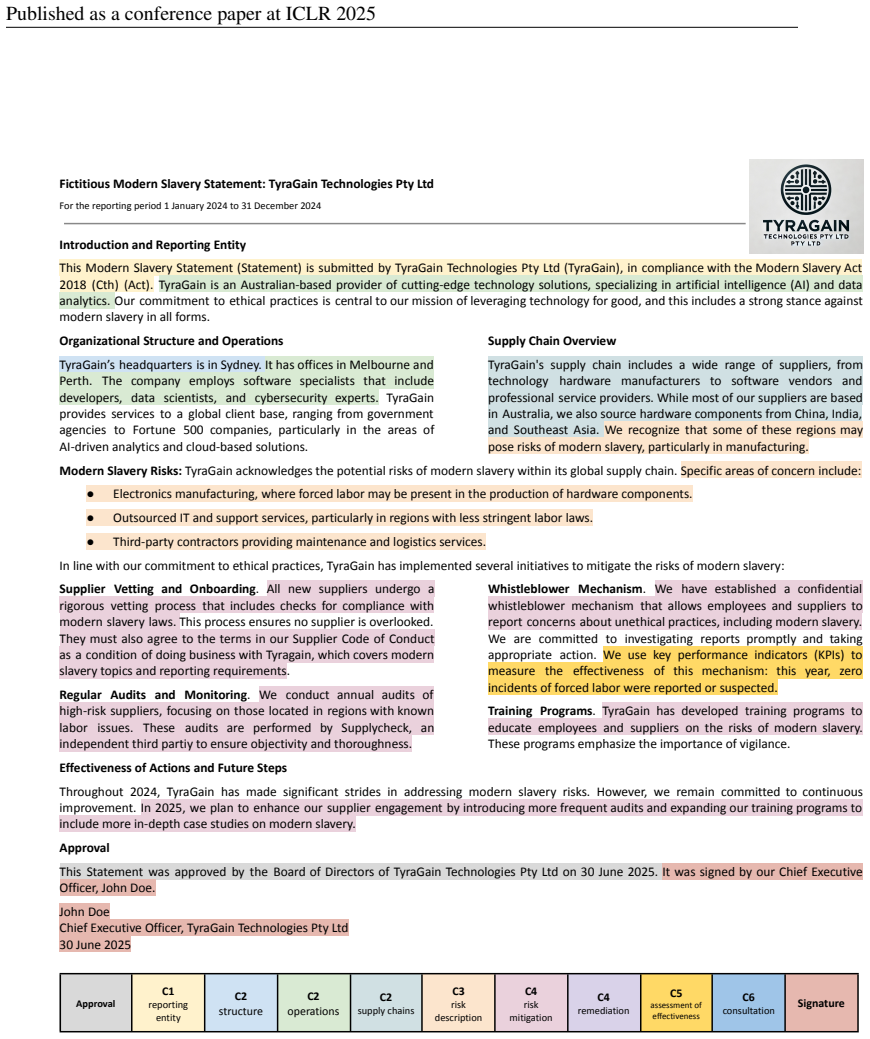
- [Appendix C, Table 4] In the C1 (reporting entity) row, a company logo on the first page is listed as 'ambiguous information,' but the dataset pipeline excludes information embedded in figures and tables, and annotators were not asked to extract visual elements; please clarify whether this example is intended to illustrate a label that annotators would actually record, and if so, how it interoperates with the stated annotation workflow.
Circularity Check
No circularity: the dataset labels are human annotations, and benchmark results are evaluated on a separately annotated gold test set.
full rationale
The paper's central contribution is a manually annotated dataset. Labels are produced by hired annotators following a specification derived from the Australian Modern Slavery Act, and the gold evaluation sets are annotated independently by the authors' team. The benchmark compares fine-tuned models (trained on the hired-worker labels) against zero-shot models, with all models evaluated on the held-out gold test set. No parameter is fitted to the test labels and then renamed as a prediction; no self-citation is load-bearing; no uniqueness theorem is invoked; and no known result is repackaged under new coordinates. The closest point to a circularity concern is that the zero-shot prompts are described as 'essentially a condensed version of the instructions given to the annotators' (Section 4, Prompt design for zero-shot experiments). This means the prompt and the gold labels share the same operational definition of relevance. However, this is standard practice for specifying a classification task to a model, and it does not make the model's F1 score equivalent to the prompt by construction: the model must still read each sentence and apply the definition. Any concern that the 50-statement test set is too small to support the word 'significantly' is a statistical precision issue, not a circularity issue. The paper is self-contained against external benchmarks in the sense that its evaluations are measured against independent held-out annotations.
Assumptions & free parameters
assumptions (4)
- domain assumption The seven Mandatory Criteria of the AU MSA can be operationalized into eleven answerable sentence-level questions.
- domain assumption Sentence-level relevance is a valid proxy for whether a statement meets a reporting criterion.
- domain assumption The expert gold annotations (50 validation and 50 test statements) are correct enough to serve as ground truth.
- domain assumption The union of labels from two hired annotators provides a sufficiently complete positive set for training.
Cite this review
Pith. "Pith review of AIMS.au: A Dataset for the Analysis of Modern Slavery Countermeasures in Corporate Statements." pith.science (2026). https://pith.science/paper/DFZ7SC3Q
@misc{pith2026250207022,
  author       = {Pith},
  title        = {Pith review of: AIMS.au: A Dataset for the Analysis of Modern Slavery Countermeasures in Corporate Statements},
  year         = {2026},
  howpublished = {\url{https://pith.science/paper/DFZ7SC3Q}},
  note         = {Machine review of arXiv:2502.07022}
}
read the original abstract
Despite over a decade of legislative efforts to address modern slavery in the supply chains of large corporations, the effectiveness of government oversight remains hampered by the challenge of scrutinizing thousands of statements annually. While Large Language Models (LLMs) can be considered a well established solution for the automatic analysis and summarization of documents, recognizing concrete modern slavery countermeasures taken by companies and differentiating those from vague claims remains a challenging task. To help evaluate and fine-tune LLMs for the assessment of corporate statements, we introduce a dataset composed of 5,731 modern slavery statements taken from the Australian Modern Slavery Register and annotated at the sentence level. This paper details the construction steps for the dataset that include the careful design of annotation specifications, the selection and preprocessing of statements, and the creation of high-quality annotation subsets for effective model evaluations. To demonstrate our dataset's utility, we propose a machine learning methodology for the detection of sentences relevant to mandatory reporting requirements set by the Australian Modern Slavery Act. We then follow this methodology to benchmark modern language models under zero-shot and supervised learning settings.
Figures


Figures from the paper (7 more)




Reference graph
Works this paper leans on
-
[3]
the location, category, contractual arrangement, or other attributes that describe the suppliers. Any sentence that contains these kinds of information is considered relevant. Descriptions that apply to indirect suppliers (i.e. suppliers-of-suppliers) are considered relevant. Descriptions of the supply chains of entities owned or controlled by the reporti...
work page 2025
-
[4]
Australian Government, Attorney-General’s Department, Modern Slavery Business Engagement Unit
URL https://modernslaveryregister.gov.au/. Australian Government, Attorney-General’s Department, Modern Slavery Business Engagement Unit. Commonwealth Modern Slavery Act 2018: Guidance for Reporting Entities,
work page 2018
-
[5]
Simone Balloccu, Patrícia Schmidtová, Mateusz Lango, and Ondˇrej Dušek
URL https://modernslaveryregister.gov.au/resources/Commonwealth_ Modern_Slavery_Act_Guidance_for_Reporting_Entities.pdf. Simone Balloccu, Patrícia Schmidtová, Mateusz Lango, and Ondˇrej Dušek. Leak, cheat, repeat: Data contamination and evaluation malpractices in closed-source LLMs. arXiv preprint: 2402.03927,
-
[6]
doi: 10.1016/j.jbankfin.2023.107191. A. Bora. Using augmented intelligence in accelerating the eradication of modern slavery: Applied machine learning in analysing and benchmarking the modern slavery businesses’ reports. Thesis,
arXiv 2023
-
[8]
Florian Bordes, Richard Yuanzhe Pang, Anurag Ajay, Alexander C. Li, Adrien Bardes, Suzanne Petryk, Oscar Mañas, Zhiqiu Lin, Anas Mahmoud, Bargav Jayaraman, Mark Ibrahim, Melissa Hall, Yunyang Xiong, Jonathan Lebensold, Candace Ross, Srihari Jayakumar, Chuan Guo, Diane Bouchacourt, Haider Al-Tahan, Karthik Padthe, Vasu Sharma, Hu Xu, Xiaoqing Ellen Tan, Me...
-
[9]
URL https://laws.justice.gc.ca/eng/acts/F-10.6/. Accessed: 2024-06-05. Katherine Leanne Christ, Kathyayini Kathy Rao, and Roger Leonard Burritt. Accounting for modern slavery: an analysis of australian listed company disclosures. Accounting, Auditing & Accountability Journal, 32(3):836–865,
work page 2024
-
[11]
hrlc.org.au/reports-news-commentary/broken-promises
URL https://www. hrlc.org.au/reports-news-commentary/broken-promises . Abhimanyu Dubey, Abhinav Jauhri, Abhinav Pandey, Abhishek Kadian, Ahmad Al-Dahle, Aiesha Letman, Akhil Mathur, Alan Schelten, Amy Yang, Angela Fan, Anirudh Goyal, Anthony Hartshorn, Aobo Yang, Archi Mitra, Archie Sravankumar, Artem Korenev, Arthur Hinsvark, Arun Rao, Aston Zhang, Aurel...
work page 2025
-
[12]
URL https://arxiv.org/abs/2407.21783. Sabit Ekin. Prompt engineering for ChatGPT: a quick guide to techniques, tips, and best practices. Authorea Preprints,
Show all 40 references
-
[13]
The GEM benchmark: Natural language generation, its evaluation and metrics
Sebastian Gehrmann, Tosin Adewumi, Karmanya Aggarwal, Pawan Sasanka Ammanamanchi, Aremu Anuoluwapo, Antoine Bosselut, Khyathi Raghavi Chandu, Miruna Clinciu, Dipanjan Das, Kaus- tubh D Dhole, et al. The GEM benchmark: Natural language generation, its evaluation and metrics. ar...
-
[14]
LegalBench: A collabora- tively built benchmark for measuring legal reasoning in large language models
Neel Guha, Julian Nyarko, Daniel Ho, Christopher Ré, Adam Chilton, Alex Chohlas-Wood, Austin Peters, Brandon Waldon, Daniel Rockmore, Diego Zambrano, et al. LegalBench: A collabora- tively built benchmark for measuring legal reasoning in large language models. arXiv preprint: ...
-
[15]
Deep Lake: A lakehouse for deep learning
Sasun Hambardzumyan, Abhinav Tuli, Levon Ghukasyan, Fariz Rahman, Hrant Topchyan, David Isayan, Mark McQuade, Mikayel Harutyunyan, Tatevik Hakobyan, Ivo Stranic, et al. Deep Lake: A lakehouse for deep learning. arXiv preprint: 2209.10785,
-
[16]
Hu, Yelong Shen, Phillip Wallis, Zeyuan Allen-Zhu, Yuanzhi Li, Shean Wang, Lu Wang, and Weizhu Chen
Edward J. Hu, Yelong Shen, Phillip Wallis, Zeyuan Allen-Zhu, Yuanzhi Li, Shean Wang, Lu Wang, and Weizhu Chen. LoRA: Low-rank adaptation of large language models. arXiv preprint: 2106.09685,
-
[17]
Adam: A method for stochastic optimization
13 Published as a conference paper at ICLR 2025 Diederik P Kingma and Jimmy Ba. Adam: A method for stochastic optimization. arXiv preprint: 1412.6980,
2025 arXiv
-
[19]
CHATREPORT: Democratizing sustainability disclosure analysis through LLM-based tools
Jingwei Ni, Julia Bingler, Chiara Colesanti-Senni, Mathias Kraus, Glen Gostlow, Tobias Schimanski, et al. CHATREPORT: Democratizing sustainability disclosure analysis through LLM-based tools. arXiv preprint: 2307.15770,
-
[20]
CLIMATEBERT: A pretrained language model for climate-related text
Julia Anna Bingler Nicolas Webersinke, Mathias Kraus and Markus Leippold. CLIMATEBERT: A pretrained language model for climate-related text. arXiv preprint: 2110.12010,
-
[21]
FLawN-T5: An empirical examination of effective instruction-tuning data mixtures for legal reasoning
Joel Niklaus, Lucia Zheng, Arya D McCarthy, Christopher Hahn, Brian M Rosen, Peter Henderson, Daniel E Ho, Garrett Honke, Percy Liang, and Christopher Manning. FLawN-T5: An empirical examination of effective instruction-tuning data mixtures for legal reasoning. arXiv preprint:...
-
[22]
DistilBERT, a distilled version of BERT: smaller, faster, cheaper and lighter
Victor Sanh, Lysandre Debut, Julien Chaumond, and Thomas Wolf. DistilBERT, a distilled version of BERT: smaller, faster, cheaper and lighter. arXiv preprint: 1910.01108,
1910 arXiv
-
[24]
Mirac Suzgun, Luke Melas-Kyriazi, Suproteem Sarkar, Scott D Kominers, and Stuart Shieber
URL https://www.hrlc.org.au/reports-news-commentary/2022/2/3/ paper-promises-evaluating-the-early-impact-of-australias-modern-slavery-act . Mirac Suzgun, Luke Melas-Kyriazi, Suproteem Sarkar, Scott D Kominers, and Stuart Shieber. The Harvard USPTO patent dataset: A large-scale...
2022
-
[25]
Hierarchical Data Format, version
14 Published as a conference paper at ICLR 2025 The HDF Group. Hierarchical Data Format, version
2025
-
[26]
URL https://doi.org/10.1038/ s41597-023-02093-3
doi: 10.1038/s41597-023-02093-3. URL https://doi.org/10.1038/ s41597-023-02093-3 . Hugo Touvron, Louis Martin, Kevin Stone, Peter Albert, Amjad Almahairi, Yasmine Babaei, Nikolay Bashlykov, Soumya Batra, Prajjwal Bhargava, Shruti Bhosale, Dan Bikel, Lukas Blecher, Cris- tian C...
-
[27]
Modern slavery act 2015, section 54,
UK Government. Modern slavery act 2015, section 54,
2015
-
[29]
AI against modern slavery: Digital insights into modern slavery reporting – challenges and opportunities
Nyasha Weinberg, Adriana Bora, Francisca Sassetti, Katharine Bryant, Edgar Rootalu, Karyna Bikziantieieva, Laureen van Breen, Patricia Carrier, Yolanda Lannquist, and Nicolas Miailhe10. AI against modern slavery: Digital insights into modern slavery reporting – challenges and ...
-
[30]
org/UK_Modern_Slavery_Act_Research
URL https://wikirate. org/UK_Modern_Slavery_Act_Research. Thomas Wolf, Lysandre Debut, Victor Sanh, Julien Chaumond, Clement Delangue, Anthony Moi, Pierric Cistac, Tim Rault, Rémi Louf, Morgan Funtowicz, et al. HuggingFace’s Transformers: State-of-the-art natural language proc...
1910 arXiv
-
[31]
Some academic groups and non-profit organizations have conducted analyses of Australian modern slavery statements to evaluate the legislation’s effectiveness
A O THER RELATED WORKS Australian modern slavery statement manual reviews. Some academic groups and non-profit organizations have conducted analyses of Australian modern slavery statements to evaluate the legislation’s effectiveness. For instance, in the work of Christ et al. ...
2019
-
[32]
gold” validation set. We may withhold the release of the “gold
for detecting net zero and emission reduction targets. Bingler et al. (2024) also explored climate disclosures and reputational risks with ClimateBertCTI, stressing the credibility of transition plans. Additionally, ClimateBERT and other language models such as BERT, RoBERTa, ...
2024
-
[33]
This statement was approved by our principal governing body (our board) on March 15th, 2023
distracting information. These examples are inspired by the contents of real statements and highlight the significant challenge of distinguishing between relevant and irrelevant information. 17 Published as a conference paper at ICLR 2025 Table 4: Examples of relevant and irre...
2025
-
[34]
Statement collection process
were annotated for three out of our eleven mandatory content questions by hired workers; – 4,657 statements published by April 2023 that are less than 15 pages were also double- annotated for the remaining eight questions by hired workers; and 20 Published as a conference pape...
2023
-
[35]
brick-and- mortar
while making no mention of the importance of capital structure, reporting structure, or taxation structure descriptions. Classifying information on shareholders is also difficult, as it may sometimes be relevant when few shareholders have significant control over the reporting...
2023
-
[36]
the reporting entity and any entities it owns or controls
also mentions that entities are not required to report this information. However, the distribution of products or services to customers is considered a relevant activity (or operation). Risks and actions may not always apply to owned or controlled entities. Specifically, Manda...
2025
-
[37]
the model will use log probability to automatically increase the temperature until certain thresholds are hit
In addition to the experimentation details presented in Section 5 of the paper (Benchmark Experiments), we report that the models are fine-tuned with a cross-entropy loss using the Adam optimizer and without a learning rate scheduler. Each model is trained for 24 hours on a A1...
2021
-
[38]
supply chains
28 Published as a conference paper at ICLR 2025 Prompt template (C2, “supply chains”, no-context) You are an analyst that inspects modern slavery declarations made by Australian reporting entities. You are specialized in the analysis of statements made with respect to the Aust...
2025
-
[40]
Beyond Compliance
the location, category, contractual arrangement, or other attributes that describe the suppliers. Any sentence that contains these kinds of information is considered relevant. Descriptions that apply to indirect suppliers (i.e. suppliers-of-suppliers) are considered relevant. ...
2025
-
[2014]
Analyzing sustainability reports using natural language processing
Alexandra Luccioni, Emily Baylor, and Nicolas Duchene. Analyzing sustainability reports using natural language processing. arXiv preprint: 2011.08073,
2011 arXiv
-
[2015]
legislation.gov.uk/ukpga/2015/30/section/54
URL https://www. legislation.gov.uk/ukpga/2015/30/section/54. Accessed: 2024-06-05. Walk Free. Global estimates of modern slavery: Forced labour and forced marriage. Technical Report, International Labour Organization (ILO), 2022a. URL https://www.ilo.org/media/ 370826/downloa...
2015
-
[2019]
Accessed on 08 May
URL http://dx.doi.org/10.13140/RG.2.2.15257.77921. Accessed on 08 May
-
[2020]
ClimateBERT-NetZero: Detecting and assessing net zero and reduction targets
Tobias Schimanski et al. ClimateBERT-NetZero: Detecting and assessing net zero and reduction targets. arXiv preprint: 2310.08096,
-
[2021]
Accessed on 08 May
URL https://acsi.org.au/wp-content/uploads/2021/07/ ACSI_ModernSlavery_July2021.pdf. Accessed on 08 May
2021
-
[2022]
11 Published as a conference paper at ICLR 2025 Jacob Devlin, Ming-Wei Chang, Kenton Lee, and Kristina Toutanova
URL https://www.humanrights.dk/files/media/document/ DataAnalysis-CompanyReporting_EN_2022_accessible.pdf. 11 Published as a conference paper at ICLR 2025 Jacob Devlin, Ming-Wei Chang, Kenton Lee, and Kristina Toutanova. BERT: Pre-training of deep bidirectional transformers fo...
2025 arXiv
-
[2023]
Domus 8.7 index modern slavery statement benchmark
ACAN. Domus 8.7 index modern slavery statement benchmark. Recorded workshop presentation, available at: https://vimeo.com/705946874,
-
[2024]
Implementing the Modern Slavery Act 2018: The Australian Government’s 2022 Annual Report
Australian Government. Implementing the Modern Slavery Act 2018: The Australian Government’s 2022 Annual Report. Technical Report,
2018
Reviewed August 8, 2026 · model on record in the stance chip above.
Discussion (0). Continue with ORCID to comment.