REVIEW 4 major objections 6 minor 121 references
Few-Shot Multi-Human Neural Rendering Using Geometry Constraints
T0 review · 4 major / 6 minor · reviewed 2026-08-08 · deepseek-v4-flash
Pith's one-line read A neural rendering method reconstructs several people's surfaces and appearance from as few as five images by anchoring an implicit surface to pre-computed body-model meshes.
desk verdict Solid incremental paper on SMPL-prior sparse multi-human neural rendering; worth refereeing, but the SOTA claim overreaches given narrow baselines and unresolved SMPL bias. read the letter →
The pith
A machine-rendered reading of the paper's core claim, the machinery that carries it, and where it could break.
The reading
What carries the argument
The load-bearing object is the SMPL mesh treated as a noisy signed-distance prior, encoded in the negative log-likelihood loss of Equation 6 with a predicted per-point uncertainty. Around it, the union of per-person SMPL bounding boxes in Equation 8 defines a foreground volume that replaces a single foreground sphere, making hierarchical sampling concentrate on the bodies and providing a clean foreground-background split without segmentation masks. The ray-consistency loss compares a rendered ray to an interpolated neighboring ray with an additional KL-divergence term on ray density, and the saturation loss adds an L1 term on HSV saturation values. Together these components carry the argument from coarse body-model fits to detailed multi-human surfaces.
What would settle it
Run the trained model on a multi-human scene where one person wears a large rigid backpack or holds a wide object, and compare Chamfer distance against ground-truth scans: if geometry quality collapses for that person while other people stay accurate, the body-model-prior-as-noise assumption is the point of failure.
Extended reading notes
Core claim
The paper establishes that a multi-human scene's implicit geometry can be recovered from sparse views by combining an SDF network pretrained on SMPL distance supervision with a foreground model made of the union of per-person bounding boxes rather than a single sphere. The SMPL meshes are not treated as ground truth: the network also outputs a per-point uncertainty, and the pretraining loss minimizes a Gaussian negative log-likelihood so that confident regions act as anchors while uncertain regions, such as clothing and hair, are free to move under photometric evidence. During fine-tuning an SDF loss with thresholds keeps the reconstruction consistent with the prior only where the predicted distance or uncertainty is small. The rendering is hybrid: points inside any person's box are handled by the SDF and radiance network, points outside by a background NeRF, which lets occlusion be reasoned about jointly instead of per person. The result claimed is state-of-the-art surface and novel-view quality on multi-human scenes with 5 to 20 views.
Load-bearing premise
The method assumes the body-model meshes computed from the sparse views are close enough to the real bodies that their geometry and bounding boxes contain every visible person.
Editorial extensions
If this is right
- With as few as five training views, a multi-human scene can be rendered from novel viewpoints without segmentation masks or pre-scanned templates, because the union of SMPL boxes supplies the foreground-background split.
- The number of people in view degrades the baselines much faster than the proposed method, so the approach is aimed specifically at crowded scenes rather than single-person capture.
- The same trained network supports scene editing: rigidly transforming, scaling, or removing a person requires only transforming the points sampled inside that person's bounding box before rendering.
- The performance gain over NeuS and VolSDF shrinks as the input becomes dense, indicating that the contribution is concentrated in the sparse-view regime.
- Because all people are learned jointly through the union of boxes, the method avoids the per-person preprocessing and erroneous occlusion supervision that arise when running a single-human NeRF separately for each subject.
Reading between the lines
- The per-point uncertainty output could be used as a confidence map to guide active camera selection in a capture system, suggesting which views would most reduce geometric ambiguity; the paper does not explore this.
- Because the foreground is decomposed into independent person boxes, one could plausibly swap or re-compose people across scenes at render time, extending the editing results in the supplementary material into a broader re-composition tool.
- The Gaussian-noise model assumes SMPL errors are unbiased, so systematic mis-fits such as heavy clothing or held objects may need an explicit bias term or an SMPL-free region; testing this would clarify the method's failure envelope.
Editorial analysis
A structured set of objections, weighed in public.
Referee Report
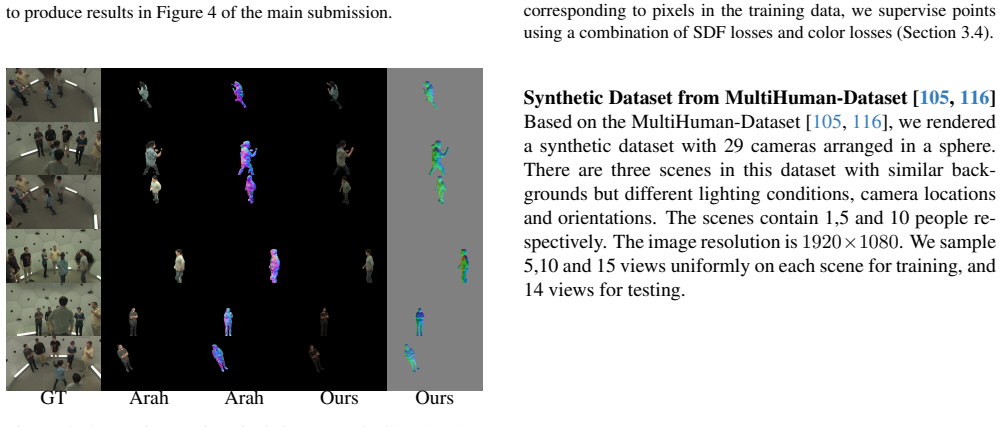
Summary. The paper proposes a few-shot multi-human neural rendering method that combines an implicit SDF representation with a pre-computed SMPL body-model prior. The method initializes the SDF network from SMPL distance fields with a Gaussian uncertainty model, defines per-person foreground bounding boxes for hybrid foreground/background rendering, and adds a ray-consistency loss and a saturation loss to regularize sparse-view optimization. Experiments on CMU Panoptic and on a synthetic MultiHuman-derived dataset compare against NeuS, VolSDF, InfoNeRF, and ARAH, reporting improved novel-view quality and geometry reconstruction from 5 to 20 training views.
Significance. If the reported results hold, the paper would make a useful practical contribution: it shows that a coarse SMPL prior can help sparse-view neural surface reconstruction in multi-human scenes, and the proposed bounding-box-based hybrid rendering is a plausible way to reduce empty-space sampling. The ablation study provides some evidence that each proposed component contributes. The significance is moderate rather than high, because the evaluation is narrow in both baselines and metrics, and the central geometric assumption about SMPL accuracy is not directly validated.
major comments (4)
- [Sec. 3.3, Eq. (8); Sec. 3.2, Eq. (6)] The hard foreground/background split in Eq. (8) assumes that every true surface point of a person lies inside the SMPL-derived bounding box plus margin δ=0.1. If an SMPL fit is systematically offset due to clothing, hair, object contact, or pose error, points beyond the margin are assigned to the background NeRF and are excluded from SDF and normal estimation, so the "complete geometry" claim in Sec. 4.2 cannot hold in general. The Gaussian uncertainty model in Eq. (6) treats the SMPL error as zero-mean noise; a systematic offset can be absorbed by inflating s_noise, which reduces the loss without moving the surface to the true location. The manuscript reports no evaluation of SMPL fit accuracy and no sensitivity analysis on δ; please add such an analysis or some form of soft/adaptive foreground assignment.
- [Sec. 4.3, Table 3; Supp. Table 5] The main geometry result is reported as one-way Chamfer distance from ground truth to reconstruction. One-way distance can be made artificially small by reconstructing only a subset of the surface, and it is not a sufficient metric to support the paper's claim of complete geometry. The supplementary table reports bidirectional Chamfer distances, which are considerably larger and sometimes close to the baselines (e.g., scene 1, 15 views: 0.154 vs 0.167). Please report bidirectional Chamfer or precision/recall/completeness in the main paper, and avoid the claim of an "order of magnitude less error" based on one-way values. Also, no quantitative geometry metric is reported for the real CMU Panoptic experiments, despite the geometry claim in Sec. 4.2.
- [Sec. 4.2-4.3, Tables 1 and 3] All quantitative results appear to be single runs on a single random selection of training views. Given the explicit statement that training views were randomly extracted, the reported improvements (which are often small, e.g., SSIM differences of 0.01-0.03 in Table 1) could be within view-selection noise. Please provide results over multiple random training-view selections with mean and standard deviation, or otherwise justify that the observed differences are statistically significant. This is directly load-bearing for the state-of-the-art claim.
- [Abstract; Sec. 4] The "state-of-the-art" claim is supported by only four sparse-view baselines, two of which (NeuS and VolSDF) are general-purpose implicit surface methods without human-specific priors. To make the claim proportionate, either restrict it to "compared with NeuS, VolSDF, InfoNeRF, and ARAH" or compare with recent multi-human sparse-view methods that also exploit body models (e.g., the methods cited as [30, 110, 115, 116]) and report computational cost. The current evidence supports an improvement over the four tested baselines, not a general state-of-the-art statement.
minor comments (6)
- [Sec. 3.4, Eq. (12) and Eq. (14)] Eq. (12) uses L_r for both the photometric reconstruction loss and the ray-consistency loss; the latter should be renamed (e.g., L_ray). In Eq. (14), C(r^*) is used but the text defines C(r_p^*) on an interpolated ray, and the density distribution P(·) is not fully defined.
- [Sec. 4.2] The text refers to "Tab. 6" when discussing the InfoNeRF comparison, but the actual table is Table 2; please fix the cross-reference.
- [Table 3 caption] The caption spells the metric as "LIPIS"; this should be LPIPS. Inconsistencies such as "Neus" versus "NeuS" also appear in Figure 2 and Table 4.
- [Fig. 1 caption] The caption says "SMLP bounding boxes"; this should be SMPL.
- [Sec. 4.2 and Supp. Sec. 8] The main text says training views were "randomly extracted" while the supplementary material says they were "uniformly sampled"; please clarify the protocol and report the random seed used.
- [Sec. 4.3 and Supp. Sec. 8] The synthetic dataset is described as having 29 cameras arranged in a "great circle" in the main text but as arranged in a "sphere" in the supplementary material; please reconcile these descriptions.
Circularity Check
No significant circularity: SMPL prior is an external geometric input and all headline results are evaluated against external ground-truth geometry and images.
full rationale
The paper's derivation chain is self-contained in the relevant sense. The SMPL fits are obtained from off-the-shelf body estimation and are treated as a noisy external geometric prior: Section 3.2 'independently training fθ0 using off-the-shelf SMPL fittings,' and Section 3.3 defines bounding boxes directly from the same SMPL fits. These are inputs to the method, not quantities the paper claims to predict. Equation 6 models the SMPL distance field as Gaussian noise and learns an uncertainty, which is a regularizer rather than a renamed prediction. Equation 13 anchors the final SDF to the initial SMPL-initialized network only under thresholds, again a prior-supervision term. The final geometry is optimized with photometric losses against multi-view images and is evaluated against external ground truth: CMU Panoptic data for image metrics and synthetic MultiHuman meshes for Chamfer distance. The claimed state-of-the-art results are therefore externally falsifiable and do not reduce to the fitted SMPL values by construction. The self-citations in the related-work section (e.g., [48, 49, 65-70, 102]) are background context for generalizable sparse-view methods and are not load-bearing for the paper's central claim. The main risk identified by the skeptical analysis is that systematic SMPL fit errors could push true surface points outside the 0.1 m bounding-box margin, but that is a correctness and robustness concern, not circularity.
Assumptions & free parameters
free parameters (6)
- Eikonal loss weight lambda_eik =
not specified
- SDF regularization weight lambda_sdf =
not specified
- Ray consistency loss weight lambda_r =
not specified
- Saturation loss weight lambda_s =
not specified
- SDF uncertainty thresholds xi0 and xi1 =
xi0=0.2, xi1=0.5
- Bounding box margin delta =
0.1
assumptions (5)
- domain assumption NeuS SDF-based volume rendering formulation (Equations 1-5) renders color correctly for implicit surfaces.
- domain assumption SMPL body fits from the input views are sufficiently accurate to initialize the SDF and define per-person boxes.
- ad hoc to paper Per-point error between SMPL and the true surface is zero-mean Gaussian with variance s_noise^2 (Equation 6).
- ad hoc to paper Each human is wholly contained in its SMPL-derived bounding box plus margin delta.
- ad hoc to paper Interpolated rays on a patch should match observed neighboring rays in color and density (Equation 14).
Cite this review
Pith. "Pith review of Few-Shot Multi-Human Neural Rendering Using Geometry Constraints." pith.science (2026). https://pith.science/paper/AUPUCZDI
@misc{pith2026250207140,
  author       = {Pith},
  title        = {Pith review of: Few-Shot Multi-Human Neural Rendering Using Geometry Constraints},
  year         = {2026},
  howpublished = {\url{https://pith.science/paper/AUPUCZDI}},
  note         = {Machine review of arXiv:2502.07140}
}
read the original abstract
We present a method for recovering the shape and radiance of a scene consisting of multiple people given solely a few images. Multi-human scenes are complex due to additional occlusion and clutter. For single-human settings, existing approaches using implicit neural representations have achieved impressive results that deliver accurate geometry and appearance. However, it remains challenging to extend these methods for estimating multiple humans from sparse views. We propose a neural implicit reconstruction method that addresses the inherent challenges of this task through the following contributions: First, we propose to use geometry constraints by exploiting pre-computed meshes using a human body model (SMPL). Specifically, we regularize the signed distances using the SMPL mesh and leverage bounding boxes for improved rendering. Second, we propose a ray regularization scheme to minimize rendering inconsistencies, and a saturation regularization for robust optimization in variable illumination. Extensive experiments on both real and synthetic datasets demonstrate the benefits of our approach and show state-of-the-art performance against existing neural reconstruction methods.
Figures


Figures from the paper (8 more)



Reference graph
Works this paper leans on
-
[1]
Neural point-based graph- ics
Kara-Ali Aliev, Artem Sevastopolsky, Maria Kolos, Dmitry Ulyanov, and Victor Lempitsky. Neural point-based graph- ics. In European Conference on Computer Vision , pages 696–712. Springer, 2020. 2
2020
-
[2]
Detailed human avatars from monocular video
Thiemo Alldieck, Marcus Magnor, Weipeng Xu, Christian Theobalt, and Gerard Pons-Moll. Detailed human avatars from monocular video. In 2018 International Conference on 3D Vision (3DV), pages 98–109. IEEE, 2018. 1
2018
-
[3]
Video based reconstruc- tion of 3d people models
Thiemo Alldieck, Marcus Magnor, Weipeng Xu, Christian Theobalt, and Gerard Pons-Moll. Video based reconstruc- tion of 3d people models. In Proceedings of the IEEE Con- ference on Computer Vision and Pattern Recognition, pages 8387–8397, 2018. 2
2018
-
[4]
Photorealistic monocular 3d reconstruction of hu- mans wearing clothing
Thiemo Alldieck, Mihai Zanfir, and Cristian Sminchis- escu. Photorealistic monocular 3d reconstruction of hu- mans wearing clothing. In Proceedings of the IEEE/CVF Conference on Computer Vision and Pattern Recognition , pages 1506–1515, 2022. 2
2022
-
[5]
Neural rgb-d surface reconstruction
Dejan Azinovi ´c, Ricardo Martin-Brualla, Dan B Goldman, Matthias Nießner, and Justus Thies. Neural rgb-d surface reconstruction. In Proceedings of the IEEE/CVF Confer- ence on Computer Vision and Pattern Recognition , pages 6290–6301, 2022. 4
2022
-
[6]
Detailed human shape and pose from images
Alexandru O Balan, Leonid Sigal, Michael J Black, James E Davis, and Horst W Haussecker. Detailed human shape and pose from images. In 2007 IEEE Conference on Computer Vision and Pattern Recognition , pages 1–8. IEEE, 2007. 2
2007
-
[7]
Keep it smpl: Automatic estimation of 3d human pose and shape from a single image
Federica Bogo, Angjoo Kanazawa, Christoph Lassner, Pe- ter Gehler, Javier Romero, and Michael J Black. Keep it smpl: Automatic estimation of 3d human pose and shape from a single image. In European conference on computer vision, pages 561–578. Springer, 2016. 2
2016
-
[8]
Poco: Point con- volution for surface reconstruction
Alexandre Boulch and Renaud Marlet. Poco: Point con- volution for surface reconstruction. In Proceedings of the IEEE/CVF Conference on Computer Vision and Pattern Recognition, pages 6302–6314, 2022. 2
2022
Show all 121 references
-
[9]
Dy- namic surface function networks for clothed human bodies
Andrei Burov, Matthias Nießner, and Justus Thies. Dy- namic surface function networks for clothed human bodies. In Proceedings of the IEEE/CVF International Conference on Computer Vision, pages 10754–10764, 2021. 2
2021
-
[10]
Free-viewpoint video of human ac- tors
Joel Carranza, Christian Theobalt, Marcus A Magnor, and Hans-Peter Seidel. Free-viewpoint video of human ac- tors. ACM transactions on graphics (TOG), 22(3):569–577,
-
[11]
Unsuper- vised inference of signed distance functions from single sparse point clouds without learning priors
Chao Chen, Zhizhong Han, and Yu-Shen Liu. Unsuper- vised inference of signed distance functions from single sparse point clouds without learning priors. In Proceed- ings of the IEEE/CVF Conference on Computer Vision and Pattern Recognition (CVPR), 2023. 2
2023
-
[12]
Animatable neural ra- diance fields from monocular rgb videos
Jianchuan Chen, Ying Zhang, Di Kang, Xuefei Zhe, Lin- chao Bao, Xu Jia, and Huchuan Lu. Animatable neural ra- diance fields from monocular rgb videos. arXiv preprint arXiv:2106.13629, 2021. 1
2021 arXiv
-
[13]
Implicit functions in feature space for 3d shape reconstruc- tion and completion
Julian Chibane, Thiemo Alldieck, and Gerard Pons-Moll. Implicit functions in feature space for 3d shape reconstruc- tion and completion. In Proceedings of the IEEE/CVF Con- ference on Computer Vision and Pattern Recognition, pages 6970–6981, 2020. 2
2020
-
[14]
Learning to estimate robust 3d human mesh from in-the-wild crowded scenes
Hongsuk Choi, Gyeongsik Moon, JoonKyu Park, and Ky- oung Mu Lee. Learning to estimate robust 3d human mesh from in-the-wild crowded scenes. In Proceedings of the IEEE/CVF Conference on Computer Vision and Pattern Recognition, pages 1475–1484, 2022. 1, 2
2022
-
[15]
Monocular expres- sive body regression through body-driven attention
Vasileios Choutas, Georgios Pavlakos, Timo Bolkart, Dim- itrios Tzionas, and Michael J Black. Monocular expres- sive body regression through body-driven attention. In European Conference on Computer Vision , pages 20–40. Springer, 2020. 1, 2
2020
-
[16]
High-quality streamable free- viewpoint video
Alvaro Collet, Ming Chuang, Pat Sweeney, Don Gillett, Dennis Evseev, David Calabrese, Hugues Hoppe, Adam Kirk, and Steve Sullivan. High-quality streamable free- viewpoint video. ACM Transactions on Graphics (ToG) , 34(4):1–13, 2015. 1, 2
2015
-
[17]
Performance capture from sparse multi-view video
Edilson De Aguiar, Carsten Stoll, Christian Theobalt, Naveed Ahmed, Hans-Peter Seidel, and Sebastian Thrun. Performance capture from sparse multi-view video. InACM SIGGRAPH 2008 papers, pages 1–10. 2008. 2
2008
-
[18]
Depth-supervised nerf: Fewer views and faster training for free
Kangle Deng, Andrew Liu, Jun-Yan Zhu, and Deva Ra- manan. Depth-supervised nerf: Fewer views and faster training for free. In Proceedings of the IEEE/CVF Confer- ence on Computer Vision and Pattern Recognition , pages 12882–12891, 2022. 2, 3
2022
-
[19]
Pina: Learning a personalized implicit neural avatar from a single rgb-d video sequence
Zijian Dong, Chen Guo, Jie Song, Xu Chen, Andreas Geiger, and Otmar Hilliges. Pina: Learning a personalized implicit neural avatar from a single rgb-d video sequence. In Proceedings of the IEEE/CVF Conference on Computer Vision and Pattern Recognition, pages 20470–20480, 2022. 1
2022
-
[20]
Shape-aware multi-person pose estimation from multi-view images
Zijian Dong, Jie Song, Xu Chen, Chen Guo, and Otmar Hilliges. Shape-aware multi-person pose estimation from multi-view images. In Proceedings of the IEEE/CVF In- ternational Conference on Computer Vision, pages 11158– 11168, 2021. 2
2021
-
[21]
Fusion4d: Real-time performance capture of challenging scenes
Mingsong Dou, Sameh Khamis, Yury Degtyarev, Philip Davidson, Sean Ryan Fanello, Adarsh Kowdle, Sergio Orts Escolano, Christoph Rhemann, David Kim, Jonathan Tay- lor, et al. Fusion4d: Real-time performance capture of challenging scenes. ACM Transactions on Graphics (ToG), 35(4)...
2016
-
[22]
Three- dimensional reconstruction of human interactions
Mihai Fieraru, Mihai Zanfir, Elisabeta Oneata, Alin-Ionut Popa, Vlad Olaru, and Cristian Sminchisescu. Three- dimensional reconstruction of human interactions. In Pro- ceedings of the IEEE/CVF Conference on Computer Vision and Pattern Recognition, pages 7214–7223, 2020. 1, 2
2020
-
[23]
Motion capture using joint skeleton tracking and surface estimation
Juergen Gall, Carsten Stoll, Edilson De Aguiar, Christian Theobalt, Bodo Rosenhahn, and Hans-Peter Seidel. Motion capture using joint skeleton tracking and surface estimation. In 2009 IEEE Conference on Computer Vision and Pattern Recognition, pages 1746–1753. Ieee, 2009. 2
2009
-
[24]
Implicit geometric regularization for learn- ing shapes
Amos Gropp, Lior Yariv, Niv Haim, Matan Atzmon, and Yaron Lipman. Implicit geometric regularization for learn- ing shapes. arXiv preprint arXiv:2002.10099, 2020. 4
2002 arXiv
-
[25]
Holopose: Holis- tic 3d human reconstruction in-the-wild
Riza Alp Guler and Iasonas Kokkinos. Holopose: Holis- tic 3d human reconstruction in-the-wild. In Proceedings of the IEEE/CVF Conference on Computer Vision and Pattern Recognition, pages 10884–10894, 2019. 2
2019
-
[26]
The re- lightables: V olumetric performance capture of humans with realistic relighting
Kaiwen Guo, Peter Lincoln, Philip Davidson, Jay Busch, Xueming Yu, Matt Whalen, Geoff Harvey, Sergio Orts- Escolano, Rohit Pandey, Jason Dourgarian, et al. The re- lightables: V olumetric performance capture of humans with realistic relighting. ACM Transactions on Graphics (To...
2019
-
[27]
Geo-pifu: Geometry and pixel aligned implicit functions for single-view human reconstruction
Tong He, John Collomosse, Hailin Jin, and Stefano Soatto. Geo-pifu: Geometry and pixel aligned implicit functions for single-view human reconstruction. Advances in Neural Information Processing Systems, 33:9276–9287, 2020. 2
2020
-
[28]
Arch++: Animation-ready clothed human re- construction revisited
Tong He, Yuanlu Xu, Shunsuke Saito, Stefano Soatto, and Tony Tung. Arch++: Animation-ready clothed human re- construction revisited. In Proceedings of the IEEE/CVF In- ternational Conference on Computer Vision, pages 11046– 11056, 2021. 2
2021
-
[29]
Image quality metrics: Psnr vs
Alain Hore and Djemel Ziou. Image quality metrics: Psnr vs. ssim. In 2010 20th international conference on pattern recognition, pages 2366–2369. IEEE, 2010. 5
2010
-
[30]
Dynamic multi-person mesh recovery from uncali- brated multi-view cameras
Buzhen Huang, Yuan Shu, Tianshu Zhang, and Yangang Wang. Dynamic multi-person mesh recovery from uncali- brated multi-view cameras. In 2021 International Confer- ence on 3D Vision (3DV), pages 710–720. IEEE, 2021. 1, 2
2021
-
[31]
Neural kernel surface re- construction
Jiahui Huang, Zan Gojcic, Matan Atzmon, Or Litany, Sanja Fidler, and Francis Williams. Neural kernel surface re- construction. In Proceedings of the IEEE/CVF Conference on Computer Vision and Pattern Recognition, pages 4369– 4379, 2023. 2
2023
-
[32]
Towards accurate marker-less hu- man shape and pose estimation over time
Yinghao Huang, Federica Bogo, Christoph Lassner, Angjoo Kanazawa, Peter V Gehler, Javier Romero, Ijaz Akhter, and Michael J Black. Towards accurate marker-less hu- man shape and pose estimation over time. In 2017 inter- national conference on 3D vision (3DV) , pages 421–430. I...
2017
-
[33]
Deep volumetric video from very sparse multi- view performance capture
Zeng Huang, Tianye Li, Weikai Chen, Yajie Zhao, Jun Xing, Chloe LeGendre, Linjie Luo, Chongyang Ma, and Hao Li. Deep volumetric video from very sparse multi- view performance capture. In Proceedings of the European Conference on Computer Vision (ECCV) , pages 336–354,
-
[34]
Arch: Animatable reconstruction of clothed humans
Zeng Huang, Yuanlu Xu, Christoph Lassner, Hao Li, and Tony Tung. Arch: Animatable reconstruction of clothed humans. In Proceedings of the IEEE/CVF Conference on Computer Vision and Pattern Recognition , pages 3093– 3102, 2020. 2
2020
-
[35]
Neural mesh-based graphics
Shubhendu Jena, Franck Multon, and Adnane Boukhayma. Neural mesh-based graphics. In European Conference on Computer Vision, pages 739–757. Springer, 2022. 2
2022
-
[36]
Geotransfer: Generalizable few-shot multi-view re- construction via transfer learning
Shubhendu Jena, Franck Multon, and Adnane Boukhayma. Geotransfer: Generalizable few-shot multi-view re- construction via transfer learning. arXiv preprint arXiv:2408.14724, 2024. 2
2024 arXiv
-
[37]
Selfrecon: Self reconstruction your digital avatar from monocular video
Boyi Jiang, Yang Hong, Hujun Bao, and Juyong Zhang. Selfrecon: Self reconstruction your digital avatar from monocular video. In Proceedings of the IEEE/CVF Confer- ence on Computer Vision and Pattern Recognition , pages 5605–5615, 2022. 1
2022
-
[38]
Coherent reconstruction of multiple humans from a single image
Wen Jiang, Nikos Kolotouros, Georgios Pavlakos, Xiaowei Zhou, and Kostas Daniilidis. Coherent reconstruction of multiple humans from a single image. In Proceedings of the IEEE/CVF Conference on Computer Vision and Pattern Recognition, pages 5579–5588, 2020. 1, 2
2020
-
[39]
Panoptic studio: A massively multiview system for social motion capture
Hanbyul Joo, Hao Liu, Lei Tan, Lin Gui, Bart Nabbe, Iain Matthews, Takeo Kanade, Shohei Nobuhara, and Yaser Sheikh. Panoptic studio: A massively multiview system for social motion capture. In Proceedings of the IEEE Interna- tional Conference on Computer Vision , pages 3334–3342,
-
[40]
Panoptic studio: A massively multiview system for social interaction capture
Hanbyul Joo, Tomas Simon, Xulong Li, Hao Liu, Lei Tan, Lin Gui, Sean Banerjee, Timothy Scott Godisart, Bart Nabbe, Iain Matthews, Takeo Kanade, Shohei Nobuhara, and Yaser Sheikh. Panoptic studio: A massively multiview system for social interaction capture. IEEE Transactions on...
2017
-
[41]
End-to-end recovery of human shape and pose
Angjoo Kanazawa, Michael J Black, David W Jacobs, and Jitendra Malik. End-to-end recovery of human shape and pose. In Proceedings of the IEEE conference on computer vision and pattern recognition, pages 7122–7131, 2018. 1, 2
2018
-
[42]
Neural lumigraph ren- dering
Petr Kellnhofer, Lars C Jebe, Andrew Jones, Ryan Spicer, Kari Pulli, and Gordon Wetzstein. Neural lumigraph ren- dering. In Proceedings of the IEEE/CVF Conference on Computer Vision and Pattern Recognition , pages 4287– 4297, 2021. 2
2021
-
[43]
Infonerf: Ray entropy minimization for few-shot neural volume ren- dering
Mijeong Kim, Seonguk Seo, and Bohyung Han. Infonerf: Ray entropy minimization for few-shot neural volume ren- dering. In Proceedings of the IEEE/CVF Conference on Computer Vision and Pattern Recognition , pages 12912– 12921, 2022. 2, 5, 7
2022
-
[44]
Adam: A method for stochastic optimization
Diederik P Kingma and Jimmy Ba. Adam: A method for stochastic optimization. arXiv preprint arXiv:1412.6980 ,
-
[45]
Muhammed Kocabas, Nikos Athanasiou, and Michael J. Black. VIBE: Video inference for human body pose and shape estimation. In 2020 IEEE/CVF Conference on Com- puter Vision and Pattern Recognition (CVPR 2020), pages 5252–5262, Piscataway, NJ, June 2020. IEEE. 1, 2
2020
-
[46]
Neural human performer: Learning generalizable radiance fields for human performance rendering.Advances in Neural Information Processing Systems, 34, 2021
Youngjoong Kwon, Dahun Kim, Duygu Ceylan, and Henry Fuchs. Neural human performer: Learning generalizable radiance fields for human performance rendering.Advances in Neural Information Processing Systems, 34, 2021. 1, 2
2021
-
[47]
Shape reconstruction using volume sweeping and learned photoconsistency
Vincent Leroy, Jean-S ´ebastien Franco, and Edmond Boyer. Shape reconstruction using volume sweeping and learned photoconsistency. In Proceedings of the European Confer- ence on Computer Vision (ECCV) , pages 781–796, 2018. 2
2018
-
[48]
Learn- ing generalizable light field networks from few images
Qian Li, Franck Multon, and Adnane Boukhayma. Learn- ing generalizable light field networks from few images. In ICASSP 2023-2023 IEEE International Conference on Acoustics, Speech and Signal Processing (ICASSP) , pages 1–5. IEEE, 2023. 2
2023
-
[49]
Regu- larizing neural radiance fields from sparse rgb-d inputs
Qian Li, Franck Multon, and Adnane Boukhayma. Regu- larizing neural radiance fields from sparse rgb-d inputs. In 2023 IEEE International Conference on Image Processing (ICIP), pages 2320–2324. IEEE, 2023. 2
2023
-
[50]
Shape-aware human pose and shape reconstruction using multi-view images
Junbang Liang and Ming C Lin. Shape-aware human pose and shape reconstruction using multi-view images. In Pro- ceedings of the IEEE/CVF International Conference on Computer Vision, pages 4352–4362, 2019. 2
2019
-
[51]
Dynamic plane convolutional occupancy networks
Stefan Lionar, Daniil Emtsev, Dusan Svilarkovic, and Songyou Peng. Dynamic plane convolutional occupancy networks. In Proceedings of the IEEE/CVF Winter Con- ference on Applications of Computer Vision , pages 1829– 1838, 2021. 2
2021
-
[52]
Neural actor: Neural free-view synthesis of human actors with pose con- trol
Lingjie Liu, Marc Habermann, Viktor Rudnev, Kripasindhu Sarkar, Jiatao Gu, and Christian Theobalt. Neural actor: Neural free-view synthesis of human actors with pose con- trol. ACM Transactions on Graphics (TOG) , 40(6):1–16,
-
[53]
Recent advances of monocular 2d and 3d human pose estimation: A deep learning perspective
Wu Liu and Tao Mei. Recent advances of monocular 2d and 3d human pose estimation: A deep learning perspective. ACM Computing Surveys (CSUR), 2022. 1, 2
2022
-
[54]
Markerless motion capture of multiple characters using multiview image seg- mentation
Yebin Liu, Juergen Gall, Carsten Stoll, Qionghai Dai, Hans- Peter Seidel, and Christian Theobalt. Markerless motion capture of multiple characters using multiview image seg- mentation. IEEE transactions on pattern analysis and ma- chine intelligence, 35(11):2720–2735, 2013. 2
2013
-
[55]
Markerless motion capture of in- teracting characters using multi-view image segmentation
Yebin Liu, Carsten Stoll, Juergen Gall, Hans-Peter Seidel, and Christian Theobalt. Markerless motion capture of in- teracting characters using multi-view image segmentation. In CVPR 2011, pages 1249–1256. Ieee, 2011. 1, 2
2011
-
[56]
SparseNeuS: Fast generalizable neural sur- face reconstruction from sparse views
Xiaoxiao Long, Cheng Lin, Peng Wang, Taku Komura, and Wenping Wang. SparseNeuS: Fast generalizable neural sur- face reconstruction from sparse views. ECCV, 2022. 2, 3
2022
-
[57]
Smpl: A skinned multi-person linear model
Matthew Loper, Naureen Mahmood, Javier Romero, Ger- ard Pons-Moll, and Michael J Black. Smpl: A skinned multi-person linear model. ACM transactions on graphics (TOG), 34(6):1–16, 2015. 1, 2
2015
-
[58]
Nerf in the wild: Neural radiance fields for uncon- strained photo collections
Ricardo Martin-Brualla, Noha Radwan, Mehdi SM Sajjadi, Jonathan T Barron, Alexey Dosovitskiy, and Daniel Duck- worth. Nerf in the wild: Neural radiance fields for uncon- strained photo collections. InProceedings of the IEEE/CVF Conference on Computer Vision and Pattern Recogni...
2021
-
[59]
Nerf: Representing scenes as neural radiance fields for view syn- thesis
Ben Mildenhall, Pratul P Srinivasan, Matthew Tancik, Jonathan T Barron, Ravi Ramamoorthi, and Ren Ng. Nerf: Representing scenes as neural radiance fields for view syn- thesis. In European conference on computer vision, pages 405–421. Springer, 2020. 1, 2, 3, 4, 5, 14, 16
2020
-
[60]
On self-contact and human pose
Lea Muller, Ahmed AA Osman, Siyu Tang, Chun-Hao P Huang, and Michael J Black. On self-contact and human pose. In Proceedings of the IEEE/CVF Conference on Com- puter Vision and Pattern Recognition , pages 9990–9999,
-
[61]
Multi-person implicit reconstruction from a single image
Armin Mustafa, Akin Caliskan, Lourdes Agapito, and Adrian Hilton. Multi-person implicit reconstruction from a single image. In Proceedings of the IEEE/CVF Confer- ence on Computer Vision and Pattern Recognition , pages 14474–14483, 2021. 1, 2
2021
-
[62]
Regnerf: Regularizing neural radiance fields for view syn- thesis from sparse inputs
Michael Niemeyer, Jonathan T Barron, Ben Mildenhall, Mehdi SM Sajjadi, Andreas Geiger, and Noha Radwan. Regnerf: Regularizing neural radiance fields for view syn- thesis from sparse inputs. In Proceedings of the IEEE/CVF Conference on Computer Vision and Pattern Recognition , ...
2022
-
[63]
Differentiable volumetric rendering: Learning implicit 3d representations without 3d supervi- sion
Michael Niemeyer, Lars Mescheder, Michael Oechsle, and Andreas Geiger. Differentiable volumetric rendering: Learning implicit 3d representations without 3d supervi- sion. In Proceedings of the IEEE/CVF Conference on Com- puter Vision and Pattern Recognition , pages 3504–3515,
-
[64]
Unisurf: Unifying neural implicit surfaces and radiance fields for multi-view reconstruction
Michael Oechsle, Songyou Peng, and Andreas Geiger. Unisurf: Unifying neural implicit surfaces and radiance fields for multi-view reconstruction. In Proceedings of the IEEE/CVF International Conference on Computer Vision , pages 5589–5599, 2021. 2
2021
-
[65]
Few’zero level set’-shot learning of shape signed distance functions in fea- ture space
Amine Ouasfi and Adnane Boukhayma. Few’zero level set’-shot learning of shape signed distance functions in fea- ture space. In ECCV, 2022. 2
2022
-
[66]
Few-shot unsu- pervised implicit neural shape representation learning with spatial adversaries
Amine Ouasfi and Adnane Boukhayma. Few-shot unsu- pervised implicit neural shape representation learning with spatial adversaries. arXiv preprint arXiv:2408.15114, 2024. 2
2024 arXiv
-
[67]
Mixing-denoising generalizable occupancy networks
Amine Ouasfi and Adnane Boukhayma. Mixing-denoising generalizable occupancy networks. 3DV, 2024. 2
2024
-
[68]
Robustifying gen- eralizable implicit shape networks with a tunable non- parametric model
Amine Ouasfi and Adnane Boukhayma. Robustifying gen- eralizable implicit shape networks with a tunable non- parametric model. Advances in Neural Information Pro- cessing Systems, 36, 2024. 2
2024
-
[69]
Unsupervised oc- cupancy learning from sparse point cloud
Amine Ouasfi and Adnane Boukhayma. Unsupervised oc- cupancy learning from sparse point cloud. In Proceedings of the IEEE/CVF Conference on Computer Vision and Pat- tern Recognition, pages 21729–21739, 2024. 2
2024
-
[70]
Toward robust neural reconstruction from sparse point sets, 2024
Amine Ouasfi, Shubhendu Jena, Eric Marchand, and Ad- nane Boukhayma. Toward robust neural reconstruction from sparse point sets, 2024. 2
2024
-
[71]
Deepsdf: Learning continuous signed distance functions for shape representa- tion
Jeong Joon Park, Peter Florence, Julian Straub, Richard Newcombe, and Steven Lovegrove. Deepsdf: Learning continuous signed distance functions for shape representa- tion. In Proceedings of the IEEE/CVF conference on com- puter vision and pattern recognition, pages 165–174, 2019. 1, 3
2019
-
[72]
Pytorch: An imperative style, high-performance deep learning library
Adam Paszke, Sam Gross, Francisco Massa, Adam Lerer, James Bradbury, Gregory Chanan, Trevor Killeen, Zeming Lin, Natalia Gimelshein, Luca Antiga, et al. Pytorch: An imperative style, high-performance deep learning library. Advances in neural information processing systems , 32,
-
[73]
An- imatable neural radiance fields for modeling dynamic hu- man bodies
Sida Peng, Junting Dong, Qianqian Wang, Shangzhan Zhang, Qing Shuai, Xiaowei Zhou, and Hujun Bao. An- imatable neural radiance fields for modeling dynamic hu- man bodies. In Proceedings of the IEEE/CVF Inter- national Conference on Computer Vision , pages 14314– 14323, 2021. 1, 2
2021
-
[74]
Shape as points: A differentiable poisson solver
Songyou Peng, Chiyu Jiang, Yiyi Liao, Michael Niemeyer, Marc Pollefeys, and Andreas Geiger. Shape as points: A differentiable poisson solver. Advances in Neural Informa- tion Processing Systems, 34:13032–13044, 2021. 2
2021
-
[75]
Convolutional occupancy networks
Songyou Peng, Michael Niemeyer, Lars Mescheder, Marc Pollefeys, and Andreas Geiger. Convolutional occupancy networks. In European Conference on Computer Vision , pages 523–540. Springer, 2020. 2
2020
-
[76]
Neural body: Implicit neural representations with structured latent codes for novel view synthesis of dynamic humans
Sida Peng, Yuanqing Zhang, Yinghao Xu, Qianqian Wang, Qing Shuai, Hujun Bao, and Xiaowei Zhou. Neural body: Implicit neural representations with structured latent codes for novel view synthesis of dynamic humans. In Proceed- ings of the IEEE/CVF Conference on Computer Vision a...
2021
-
[77]
Dense depth priors for neural radiance fields from sparse input views
Barbara Roessle, Jonathan T Barron, Ben Mildenhall, Pratul P Srinivasan, and Matthias Nießner. Dense depth priors for neural radiance fields from sparse input views. In Proceedings of the IEEE/CVF Conference on Computer Vi- sion and Pattern Recognition , pages 12892–12901, 2022. 2, 3
2022
-
[78]
Pifu: Pixel-aligned implicit function for high-resolution clothed human digiti- zation
Shunsuke Saito, Zeng Huang, Ryota Natsume, Shigeo Mor- ishima, Angjoo Kanazawa, and Hao Li. Pifu: Pixel-aligned implicit function for high-resolution clothed human digiti- zation. In Proceedings of the IEEE/CVF International Con- ference on Computer Vision, pages 2304–2314, 2019. 2
2019
-
[79]
Pifuhd: Multi-level pixel-aligned implicit function for high-resolution 3d human digitization
Shunsuke Saito, Tomas Simon, Jason Saragih, and Hanbyul Joo. Pifuhd: Multi-level pixel-aligned implicit function for high-resolution 3d human digitization. In Proceedings of the IEEE/CVF Conference on Computer Vision and Pattern Recognition, pages 84–93, 2020. 2
2020
-
[80]
Novel view synthe- sis of human interactions from sparse multi-view videos
Qing Shuai, Chen Geng, Qi Fang, Sida Peng, Wenhao Shen, Xiaowei Zhou, and Hujun Bao. Novel view synthe- sis of human interactions from sparse multi-view videos. In ACM SIGGRAPH 2022 Conference Proceedings, pages 1–10, 2022. 2
2022
-
[81]
Hand key- point detection in single images using multiview bootstrap- ping
Tomas Simon, Hanbyul Joo, and Yaser Sheikh. Hand key- point detection in single images using multiview bootstrap- ping. CVPR, 2017. 2, 5, 6, 7, 8, 9, 14, 15
2017
-
[82]
Surface capture for performance-based animation
Jonathan Starck and Adrian Hilton. Surface capture for performance-based animation. IEEE computer graphics and applications, 27(3):21–31, 2007. 2
2007
-
[83]
Monocular, one-stage, regression of mul- tiple 3d people
Yu Sun, Qian Bao, Wu Liu, Yili Fu, Michael J Black, and Tao Mei. Monocular, one-stage, regression of mul- tiple 3d people. In Proceedings of the IEEE/CVF Inter- national Conference on Computer Vision , pages 11179– 11188, 2021. 1, 2
2021
-
[84]
Putting people in their place: Monocular regression of 3d people in depth
Yu Sun, Wu Liu, Qian Bao, Yili Fu, Tao Mei, and Michael J Black. Putting people in their place: Monocular regression of 3d people in depth. In Proceedings of the IEEE/CVF Conference on Computer Vision and Pattern Recognition , pages 13243–13252, 2022. 1, 2
2022
-
[85]
Fourier fea- tures let networks learn high frequency functions in low di- mensional domains
Matthew Tancik, Pratul Srinivasan, Ben Mildenhall, Sara Fridovich-Keil, Nithin Raghavan, Utkarsh Singhal, Ravi Ramamoorthi, Jonathan Barron, and Ren Ng. Fourier fea- tures let networks learn high frequency functions in low di- mensional domains. Advances in Neural Information ...
2020
-
[86]
De- ferred neural rendering: Image synthesis using neural tex- tures
Justus Thies, Michael Zollh ¨ofer, and Matthias Nießner. De- ferred neural rendering: Image synthesis using neural tex- tures. Acm Transactions on Graphics (TOG) , 38(4):1–12,
-
[87]
Body size and depth disambiguation in multi-person reconstruction from single images
Nicolas Ugrinovic, Adria Ruiz, Antonio Agudo, Alberto Sanfeliu, and Francesc Moreno-Noguer. Body size and depth disambiguation in multi-person reconstruction from single images. In 2021 International Conference on 3D Vi- sion (3DV), pages 53–63. IEEE, 2021. 1, 2
2021
-
[88]
Articulated mesh animation from multi-view sil- houettes
Daniel Vlasic, Ilya Baran, Wojciech Matusik, and Jovan Popovi´c. Articulated mesh animation from multi-view sil- houettes. In ACM SIGGRAPH 2008 papers , pages 1–9
2008
-
[89]
Dynamic shape capture using multi-view photometric stereo
Daniel Vlasic, Pieter Peers, Ilya Baran, Paul Debevec, Jo- van Popovi ´c, Szymon Rusinkiewicz, and Wojciech Ma- tusik. Dynamic shape capture using multi-view photometric stereo. In ACM SIGGRAPH Asia 2009 papers, pages 1–11
2009
-
[90]
Neus: Learning neural implicit surfaces by volume rendering for multi-view recon- struction
Peng Wang, Lingjie Liu, Yuan Liu, Christian Theobalt, Taku Komura, and Wenping Wang. Neus: Learning neural implicit surfaces by volume rendering for multi-view recon- struction. arXiv preprint arXiv:2106.10689, 2021. 1, 2, 3, 5, 6, 8, 14, 15
2021 arXiv
-
[91]
Arah: Animatable volume rendering of articulated human sdfs
Shaofei Wang, Katja Schwarz, Andreas Geiger, and Siyu Tang. Arah: Animatable volume rendering of articulated human sdfs. In European Conference on Computer Vision,
-
[92]
Image quality assessment: from error visibility to structural similarity
Zhou Wang, Alan C Bovik, Hamid R Sheikh, and Eero P Simoncelli. Image quality assessment: from error visibility to structural similarity. IEEE transactions on image pro- cessing, 13(4):600–612, 2004. 5
2004
-
[93]
Hu- mannerf: Free-viewpoint rendering of moving people from monocular video
Chung-Yi Weng, Brian Curless, Pratul P Srinivasan, Jonathan T Barron, and Ira Kemelmacher-Shlizerman. Hu- mannerf: Free-viewpoint rendering of moving people from monocular video. In Proceedings of the IEEE/CVF Confer- ence on Computer Vision and Pattern Recognition , pages 162...
2022
-
[94]
Neural fields as learnable kernels for 3d reconstruction
Francis Williams, Zan Gojcic, Sameh Khamis, Denis Zorin, Joan Bruna, Sanja Fidler, and Or Litany. Neural fields as learnable kernels for 3d reconstruction. In CVPR, 2022. 2
2022
-
[95]
Neural splines: Fitting 3d surfaces with infinitely- wide neural networks
Francis Williams, Matthew Trager, Joan Bruna, and Denis Zorin. Neural splines: Fitting 3d surfaces with infinitely- wide neural networks. In CVPR, 2021. 2
2021
-
[96]
On-set performance capture of multiple actors with a stereo camera
Chenglei Wu, Carsten Stoll, Levi Valgaerts, and Christian Theobalt. On-set performance capture of multiple actors with a stereo camera. ACM Transactions on Graphics (TOG), 32(6):1–11, 2013. 1, 2
2013
-
[97]
Full body performance capture under uncontrolled and vary- ing illumination: A shading-based approach
Chenglei Wu, Kiran Varanasi, and Christian Theobalt. Full body performance capture under uncontrolled and vary- ing illumination: A shading-based approach. In European Conference on Computer Vision, pages 757–770. Springer,
-
[98]
Multi- view neural human rendering
Minye Wu, Yuehao Wang, Qiang Hu, and Jingyi Yu. Multi- view neural human rendering. In Proceedings of the IEEE/CVF Conference on Computer Vision and Pattern Recognition, pages 1682–1691, 2020. 2
2020
-
[99]
H-nerf: Neural radiance fields for rendering and temporal reconstruction of humans in motion.Advances in Neural In- formation Processing Systems, 34:14955–14966, 2021
Hongyi Xu, Thiemo Alldieck, and Cristian Sminchisescu. H-nerf: Neural radiance fields for rendering and temporal reconstruction of humans in motion.Advances in Neural In- formation Processing Systems, 34:14955–14966, 2021. 1, 2
2021
-
[100]
V olume rendering of neural implicit surfaces
Lior Yariv, Jiatao Gu, Yoni Kasten, and Yaron Lipman. V olume rendering of neural implicit surfaces. Advances in Neural Information Processing Systems, 34:4805–4815,
-
[101]
Multiview neu- ral surface reconstruction by disentangling geometry and appearance
Lior Yariv, Yoni Kasten, Dror Moran, Meirav Galun, Matan Atzmon, Basri Ronen, and Yaron Lipman. Multiview neu- ral surface reconstruction by disentangling geometry and appearance. Advances in Neural Information Processing Systems, 33:2492–2502, 2020. 1, 2, 3, 4, 5
2020
-
[102]
Sparsecraft: Few-shot neural reconstruction through stere- opsis guided geometric linearization
Mae Younes, Amine Ouasfi, and Adnane Boukhayma. Sparsecraft: Few-shot neural reconstruction through stere- opsis guided geometric linearization. In European Confer- ence on Computer Vision, pages 37–56. Springer, 2025. 2
2025
-
[103]
pixelnerf: Neural radiance fields from one or few images
Alex Yu, Vickie Ye, Matthew Tancik, and Angjoo Kanazawa. pixelnerf: Neural radiance fields from one or few images. In Proceedings of the IEEE/CVF Conference on Computer Vision and Pattern Recognition, pages 4578– 4587, 2021. 2
2021
-
[104]
Bodyfusion: Real-time capture of human motion and sur- face geometry using a single depth camera
Tao Yu, Kaiwen Guo, Feng Xu, Yuan Dong, Zhaoqi Su, Jianhui Zhao, Jianguo Li, Qionghai Dai, and Yebin Liu. Bodyfusion: Real-time capture of human motion and sur- face geometry using a single depth camera. In Proceedings of the IEEE International Conference on Computer Vision, p...
2017
-
[105]
Function4d: Real-time human vol- umetric capture from very sparse consumer rgbd sensors
Tao Yu, Zerong Zheng, Kaiwen Guo, Pengpeng Liu, Qiong- hai Dai, and Yebin Liu. Function4d: Real-time human vol- umetric capture from very sparse consumer rgbd sensors. In IEEE Conference on Computer Vision and Pattern Recog- nition (CVPR2021), June 2021. 7, 16
2021
-
[106]
Dou- blefusion: Real-time capture of human performances with inner body shapes from a single depth sensor
Tao Yu, Zerong Zheng, Kaiwen Guo, Jianhui Zhao, Qiong- hai Dai, Hao Li, Gerard Pons-Moll, and Yebin Liu. Dou- blefusion: Real-time capture of human performances with inner body shapes from a single depth sensor. In Proceed- ings of the IEEE conference on computer vision and pa...
2018
-
[107]
Glamr: Global occlusion-aware human mesh recovery with dynamic cameras
Ye Yuan, Umar Iqbal, Pavlo Molchanov, Kris Kitani, and Jan Kautz. Glamr: Global occlusion-aware human mesh recovery with dynamic cameras. In Proceedings of the IEEE/CVF Conference on Computer Vision and Pattern Recognition (CVPR), 2022. 2
2022
-
[108]
Monocular 3d pose and shape estimation of mul- tiple people in natural scenes-the importance of multiple scene constraints
Andrei Zanfir, Elisabeta Marinoiu, and Cristian Sminchis- escu. Monocular 3d pose and shape estimation of mul- tiple people in natural scenes-the importance of multiple scene constraints. In Proceedings of the IEEE Conference on Computer Vision and Pattern Recognition, pages 2...
2018
-
[109]
Deep network for the integrated 3d sensing of multiple people in natural images
Andrei Zanfir, Elisabeta Marinoiu, Mihai Zanfir, Alin-Ionut Popa, and Cristian Sminchisescu. Deep network for the integrated 3d sensing of multiple people in natural images. Advances in Neural Information Processing Systems , 31,
-
[110]
Editable free-viewpoint video using a lay- ered neural representation
Jiakai Zhang, Xinhang Liu, Xinyi Ye, Fuqiang Zhao, Yan- shun Zhang, Minye Wu, Yingliang Zhang, Lan Xu, and Jingyi Yu. Editable free-viewpoint video using a lay- ered neural representation. ACM Transactions on Graphics (TOG), 40(4):1–18, 2021. 1
2021
-
[111]
Body meshes as points
Jianfeng Zhang, Dongdong Yu, Jun Hao Liew, Xuecheng Nie, and Jiashi Feng. Body meshes as points. In Proceed- ings of the IEEE/CVF Conference on Computer Vision and Pattern Recognition, pages 546–556, 2021. 1, 2
2021
-
[112]
Perceiving 3d human-object spatial arrangements from a single image in the wild
Jason Y Zhang, Sam Pepose, Hanbyul Joo, Deva Ramanan, Jitendra Malik, and Angjoo Kanazawa. Perceiving 3d human-object spatial arrangements from a single image in the wild. InEuropean conference on computer vision, pages 34–51. Springer, 2020. 2
2020
-
[113]
Nerf++: Analyzing and improving neural radiance fields
Kai Zhang, Gernot Riegler, Noah Snavely, and Vladlen Koltun. Nerf++: Analyzing and improving neural radiance fields. arXiv preprint arXiv:2010.07492, 2020. 3
2010 arXiv
-
[114]
The unreasonable effectiveness of deep features as a perceptual metric
Richard Zhang, Phillip Isola, Alexei A Efros, Eli Shecht- man, and Oliver Wang. The unreasonable effectiveness of deep features as a perceptual metric. In Proceedings of the IEEE conference on computer vision and pattern recogni- tion, pages 586–595, 2018. 5
2018
-
[115]
Lightweight multi-person total motion cap- ture using sparse multi-view cameras
Yuxiang Zhang, Zhe Li, Liang An, Mengcheng Li, Tao Yu, and Yebin Liu. Lightweight multi-person total motion cap- ture using sparse multi-view cameras. In Proceedings of the IEEE/CVF International Conference on Computer Vi- sion, pages 5560–5569, 2021. 1, 2
2021
-
[116]
Deepmulticap: Per- formance capture of multiple characters using sparse mul- tiview cameras
Yang Zheng, Ruizhi Shao, Yuxiang Zhang, Tao Yu, Zerong Zheng, Qionghai Dai, and Yebin Liu. Deepmulticap: Per- formance capture of multiple characters using sparse mul- tiview cameras. In Proceedings of the IEEE/CVF Interna- tional Conference on Computer Vision , pages 6239–6249,
-
[118]
1, 2, 7, 8, 9, 16 Few-Shot Multi-Human Neural Rendering Using Geometry Constraints Supplementary Material
-
[119]
We show here how our method can be used to perform post-learning scene editing without any addi- tional training
Additional Results Scene editing. We show here how our method can be used to perform post-learning scene editing without any addi- tional training. Thanks to the human bounding-box-based modeling of the foreground scene, it is straightforward to rigidly transform or omit each ...
-
[120]
11 shows the architecture of our network in more detail (Section 3 in the main submission)
Implementation Details Fig. 11 shows the architecture of our network in more detail (Section 3 in the main submission). The geometry MLP has 8 layers of width 256, with a skip connection from the input to the 4th layer. The radiance MLP consists of additional 4 layers of width...
-
[121]
CMU Panoptic [40, 81]
Datasets We provide here additional details on the evaluation datasets used in Section 4 from the main paper. CMU Panoptic [40, 81]. Our experiments were per- formed on five different scenes from the CMU Panoptic dataset [40, 81], where each scene includes originally 30 views ...
-
[2021]
1, 2, 5, 6, 8, 14, 15
Reviewed August 8, 2026 · model on record in the stance chip above.
Discussion (0). Continue with ORCID to comment.