REVIEW 4 major objections 5 minor 1 cited by
Exoplanet Transit Candidate Identification in TESS Full-Frame Images via a Transformer-Based Algorithm
T0 review · 4 major / 5 minor · reviewed 2026-08-08 · deepseek-v4-flash
Pith's one-line read A transformer network finds 214 new exoplanet transit candidates in TESS light curves without phase-folding or assuming a period.
desk verdict A genuine periodicity-free search method and a useful candidate list, but the 214-candidate claim is under-validated and the single-transit count has an internal inconsistency; worth a serious referee with major revision. read the letter →
The pith
A machine-rendered reading of the paper's core claim, the machinery that carries it, and where it could break.
The reading
What carries the argument
The key object is a transformer encoder with multi-head self-attention preceded by two 1-D convolutional embedding layers. The convolutions turn local windows of the flux, centroid, and background time series into tokens, and the self-attention lets the model weigh any two time steps against each other, so it can recognize a transit dip embedded in stellar variability without needing repeated transits. The encoder's output is average-pooled and passed through a multilayer perceptron to give a single probability that the light curve contains an exoplanet transit.
What would settle it
Inject synthetic transits of known depth and duration into genuine SPOC light curves from sectors 1–26, run the trained network on them, and measure the recovery rate; if the model misses injected transits that are visible by eye, or flags a comparable fraction of pure non-transit light curves, then the 214 candidates cannot be trusted as transits. A cheaper check is the false-positive rate on the non-transit and eclipsing-binary test sets, which the paper does not report for the blind search.
Extended reading notes
Core claim
The central claim is that the transformer's multi-head self-attention, applied directly to full light curves alongside centroid and background time series, learns the dip shape of a planetary transit well enough to distinguish it from eclipsing binaries, stellar variability, and instrumental systematics, without any transit parameters. The network identifies 122 multi-transit light curves, 88 single-transit events, and 4 multi-planet systems among TESS sectors 1–26, and the paper argues that the detection does not rely on periodicity, extending automated searches to regimes that phase-folding pipelines systematically under-sample.
Load-bearing premise
The load-bearing premise is that training on confirmed planets plus injected transit signals teaches the network a general transit shape, so that when it flags an unseen light curve as planet-bearing, the curve really contains a transit rather than stellar variability or instrumental noise.
Editorial extensions
If this is right
- Transit searches can be run directly on full light curves, removing the need for de-trending and phase-folding that can erase or distort signals.
- Single-transit events—candidates with orbital periods longer than a single TESS sector—become retrievable, yielding 88 new single-transit candidates.
- Systems with transit-timing variations, where transits are not strictly periodic, are accessible to automated detection.
- Adding background and centroid time series as inputs raises the AUC from 0.85 to 0.88, cutting false positives from blended or background sources.
- The current model detects planets only above about 0.27 Jupiter radii, so Earth-sized and super-Earth candidates remain out of reach of this approach.
Reading between the lines
- The 88 single-transit candidates form a ready list for radial-velocity and photometric follow-up; if even a fraction are confirmed, they would populate the warm Jupiter gap that short-period surveys under-sample.
- The same architecture should transfer to future surveys like PLATO or Roman, where single-transit and TTV cases will be proportionally more common; a direct test would be fine-tuning on simulated Roman light curves.
- A fallback that combines this detector with a shallow periodic search (e.g., BLS) might recover smaller planets while keeping the single-transit channel, since the paper itself finds its method misses shallow transits.
- The reported 0.1% positive rate in the blind search is only an upper bound on true candidacy until an injection-recovery experiment measures the completeness and false-positive rate on the actual survey light curves.
Editorial analysis
A structured set of objections, weighed in public.
Referee Report
Summary. The paper proposes a Transformer-based binary classifier that takes TESS SPOC FFI light curves as input, using concatenated flux, centroid, and background time series, and predicts whether a light curve contains a planetary transit without requiring phase folding or prior transit parameters. The model is trained on confirmed ExoFOP planets, eclipsing binaries, non-transit signals, and injected transit signals, and is evaluated with 10-fold stratified cross-validation using a target-aware split, reporting an average AUC of 0.88 and F1 of 0.82. The trained model is then applied to 4.1 million SPOC light curves from TESS sectors 1-26. After BLS, DAVE, human vetting, and a Gaia radial-velocity error filter, the authors report 214 new planetary system candidates: 122 single-planet multi-transit light curves, 88 single-transit candidates, and 4 multi-planet systems.
Significance. If the central claim is supported, the paper would demonstrate a useful periodicity-free transit search method that can find single-transit and TTV-bearing systems that phase-folding pipelines may miss. The paper has several concrete strengths: it uses target-aware train/test splitting, includes auxiliary centroid and background time series, reports an explicit false-positive example, and makes the code publicly available. The candidate list, with transit parameters and radii, could provide useful follow-up targets. However, the validation of the blind survey search is incomplete: the paper reports no injection-recovery experiments in the actual survey light curves, no false-positive rate for the end-to-end pipeline, and the single-transit vetting rests on a Gaia RV-error cutoff that does not discriminate true long-period planets from blended eclipsing binaries or instrumental artifacts. The significance of the 214-candidate claim is therefore currently limited by missing quantitative validation rather than by the core model design.
major comments (4)
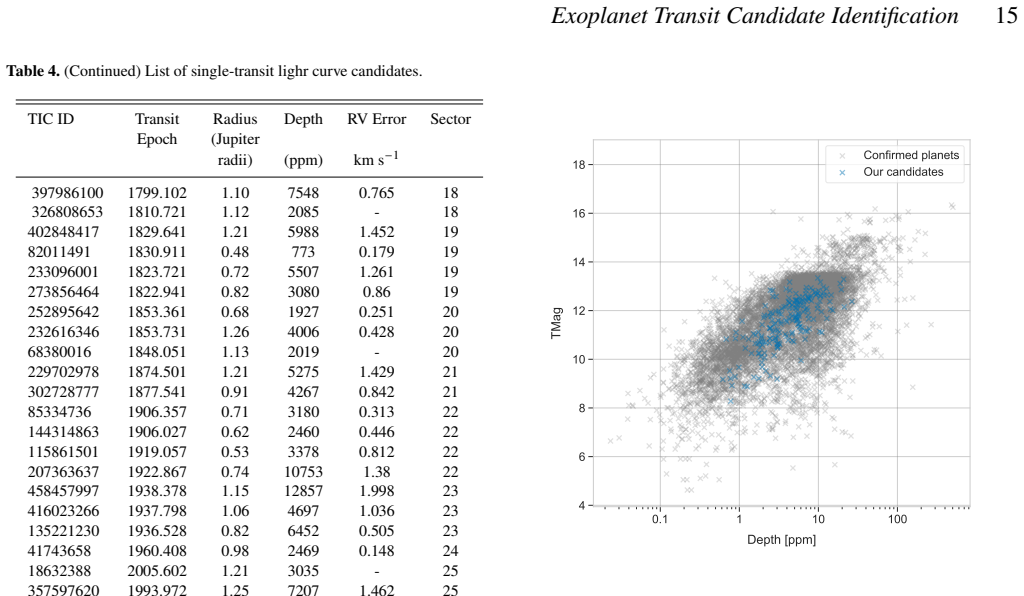
- [Section 6.2, Table 4, Abstract, Section 7] The number of single-transit candidates is internally inconsistent. Section 6.2 states that 'leaving 82 validated as single transiters' and Table 4 lists 82 entries, but the Abstract and Section 7 report 88 single-transit candidates and a total of 214 candidates. This discrepancy affects the headline result and must be resolved; the final counts must be reproducible from the tables.
- [Sections 6.1-6.2] The paper does not provide a measured false-positive rate or completeness for the blind survey search. The curated test-set AUC/F1 (Section 5.2, Table 2) measures performance on labeled confirmed planets, EBs, and non-transits, but the 4.1-million-light-curve search is unlabeled and the funnel from model positives to final candidates is only given as '~20%' after BLS and '~25%' after DAVE, with no cumulative counts and no injection-recovery experiment into actual survey light curves. Without an end-to-end false-positive rate, the claim that the 214 candidates are 'new planetary system candidates' is not quantitatively supported; a large unknown fraction could be false positives.
- [Section 6.2] The single-transit vetting uses a Gaia RV-error cutoff of 2 km/s and visual inspection, but this does not discriminate a true long-period transiting planet from a blended eclipsing binary or an instrumental dip. The paper itself shows in Section 6.5 that a false positive (TIC 296945443) passed the network with high probability because the aperture did not capture the centroid shift. The single-transit candidates are not subjected to the same DAVE centroid and secondary-eclipse checks as the multi-transit candidates, so their status as planetary candidates is weakly supported. The manuscript should either apply quantitative false-positive diagnostics to these candidates or explicitly label them as transit-like single events requiring confirmation.
- [Section 6.5] The false-positive example TIC 296945443 demonstrates an aperture-dependent failure mode in which the network assigns high probability despite background-star contamination. Since this failure mode is identified only through external examination in a later sector, and since the final candidate list is not screened in this way for all entries, the rate at which such false positives contaminate the 214-candidate list is unknown. Reporting the number of model positives that were rejected at each vetting stage, and ideally a small cross-match against known false-positive catalogs, would help bound this contamination.
minor comments (5)
- [Eq. (5), Section 4.3.1] The positional encoding formula uses sin for both even and odd indices; the standard Vaswani et al. (2017) formulation uses sine for even indices and cosine for odd indices. If the implementation follows the standard formulation, the formula should be corrected; otherwise the deviation should be explained.
- [Section 6.1] The text contains an unresolved 'Figure??' reference in the paragraph discussing radius versus orbital period. This must be fixed before publication.
- [Tables 3 and 4] The column labeled 'Transit Epoch' lists values such as 1386.206, but the unit (presumably BTJD) and the precision convention are not stated. Please define the epoch unit and explain why four significant figures are used.
- [Table 4] The table header contains a typo: 'lighr curve' should be 'light curve'.
- [Section 5.2] The sentence 'our model identified that approximately 0.1% of the light curves contain planetary transit signals' should be phrased as 'predicted to contain', since these are model-positive predictions, not confirmed transit detections.
Circularity Check
No significant circularity: trained labels are external and the candidate search is a genuine model application; remaining issues are validation gaps, not circular reasoning.
full rationale
The derivation chain is not circular. The network is trained on externally labelled ground truth (ExoFOP confirmed planets, EBs from Prša et al. 2022, ExoFOP, and Yu et al. 2019, plus non-transit light curves), with injected transit signals used as data augmentation. This is standard supervised learning: the labels come from independent catalogues and follow-up, not from the model's own candidate list. The blind search is a genuine application of the trained network to 4.1 million SPOC light curves from sectors 1-26, and the 214 candidates are those surviving BLS, DAVE, Gaia RV-error filtering, and visual vetting; no fitted parameter is renamed as a prediction. The radius estimate r_p = r_* sqrt(d(c+1)) uses BLS transit depth plus TIC/Gaia stellar radii and contamination values, all external to the training labels. Self-citations to Salinas et al. (2023) and Olmschenk et al. (2021) describe the Transformer architecture and the injection technique, but they are not load-bearing: the architecture and training are specified in Sections 4.3-4.4, and the central claim rests on the reported test metrics rather than on those citations. Consequently, the paper's weaknesses are validation risks rather than circularity: the blind search has no measured false-positive rate or injection-recovery experiment in the actual survey light curves, the single-transit count is internally inconsistent (82 in Section 6.2 versus 88 in the abstract), and Section 6.5 openly documents a false positive that passed the network. These issues affect the strength of the 214-candidate claim, but they do not make the derivation equivalent to its inputs.
Assumptions & free parameters
free parameters (3)
- candidate radius threshold (1.8 RJup) =
1.8 RJup
- radial velocity error cutoff (2 km/s) =
2 km/s
- detection probability threshold =
not stated (default 0.5)
assumptions (5)
- domain assumption Ground truth labels from ExoFOP are accurate and complete enough for training positive examples.
- standard math The transit-depth to radius conversion r_p = r_* sqrt(d(c+1)) is valid for these candidates.
- domain assumption SPOC PDCSAP flux, centroid, and background time series are sufficient to distinguish true transits from false positives.
- domain assumption Injected light curves preserve the physical transit shape and noise properties of real transits.
- domain assumption The BLS periodogram and DAVE vetting correctly recover transit parameters and false-positive flags for these FFI light curves.
Cite this review
Pith. "Pith review of Exoplanet Transit Candidate Identification in TESS Full-Frame Images via a Transformer-Based Algorithm." pith.science (2026). https://pith.science/paper/RJBGPETX
@misc{pith2026250207542,
  author       = {Pith},
  title        = {Pith review of: Exoplanet Transit Candidate Identification in TESS Full-Frame Images via a Transformer-Based Algorithm},
  year         = {2026},
  howpublished = {\url{https://pith.science/paper/RJBGPETX}},
  note         = {Machine review of arXiv:2502.07542}
}
abstract
The Transiting Exoplanet Survey Satellite (TESS) is surveying a large fraction of the sky, generating a vast database of photometric time series data that requires thorough analysis to identify exoplanetary transit signals. Automated learning approaches have been successfully applied to identify transit signals. However, most existing methods focus on the classification and validation of candidates, while few efforts have explored new techniques for the search of candidates. To search for new exoplanet transit candidates, we propose an approach to identify exoplanet transit signals without the need for phase folding or assuming periodicity in the transit signals, such as those observed in multi-transit light curves. To achieve this, we implement a new neural network inspired by Transformers to directly process Full Frame Image (FFI) light curves to detect exoplanet transits. Transformers, originally developed for natural language processing, have recently demonstrated significant success in capturing long-range dependencies compared to previous approaches focused on sequential data. This ability allows us to employ multi-head self-attention to identify exoplanet transit signals directly from the complete light curves, combined with background and centroid time series, without requiring prior transit parameters. The network is trained to learn characteristics of the transit signal, like the dip shape, which helps distinguish planetary transits from other variability sources. Our model successfully identified 214 new planetary system candidates, including 122 multi-transit light curves, 88 single-transit and 4 multi-planet systems from TESS sectors 1-26 with a radius > 0.27 $R_{\mathrm{Jupiter}}$, demonstrating its ability to detect transits regardless of their periodicity.
Figures


Figures from the paper (9 more)




Forward citations
Cited by 1 Pith paper
-
HD 148797: A bright F-type star with two moderate-period low-density sub-Jovian planets. Compact multi-planet architectures are common in the Neptunian savanna
HD 148797 hosts two ~40 ME, ~8.3 RE, low-density savanna planets near a 1.619 period ratio whose anti-correlated TTVs yield masses and support compact multi-planet architectures as typical in the savanna.
Reference graph
Works this paper leans on
-
[1]
write newline
" write newline "" before.all 'output.state := FUNCTION fin.entry write newline FUNCTION new.block output.state before.all = 'skip after.block 'output.state := if FUNCTION new.sentence output.state after.block = 'skip output.state before.all = 'skip after.sentence 'output.state := if if FUNCTION not #0 #1 if FUNCTION and 'skip pop #0 if FUNCTION or pop #1...
-
[2]
Agol E., Fabrycky D., 2017, arXiv preprint arXiv:1706.09849
work page Pith review arXiv 2017
-
[3]
D., 2021, arXiv preprint arXiv:2105.06178
Allam Jr T., McEwen J. D., 2021, arXiv preprint arXiv:2105.06178
arXiv 2021
-
[4]
Ba J., Hinton G. E., Mnih V., Leibo J. Z., Ionescu C., 2016, Advances in neural information processing systems, 29
work page 2016
-
[5]
Bahdanau D., Cho K., Bengio Y., 2014, arXiv preprint arXiv:1409.0473
arXiv 2014
-
[6]
Battley M. P., et al., 2024, @doi [ ] 10.1051/0004-6361/202449307 , https://ui.adsabs.harvard.edu/abs/2024A&A...686A.230B 686, A230
-
[7]
J., et al., 2010, Science, 327, 977
Borucki W. J., et al., 2010, Science, 327, 977
2010
-
[8]
Brahm R., et al., 2023, @doi [ ] 10.3847/1538-3881/accadd , https://ui.adsabs.harvard.edu/abs/2023AJ....165..227B 165, 227
Show all 71 references
-
[9]
T., et al., 2020, Kepler Science Document KSCI-19081-003, p
Bryson S. T., et al., 2020, Kepler Science Document KSCI-19081-003, p. 3
2020
-
[10]
A., et al., 2020, Research Notes of the AAS, 4, 201
Caldwell D. A., et al., 2020, Research Notes of the AAS, 4, 201
2020
-
[11]
W., et al., 2020, The Astronomical Journal, 160, 53
Carmichael T. W., et al., 2020, The Astronomical Journal, 160, 53
2020
-
[12]
Cho K., Van Merri \"e nboer B., Gulcehre C., Bahdanau D., Bougares F., Schwenk H., Bengio Y., 2014, arXiv preprint arXiv:1406.1078
2014 arXiv
-
[13]
pp 3642--3649
Ciregan D., Meier U., Schmidhuber J., 2012, in 2012 IEEE conference on computer vision and pattern recognition. pp 3642--3649
2012
-
[14]
Cui K., Liu J., Feng F., Liu J., 2021, The Astronomical Journal, 163, 23
2021
-
[15]
I., Johnson J
Dawson R. I., Johnson J. A., 2018, @doi [ ] 10.1146/annurev-astro-081817-051853 , https://ui.adsabs.harvard.edu/abs/2018ARA&A..56..175D 56, 175
2018 doi
-
[16]
I., et al., 2021, @doi [ ] 10.3847/1538-3881/abd8d0 , https://ui.adsabs.harvard.edu/abs/2021AJ....161..161D 161, 161
Dawson R. I., et al., 2021, @doi [ ] 10.3847/1538-3881/abd8d0 , https://ui.adsabs.harvard.edu/abs/2021AJ....161..161D 161, 161
2021 doi
-
[17]
Dosovitskiy A., et al., 2020, arXiv preprint arXiv:2010.11929
2020 arXiv
-
[18]
D., Hogg D
Foreman-Mackey D., Morton T. D., Hogg D. W., Agol E., Sch \"o lkopf B., 2016, The Astronomical Journal, 152, 206
2016
-
[19]
N., 2017, in International Conference on Machine Learning
Gehring J., Auli M., Grangier D., Yarats D., Dauphin Y. N., 2017, in International Conference on Machine Learning. pp 1243--1252
2017
-
[20]
Gill S., et al., 2020a, Monthly Notices of the Royal Astronomical Society, 491, 1548
-
[21]
Gill S., et al., 2020b, The Astrophysical Journal Letters, 898, L11
-
[22]
Gill S., et al., 2020c, @doi [ ] 10.3847/2041-8213/ab9eb9 , https://ui.adsabs.harvard.edu/abs/2020ApJ...898L..11G 898, L11
-
[23]
MIT press
Goodfellow I., Bengio Y., Courville A., 2016, Deep learning. MIT press
2016
-
[24]
Grieves N., et al., 2022, @doi [ ] 10.1051/0004-6361/202244077 , https://ui.adsabs.harvard.edu/abs/2022A&A...668A..29G 668, A29
2022 doi
-
[25]
M., et al., 2021, The Astrophysical Journal Supplement Series, 254, 39
Guerrero N. M., et al., 2021, The Astrophysical Journal Supplement Series, 254, 39
2021
-
[26]
D., et al., 2019, @doi [ ] 10.3847/1538-3881/aaf8b6 , https://ui.adsabs.harvard.edu/abs/2019AJ....157...55H 157, 55
Hartman J. D., et al., 2019, @doi [ ] 10.3847/1538-3881/aaf8b6 , https://ui.adsabs.harvard.edu/abs/2019AJ....157...55H 157, 55
2019 doi
-
[27]
M., 2004, Journal of chemical information and computer sciences, 44, 1
Hawkins D. M., 2004, Journal of chemical information and computer sciences, 44, 1
2004
-
[28]
Hawthorn F., et al., 2024, Monthly Notices of the Royal Astronomical Society, 528, 1841
2024
-
[29]
pp 770--778
He K., Zhang X., Ren S., Sun J., 2016, in Proceedings of the IEEE conference on computer vision and pattern recognition. pp 770--778
2016
-
[30]
Hendrycks D., Gimpel K., 2016, arXiv preprint arXiv:1606.08415
2016 arXiv
-
[31]
Hod z i \'c V., et al., 2018, Monthly Notices of the Royal Astronomical Society, 481, 5091
2018
-
[32]
pp 449--456
Karita S., et al., 2019, in 2019 IEEE Automatic Speech Recognition and Understanding Workshop (ASRU). pp 449--456
2019
-
[33]
P., Ba J., 2014, arXiv preprint arXiv:1412.6980
Kingma D. P., Ba J., 2014, arXiv preprint arXiv:1412.6980
2014 arXiv
-
[34]
B., et al., 2019, The Astronomical Journal, 157, 124
Kostov V. B., et al., 2019, The Astronomical Journal, 157, 124
2019
-
[35]
Kov \'a cs G., Zucker S., Mazeh T., 2002, Astronomy & Astrophysics, 391, 369
2002
-
[36]
E., 2012, Advances in neural information processing systems, 25
Krizhevsky A., Sutskever I., Hinton G. E., 2012, Advances in neural information processing systems, 25
2012
-
[37]
E., 2017, Communications of the ACM, 60, 84
Krizhevsky A., Sutskever I., Hinton G. E., 2017, Communications of the ACM, 60, 84
2017
-
[38]
M., Cettolo M., Federico M., 2018, arXiv preprint arXiv:1806.06957
Lakew S. M., Cettolo M., Federico M., 2018, arXiv preprint arXiv:1806.06957
2018 arXiv
-
[39]
LeCun Y., Bengio Y., Hinton G., 2015, nature, 521, 436
2015
-
[40]
Lendl M., et al., 2020, Monthly Notices of the Royal Astronomical Society, 492, 1761
2020
-
[41]
Magliano C., et al., 2023, Monthly Notices of the Royal Astronomical Society, 521, 3749
2023
-
[42]
G., 2017, The Astrophysical Journal Letters, 837, L1
M \'e ndez A., Rivera-Valent \' n E. G., 2017, The Astrophysical Journal Letters, 837, L1
2017
-
[43]
H., Waldmann I., 2022, arXiv preprint arXiv:2207.02777
Morvan M., Nikolaou N., Yip K. H., Waldmann I., 2022, arXiv preprint arXiv:2207.02777
2022 arXiv
-
[44]
Olmschenk G., et al., 2021, The Astronomical Journal, 161, 273
2021
-
[45]
P., et al., 2020, Astronomy & Astrophysics, 633, A53
Osborn H. P., et al., 2020, Astronomy & Astrophysics, 633, A53
2020
-
[46]
Paszke A., et al., 2019, Advances in neural information processing systems, 32
2019
-
[47]
B., Hubickyj O., Bodenheimer P., Lissauer J
Pollack J. B., Hubickyj O., Bodenheimer P., Lissauer J. J., Podolak M., Greenzweig Y., 1996, @doi [ ] 10.1006/icar.1996.0190 , https://ui.adsabs.harvard.edu/abs/1996Icar..124...62P 124, 62
1996
-
[48]
M., 2020, arXiv preprint arXiv:2010.16061
Powers D. M., 2020, arXiv preprint arXiv:2010.16061
2020 arXiv
-
[49]
Pr s a A., et al., 2022, The Astrophysical Journal Supplement Series, 258, 16
2022
-
[50]
J., 2010, arXiv preprint arXiv:1006.3727
Ragozzine D., Holman M. J., 2010, arXiv preprint arXiv:1006.3727
2010 arXiv
-
[51]
Rao S., Mahabal A., Rao N., Raghavendra C., 2021, Monthly Notices of the Royal Astronomical Society, 502, 2845
2021
-
[52]
Rauer H., Aerts C., Cabrera J., Team P., et al., 2016, Astronomische Nachrichten, 337, 961
2016
-
[53]
Redmon J., Farhadi A., 2018, YOLOv3: An Incremental Improvement ( @eprint arXiv 1804.02767 ), https://arxiv.org/abs/1804.02767
2018 arXiv
-
[54]
R., et al., 2014, Journal of Astronomical Telescopes, Instruments, and Systems, 1, 014003
Ricker G. R., et al., 2014, Journal of Astronomical Telescopes, Instruments, and Systems, 1, 014003
2014
-
[55]
R., et al., 2015, @doi [Journal of Astronomical Telescopes, Instruments, and Systems] 10.1117/1.JATIS.1.1.014003 , https://ui.adsabs.harvard.edu/abs/2015JATIS...1a4003R 1, 014003
Ricker G. R., et al., 2015, @doi [Journal of Astronomical Telescopes, Instruments, and Systems] 10.1117/1.JATIS.1.1.014003 , https://ui.adsabs.harvard.edu/abs/2015JATIS...1a4003R 1, 014003
2015 doi
-
[56]
Salinas H., Pichara K., Brahm R., Pérez-Galarce F., Mery D., 2023, @doi [Monthly Notices of the Royal Astronomical Society] 10.1093/mnras/stad1173 , 522, 3201
2023 doi
-
[57]
F., Levrard B., Paillet J., Ribas I., Delfosse X., 2007, Astronomy & Astrophysics, 476, 1373
Selsis F., Kasting J. F., Levrard B., Paillet J., Ribas I., Delfosse X., 2007, Astronomy & Astrophysics, 476, 1373
2007
-
[58]
M., 2019, Journal of big data, 6, 1
Shorten C., Khoshgoftaar T. M., 2019, Journal of big data, 6, 1
2019
-
[59]
Srivastava N., Hinton G., Krizhevsky A., Sutskever I., Salakhutdinov R., 2014, The journal of machine learning research, 15, 1929
2014
-
[60]
W., et al., 2015, The Astrophysical Journal, 809, 77
Sullivan P. W., et al., 2015, The Astrophysical Journal, 809, 77
2015
-
[61]
Tenenbaum P., et al., 2012, @doi [ ] 10.1088/0067-0049/199/1/24 , https://ui.adsabs.harvard.edu/abs/2012ApJS..199...24T 199, 24
2012 doi
-
[62]
Tey E., et al., 2023, The Astronomical Journal, 165, 95
2023
-
[63]
Valizadegan H., et al., 2022, The Astrophysical Journal, 926, 120
2022
-
[64]
Vallenari A., et al., 2023, Astronomy & Astrophysics, 674, A1
2023
-
[65]
N., Kaiser ., Polosukhin I., 2017, in Advances in neural information processing systems
Vaswani A., Shazeer N., Parmar N., Uszkoreit J., Jones L., Gomez A. N., Kaiser ., Polosukhin I., 2017, in Advances in neural information processing systems. pp 5998--6008
2017
-
[66]
Voulodimos A., Doulamis N., Doulamis A., Protopapadakis E., 2018, Computational intelligence and neuroscience, 2018
2018
-
[67]
F., Chao L
Wang Q., Li B., Xiao T., Zhu J., Li C., Wong D. F., Chao L. S., 2019, arXiv preprint arXiv:1906.01787
2019 arXiv
-
[68]
Wang S., et al., 2021, The Astronomical Journal, 162, 50
2021
-
[69]
F., et al., 2023, The Astrophysical Journal Supplement Series, 269, 5
Wilson R. F., et al., 2023, The Astrophysical Journal Supplement Series, 269, 5
2023
-
[70]
Yu L., et al., 2019, The Astronomical Journal, 158, 25
2019
-
[71]
pp 2114--2124
Zerveas G., Jayaraman S., Patel D., Bhamidipaty A., Eickhoff C., 2021, in Proceedings of the 27th ACM SIGKDD Conference on Knowledge Discovery & Data Mining. pp 2114--2124
2021
Reviewed August 8, 2026 · model on record in the stance chip above.
Discussion (0). Continue with ORCID to comment.