REVIEW 3 major objections 5 minor 3 cited by
Disk reflection and energetics from the accreting millisecond pulsar SRGA J144459.2-604207
T0 review · 3 major / 5 minor · reviewed 2026-08-08 · deepseek-v4-flash
Pith's one-line read This paper reports the first detection of a relativistically broadened iron line in the accreting millisecond pulsar SRGA J144459.2−604207, with a preferred reflection fit placing the inner accretion disk at 6 gravitational radii and…
desk verdict A competent, honest spectral analysis whose headline geometry is an overstatement: the 6 Rg inner radius is a pegged model boundary, not a free measurement. read the letter →
The pith
A machine-rendered reading of the paper's core claim, the machinery that carries it, and where it could break.
The reading
What carries the argument
The central machinery is the relativistically blurred reflection model built from the reflection convolution model and the relativistic blurring kernel, together with the diskline profile used for the iron line. These components apply Doppler shifts and gravitational redshifts to line photons emitted from a rotating disk, so the shape of the iron line carries the disk's inner radius, emissivity index, and inclination. In this paper the decisive move is a parameter freeze: the iron-line inclination is set to the 53-degree value returned by the reflection fit, which places the line at 6.41 keV and drives the inner radius to the model limit of 6 $R_g$; leaving the inclination free instead gives 85 degrees and 10 $R_g$. The edge at 9.68 keV is modeled as a simple absorption edge, and its offset from the laboratory Fe XXVI energy is the basis for the claimed $0.04c$ outflow.
What would settle it
Re-fit the same spectra with the inclination left free and the iron line energy constrained to the 6.4–6.97 keV K-$\alpha$ band, or obtain a microcalorimeter spectrum that resolves the line profile; if the best fit then requires $R_{\rm in}>6\,R_g$ or fails to reproduce the observed line shape, the paper's central 6-$R_g$ claim is falsified.
Extended reading notes
Core claim
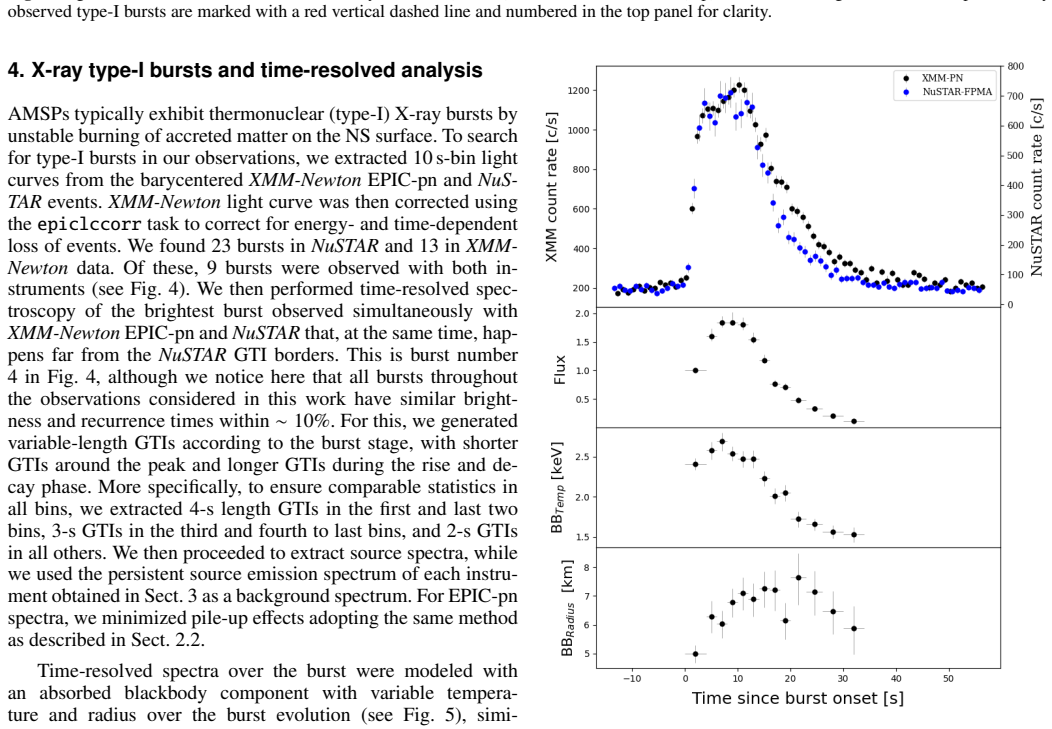
On the paper's own terms, the discovery is that SRGA J1444's persistent emission contains a relativistically broadened iron K$\alpha$ line, and that a blurred reflection fit describes the full 0.5–50 keV spectrum with the disk inner radius at the lower boundary of the model, $R_{\rm in}=6\,R_g$, an inclination of $52.7^{+1.9}_{-1.6}$ degrees, ionization parameter $\log\xi=2.31^{+0.05}_{-0.03}$, and iron abundance $0.16\pm0.01$ times solar. The fit improves from $\chi^2/{\rm d.o.f.}=1735/724$ without the line to $881/719$ with the full reflection model. The spectra also show an absorption edge at $9.68$ keV, which the authors cautiously identify with a blueshifted Fe XXVI K-edge at about $0.04c$, while acknowledging that the low ionization state creates a tension with that identification. The burst analysis yields a peak blackbody temperature near 2.7 keV, no photospheric radius expansion, and a recurrence-time versus count-rate slope $\beta\simeq0.5$; using the measured burst fluence and $\alpha\simeq76$, the inferred mean hydrogen fraction $\bar{X}\simeq0.29$ leads to an expected recurrence time about a factor of three below the observed 2.4 hours.
Load-bearing premise
The claim that the disk reaches 6 gravitational radii rests on the assumption that the reflection-model inclination of 53 degrees is the true geometry and that the iron line sits at the model's innermost allowed radius.
Editorial extensions
If this is right
- If the 6-$R_g$ inner radius is correct, SRGA J1444's disk is truncated extremely close to the neutron star surface, making the source a useful target for equation-of-state and strong-gravity tests.
- The broadened iron line establishes SRGA J1444 as a new member of the small class of accreting millisecond pulsars whose inner disks can be mapped by relativistic reflection.
- If the 9.68 keV edge is confirmed as a blueshifted Fe XXVI edge, SRGA J1444 would join the accreting millisecond pulsars with ultrafast outflows, implying that material is being ejected at roughly 4 percent of light speed.
- The burst energetics imply a hydrogen-poor fuel, and the factor-of-three mismatch between expected and observed recurrence time points either to a helium-rich environment, beamed persistent emission, or an unusually massive neutron star.
Reading between the lines
- The paper's two preferred geometries (53 degrees with 6 $R_g$ versus 85 degrees with 10 $R_g$) could be tested against the independent polarization inclination of roughly 74 degrees; a joint fit using that as a prior would decide whether the 6-$R_g$ inner edge survives or is a freeze artifact.
- If the true inclination is high, the implied magnetospheric truncation radius would be larger, and SRGA J1444 would be a less extreme disk-truncation case; the paper's qualitative disk-warp idea could be checked by comparing phase-resolved polarization angles with line-profile predictions.
- The low iron abundance and the possible Fe XXVI edge can coexist if the reflecting disk and the outflow are in different ionization states, which predicts that the 9.7 keV edge should respond to changes in the Comptonized continuum or vanish in lower-flux states.
- The factor-of-three recurrence-time shortfall could be sharpened into a mass constraint: if the donor composition is pinned down by future optical spectroscopy, the remaining discrepancy would constrain the neutron star mass through the gravitational-redshift term in the recurrence-time formula.
Editorial analysis
A structured set of objections, weighed in public.
Referee Report
Summary. The paper presents XMM-Newton and NuSTAR spectral analysis of the persistent emission and type-I bursts of the accreting millisecond pulsar SRGA J144459.2-604207. The authors fit the broadband spectrum with a semi-phenomenological continuum model and a physical reflection model, claiming detection of a relativistically broadened iron K-alpha line. They infer a disk inner radius of about 6 gravitational radii and inclination of about 53 degrees, a moderate ionization parameter log xi ~ 2.3, and an absorption edge at 9.68 keV which they suggest is an Fe XXVI edge blueshifted by an ultrafast outflow at ~0.04c. For the bursts, they find no photospheric radius expansion, a burst recurrence time dependence on count rate with a power-law index beta ~ 0.5, and a factor ~3 discrepancy between observed and expected recurrence times, which they discuss in terms of fuel composition and high neutron star mass.
Significance. The paper provides a detailed, high-quality spectral analysis of a newly discovered accreting millisecond pulsar, with a plausible detection of a broad iron line supported by a large improvement in fit statistic (Delta chi2 ~ 406 for the diskline model; F-test probability ~10^-63 for the reflection component). The time-resolved burst analysis is a contribution to the sample of AMSP burst properties. However, the headline geometric claims (6 Rg inner radius, 53 deg inclination) are not free measurements: the 6 Rg value is a model boundary obtained after fixing the inclination, and the free-fit inclination of 85 deg is in better agreement with the independent IXPE polarization measurement of 74 deg. The claimed ultrafast outflow at 9.68 keV is internally inconsistent with the best-fit ionization parameter. These issues materially weaken the abstract's conclusions, though they are fixable by reframing the results as degenerate and tentative.
major comments (3)
- [Abstract; §3.1; Table 1] The abstract's claim that the accretion disk 'extends down to 6 gravitational radii' is not supported as a free measurement. In the diskline fit of Sect. 3.1, freeing all line parameters yields Rin = 10.0(+1.2/-1.7) Rg and i = 85(+5/-14) deg, with line energy 6.2 keV; only after freezing i to the reflection-model value of 53 deg does the fit return Rin = 6.0(+0.3) Rg, with the lower uncertainty pegged to the model limit. In the reflection model of Sect. 3.2 (Table 1), Rin is again at the lower boundary (6.0(+1.6) Rg). The quoted 6 Rg is therefore an upper limit on the inner disk edge, not a measured truncation radius, and it is degenerate with the assumed inclination. The alternative solution at Rin = 10 Rg and i = 85 deg agrees with the IXPE polarization measurement of 74(+6/-6) deg (Papitto et al. 2025). The central geometric claims in the abstract and Sect. 5.1 should be reframed as a degenerate set of solutions, with the 6 Rg value explicitly labeled as an upper limit for a fixed inclination.
- [§5.2; Table 1] The 9.68 keV absorption edge is interpreted as an Fe XXVI edge in a ~0.04c ultrafast outflow, but this is internally inconsistent with the best-fit log xi = 2.31 from the same reflection model (Table 1). The paper itself acknowledges this ('clashes with the very interpretation of a fully ionized iron state'), and the claimed remedy (sub-solar iron with solar other elements) is speculative. Moreover, the edge depth is small (tau = 0.014), and the alternative Zn-edge identification is dismissed without a quantitative abundance argument. The abstract's inclusion of the outflow as a firm result should be downgraded to a tentative interpretation, with a concrete test of the two scenarios (e.g., fitting with a self-consistent photoionized absorption model rather than a multiplicative edge).
- [Abstract vs. §4 and §5.3] The abstract states that the burst recurrence time depends on the count rate with 'the steepest slope ever observed in these systems,' but Section 4 finds beta = 0.5 from Eq. (1), which is shallower than the typical beta ~ 1 and shallower than the previous determinations for this source (0.8-1.0) quoted in the same section. The discussion in Sect. 5.3 correctly describes the dependence as 'milder.' The abstract and the body are contradictory and must be reconciled before acceptance.
minor comments (5)
- [Table 1] The reflection fraction is given as -0.73(+0.17/-0.10); since a negative reflection fraction has no simple interpretation as a ratio of reflected to incident flux, the model definition and physical meaning should be stated explicitly.
- [Table 1; §3.1] Table 1 reports Rin = 6.0(+1.6) with no lower error; the text explains that the lower value is pegged, but a note in the table would help avoid misinterpretation.
- [§3.1] The improvement in chi2 for the diskline component (from 1735/724 to 1329/722) is quoted without a quantitative significance estimate; an F-test probability, as given for the reflection component in Sect. 3.2, would make the detection claim easier to evaluate.
- [§5.1] The qualitative suggestion that the inner disk is more inclined than the outer disk is not modeled; given the known degeneracy between inclination and inner radius, a comment on whether such a geometry would produce the observed line profile would strengthen the argument.
- [§4; Fig. 6] The fit to the recurrence time relation is reported without quoting chi2 values for the free-beta and fixed-beta fits shown in Fig. 6; adding these values would clarify whether the new beta = 0.5 is statistically preferred.
Circularity Check
No circular derivation: the broad iron line and reflection component are data-driven, and the 6 Rg / 53 deg geometry, while model-dependent and pegged at a boundary, is not an input recycled as a prediction.
full rationale
The paper's central result, the presence of a relativistically broadened iron line, is established from spectral residuals that do not require the disputed geometric parameters: removing the diskline component worsens the fit from 1329/722 to 1735/724, and the F-test probability for including the rfxconv reflection component is 10^-63. The quoted geometry (Rin=6 Rg, i=53 deg) comes from fitting standard XSPEC models, not from an assumed input equal to the output. The paper explicitly reports that with all diskline parameters free the fit gives E=6.2 keV, Rin=10.0 Rg, and i=85 deg, and that the 6 Rg value arises only after freezing inclination to the reflection-model value, with the lower error 'pegged to the model limit of 6 Rg'; the reflection model itself also returns Rin at that same boundary. This is a genuine model degeneracy and boundary effect that weakens the physical interpretation, and the authors acknowledge it ('the observed discrepancy is rather due to the model-driven dependence of the two parameters'), but it is not a circular reduction: the line detection and the reflection continuum are independently constrained by the data. The burst fuel-composition estimate (Xbar=0.29) is obtained from the observed alpha via standard analytic formulae and then compared with recurrence-time expectations, rather than used as their input. Self-citations such as Papitto et al. 2025 for IXPE polarization supply external measurements or standard model references and are not load-bearing in a circular sense.
Assumptions & free parameters
free parameters (7)
- Disk inclination (reflection model) =
52.7 (+1.9/-1.6) deg
- Inner disk radius Rin =
6.0 (+0.3/-0.0) Rg
- Iron abundance =
0.16 (+0.01/-0.01) solar
- Ionization parameter log xi =
2.31 (+0.05/-0.03)
- Absorption edge at 9.68 keV =
9.68 +/- 0.13 keV, tau = 0.014
- Burst recurrence power-law index beta =
~0.5
- Cross-normalization constant XMM/NuSTAR =
~1.16
assumptions (6)
- domain assumption Wilms et al. (2000) solar abundances (wilm) describe interstellar absorption
- domain assumption nthComp thermal Comptonization accurately describes the corona
- domain assumption rfxconv reflection model with rdblur relativistic blurring describes the disk reflection
- domain assumption Source distance of 8 kpc (from Molkov et al. 2024) assumed for luminosity and radius estimates
- domain assumption Neutron star mass 1.4 Msun and radius 11.2 km, giving gravitational redshift z = 0.259
- standard math Galloway et al. (2022) empirical relation between alpha and fuel composition Xbar
invented entities (1)
-
Ultrafast outflow (v ~ 0.04c)
Cite this review
Pith. "Pith review of Disk reflection and energetics from the accreting millisecond pulsar SRGA J144459.2-604207." pith.science (2026). https://pith.science/paper/EJBTYPXS
@misc{pith2026250208239,
  author       = {Pith},
  title        = {Pith review of: Disk reflection and energetics from the accreting millisecond pulsar SRGA J144459.2-604207},
  year         = {2026},
  howpublished = {\url{https://pith.science/paper/EJBTYPXS}},
  note         = {Machine review of arXiv:2502.08239}
}
abstract
Accreting millisecond pulsars (AMSPs) are excellent laboratories to study reflection spectra and their features from an accretion disk truncated by a rapidly rotating magnetosphere near the neutron star surface. These systems also exhibit thermonuclear (type-I) bursts that can provide insights on the accretion physics and fuel composition. We explore spectral properties of the AMSP SRGA J144459 observed during the outburst that recently led to its discovery in February 2024. We aim to characterize the spectral shape of the persistent emission and to analyze type-I bursts properties employing XMM + NuSTAR overlapping observations taken during the most recent outburst. We perform spectral analysis of the time-averaged persistent (i.e., non-bursting) emission. For this, we first employ a semi-phenomenological continuum model made of a dominant thermal Comptonization plus two thermal contributions. A separate fit has also been performed employing a physical reflection model. We also perform time-resolved spectral analysis of a type-I burst employing a blackbody model. We observe a broadened iron emission line, thus suggesting relativistic effects, supported by the physical model accounting for relativistically blurred reflection. The resulting accretion disk extends down to 6 gravitational radii, inclined at ~$53^{\circ}$, and only moderately ionized (log$\xi\simeq2.3$). We observe an absorption edge at ~9.7 keV that can be interpreted as an Fe XXVI edge blueshifted by an ultrafast ($\simeq0.04$c) outflow. Our broadband observations of type-I bursts do not find evidence of photospheric radius expansion. The burst recurrence time shows a dependence on the count rate with the steepest slope ever observed in these systems. We also observe a discrepancy of ~3 between the observed and expected burst recurrence time, which we discuss in the framework of fuel composition and high NS mass scenarios.
Figures


Figures from the paper (3 more)


Forward citations
Cited by 3 Pith papers
-
Relativistic X-ray reflection and thermonuclear burst from accreting millisecond X-ray pulsar SRGA J144459.2-604207
Time-resolved X-ray spectral fits of SRGA J1444 reveal up to 30% disk reflection during thermonuclear bursts, an inner disk radius near 11 gravitational radii, and a polar magnetic field around 6e8 Gauss.
-
Timing and spectral studies of SRGA J144459.2$-$604207 with NICER, Einstein Probe, IXPE, NuSTAR, Insight-HXMT and INTEGRAL during its 2024 outburst
During its 2024 outburst the 448 Hz pulsar spun up at 3.15e-13 Hz/s until MJD 60377, then its pulse phase swung, and burst-time pulse profiles lagged persistent profiles by an amount decreasing with X-ray energy.
-
Spectral study of the outburst decay of the accreting millisecond X-ray pulsar SRGA J144459.2-604207
The 2024 outburst decay and quiescence of AMXP SRGA J144459.2-604207 are spectrally characterized, and its 45-year quiescent luminosity is found to be consistent with deep crustal heating under assumed outburst recurrences.
Reference graph
Works this paper leans on
-
[1]
L., Schulz, N
Allen, J. L., Schulz, N. S., Homan, J., et al. 2018, ApJ, 861, 26
2018
-
[2]
Arnaud, K. A. 1996, in ASP Conf. Ser., V ol. 101, Astronomical Data Analy- sis Software and Systems V , ed. G. H. Jacoby & J. Barnes (San Francisco: Astron. Soc. Pac.), 17
1996
-
[3]
Bagnoli, T., in’t Zand, J. J. M., Galloway, D. K., & Watts, A. L. 2013, MNRAS, 431, 1947
work page 2013
- [4]
-
[5]
Barret, D., Olive, J. F., Boirin, L., et al. 2000, ApJ, 533, 329
work page 2000
-
[6]
Bobrikova, A., Loktev, V ., Salmi, T., & Poutanen, J. 2023, A&A, 678, A99
work page 2023
-
[7]
Cackett, E. M., Miller, J. M., Ballantyne, D. R., et al. 2010, ApJ, 720, 205
work page 2010
- [8]
Show all 53 references
-
[9]
M., et al
Degenaar, N., Pinto, C., Miller, J. M., et al. 2017, MNRAS, 464, 398 Di Salvo, T., & Sanna, A. 2022, in ASSL, V ol. 465, Astrophysics and Space Science Library, ed. S. Bhattacharyya, A. Papitto, & D. Bhattacharya, 87 Di Salvo, T., Sanna, A., Burderi, L., et al. 2019, MNRAS, 48...
2017
-
[10]
M., Grinberg, V ., Fürst, F., et al
Diez, C. M., Grinberg, V ., Fürst, F., et al. 2023, A&A, 674, A147
2023
-
[11]
2024, PASJ, in press, arXiv:2411.10993
Dohi, A., Nishimura, N., Hirai, R., et al. 2024, PASJ, in press, arXiv:2411.10993
2024 arXiv
-
[12]
2006, MNRAS, 367, 659
Done, C., & Gierli´nski, M. 2006, MNRAS, 367, 659
2006
-
[13]
2017, ApJ, 838, 120
Egron, E., Pellizzoni, A., Pollock, A., et al. 2017, ApJ, 838, 120
2017
-
[14]
C., Rees, M
Fabian, A. C., Rees, M. J., Stella, L., & White, N. E. 1989, MNRAS, 238, 729
1989
-
[15]
2012, A&A, 545, A26 —
Falanga, M., Kuiper, L., Poutanen, J., et al. 2012, A&A, 545, A26 —. 2011, A&A, 529, A68
2012
-
[16]
K., Johnston, Z., Goodwin, A., & He, C.-C
Galloway, D. K., Johnston, Z., Goodwin, A., & He, C.-C. 2022, ApJS, 263, 30
2022
-
[17]
K., Muno, M
Galloway, D. K., Muno, M. P., Hartman, J. M., Psaltis, D., & Chakrabarty, D. 2008, ApJS, 179, 360 García, J. A., Dauser, T., Ludlam, R., et al. 2022, ApJ, 926, 13
2008
-
[18]
M., & Fabian, A
George, I. M., & Fabian, A. C. 1991, MNRAS, 249, 352 Gierli´nski, M., Done, C., & Barret, D. 2002, MNRAS, 331, 141 Gierli´nski, M., & Poutanen, J. 2005, MNRAS, 359, 1261
1991
-
[19]
1998, A&A, 338, L83
Gilfanov, M., Revnivtsev, M., Sunyaev, R., & Churazov, E. 1998, A&A, 338, L83
1998
-
[20]
J., Heger, A., & Galloway, D
Goodwin, A. J., Heger, A., & Galloway, D. K. 2019, ApJ, 870, 64
2019
-
[21]
A., Craig, W
Harrison, F. A., Craig, W. W., Christensen, F. E., et al. 2013, ApJ, 770, 103
2013
-
[22]
R., Fujii, M
Hirai, Y ., Saitoh, T. R., Fujii, M. S., Kaneko, K., & Beers, T. C. 2025, ApJ, 980, L25
2025
-
[23]
S., & Bleeker, J
Kaastra, J. S., & Bleeker, J. A. M. 2016, A&A, 587, A151
2016
-
[24]
2001, ApJ, 560, L147
Kubota, A., Makishima, K., & Ebisawa, K. 2001, ApJ, 560, L147
2001
-
[25]
R., in’t Zand, J
Kuulkers, E., den Hartog, P. R., in’t Zand, J. J. M., et al. 2003, A&A, 399, 663
2003
-
[26]
Lampe, N., Heger, A., & Galloway, D. K. 2016, ApJ, 819, 46
2016
-
[27]
M., Miller, J
Ludlam, R. M., Miller, J. M., Degenaar, N., et al. 2017, ApJ, 847, 135
2017
-
[28]
1986, in Lecture Notes in Physics, V ol
Makishima, K. 1986, in Lecture Notes in Physics, V ol. 266, The Physics of Ac- cretion onto Compact Objects, ed. K. O. Mason, M. G. Watson, & N. E. White (Berlin Heidelberg New York: Springer-Verlag), 249
1986
-
[29]
Markwardt, C. B. 2003, The Astronomer’s Telegram, 115, 1
2003
-
[30]
A., Semena, A
Mereminskiy, I. A., Semena, A. N., Molkov, S. V ., et al. 2024, The Astronomer’s Telegram, 16464, 1
2024
-
[31]
M., Fabian, A
Miller, J. M., Fabian, A. C., Kaastra, J., et al. 2015, ApJ, 814, 87
2015
-
[32]
M., Raymond, J., Cackett, E., Grinberg, V ., & Nowak, M
Miller, J. M., Raymond, J., Cackett, E., Grinberg, V ., & Nowak, M. 2016, ApJ, 822, L18
2016
-
[33]
V ., Lutovinov, A
Molkov, S. V ., Lutovinov, A. A., Tsygankov, S. S., et al. 2024, A&A, 690, A353
2024
-
[34]
S., Sanna, A., et al
Ng, M., Ray, P. S., Sanna, A., et al. 2024, ApJ, 968, L7
2024
-
[35]
A., Paizis, A., Jaisawal, G
Nowak, M. A., Paizis, A., Jaisawal, G. K., et al. 2019, ApJ, 874, 69
2019
-
[36]
2009, A&A, 493, L39
Papitto, A., Di Salvo, T., D’Aì, A., et al. 2009, A&A, 493, L39
2009
-
[37]
2010, MNRAS, 407, 2575
Papitto, A., Riggio, A., di Salvo, T., et al. 2010, MNRAS, 407, 2575
2010
-
[38]
2025, A&A, 694, A37
Papitto, A., Di Marco, A., Poutanen, J., et al. 2025, A&A, 694, A37
2025
-
[39]
Patruno, A., & Watts, A. L. 2021, in ASSL, V ol. 461, Timing Neutron Stars:
2021
-
[40]
2021, A&A, 650, A42
Pavlinsky, M., Tkachenko, A., Levin, V ., et al. 2021, A&A, 650, A42
2021
-
[41]
2016, MNRAS, 457, 2988
Pintore, F., Sanna, A., Di Salvo, T., et al. 2016, MNRAS, 457, 2988
2016
-
[42]
2006, Advances in Space Research, 38, 2697
Poutanen, J. 2006, Advances in Space Research, 38, 2697
2006
-
[43]
N., Porquet, D., & Turner, T
Reeves, J. N., Porquet, D., & Turner, T. J. 2004, ApJ, 615, 150
2004
-
[44]
R., & Fabian, A
Ross, R. R., & Fabian, A. C. 2007, MNRAS, 381, 1697
2007
-
[45]
A., Fogantini, F
Saavedra, E. A., Fogantini, F. A., Escobar, G. J., et al. 2023, A&A, 680, A88
2023
-
[46]
2020, ApJ, 899, 127
Snios, B., Siemiginowska, A., Sobolewska, M., et al. 2020, ApJ, 899, 127
2020
-
[47]
2006, in Compact stellar X-ray sources, Cam- bridge Astrophysics Series, No
Strohmayer, T., & Bildsten, L. 2006, in Compact stellar X-ray sources, Cam- bridge Astrophysics Series, No. 39, ed. W. Lewin & M. van der Klis (Cam- bridge: Cambridge University Press), 113
2006
-
[48]
2021, A&A, 656, A132
Sunyaev, R., Arefiev, V ., Babyshkin, V ., et al. 2021, A&A, 656, A132
2021
-
[49]
2024, PASJ, in press, arXiv:2411.10992
Takeda, T., Tamagawa, T., Enoto, T., et al. 2024, PASJ, in press, arXiv:2411.10992
2024 arXiv
-
[50]
B., Tucker, W
Tarter, C. B., Tucker, W. H., & Salpeter, E. E. 1969, ApJ, 156, 943
1969
-
[51]
2000, ApJ, 542, 914
Wilms, J., Allen, A., & McCray, R. 2000, ApJ, 542, 914
2000
-
[52]
A., & De Marco, B
Zdziarski, A. A., & De Marco, B. 2020, ApJ, 896, L36
2020
-
[53]
A., Johnson, W
Zdziarski, A. A., Johnson, W. N., & Magdziarz, P. 1996, MNRAS, 283, 193 ˙Zycki, P. T., Done, C., & Smith, D. A. 1999, MNRAS, 309, 561 Article number, page 8
1996
Reviewed August 8, 2026 · model on record in the stance chip above.
Discussion (0). Continue with ORCID to comment.