REVIEW 4 major objections 5 minor 1 cited by
Large Images are Gaussians: High-Quality Large Image Representation with Levels of 2D Gaussian Splatting
T0 review · 4 major / 5 minor · reviewed 2026-08-07 · deepseek-v4-flash
Pith's one-line read Two-stage Gaussian splats fit 9K images at 42 dB
desk verdict The central scaling claim against GaussianImage is compromised by an iteration-count mismatch; the paper's design ideas are solid but the headline numbers need re-derivation under matched training budgets. read the letter →
The pith
A machine-rendered reading of the paper's core claim, the machinery that carries it, and where it could break.
The reading
What carries the argument
The mechanism is the Level-of-Gaussian pipeline on a modified 2D Gaussian splat. Each splat keeps the 8-parameter form (position, covariance, weighted color) of GaussianImage, but the covariance is optimized directly as a symmetric 2×2 matrix; in the rasterizer, any pixel–Gaussian pair with $\sigma_n = \frac{1}{2} d_n^T \Sigma_n^{-1} d_n$ negative is dropped from the $\alpha$-blending sum, which removes every provably non-positive-semi-definite matrix. Then LOG trains two levels: level 0 fits the downsampled image with 12.5% of the Gaussians, and level 1 fits the min-max normalized difference image with the remaining 87.5%, with level 0 frozen during level 1 training so that fewer parameters carry gradients and memory stays bounded. The two-stage design is what lets quality climb as the point count reaches tens of millions.
What would settle it
Retrain LIG on the 9K STimage set at 5.5e7 Gaussians with every covariance matrix projected to positive semi-definite after each optimizer step, keeping the two-level pipeline otherwise identical. If PSNR falls materially below the reported 42.19 dB, the quality gain depends on keeping indefinite matrices, not just on the Level-of-Gaussian or direct optimization.
Extended reading notes
Core claim
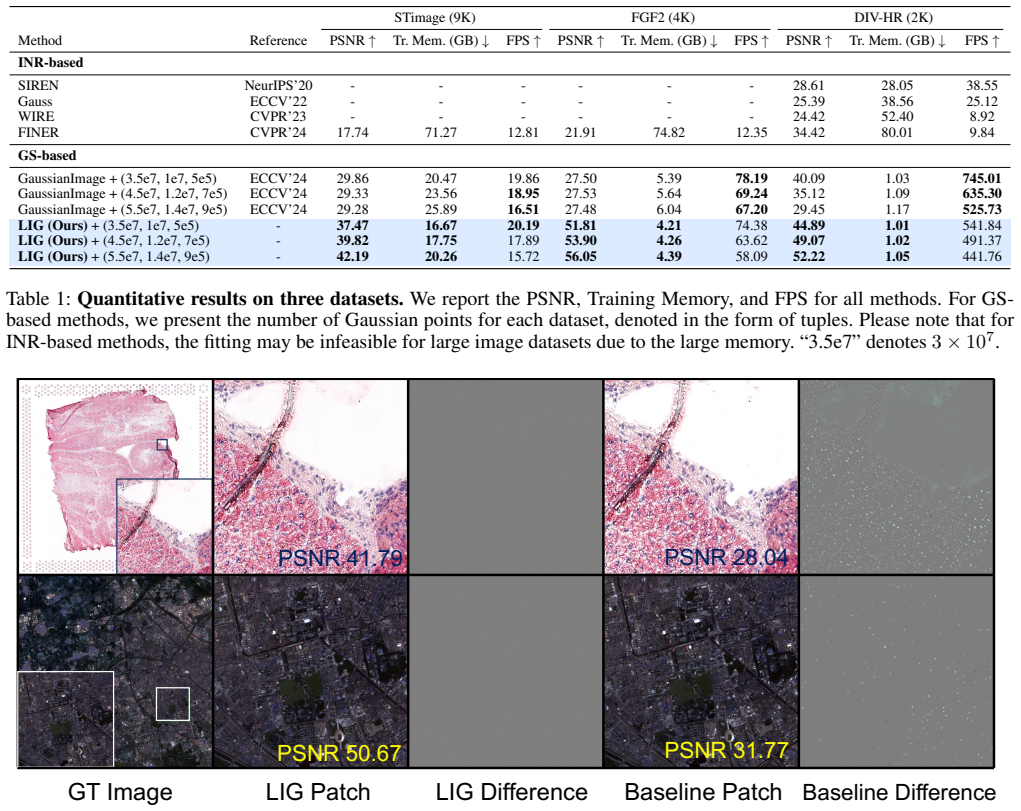
The central claim is that 2D Gaussian splatting can be made to fit very large images at high quality if two conditions hold: the covariance is optimized directly as a symmetric matrix, with any contribution whose negative exponent falls below zero filtered out during rasterization, and the fitting target is decomposed into two levels—a small group of Gaussians reconstructs the downsampled low-frequency image, then the main group fits the min-max normalized difference between the upsampled first-level render and the target. Under that design, fitting quality rises as the number of Gaussians grows, from 37.47 to 42.19 dB on 9K STimage as the budget goes from 3.5e7 to 5.5e7 points, while GaussianImage stays flat or falls. The paper claims this is the first GS-based representation that extends successfully to large images, and backs it with ablations showing both the direct covariance optimization and the Level-of-Gaussian mechanism contribute.
Load-bearing premise
The load-bearing premise is that dropping every pixel–Gaussian pair with $\sigma_n < 0$ keeps optimization stable and well-graded when tens of millions of non-positive-semi-definite covariance matrices are optimized directly; if the filter lets the fit drift, or if the retained indefinite matrices are the true source of the quality gain, the scaling behavior will not transfer to other large images.
Editorial extensions
If this is right
- If LIG is right, explicit 2D Gaussian representations can be scaled to very large images without the memory blowup of grid-based implicit neural representations.
- Quality becomes a tunable point budget: the same pipeline yields higher PSNR as the Gaussian count increases, so users can trade storage and training time against fidelity.
- The two-level residual scheme (low-frequency first, normalized high-frequency difference second) should transfer to other large-signal fitting problems, not just still images.
- Because the first level is frozen during second-level training, memory stays bounded enough to fit 9K images on a single GPU.
Reading between the lines
- Testable extension: projecting each covariance matrix to positive semi-definite after every update, while keeping the two levels, would reveal how much of the reported gain depends on retaining indefinite matrices.
- The two-level residual trick could be applied tile-wise to gigapixel whole-slide images, though the paper does not address tile-boundary artifacts.
- The compact 8-parameter per-Gaussian format and the stored min-max scaler suggest a direct path to learned compression of large images, a direction the paper flags as future work.
- Because L1 fits a normalized residual, the choice of min-max normalization could be ablated; a raw-difference variant would isolate the contribution of conditioning the second-stage target.
Editorial analysis
A structured set of objections, weighed in public.
Referee Report
Summary. The paper introduces LIG, a 2D Gaussian splatting representation for large images. It makes two main changes relative to GaussianImage: (1) it optimizes the 2D covariance matrix directly instead of using a rotation/scale decomposition, filtering out Gaussian points with negative sigma during rasterization, and (2) it uses a two-level Level-of-Gaussian scheme, where a small set of Gaussians first fits a downsampled low-frequency target and a larger set then fits the normalized difference image. The authors report large PSNR gains over GaussianImage on 2K, 4K, and 9K images, with quality increasing as the number of Gaussians grows, and they provide ablations for the two components, training-memory comparisons, and code.
Significance. If the reported scaling behavior holds, LIG is a useful step toward making explicit Gaussian-based image representations practical at high resolution: it combines a coarse-to-fine fitting target with a direct covariance parameterization that appears to remain stable at tens of millions of Gaussians. The paper includes experiments on diverse data types (histopathology, satellite, natural images), reports training memory and FPS, and releases code, all of which strengthen the empirical contribution. However, the central quantitative claim rests on a comparison whose optimization budget is internally inconsistent, and one of the two claimed design components is not isolated in the ablations. The core idea is plausible, but the evidence as presented does not yet establish that the gains come from the representation rather than from an unfair or uncontrolled training setup.
major comments (4)
- [Implementation Details; Table 4; Table 1] The training budget for the main results is contradictory. The Implementation Details section states that 'The training steps for L0 and L1 are set to the same, 30,000 steps in our implementation,' while Table 4 reports iterations from 1e5 to 5e5 and says that '3e5 iterations representing a compromise point adopted in our experiments.' The 3e5 row of Table 4 matches the main PSNR values in Table 1 (e.g., 39.82 dB on STimage at 4.5e7 points and 56.05 dB on FGF2 at 1.4e7 points), so the reader cannot tell whether GaussianImage was allowed the same optimization budget as LIG. Since the paper's central claim is the scaling contrast in Figure 1 and Table 2, the authors must state the exact iteration count used for every method and either rerun GaussianImage with matched iterations and re-tuned hyperparameters or demonstrate that the published GaussianImage numbers already use this budget.
- [Table 3] The evidence for the benefit of low-frequency initialization is confounded by point count. Each row compares a single-level model with only |N1| Gaussians against the two-level model with |N0|+|N1| Gaussians, so the PSNR improvement could come from the additional |N0| Gaussians rather than from the coarse target. To support the claim that the L0 target helps, the comparison should hold the total number of Gaussians fixed, for example by training a single-level model with |N0|+|N1| points or by giving L0 a zero/random target with the same total point budget. In addition, the point ratios in Table 3 are inconsistent with Eq. (5) and r=0.125: for instance, 4,375,000 / 30,625,000 = 1/7, not 0.125, and the stated totals do not match the 3.5e7/5.5e7 settings used elsewhere.
- [2D Gaussians Formulation; Table 2] The claimed benefit of direct covariance optimization is not isolated from other implementation differences. Table 2 compares GaussianImage with 'Ours w/o LOG', but 'Ours w/o LOG' differs from GaussianImage not only in the covariance parameterization but also in the re-implemented CUDA kernels, initialization, and possibly other details. The text states only that 'we find that optimizing the decomposed parameters can be challenging when the Gaussian points are numerous' without reporting a controlled comparison. A head-to-head experiment within the same pipeline (decomposed covariance vs. direct covariance with the same optimizer, iterations, and initialization) is needed to attribute the large-point-count improvement to the representation variant rather than to unrelated engineering changes.
- [2D Gaussians Formulation, Eq. (4)] The paper's own text acknowledges that filtering sigma_n < 0 does not guarantee that all retained covariance matrices are positive semi-definite, because the condition in Eq. (4) is verified only on the finite set of queried pixel centers. Since the method optimizes tens of millions of potentially indefinite covariance matrices and the headline results depend on stability at 5.5e7 Gaussians, the manuscript should report at least one piece of supporting evidence, such as the fraction of active Gaussians with indefinite covariance during training, the fraction of filtered points, or convergence curves showing that gradient behavior does not degrade at the largest scale. Without this, the scaling claim rests on an empirical observation whose transfer to other large images is not yet validated.
minor comments (5)
- [Table 4] The caption 'The number for Gaussian points are (4.5e7, 1.4e7) for two datasets' is ambiguous; please clarify which tuple element belongs to which dataset and whether these are total or per-level point counts.
- [Levels of 2D Gaussians, Eq. (7)] The final image is not explicitly defined: after L1 is trained on the normalized difference target, the reconstruction must combine Render(L0) and Render(L1), but this combination formula is not given in the main text.
- [Figure 4] The caption states that difference images are shifted to 0.5 for visualization; please state explicitly whether the same shift and scaling are applied to both the LIG and the GaussianImage difference images.
- [Table 1] The note '3.5e7 denotes 3 × 10^7' uses a nonstandard exponent notation; using '×10^7' consistently would improve readability.
- [2D Gaussians Formulation] The phrase 'semi-implicit fitters' is used without definition; please define or rephrase it.
Circularity Check
No significant circularity: LIG is an empirical fitting benchmark whose reported gains are validated by ablations and external baselines, not by construction.
full rationale
LIG's contribution is a representation change (direct covariance optimization plus a two-level Gaussian scheme) evaluated by PSNR/FPS on external datasets. The pipeline fits Gaussian parameters to target images and measures reconstruction quality; no reported number is defined as the value of a fitted parameter, so the 'predictions' are not forced by construction. The PSD-filter argument (Eqs. 3-4) is a mathematical implication about positive semi-definite matrices and is acknowledged to be only a sufficient filter ('we cannot ensure that all covariance matrices producing positive sigma have physical meanings'), so it is a stated limitation rather than a circular derivation. Related-work citations to prior work by the same group (e.g., Zhu et al. 2024) are contextual and not load-bearing. The only notable issue is an internal inconsistency between Implementation Details ('The training steps for L0 and L1 are set to the same, 30,000 steps') and Table 4 ('3e5 iterations representing a compromise point adopted in our experiments'); this affects comparability of baselines and is a correctness risk, not circularity, because the comparison still relies on independent optimization of external baselines. Ablations (Table 2, Table 3) support the two design choices by held-in fitting performance, which is standard for representation fitting tasks. Therefore no circular step meeting the required evidence threshold is present.
Assumptions & free parameters
free parameters (2)
- r (level-0 allocation ratio) =
0.125
- number of levels =
2
assumptions (3)
- ad hoc to paper Filtering sigma_n < 0 during rendering removes non-PSD covariance matrices and leaves a well-behaved optimization target
- domain assumption Two-level coarse-to-fine residual decomposition with downsampled target and normalized difference image improves fidelity for any large image
- domain assumption The 8-parameter 2DGS representation with accumulated summation from GaussianImage is a valid image fitting model
Cite this review
Pith. "Pith review of Large Images are Gaussians: High-Quality Large Image Representation with Levels of 2D Gaussian Splatting." pith.science (2026). https://pith.science/paper/PJGUGS2W
@misc{pith2026250209039,
  author       = {Pith},
  title        = {Pith review of: Large Images are Gaussians: High-Quality Large Image Representation with Levels of 2D Gaussian Splatting},
  year         = {2026},
  howpublished = {\url{https://pith.science/paper/PJGUGS2W}},
  note         = {Machine review of arXiv:2502.09039}
}
read the original abstract
While Implicit Neural Representations (INRs) have demonstrated significant success in image representation, they are often hindered by large training memory and slow decoding speed. Recently, Gaussian Splatting (GS) has emerged as a promising solution in 3D reconstruction due to its high-quality novel view synthesis and rapid rendering capabilities, positioning it as a valuable tool for a broad spectrum of applications. In particular, a GS-based representation, 2DGS, has shown potential for image fitting. In our work, we present \textbf{L}arge \textbf{I}mages are \textbf{G}aussians (\textbf{LIG}), which delves deeper into the application of 2DGS for image representations, addressing the challenge of fitting large images with 2DGS in the situation of numerous Gaussian points, through two distinct modifications: 1) we adopt a variant of representation and optimization strategy, facilitating the fitting of a large number of Gaussian points; 2) we propose a Level-of-Gaussian approach for reconstructing both coarse low-frequency initialization and fine high-frequency details. Consequently, we successfully represent large images as Gaussian points and achieve high-quality large image representation, demonstrating its efficacy across various types of large images. Code is available at {\href{https://github.com/HKU-MedAI/LIG}{https://github.com/HKU-MedAI/LIG}}.
Figures


Figures from the paper (1 more)
Forward citations
Cited by 1 Pith paper
-
Information-computation trade-offs in non-linear transforms
A universal LZ78 transform turns any zero-order-optimal probability model into a provably universal sequential predictor, alongside qualitative INR, Gaussian-splatting, and textual-denoising studies.
Reference graph
Works this paper leans on
-
[1]
, " * write output.state after.block = add.period write newline
ENTRY address archivePrefix author booktitle chapter edition editor eid eprint howpublished institution isbn journal key month note number organization pages publisher school series title type volume year label extra.label sort.label short.list INTEGERS output.state before.all mid.sentence after.sentence after.block FUNCTION init.state.consts #0 'before.a...
-
[2]
write newline
" write newline "" before.all 'output.state := FUNCTION n.dashify 't := "" t empty not t #1 #1 substring "-" = t #1 #2 substring "--" = not "--" * t #2 global.max substring 't := t #1 #1 substring "-" = "-" * t #2 global.max substring 't := while if t #1 #1 substring * t #2 global.max substring 't := if while FUNCTION word.in bbl.in capitalize " " * FUNCT...
-
[3]
T.; Mildenhall, B.; Tancik, M.; Hedman, P.; Martin-Brualla, R.; and Srinivasan, P
Barron, J. T.; Mildenhall, B.; Tancik, M.; Hedman, P.; Martin-Brualla, R.; and Srinivasan, P. P. 2021. Mip-nerf: A multiscale representation for anti-aliasing neural radiance fields. In Proceedings of the IEEE/CVF international conference on computer vision, 5855--5864
2021
-
[4]
Bengio, Y.; Courville, A.; and Vincent, P. 2013. Representation learning: A review and new perspectives. IEEE transactions on pattern analysis and machine intelligence, 35(8): 1798--1828
work page 2013
-
[5]
Chen, H.; Gwilliam, M.; Lim, S.-N.; and Shrivastava, A. 2023 a . Hnerv: A hybrid neural representation for videos. In Proceedings of the IEEE/CVF Conference on Computer Vision and Pattern Recognition, 10270--10279
work page 2023
-
[6]
Chen, H.; He, B.; Wang, H.; Ren, Y.; Lim, S. N.; and Shrivastava, A. 2021. Nerv: Neural representations for videos. Advances in Neural Information Processing Systems, 34: 21557--21568
work page 2021
-
[7]
Chen, J.; Li, C.; Zhang, J.; Zhu, L.; Huang, B.; Chen, H.; and Lee, G. H. 2024 a . Generalizable Human Gaussians from Single-View Image. arXiv preprint arXiv:2406.06050
arXiv 2024
-
[8]
Chen, J.; Zhou, M.; Wu, W.; Zhang, J.; Li, Y.; and Li, D. 2024 b . STimage-1K4M: A histopathology image-gene expression dataset for spatial transcriptomics. arXiv:2406.06393
arXiv 2024
Show all 57 references
-
[9]
Chen, Y.; Liu, S.; and Wang, X. 2021. Learning continuous image representation with local implicit image function. In Proceedings of the IEEE/CVF conference on computer vision and pattern recognition, 8628--8638
2021
-
[10]
Chen, Z.; Li, Z.; Song, L.; Chen, L.; Yu, J.; Yuan, J.; and Xu, Y. 2023 b . Neurbf: A neural fields representation with adaptive radial basis functions. In Proceedings of the IEEE/CVF International Conference on Computer Vision, 4182--4194
2023
-
[11]
Chen, Z.; and Zhang, H. 2019. Learning implicit fields for generative shape modeling. In Proceedings of the IEEE/CVF conference on computer vision and pattern recognition, 5939--5948
2019
-
[12]
De Sanctis, M.; Cianca, E.; Araniti, G.; Bisio, I.; and Prasad, R. 2015. Satellite communications supporting internet of remote things. IEEE Internet of Things Journal, 3(1): 113--123
2015
-
[13]
W.; and Doucet, A
Dupont, E.; Goli \'n ski, A.; Alizadeh, M.; Teh, Y. W.; and Doucet, A. 2021. Coin: Compression with implicit neural representations. arXiv preprint arXiv:2103.03123
2021 arXiv
-
[14]
Hu, J.; Xia, B.; Chen, B.; Yang, W.; and Zhang, L. 2024. GaussianSR: High Fidelity 2D Gaussian Splatting for Arbitrary-Scale Image Super-Resolution. arXiv preprint arXiv:2407.18046
2024 arXiv
-
[15]
Huang, B.; Yu, Z.; Chen, A.; Geiger, A.; and Gao, S. 2024. 2d gaussian splatting for geometrically accurate radiance fields. In ACM SIGGRAPH 2024 Conference Papers, 1--11
2024
-
[16]
Kerbl, B.; Kopanas, G.; Leimk \"u hler, T.; and Drettakis, G. 2023. 3D Gaussian Splatting for Real-Time Radiance Field Rendering. ACM Trans. Graph., 42(4): 139--1
2023
-
[17]
Kerbl, B.; Meuleman, A.; Kopanas, G.; Wimmer, M.; Lanvin, A.; and Drettakis, G. 2024. A hierarchical 3d gaussian representation for real-time rendering of very large datasets. ACM Transactions on Graphics (TOG), 43(4): 1--15
2024
-
[18]
Khayam, S. A. 2003. The discrete cosine transform (DCT): theory and application. Michigan State University, 114(1): 31
2003
-
[19]
P.; and Ba, J
Kingma, D. P.; and Ba, J. 2014. Adam: A method for stochastic optimization. arXiv preprint arXiv:1412.6980
2014 arXiv
-
[20]
Lassner, C.; and Zollhofer, M. 2021. Pulsar: Efficient sphere-based neural rendering. In Proceedings of the IEEE/CVF Conference on Computer Vision and Pattern Recognition, 1440--1449
2021
-
[21]
LeCun, Y.; Bengio, Y.; and Hinton, G. 2015. Deep learning. nature, 521(7553): 436--444
2015
-
[22]
Y.; Liu, Y.; Liu, H.; Wang, C.; Yu, W.; and Yuan, Y
Li, C.; Feng, B. Y.; Liu, Y.; Liu, H.; Wang, C.; Yu, W.; and Yuan, Y. 2024. Endosparse: Real-time sparse view synthesis of endoscopic scenes using gaussian splatting. In International Conference on Medical Image Computing and Computer-Assisted Intervention, 252--262. Springer
2024
-
[23]
Li, Z.; Wang, M.; Pi, H.; Xu, K.; Mei, J.; and Liu, Y. 2022. E-nerv: Expedite neural video representation with disentangled spatial-temporal context. In European Conference on Computer Vision, 267--284. Springer
2022
-
[24]
Liu, X.; Zhan, X.; Tang, J.; Shan, Y.; Zeng, G.; Lin, D.; Liu, X.; and Liu, Z. 2024 a . Humangaussian: Text-driven 3d human generation with gaussian splatting. In Proceedings of the IEEE/CVF Conference on Computer Vision and Pattern Recognition, 6646--6657
2024
-
[25]
Liu, Y.; Li, C.; Yang, C.; and Yuan, Y. 2024 b . Endogaussian: Gaussian splatting for deformable surgical scene reconstruction. arXiv preprint arXiv:2401.12561
2024 arXiv
-
[26]
Liu, Z.; Zhu, H.; Zhang, Q.; Fu, J.; Deng, W.; Ma, Z.; Guo, Y.; and Cao, X. 2024 c . FINER: Flexible spectral-bias tuning in Implicit NEural Representation by Variable-periodic Activation Functions. In Proceedings of the IEEE/CVF Conference on Computer Vision and Pattern Recog...
2024
-
[27]
Lu, G.; Zhang, S.; Wang, Z.; Liu, C.; Lu, J.; and Tang, Y. 2024. Manigaussian: Dynamic gaussian splatting for multi-task robotic manipulation. arXiv preprint arXiv:2403.08321
2024 arXiv
-
[28]
Ma, C.; Yu, P.; Lu, J.; and Zhou, J. 2022. Recovering realistic details for magnification-arbitrary image super-resolution. IEEE Transactions on Image Processing, 31: 3669--3683
2022
-
[29]
N.; Lindell, D
Martel, J. N.; Lindell, D. B.; Lin, C. Z.; Chan, E. R.; Monteiro, M.; and Wetzstein, G. 2021. Acorn: Adaptive coordinate networks for neural scene representation. arXiv preprint arXiv:2105.02788
2021 arXiv
-
[30]
H.; and Davison, A
Matsuki, H.; Murai, R.; Kelly, P. H.; and Davison, A. J. 2024. Gaussian splatting slam. In Proceedings of the IEEE/CVF Conference on Computer Vision and Pattern Recognition, 18039--18048
2024
-
[31]
K.; Jack, D.; Baktashmotlagh, M.; and Eriksson, A
Michalkiewicz, M.; Pontes, J. K.; Jack, D.; Baktashmotlagh, M.; and Eriksson, A. 2019. Implicit surface representations as layers in neural networks. In Proceedings of the IEEE/CVF International Conference on Computer Vision, 4743--4752
2019
-
[32]
P.; Tancik, M.; Barron, J
Mildenhall, B.; Srinivasan, P. P.; Tancik, M.; Barron, J. T.; Ramamoorthi, R.; and Ng, R. 2021. Nerf: Representing scenes as neural radiance fields for view synthesis. Communications of the ACM, 65(1): 99--106
2021
-
[33]
P.; and Kvedar, J
Mittermaier, M.; Venkatesh, K. P.; and Kvedar, J. C. 2023. Digital health technology in clinical trials. NPJ Digital Medicine, 6(1): 88
2023
-
[34]
M \"u ller, T.; Evans, A.; Schied, C.; and Keller, A. 2022. Instant neural graphics primitives with a multiresolution hash encoding. ACM transactions on graphics (TOG), 41(4): 1--15
2022
-
[35]
J.; Florence, P.; Straub, J.; Newcombe, R.; and Lovegrove, S
Park, J. J.; Florence, P.; Straub, J.; Newcombe, R.; and Lovegrove, S. 2019. Deepsdf: Learning continuous signed distance functions for shape representation. In Proceedings of the IEEE/CVF conference on computer vision and pattern recognition, 165--174
2019
-
[36]
Rabbani, M.; and Joshi, R. 2002. An overview of the JPEG 2000 still image compression standard. Signal processing: Image communication, 17(1): 3--48
2002
-
[37]
Ramasinghe, S.; and Lucey, S. 2022. Beyond periodicity: Towards a unifying framework for activations in coordinate-mlps. In European Conference on Computer Vision, 142--158. Springer
2022
-
[38]
Ren, K.; Jiang, L.; Lu, T.; Yu, M.; Xu, L.; Ni, Z.; and Dai, B. 2024. Octree-gs: Towards consistent real-time rendering with lod-structured 3d gaussians. arXiv preprint arXiv:2403.17898
2024 arXiv
-
[39]
Saragadam, V.; LeJeune, D.; Tan, J.; Balakrishnan, G.; Veeraraghavan, A.; and Baraniuk, R. G. 2023. Wire: Wavelet implicit neural representations. In Proceedings of the IEEE/CVF Conference on Computer Vision and Pattern Recognition, 18507--18516
2023
-
[40]
G.; and Veeraraghavan, A
Saragadam, V.; Tan, J.; Balakrishnan, G.; Baraniuk, R. G.; and Veeraraghavan, A. 2022. Miner: Multiscale implicit neural representation. In European Conference on Computer Vision, 318--333. Springer
2022
-
[41]
Sitzmann, V.; Martel, J.; Bergman, A.; Lindell, D.; and Wetzstein, G. 2020. Implicit neural representations with periodic activation functions. Advances in neural information processing systems, 33: 7462--7473
2020
-
[42]
V.; and Tombari, F
Str \"u mpler, Y.; Postels, J.; Yang, R.; Gool, L. V.; and Tombari, F. 2022. Implicit neural representations for image compression. In European Conference on Computer Vision, 74--91. Springer
2022
-
[43]
Szymanowicz, S.; Rupprecht, C.; and Vedaldi, A. 2024. Splatter image: Ultra-fast single-view 3d reconstruction. In Proceedings of the IEEE/CVF Conference on Computer Vision and Pattern Recognition, 10208--10217
2024
-
[44]
Tang, J.; Chen, Z.; Chen, X.; Wang, T.; Zeng, G.; and Liu, Z. 2024. Lgm: Large multi-view gaussian model for high-resolution 3d content creation. arXiv preprint arXiv:2402.05054
2024 arXiv
-
[45]
Tang, J.; Ren, J.; Zhou, H.; Liu, Z.; and Zeng, G. 2023. Dreamgaussian: Generative gaussian splatting for efficient 3d content creation. arXiv preprint arXiv:2309.16653
2023 arXiv
-
[46]
Wang, Y.; He, X.; Dong, Y.; Lin, Y.; Huang, Y.; and Ding, X. 2024. Cross-Modality Interaction Network for Pan-sharpening. IEEE Transactions on Geoscience and Remote Sensing
2024
-
[47]
Xiangli, Y.; Xu, L.; Pan, X.; Zhao, N.; Rao, A.; Theobalt, C.; Dai, B.; and Lin, D. 2022. Bungeenerf: Progressive neural radiance field for extreme multi-scale scene rendering. In European conference on computer vision, 106--122. Springer
2022
-
[48]
Xu, Q.; Wang, W.; Ceylan, D.; Mech, R.; and Neumann, U. 2019. Disn: Deep implicit surface network for high-quality single-view 3d reconstruction. Advances in neural information processing systems, 32
2019
-
[49]
Xu, Y.; Shi, Z.; Yifan, W.; Chen, H.; Yang, C.; Peng, S.; Shen, Y.; and Wetzstein, G. 2024. Grm: Large gaussian reconstruction model for efficient 3d reconstruction and generation. arXiv preprint arXiv:2403.14621
2024 arXiv
-
[50]
F.; Chen, Y.; and Lee, G
Yan, Z.; Low, W. F.; Chen, Y.; and Lee, G. H. 2024. Multi-scale 3d gaussian splatting for anti-aliased rendering. In Proceedings of the IEEE/CVF Conference on Computer Vision and Pattern Recognition, 20923--20931
2024
-
[51]
Ye, V.; and Kanazawa, A. 2023. Mathematical Supplement for the gsplat Library. arXiv:2312.02121
2023 arXiv
-
[52]
Yu, Z.; Chen, A.; Huang, B.; Sattler, T.; and Geiger, A. 2024. Mip-splatting: Alias-free 3d gaussian splatting. In Proceedings of the IEEE/CVF Conference on Computer Vision and Pattern Recognition, 19447--19456
2024
-
[53]
Yugay, V.; Li, Y.; Gevers, T.; and Oswald, M. R. 2023. Gaussian-slam: Photo-realistic dense slam with gaussian splatting. arXiv preprint arXiv:2312.10070
2023 arXiv
-
[54]
Zhang, X.; Ge, X.; Xu, T.; He, D.; Wang, Y.; Qin, H.; Lu, G.; Geng, J.; and Zhang, J. 2024 a . GaussianImage: 1000 FPS Image Representation and Compression by 2D Gaussian Splatting. arXiv preprint arXiv:2403.08551
2024 arXiv
-
[55]
Zhang, Y.; Kuznetsov, A.; Jindal, A.; Chen, K.; Sochenov, A.; Kaplanyan, A.; and Sun, Q. 2024 b . Image-GS: Content-Adaptive Image Representation via 2D Gaussians. arXiv preprint arXiv:2407.01866
2024 arXiv
-
[56]
Zhao, H.; Zhao, X.; Zhu, L.; Zheng, W.; and Xu, Y. 2024. HFGS: 4D Gaussian Splatting with Emphasis on Spatial and Temporal High-Frequency Components for Endoscopic Scene Reconstruction. arXiv preprint arXiv:2405.17872
2024 arXiv
-
[57]
Zhu, L.; Wang, Z.; Jin, Z.; Lin, G.; and Yu, L. 2024. Deformable endoscopic tissues reconstruction with gaussian splatting. arXiv preprint arXiv:2401.11535
2024 arXiv
Reviewed August 7, 2026 · model on record in the stance chip above.
Discussion (0). Sign in to comment.