REVIEW 5 major objections 6 minor 39 references
The Joint Entity-Relation Extraction Model Based on Span and Interactive Fusion Representation for Chinese Medical Texts with Complex Semantics
T0 review · 5 major / 6 minor · reviewed 2026-08-07 · deepseek-v4-flash
Pith's one-line read ISER, a span-based joint extraction model with bidirectional cross-attention fusion, reports the best F1 among compared baselines on CH-DDI and CoNLL04.
desk verdict A competent span-based joint extraction model with a plausible fusion module, but the SOTA claim rests on unreleased code/data and a dataset with an entity-prompting shortcut. read the letter →
The pith
A machine-rendered reading of the paper's core claim, the machinery that carries it, and where it could break.
The reading
What carries the argument
The load-bearing mechanism is the interactive fusion representation module built on scaled dot-product cross-attention. The encoder creates two parallel token representations, one oriented to entities and one to relations; cross-attention uses each as the query against the other's keys and values, then BiLSTM concatenates and fuses the two revised streams. This lets the entity classifier see relation-oriented context and the relation classifier see entity-oriented context before span features are computed. The span-based feature extraction module supplies the entity-side input: it enumerates all spans within a width limit, max-pools internal span features, adds a width embedding, and appends an SEA context vector obtained by multi-head self-attention and BiGRU on the span-masked sentence. The relation classifier consumes max-pooled local context between span pairs, which the paper says helps with overlapping drug interactions.
What would settle it
Run ISER and the same baselines on a larger public Chinese medical benchmark with multiple entity types under identical negative sampling and relation-threshold search; if the reported relation-F1 advantage over SpERT and STER shrinks or reverses, the claimed benefit of interactive fusion is specific to CH-DDI rather than general.
Extended reading notes
Core claim
The central claim is that the ISER model outperforms existing joint extraction methods by combining span-based candidate generation with two-way information exchange between entity recognition and relation extraction. The authors argue that entity recognition benefits from knowing what relations are present and relation extraction benefits from knowing which spans are entities, so they route entity-specific and relation-specific token representations through cross-attention in both directions and then fuse the exchanged vectors with BiLSTM. For entity-side context they propose the SEA module, multi-head self-attention plus BiGRU over a span-masked sequence, and for relation-side context they max-pool the local text between candidate span pairs. On CH-DDI the full model reports NER F1 of 96.73% and relation F1 of 78.43%; on CoNLL04 it reports 88.37% and 71.53%. Ablations show that removing the interactive fusion module costs 1.27 and 3.06 relation-F1 points on the two datasets, respectively.
Load-bearing premise
The evaluation depends on the assumption that CH-DDI, with 585 training sentences and one entity type, is a fair testbed for Chinese medical joint extraction and that every reproduced baseline is tuned as carefully as ISER.
Editorial extensions
If this is right
- On the CH-DDI corpus, ISER improves over the SpERT span baseline by 1.62 NER-F1 and 2.26 relation-F1 points, so the added interaction and context modules carry a measurable benefit on Chinese drug-interaction text.
- Removing the interactive fusion module lowers relation F1 by 1.27 points on CH-DDI and 3.06 points on CoNLL04, indicating bidirectional task exchange is the main engine behind the relation-extraction gains.
- Replacing the SEA context module with the BERT CLS token hurts entity recognition on both datasets, so long-range contextual span features are doing real work.
- The same architecture reaches 88.37% NER F1 and 71.53% relation F1 on the English CoNLL04 benchmark, supporting the paper's generalization claim.
- Using max-pooled local context between span pairs rather than self-attention keeps relation F1 almost unchanged while saving computation, so the local-context choice is a practical default.
Reading between the lines
- The paper's evidence is strongest for a single-entity-type, 585-sentence corpus; extending the same architecture to a multi-entity clinical corpus and a larger relation vocabulary is the natural test of whether the reported Chinese-domain gains persist.
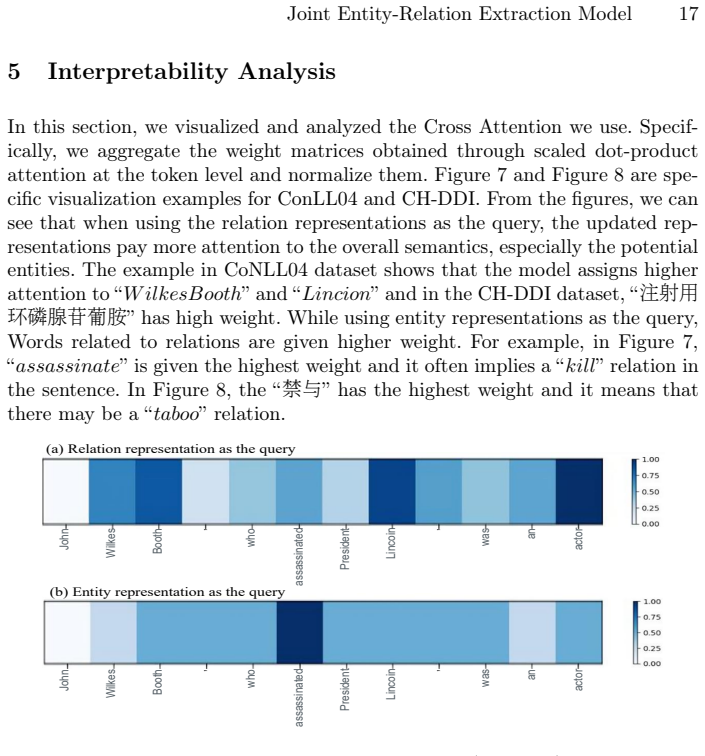
- The cross-attention visualizations suggest a direct behavioral test: relation-as-query attention should concentrate on candidate entity tokens and entity-as-query attention on relation cue words; comparing these distributions with human-annotated cues would show whether the information exchange is genuinely semantic.
- Because relation extraction is built on predicted span pairs, its ceiling is span recall; an inference from the paper's design is that widening span limits or adding a recall-oriented entity loss should improve relation F1 without touching the fusion module.
- The authors note CH-DDI has class imbalance across its seven relation types; outside the paper's experiments, reweighted losses or data augmentation targeting rare relation types would likely change the relation-F1 ranking across baselines.
Editorial analysis
A structured set of objections, weighed in public.
Referee Report
Summary. The paper proposes ISER, a span-based joint entity-relation extraction model for Chinese medical texts. It introduces a SEA module for extracting contextual span semantics and an interactive fusion module that uses cross-attention and BiLSTM to exchange information between entity recognition and relation extraction. The authors construct a Chinese drug-drug interaction dataset (CH-DDI) and report experiments on CH-DDI and CoNLL04, claiming the best results on both datasets. The paper also includes ablation studies and attention visualizations.
Significance. The proposed architecture is a reasonable extension of span-based joint extraction methods such as SpERT and SPAN, and the CH-DDI dataset addresses a genuine gap in Chinese medical resources. If the empirical results are reproducible, the model offers a useful contribution to joint extraction for Chinese medical text. However, the strength of the empirical claim is currently not fully established: the results are single-run, the CH-DDI evaluation is acknowledged to benefit from entity prompting, baseline tuning is not described, and the dataset/code are not released. The contributions are thus promising but require substantial additional evaluation before the stated conclusions can be supported.
major comments (5)
- [§4.3, Tables 3–4] The central claim that ISER achieves the best results on both datasets rests on single-run F1 scores with no error bars, multiple seeds, or significance tests. The reported gains over SpERT (CH-DDI: +1.62 NER F1, +2.26 RE F1; CoNLL04: +1.63, +3.22) are small and could easily fall within run-to-run variance for neural models of this type. Please report mean and standard deviation over at least five seeds and a paired significance test (or bootstrap) to support the superiority claim.
- [§4.3, CH-DDI] The authors themselves note that the entity before '@' 'can be seen as entity prompting' and that CH-DDI contains only one entity type. As a result, the NER F1 of 96.73% is inflated by near-gold entity mentions appearing verbatim in the sentence, and the relation extraction evaluation inherits this bias because a relation is counted only when both spans are correctly recognized. This makes CH-DDI unsuitable for supporting the paper's entity recognition superiority claim and weakens the generalization argument.
- [§4.2–4.3] The baseline reproduction protocol is not specified. The statement 'we reproduced all the benchmark models' is not enough: the reader needs hyperparameter search ranges, early-stopping criteria, number of runs, and how the best result was selected. Without this, the reported margins may reflect unequal tuning effort rather than architectural advantage. Please provide a complete experimental protocol and, ideally, release the reproduction code.
- [§3.7, Eq. (17)] There is a mathematical inconsistency in the loss definition. Eq. (14) defines eyr as the sigmoid output of a linear layer, but Eq. (17) applies BCEWithLogits(eyr, yr), which itself computes sigmoid on its input. As written, the sigmoid would be applied twice. Either Eq. (14) should output logits (no sigmoid) or the loss should be BCELoss. Please correct this and clarify what was actually implemented.
- [§4.1, dataset release] The CH-DDI dataset is introduced as a contribution but is not made available, and no code is released. Given that the experimental evaluation is the paper's main evidence, the absence of both the dataset and the code substantially limits reproducibility. Please release the dataset (under a clear license) and the code with model configuration.
minor comments (6)
- [Abstract] The abstract reports 'relation extraction accuracy of 71.64%', but Table 4 shows this is the precision value, not the F1 (71.53%). Please report F1 consistently for both tasks.
- [Table 4, last row] 'IESR(macro)' appears to be a typo for 'ISER(macro)'.
- [§4.1] 922 training datasets and 231 testing datasets should read 'sentences'.
- [§4.3] 'symble' should be 'symbol'.
- [§1] In the text, 'However,Theseapproachesstruggle' lacks a space and should be 'However, these approaches struggle'.
- [§2, Tables 3–4] Several recent methods discussed in the related work (e.g., LinkNER [24], generative RE [25,34]) are not included in the experimental comparison. If they are applicable to the datasets, they should be included or the omission justified.
Circularity Check
No circularity: the ISER model is an empirical architecture evaluated on an external benchmark (CoNLL04) and a self-built dataset; no derivation step reduces to its inputs or to a self-citation chain.
full rationale
The paper makes no formal derivation claim; it proposes an architecture (BERT encoder, cross-attention/BiLSTM interaction module, span-based features) and evaluates it empirically. Checking the enumerated circularity patterns: (1) No quantity is defined in terms of the quantity it is said to predict; entity and relation classifiers are trained with standard cross-entropy/BCE losses (Eqs. 16-17) on annotated data and evaluated on held-out test splits. (2) No fitted parameter is renamed as a prediction; hyperparameters (peak LR 2e-5, batch size 2, dropout 0.1/0.75, 70 epochs, negative-sample counts) are declared in Section 4.2 as experiment settings, not as outputs of the model. (3-4) There are no load-bearing self-citations or imported uniqueness theorems; the reference list contains no works by the present authors, and the motivation cites external work (SpERT, SPAN, gating mechanism) without relying on an unverified self-cited theorem. (5) No ansatz is smuggled in via citation; the SEA and interactive-fusion modules are introduced in the paper itself with equations (Eqs. 3-9) rather than adopted from prior work. (6) No known result is renamed; CH-DDI is a new dataset with a documented annotation process. The acknowledged weakness that CH-DDI contains only one entity type and the pre-@ drug name 'can be seen as entity prompting' (Section 4.3) is an evaluation-validity limitation that could inflate reported NER/RE scores and calls into question the strength of the SOTA claim, especially since baseline reproduction details and variance are not reported. This is a correctness/robustness concern, not circularity: the model's outputs are not constructed to equal its inputs, and the comparison is against external baselines on an independent public benchmark (CoNLL04). Therefore the circularity score is 0.
Assumptions & free parameters
free parameters (4)
- relation_threshold =
0.4
- dropout_rate =
0.1 (CoNLL04), 0.75 (CH-DDI)
- negative_sample_count =
100 per sentence (CoNLL04), 50 (CH-DDI)
- max_span_width =
not stated
assumptions (4)
- domain assumption All entities in CH-DDI are single tokens or short spans captured by the sliding window.
- domain assumption The annotated relation types in CH-DDI are exhaustive and correctly labeled.
- standard math Standard attention and sequence models (softmax, Multi-Head Attention, BiLSTM, BiGRU) function as described in the literature.
- domain assumption The CoNLL04 dataset split used is the same as SpERT's and is a fair comparison.
Cite this review
Pith. "Pith review of The Joint Entity-Relation Extraction Model Based on Span and Interactive Fusion Representation for Chinese Medical Texts with Complex Semantics." pith.science (2026). https://pith.science/paper/FNJ7Z3Q4
@misc{pith2026250209247,
  author       = {Pith},
  title        = {Pith review of: The Joint Entity-Relation Extraction Model Based on Span and Interactive Fusion Representation for Chinese Medical Texts with Complex Semantics},
  year         = {2026},
  howpublished = {\url{https://pith.science/paper/FNJ7Z3Q4}},
  note         = {Machine review of arXiv:2502.09247}
}
read the original abstract
Joint entity-relation extraction is a critical task in transforming unstructured or semi-structured text into triplets, facilitating the construction of large-scale knowledge graphs, and supporting various downstream applications. Despite its importance, research on Chinese text, particularly with complex semantics in specialized domains like medicine, remains limited. To address this gap, we introduce the CH-DDI, a Chinese drug-drug interactions dataset designed to capture the intricacies of medical text. Leveraging the strengths of attention mechanisms in capturing long-range dependencies, we propose the SEA module, which enhances the extraction of complex contextual semantic information, thereby improving entity recognition and relation extraction. Additionally, to address the inefficiencies of existing methods in facilitating information exchange between entity recognition and relation extraction, we present an interactive fusion representation module. This module employs Cross Attention for bidirectional information exchange between the tasks and further refines feature extraction through BiLSTM. Experimental results on both our CH-DDI dataset and public CoNLL04 dataset demonstrate that our model exhibits strong generalization capabilities. On the CH-DDI dataset, our model achieves an F1-score of 96.73% for entity recognition and 78.43% for relation extraction. On the CoNLL04 dataset, it attains an entity recognition precision of 89.54% and a relation extraction accuracy of 71.64%.
Figures


Figures from the paper (5 more)



Reference graph
Works this paper leans on
-
[1]
Distant supervision for relation extraction without labeled data
Mike Mintz, Steven Bills, Rion Snow, and Dan Jurafsky. Distant supervision for relation extraction without labeled data. InProceedings of the Joint Conference of the 47th Annual Meeting of the ACL and the 4th International Joint Conference on Natural Language Processing of the AFNLP, pages 1003–1011, 2009
work page 2009
-
[2]
A frustratingly easy approach for entity and relation extraction
Zexuan Zhong and Danqi Chen. A frustratingly easy approach for entity and relation extraction. arXiv preprint arXiv:2010.12812, 2020
arXiv 2010
-
[3]
Zhaoran Liu, Haozhe Li, Hao Wang, Yilin Liao, Xinggao Liu, and Gaojie Wu. A novel pipelined end-to-end relation extraction framework with entity mentions and contextual semantic representation.Expert Systems with Applications, 228:120435, 2023
work page 2023
-
[4]
Cotype: Joint extraction of typed entities and relations with knowledge bases
Xiang Ren, Zeqiu Wu, Wenqi He, Meng Qu, Clare R Voss, Heng Ji, Tarek F Ab- delzaher, and Jiawei Han. Cotype: Joint extraction of typed entities and relations with knowledge bases. InProceedings of the 26th international conference on world wide web, pages 1015–1024, 2017
work page 2017
-
[5]
Xiaofeng Yu and Wai Lam. Jointly identifying entities and extracting relations in encyclopedia text via a graphical model approach. InColing 2010: Posters, pages 1399–1407, 2010
work page 2010
-
[6]
Joint extraction of entities and relations based on a novel tagging scheme
Suncong Zheng, Feng Wang, Hongyun Bao, Yuexing Hao, Peng Zhou, and Bo Xu. Joint extraction of entities and relations based on a novel tagging scheme. In Proceedings of the 55th Annual Meeting of the Association for Computational Lin- guistics (Volume 1: Long Papers), pages 1227–1236, Vancouver, Canada, July 2017. Association for Computational Linguistics....
work page 2017
-
[7]
A novel global feature-oriented relational triple extraction model based on table filling
Feiliang Ren, Longhui Zhang, Shujuan Yin, Xiaofeng Zhao, Shilei Liu, Bochao Li, and Yaduo Liu. A novel global feature-oriented relational triple extraction model based on table filling. InProceedings of the 2021 Conference on Empirical Meth- ods in Natural Language Processing, pages 2646–2656, Online and Punta Cana, Dominican Republic, November 2021. Asso...
work page 2021
-
[8]
Onerel: Joint entity and relation extraction with one module in one step
Yu-Ming Shang, Heyan Huang, and Xianling Mao. Onerel: Joint entity and relation extraction with one module in one step. InProceedings of the AAAI conference on artificial intelligence, volume 36, pages 11285–11293, 2022
work page 2022
Show all 39 references
-
[9]
Relation clas- sification via convolutional deep neural network
Daojian Zeng, Kang Liu, Siwei Lai, Guangyou Zhou, and Jun Zhao. Relation clas- sification via convolutional deep neural network. InProceedings of COLING 2014, the 25th international conference on computational linguistics: technical papers, pages 2335–2344, 2014
2014
-
[10]
End-to-end relation extraction using lstms on sequences and tree structures.arXiv preprint arXiv:1601.00770, 2016
Makoto Miwa and Mohit Bansal. End-to-end relation extraction using lstms on sequences and tree structures.arXiv preprint arXiv:1601.00770, 2016
2016 arXiv
-
[11]
Joint entity and relation extraction based on a hybrid neural network
Suncong Zheng, Yuexing Hao, Dongyuan Lu, Hongyun Bao, Jiaming Xu, Hongwei Hao, and Bo Xu. Joint entity and relation extraction based on a hybrid neural network. Neurocomputing, 257:59–66, 2017
2017
-
[12]
Span-based joint entity and relation extraction with transformer pre-training
Markus Eberts and Adrian Ulges. Span-based joint entity and relation extraction with transformer pre-training. InEuropean Conference on Artificial Intelligence, 2019
2019
-
[13]
BERT: Pre-training of deep bidirectional transformers for language understanding
Jacob Devlin, Ming-Wei Chang, Kenton Lee, and Kristina Toutanova. BERT: Pre-training of deep bidirectional transformers for language understanding. In Proceedings of the 2019 Conference of the North American Chapter of the Asso- ciation for Computational Linguistics: Human Lan...
2019
-
[14]
Span-based joint entity and relation extraction with attention-based span-specific and contextual semantic representations
Bin Ji, Jie Yu, Shasha Li, Jun Ma, Qingbo Wu, Yusong Tan, and Huijun Liu. Span-based joint entity and relation extraction with attention-based span-specific and contextual semantic representations. InProceedings of the 28th international conference on computational linguistics...
2020
-
[15]
A multi-gate encoder for joint entity and relation extraction
Xiong Xiong, Yunfei Liu, Anqi Liu, Shuai Gong, and Shengyang Li. A multi-gate encoder for joint entity and relation extraction. InChina National Conference on Chinese Computational Linguistics, pages 163–179. Springer, 2022
2022
-
[16]
A novel cascade binary tagging framework for relational triple extraction
Zhepei Wei, Jianlin Su, Yue Wang, Yuan Tian, and Yi Chang. A novel cascade binary tagging framework for relational triple extraction. In Proceedings of the 58th Annual Meeting of the Association for Computational Linguistics, pages 1476– 1488, Online, July 2020. Association fo...
2020
-
[17]
Graphrel:Modelingtextasrelational graphs for joint entity and relation extraction
Tsu-JuiFu,Peng-HsuanLi,andWei-YunMa. Graphrel:Modelingtextasrelational graphs for joint entity and relation extraction. InProceedings of the 57th annual meeting of the association for computational linguistics, pages 1409–1418, 2019
2019
-
[18]
Joint entity recognition and relation extraction as a multi-head selection problem.Expert Systems with Applications, 114:34–45, 2018
Giannis Bekoulis, Johannes Deleu, Thomas Demeester, and Chris Develder. Joint entity recognition and relation extraction as a multi-head selection problem.Expert Systems with Applications, 114:34–45, 2018
2018
-
[19]
Bert-based multi- head selection for joint entity-relation extraction
Weipeng Huang, Xingyi Cheng, Taifeng Wang, and Wei Chu. Bert-based multi- head selection for joint entity-relation extraction. InNatural Language Processing and Chinese Computing: 8th CCF International Conference, NLPCC 2019, Dun- huang, China, October 9–14, 2019, Proceedings,...
2019
-
[20]
Exploringprivileged features for relation extraction with contrastive student-teacher learning.IEEE Transactions on Knowledge and Data Engineering, 2022
XiaoyanZhao,MinYang,QiangQu,RuifengXu,andJiekeLi. Exploringprivileged features for relation extraction with contrastive student-teacher learning.IEEE Transactions on Knowledge and Data Engineering, 2022. 20 Feng et al
2022
-
[21]
TPLinker:Single-stagejointextractionofentitiesandrelationsthrough token pair linking
Yucheng Wang, Bowen Yu, Yueyang Zhang, Tingwen Liu, Hongsong Zhu, and LiminSun. TPLinker:Single-stagejointextractionofentitiesandrelationsthrough token pair linking. In Donia Scott, Nuria Bel, and Chengqing Zong, editors,Pro- ceedings of the 28th International Conference on Co...
2020
-
[22]
Attention is all you need
Ashish Vaswani, Noam Shazeer, Niki Parmar, Jakob Uszkoreit, Llion Jones, Aidan N Gomez, Łukasz Kaiser, and Illia Polosukhin. Attention is all you need. Advances in neural information processing systems, 30, 2017
2017
-
[23]
Joint entity and relation extraction with set prediction networks.IEEE Transactions on Neural Networks and Learning Systems, 2023
Dianbo Sui, Xiangrong Zeng, Yubo Chen, Kang Liu, and Jun Zhao. Joint entity and relation extraction with set prediction networks.IEEE Transactions on Neural Networks and Learning Systems, 2023
2023
-
[24]
Linkner: Linking local named entity recognition models to large language models using uncertainty
Zhen Zhang, Yuhua Zhao, Hang Gao, and Mengting Hu. Linkner: Linking local named entity recognition models to large language models using uncertainty. In Proceedings of the ACM on Web Conference 2024, pages 4047–4058, 2024
2024
-
[25]
Enhancing relation extraction from biomedical texts by large language models
Masaki Asada and Ken Fukuda. Enhancing relation extraction from biomedical texts by large language models. InInternational Conference on Human-Computer Interaction, pages 3–14. Springer, 2024
2024
-
[26]
Introduction to the CoNLL-2004 shared task: Semantic role labeling
Xavier Carreras and Lluís Màrquez. Introduction to the CoNLL-2004 shared task: Semantic role labeling. InProceedings of the Eighth Conference on Computational Natural Language Learning (CoNLL-2004) at HLT-NAACL 2004, pages 89–97, Boston, Massachusetts, USA, May 6 - May 7 2004....
2004
-
[27]
Unified structure generation for universal information extraction
Yaojie Lu, Qing Liu, Dai Dai, Xinyan Xiao, Hongyu Lin, Xianpei Han, Le Sun, and Hua Wu. Unified structure generation for universal information extraction. arXiv preprint arXiv:2203.12277, 2022
2022 arXiv
-
[28]
Named entity recognition and relation extraction: State-of-the-art
Zara Nasar, Syed Waqar Jaffry, and Muhammad Kamran Malik. Named entity recognition and relation extraction: State-of-the-art. ACM Computing Surveys (CSUR), 54(1):1–39, 2021
2021
-
[29]
Unified named entity recognition as word-word rela- tion classification
Jingye Li, Hao Fei, Jiang Liu, Shengqiong Wu, Meishan Zhang, Chong Teng, Donghong Ji, and Fei Li. Unified named entity recognition as word-word rela- tion classification. Inproceedings of the AAAI conference on artificial intelligence, volume 36, pages 10965–10973, 2022
2022
-
[30]
Kernel methods for relation extraction.Journal of machine learning research, 3(Feb):1083–1106, 2003
Dmitry Zelenko, Chinatsu Aone, and Anthony Richardella. Kernel methods for relation extraction.Journal of machine learning research, 3(Feb):1083–1106, 2003
2003
-
[31]
Modeling joint entity and relation extraction with table representation
Makoto Miwa and Yutaka Sasaki. Modeling joint entity and relation extraction with table representation. In Proceedings of the 2014 conference on empirical methods in natural language processing (EMNLP), pages 1858–1869, 2014
2014
-
[32]
Global pointer: Novel efficient span-based approach for named entity recognition.arXiv preprint arXiv:2208.03054, 2022
Jianlin Su, Ahmed Murtadha, Shengfeng Pan, Jing Hou, Jun Sun, Wanwei Huang, Bo Wen, and Yunfeng Liu. Global pointer: Novel efficient span-based approach for named entity recognition.arXiv preprint arXiv:2208.03054, 2022
2022 arXiv
-
[33]
Extracting multiple-relations in one-pass with pre-trained transformers
Haoyu Wang, Ming Tan, Mo Yu, Shiyu Chang, Dakuo Wang, Kun Xu, Xiaoxiao Guo, and Saloni Potdar. Extracting multiple-relations in one-pass with pre-trained transformers. arXiv preprint arXiv:1902.01030, 2019
1902 arXiv
-
[34]
Generativere: Incorporating a novel copy mech- anism and pretrained model for joint entity and relation extraction
Jiarun Cao and Sophia Ananiadou. Generativere: Incorporating a novel copy mech- anism and pretrained model for joint entity and relation extraction. InFindings of the Association for Computational Linguistics: EMNLP 2021, pages 2119–2126, 2021
2021
-
[35]
Semi-supervised classification with graph con- volutional networks.arXiv preprint arXiv:1609.02907, 2016
Thomas N Kipf and Max Welling. Semi-supervised classification with graph con- volutional networks.arXiv preprint arXiv:1609.02907, 2016. Joint Entity-Relation Extraction Model 21
2016 arXiv
-
[36]
Span-level model for relation extraction
Kalpit Dixit and Yaser Al-Onaizan. Span-level model for relation extraction. In Proceedings of the 57th annual meeting of the association for computational lin- guistics, pages 5308–5314, 2019
2019
-
[37]
Gpt-ner: Named entity recognition via large language models
Shuhe Wang, Xiaofei Sun, Xiaoya Li, Rongbin Ouyang, Fei Wu, Tianwei Zhang, Jiwei Li, and Guoyin Wang. Gpt-ner: Named entity recognition via large language models. arXiv preprint arXiv:2304.10428, 2023
2023 arXiv
-
[38]
Exploiting syntactico-semantic structures for rela- tion extraction
Yee Seng Chan and Dan Roth. Exploiting syntactico-semantic structures for rela- tion extraction. In Proceedings of the 49th annual meeting of the association for computational linguistics: human language technologies, pages 551–560, 2011
2011
-
[39]
Boundary regression model for joint entity and relation extraction.Expert Systems with Applications, 229:120441, 2023
Ruixue Tang, Yanping Chen, Yongbin Qin, Ruizhang Huang, and Qinghua Zheng. Boundary regression model for joint entity and relation extraction.Expert Systems with Applications, 229:120441, 2023
2023
Reviewed August 7, 2026 · model on record in the stance chip above.
Discussion (0). Continue with ORCID to comment.