REVIEW 3 major objections 4 minor 5 cited by
SelfCite: Self-Supervised Alignment for Context Attribution in Large Language Models
T0 review · 3 major / 4 minor · reviewed 2026-08-07 · deepseek-v4-flash
Pith's one-line read SelfCite lifts LLM citation F1 by 5.3 points with no human labels
desk verdict A clever, well-ablated self-supervised citation reward that deserves review, but the headline F1 gain needs an error-bar and baseline-reconciliation pass. read the letter →
The pith
A machine-rendered reading of the paper's core claim, the machinery that carries it, and where it could break.
The reading
What carries the argument
The load-bearing object is the context-ablation reward pair: a necessity score (probability drop when the cited sentences are removed) plus a sufficiency score (probability hold when only the cited sentences remain), which telescope into Eq. (1). This reward is computed with the language model in eval mode, requires no trained reward model or annotation, and is used in two ways: (i) best-of-N sampling reranks N citation-span candidates per statement by the reward; (ii) preference optimization with SimPO uses the BoN-improved responses as chosen examples to internalize the behavior. The token-length cap (384 tokens unless the citation is a single sentence) prevents the model from gaming the reward by citing long passages.
What would settle it
Measure, on a held-out set of LongBench-Cite statements with human citation-quality judgments, the rank correlation between the SelfCite reward and human citation precision/recall: if the reward's ranking of alternative citation candidates does not positively correlate with human scores (or if inserting an irrelevant but causally influential sentence into a citation increases the reward), the central claim that the ablation reward tracks citation quality is falsified.
Extended reading notes
Core claim
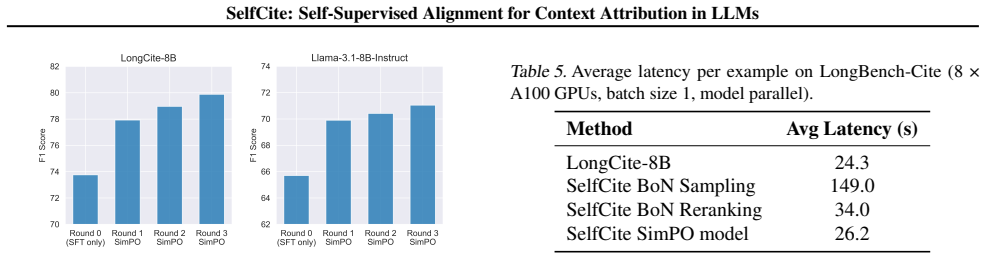
The central discovery is that the difference between the log-probability of a response statement given only the cited sentences and given the context minus the cited sentences—$\text{Reward}(e_i) = \log p_{LM}(r_i \mid E_i) - \log p_{LM}(r_i \mid C \setminus E_i)$—is a sufficient reward signal to rerank candidate citations. The paper shows that selecting, for each statement, the candidate citation that maximizes this reward (with a token-length cap) improves both citation recall and precision, pushing average citation F1 from 73.8 to 77.5 on LongBench-Cite. Training with SimPO on preference pairs built from best-of-N selections matches this gain in a single forward pass (77.9 F1), and applying best-of-N again on the SimPO model reaches 79.1 F1, an improvement of 5.3 points over the base model. The authors interpret this as evidence that the contributive, causality-oriented attribution signal is at least partially aligned with the corroborative, support-based citation quality measured by the benchmark.
Load-bearing premise
The method assumes that the change in the model's own next-token probability when context is ablated faithfully tracks whether a citation is necessary and sufficient, and that this contributive signal improves the external, corroborative citation F1 score measured by GPT-4o on LongBench-Cite; it also assumes the base model can already generate parseable citation candidates.
Editorial extensions
If this is right
- Citation alignment can be performed without human annotation or proprietary APIs, since the reward is computed from the model's own probabilities.
- Best-of-N sampling alone yields immediate citation gains (73.8 to 77.5 F1) at inference time, with only short citation spans being resampled, so latency scales only modestly.
- SimPO fine-tuning internalizes the BoN gains, giving equal or better citation quality in a single forward pass (77.9 F1) and eliminating BoN's latency overhead.
- A fully self-supervised pipeline (ContextCite-generated SFT data plus SelfCite) cuts the gap to the supervised LongCite-8B from 8.1 to 2.3 F1 points (65.7 to 71.5 with BoN), suggesting that human or SFT annotation may be replaceable.
- Iterative SimPO over three rounds keeps improving F1, indicating the reward remains reliable under the model's evolving output distribution.
Reading between the lines
- The reward measures causal contribution to the model's own generation, not semantic support; on claims where the model relies on spurious or biased context signals, the reward could rank a citation that triggers the response above one a human would judge as evidence. The paper itself notes this contributive/corroborative mismatch is not guaranteed to align.
- Because the method requires access to token-level output probabilities, it cannot be applied directly to closed-source APIs; a testable extension would be to distill a probability-estimating surrogate or to approximate the reward with sampling-based estimates.
- The ablation-based reward could serve as a general-purpose attribution quality metric beyond citations—for example, evaluating RAG faithfulness or selecting evidence in retrieval pipelines—since it is annotation-free and model-specific.
- A concrete stress test: if the reward is used to filter cited sentences generated by a deliberately hallucinating model, does citation F1 still improve without answer correctness collapsing? The paper reports correctness is unchanged, but the test would bound the method's safety.
Editorial analysis
A structured set of objections, weighed in public.
Referee Report
Summary. The paper introduces SelfCite, a self-supervised method for improving sentence-level citation quality in long-form question answering. A reward is computed from the language model's own probabilities under context ablation: removing the cited sentences should lower the probability of the response statement (necessity), and retaining only the cited sentences should keep it high (sufficiency); the two scores are summed into a single reward (Eq. 1). This reward is used in two ways: best-of-N reranking of citation candidates (Section 2.3) and SimPO preference optimization (Section 2.4). Experiments on LongBench-Cite across five datasets report that applying best-of-N to a SimPO-finetuned LongCite-8B raises average citation F1 from a reproduced baseline of 73.8 to 79.1, a gain of 5.3 points, and that the SimPO model alone reaches 77.9 F1. The paper also includes a fully self-supervised setting where an SFT model is trained on ContextCite-generated citations, ablations of the reward components, length balancing, training-size studies, and a comparison against an NLI-reward baseline.
Significance. If the empirical claims hold, this is a valuable result: it shows that citation quality can be improved without human annotation or proprietary API supervision at the alignment stage, using a simple and interpretable probability-based reward. The paper includes several commendable controls: the NLI-reward SimPO baseline uses the same pipeline with only the reward changed; the ablation in Table 3 fixes the candidate set and varies only the reward; the length-balancing ablation isolates a known shortcut; and the authors explicitly acknowledge the contributive-versus-corroborative mismatch in Section 5. The code is released, which aids reproducibility. The main weakness is that the headline numerical claim is supported by single-run point estimates with an unexplained gap between the reproduced baseline and the published LongCite-8B number, so the central quantitative claim is not yet fully verified.
major comments (3)
- [Section 3.4, Table 1] The paper reports no variance or significance information for any of the main F1 numbers. Generation is stochastic (temperature 0.95, top-p 0.7, and temperature 1.2 for best-of-N sampling), and the citation F1 judge is a nondeterministic GPT-4o model. On the dataset sizes typical of LongBench-Cite, a small number of judge disagreements or one unlucky seed could plausibly move average F1 by several points. Please report variance across multiple seeds, a bootstrap over evaluated instances, or at least a judge-sensitivity analysis, and state whether the reported numbers are averages over repeats.
- [Table 1, LongCite-8B rows] The reproduced LongCite-8B baseline is 73.8 average F1, while the published LongCite-8B row is 72.0. This 1.8-point gap is never explained. If the reproduction pipeline is systematically more lenient (different GPT-4o version, different judge prompt, different decoding configuration), then the absolute comparison to all published baselines is distorted. Please reconcile the gap by running the official evaluation code, documenting any pipeline differences, and showing that the 5.3-point gain over the reproduction is robust to those differences.
- [Section 5 and Section 3.4] The paper's central assumption is that the contributive reward transfers to the corroborative evaluation metric. The authors state this alignment is 'at least partially aligned' and 'not guaranteed,' which is honest, but the empirical evidence for transfer is currently only the five point estimates in Table 1. Without per-dataset error bars or a simple sign test over the five datasets, it is hard to know whether the consistent direction of improvement is statistically reliable or consistent with noise. Please add a per-dataset uncertainty estimate or another explicit transfer test.
minor comments (4)
- [Section 5, Related Work] The sentence 'it depends on larger proprietary models two proprietary APIs' is missing a word; it should read 'it depends on two larger proprietary APIs' or similar.
- [Footnote 1, Section 3.1] The footnote reports that after deduplication only 4.8 candidates remain per statement on average, but the text still refers to N=10 candidates. Please clarify whether the reward selection operates over the deduplicated set and whether the effective candidate count varies across statements.
- [Table 3, caption] The caption says citation lengths are computed across all LongBench-Cite datasets, but the table has a single 'Citation Length' column next to HotpotQA-specific R/P/F1. Please clarify in the caption that R/P/F1 are for HotpotQA while citation length is the LongBench-Cite average, or split them into separate columns.
- [Appendix A] The hyperparameter selection for SimPO is described as choosing a learning rate on a 100-example development set, but no development-set results are shown. Reporting the selected learning rate and the sensitivity of the final F1 to it would help reproducibility.
Circularity Check
No significant circularity: the SelfCite reward is a model-probability contrast and is validated against an external GPT-4o benchmark, not against its own inputs.
full rationale
We walked the claimed derivation chain. The reward in Eq. (1), Reward(e_i) = log p_LM(r_i | E_i) - log p_LM(r_i | C without E_i), is a causal contrast over the model's own probabilities; it is not defined in terms of LongBench-Cite's citation recall or precision, nor in terms of the GPT-4o judge. Best-of-N sampling uses this reward only to rerank candidate citation strings, and SimPO is trained on preference pairs created by that reranking, so the optimization signal is self-supervised and separate from the external evaluation. The paper's headline improvement is measured on LongBench-Cite with GPT-4o, which is independent of the reward construction, and the contributive-to-corroborative mismatch is explicitly acknowledged in Section 5 rather than hidden. The only notable author-overlap citation is ContextCite (Cohen-Wang et al., 2024), used as inspiration and as a reference baseline; this is not load-bearing because the main result does not depend on any unverified claim imported from that paper, and no uniqueness theorem or fitted benchmark parameter is invoked. The unexplained 1.8-F1 gap between the reproduced LongCite-8B baseline (73.8) and the published value (72.0), and the absence of variance estimates, are legitimate empirical-verification concerns but are not circularity. We therefore find no step in which a prediction reduces by construction to its input.
Assumptions & free parameters
free parameters (4)
- Lmax citation length cap =
384 tokens
- BoN candidate count N =
10
- ContextCite SFT thresholds =
t=1.5, p=0.7, k=4
- SimPO learning rate =
selected from 1e-7 to 7e-7
assumptions (4)
- domain assumption Next-token probability changes under context ablation are a valid proxy for evidence necessity and sufficiency.
- domain assumption Contributive attribution is at least partially aligned with corroborative attribution as measured by the benchmark.
- domain assumption The LongBench-Cite GPT-4o-based evaluation is a valid measurement of citation quality.
- domain assumption The base model can already generate structured citation candidates.
Cite this review
Pith. "Pith review of SelfCite: Self-Supervised Alignment for Context Attribution in Large Language Models." pith.science (2026). https://pith.science/paper/Q6VUNR6W
@misc{pith2026250209604,
  author       = {Pith},
  title        = {Pith review of: SelfCite: Self-Supervised Alignment for Context Attribution in Large Language Models},
  year         = {2026},
  howpublished = {\url{https://pith.science/paper/Q6VUNR6W}},
  note         = {Machine review of arXiv:2502.09604}
}
read the original abstract
We introduce SelfCite, a novel self-supervised approach that aligns LLMs to generate high-quality, fine-grained, sentence-level citations for the statements in their generated responses. Instead of only relying on costly and labor-intensive annotations, SelfCite leverages a reward signal provided by the LLM itself through context ablation: If a citation is necessary, removing the cited text from the context should prevent the same response; if sufficient, retaining the cited text alone should preserve the same response. This reward can guide the inference-time best-of-N sampling strategy to improve citation quality significantly, as well as be used in preference optimization to directly fine-tune the models for generating better citations. The effectiveness of SelfCite is demonstrated by increasing citation F1 up to 5.3 points on the LongBench-Cite benchmark across five long-form question answering tasks. The source code is available at https://github.com/facebookresearch/SelfCite
Figures

Forward citations
Cited by 5 Pith papers
-
How Context Attribution Handles What the Model Already Knows
Context attribution methods cannot disentangle in-context from in-weight knowledge and assign unfaithful scores under overlap; new metrics and WMDP-Cyber++ quantify the failure.
-
On Improving Faithfulness of Podcasts from Documents
AI-generated podcasts often add unsupported claims; a turn-level detector plus rewrite pass improves measured faithfulness across five models and in- and out-of-domain documents.
-
MedPAIR: Measuring Physicians and AI Relevance Alignment in Medical Question Answering
LLM relevance judgments align with physician trainees on only about 45 to 66 percent of sentences, and pruning contexts to physician-labeled relevant sentences improves LLM and trainee accuracy.
-
TRUE: A Trustworthy Unified Explanation Framework for Large Language Model Reasoning
TRUE checks whether LLM reasoning traces are self-sufficient by executing them blind, maps neighboring reasoning paths into a DAG, and ranks recurring failure modes by Shapley values.
-
LCDS: A Logic-Controlled Discharge Summary Generation System Supporting Source Attribution and Expert Review
A logic-controlled pipeline with source mapping and sentence-level attribution generates discharge summaries that score higher than a GPT-4o chain-of-thought baseline in this study.
Reference graph
Works this paper leans on
-
[1]
write newline
" write newline "" before.all 'output.state := FUNCTION n.dashify 't := "" t empty not t #1 #1 substring "-" = t #1 #2 substring "--" = not "--" * t #2 global.max substring 't := t #1 #1 substring "-" = "-" * t #2 global.max substring 't := while if t #1 #1 substring * t #2 global.max substring 't := if while FUNCTION format.date year duplicate empty "emp...
-
[2]
Anthropic: Introducing claude 3.5 sonnet, 2024
Anthropic. Anthropic: Introducing claude 3.5 sonnet, 2024. URL https://www.anthropic.com/news/claude-3-5-sonnet
2024
-
[3]
Training a helpful and harmless assistant with reinforcement learning from human feedback
Bai, Y., Jones, A., Ndousse, K., Askell, A., Chen, A., DasSarma, N., Drain, D., Fort, S., Ganguli, D., Henighan, T., et al. Training a helpful and harmless assistant with reinforcement learning from human feedback. arXiv preprint arXiv:2204.05862, 2022
arXiv 2022
-
[4]
Longbench: A bilingual, multitask benchmark for long context understanding
Bai, Y., Lv, X., Zhang, J., Lyu, H., Tang, J., Huang, Z., Du, Z., Liu, X., Zeng, A., Hou, L., et al. Longbench: A bilingual, multitask benchmark for long context understanding. arXiv preprint arXiv:2308.14508, 2023
arXiv 2023
-
[5]
Longalign: A recipe for long context alignment of large language models
Bai, Y., Lv, X., Zhang, J., He, Y., Qi, J., Hou, L., Tang, J., Dong, Y., and Li, J. Longalign: A recipe for long context alignment of large language models. arXiv preprint arXiv:2401.18058, 2024
arXiv 2024
-
[6]
Nltk: the natural language toolkit
Bird, S. Nltk: the natural language toolkit. In Proceedings of the COLING/ACL 2006 Interactive Presentation Sessions, pp.\ 69--72, 2006
work page 2006
-
[7]
Chuang, Y.-S., Qiu, L., Hsieh, C.-Y., Krishna, R., Kim, Y., and Glass, J. Lookback lens: Detecting and mitigating contextual hallucinations in large language models using only attention maps. In Proceedings of the 2024 Conference on Empirical Methods in Natural Language Processing, pp.\ 1419--1436, 2024
work page 2024
-
[8]
Contextcite: Attributing model generation to context
Cohen-Wang, B., Shah, H., Georgiev, K., and Madry, A. Contextcite: Attributing model generation to context. In The Thirty-eighth Annual Conference on Neural Information Processing Systems, 2024
work page 2024
Show all 45 references
-
[9]
The llama 3 herd of models
Dubey, A., Jauhri, A., Pandey, A., Kadian, A., Al-Dahle, A., Letman, A., Mathur, A., Schelten, A., Yang, A., Fan, A., et al. The llama 3 herd of models. arXiv preprint arXiv:2407.21783, 2024
2024 arXiv
-
[10]
T., Fan, Y., Zhao, V
Gao, L., Dai, Z., Pasupat, P., Chen, A., Chaganty, A. T., Fan, Y., Zhao, V. Y., Lao, N., Lee, H., Juan, D.-C., et al. Rarr: Researching and revising what language models say, using language models. arXiv preprint arXiv:2210.08726, 2022
-
[11]
Scaling laws for reward model overoptimization
Gao, L., Schulman, J., and Hilton, J. Scaling laws for reward model overoptimization. In International Conference on Machine Learning, pp.\ 10835--10866. PMLR, 2023 a
2023
-
[12]
Enabling large language models to generate text with citations
Gao, T., Yen, H., Yu, J., and Chen, D. Enabling large language models to generate text with citations. In Proceedings of the 2023 Conference on Empirical Methods in Natural Language Processing, pp.\ 6465--6488, 2023 b
2023
-
[13]
GLM, T., Zeng, A., Xu, B., Wang, B., Zhang, C., Yin, D., Rojas, D., Feng, G., Zhao, H., Lai, H., Yu, H., Wang, H., Sun, J., Zhang, J., Cheng, J., Gui, J., Tang, J., Zhang, J., Li, J., Zhao, L., Wu, L., Zhong, L., Liu, M., Huang, M., Zhang, P., Zheng, Q., Lu, R., Duan, S., Zhan...
2024
-
[14]
Dureader: a chinese machine reading comprehension dataset from real-world applications
He, W., Liu, K., Liu, J., Lyu, Y., Zhao, S., Xiao, X., Liu, Y., Wang, Y., Wu, H., She, Q., et al. Dureader: a chinese machine reading comprehension dataset from real-world applications. In Proceedings of the Workshop on Machine Reading for Question Answering, pp.\ 37--46, 2018
2018
-
[15]
The curious case of neural text degeneration
Holtzman, A., Buys, J., Du, L., Forbes, M., and Choi, Y. The curious case of neural text degeneration. In International Conference on Learning Representations, 2020. URL https://openreview.net/forum?id=rygGQyrFvH
2020
-
[16]
Liger kernel: Efficient triton kernels for llm training
Hsu, P.-L., Dai, Y., Kothapalli, V., Song, Q., Tang, S., Zhu, S., Shimizu, S., Sahni, S., Ning, H., and Chen, Y. Liger kernel: Efficient triton kernels for llm training. arXiv preprint arXiv:2410.10989, 2024. URL https://arxiv.org/abs/2410.10989
2024 arXiv
-
[17]
Training language models to generate text with citations via fine-grained rewards
Huang, C., Wu, Z., Hu, Y., and Wang, W. Training language models to generate text with citations via fine-grained rewards. arXiv preprint arXiv:2402.04315, 2024 a
2024 arXiv
-
[18]
Efficient attentions for long document summarization
Huang, L., Cao, S., Parulian, N., Ji, H., and Wang, L. Efficient attentions for long document summarization. In Proceedings of the 2021 Conference of the North American Chapter of the Association for Computational Linguistics: Human Language Technologies, pp.\ 1419--1436, 2021
2021
-
[19]
Advancing large language model attribution through self-improving
Huang, L., Feng, X., Ma, W., Zhao, L., Fan, Y., Zhong, W., Xu, D., Yang, Q., Liu, H., and Qin, B. Advancing large language model attribution through self-improving. In Proceedings of the 2024 Conference on Empirical Methods in Natural Language Processing, pp.\ 3822--3836, 2024 b
2024
-
[20]
J., Madotto, A., and Fung, P
Ji, Z., Lee, N., Frieske, R., Yu, T., Su, D., Xu, Y., Ishii, E., Bang, Y. J., Madotto, A., and Fung, P. Survey of hallucination in natural language generation. ACM Computing Surveys, 55 0 (12): 0 1--38, 2023
2023
-
[21]
Aligning large language models through synthetic feedback
Kim, S., Bae, S., Shin, J., Kang, S., Kwak, D., Yoo, K., and Seo, M. Aligning large language models through synthetic feedback. In Proceedings of the 2023 Conference on Empirical Methods in Natural Language Processing, pp.\ 13677--13700, 2023
2023
-
[22]
Rationalizing neural predictions
Lei, T., Barzilay, R., and Jaakkola, T. Rationalizing neural predictions. In Proceedings of the 2016 Conference on Empirical Methods in Natural Language Processing, pp.\ 107--117, 2016
2016
-
[23]
Let's verify step by step
Lightman, H., Kosaraju, V., Burda, Y., Edwards, H., Baker, B., Lee, T., Leike, J., Schulman, J., Sutskever, I., and Cobbe, K. Let's verify step by step. In The Twelfth International Conference on Learning Representations, 2024. URL https://openreview.net/forum?id=v8L0pN6EOi
2024
-
[24]
Sim PO : Simple preference optimization with a reference-free reward
Meng, Y., Xia, M., and Chen, D. Sim PO : Simple preference optimization with a reference-free reward. In The Thirty-eighth Annual Conference on Neural Information Processing Systems, 2024. URL https://openreview.net/forum?id=3Tzcot1LKb
2024
-
[25]
Teaching language models to support answers with verified quotes
Menick, J., Trebacz, M., Mikulik, V., Aslanides, J., Song, F., Chadwick, M., Glaese, M., Young, S., Campbell-Gillingham, L., Irving, G., et al. Teaching language models to support answers with verified quotes. arXiv preprint arXiv:2203.11147, 2022
2022 arXiv
-
[26]
Mistral large, 2024
Mistral. Mistral large, 2024. URL https://mistral.ai/news/mistral-large/
2024
-
[27]
Controlled decoding from language models
Mudgal, S., Lee, J., Ganapathy, H., Li, Y., Wang, T., Huang, Y., Chen, Z., Cheng, H.-T., Collins, M., Strohman, T., et al. Controlled decoding from language models. In International Conference on Machine Learning, pp.\ 36486--36503. PMLR, 2024
2024
-
[28]
Webgpt: Browser-assisted question-answering with human feedback
Nakano, R., Hilton, J., Balaji, S., Wu, J., Ouyang, L., Kim, C., Hesse, C., Jain, S., Kosaraju, V., Saunders, W., et al. Webgpt: Browser-assisted question-answering with human feedback. arXiv preprint arXiv:2112.09332, 2021
2021 arXiv
-
[29]
Introducing chatgpt, November 2022
OpenAI. Introducing chatgpt, November 2022. URL https://openai.com/blog/chatgpt
2022
-
[30]
Gpt-4 technical report, 2023
OpenAI. Gpt-4 technical report, 2023. URL https://cdn.openai.com/papers/gpt-4.pdf
2023
-
[31]
Ouyang, L., Wu, J., Jiang, X., Almeida, D., L. Wainwright, C., Mishkin, P., Zhang, C., Agarwal, S., Slama, K., Ray, A., Schulman, J., Hilton, J., Kelton, F., Miller, L., Simens, M., Askell, A., Welinder, P., Christiano, P., Leike, J., and Lowe, R. Training language models to f...
2022 arXiv
-
[32]
Y., Yuan, W., Cho, K., He, H., Sukhbaatar, S., and Weston, J
Pang, R. Y., Yuan, W., Cho, K., He, H., Sukhbaatar, S., and Weston, J. Iterative reasoning preference optimization. arXiv preprint arXiv:2404.19733, 2024
2024 arXiv
-
[33]
Phukan, A., Somasundaram, S., Saxena, A., Goswami, K., and Srinivasan, B. V. Peering into the mind of language models: An approach for attribution in contextual question answering. arXiv preprint arXiv:2405.17980, 2024
2024 arXiv
-
[34]
Model internals-based answer attribution for trustworthy retrieval-augmented generation
Qi, J., Sarti, G., Fern \'a ndez, R., and Bisazza, A. Model internals-based answer attribution for trustworthy retrieval-augmented generation. arXiv preprint arXiv:2406.13663, 2024
2024 arXiv
-
[35]
D., Ermon, S., and Finn, C
Rafailov, R., Sharma, A., Mitchell, E., Manning, C. D., Ermon, S., and Finn, C. Direct preference optimization: Your language model is secretly a reward model. Advances in Neural Information Processing Systems, 36, 2024
2024
-
[36]
Proximal policy optimization algorithms
Schulman, J., Wolski, F., Dhariwal, P., Radford, A., and Klimov, O. Proximal policy optimization algorithms. In arXiv preprint arXiv:1707.06347, 2017
2017 arXiv
-
[37]
Trusting your evidence: Hallucinate less with context-aware decoding
Shi, W., Han, X., Lewis, M., Tsvetkov, Y., Zettlemoyer, L., and Yih, W.-t. Trusting your evidence: Hallucinate less with context-aware decoding. In Proceedings of the 2024 Conference of the North American Chapter of the Association for Computational Linguistics: Human Language...
2024
-
[38]
Attribute first, then generate: Locally-attributable grounded text generation
Slobodkin, A., Hirsch, E., Cattan, A., Schuster, T., and Dagan, I. Attribute first, then generate: Locally-attributable grounded text generation. arXiv preprint arXiv:2403.17104, 2024
2024 arXiv
-
[39]
L., Gugger, S., Drame, M., Lhoest, Q., and Rush, A
Wolf, T., Debut, L., Sanh, V., Chaumond, J., Delangue, C., Moi, A., Cistac, P., Rault, T., Louf, R., Funtowicz, M., Davison, J., Shleifer, S., von Platen, P., Ma, C., Jernite, Y., Plu, J., Xu, C., Scao, T. L., Gugger, S., Drame, M., Lhoest, Q., and Rush, A. M. Transformers: St...
2020
-
[40]
H., Meister, N., Winston, C., and Guestrin, C
Worledge, T., Shen, J. H., Meister, N., Winston, C., and Guestrin, C. Unifying corroborative and contributive attributions in large language models. arXiv preprint arXiv:2311.12233, 2023
2023 arXiv
-
[41]
W., Salakhutdinov, R., and Manning, C
Yang, Z., Qi, P., Zhang, S., Bengio, Y., Cohen, W. W., Salakhutdinov, R., and Manning, C. D. Hotpotqa: A dataset for diverse, explainable multi-hop question answering. arXiv preprint arXiv:1809.09600, 2018
2018 arXiv
-
[42]
Alma: Alignment with minimal annotation
Yasunaga, M., Shamis, L., Zhou, C., Cohen, A., Weston, J., Zettlemoyer, L., and Ghazvininejad, M. Alma: Alignment with minimal annotation. arXiv preprint arXiv:2412.04305, 2024
2024 arXiv
-
[43]
Y., Cho, K., Li, X., Sukhbaatar, S., Xu, J., and Weston, J
Yuan, W., Pang, R. Y., Cho, K., Li, X., Sukhbaatar, S., Xu, J., and Weston, J. E. Self-rewarding language models. In Forty-first International Conference on Machine Learning, 2024. URL https://openreview.net/forum?id=0NphYCmgua
2024
-
[44]
Longcite: Enabling llms to generate fine-grained citations in long-context qa
Zhang, J., Bai, Y., Lv, X., Gu, W., Liu, D., Zou, M., Cao, S., Hou, L., Dong, Y., Feng, L., et al. Longcite: Enabling llms to generate fine-grained citations in long-context qa. arXiv preprint arXiv:2409.02897, 2024
2024 arXiv
-
[45]
LIMA : Less is more for alignment
Zhou, C., Liu, P., Xu, P., Iyer, S., Sun, J., Mao, Y., Ma, X., Efrat, A., Yu, P., YU, L., Zhang, S., Ghosh, G., Lewis, M., Zettlemoyer, L., and Levy, O. LIMA : Less is more for alignment. In Oh, A., Naumann, T., Globerson, A., Saenko, K., Hardt, M., and Levine, S. (eds.), Adva...
2023
Reviewed August 7, 2026 · model on record in the stance chip above.
Discussion (0). Continue with ORCID to comment.